
Menu: Poached Eggs and Parmesan in Broth, Milan-Style “Veal” Cutlet, Arugula Salad with Lemon Dressing, Apple/Pear/Ginger Milan Charlotte
Recommended Wine: Sassella, Grumello, or Inferno (Reds)
Heading north again, we arrive in Lombardy. Like Emilia-Romagna, most of the region is a fertile, relatively flat plain (part of the same river valley, actually, just upriver to the northwest). As the largest river valley in Italy, the Po Valley has long been one of its granaries, particularly in recent centuries as drainage methods have improved. Bordered by the Alps, dotted by glacial lakes and with adequate rainfall, the land around Milan, Pavia, Cremona, and Bergamo is remarkably different from Lazio and Tuscany, as is its history. Held by Celtic peoples until the 3rd century BC, it was occupied by Germanic Ostrogoths and Lombards (hence the name Lombardy) from the 5th to 8th centuries AD. Perhaps due to similar terrain and history, there are a number of similarities between the cuisines of Lombardy and Emilia-Romagna, particularly in the larger presence of meat, use of butter instead of olive oil, and large variety of cow’s milk cheeses.
Compared to those from regions further south, the recipes in the Lombardy chapter are distinctly less “Mediterranean” and to many Americans, more “familiar.” Unlike the last menu, which used a substantial quantity of olive oil, this one is full of butter. Without pasta, tomatoes or garlic, this meal of a rich soup, schnitzel-style “veal” cutlet, arugula salad, and a dessert of apples and pears stuffed in buttered bread is far from stereotypically Italian. It was delicious, though, perhaps my favorite menu so far.
Besides pasta, soup is a common first course in Italian cuisine. Along with many varieties of minestrone, there are soups and stews with vegetables, legumes and/or meat in various combinations, tortellini in broth, seafood chowders, and creamed vegetable soups, to name a few. This is one of the more unique ones. Called Zuppa Pavese in Italian, there is no direct English translation, but Mr. Famularo translates it as poached eggs and parmesan in broth. Layering a buttered piece of toast, a poached egg, and a sprinkle of parmesan cheese, then pouring a mix of chicken and beef broth over them, this interesting combination proves that broth-based soups can indeed be decadent.

Zuppa Pavese
This soup also has an interesting backstory. It is said to have been created in 1525 for Francis I of France, who had recently been taken prisoner at the Battle of Pavia. The French had been fighting the Spanish over rival dynastic claims to Burgundy, Naples, and, most pertinently here, Milan. The backstories to these claims are fascinating, stretching back to the 13th Century and including a Sicilian rebellion against French rule backed by Aragon, various French incursions in the 14th Century, the first diamond engagement ring in 1477, and the various dynastic successes and mishaps of the children of Ferdinand and Isabella.
The Italian Wars, as they came to be called, started when Charles VIII of France invaded Naples in 1494. The king of Naples called in his ally/relative/eventual successor Ferdinand of Aragon. Hostilities continued under their respective successors until 1559. In 1525 the French monarch in question was Francis I, an energetic, boisterous figure with a love of all things Renaissance. Anyway, in the battle, Francis made the mistake of fighting in person. Though by all accounts he fought bravely, things didn’t go as planned and he was captured by the forces of his rival, the Holy Roman Emperor Charles V, who also happened to be Ferdinand and Isabella’s grandson. The conflict would outlive both of them, only being resolved (mostly in Spain’s favor) by their sons Henry II and Philip II in 1559.
While I don’t normally like poached eggs, they definitely made this soup. The buttery toasts, mixed broth, and parmesan cheese were good on their own, but the egg added richness and body. While there are broth recipes in the book, I used the alternate suggestion of low-sodium broth from cartons. Homemade is always nice, but also a lot of work in straining and freezing in manageable portions. The store brand was perfectly good, with a nice depth of flavor and not too much salt.
Due to a timing miscalculation, dessert was next: an apple and pear Charlotte, flavored with candied ginger. What is that, you may ask? There are actually two types of desserts known as “Charlottes.” One type, which you may have seen on the Great British Baking Show, is mostly composed of fruit, cream, and gelatin, with a border of ladyfingers or cake. The type here, however, has a fruit filling somewhat resembling pie filling and a “crust” of buttered bread. In the Milanese original version, buttered and sugared French bread is used to line a ring mold, which is filled with apples, raisins, and pine nuts, baked, and flambeed with rum. (Text, pg. 97) Mr. Famularo’s variation omits the rum and flambé (“too French for my Italian taste”), uses crustless white bread with just butter, replaces the raisins and pine nuts with pears and ginger, and is baked in timbale molds.
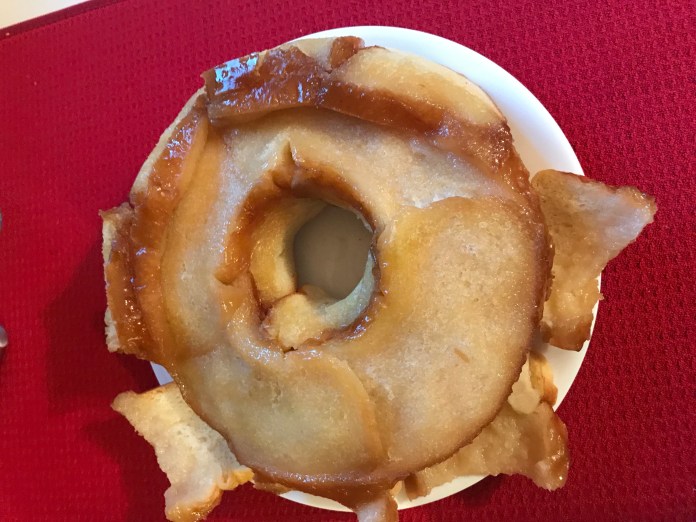
Since I don’t actually have timbale molds (I’m not entirely sure what they are, but they sound like cone-shaped molds with the point removed), I used a ring mold. As I had already bought Italian bread for the soup, I used that to line the molds, but otherwise followed the recipe as written. It took a while to figure out how to line the mold, but once I did and got it filled and in the oven, it seemed like smooth sailing. Or so I thought. Since the bottom of the pan was removeable, some of the melting butter and juice from the baking fruit managed to leak out through the tiny gaps and made a mess in the oven.
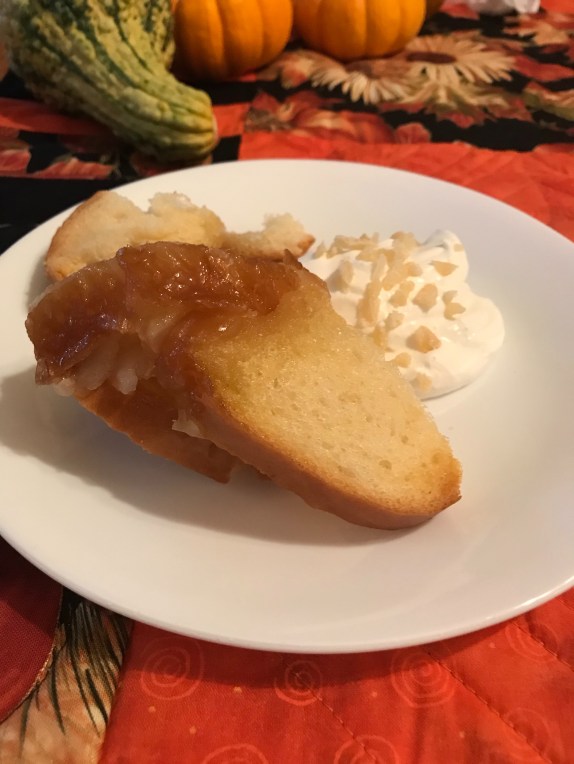
The final dessert wasn’t necessarily pretty, but it tasted great. I was expecting soggy bread, but parts were crisp, other parts pleasantly sticky but holding together. The ginger was an interesting and delicious change of pace from the cinnamon/pie spice normally associated with apple desserts, though I’m sure either of those would have been good. Unsweetened whipped cream (which seems to be the norm in Italy as far as I can tell) and a sprinkle of chopped candied ginger balanced things perfectly. The recipe also called for a bit of softened gorgonzola cheese to be swirled into the whipped cream, but that was one thing I was not up to trying.
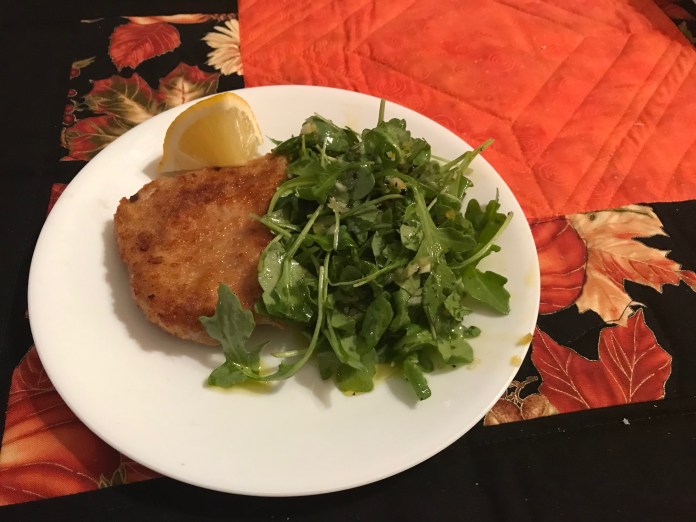
Though pretty full by this point, we managed to make room for a bit of Milan-style “veal” cutlet and arugula salad with lemon dressing. Due to concerns about raising methods and veal being hard to find, I replaced the veal chops with pork chops. Though beef might seem a more likely replacement for veal, pork is often used as a substitute in the similar German/Austrian dish schnitzel, so that is what I ended up using. Plus, pork chops are much more affordable than pretty much any cut of beef. After pounding the bone-in chops to flatten then, they are soaked in milk for an hour, then dried, dipped in egg then breadcrumbs, and fried in butter.
Supposedly they should cook for 2-3 minutes per side then 5 more minutes to cook the middle (Text, pg. 96). Maybe for veal that would be the case, but I found it took noticeably longer. Most likely, the reason for this is that while red meat is often not cooked all the way through, I am weirded out by pork that isn’t, even though, with modern food safety standards, it is not strictly necessary. At any rate, when cooked, the chops are served with a lemon wedge.
They are good with just lemon, but with a bit of the salad dressing they are even better. Due to not wanting to wash more plates/bowls than necessary, I ended up putting the salad on the plates with the pork chops, where a bit of the dressing inevitably ended up on the meat. With lemon juice instead of vinegar, smoothed out by olive oil and a tiny bit of sugar, and made aromatic with lemon zest and minced garlic, the dressing, along with the peppery arugula, made a wonderful contrast to the rich, buttery pork. If you wish, a few different red wines from Lombardy are suggested to go with this menu.
 Feasting Through Time