A few months ago, I took a road trip to Canada, through Toronto, Ottawa, Montreal, Quebec City, and Nova Scotia. Aside from hitting as many of the must-see locations as possible during the one to two days available in each location, there was a lot of interesting food to try. Poutine is the most obvious. Originally French-Canadian, it has since been adopted across the country as Canada’s national dish.
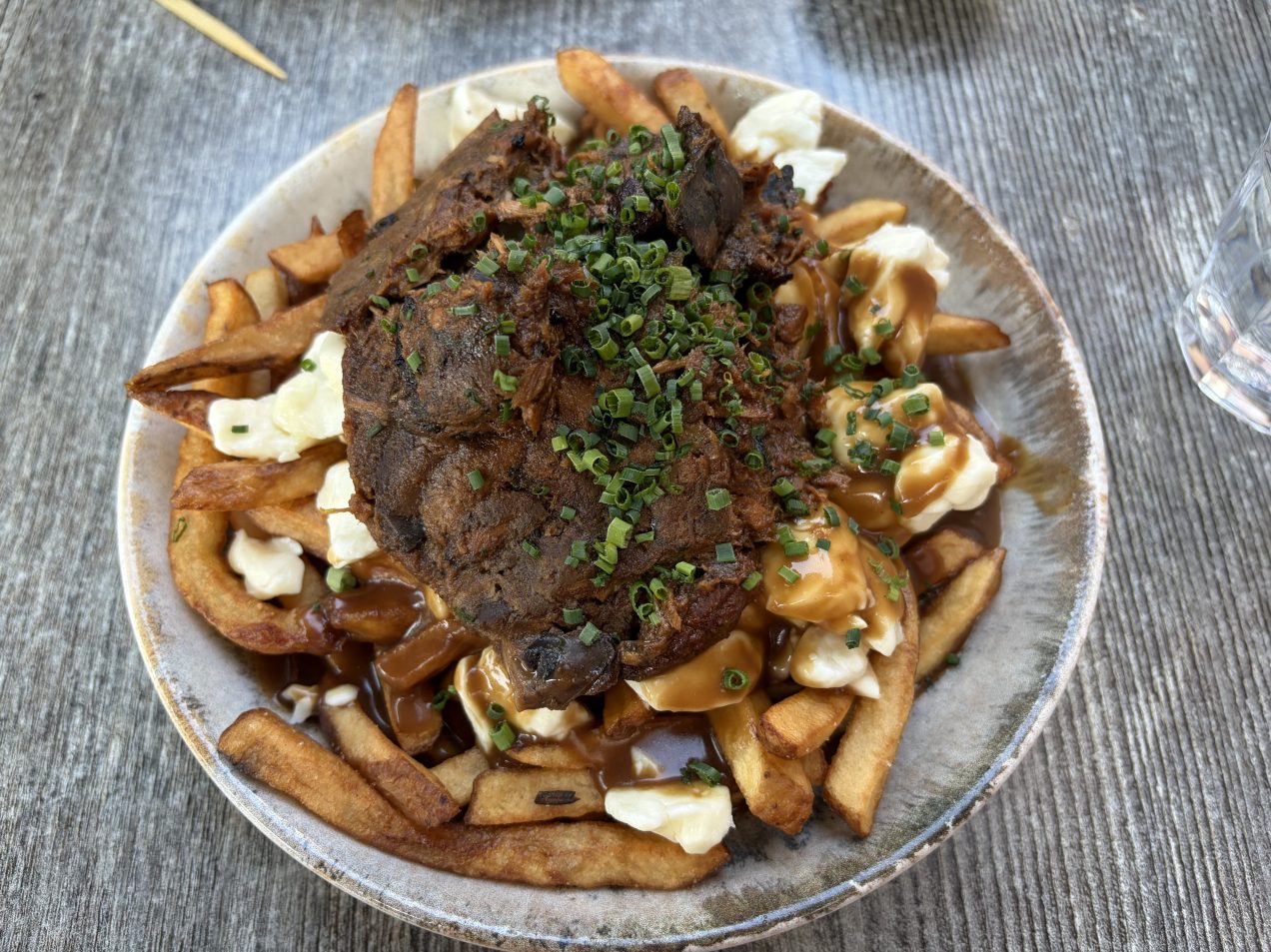
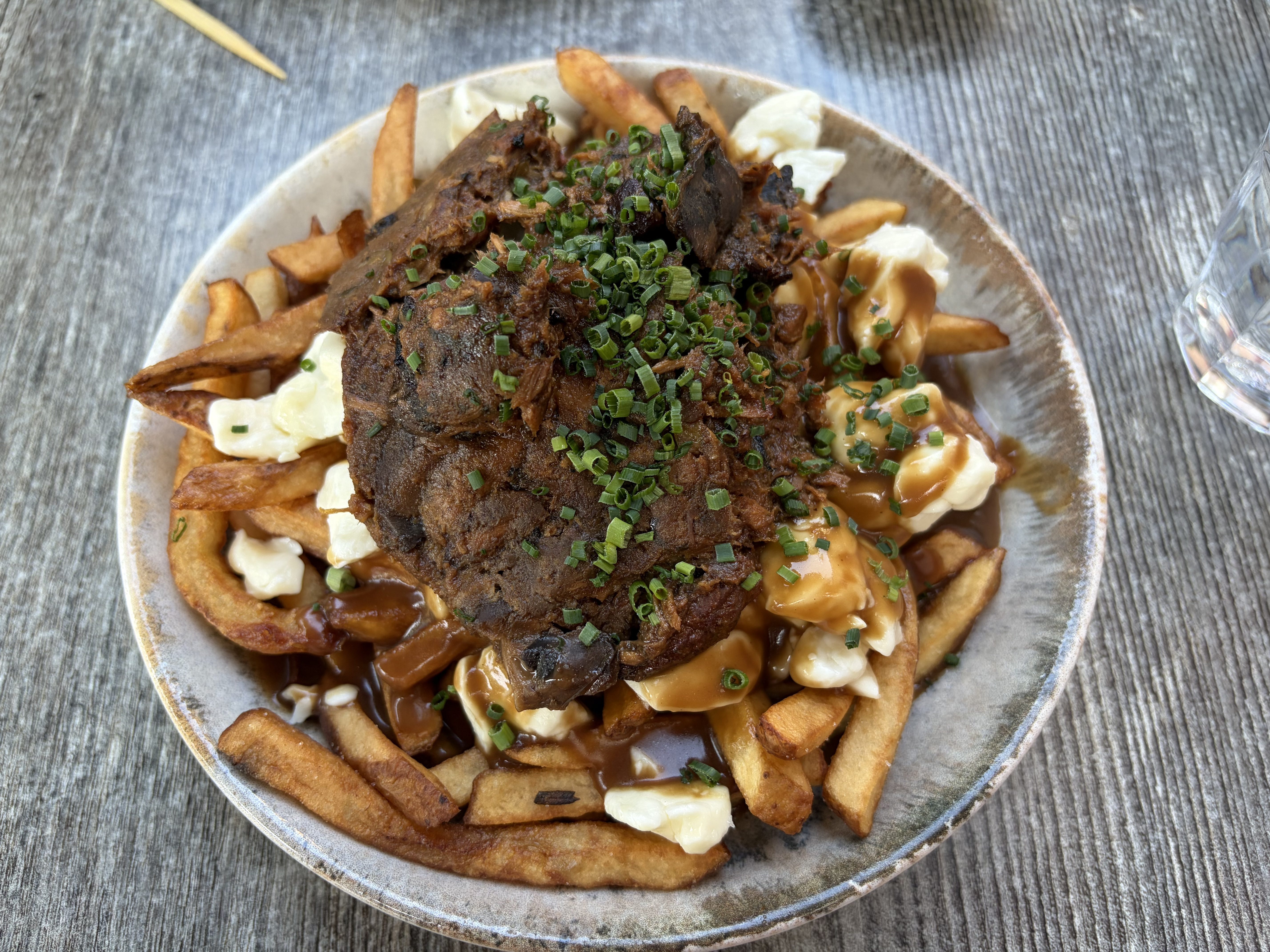
Classic PoutineDeluxe Poutine
At its most basic, poutine has just three ingredients: French fries, cheese curds, and gravy. All sorts of things can be added on top, from braised beef to chili peppers to all manner of sauces, but three things seem to be essential to success. First, the fries must be fresh and crisp. Second, the cheese curds must also be fresh. If you’re unfamiliar with these, they are pieces of cheese, typically cheddar and less than a day old, that squeak a little when you chew them.
The gravy appears to be the biggest variable, as far as quality goes. It shouldn’t be too salty, and is best in moderate amounts. It’s important to moisten the dish and “tie” the fries and cheese curds together, but too much makes the fries really soggy and overly salty. In other words, balance is key.
Advertisements
One addition that didn’t upset the balance was braised beef. Other good options might include classic potato toppings like bacon, scallions, or chives, fresh herbs, or spicy chicken or vegetables. The original can be very good, but it is pretty rich and heavy. Something fresh and/or spicy to add contrast would make it even better.
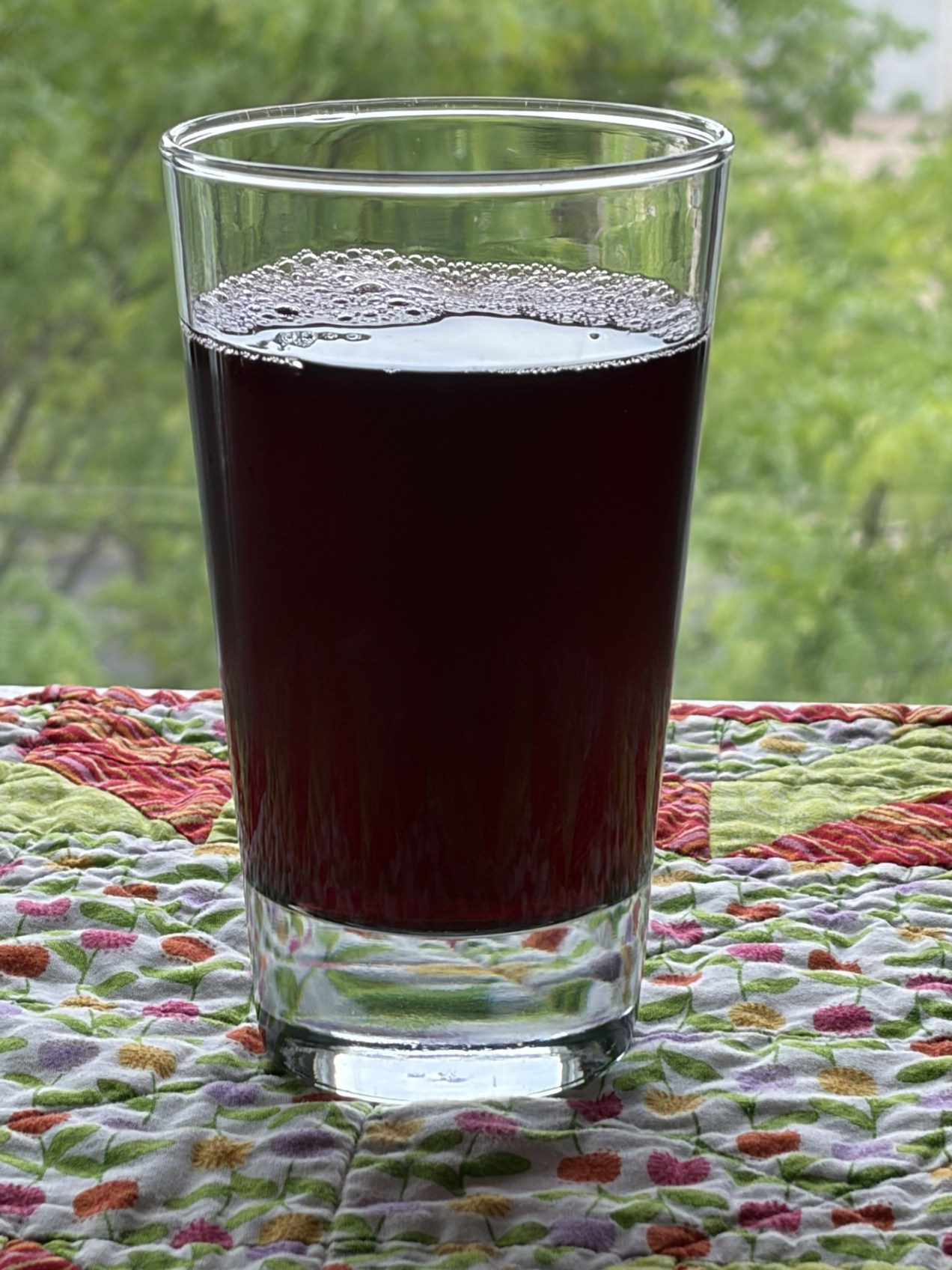
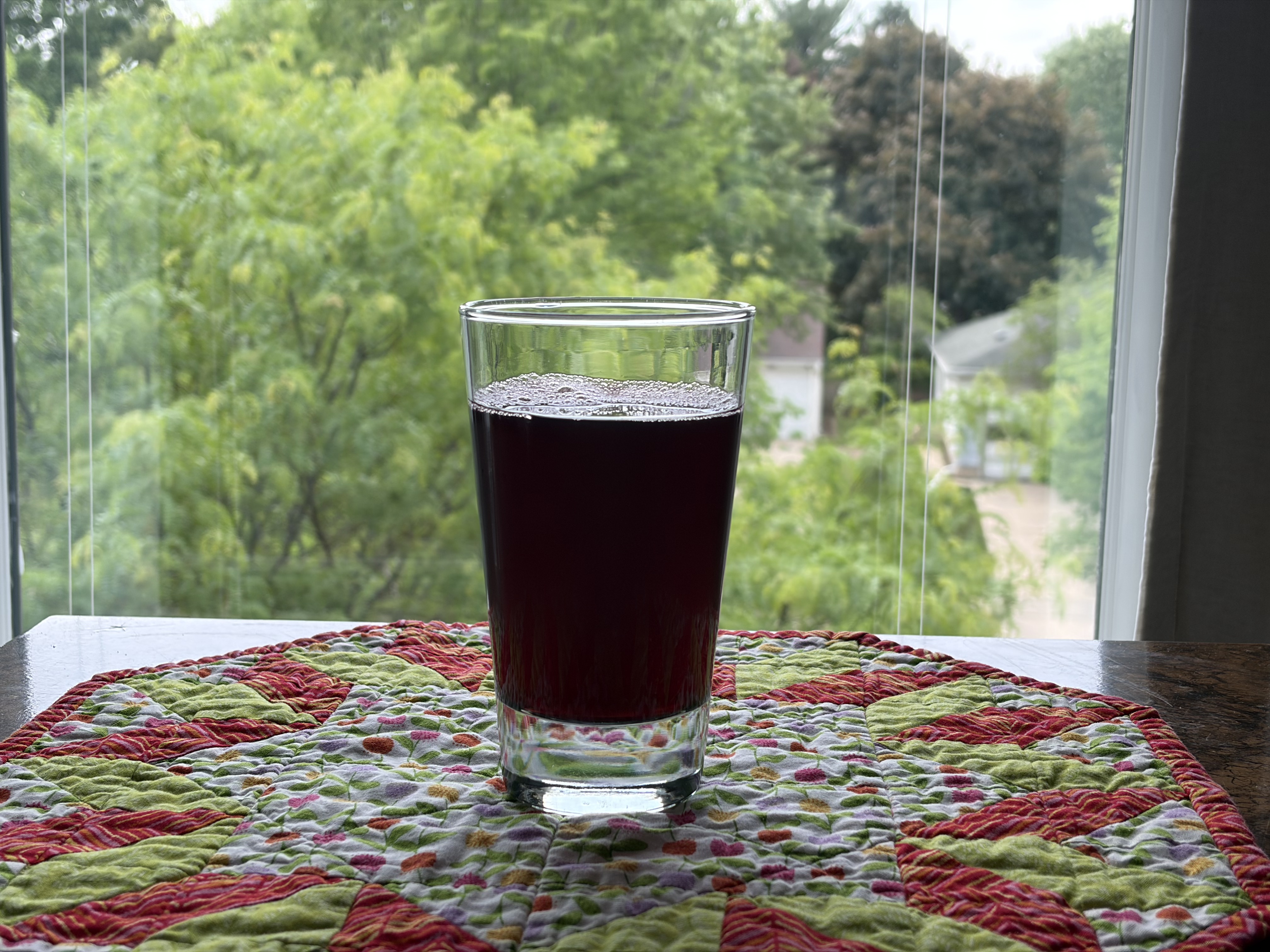
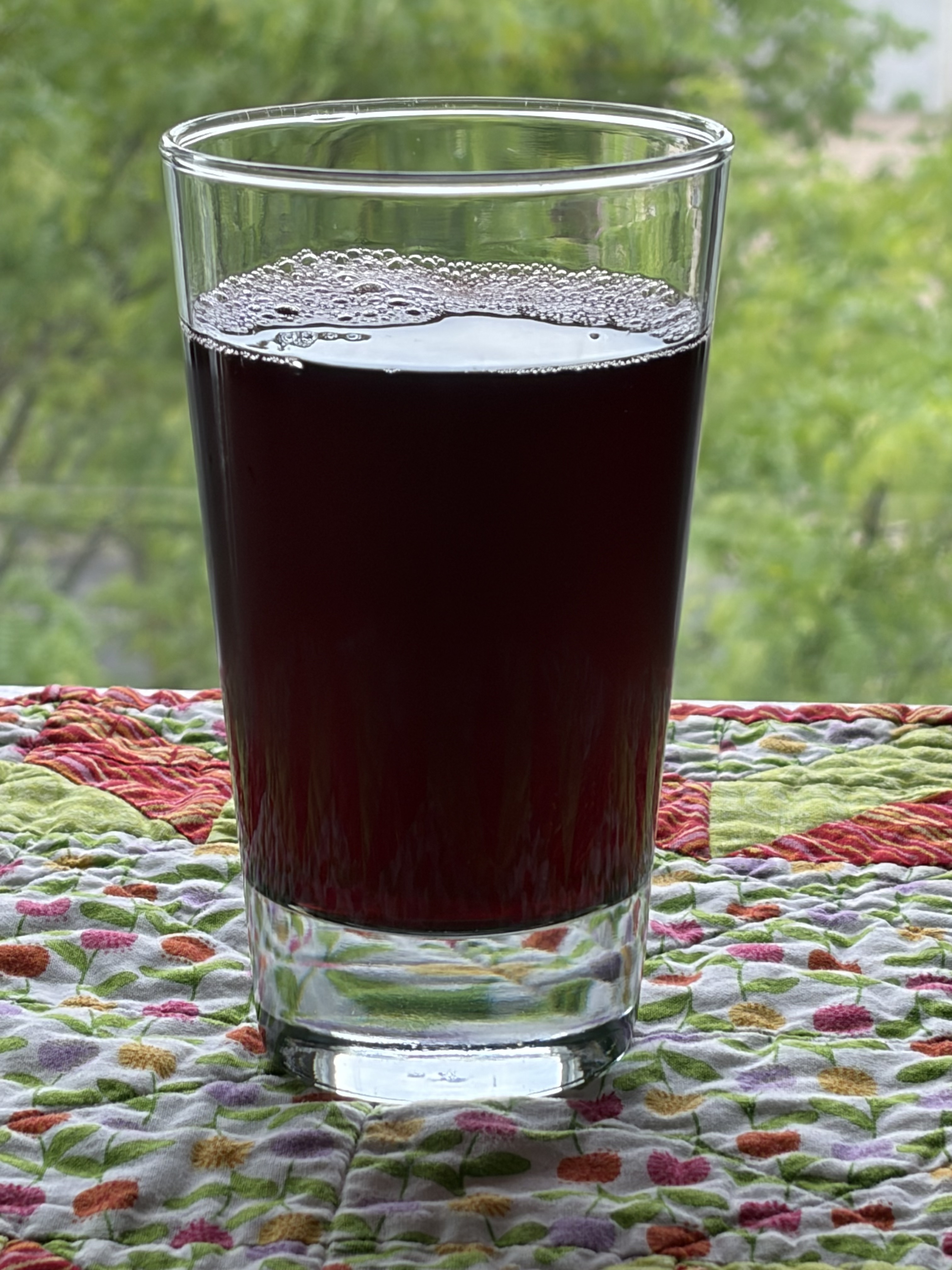
Jamaica isn’t the only place where people brew hibiscus flowers to make a beverage. After all, they have a pleasantly sour, aromatic, vaguely fruity flavor, and produce a liquid with a stunning red color. All it needs is a little sweetener to produce an excellent sweet-tart, refreshing drink.
There are a few differences. Sorrel punch is usually spiced with allspice, ginger, and sometimes cinnamon and cloves. Sometimes karkade includes a bit of spice, but not always, and it typically has some lemon. Mimi Sheraton gives a fetching description of enjoying kardade at a café in Cairo on page 710 of 1000 Foods to Eat Before You Die. If you don’t feel comfortable traveling to Egypt or don’t want to pay to do so, you can still imagine it.
Advertisements
To make it, just pour a quart of boiling water over a cup of dried hibiscus flowers, strips of peel from one lemon, and, if desired, a cinnamon stick, two or three cloves, and a pinch of grated ginger, dried or fresh. Spices are sometimes added, especially in winter, but they’re not as central as in the Jamaican version. Let cool and steep for several hours or overnight.
Close-up
After steeping, strain and stir in ½ cup sugar and a quart of cool water. Taste for sweetness and intensity, adding a little more sugar and water if you think the karkade needs it. Unlike Jamaican sorrel punch, Egyptian karkade doesn’t usually contain rum or other alcohol, making it a great mocktail. Supposedly, Egyptians have been brewing hibiscus flowers since ancient times. Surely, millions of people over thousands of years can’t all be wrong, can they?
Menu: Bread Toasts with Truffles, Marinated Salmon with Rhubarb Sauce, Penne Pasta with Brandy Tomato Cream Sauce, Umbrian-Style “Suckling Pig,” Vegetable Rainbow with Asparagus, Carrots, and Zucchini, Italian Cheese Tray with Mostarda
Recommended Wine: Lungarotti White and Red (Chardonnay di Miralduolo, Cabernet Sauvignon di Miralduolo)
I’m not sure how one chooses the menu for an orgy, but there’s a tongue-in-cheek (I hope) suggestion in A Cook’s Tour of Italy, to be held in Perugia. Situated in the hills above the Tiber River upstream from Rome, the city has a prime location. An important city even before the Roman Empire, Perugia reached the peak of its influence in the Middle Ages. Several popes were elected there, and it was a regular refuge at times of civil unrest in Rome.
As in Tuscany, Emilia-Romagna, Lombardy, and other parts of northern and central Italy, the weakening Holy Roman Empire created a power vacuum in Umbria during the High Middle Ages. It was filled by constantly-squabbling city states like Perugia, Assisi, and Spoleto. In one conflict in 1202, 20-year-old Francis of Assisi was captured and held in Perugia for a year. During this time, he began his spiritual journey, eventually leading to sainthood.
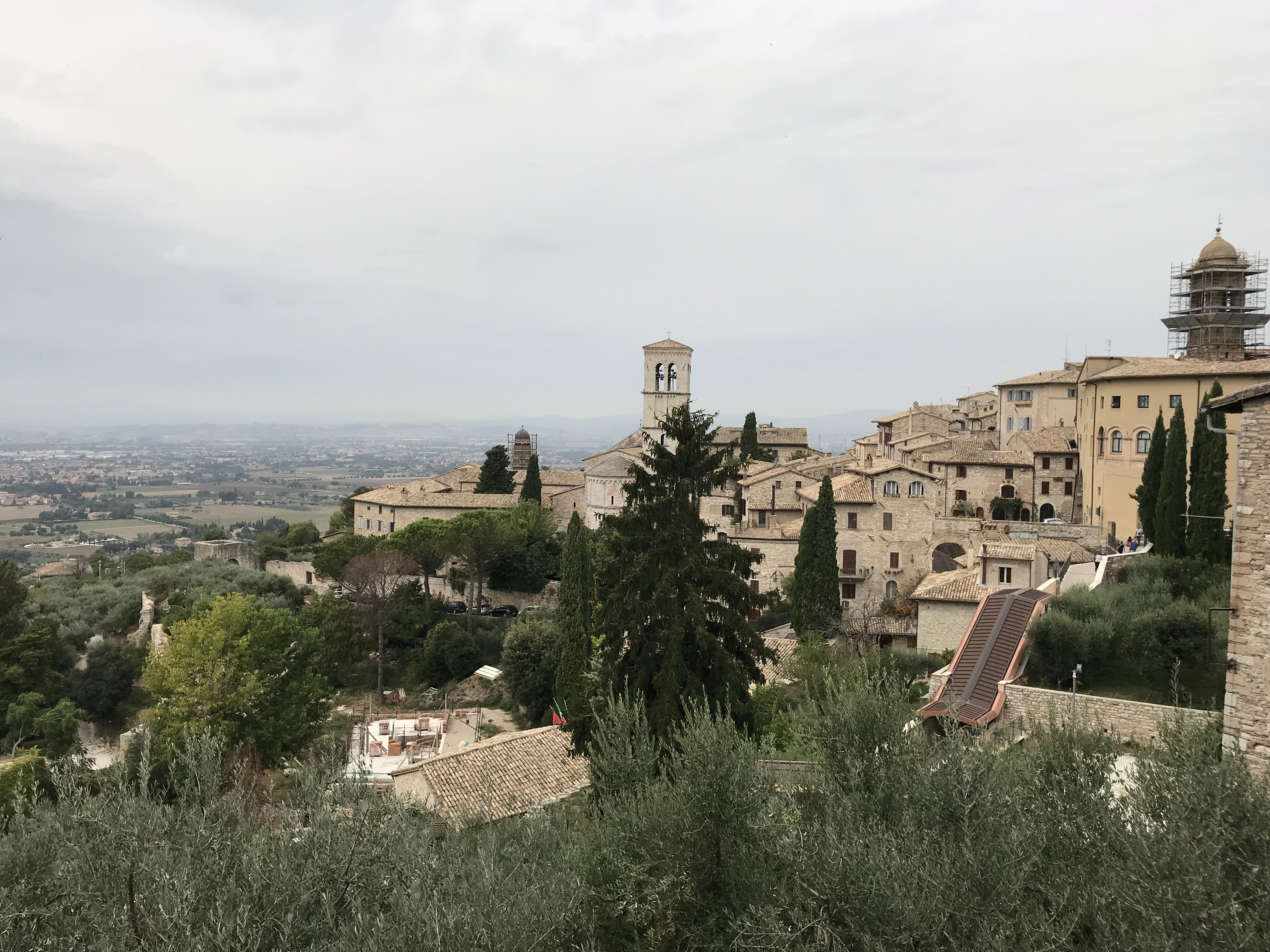
The landscape of Umbria greatly resembles that of neighboring Tuscany, with hilltop towns, vineyards, olive groves, cypress trees, and groves of forest full of wild boars. Just think about a postcard or Renaissance landscape, and you’ll get a pretty good idea. The region is famous for pork, wild game, bread, oil, wine, truffles, and, more recently, chocolate.
View of Assisi
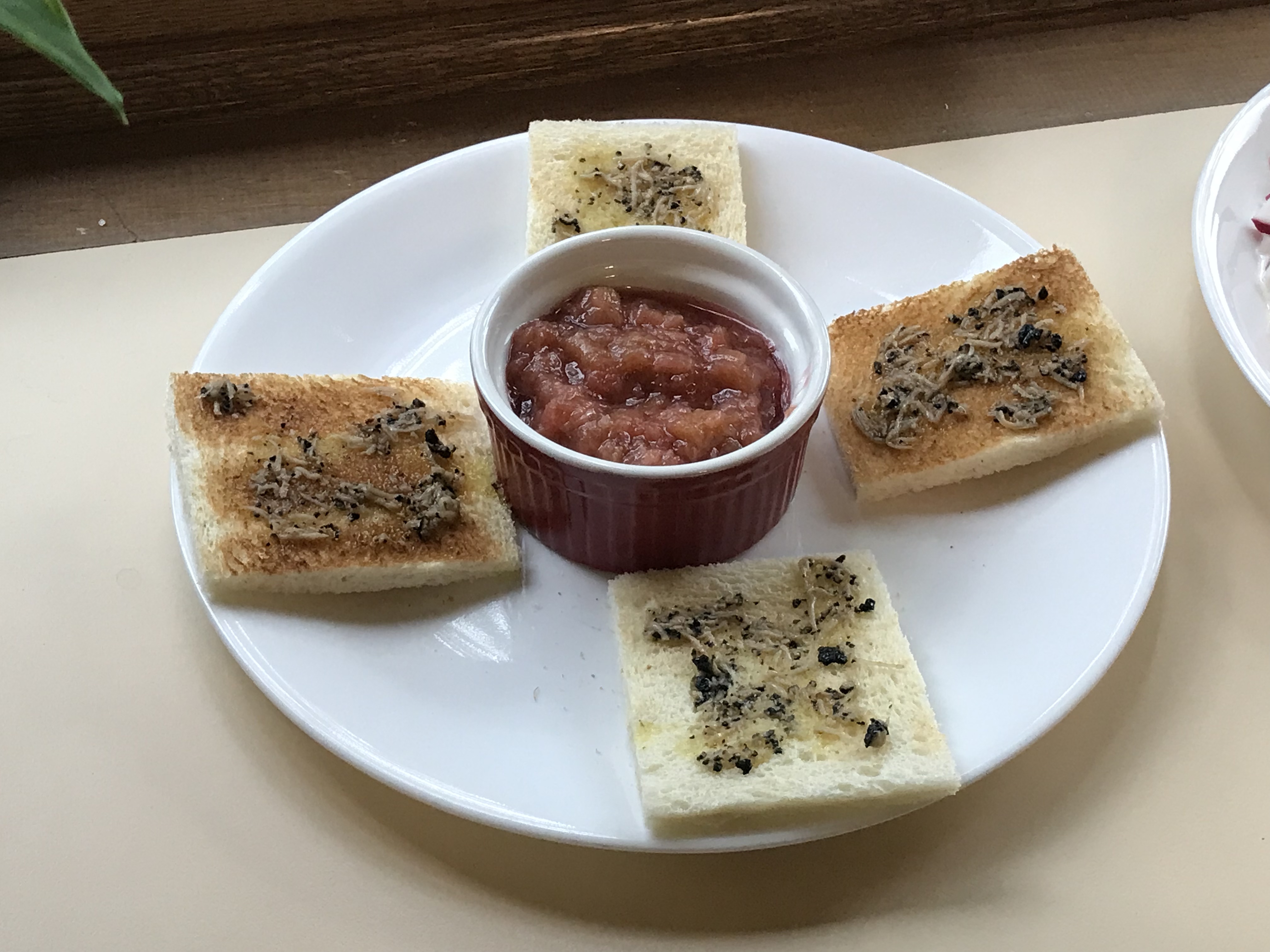
We start off with a bit of grated truffle, mixed with garlic, oil, and lemon juice for a sort of pate, on toast. Unlike the white truffles of the Piedmont region, which are supposedly ruined by cooking and should only be grated over a finished dish, the less expensive black truffles found in Umbria can stand up to light cooking. Here, they’re briefly sauteed in the oil with garlic. Even though I didn’t use top-quality black truffles (instead using a roughly $12 jar I found at World Market), they had a pleasant and interesting flavor. I’m not sure if I’d bother again, but it was nice to try.
Truffle toasts, plus rhubarb sauce
The ancient Romans loved mushrooms and frequently ate them as appetizers. According to some sources, Emperor Claudius was poisoned by them. A variety called death caps has been implicated in countless accidental and deliberate mushroom poisonings over the centuries, and are still responsible for over half of fatal cases, so they seem like the prime suspect. Perhaps fear of a repeat made edible fungi go out of fashion during the Middle Ages, and maybe that’s why medieval people considered them to be dangerously cold and wet. It wasn’t until the Renaissance that the wealthy even considered them again. Presumably that’s when Umbrians discovered (or rediscovered) their truffles.
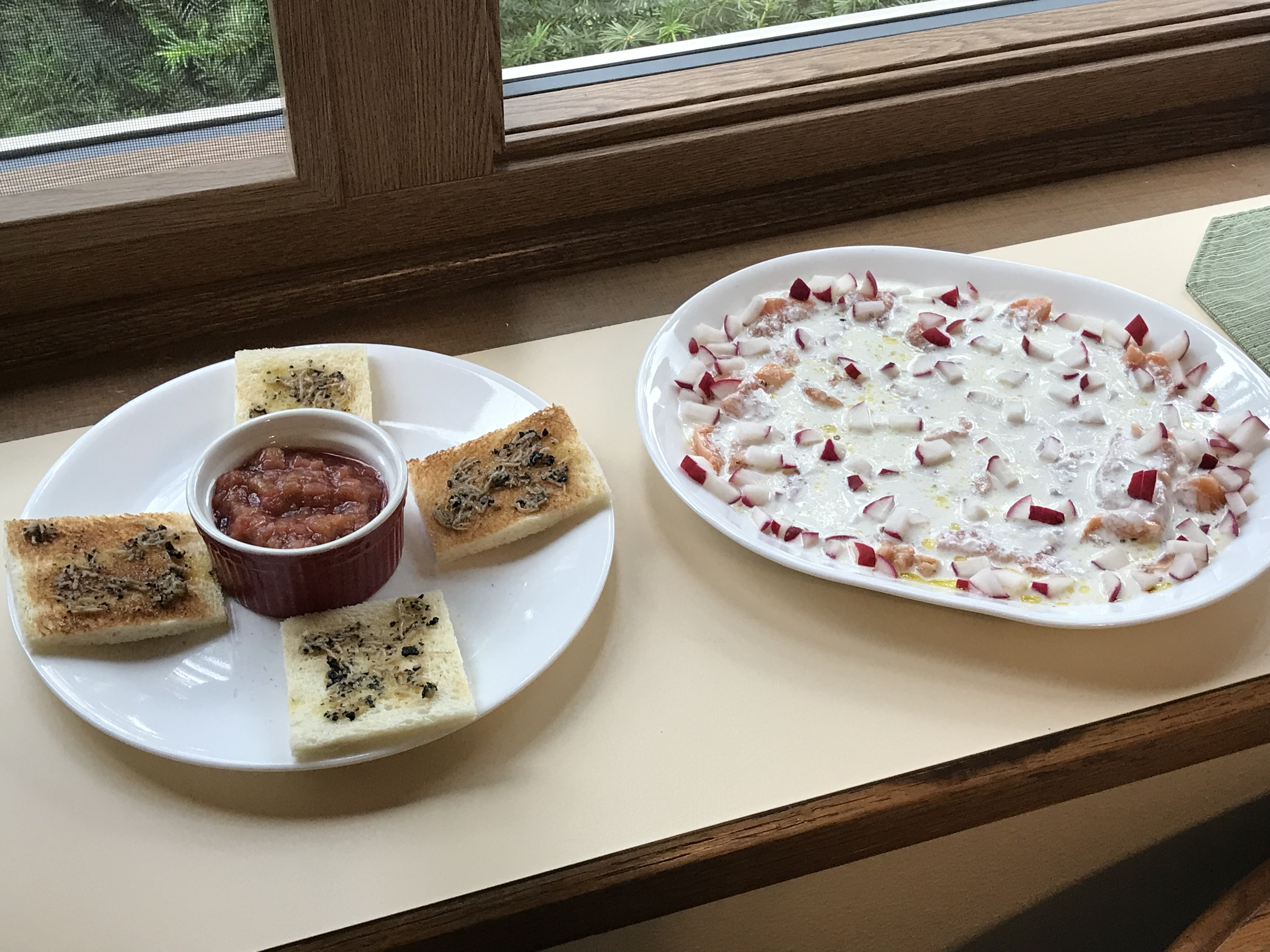
The first two courses
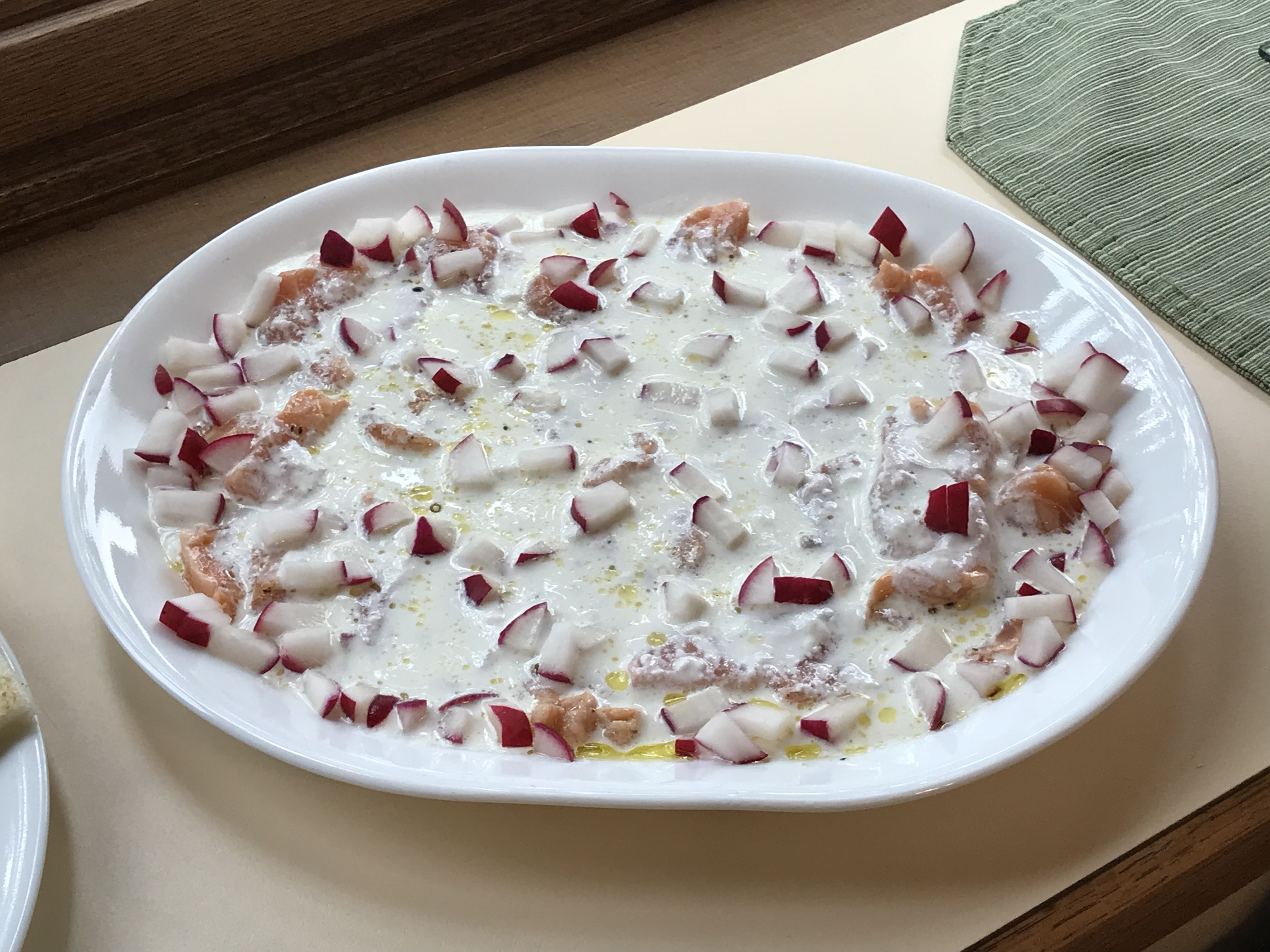
The next dish is an interesting one. Landlocked Umbria is known for its freshwater fish, but salmon is not native. Mr. Famularo based this dish on one he had at a posh little hotel in the area. The salmon is raw, only “cooked” by an acidic marinade, served in a cream sauce, with a sweet-and-sour rhubarb sauce alongside. Since I was serving two people and not twelve, I only made a fraction of the amount of fish, to ensure it all got eaten. Leftovers probably would have not improved in the fridge.
Salmon to serve with rhubarb sauce
The rhubarb sauce was another story. To make things a little easier, I served the toasts and fish on one day, and everything else on another. The texture of the fish took a little getting used to, but the cream and especially rhubarb sauce really made the dish. A little bit of lemon peel added extra flavor. For a full party of twelve, I probably would have needed to double the recipe to have enough. Leftovers are a great topping for ice cream, pancakes, and waffles. Rhubarb sundaes, with either vanilla or strawberry ice cream, could be the next big thing.
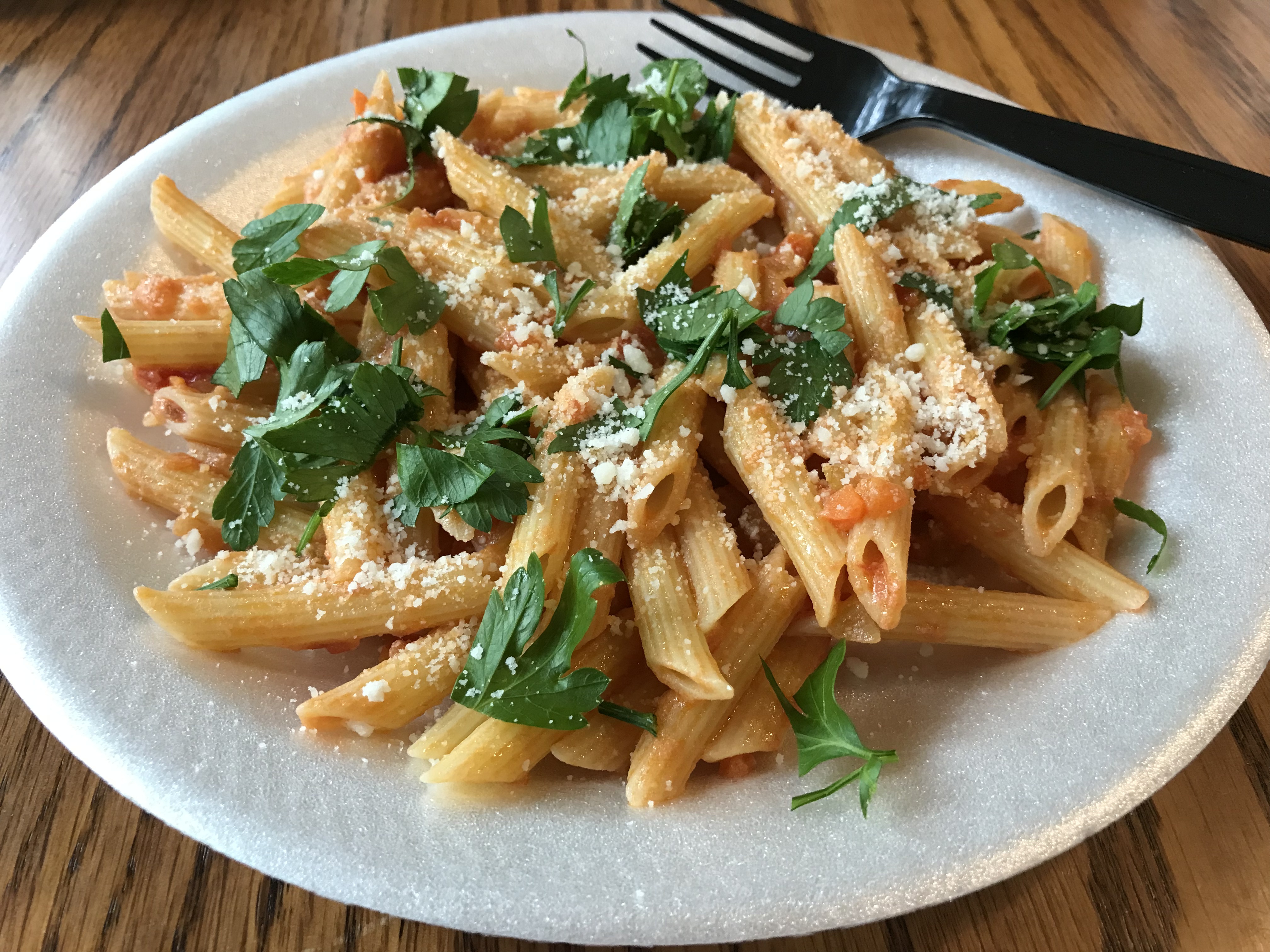
If you’re wondering why the pasta is on Styrofoam plates, it’s because the water softener was out of commission, waiting for repair. To avoid unpleasant powdery mineral buildup on the regular plates, we used foam and paper ones for several days. Pasta with a homemade tomato-cream sauce tastes just as good that way. I couldn’t taste the bit of “cognac” in it, so using a basic domestic brandy worked just fine.
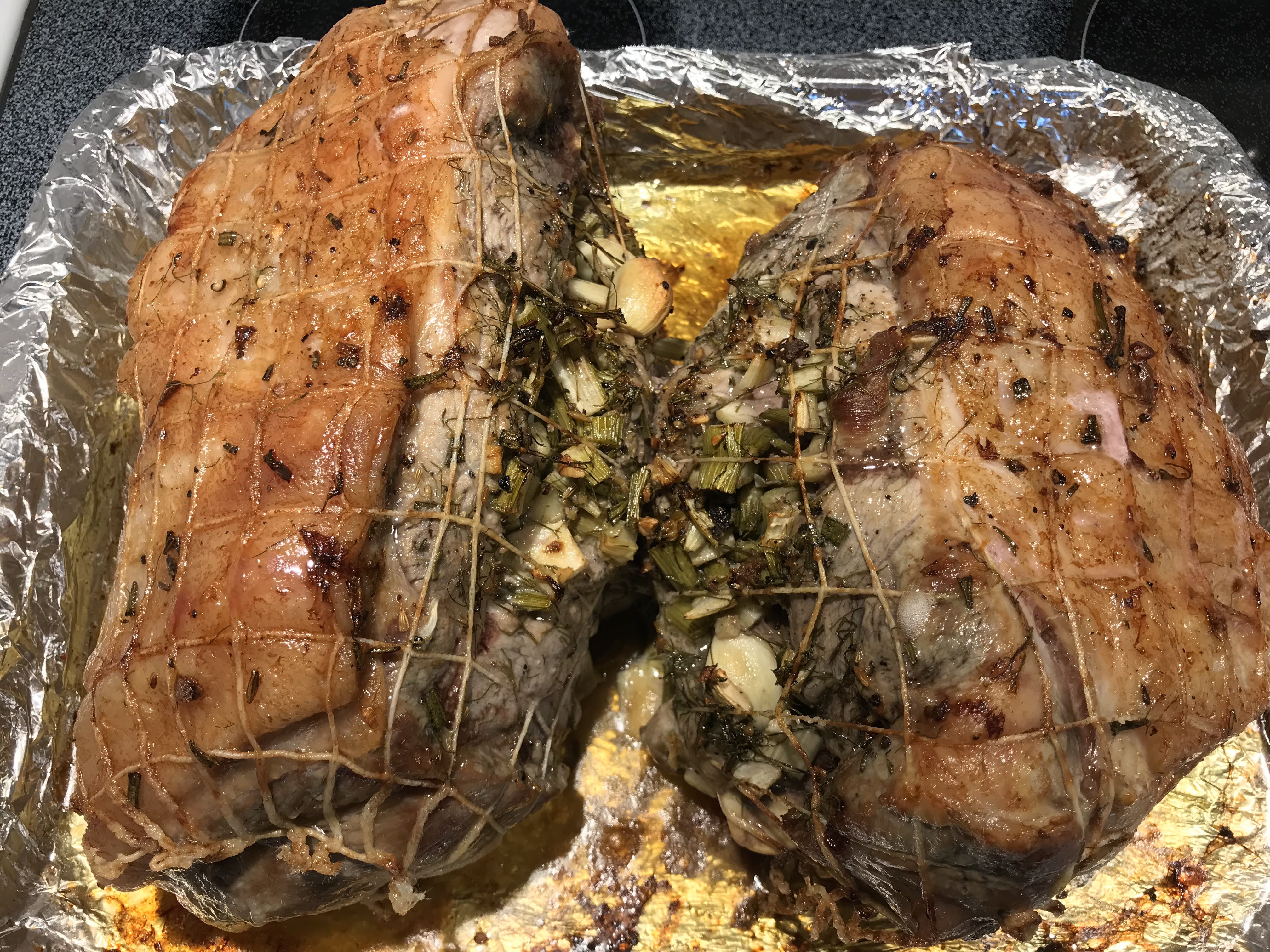
Sort-of porchetta
As a substitute for suckling pig, I used two chunks of pork butt, which are large and fatty enough to stand up to the long cooking time without drying out. The cooking time didn’t need to be reduced as much as I expected, so the pork became a bedtime snack a few hours after dinner. And porchetta sandwiches for a week of lunches. Luckily – but not surprisingly – it tasted delicious. Pork and herbs are a classic combination for a reason.
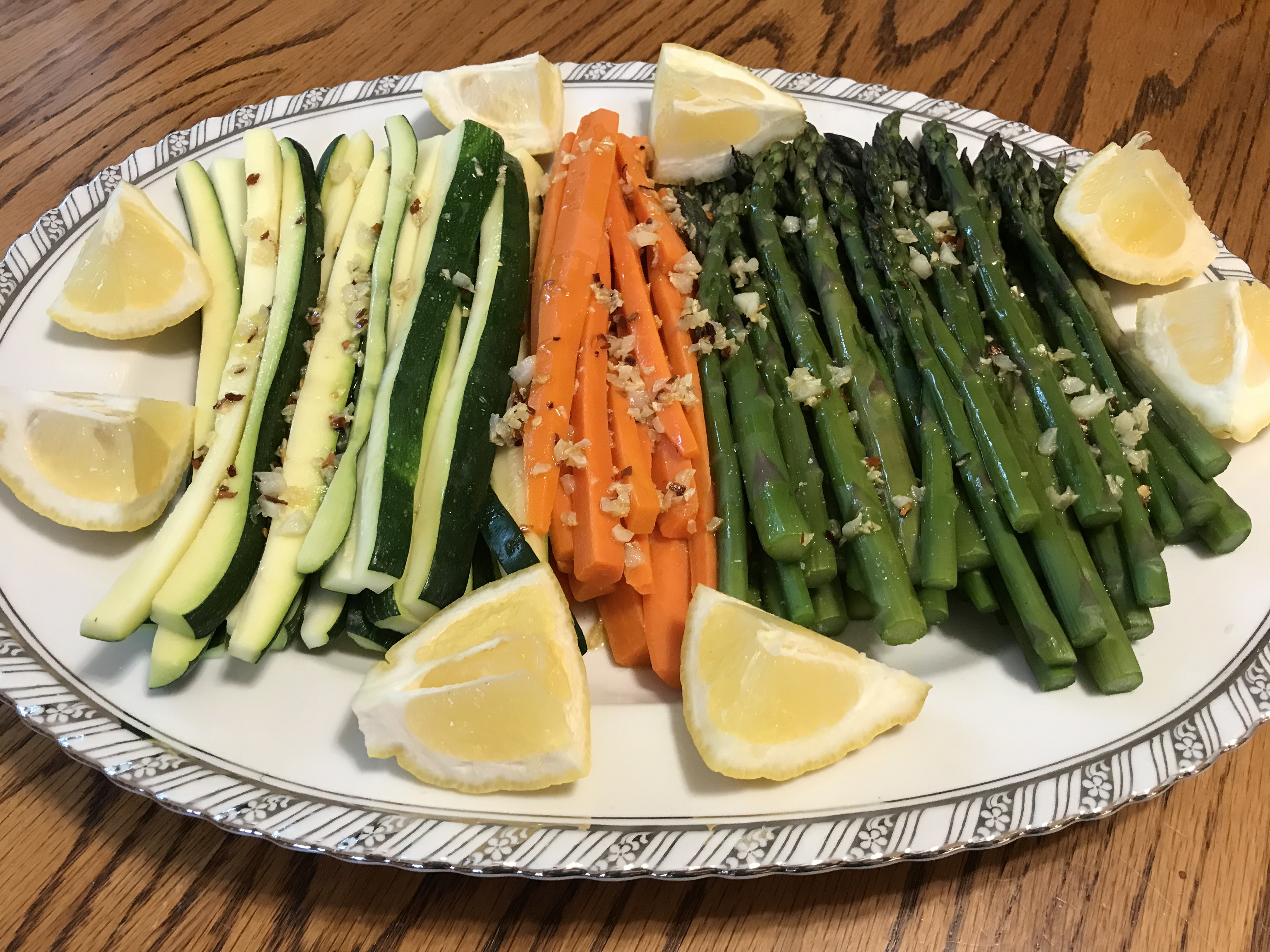
Upgraded veggie tray
The vegetables are simply steamed, arranged on a platter, drizzled with olive oil with sauteed bits of garlic, and served with lemon wedges. The combination would probably work with any sort of steamed or grilled vegetables. Lemon, oil, and garlic are a great combination.
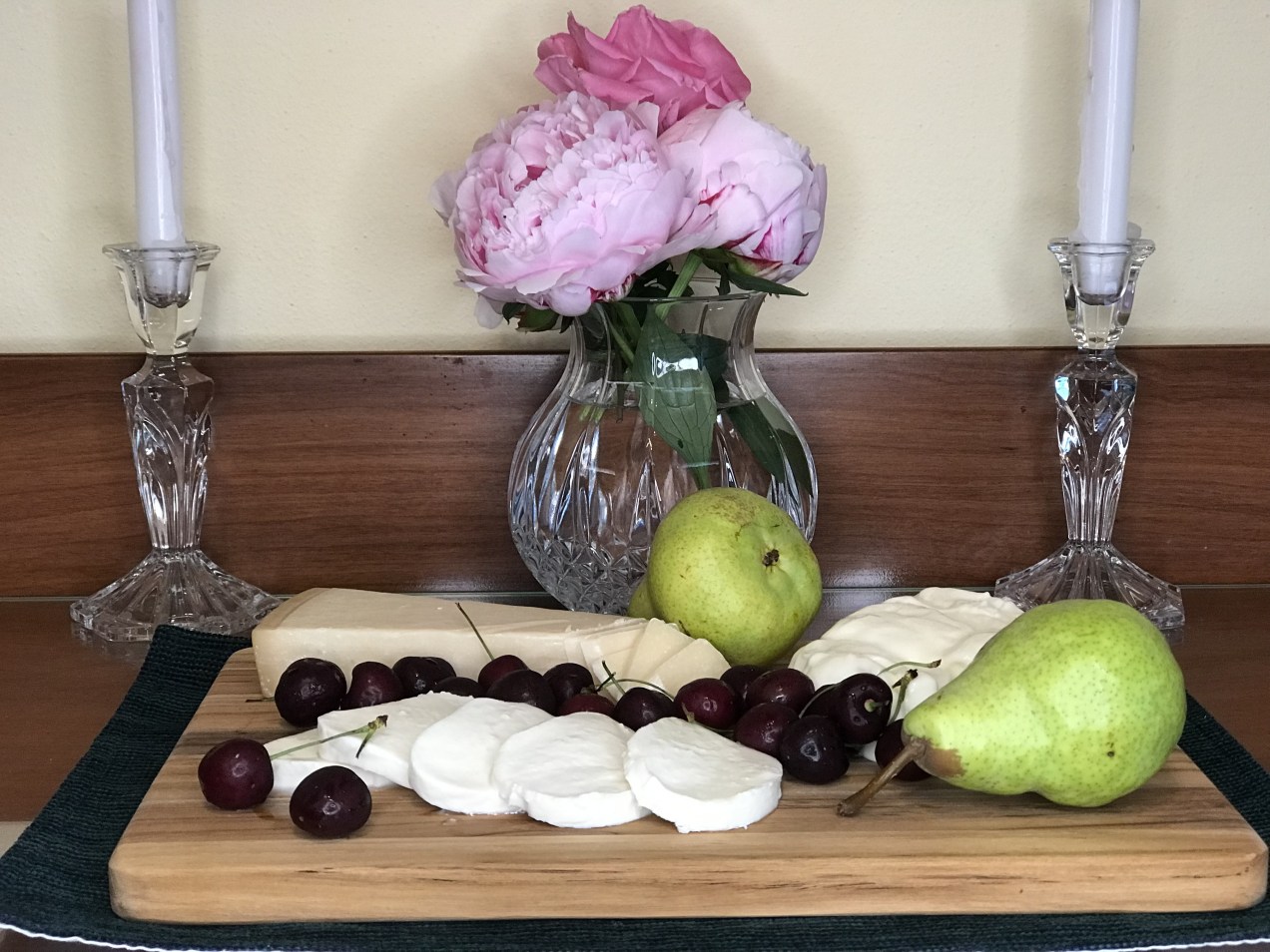
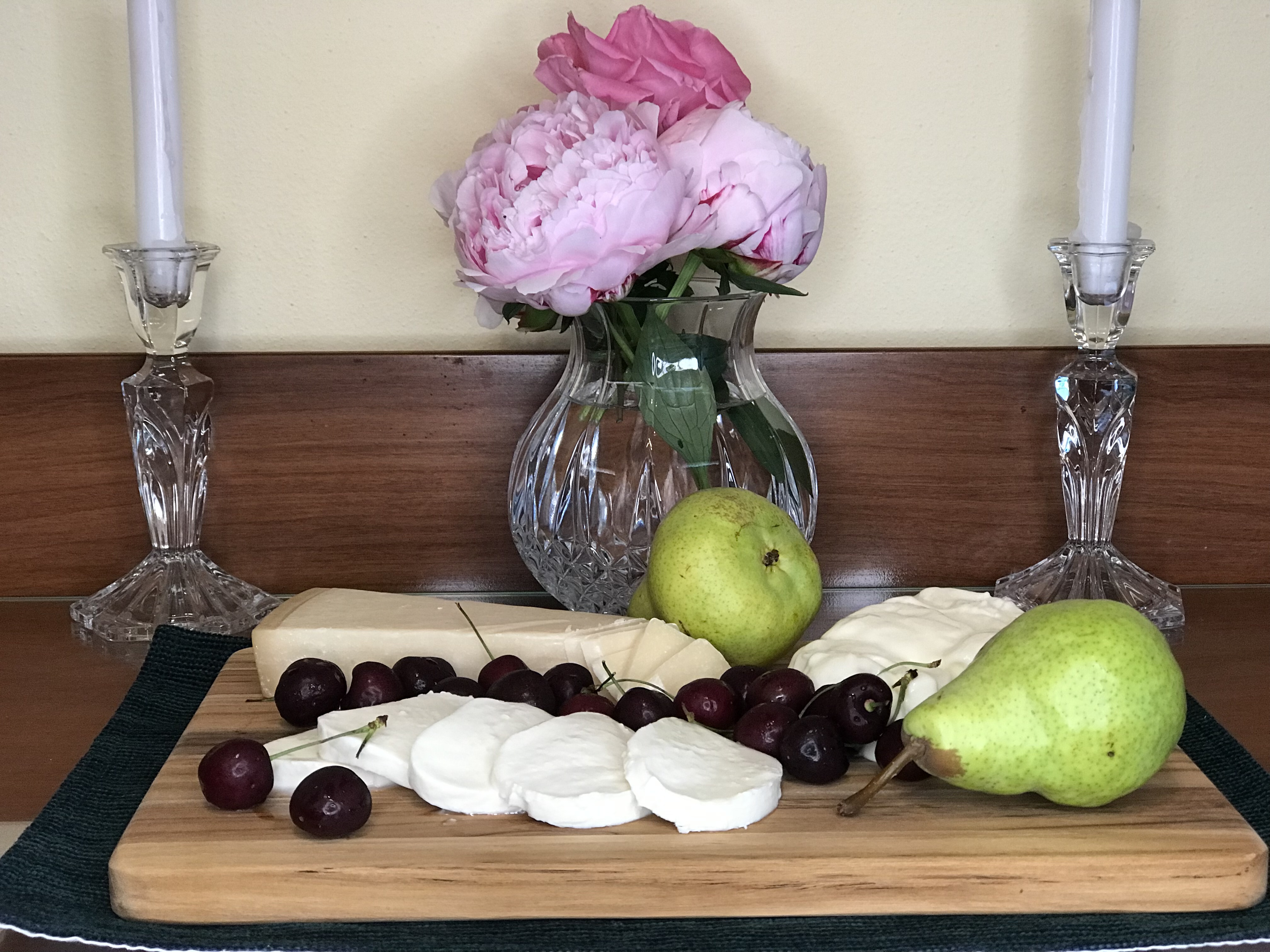
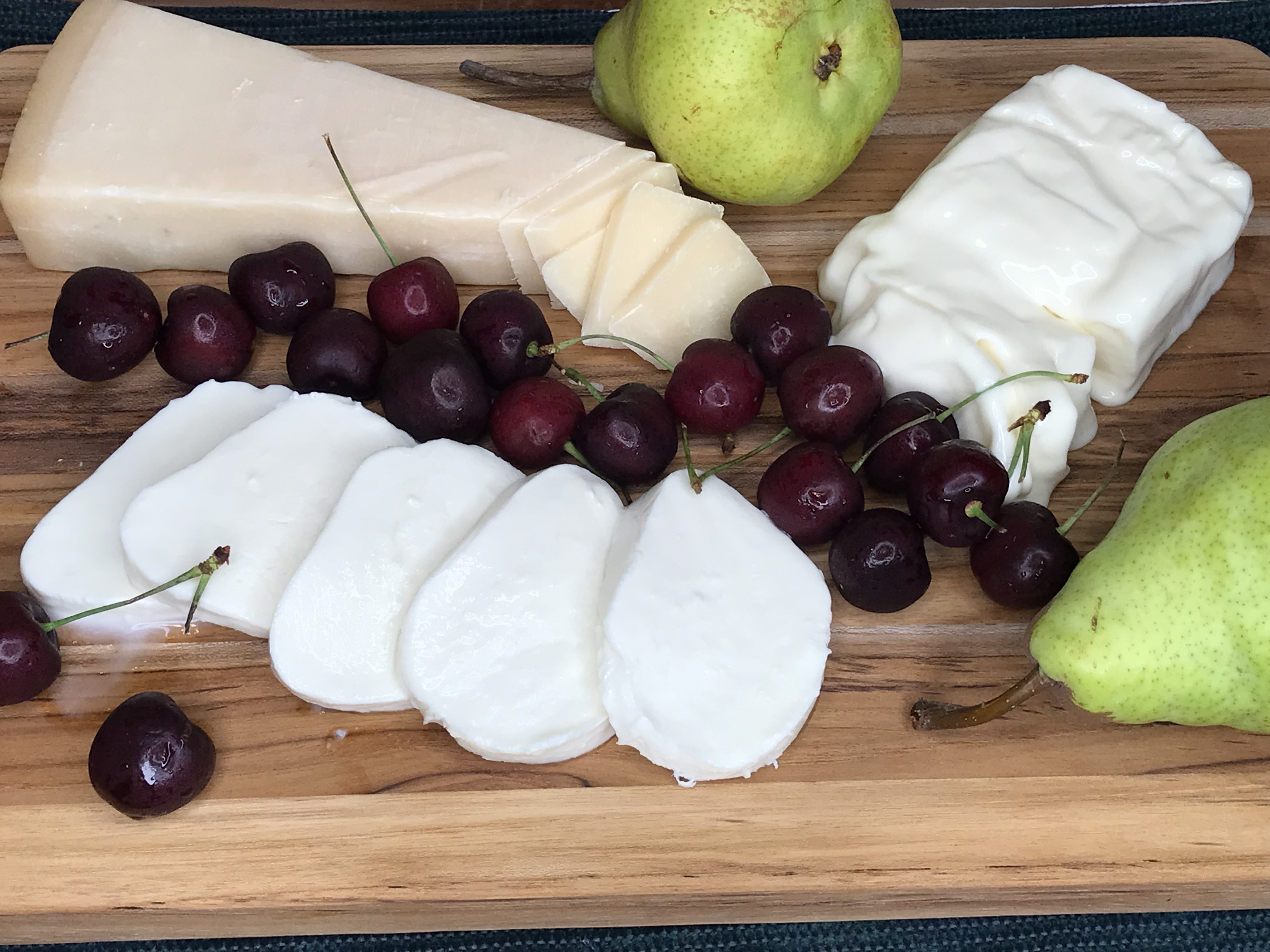
Still-life of fruit and cheese
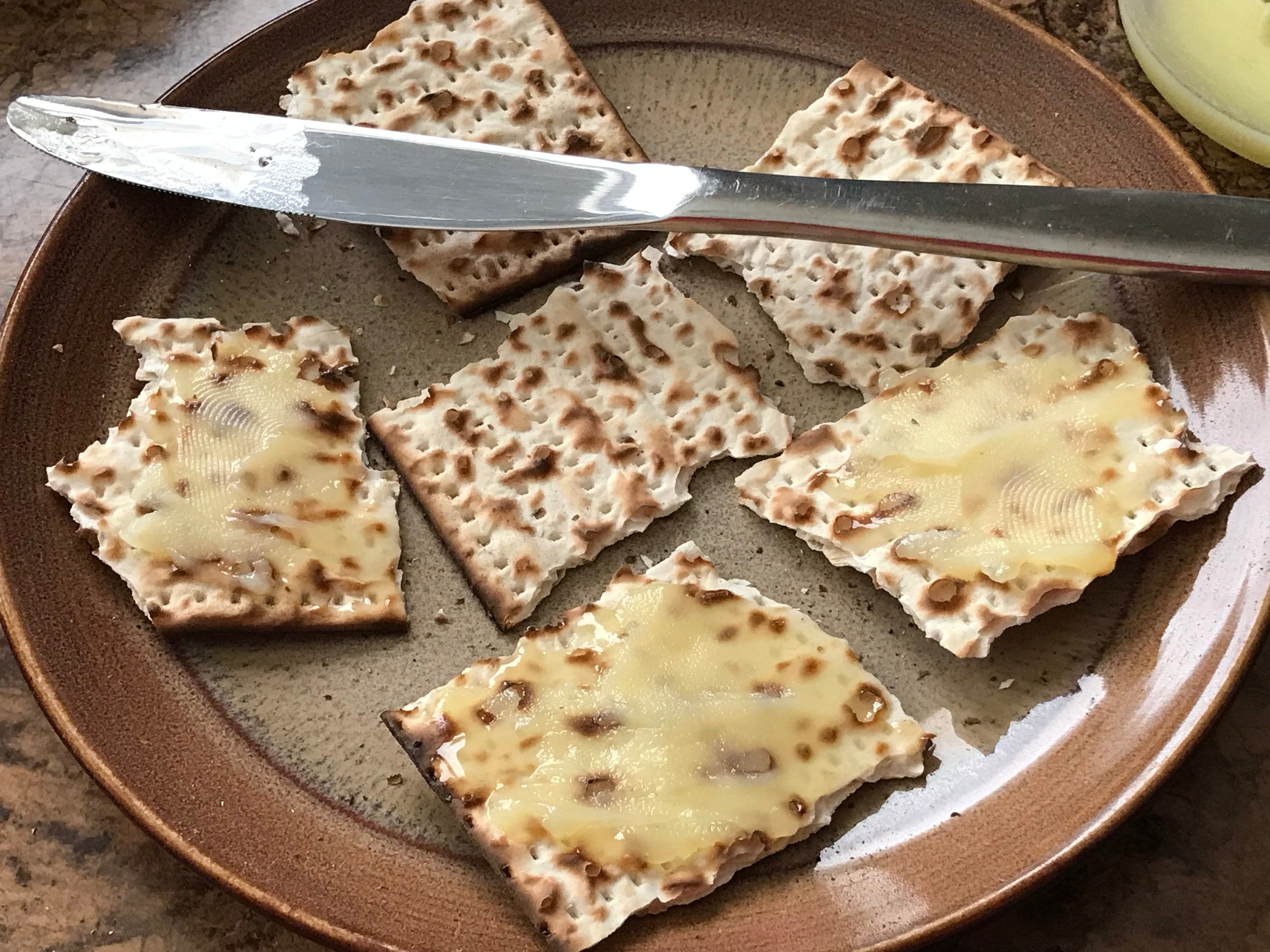
I didn’t have mostarda di frutta, a mix of fruits preserved in a mustard-flavored syrup, to go with the cheeses for dessert, so I improvised with a still-life – fruit, cheeses, and flowers. In this case, I used fresh mozzarella in place of smoked, which might overpower the fresh pears and cherries, true Italian Parmigiano-Reggiano, and a soft rindless cheese called stracchino. The last was sort of like brie without the rind, was just firm enough to slice, and just runny enough to very slowly spread out and make the slices run back together. To make eating it easier, I got out some matzo from the cabinet, which worked perfectly.
Advertisements
Parmigiano-Reggiano is sometimes called the “King of Cheeses.” Imitations abound, but to get the coveted name, the cheese has to be made of cows’ milk, according to a specific process, in a limited part of Emilia-Romagna near Parma, hence the name. Normally for pasta, soup, etc., a decent domestic parmesan is perfectly acceptable. It still has that characteristic slightly sweet, nutty flavor, even if the texture is less granular. Mimi Sheraton also praised its virtues on pages 216 – 217 of 1000 Foods to Eat Before You Die. But even the domestic stuff is delicious. At least if it’s made in Wisconsin.
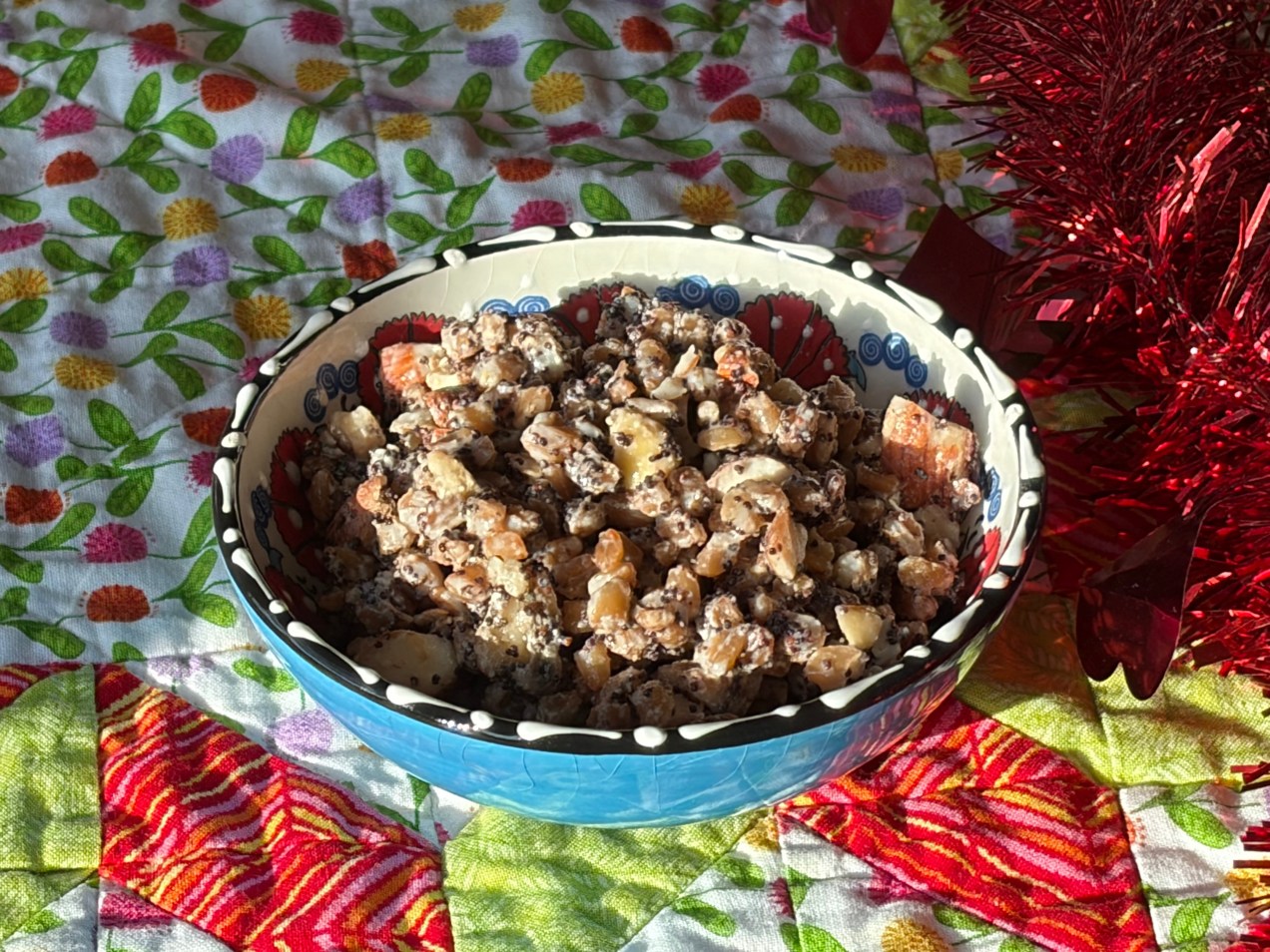
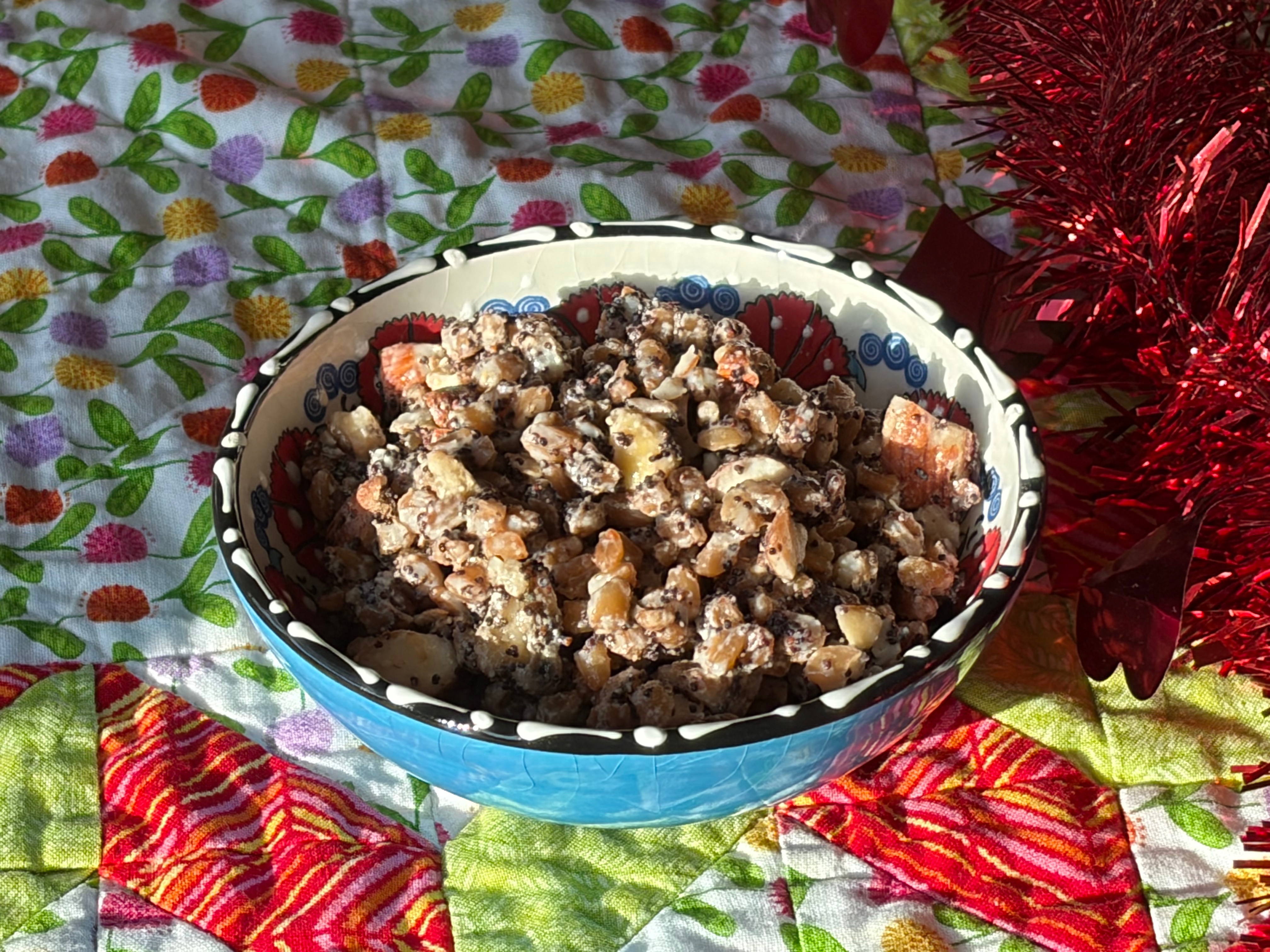
Healthy eating can be a challenge for those of us with a sweet tooth. While nothing can fully replace the baked goods and other desserts with limited nutritional value, there are healthier ways to at least calm the cravings. One option is kutya, a dessert based on wheat berries, honey, nuts, poppy seeds, and sometimes a bit of cream. Traditionally a Christmas Eve specialty in Poland and Ukraine, it’s good enough to eat year-round. I fully agree with Mimi Sheraton in 1000 Foods to Eat Before You Die (pages 401 – 402).
During the Early Modern Era, both Poland and Ukraine (then mostly part of the Polish-Lithuanian Commonwealth) exported huge amounts of grain, especially wheat, to Western Europe. In the 16th and early 17th Centuries, the Commonwealth was one of Europe’s great powers. The story of how the grain trade aided both the rise and fall of Poland-Lithuania is way too complicated to get into here (and I’m still trying to make sense of some of the economics). Suffice it to say, the role of grain is central to Polish and Ukrainian history – and cuisine.
Advertisements
I liked this a lot better than the Armenian wheat pudding anoush aboor. The grains have more texture and aren’t oversalted, adding nuts gives it more crunch, and honey gives it a more dessert-like character. Many recipes call for raisins or other dried fruit. For my own recipe I omitted them, and added the optional splash of cream. It wasn’t as good as the chocolate cupcakes I made for a co-worker’s baby shower, but it’s pretty hard to compete with homemade frosting. This wheat berry pudding is still a good dessert. It’s even filling enough for breakfast, without causing a sugar crash later.
There are two warnings I should give you beforehand. 1) Poppyseeds can cause a false positive for opiates on a drug test. This is fairly well-known, but worth a reminder. 2) Poppyseeds stick in the teeth. The problem seems worse in kutya than in cake or muffins, probably because they aren’t “bound up” in the structure. Have a toothbrush and floss handy.
Ingredients:
1 cup wheat berries or farro, cooked according to package directions and cooled
½ cup almonds, toasted and coarsely chopped
½ cup walnut pieces, toasted and coarsely chopped
¼ cup poppy seeds
¼ cup honey
¼ cup cream or half-and-half
Directions:
Combine the poppy seeds with a quarter cup hot water and allow to soak for about an hour. Drain off the water.
If you have a mortar and pestle or spice grinder, crush or grind the seeds a bit. They won’t get very fine, and this step isn’t strictly necessary, but it does help release their flavor. Mix in the cream or half-and-half.
Stir together the wheat berries, nuts, honey, and poppyseed mixture. For the best presentation, serve in pretty painted bowls.
If you thought this was interesting, don’t forget to like, share, and/or subscribe for more food history and recipes.
It’s that time of year. Cold and flu viruses are everywhere, and most people will get sick at least once. I’ve already had a few colds, a sinus infection, and most recently the flu, and the season is only just winding down. Humans living in temperate and arctic climates have dealt with these illnesses for thousands of years. (Those living in tropical climates had a whole other host of ailments.) Around the world, home remedies consistently involve soup, tea, and other hot liquids. Only the ingredients vary.
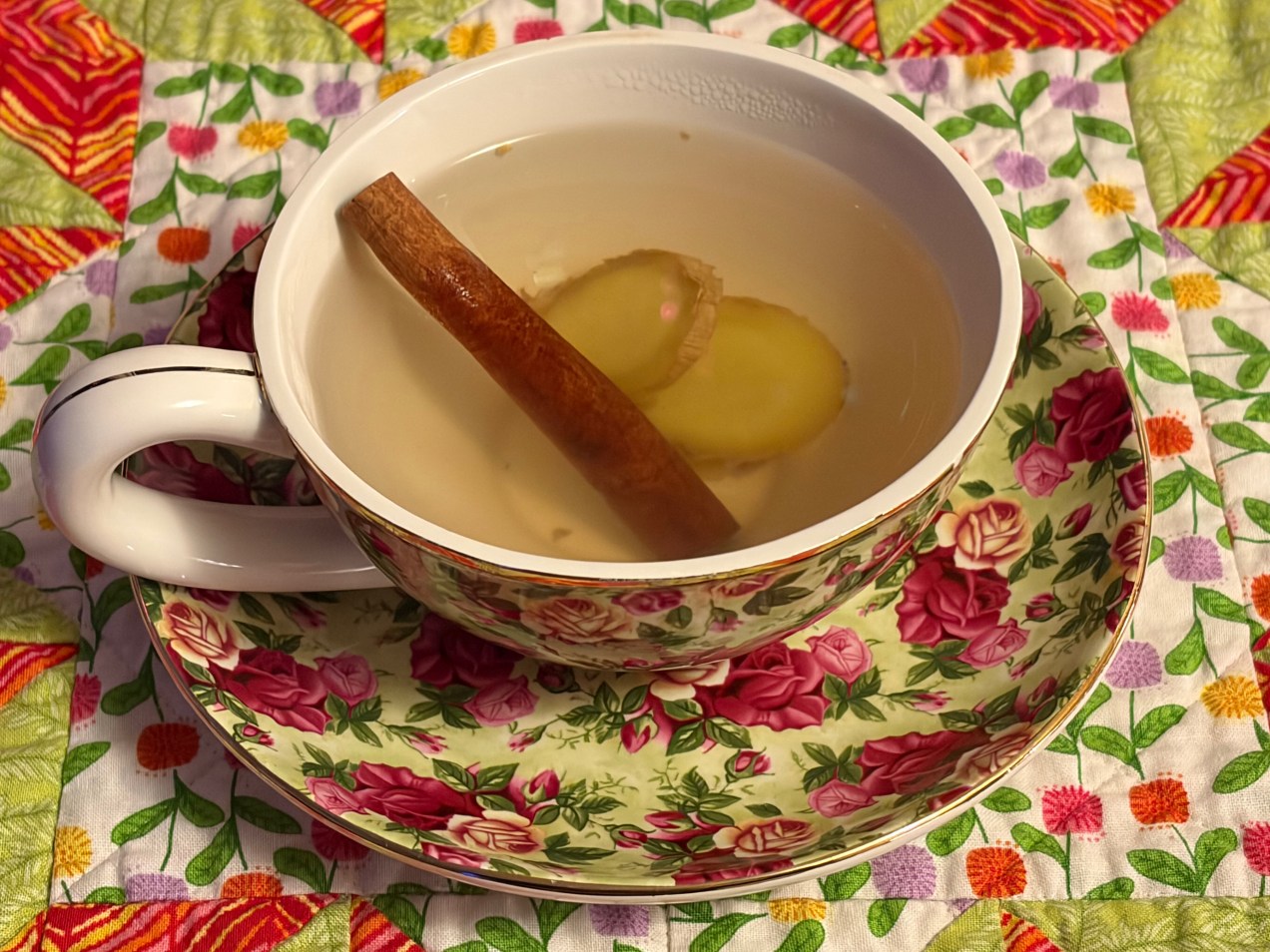
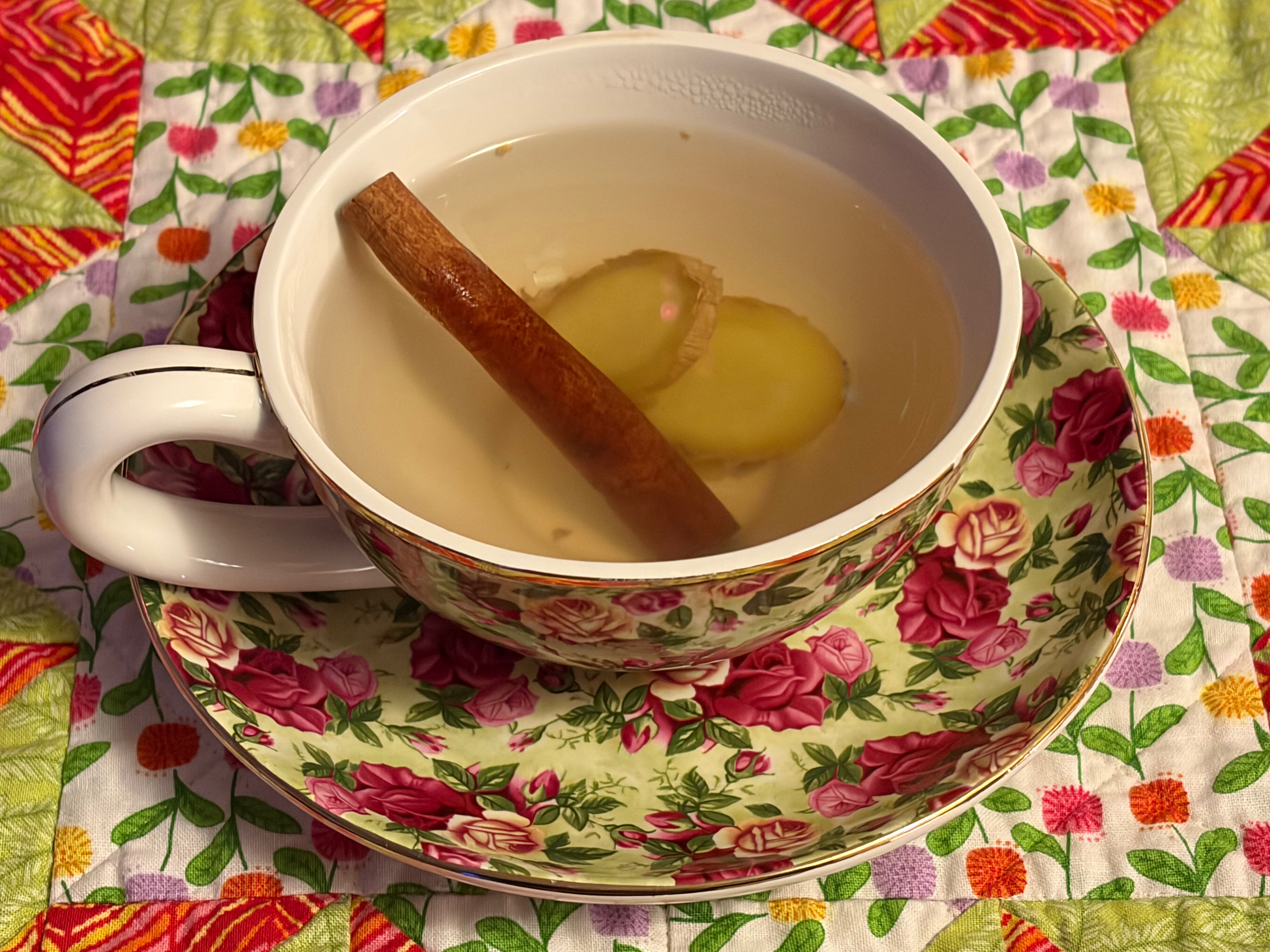
One Korean cold remedy is ginger tea. In this case, there are no actual tea leaves involved. Hot water is poured over slices of fresh or dried ginger and often a cinnamon stick. A little honey sweetens the mix and balances the spice. Some studies suggest that ginger is an anti-inflammatory, and honey is known for its anti-bacterial properties, so this traditional remedy might have scientific backing. It certainly won’t hurt. And Korean ginger tea is delicious.
You have to be careful with folk remedies. Many herbs and spices have some medicinal benefit, but some have side effects or interact with prescription medicines. Luckily, all the ingredients in ginger tea are widely consumed without incident, the cinnamon challenge notwithstanding. As an added bonus, it’s caffeine free, for the perfect evening drink.
To make it:
All you need is a few slices of fresh ginger and about a teaspoon of honey per cup. Add boiling water, stir with a cinnamon stick, and leave it in. The normal cassia cinnamon sticks found at the grocery store are good – there’s no need to hunt down the softer, more expensive “Ceylon cinnamon.” The subtler Ceylon cinnamon would be completely overwhelmed by the ginger. Once the tea is cool enough to drink, the flavors will be fully infused. Just give it another stir before enjoying. The ginger slices and cinnamon stick can be reused for a second cup of tea. The flavor won’t be as strong, but it is still distinctive and tasty.
Perhaps more than any other cooking fat, rendered chicken or other poultry fat is associated with a specific cuisine: Ashkenazi Jewish. It was a historical necessity. Butter couldn’t be used in a meat meal, due to the prohibition against combining meat and dairy. Certain types of beef fat aren’t kosher, which makes tallow a tricky proposition. As a pork product, lard was definitely out. Since olive trees can’t grow in Central and Eastern Europe, poultry fat was the only option before seed oils like canola and sunflower. Few other societies faced the same religious restrictions in the same kind of environment, so use of rendered poultry fat, or schmaltz, became stereotypically Ashkenazi. Jewish immigration brought it to America, especially New York.
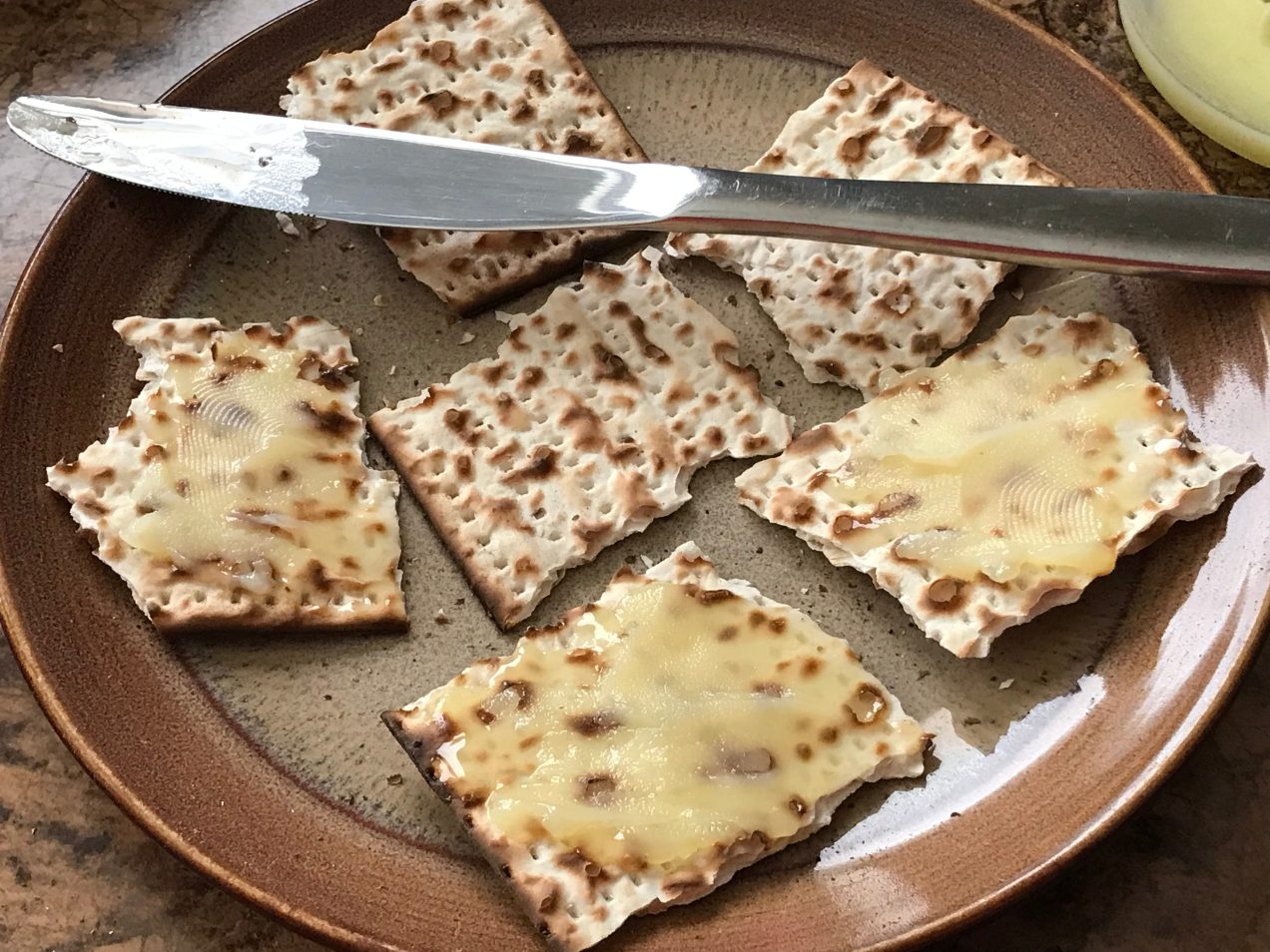
For generations, New Yorkers have used schmaltz in frying, knishes, and even as a spread on matzo crackers. Since the recipe on pages 464 – 465 of 1000 Foods to Eat Before You Die doesn’t make a huge quantity and I only had enough chicken skin for half, I decided to follow Mimi Sheraton’s suggestion to try it on piece of matzo with just a little salt. It wasn’t bad, tasting sort of like fried chicken cooked in slightly overused oil, and was even tasty after getting used to the flavor coming from a soft spread. The little chicken cracklings, called gribenes, were even better, tasting like pieces of fried chicken skin, which they what they are.
Advertisements
That said, schmaltz is a lot of work for a small reward. Not to mention, half of the cracklings stuck to the bottom of my pan, requiring multiple soakings and scrapings to remove. With the widespread availability of vegetable oils, shortening, and margarine, rendered chicken or other poultry fat is no longer necessary for kosher frying. And for anyone craving the fatty chicken flavor, many grocery stores sell ready-made fried chicken.
Schmaltz certainly has historical interest, and is currently enjoying a culinary revival, but I struggle to see the appeal. Having grown up eating non-kosher casseroles with ham and cheddar cheese, cheeseburgers, and pulled pork, the traditional “New York deli” specialties don’t have any nostalgia value. Would I scrape the solidified fat from a chilled pot of chicken or turkey soup to make gravy? Certainly – it would give the poultry flavor a nice boost. But I’m unlikely to make my own schmaltz again. It was worth trying once. In this case, once was enough.
Of all the world’s foods, haggis has one of the worst reputations. In the modern age, minced sheep’s organs, fat, and oatmeal, cooked together in the stomach, are a hard sell. It’s a dish born out of harder times. Traditionally, Scottish farmers often found it more productive to raise cattle and sheep than to grow grain, and oats tolerate the cool, damp climate better than wheat. Almost from the arrival of agriculture, residents of Scotland had everything they needed to make haggis.
Today, it’s Scotland’s national dish. Traditionally, it’s heavily peppered and served with neeps and tatties. Neeps are mashed “turnips,” which are actually rutabagas. Tatties are potatoes. Aside from the potatoes, this would all be recognizable to ancient peoples.
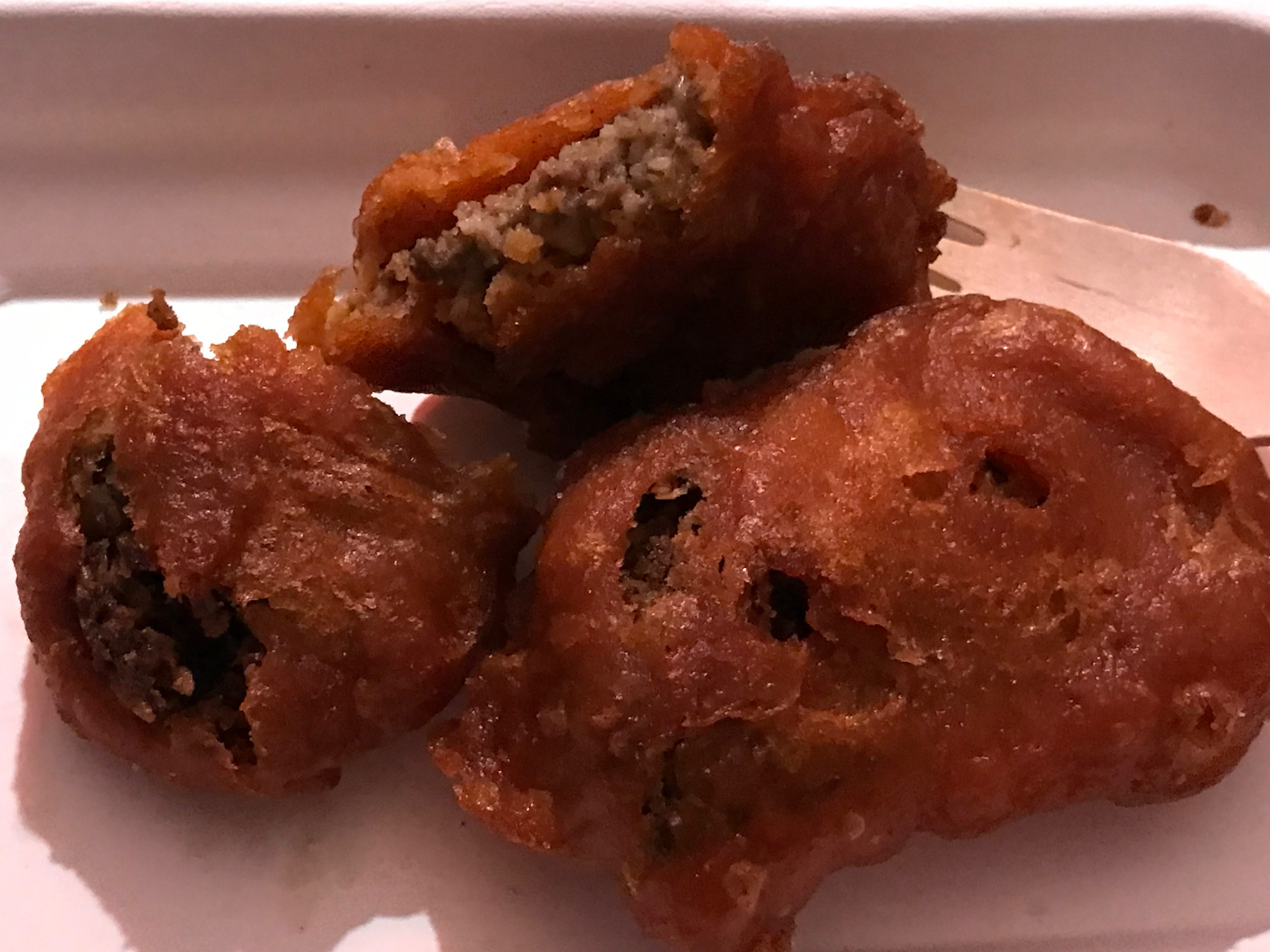
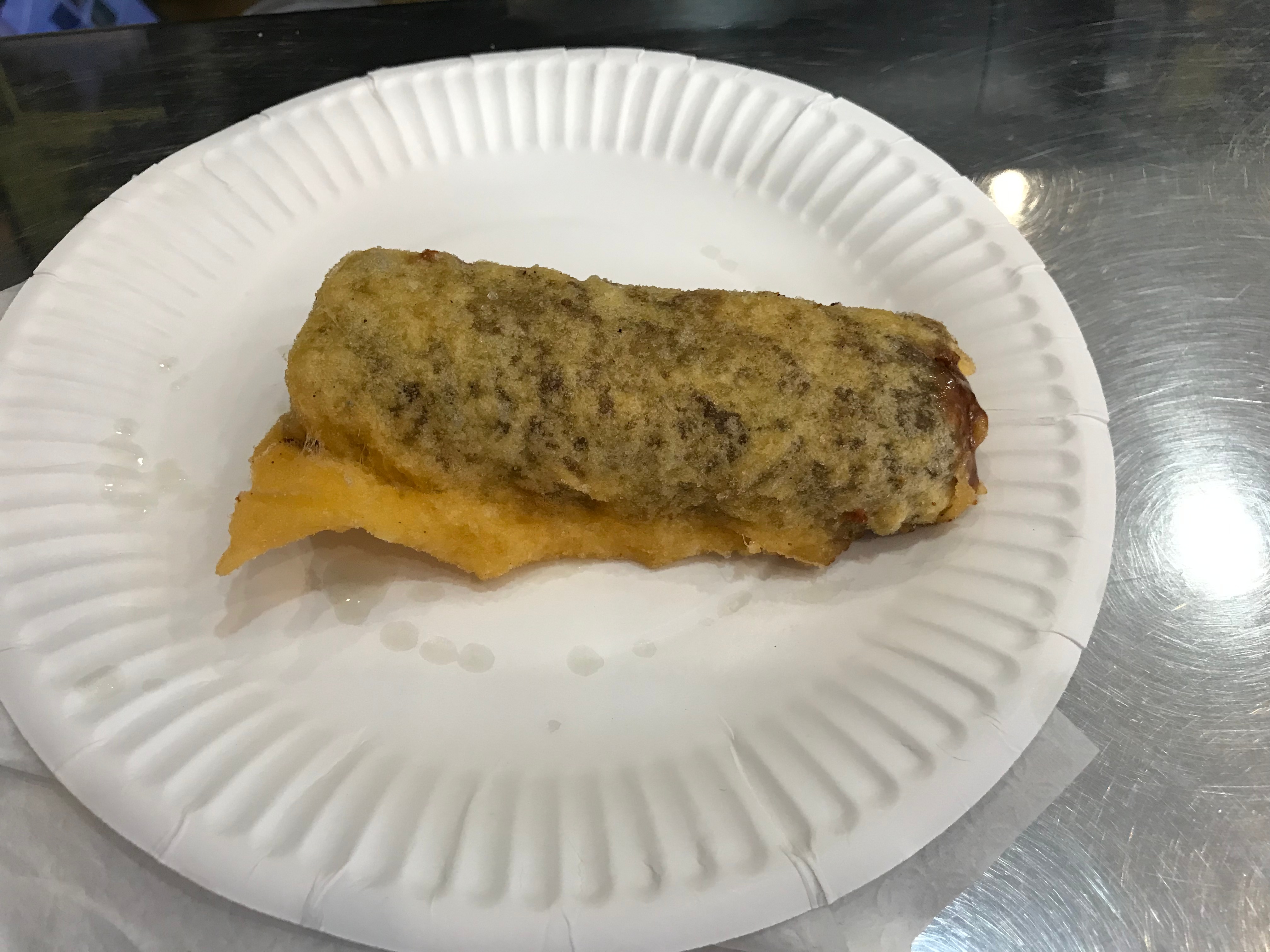
In Edinburgh, you can even get it battered, fried, and enhanced with Indian-style spices at fish and chips shops. One such shop was within easy walking distance from the hostel where our group was staying, so was the perfect stop for a quick lunch between morning and afternoon activities. In addition to fish and chips, which were delicious, they served chicken, vegetable, and haggis pakoras, which are a sort of Indian fritter. In this case, a traditional Scottish staple was cooked Indian-style, and served by Kurdish proprietors. Talk about international cuisine.
Advertisements
I was a little unsure about the haggis, but it was actually delicious. Since everything was ground up, it tasted like a peppery, crumbly sausage, enhanced by a spicy coating. There were no “weird” flavors at all.
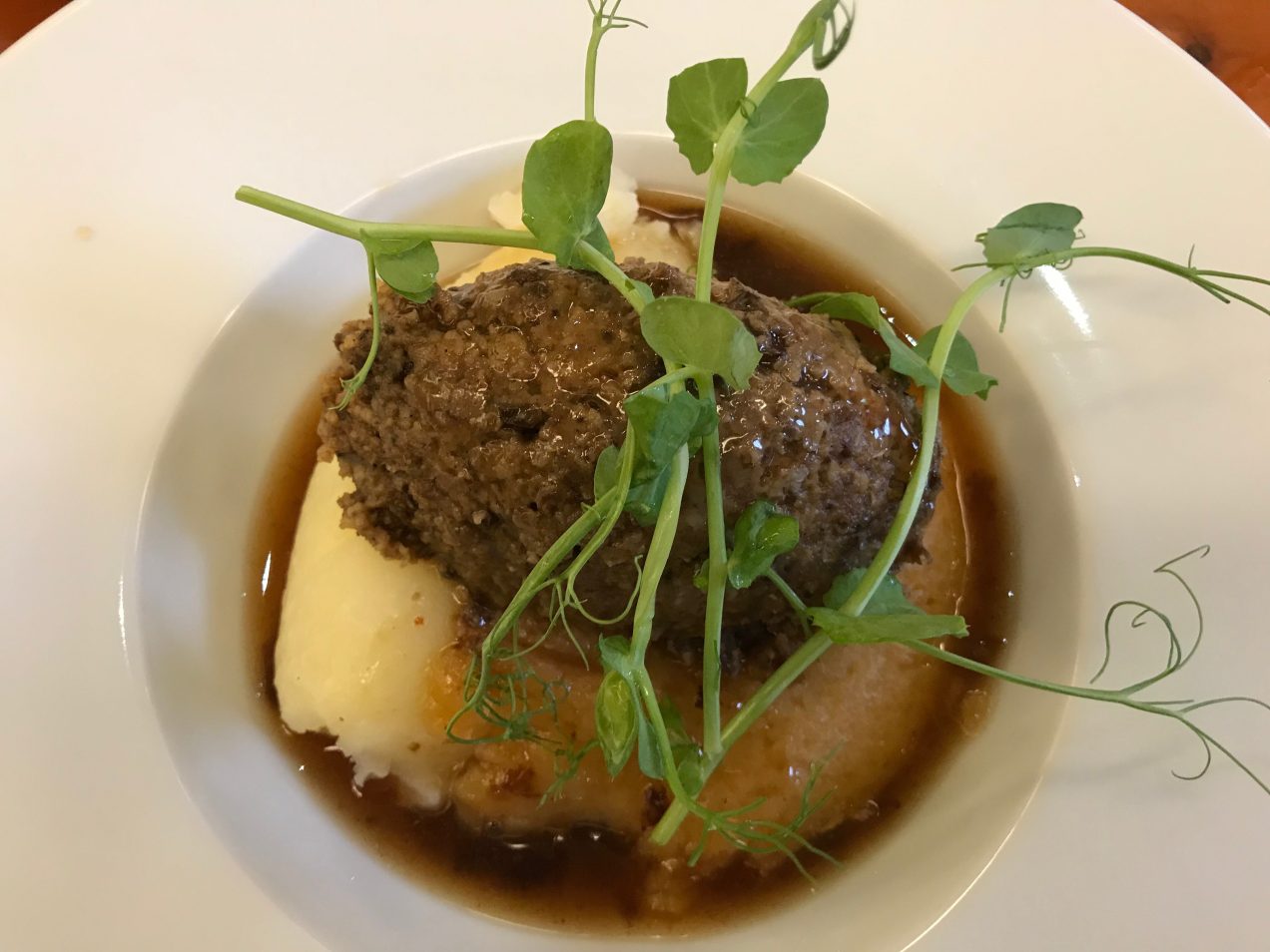
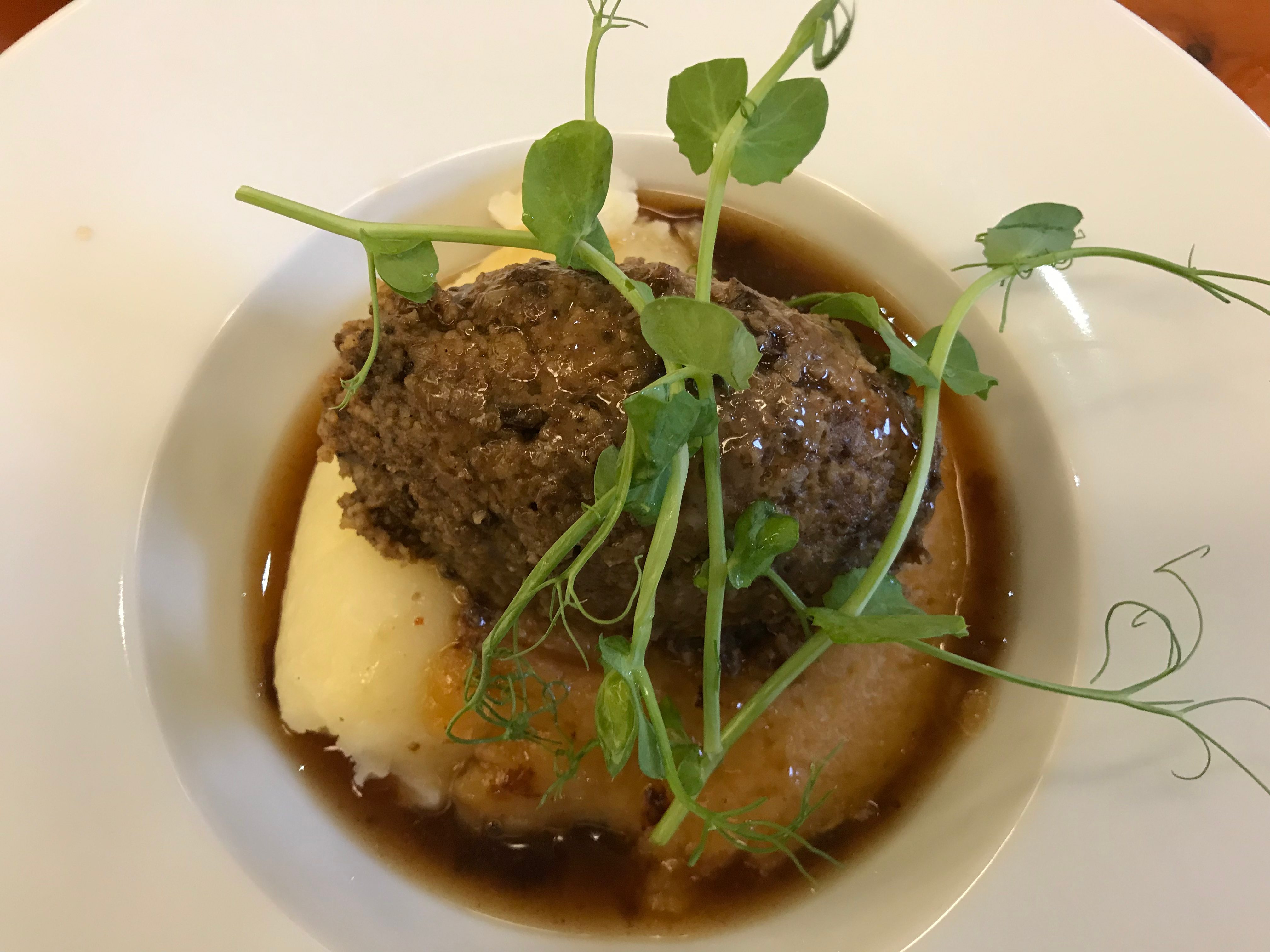
That evening, we went to a restaurant and tried a more refined version, served with neeps, tatties, and gravy. It was sort of like sticky meatloaf, probably from the ground oats in the mix, and rather pleasant. Overall, I still preferred the pakoras, but both were good. The trick with “variety meats” must be to grind them up, add a lot of spices, and possibly fry them. Almost anything tastes good that way.
LunchDinnerand Dessert
Apparently, Scottish cuisine has a reputation for deep-frying anything, including candy bars. Mars bars are sort of like American Milky Way bars, with a nougat and caramel center. When battered and fried, they become sticky, melty, and crispy, a delightful mix of textures. It’s clear why both haggis and deep-fried Mars bars are foods to eat at some point in your life. (For more information, reference 1,000 Foods to Eat Before You Die, by Mimi Sheraton, pages 38, 40 – 41.)
For many people, the days leading up to Christmas are cookie-baking season, and they finish eating them around New Year’s. Crunchy butter cookies are especially great. Not only are the delicious, but they can be kept longer than most cookies without getting stale. This enables a cook with sufficient willpower to make a variety over the course of a few weeks to a month. When I worked at a bakery for a year right after graduating college, we made and assembled the boxes of assorted butter cookies before Thanksgiving, and they held up fine. This year, I decided to make my own selection to give as gifts.
Marzipan is another popular Christmas treat, especially in Europe. At its simplest, it’s just a mixture of blanched almonds, sugar, and enough water to form a paste. Many homemade versions add egg white as a binder. Historically, a few bitter almonds were used to add the distinctive aromatic almond flavor, since the more common sweet almonds have a pleasant but very mild taste, but it was hard to get the ratio right. Bitter almonds contain a small amount of cyanide, dangerous in the hands of an inept or unscrupulous cook, so almond extract is typically used today. Rosewater is a traditional flavoring, though perhaps not as common today.
Advertisements
Almonds, sugar, and rosewater were elite, prestigious ingredients in the Middle Ages, especially in Northern Europe where there were more middlemen between the source and final destination. Exactly when and where marzipan came from is unclear, though the Middle East is a likely candidate. Sweet dishes with nuts and rosewater can be found from Morocco to India. Through a combination of trade and warfare, Europeans discovered and adapted these specialties.
In Sicily, shops sell stunningly realistic-looking marzipan fruit. English Christmas cake and Swedish princess torte are covered with a layer of rolled marzipan. All over Europe, marzipan is covered in chocolate, stuffed into festive breads and cakes, and made into figurines, including the pigs that are supposedly good luck for the New Year. Germans seem to be particularly fond of it, and specialize in two main kinds, both originating in trading ports on the Baltic Sea. Lubeck-style is soft and typically lower in sugar, while Konigsberg-style is browned under a broiler for a caramelized flavor. (For more information, see 1,000 Foods to Eat Before You Die, pg. 304)
Advertisements
Homemade marzipan is easier to make than you might expect, and has a much better flavor than most store-bought varieties. The only somewhat tricky part is blanching the almonds, but it’s more time-consuming than difficult. Just put the almonds in a bowl, cover with boiling water and stir, let stand a minute, pour off most of the boiling water, and add cool water until you reach a comfortable working temperature. The skins slip right off when squeezed, especially if the almonds are kept in the warm water until ready. Individually squeezing each almond takes a while, but it’s a satisfying process, especially with something to listen to. If you can rope in your spouse, child, guest, or any combination, it will go even faster.
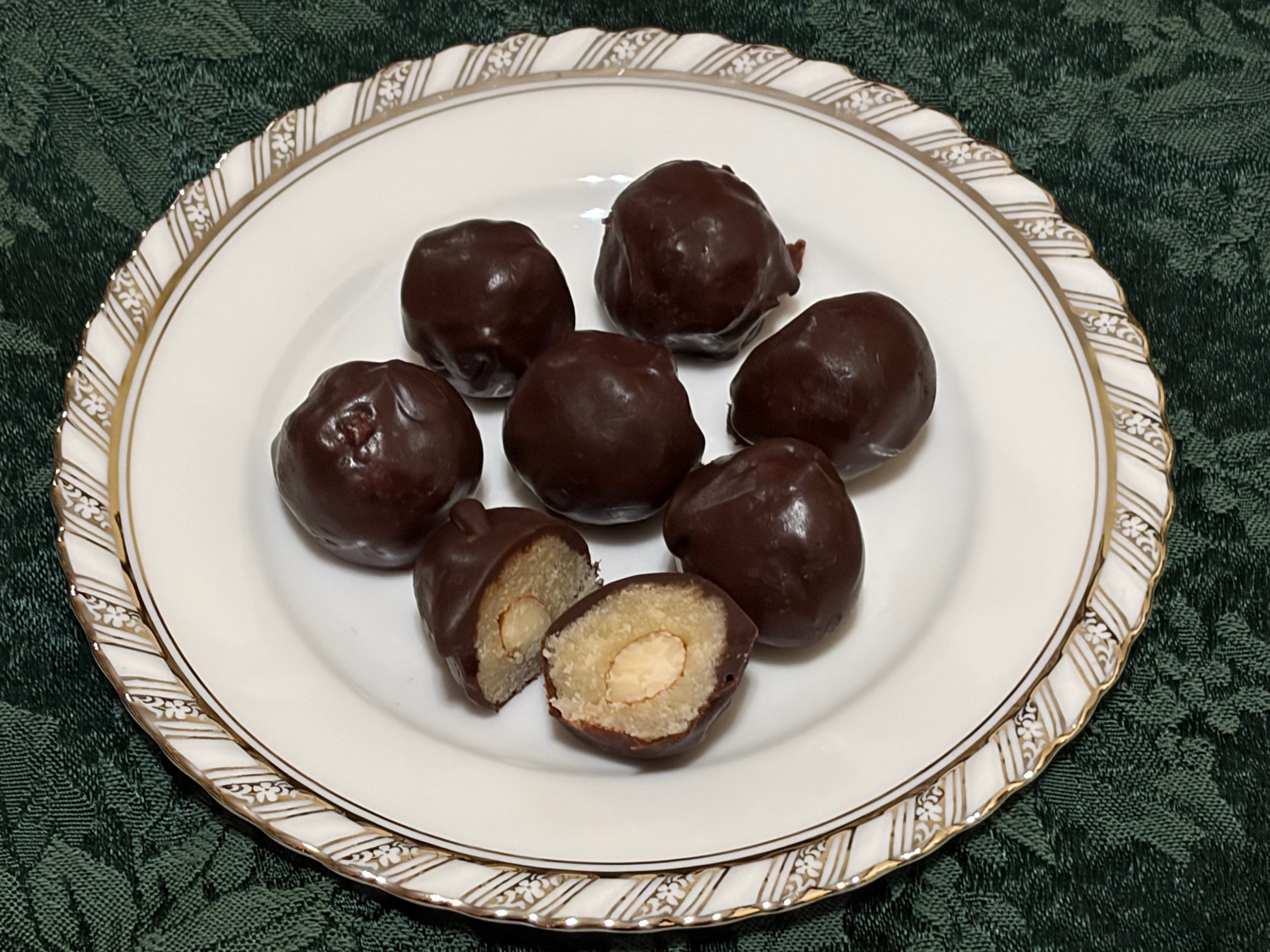
Lubeck-Style, molded around an almond, covered in chocolate
There’s one thing to note before beginning. Rosewater is a common flavoring in marzipan and goes very well with almond, but be careful with it. Depending on the brand and how fresh it is, rosewater varies in strength. Generally, brands with an alcohol base are stronger and keep their flavor better after being opened than those distilled with just water, but this is far from an absolute rule. Add it slowly, a teaspoon at a time, tasting as you go, until desired flavor is reached. You want a light floral taste, not edible perfume.
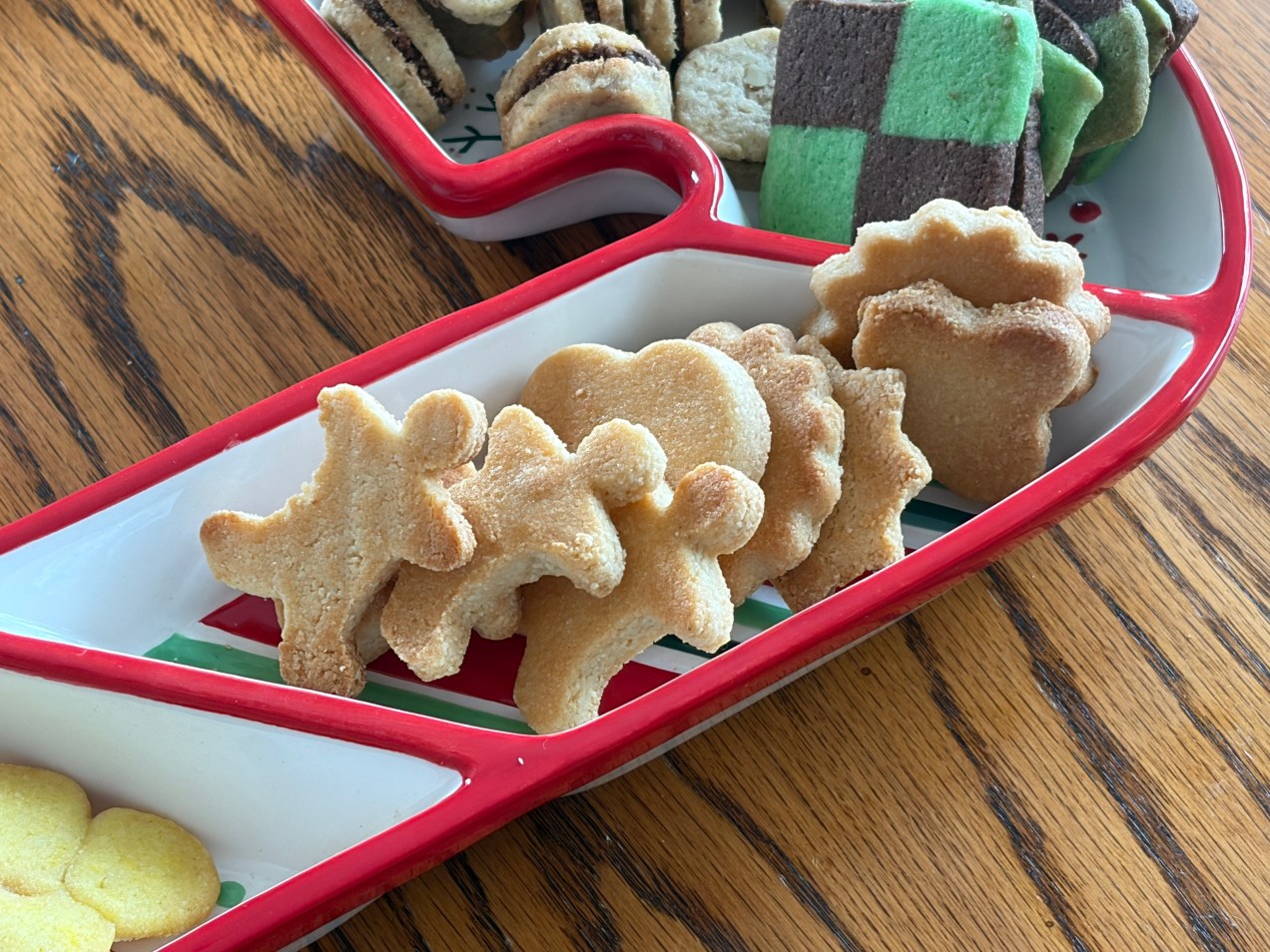
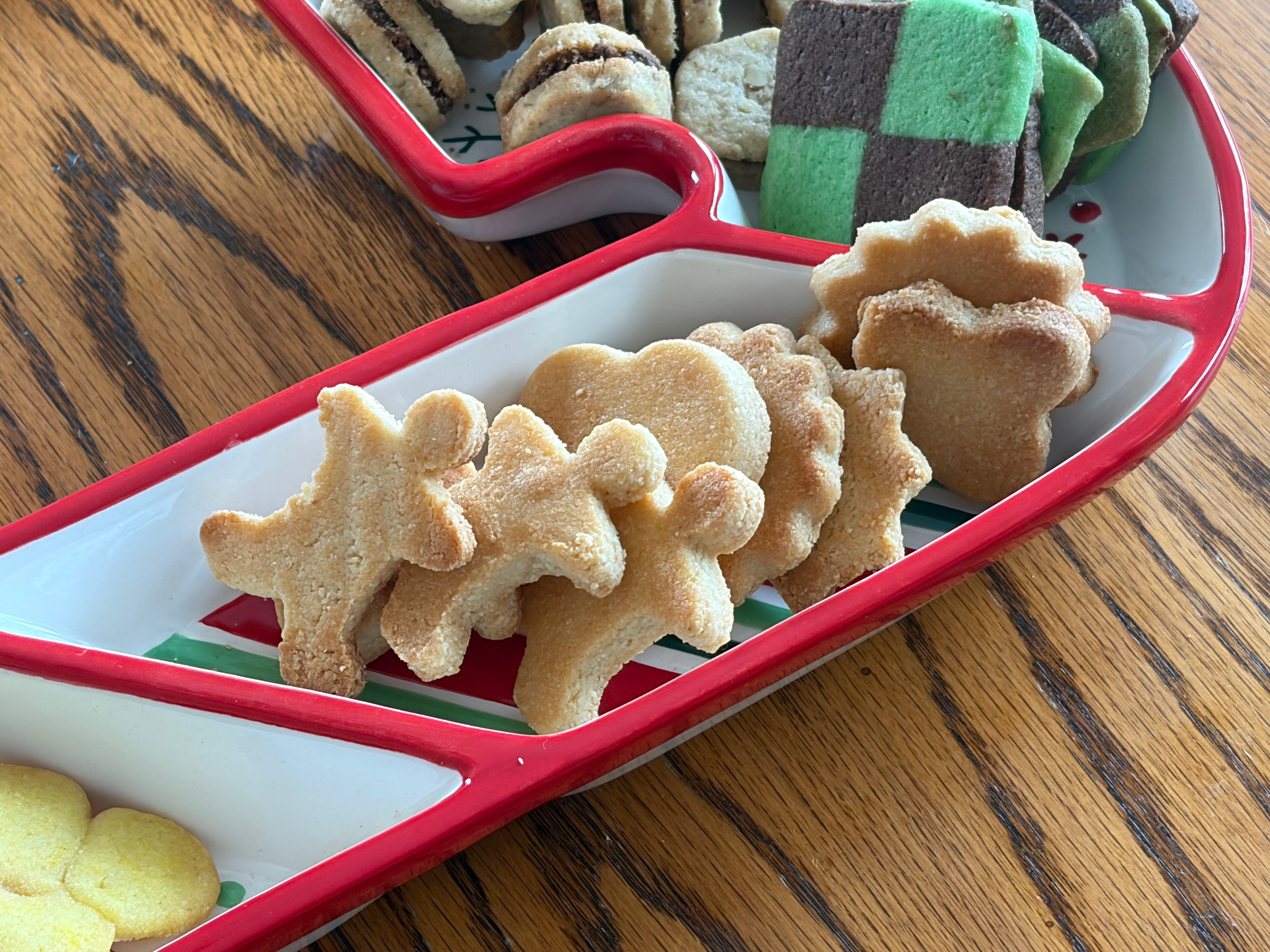
Konigsberg-Style cutouts, with assorted cookies
Ingredients:
1 pound almonds, blanched
1 cup powdered sugar
1 – 2 teaspoons almond extract (use more if not also using rosewater)
1 teaspoon or more rosewater
2 – 4 tablespoons water
Sugar for rolling out dough
Parchment paper (essential for getting baked marzipan off cookie sheet)
Directions:
Coarsely grind almonds in a food processor, add sugar and flavorings, and grind again to reach a sandy texture.
Add 2 tablespoons water, process again, and taste for rosewater. Add more if you think it needs it.
Pinch some of the mix together to see if it comes together as a sticky dough. If not, add more water, a tablespoon at a time, until it does. The texture won’t be as fine as store-bought marzipan.
For Lubeck-style marzipan, the mixture is ready to form into shapes, coat in chocolate, mold around whole almonds, and so on.
For Konigsberg-style marzipan, lightly sugar a flat surface, pat the marzipan into a disk, sugar the top, roll out about a quarter-inch thick, and cut out shapes with cookie cutters. Since the dough has no flour, it can be rerolled without toughening.
Bake on parchment paper-lined baking sheets at 350 for 12 – 15 minutes, just until set.
To brown the marzipan, place each cookie sheet under the broiler for two minutes, with the oven door cracked (which keeps the broiler from overheating). Then, watching constantly, broil for another minute or two, until the tops are golden brown.
As an added bonus, eggless marzipan such as this is gluten-free, dairy-free, vegan, pareve, and Passover-friendly. Assuming the parchment paper is clean, that is, and not previously used for several batches of butter-and-flour-based cookies.
Germanic cultures take Christmas cheer seriously. In Germany, Austria, and occasionally in neighboring countries, towns go so far as to have specialized Christmas markets, called Christkindlmarkt, which have been going on for centuries. At these frequently month-long festivals, you can buy (or just admire) all manner of traditional handicrafts. And of course, there are plenty of snacks. Selections often include sausages, marzipan, chocolates, and German-style mulled wine called glühwein. A similar Scandinavian mulled wine is called glogg.
Due to large-scale German immigration in the 19th Century, the tradition spread to the US, particularly Wisconsin. Many schools have holiday craft fairs, usually to raise money for various clubs and extracurricular activities, which bear a strong resemblance to Germanic Christmas markets. In my hometown, the two or three-dollar admission gets you access to dozens of local vendors, all set up in the high school commons and gym. Knitted hats, scarves, and mittens, painted wood and glass ornaments, creative jewelry, local honey and maple syrup, homemade jam, artisanal soaps and candles, bake sale treats, candied nuts, kettle corn, and all manner of decorations are available for purchase.
Advertisements
And don’t forget the lotion and lip balm. They’re great gifts because 1) they get used up and don’t add to “clutter” and 2) everyone can use them. When the heat gets turned on, everyone’s skin dries right out, especially the hands and lips. Almost every craft fair has a vendor selling these things, and they always do good business. Just make sure not to put scented soap and lotion in the same bag as your food, or the aroma will infuse. Eucalyptus-scented brownies aren’t for everyone.
For a more “authentic” European Christmas market experience, there are several options. I spent an enjoyable afternoon at one a few weeks ago and found some great treasures. It resembled a craft fair in some ways, but with more unusual and high-end merchandise. One memorable stand had ostentatious fur hats, made of fox, coyote, wolf, racoon, skunk, and rabbit. They were pretty flamboyant and definitely out of my budget, but fun to look at. Other stands had unique maps, Baltic amber, alpaca wool socks, scarves, and hats, hand-painted wooden nesting dolls, German beer steins, and of course, all sorts of food.
Advertisements
Just like in Germany and Austria, the market in Wisconsin served up sausages, schnitzel sandwiches, little spätzle dumplings, red cabbage, and amazing potato pancakes. I definitely need to master making them at home. Desserts included apple strudel and crepe-like German pancakes, homemade cookies and bars, tins of Scandinavian-style gingersnaps and cardamom cookies, and all sorts of European chocolates. To wash everything down, there was a variety of beer and wine, including, naturally, hot glühwein.
After purchasing a few “winter survival” lotion/lip balm kits, I loaded up on edible treasures. Between the toffee, cardamom cookies, and fabulous 2-year aged cheddar, a trip or two to the gym might be in order. Really, that’s a good idea anyway. The more time spent watching documentaries while on the elliptical, the more Christmas treats you can enjoy.
High cuisine, not a simple attempt to use things up before going out of town for Thanksgiving
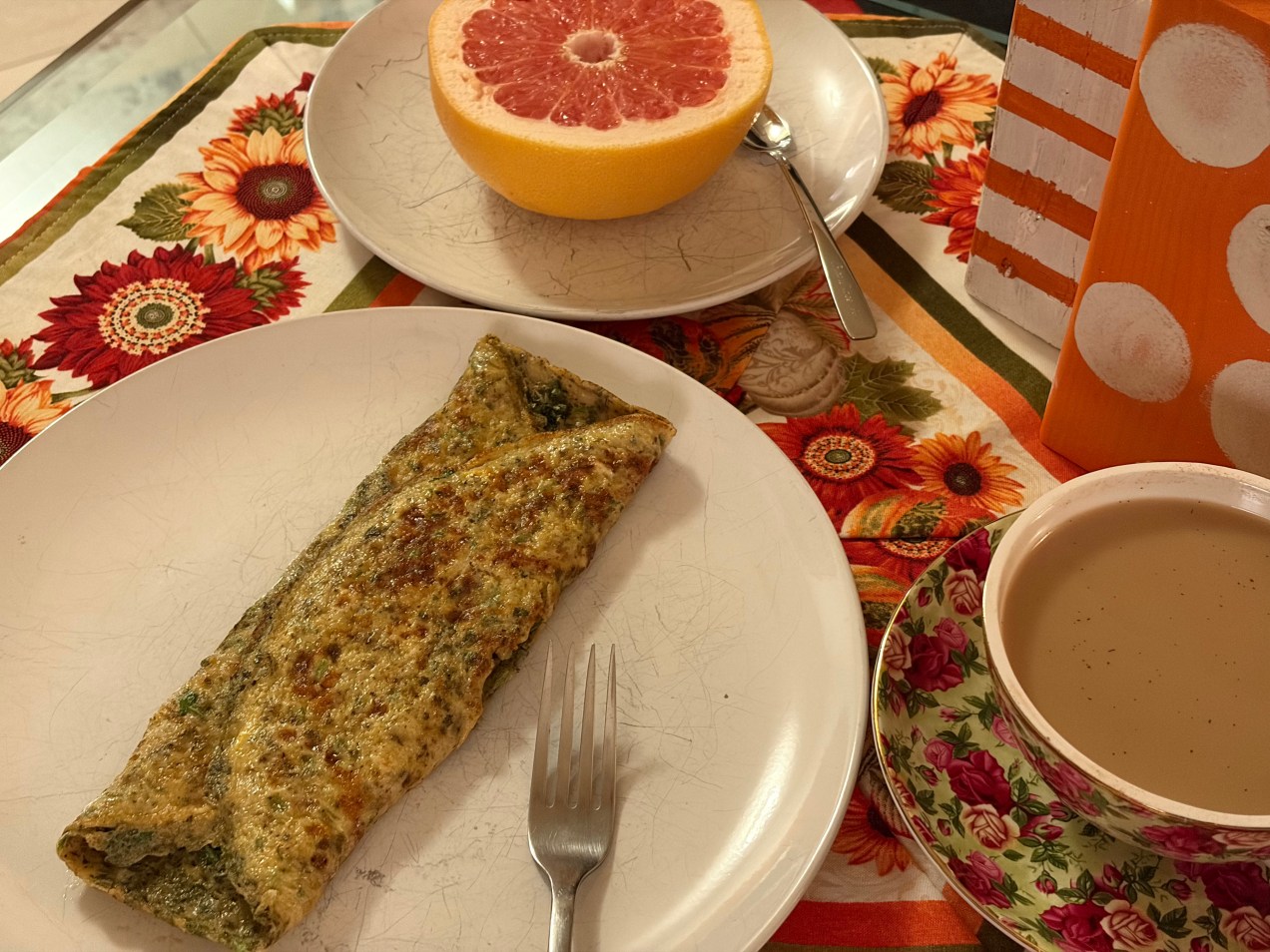
Every fall, I bring my potted herb plants in from outside to enjoy using them for a bit longer. It works well enough for a while, but eventually they start to suffer from the limited sunshine. Since most of them are annuals, the time comes to use up what I can before starting again when summer returns. Everything except the rosemary is either done or fading. To use up as much as possible, I made a French classic, omelette aux fines herbes.
Fines herbes is a mix of parsley, chives, tarragon, and chervil, common in French cuisine. The first three are widely available in the US, but chervil might require a specialty spice store or the internet. Supposedly it tastes like a milder parsley with a bit of a licorice undertone, but I couldn’t taste much difference. To compensate for all the herbs except parsley being dried, I also added some minced scallions to brighten things up.
For many French chefs, making a perfect omelet is one of the primary tests of skill. After following the basic directions on pages 107 – 108 of 1000 Foods to Eat Before You Die, mine turned out pretty well. The flavor is distinctly understated, but the freshness from the herbs was nice as fall turns to winter. The slight licorice flavor from either the tarragon or chervil is definitely there. Perhaps it just needs a little heat to release its flavor. Chefs disagree on how much browning, if any, is ideal. Personally, I like more browning, both for flavor and the fact that it helps the egg unstick itself from the pan.
Advertisements
For each omelet, I used three eggs, beaten together with salt, pepper, and a tablespoon of milk. The herb mix contained three large parsley sprigs, minced, one minced scallion, and a teaspoon each dried chives, tarragon, and chervil. Half of the herb mixture gets added into the eggs before cooking. After melting about a tablespoon butter in a skillet over medium heat, the egg mixture is added to cook.
To make sure that none of the eggs end up runny, I like to tilt the pan and lift up the edges of the cooked portion, letting the uncooked egg flow underneath. After this, sprinkle the remaining herb mixture over the surface. When the top is almost set, fold the right and left thirds of the omelet over onto the center. If this doesn’t work and you end up with a half-moon shaped omelet, don’t worry about it, it will still taste good. Let the omelet cook for another minute, covering the pan if desired to help it set, then slide it onto a plate.
To make this simple mix of eggs and herbs sound extra fancy, serve with pommes de terre frits, compote de pomme, fruits frais, café au lait, or any combination thereof. In English, these are fried potatoes, applesauce, fresh fruit, and coffee with milk. To make anything sound fancy, say it in French, even if you have to use a translation app.