Perhaps more than any other cooking fat, rendered chicken or other poultry fat is associated with a specific cuisine: Ashkenazi Jewish. It was a historical necessity. Butter couldn’t be used in a meat meal, due to the prohibition against combining meat and dairy. Certain types of beef fat aren’t kosher, which makes tallow a tricky proposition. As a pork product, lard was definitely out. Since olive trees can’t grow in Central and Eastern Europe, poultry fat was the only option before seed oils like canola and sunflower. Few other societies faced the same religious restrictions in the same kind of environment, so use of rendered poultry fat, or schmaltz, became stereotypically Ashkenazi. Jewish immigration brought it to America, especially New York.
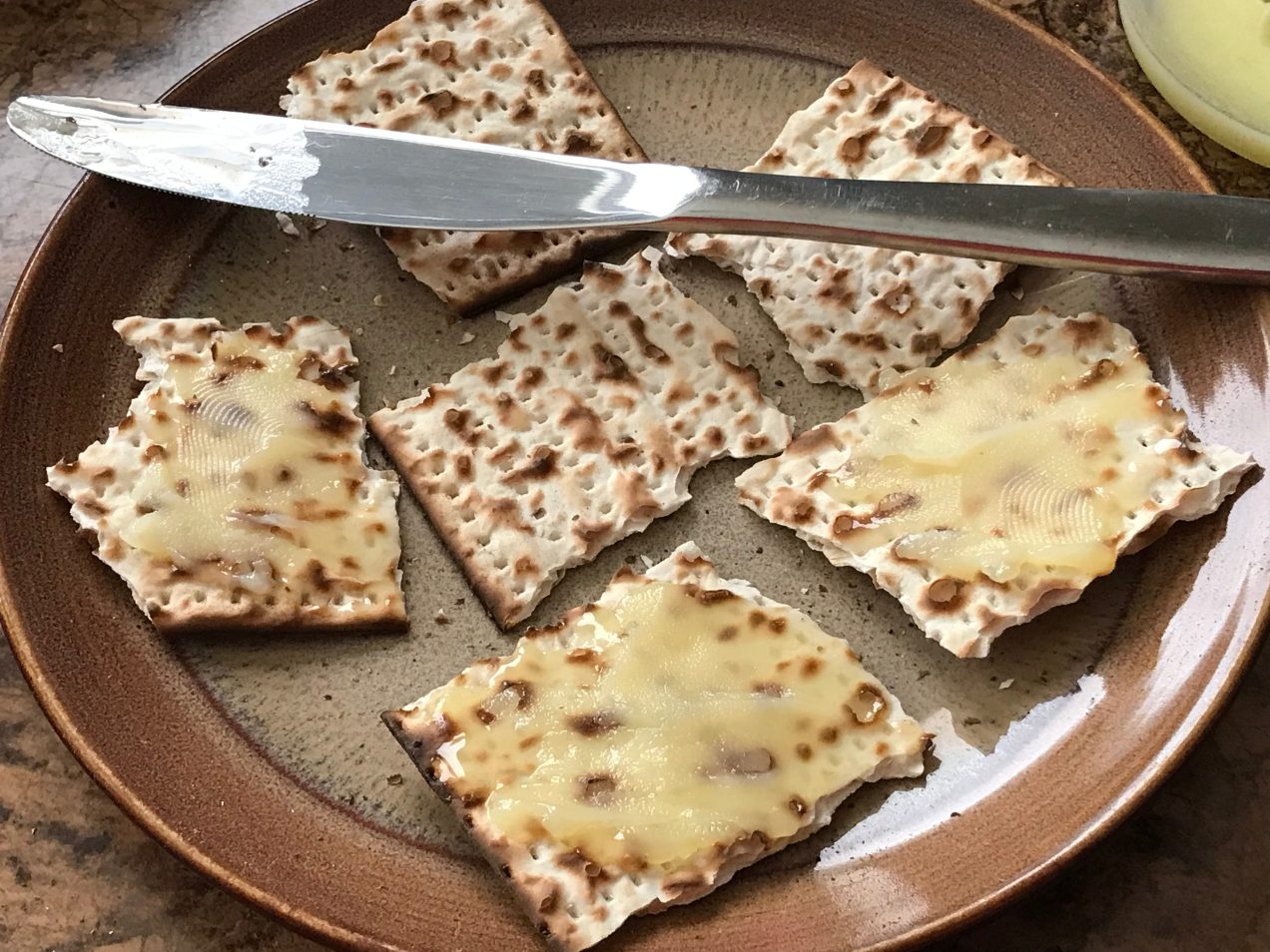
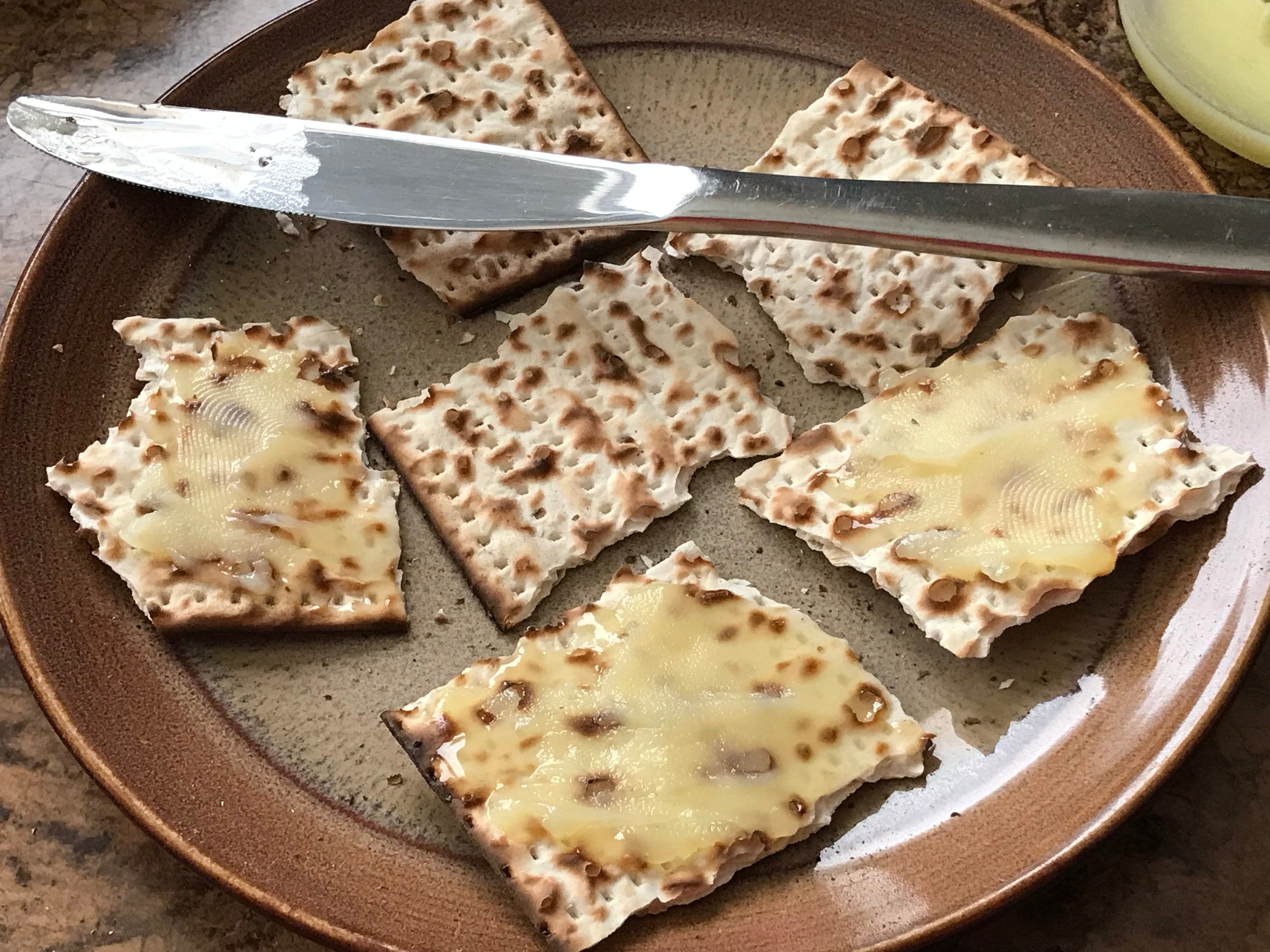
For generations, New Yorkers have used schmaltz in frying, knishes, and even as a spread on matzo crackers. Since the recipe on pages 464 – 465 of 1000 Foods to Eat Before You Die doesn’t make a huge quantity and I only had enough chicken skin for half, I decided to follow Mimi Sheraton’s suggestion to try it on piece of matzo with just a little salt. It wasn’t bad, tasting sort of like fried chicken cooked in slightly overused oil, and was even tasty after getting used to the flavor coming from a soft spread. The little chicken cracklings, called gribenes, were even better, tasting like pieces of fried chicken skin, which they what they are.
Advertisements
That said, schmaltz is a lot of work for a small reward. Not to mention, half of the cracklings stuck to the bottom of my pan, requiring multiple soakings and scrapings to remove. With the widespread availability of vegetable oils, shortening, and margarine, rendered chicken or other poultry fat is no longer necessary for kosher frying. And for anyone craving the fatty chicken flavor, many grocery stores sell ready-made fried chicken.
Schmaltz certainly has historical interest, and is currently enjoying a culinary revival, but I struggle to see the appeal. Having grown up eating non-kosher casseroles with ham and cheddar cheese, cheeseburgers, and pulled pork, the traditional “New York deli” specialties don’t have any nostalgia value. Would I scrape the solidified fat from a chilled pot of chicken or turkey soup to make gravy? Certainly – it would give the poultry flavor a nice boost. But I’m unlikely to make my own schmaltz again. It was worth trying once. In this case, once was enough.
Of all the world’s foods, haggis has one of the worst reputations. In the modern age, minced sheep’s organs, fat, and oatmeal, cooked together in the stomach, are a hard sell. It’s a dish born out of harder times. Traditionally, Scottish farmers often found it more productive to raise cattle and sheep than to grow grain, and oats tolerate the cool, damp climate better than wheat. Almost from the arrival of agriculture, residents of Scotland had everything they needed to make haggis.
Today, it’s Scotland’s national dish. Traditionally, it’s heavily peppered and served with neeps and tatties. Neeps are mashed “turnips,” which are actually rutabagas. Tatties are potatoes. Aside from the potatoes, this would all be recognizable to ancient peoples.
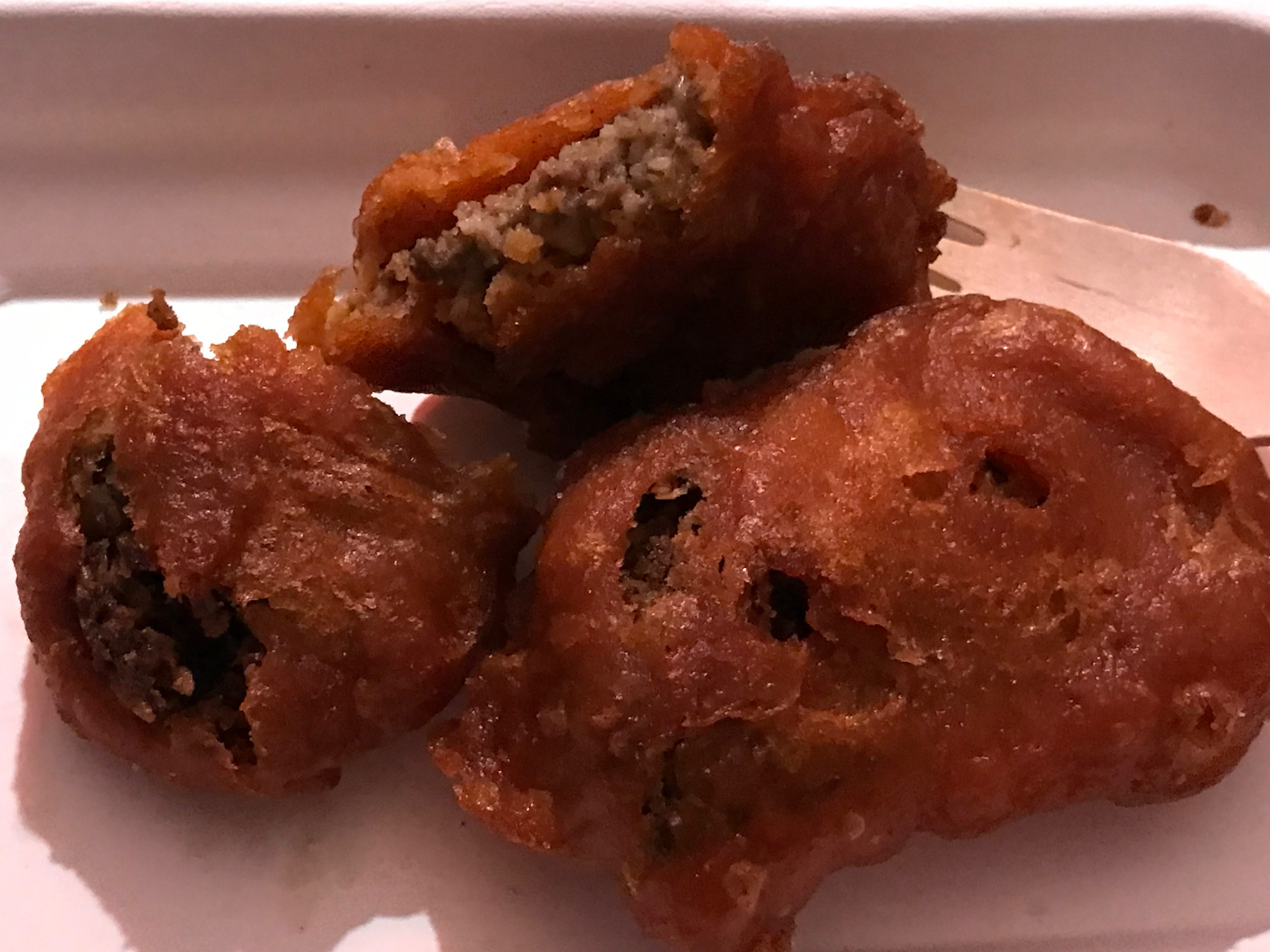
In Edinburgh, you can even get it battered, fried, and enhanced with Indian-style spices at fish and chips shops. One such shop was within easy walking distance from the hostel where our group was staying, so was the perfect stop for a quick lunch between morning and afternoon activities. In addition to fish and chips, which were delicious, they served chicken, vegetable, and haggis pakoras, which are a sort of Indian fritter. In this case, a traditional Scottish staple was cooked Indian-style, and served by Kurdish proprietors. Talk about international cuisine.
Advertisements
I was a little unsure about the haggis, but it was actually delicious. Since everything was ground up, it tasted like a peppery, crumbly sausage, enhanced by a spicy coating. There were no “weird” flavors at all.
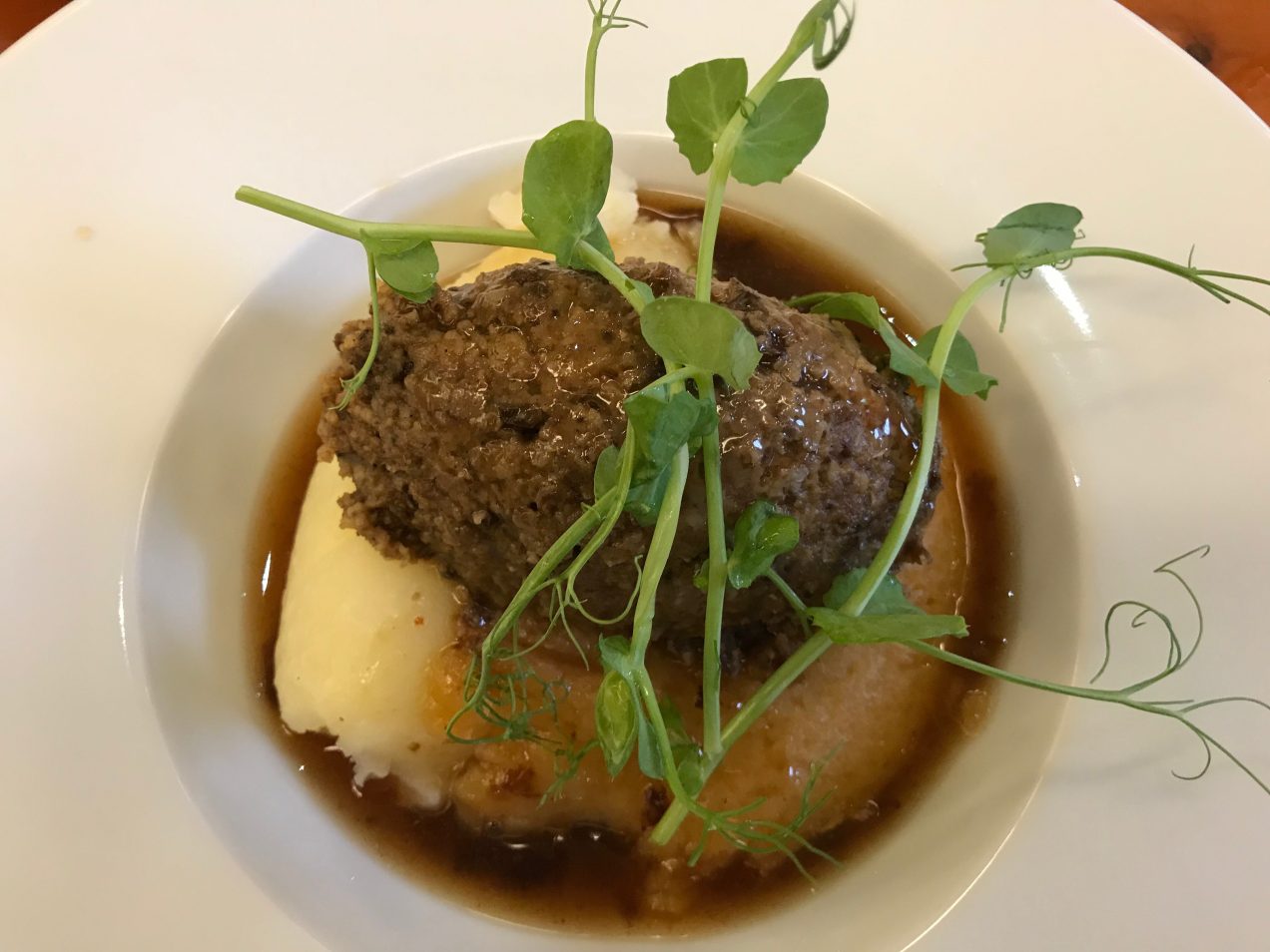
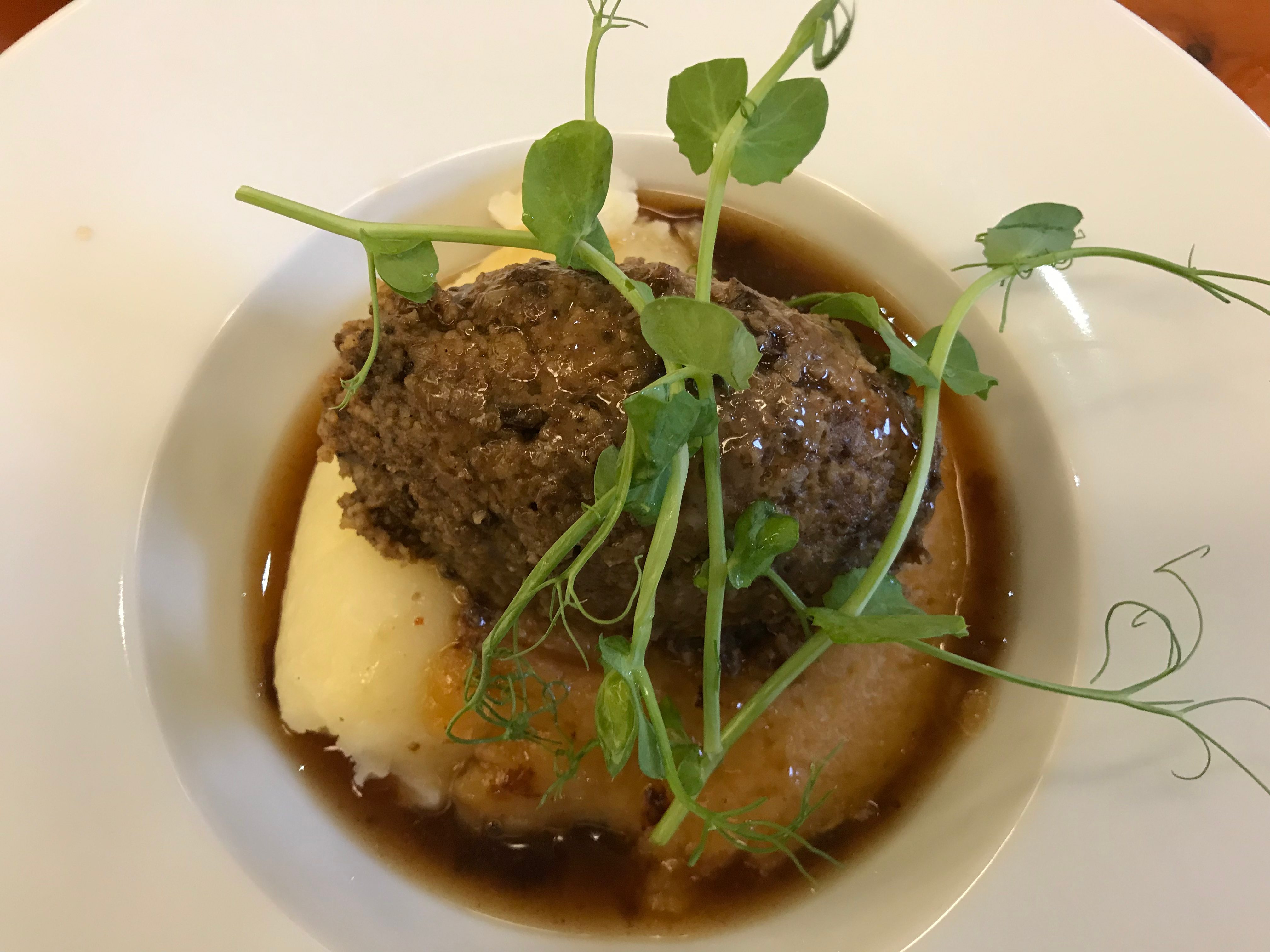
That evening, we went to a restaurant and tried a more refined version, served with neeps, tatties, and gravy. It was sort of like sticky meatloaf, probably from the ground oats in the mix, and rather pleasant. Overall, I still preferred the pakoras, but both were good. The trick with “variety meats” must be to grind them up, add a lot of spices, and possibly fry them. Almost anything tastes good that way.
LunchDinnerand Dessert
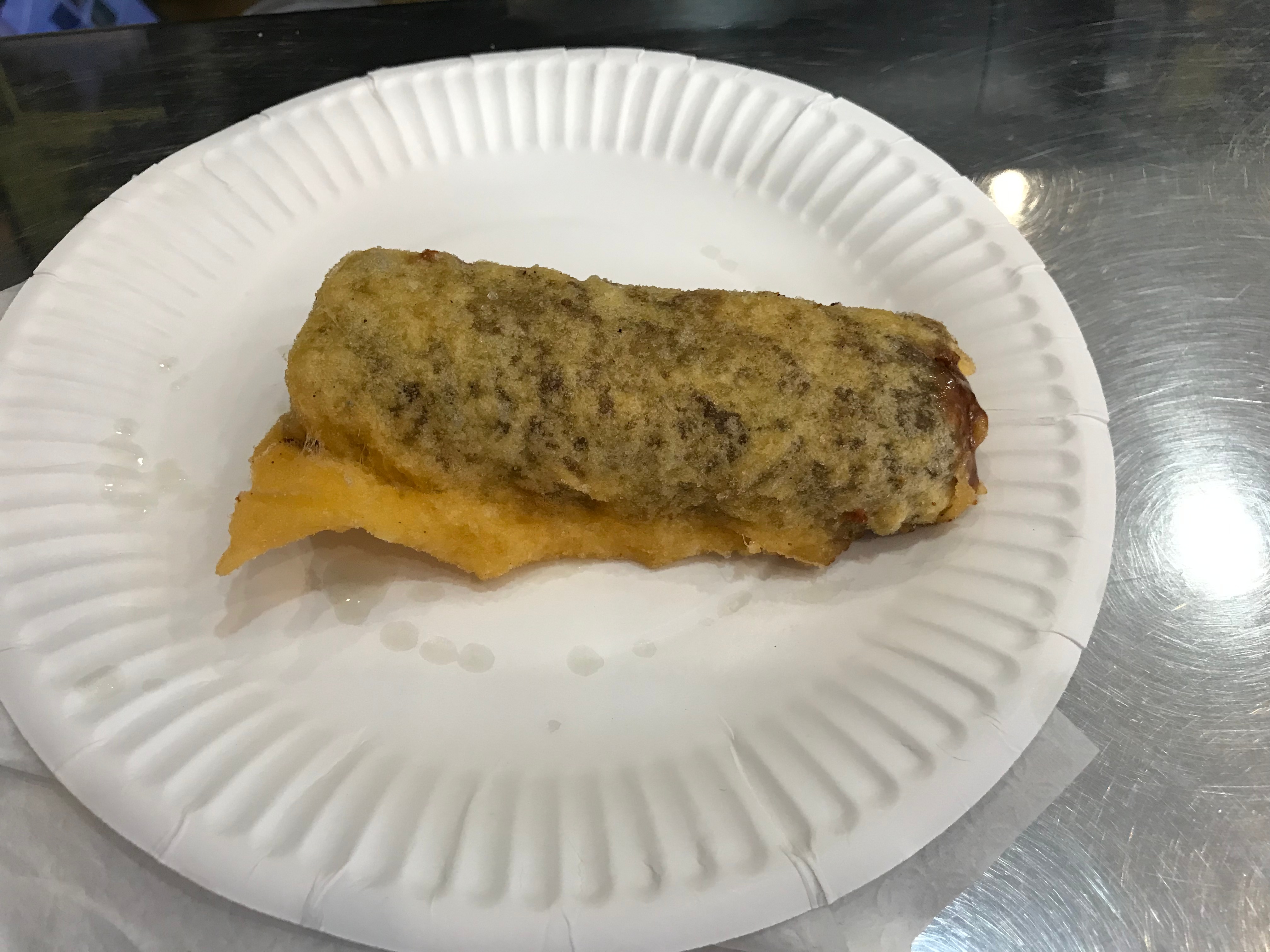
Apparently, Scottish cuisine has a reputation for deep-frying anything, including candy bars. Mars bars are sort of like American Milky Way bars, with a nougat and caramel center. When battered and fried, they become sticky, melty, and crispy, a delightful mix of textures. It’s clear why both haggis and deep-fried Mars bars are foods to eat at some point in your life. (For more information, reference 1,000 Foods to Eat Before You Die, by Mimi Sheraton, pages 38, 40 – 41.)
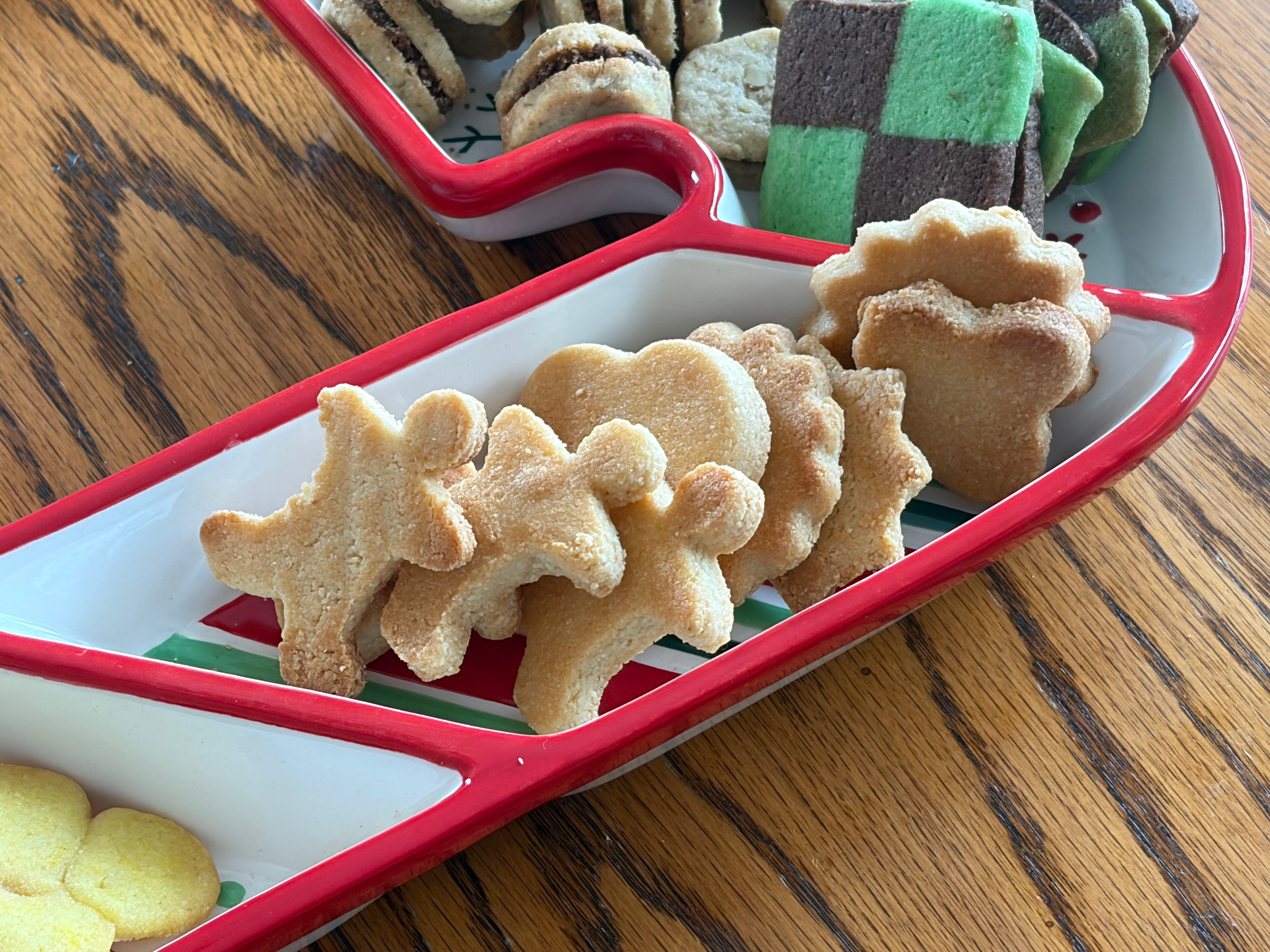
For many people, the days leading up to Christmas are cookie-baking season, and they finish eating them around New Year’s. Crunchy butter cookies are especially great. Not only are the delicious, but they can be kept longer than most cookies without getting stale. This enables a cook with sufficient willpower to make a variety over the course of a few weeks to a month. When I worked at a bakery for a year right after graduating college, we made and assembled the boxes of assorted butter cookies before Thanksgiving, and they held up fine. This year, I decided to make my own selection to give as gifts.
Marzipan is another popular Christmas treat, especially in Europe. At its simplest, it’s just a mixture of blanched almonds, sugar, and enough water to form a paste. Many homemade versions add egg white as a binder. Historically, a few bitter almonds were used to add the distinctive aromatic almond flavor, since the more common sweet almonds have a pleasant but very mild taste, but it was hard to get the ratio right. Bitter almonds contain a small amount of cyanide, dangerous in the hands of an inept or unscrupulous cook, so almond extract is typically used today. Rosewater is a traditional flavoring, though perhaps not as common today.
Advertisements
Almonds, sugar, and rosewater were elite, prestigious ingredients in the Middle Ages, especially in Northern Europe where there were more middlemen between the source and final destination. Exactly when and where marzipan came from is unclear, though the Middle East is a likely candidate. Sweet dishes with nuts and rosewater can be found from Morocco to India. Through a combination of trade and warfare, Europeans discovered and adapted these specialties.
In Sicily, shops sell stunningly realistic-looking marzipan fruit. English Christmas cake and Swedish princess torte are covered with a layer of rolled marzipan. All over Europe, marzipan is covered in chocolate, stuffed into festive breads and cakes, and made into figurines, including the pigs that are supposedly good luck for the New Year. Germans seem to be particularly fond of it, and specialize in two main kinds, both originating in trading ports on the Baltic Sea. Lubeck-style is soft and typically lower in sugar, while Konigsberg-style is browned under a broiler for a caramelized flavor. (For more information, see 1,000 Foods to Eat Before You Die, pg. 304)
Advertisements
Homemade marzipan is easier to make than you might expect, and has a much better flavor than most store-bought varieties. The only somewhat tricky part is blanching the almonds, but it’s more time-consuming than difficult. Just put the almonds in a bowl, cover with boiling water and stir, let stand a minute, pour off most of the boiling water, and add cool water until you reach a comfortable working temperature. The skins slip right off when squeezed, especially if the almonds are kept in the warm water until ready. Individually squeezing each almond takes a while, but it’s a satisfying process, especially with something to listen to. If you can rope in your spouse, child, guest, or any combination, it will go even faster.
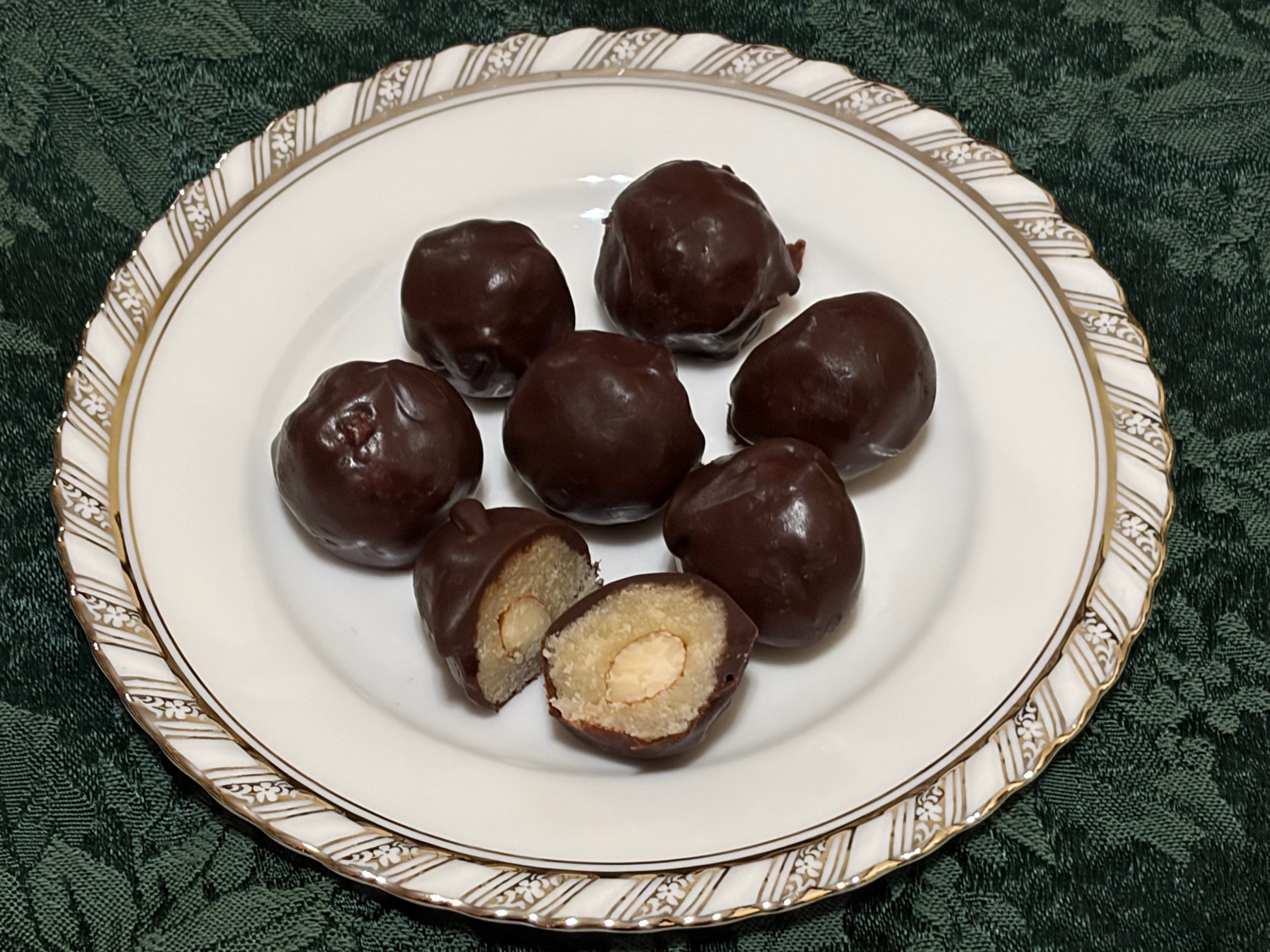
Lubeck-Style, molded around an almond, covered in chocolate
There’s one thing to note before beginning. Rosewater is a common flavoring in marzipan and goes very well with almond, but be careful with it. Depending on the brand and how fresh it is, rosewater varies in strength. Generally, brands with an alcohol base are stronger and keep their flavor better after being opened than those distilled with just water, but this is far from an absolute rule. Add it slowly, a teaspoon at a time, tasting as you go, until desired flavor is reached. You want a light floral taste, not edible perfume.
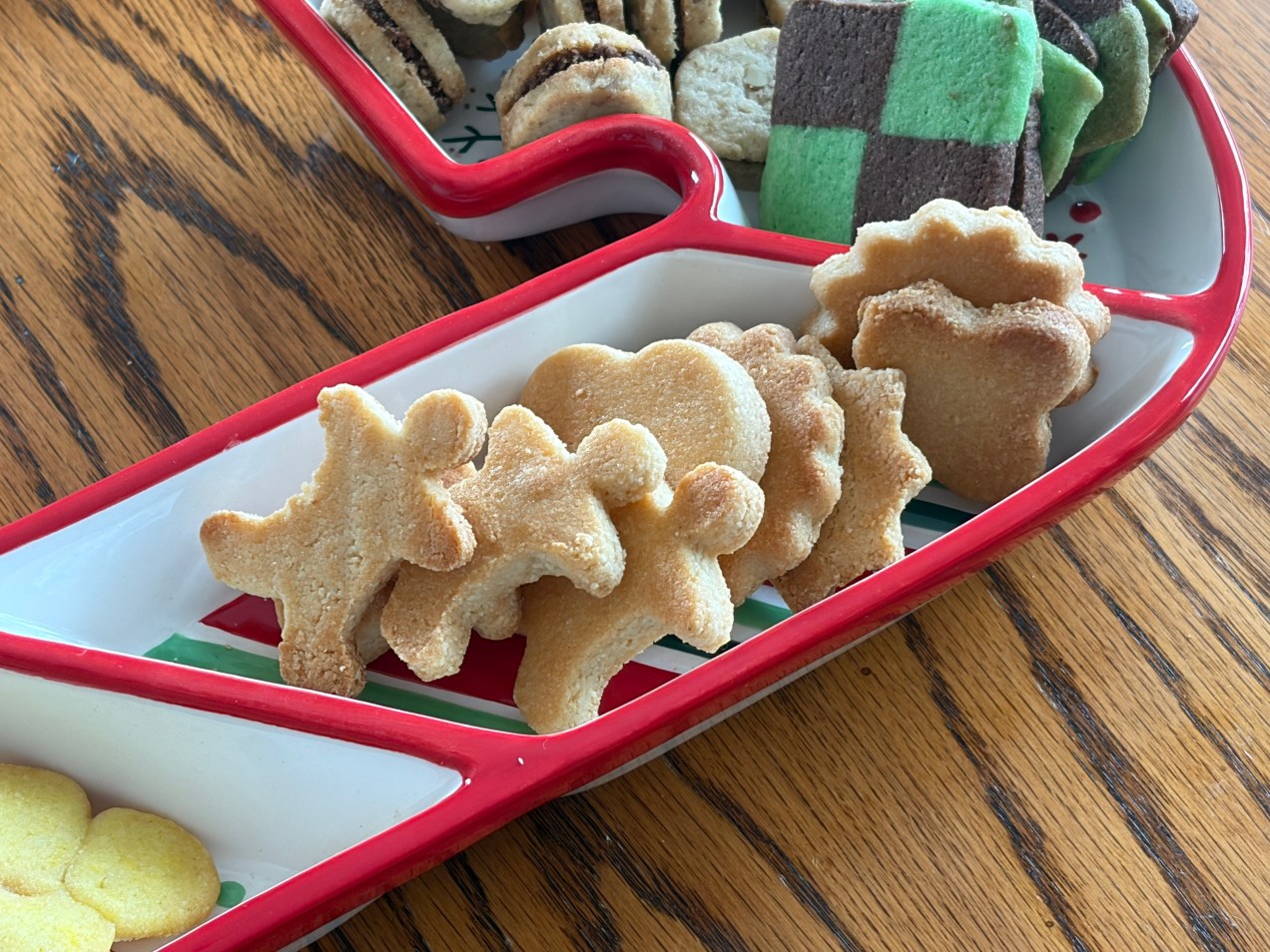
Konigsberg-Style cutouts, with assorted cookies
Ingredients:
1 pound almonds, blanched
1 cup powdered sugar
1 – 2 teaspoons almond extract (use more if not also using rosewater)
1 teaspoon or more rosewater
2 – 4 tablespoons water
Sugar for rolling out dough
Parchment paper (essential for getting baked marzipan off cookie sheet)
Directions:
Coarsely grind almonds in a food processor, add sugar and flavorings, and grind again to reach a sandy texture.
Add 2 tablespoons water, process again, and taste for rosewater. Add more if you think it needs it.
Pinch some of the mix together to see if it comes together as a sticky dough. If not, add more water, a tablespoon at a time, until it does. The texture won’t be as fine as store-bought marzipan.
For Lubeck-style marzipan, the mixture is ready to form into shapes, coat in chocolate, mold around whole almonds, and so on.
For Konigsberg-style marzipan, lightly sugar a flat surface, pat the marzipan into a disk, sugar the top, roll out about a quarter-inch thick, and cut out shapes with cookie cutters. Since the dough has no flour, it can be rerolled without toughening.
Bake on parchment paper-lined baking sheets at 350 for 12 – 15 minutes, just until set.
To brown the marzipan, place each cookie sheet under the broiler for two minutes, with the oven door cracked (which keeps the broiler from overheating). Then, watching constantly, broil for another minute or two, until the tops are golden brown.
As an added bonus, eggless marzipan such as this is gluten-free, dairy-free, vegan, pareve, and Passover-friendly. Assuming the parchment paper is clean, that is, and not previously used for several batches of butter-and-flour-based cookies.
Germanic cultures take Christmas cheer seriously. In Germany, Austria, and occasionally in neighboring countries, towns go so far as to have specialized Christmas markets, called Christkindlmarkt, which have been going on for centuries. At these frequently month-long festivals, you can buy (or just admire) all manner of traditional handicrafts. And of course, there are plenty of snacks. Selections often include sausages, marzipan, chocolates, and German-style mulled wine called glühwein. A similar Scandinavian mulled wine is called glogg.
Due to large-scale German immigration in the 19th Century, the tradition spread to the US, particularly Wisconsin. Many schools have holiday craft fairs, usually to raise money for various clubs and extracurricular activities, which bear a strong resemblance to Germanic Christmas markets. In my hometown, the two or three-dollar admission gets you access to dozens of local vendors, all set up in the high school commons and gym. Knitted hats, scarves, and mittens, painted wood and glass ornaments, creative jewelry, local honey and maple syrup, homemade jam, artisanal soaps and candles, bake sale treats, candied nuts, kettle corn, and all manner of decorations are available for purchase.
Advertisements
And don’t forget the lotion and lip balm. They’re great gifts because 1) they get used up and don’t add to “clutter” and 2) everyone can use them. When the heat gets turned on, everyone’s skin dries right out, especially the hands and lips. Almost every craft fair has a vendor selling these things, and they always do good business. Just make sure not to put scented soap and lotion in the same bag as your food, or the aroma will infuse. Eucalyptus-scented brownies aren’t for everyone.
For a more “authentic” European Christmas market experience, there are several options. I spent an enjoyable afternoon at one a few weeks ago and found some great treasures. It resembled a craft fair in some ways, but with more unusual and high-end merchandise. One memorable stand had ostentatious fur hats, made of fox, coyote, wolf, racoon, skunk, and rabbit. They were pretty flamboyant and definitely out of my budget, but fun to look at. Other stands had unique maps, Baltic amber, alpaca wool socks, scarves, and hats, hand-painted wooden nesting dolls, German beer steins, and of course, all sorts of food.
Advertisements
Just like in Germany and Austria, the market in Wisconsin served up sausages, schnitzel sandwiches, little spätzle dumplings, red cabbage, and amazing potato pancakes. I definitely need to master making them at home. Desserts included apple strudel and crepe-like German pancakes, homemade cookies and bars, tins of Scandinavian-style gingersnaps and cardamom cookies, and all sorts of European chocolates. To wash everything down, there was a variety of beer and wine, including, naturally, hot glühwein.
After purchasing a few “winter survival” lotion/lip balm kits, I loaded up on edible treasures. Between the toffee, cardamom cookies, and fabulous 2-year aged cheddar, a trip or two to the gym might be in order. Really, that’s a good idea anyway. The more time spent watching documentaries while on the elliptical, the more Christmas treats you can enjoy.
High cuisine, not a simple attempt to use things up before going out of town for Thanksgiving
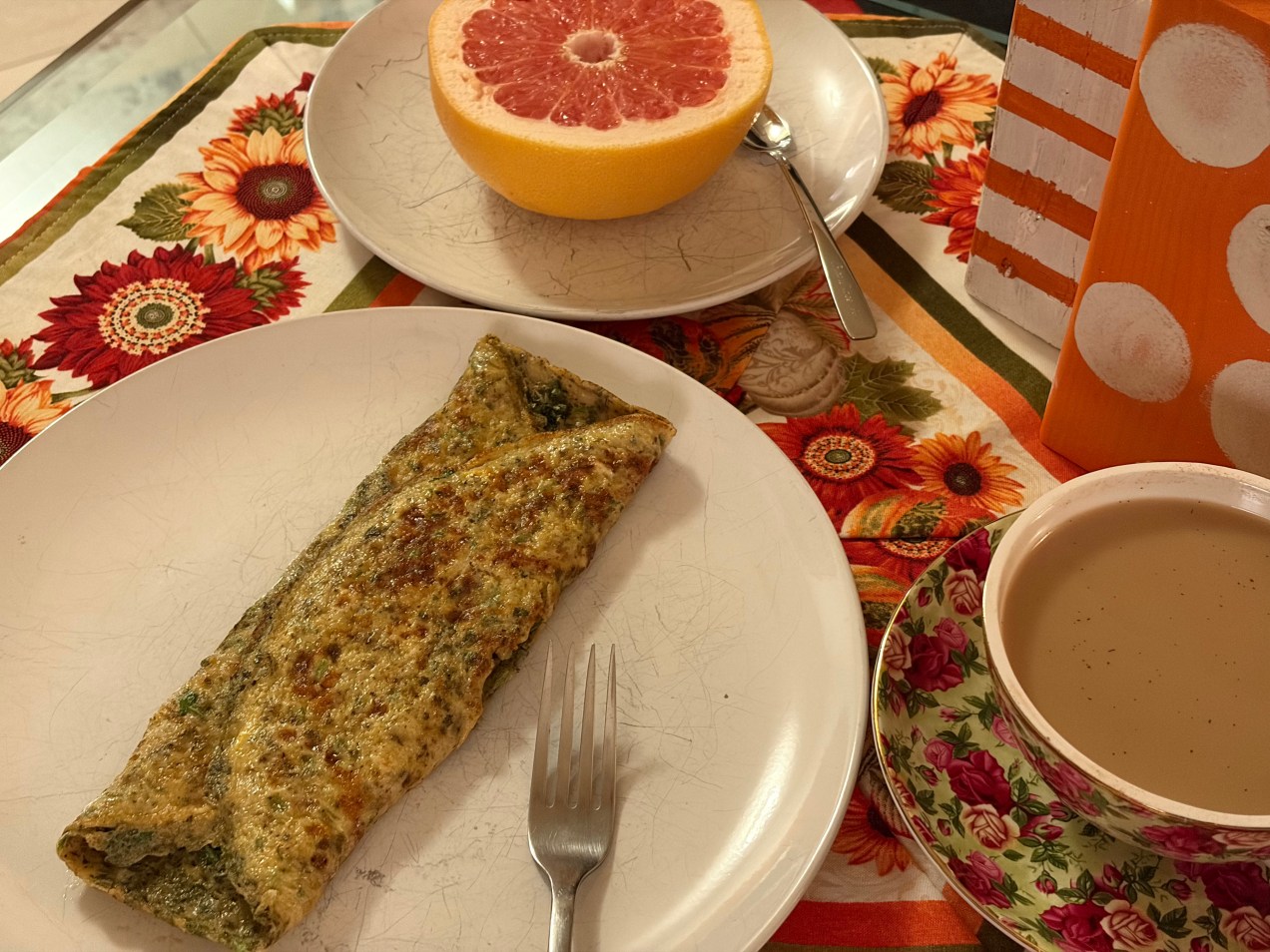
Every fall, I bring my potted herb plants in from outside to enjoy using them for a bit longer. It works well enough for a while, but eventually they start to suffer from the limited sunshine. Since most of them are annuals, the time comes to use up what I can before starting again when summer returns. Everything except the rosemary is either done or fading. To use up as much as possible, I made a French classic, omelette aux fines herbes.
Fines herbes is a mix of parsley, chives, tarragon, and chervil, common in French cuisine. The first three are widely available in the US, but chervil might require a specialty spice store or the internet. Supposedly it tastes like a milder parsley with a bit of a licorice undertone, but I couldn’t taste much difference. To compensate for all the herbs except parsley being dried, I also added some minced scallions to brighten things up.
For many French chefs, making a perfect omelet is one of the primary tests of skill. After following the basic directions on pages 107 – 108 of 1000 Foods to Eat Before You Die, mine turned out pretty well. The flavor is distinctly understated, but the freshness from the herbs was nice as fall turns to winter. The slight licorice flavor from either the tarragon or chervil is definitely there. Perhaps it just needs a little heat to release its flavor. Chefs disagree on how much browning, if any, is ideal. Personally, I like more browning, both for flavor and the fact that it helps the egg unstick itself from the pan.
Advertisements
For each omelet, I used three eggs, beaten together with salt, pepper, and a tablespoon of milk. The herb mix contained three large parsley sprigs, minced, one minced scallion, and a teaspoon each dried chives, tarragon, and chervil. Half of the herb mixture gets added into the eggs before cooking. After melting about a tablespoon butter in a skillet over medium heat, the egg mixture is added to cook.
To make sure that none of the eggs end up runny, I like to tilt the pan and lift up the edges of the cooked portion, letting the uncooked egg flow underneath. After this, sprinkle the remaining herb mixture over the surface. When the top is almost set, fold the right and left thirds of the omelet over onto the center. If this doesn’t work and you end up with a half-moon shaped omelet, don’t worry about it, it will still taste good. Let the omelet cook for another minute, covering the pan if desired to help it set, then slide it onto a plate.
To make this simple mix of eggs and herbs sound extra fancy, serve with pommes de terre frits, compote de pomme, fruits frais, café au lait, or any combination thereof. In English, these are fried potatoes, applesauce, fresh fruit, and coffee with milk. To make anything sound fancy, say it in French, even if you have to use a translation app.
At first, it might seem strange to have apples in a dish for a spring holiday. Passover, the most important holiday on the Hebrew calendar, celebrates the Israelites’ Exodus from Egypt. It always occurs in the spring (in the Northern Hemisphere), while apples are a symbol of fall. On further reflection, the use of apples actually does make sense.
Charoset is a blend of chopped fruit and nuts, representing the mortar enslaved Israelites used in Egypt, and is an essential element on the Passover Seder plate. Historically, most Ashkenazi Jews lived in Central and especially Eastern Europe. Not many fruits are in season there in March or April, but apples could be stored in a cold cellar over the winter. The only other option might be rhubarb, at least when there is plenty of sugar to counter the acid. Holiday food traditions seem to change more slowly than what people eat every day, so even with modern shipping and preservation, apples remain the base fruit.
There are many recipes out there, typically including walnuts, sugar, spices, and an acidic liquid to keep the apples from oxidizing and turning brown. Most common is sweet, kosher red wine. Not all kosher wines are sweet, but Manischewitz, the most common brand (for all sorts of kosher products, in fact), is. With at least 51% concord grapes and a bit of extra sweetener, it tastes exactly like the classic non-fermented grape juice, with the alcohol flavor only coming in at the end. Naturally, grape juice would be the perfect non-alcoholic substitute.
Advertisements
If you’re wondering why wine isn’t all kosher (as I was), it’s because ancient pagan people often used it in their rituals. To ensure their wine hadn’t previously been used in these rituals, the production from picking to transportation to serving had to be done by kosher-observant Jews. Unless, if I understand things correctly, it gets heated, which renders it unsuitable for pagan rituals. Once that’s done, anyone can handle it.
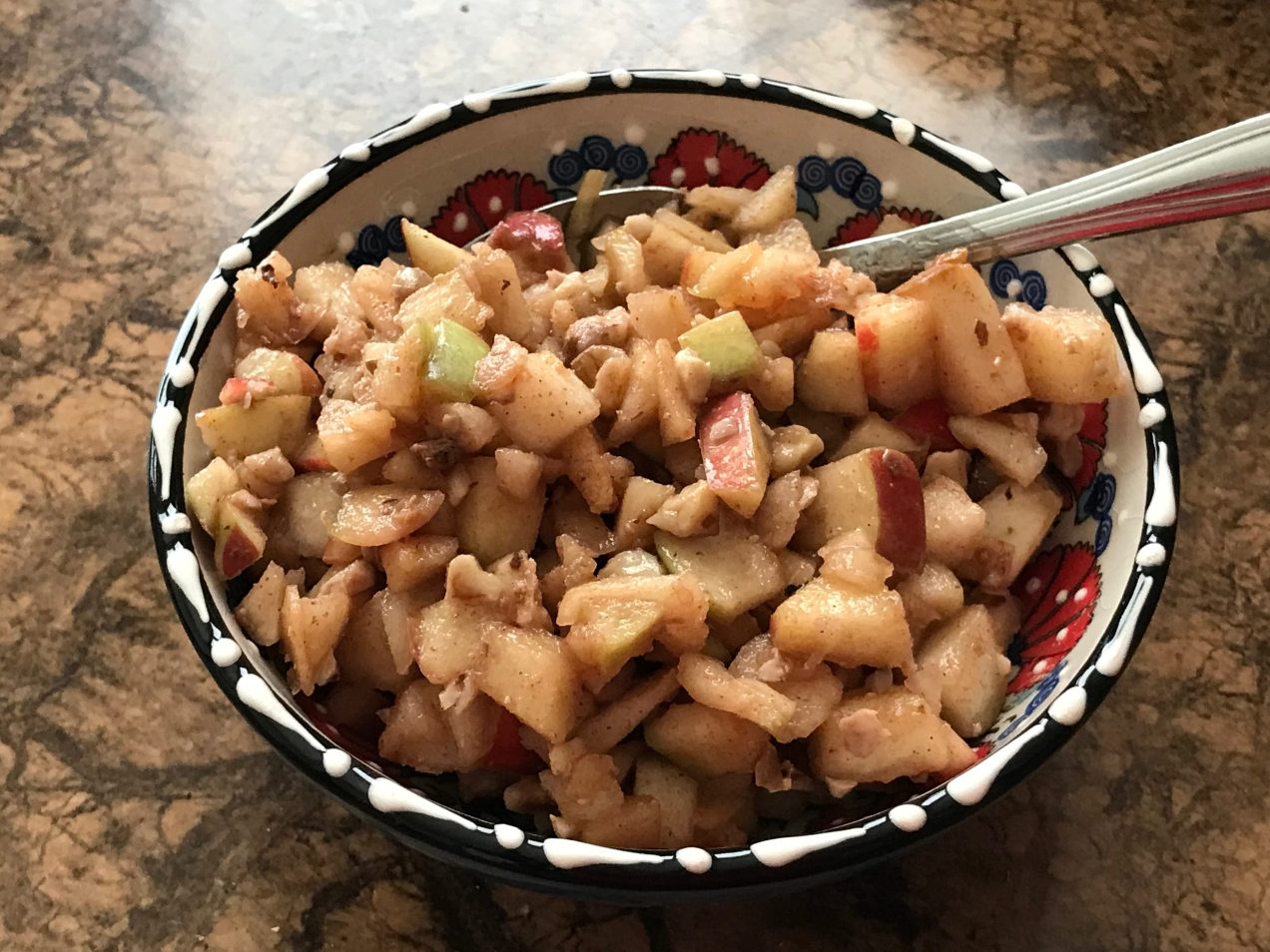
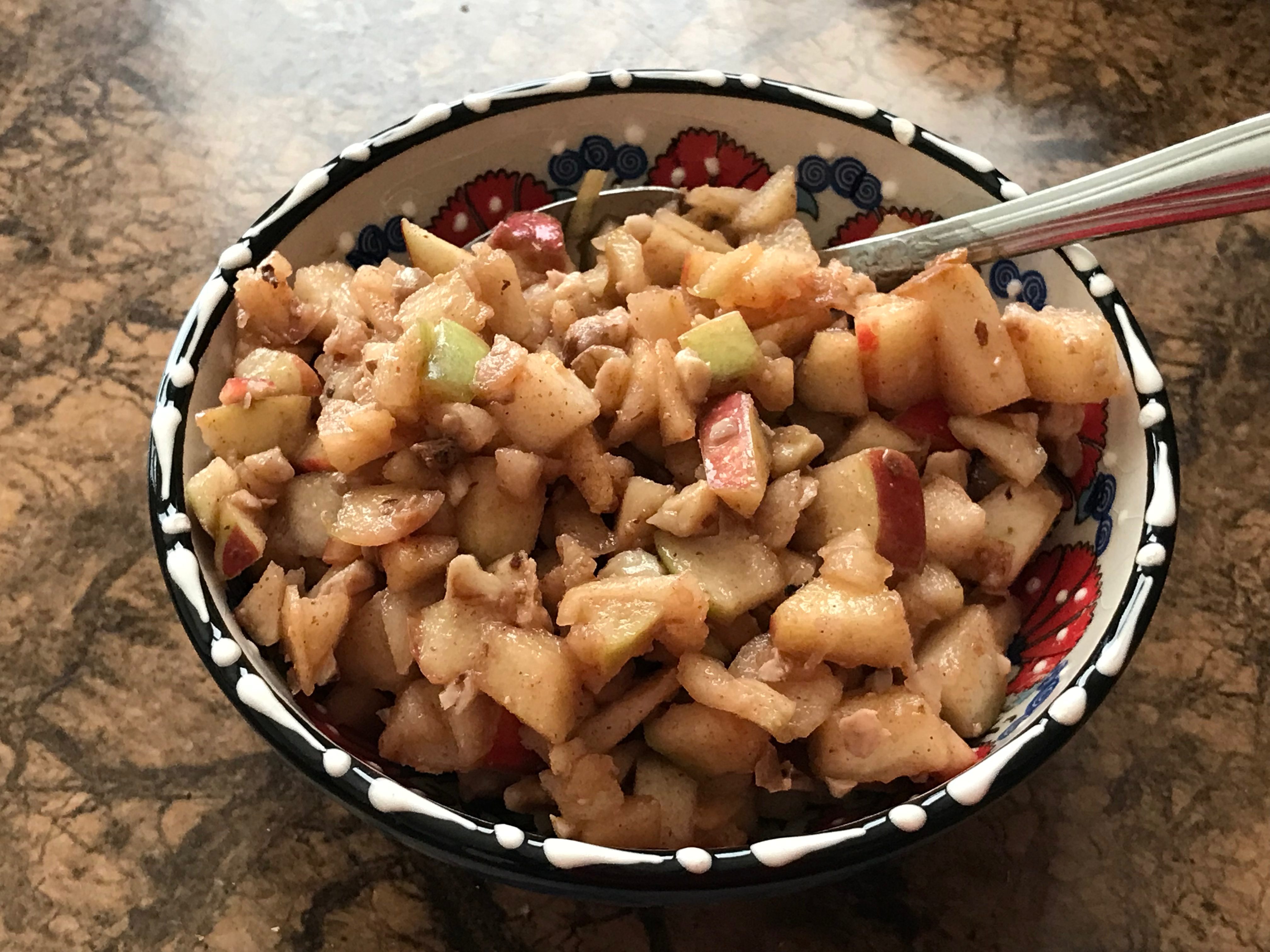
Ashkenazi charoset is delicious, regardless of faith or season. It’s sweet, tart, two different kinds of crunchy, juicy, and especially tasty during the fall, when apples are freshest. Walnuts make the mix more substantial, and spices like cinnamon and ginger make it taste like crustless apple pie.
Ingredients:
4 medium sweet-tart apples (I used 2 cortlands and 2 zestars)
½ cup walnut pieces
A few drops of lemon juice, if desired
½ teaspoon ground cinnamon
¼ teaspoon ground ginger
¼ cup (4 tablespoons) sweet kosher red wine or red concord grape juice
Sugar to taste
Directions:
Core the apples, slice, and mince as finely as you can with a knife. (One of those devices that cores an apple and cuts it into 8 or 10 slices works perfectly for the first part, and I don’t bother peeling. If using a food processor for the second part, be careful not to overprocess.) Place in a large bowl. Toss with a few drops of lemon juice if desired.
Mince the walnuts and stir in, distributing evenly. Add the spices and wine and stir again.
Taste for sweetness. Depending on the apples, you may or may not need sugar. If the mix needs it, add sugar a tablespoon at a time, tasting as you go.
Let rest in the refrigerator for 24 hours for the best flavor.
If you enjoyed this, please like, share, and/or subscribe.
Photo by Mingyang LIU on Pexels.com (I couldn’t get a good picture myself without blocking traffic)
Harrods is probably the most famous department store in London. It’s also really hard to navigate. Perhaps this is by design, so potential customers pass more high-end merchandise. After all, some of the wealthiest customers in London shop there, or have their people shop for them. But for the casual tourist who just wants to window shop in the food halls at the center, the maze is a bit annoying.
Sure, there are smaller items like rolls, pastries, jars of jam, pieces of cheese, boxes of tea, and so on, that are affordable for most people. But after being warned by the tour director that the same items are marked up heavily just because they come from Harrods, I decided to stick with admiring the selection. There is a lot to admire, starting with the store itself. It’s kept the elaborate Victorian and Edwardian columns, ceilings, arches, and crown moldings, while gleaming like any upscale modern establishment.
I’m not sure what’s more beautiful, the building or the merchandise. Right by the door where I came in was a selection of caviar, smoked salmon, and whole gourmet fish. To my other side was a whole wall of baked goods, and directly ahead was a truly international deli case. Many of the salads looked Mediterranean or Middle Eastern, but there were also ready-prepared slices of beef Wellington. On the other side of the deli I found all sorts of exotic fruits, including cacao pods. Oddly enough, after coming home I saw cacao pods at Woodman’s.
Advertisements
On a side note, if you’re ever in the produce department at Woodman’s, take a minute to smell the guavas, especially if they’re a bit overripe. The intoxicating tropical aroma is impossible to describe. Anyway, back to Harrods, where there were no guavas, but the meat cases had luxury wagyu beef, authentic Spanish jamon iberico, and any cured meat you can think of. And I’m pretty sure the cheese case contained every cheese mentioned in 1000 Foods to Eat Before You Die (the food halls themselves are featured on pg. 15).
As far as I could tell, the non-perishable (or less perishable) items like coffee, tea, honey, jams, oils, chocolates, and confectionary were more significantly overpriced than the others, though overpriced might not be the right word. There’s a quote from somewhere that “everything is worth what its purchaser will pay for it.” It’s the law of supply and demand. Perhaps because the “dry goods” can be kept for longer, the sellers can be comfortable charging more, knowing whatever doesn’t sell one day won’t be wasted. Or maybe those items are in higher demand as gifts.
In fact, the store website suggests that the chocolates and hampers (basically gift baskets) would be perfect for the hard-to-shop-for relative or business acquaintance. I’m sure they would be. Everything in the chocolate hall was beautiful, and Harrods chocolate is known to be of exceptional quality. But a mixed 15-piece box of chocolates is $35. 325 grams (just over 11 ounces) of mixed chocolate almonds is $27. And a 16-piece chocolate truffle selection box is $40. Granted, some of those are in collectible tins, but that’s still out of my price range.
For the cost of 2 of those items, I could get a bulk bag of pecans, make a batch of cinnamon sugar nuts, eat half of them, make another batch, and have enough for several homemade gift baskets. With the money left over, the baskets and tins (which have been passed back and forth between friends and relatives since about 1995) could be finished with Lindt truffles, clementines, and some homemade cookies and/or Chex mix. Maybe it’s just me, but that feels so much more personal. And who doesn’t love cinnamon sugar pecans?
Advertisements
After finishing my window shopping, there was still plenty of evening sunlight to ride the Underground to visit the Tower of London. (Another interesting thing is that because the British Isles are further north than many Americans might expect, it stays light really late during the summer. In July, there was still some twilight at 10pm.) The inside was closed (not sure why they don’t stay open later in the summer to profit from the long days and tourist surge), but I had a great view of the outside of both the Tower itself and the Tower Bridge. Even from a distance, the arrow slots in the walls were clearly visible. Add in the multiple layers of walls, and the Tower could rival any modern maximum-security prison.
Better luck getting pictures of the tower bridge
And on the ride home, there were a few drunk guys doing pull-ups on the handhold straps hanging down from the subway roof. I was a little worried the straps would give way, injuring them physically or mentally, but they held firm. Since drunken pull-ups are apparently a common thing, the train engineers probably factored that into their designs.
Point is, even if buying much from Harrods is out of your budget, it’s well worth a look around. If only they had free samples, which might encourage hesitant shoppers to buy.
Over the course of my culinary exploration, I’ve been amazed by just how many different types of oil there are. Some are pretty standard and widespread. Canola and vegetable (often soybean) oils are neutrally flavored, easy-to-find, affordable, and widely used in baking and frying. Some cooks prefer corn or peanut oil for deep frying. For sautéing and salad dressings, olive oil is a favorite. In a well-stocked grocery store, you often find sunflower, sesame, flaxseed, grapeseed, avocado, and coconut oils.
Certain oils are largely restricted to particular cuisines or uses. Sunflower is popular in Eastern Europe due to Orthodox fasting rules and the inability to grow olives. Toasted sesame oil is common in East Asia, especially China, while Middle Easterners prefer untoasted. Nut oils like almond or walnut are sometimes used in European salad dressings. And bright reddish-orange palm oil gives many West African dishes their distinctive flavor.
Advertisements
In Austria, a local specialty is pumpkin seed oil, called kurbiskernol, made from the appropriately-named oilseed pumpkin. It’s typically used in salad dressings and as a dip for bread. Due to its low smoke point, it’s not suitable for cooking, which damages its distinctive flavor. But here’s a question for you. If the stereotypical pumpkin is orange and inner seed kernels (pepitas) are green, what color is pumpkin seed oil?
Answer: It’s a lovely deep purple, with yellow-green undertones.
In 1000 Foods to Eat Before You Die (pgs. 323 – 324), Mimi Sheraton describes pumpkin seed oil as resembling liquid amethysts. If it had been available during the Middle Ages, sophisticated diners would have been all over it. They loved bright, even tacky colors, and very few foods are naturally that shade of purple. For people who created elaborate gilded dishes with egg yolks and saffron, liquid jewels sound right up their alley.
Pumpkins arrived in Europe after Columbus. Exactly when Europeans began eating them or pressing their seeds is unclear, but the oil makes a great vinaigrette base. To boost its color, I added red wine vinegar, minced shallots, a little salt, and a dash of mustard and honey to keep the dressing from separating. If you find the flavor of the pumpkin seed oil a little strong, try replacing about half of it with sunflower oil, which is typically pale, for a lighter shade of amethyst. Yellow or greenish olive oil will make it look muddy.
Thinner layers of the oil can look muddy anyway, but the taste, clearly that of roasted pumpkin seeds, is worth it. It’s a fantastic complement to potatoes, and makes salads much more satisfying. Kale is especially good, because its strong flavor is less likely to be overwhelmed. It also holds up in the fridge for a few days, even with dressing.
Advertisements
To dress about six medium potatoes or one bunch of kale, just combine 6 tablespoons of pumpkin seed oil, 2 tablespoons red wine vinegar, a minced shallot, and a little salt. Mix in a teaspoon each of Dijon mustard and honey and whisk until combined. Toss with cubes of hot cooked potatoes (waxy varieties like reds or Yukon golds are best, peeled or not is up to you) or chopped kale and let rest for an hour at room temperature. Store leftovers in refrigerator, bringing potato salad back to room temperature before serving. If desired, rewarm for about 30 seconds in the microwave. The kale salad is ready right out of the fridge.
Vinaigrette-based vegetable salads are perfect year-round. They stay crisp (if applicable) better than lettuce, are more interesting than a veggie tray, and provide a pleasantly light counterpoint to grilled or roasted meats, heavy sides, and desserts. With no egg or dairy, they’re safer on hot days than those with mayonnaise. And during the winter, sturdy vegetables like potatoes and kale (or even frozen vegetables like green beans) are more consistent than fresh sweet corn, tomatoes, or lettuce.
And with how popular pumpkin spice is, pumpkin seed dressing would be perfect on a fall or Halloween theme menu. Perhaps a kale or other cabbage salad with pumpkin seed vinaigrette and toasted pumpkin seeds to start, followed by pumpkin or squash ravioli with butter and sage, and concluding with a pumpkin or apple dessert. With plain coffee or tea, though. Pumpkin spice belongs in desserts, not beverages.
Add seasonal flowers for a lovely modern still life
Crazy as it sounds, ring bologna is actually a decent substitute for mortadella in a pinch. After all, mortadella originated in bologna. American “baloney” was an attempt to imitate it. The ring variety is better than the slices, and in either case, crisping it up in a pan gives the bologna a boost in flavor and texture. On this pizza, the oven takes care of that step for you.
If you make the dough the night before and leave it in the fridge, and if you still have garlic oil on hand (the recipe makes enough for several pizzas), this is the easiest pizza in the book. No vegetables need to be precooked; no herbs need to be minced. Just shred the fontina, rinse and chop up the canned artichokes, chop up the mortadella (or bologna) and you’re good to go.
Advertisements
The flavors and textures in this pizza are very well-balanced, between briny, slightly meaty artichokes, peppery bologna, creamy cheese, crispy crust, and garlic. On page 226, author Joe Famularo says the best way to get a good garlic flavor on a pizza without it scorching or being overwhelming is to use garlic-infused oil. And he’s absolutely right. The flavor is definitely there, but it doesn’t overpower the other flavors. Everything is in harmony.
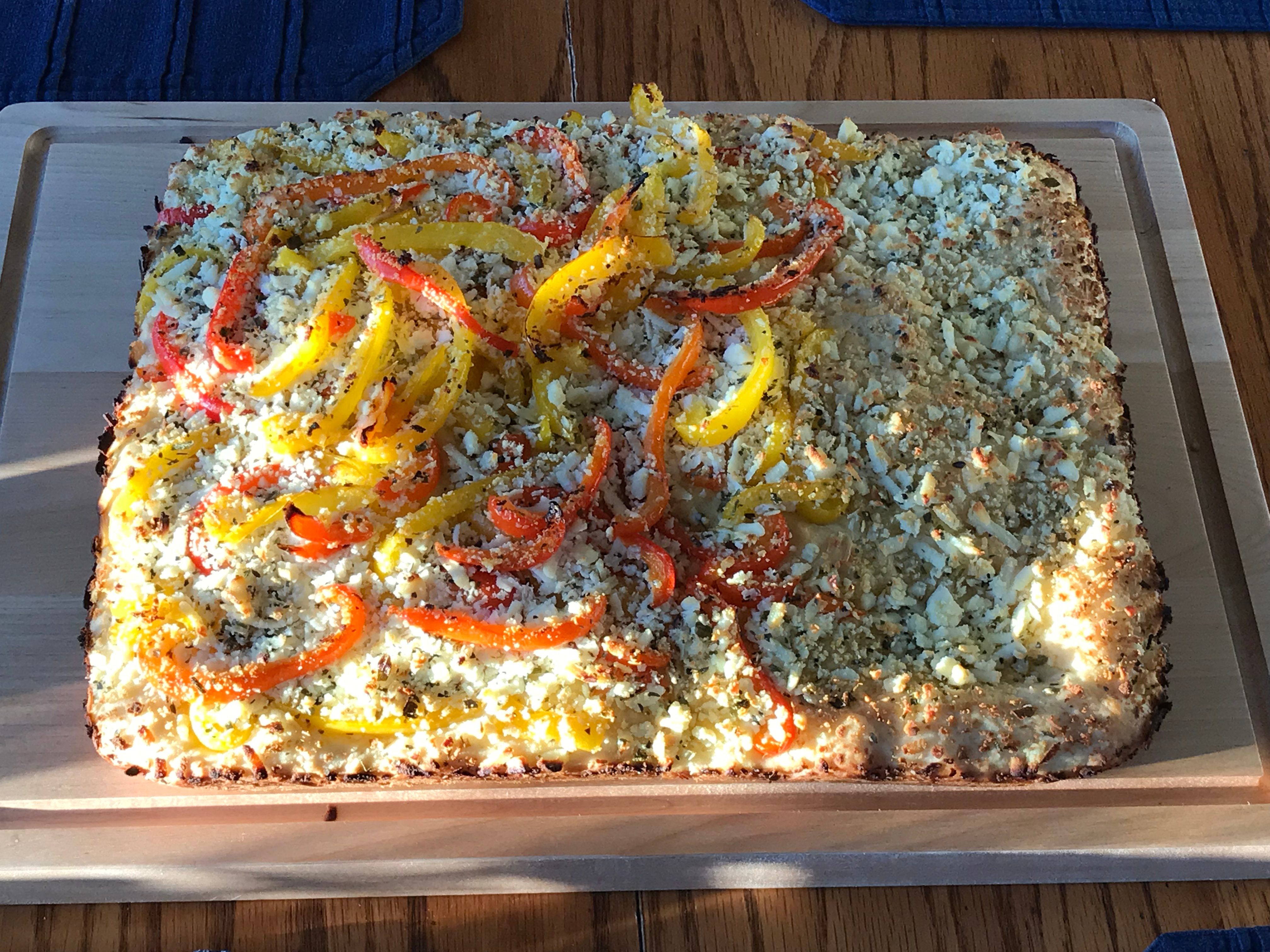
A few months ago, I came across some ricotta salata while browsing at Woodman’s. Remembering that lack of it led me to improvise on sweet pepper pizza a few years ago, I decided to remake the recipe and give it a try. Plus, I had some unbleached flour and quick-rising yeast I wanted to use up before they went bad. At the time, I’d been trying to clear out the pantry, find a use for the ingredients pushed to the back, and therefore avoid food waste.
Recently I started watching Hoarders, which is enough to make anyone want to clean, even if they don’t have a problem. Many of the jam-packed kitchens came about because their owners liked to stock up when preferred items went on sale. There’s nothing wrong with that, as long as you don’t buy more than you can use before it goes bad. Having some extra cereal, pasta, crackers, and canned goods in the basement is handy. Just don’t overdo it.
Some items, like the cornmeal that I bought at the start of Covid, expired two or three years ago and weren’t salvageable. The yeast and unbleached flour were still good, but expiring soon, so it was as good a time as any to make pizza. I made the garlic oil that all the recipes use, stuck it in a jar in the fridge, and decided to start with a white pizza using the leftover provolone and some of the pecorino from the eggplant timbale (and leftover parmesan from some gnocchi, and some mozzarella already in the fridge).
Advertisements
When I went to put the dough in the intended pan, a large round sheet pan with a short “lip,” it wasn’t there. Turns out, it had started flaking and reached the end of its natural life. Looking at my other options, I settled on a roasting pan with slightly higher sides. If I spread the dough all the way to the edge, the surface area would be similar, just in rectangular form. Nothing wrong with that.
This turned out to be the best culinary misadventure in a while. Because this dough recipe produces a thick crust, I had never spread it to the edge of the pan before, in case the garlic oil in the topping dripped off onto the bottom of the oven. Being able to do so made a huge difference. The crust rose evenly instead of bulging in the middle, and the edges got extra golden and crispy. Everything was delicious, but the edges were phenomenal. And the pizza fit perfectly on the new, giant wooden cutting board.
After this success, I decided to make any future pizzas in this pan. The sweet pepper and ricotta salata pizza was up next, for the simple reason that peppers were on sale at the store. This was good, but a little dry, even with the garlic oil. For pizza, meltier cheeses with a bit more fat seem to be the way to go.









 Feasting Through Time