
Menu: Eggplant with Capers and Anchovies, Roasted Chicken Salad in a Loaf of Italian Bread, Country Style Fava Beans, Fresh Seasonal Fruit and Italian Cheeses

Recommended Wine: Frascati (Fragrant, Dry, Semisweet)
Returning to Rome, we are invited to imagine a picnic on the outskirts of the city. For a major metropolitan area, Rome has a surprising amount of green space, even within the city itself. Part of the reason for this, according to the tour guides, was that over the centuries Popes and influential families dedicated a number of parks and gardens. Combined with potted plants and flowerbeds in piazzas and a profusion of flowers and greenery on apartment windowsills and balconies, the urban oasis feeling is rarely far away.
With eggplant marinated in a vinaigrette-type sauce, a chicken salad full of greens, sautéed fava beans, cheese, and lots of fresh fruit, this produce-heavy picnic provides another great insight into history. As a society that took pride in its agricultural roots, the Ancient Romans enjoyed and valued a variety of fresh produce. Incidentally, by the time of Julius Caesar and his contemporaries, the small family farms that society idealized had largely fallen victim to the circumstances of the times.
To *very* briefly summarize this aside, what basically happened is as follows. In the 3rd Century BC, wars with Celtic peoples in Northern Italy and Carthage in Sicily, Corsica, Sardinia and Spain led to the acquisition of several new provinces and a massive influx of slaves. After some of the recently conquered land was given out to reward veterans, wealthy Romans bought large estates, worked by the surge in slave labor. These profit-driven latifundias could produce goods more cheaply than the smaller farms, many of which were either damaged during Hannibal’s campaign in Italy or had fallen into disrepair when their owners were in the army on campaign, pushing many small farmers out of business. Worsening this problem was a surge in cheap grain from Sicily and later from North Africa and Egypt. As massive slave-run estates swallowed up many family farms, landless poor surged into the cities, unrest rose, and yearning for an older, simpler way of life captured the popular imagination. Fun fact: the Gracchi brothers, who spearheaded a reform movement and were assassinated for their troubles, were the grandsons of Scipio Africanus, who ultimately defeated Hannibal. Their mother Cornelia was seen by many as the ideal Roman matron and was one of their greatest supporters.
As mentioned before, due to lack of meat in the diet, pre-modern Romans historically ate substantial quantities of legumes. Even Apicius, more focused on upper- and middle-class Imperial Era cookery, includes several recipes for fava beans, chickpeas, and lentils. (Cannellini, navy, and kidney beans and their relatives only arrived after Columbus.) Given that olive oil, oregano, salt and pepper were widely available, it is entirely conceivable that dishes like the fava beans here were eaten 2000 or 2500 years ago. Fava beans were quite hard to find, but I managed to find both canned and frozen at a local Mediterranean/Middle Eastern grocery.

Ancient-style fava beans?
Chickens may not have been available in the early Roman Republic (they are believed to have reached Greece during Classical times, c. 5th century BC), but certainly were plentiful in Rome by Imperial times. I am not sure when arugula became available, but most of the other ingredients in the salad, including celery (based on Apicius’ references to celery seed), Pecorino Romano cheese, cured ham (if not prosciutto), vinegar, oil, and eggs, were available as well at this time.

The ultimate chicken salad
The dessert has similar antiquity. Pears, plums, the pecorino cheese again, and the ricotta were all present in ancient times. Adding cinnamon, sugar and coffee granules to the ricotta would be a more recent innovation, since evidence suggests that before medieval times, cinnamon was an incense or perfume and sugar was medicinal. Coffee was not introduced until the 16th of 17th century (sources disagree). The watermelon is even more recent. Another medieval introduction is the eggplant, introduced to Sicily when the island was under Arab control between the 9th and 11th centuries, though the anchovies seem to harken back to the ancient tradition of garum.
The best part of this menu was definitely the chicken salad. Ordinarily I don’t like chicken/egg/tuna salad because of the mayonnaise, but with a vinaigrette dressing it is really good. The mix of chicken, arugula, cheese and a bit of prosciutto blended really well together and turned out to be great on sandwiches made from the hollowed-out bread serving bowl. I did skip the hard-boiled eggs the recipe called for as a garnish since when it comes to eggs, I prefer them either mixed into a recipe, scrambled, or in an omelet. This salad was different than what Americans might imagine when we think of chicken salad, with plenty of arugula and celery mixed in and flavored with cheese and ham, but personally I think it’s a tasty way to eat more vegetables. The only thing I would change is to replace the pecorino Romano with fresh or firm mozzarella. After making the salad again at a later date (with bacon pieces instead of ham because that’s what I had on hand), this was confirmed as a perfecting improvement.
The eggplant was also good, though in the future, rather than eating it on its own, I’d try Mr. Famularo’s alternative suggestion of putting pieces on toasted bread, topping with cheese, and heating in the oven. I was admittedly underwhelmed by the beans, but they were decent hot. The issue was more being weirded out, for lack of a better term, by eating beans cold. For the dessert, the fresh ricotta with cinnamon sugar was rather enjoyable, though it took a little getting used to eating sweetened cheese that wasn’t cheesecake. I wasn’t quite so keen on the pecorino Romano, which again, is great grated and cooked, but not what I’d want to eat for dessert. In the reverse of the Italian custom, I tend to think of sweets for dessert and fruits like pears and plums for a snack, but the watermelon, the ultimate healthy summer dessert, was a fine ending to a summer picnic.
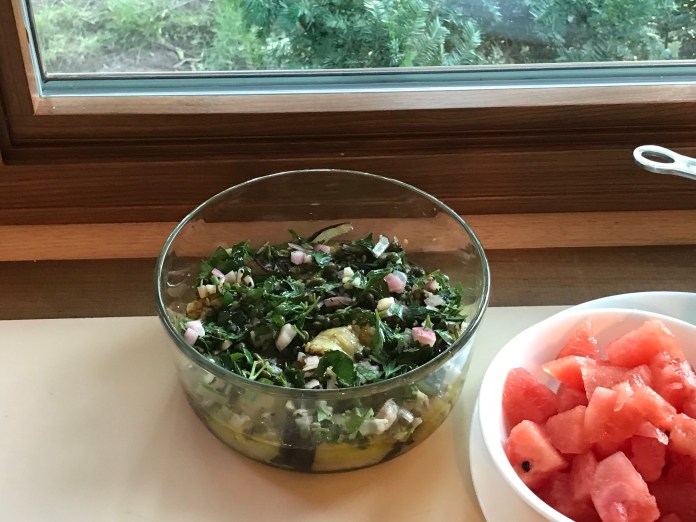
Eggplant is under the herbs

Dessert
 Feasting Through Time