
Menu: Fresh Angel Hair in Custard Mold with Herbs
Now, for the first time in this project, we travel south of Rome. The chapter covers a large swath of Southern Italy, from Naples on the peninsula’s west coast to the region around Bari, Brindisi, and Taranto in the Southeast. Despite regional variations, common themes throughout this region include dried pasta, lots of vegetables, olive oil, citrus fruit, seafood in many parts, and lower levels of meat consumption. Tomatoes are more ubiquitous here, and the sauces tend to “not have the restraint of those in the north for we are now in the land of the Greeks, the Byzantines, the exuberant, the colorful.” (Text, pg. 204)
Time for another history lesson. In the 8th and 7th Centuries BC, large numbers of Greek colonists, driven by population pressure and civil unrest, arrived in Southern Italy. They founded or came to dominate many settlements along the coast, including Naples, Bari, Brindisi, Taranto, and Syracuse, just to name a few. The mainland colonies came to be known collectively as Magna Graecia, though they were never a unified entity. Rather, as in Greece itself, they feuded constantly and alternated between trading and fighting with the Italic peoples that remained dominant further inland. The situation was even more complicated in Sicily, where they competed with Phoenicia and later Carthage for trade and colonies, and Sardinia, where Etruscans were added to the mix.
Despite the constantly shifting alliances between the various Greek, Phoenician, and Etruscan powers, Magna Graecia prospered from the 7th to the 4th Centuries BC. In fact, as discussed by Professor Timothy B. Shutt in his audiobook lecture series “Wars That Made the Western World,” Sicily in the 5th Century BC is believed to have had a Greek population as large as in Greece itself, and Syracuse was an economic and naval power on par with Athens. Even as the Romans conquered Naples at the end of the 4th Century BC and Magna Graecia and Sicily in the 3rd, the Greek influence lingered.

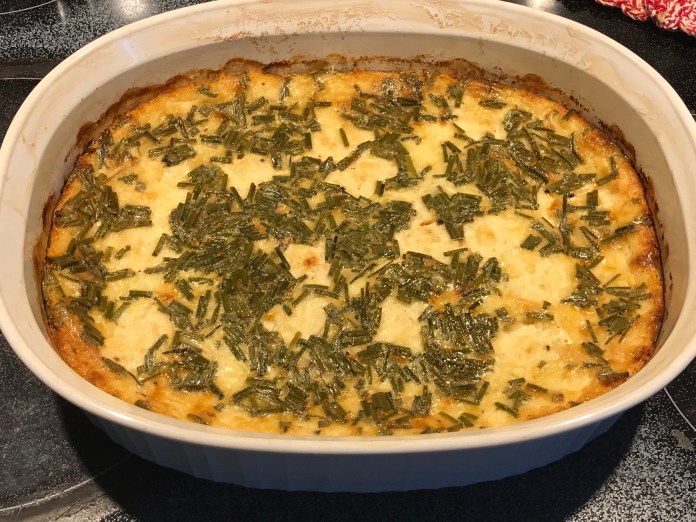
Unusually for this region, this dish contains fresh pasta, in this case fresh angel hair. After being cooked through, the pasta is mixed with a “custard” of eggs, milk, and fresh ricotta, flavored with rosemary and chives. The whole is then baked in a casserole dish, and each serving is sprinkled with more chives. For some reason the fresh angel hair was a bit gummy and clumped together, but the texture was improved upon being combined with the egg mixture. Overall, this was a pleasant dish with a mild flavor.
 Feasting Through Time
Very interesting! I had not heard of pasta in custard before.