
Menu: Potato and Zucchini Soup, Shrimp in Olive Oil and Lemon Juice with Rosemary, Red Bell Peppers Stuffed with Pine Nuts and Golden Raisins, Roasted Figs with Almonds and Chocolate
Recommended Wine: Terradora Di Paolo, Fiano Di Avellino from Campania
Heading south again, we enter the region of Apulia, now called Puglia, in the Southeast along the Adriatic Coast. Despite being across the Apennines on the other side of the peninsula, the food here has a lot of similarities to that from the Naples region (Campania). In both places, pasta, vegetables, olive oil, and fruit are staples, supplemented with smaller amounts of meat, dairy, and seafood. These ingredients are often prepared differently, however. While bold, exuberant flavors dominate around Naples, Puglia tends to favor more clear, straightforward flavors. (Text, pg. 211)
Like much of Southern Italy, Apulia was part of Magna Graecia and had a number of Greek colonies from the 7th to 3rd Centuries BC. As discussed on page 210, the Greek influence is stronger here than in Naples. At first this seems surprising, since Naples was also a Greek colony. In fact, its original Greek name, Neapolis, roughly translates as “New City.” I suspect, but cannot be sure, that geography had something to do with the difference. The coast of Apulia is more or less directly across a strait from the Greek mainland, while Naples is on the opposite side of the peninsula and only about 120 miles from Rome over relatively flat terrain. As a result, though Apulia did eventually Romanize to a degree, the process was slower and less thorough, with more lingering Greek influences.
Many elements of this menu have a long history. Seafood has been an essential element in the diet in most coastal regions since before agriculture. Olive oil was essential in the Ancient Mediterranean, and the recipes of the Roman gourmet Apicius frequently contain anchovies or fish sauce. Raisins and pine nuts were frequent additions to sauces and stuffings both in the Ancient and Medieval world. Other fruits and nuts, including almonds and figs, have always been popular desserts.
In fact, in his bestselling book Guns, Germs, and Steel, the anthropologist Jared Diamond discusses how figs were domesticated thousands of years before apples. Basically, fig trees can self-pollinate and produce seeds yielding identical offspring, making breeding the trees fairly straightforward for early farmers. Apple trees, on the other hand, tend to pollinate other apple trees, usually producing offspring different from the parent. To ensure identical offspring, the much more complicated technique of grafting is required. This process was not mastered until the Classical Period around 500 BC, so until then, apple trees remained more or less wild, though widespread. Meanwhile, the ancients had been feasting on domesticated figs, both fresh and dried, for millennia.
A few elements, such as the lemon and rosemary in the shrimp, are Medieval introductions, but most of this menu would not be possible without ingredients originally from the Americas. Potatoes, zucchini, peppers, and chocolate were brought to Europe by the Spanish in the 16th Century but took a while to catch on. By the end of the century, hot chocolate was fairly common among the wealthy in Spain, and in the next century spread throughout Europe. Since the historic Kingdom of Naples, which included pretty much all of Italy south of Rome, was controlled by Spain for most of the Early Modern Period, these New World ingredients may have been arrived sooner in Puglia than in many parts of Europe. Still, with the exception of chocolate, they were not widely consumed until the 18th Century.
Since peppers and potatoes (and tomatoes, for that matter) are in the same family as deadly nightshade, they were viewed with suspicion at first and only eaten out of necessity. As author Ken Albala explains in Food in Early Modern Europe, their high yields helped peppers and especially tomatoes catch on throughout Southern Europe, but for some reason, potatoes took even longer. Despite their hardiness, yield, and versatility, most Europeans were only starting to accept them in the late 18th Century.
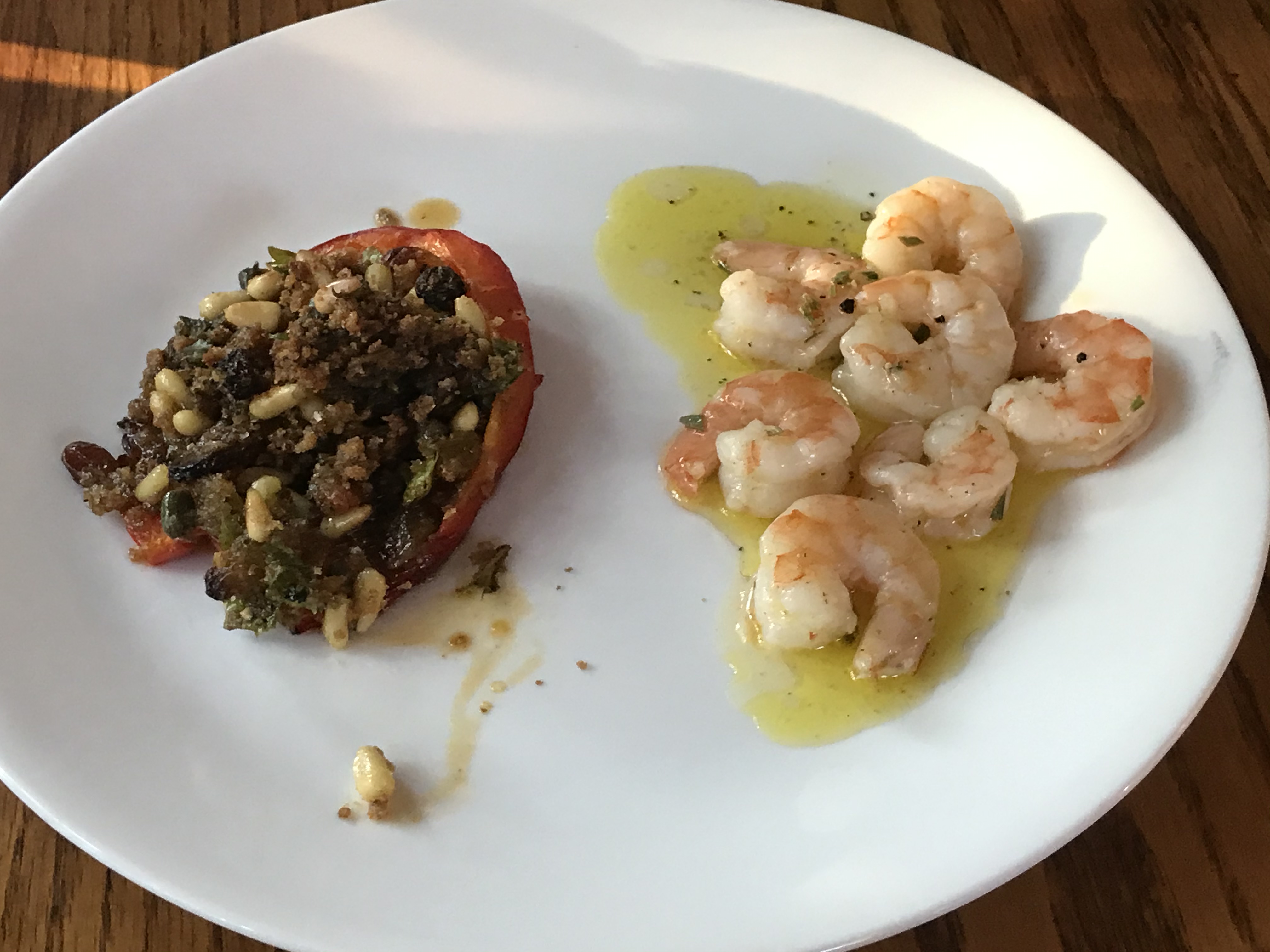
Now, let’s look at the menu. It features a number of southern Italian staples, including zucchini, dried pasta, seafood, olive oil, citrus fruit, peppers, and figs. Due to a timing miscalculation, the shrimp and peppers were eaten before the soup. The shrimp were cooked for a few minutes in boiling water, then cooled and marinated in lemon juice, olive oil, and rosemary. After being roasted and peeled, the peppers were stuffed with a mixture of breadcrumbs, raisins, pine nuts, parsley, and a bit of anchovy, then baked. This was all good, but pretty salty. As in most of the book’s recipes, salt and pepper are to taste, but I seem to have used a bit much, especially for the peppers. Plus, the anchovy flavor in the peppers was a bit strong. The raisins in the stuffing helped cut through this, but if I were to make them again, I think I would not only be more careful with the salt, but also reduce the amount of anchovy.
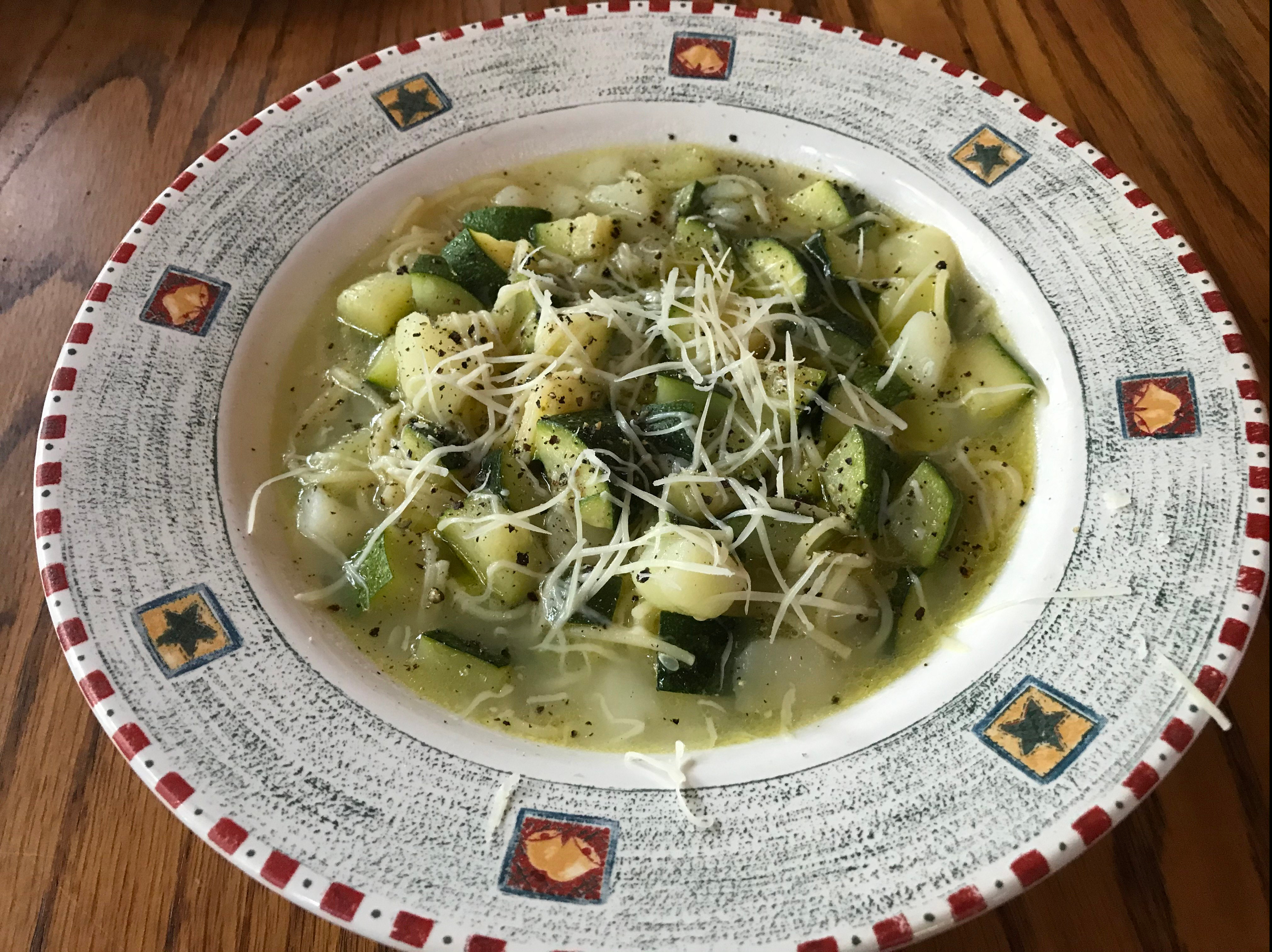
After the salty, strong flavors, the soup was really nice contrast. It’s simply a mix of potatoes, zucchini and vermicelli, cooked in salted water with a little olive oil, topped with a sprinkle of Parmesan cheese and black pepper. On page 211, Mr. Famularo describes a friend’s skepticism upon being told about the soup, wondering how it had any flavor, but then enjoying it to the point of it becoming a favorite. Upon reading the recipe, I had a similar initial reaction. I thought that without at least a bit of onion, it would be extremely bland, but it all worked together. The flavor is mild, but the large quantity of vegetables for the amount of water ensures that the broth doesn’t taste like water. The vermicelli and olive oil add body, while the cheese and pepper add another layer of depth. I was surprised by how much I enjoyed it.
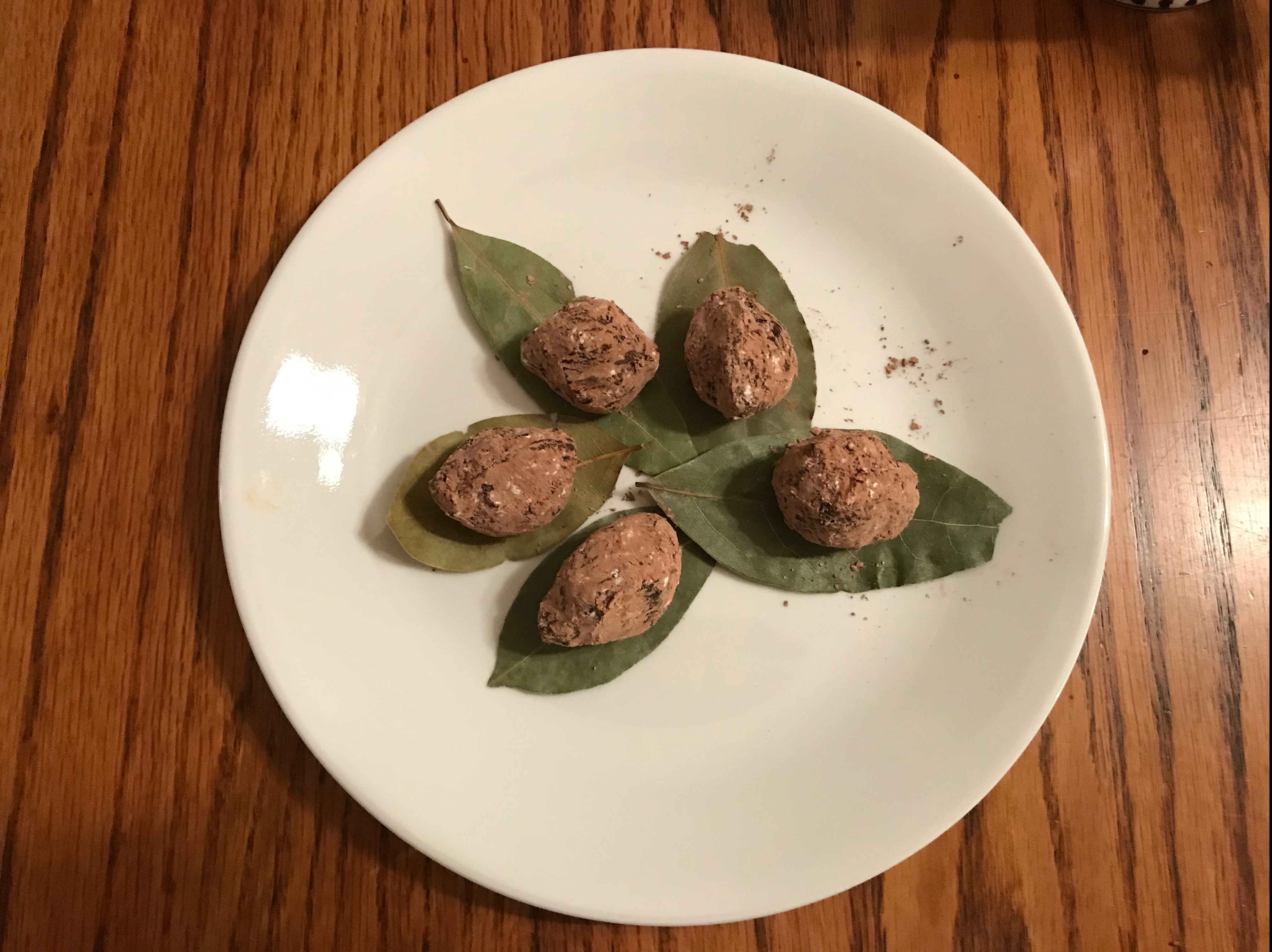
The stuffed, roasted figs were a bit time-consuming to make, but they can be made ahead and last for several days in an airtight container. Each dried fig has a pocket cut in the side, which is then stuffed with a roasted almond, a small piece of dark chocolate, a few fennel seeds, and a few small pieces of candied peel. After baking, they are rolled in a mix of cocoa powder and powdered sugar while still hot and stored in an airtight container with bay leaves. These were definitely different, but quite enjoyable. The figs and candied peel are quite sweet, but the fennel and dark chocolate help balance that, while the almonds provide a nice crunch. Overall, this was a tasty and balanced dinner.
 Feasting Through Time