Uncategorized

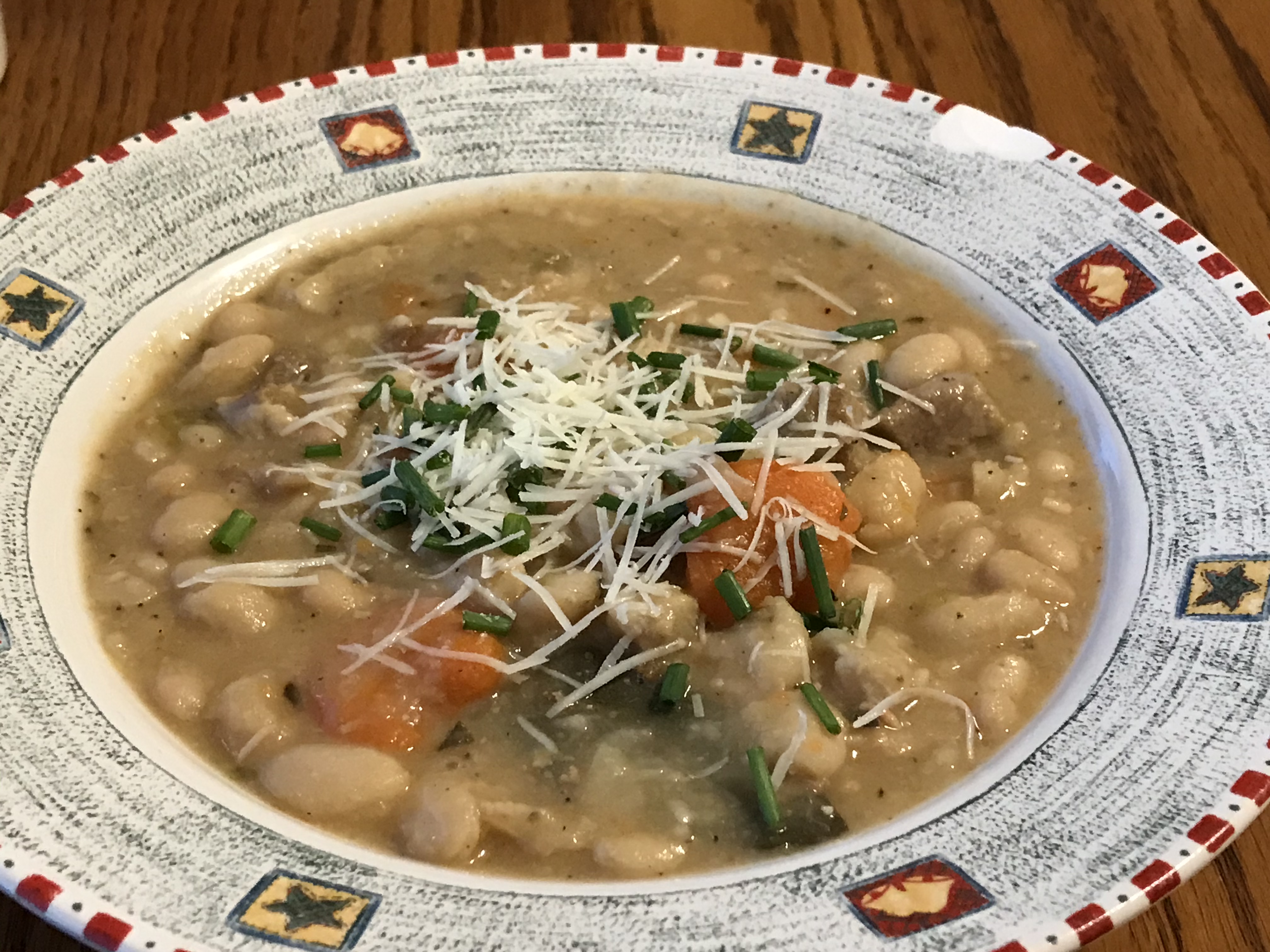
Cook’s Tour of Italy Menu 27 (Pgs. 91 – 92): Piedmontese Pork and Beans

            It seems like every cuisine that includes pork has some form of pork and beans, often using cured meat. Think of ham and bean soup, baked beans flavored with bacon, and the like. The pork and fat add flavor to the relatively neutral beans, which in turn stretch the meat while providing protein of their own. The particular type of pork, type of beans, flavorings and thickness all vary, but the basic idea is the same. In this dish, native to the mountainous Piedmont region of Northern Italy, we have pork shoulder and fat, great northern beans, root vegetables and herbs, seasoned with a basic salt and pepper.

            The text notes that this fairly rich dish is traditionally associated with Carnival. Until the 1960s, Catholic fasting rules dictated abstaining from meat for the entirely of Lent, not just the Fridays. Thus, you have traditions like Carnival and Mardi Gras, the last chance to eat meat and rich foods before Lent. In the past, when meat was more expensive relative to income, many people couldn’t afford to celebrate with a roast or other similar centerpiece, but a rich bean dish with substantial quantities of pork and fat was a viable option.

            Ideally, this recipe would use a Dutch oven or stove-safe casserole dish. Since I did not have either of these, I browned the meat and combined the ingredients in a pot on the stove, then transferred the contents to a ceramic casserole dish to bake. A small amount of the mixture didn’t fit, so I put it into a smaller ceramic dish with a cover. After a few hours, everything was finished. It just needed to stand for a few minutes to cool and thicken.

            This was fabulous. The pork was meltingly tender and its flavor, along with that of the herbs, infused throughout the beans. For anyone who wants to eat less meat, whether for health or ecological reasons or both, but doesn’t want to give it up entirely, a dish like this is an excellent choice. Beans are rich in vitamins and minerals and, like a few other plants, restore nitrogen to the soil they are grown in, naturally boosting its fertility. What’s not to love?

Standard
Uncategorized

Cook’s Tour of Italy Menu 43 (Pgs. 137 – 138): Shrimp and “Bass” Risotto with Saffron

            With its abundance of seafood and rice, it is no surprise that Venetian cuisine would feature a number of seafood risottos. Here things are kept simple with shrimp and pieces of bass or other white fish, enhanced with zucchini, shallots and parmesan cheese, but in Venice the options are nearly limitless. One especially interesting example, called risotto nero, is colored black with squid or cuttlefish ink. For this recipe, the color is a surprisingly bright yellow, courtesy of saffron.

            Saffron has a fascinating history. Grown around the Mediterranean since ancient times, its prestige was nonetheless on the level of “exotic” spices from Asia. There were two reasons for this. First, it is really labor-intensive, with each saffron crocus yielding a few strands of the spice. It’s true allure, however, is its color. When added to a bit of liquid, it produces a brilliant golden hue. During the Middle Ages and Renaissance, it was often used to create “gilded” dishes for banquets. While stirring the threads and their steeping liquid into the dish, the color showed itself by degrees, starting with a pale, creamy yellow, gradually deepening into the color shown in the picture.

            Historically, saffron was considered to have medicinal qualities. Unfortunately, in this recipe it gave a distinct medicinal edge to the flavor. In addition, the fish broth used in the recipe is enhanced by simmering with shrimp shells. I’m not sure if it was the brand of broth I used (since I opted not to make my own) or the shrimp shells, but it gave off a powerful fishy aroma while simmering that lingered in the kitchen. Before adding it to the risotto I diluted it to compensate for what boiled off and reduce the strength, but the taste was still strongly fishy and medicinal.

            You might be thinking that fish is supposed to taste fishy, but many white fish like what I used (I think it was haddock, but I can’t remember for sure. It was on sale in the freezer section) have a fairly mild taste. I personally prefer it on the relatively rare occasions that I eat seafood, but that is a matter of personal taste. Unlike many Italian cooks, who view it as culinary heresy, Mr. Famularo has no issue with combining seafood and dairy. The addition of parmesan cheese and butter really helped balance things out. The shrimp weren’t overcooked, the fish cooked up nice and flaky, and the finished dish was actually quite enjoyable once I got used to the strong flavors. That said, if I made this again I’d reduce the amount of saffron. And probably skip the fish broth altogether.

Standard