Uncategorized

Foods Not Eaten: Species Concerns

Angulas (baby glass eels), Jellied Eel, Paling in ‘t Groen (smoked eel), Caspian “000” Beluga Caviar, Payusnaya (pressed caviar), Yan Wo Tang (bird’s nest soup)

Source: 1000 Foods (pgs. 254, 16, 157, 407 – 409, 418, 794 – 795)

            Despite my enjoyment of and devotion to this project, I’m not going to put a vulnerable species in any more danger to check off a box, especially when it would also involve breaking the bank. Thus I will not be sampling glass or European eels, any type of caviar, or bird’s nest soup. The invasive lampreys (a type of eel) in the Great Lakes might be an option if I ever get my hands on one, but there’s no guarantee. Plus, a lot of the foods involving threatened species sound gross.

            A key example are angulas, or 3- to 4-inch-long glass eels, which are a delicacy in northern Spain. They are typically eaten whole after a brief sauté in olive oil with garlic. The text compares them to strands of pasta, but I would rather have pasta. It also goes well with garlic oil, isn’t endangered, and can get a bit of “oceanic” flavor from anchovy paste, if so desired. Jellied eel is exactly what it sounds like: chunks of eel cooked in liquid to extract the collagen, then cooled so the broth congeals. It was once commoner’s food and inexplicably is enjoying a renaissance in popularity in Britain. Smoked eel, a Dutch specialty, sounds a bit better, but not worth the cost, both to the wallet and the ecosystem. Plus, eating eel is linked to the death of an English king.

            In 1135, King Henry I of England had lived for 67 eventful years. The youngest son of William the Conqueror, he had fought with his brothers over the succession. Henry took Normandy from his oldest brother Robert when he was away on a crusade and subsequently imprisoned him, and probably had his other brother William killed in a “hunting accident” to gain the throne of England. He reformed the legal code and fathered something like 20 illegitimate children. Despite this, he only had two children by his first wife, a son and a daughter. A few years after the death of his first wife, his son, William Adelin, died in a drunken ship accident in 1120, leaving only his daughter Matilda. At the time she was married to the Holy Roman Emperor and living in Germany.

            King Henry married again, but his second marriage was childless. The reason is unclear, since his second wife remarried after his death and had several children. Regardless of why, the lack of a legitimate son put the succession in doubt, so when the Holy Roman Emperor died Henry recalled his daughter Matilda and had his barons swear loyalty to her as his successor. While she was capable, having ruled Germany as regent during her husband’s absence, and female rulers were not unheard of, guaranteeing her succession was going to be a challenge. A particular issue was that she was a childless widow. To remedy this, Henry married her to a French count named Geoffrey of Anjou, whose lands bordered his own. While the marriage got off to a rocky start, eventually the couple had three sons. In 1135, the eldest, the future Henry II, was 2 years old.

            This is where the lampreys come in. After spending some quality time with his grandchildren and going hunting, the king was hungry. For dinner, he requested lampreys, a parasitic eel with a scary-looking mouth. The story goes that his doctors warned him against it, but King Henry ignored them. Soon after, he became ill and died. Whether the lampreys had anything to do with it or if he simply caught one of the many infectious diseases rampant at the time is unclear, but ultimately doesn’t matter. His death touched off almost 20 years of civil war called The Anarchy, pitting Matilda against her cousin Stephen. Eventually a settlement was reached. Stephen kept the throne but recognized Matilda’s son Henry as his heir, setting the stage for almost 250 years of Plantagenet kings.

            While there are no such stories tied to caviar, obtaining it would not only break the bank, but also international sanctions, at least for the most highly-prized beluga variety. At one time, caviar was less desirable than the sturgeon it came from and so was sold cheap. In some cases, it was even served as a thirst-inducing bar snack, sort of like pretzels or peanuts are today. With multiple people sticking their hands in and with hand washing rates lower than today without running water, I shudder to think of how gross the dishes got. As sturgeon stocks became depleted and people living far from the Caspian Sea became interested in caviar, the price rose. This encouraged overfishing and worsened the problem.

            The shift in interest from the fish to its eggs had another consequence. When the fish were hunted primarily for their flesh, both male and female specimens were equally valuable. While the flesh was still eaten and appreciated, the rising value of caviar created an economic incentive to focus on the females. The resulting imbalance made it harder for the population to recover. Another difficulty is that the prehistoric-looking sturgeon takes a long time to reach maturity. While fishing quotas and breeding programs have been established, and there has even been some success in live-harvesting eggs for market, illegal fishing keeps the species’ future in doubt.

            Then there’s the issue of international sanctions. Only Russia and Iran have sturgeon fishing rights in the Caspian Sea, and as you’re probably aware, both have atrocious human rights’ records. Many countries have rightfully banned or restricted imports from the two countries. Thus beluga caviar, both the regular and pressed (made from eggs damaged in shipping) varieties, is difficult to find. And really, how could fish eggs be a better salty appetizer than cheese, potato chips, or salted nuts? Not only are these a tiny fraction of the cost, they come with the added benefit of not supporting aggressive, murderous dictators. That is something we should all be able to get behind.

            Finally, we come to bird’s nest soup. It has nothing to do with a pile of twigs that robins keep trying to set up behind the porch light. Rather, it is made with the gelatinous saliva of a bird native to Southeast Asia, which hardens to form their nests. While congealed bird spit does not have much flavor on its own, bird’s nest soup is beloved in much of China for its texture. Personally the gelatinous texture sounds unappealing, but different cultures have different tastes, just like different people.

            Here’s how the process works, or is at least supposed to. Tiny swiftlets build their nests in bat caves during the spring. In summer, when the birds are done using them, the nests are harvested from the cave walls. Most commonly they are cleaned, simmered in chicken broth with a few other flavorings, and served for at least $40 per bowl (text, pg. 795). That’s in 2014 dollars, so the number now is probably even higher. The rarity accounts for the cost, as does the danger in harvesting the nests. In addition to being found in bat caves, the nests are built high on the walls. Essentially, the harvesters are risking both falls and rabies.

            If the process works like it’s supposed to, no birds are harmed and the harvesters are well-paid for the danger they face. But with such high profits to be made (the nests cost hundreds to thousands of dollars per pound), there are often unethical characters involved. There are reports of knocking baby birds out of the nests to harvest them earlier, and there is always the concern about workers being exploited by whoever runs the operation. Even if both situations are uncommon, I’m not comfortable with it. Then there’s the issue of paying exorbitant fees for wild animal saliva.
Standard
Uncategorized

Foods Not Eaten: Brains and More Brains

Cervelles au Beurre Noir, Cervello Arreganata, Hirn mit Ei

Source: 1000 Foods (pgs. 72 – 73, 178 – 179, 295)

            The above dishes are brains with blackened butter, brains baked with breadcrumbs, and brains with scrambled eggs. Personally I think they all sound gross, but through much of history, brains were a delicacy. Supposedly their high fat content gives them a rich flavor and creamy texture, but no matter how delicious they are, I’m not risking Mad Cow and other prion diseases. Even a very low chance of infection is not worth it. Health regulators seem to agree. Cow brains in particular are very hard to come by in the US, at least in an edible form.

            It’s considerably easier to get them as lab specimens. Preserved in formaldehyde, brains are available to order from lab supply companies. While potentially dangerous chemicals have restrictions on who can buy them and where they can be delivered, anyone with a credit card can order a cow brain and have it delivered to their doorstep. It would be even more inedible than it was before, but observing the cells with a microscope is an interesting experiment. I clearly remember comparing cells from pig brains with other cells in high school biology, but had no desire to eat them. They were slimy and generally didn’t look like anything like food.

            While I understand the virtue of nose to tail eating, eating brains is going way too far. Whatever goes into hot dogs is fine, since it’s salted, seasoned, and ground up to mask any weird flavors and textures. Oxtails are no problem. They make great stew. I could do pigs’ feet. They seem like a lot of work for not that much meat, but that’s no different than chicken wings. Even liver is a possibility if it’s cooked properly and heavily seasoned. Maybe. But brains are different. Once the animal is slaughtered, the brains belong in a lab, not on a plate.

Standard
Uncategorized

More Stale Bread and Tomatoes: Crostini

Source: 1000 Foods (pg. 185)

            In many cultures, toast is a common breakfast food. This probably originated with people wanting to revive and use up the previous day’s bread that was starting to get stale. It’s also quick and easy to make before the morning’s work, whether in a field or an office. Toasting causes the Maillard Reaction, which browns the bread and adds flavor. In Italy, small, thin slices are called crostini, while slightly thicker ones are called bruschetta.

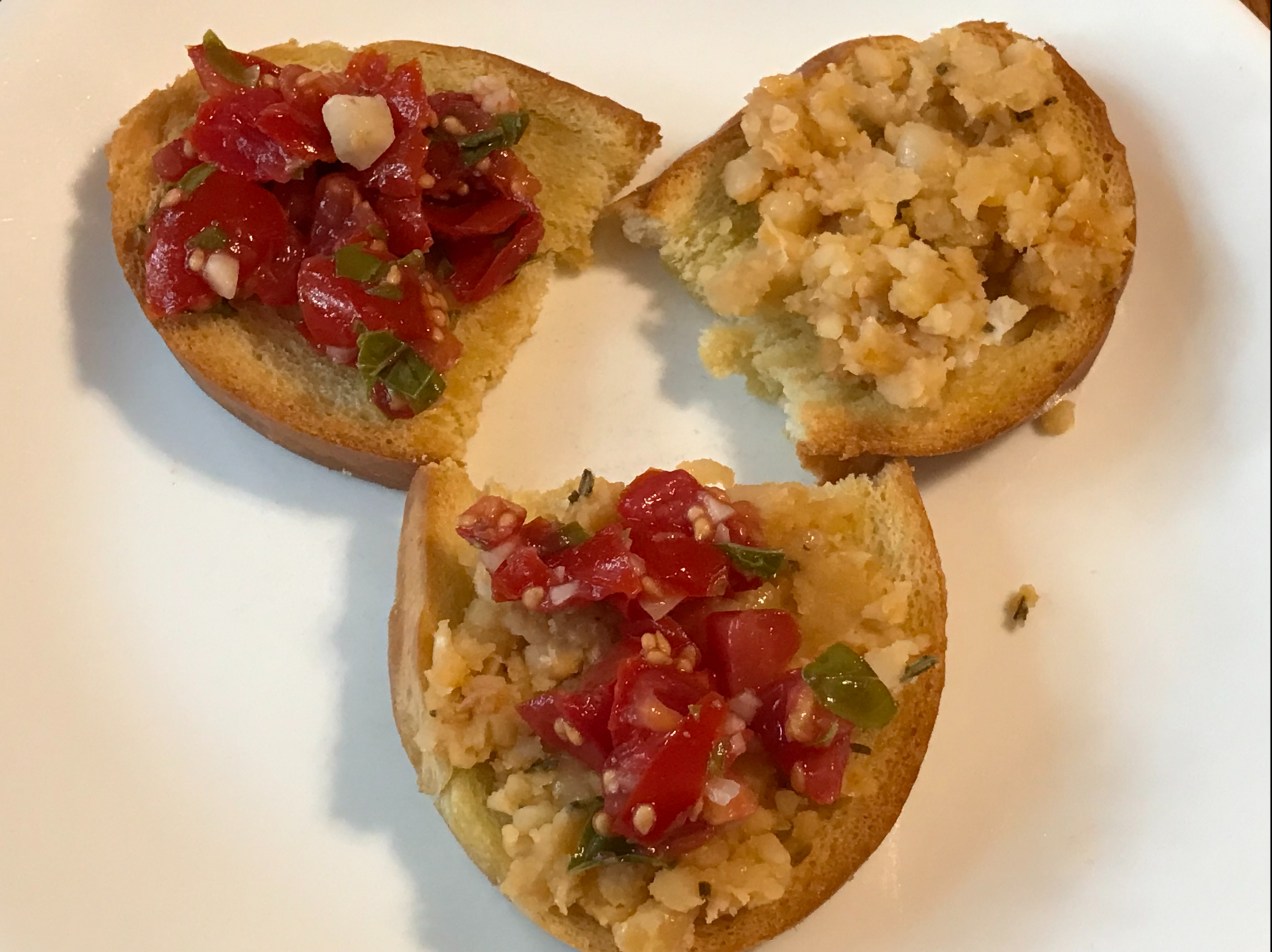
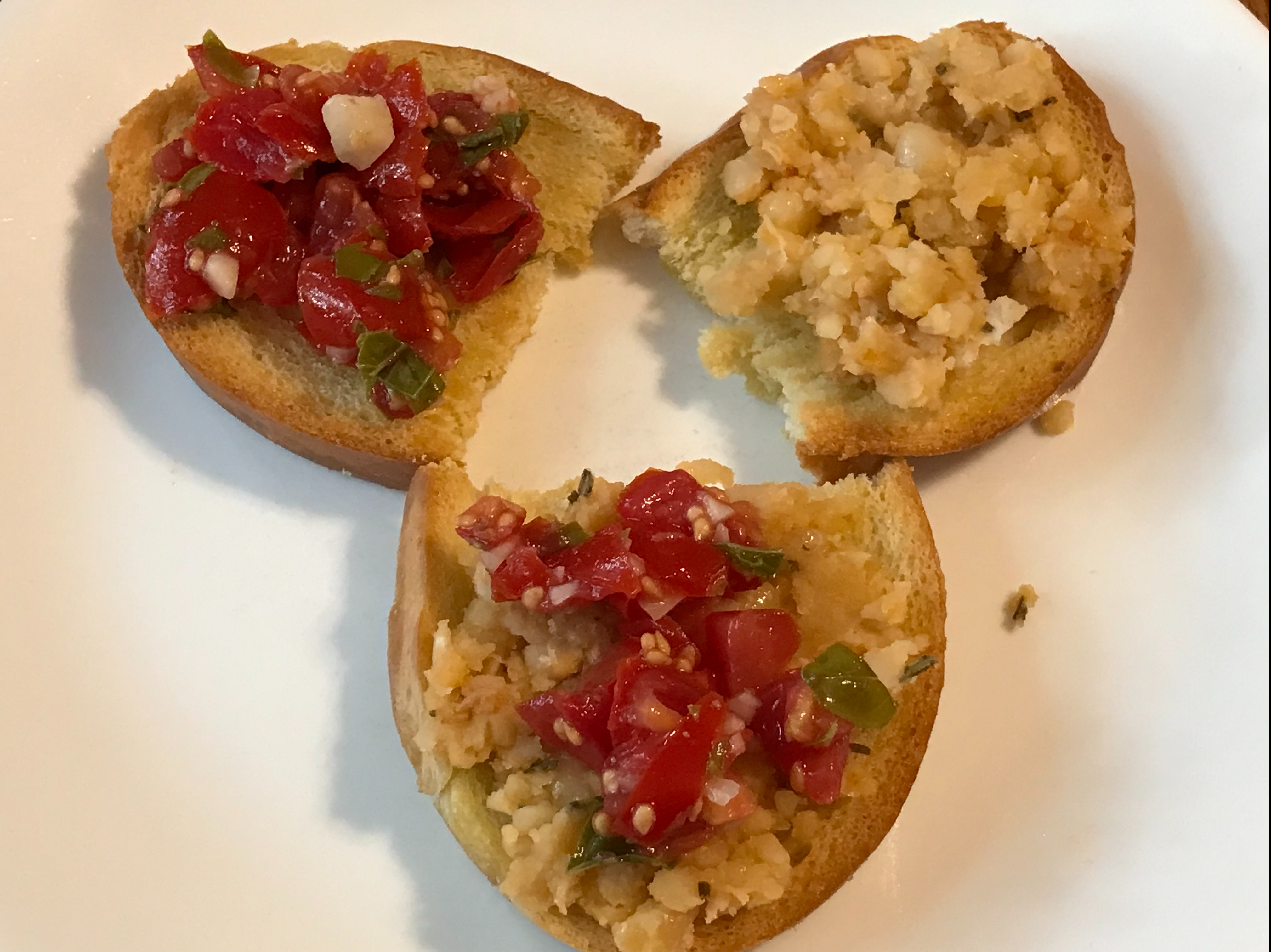
            Whatever you call it, toasted bread is a great vehicle for whatever toppings might be desired. One of the most popular toppings is a mixture of tomatoes, basil, and garlic. Southern French tapenade is made from olives. In Tuscany, one popular topping is made from chicken livers. Another is made from white beans, which Tuscans are famous for consuming in all sorts of ways. While the book was full of praise for the chicken liver version, I couldn’t bring myself to try it. Maybe I’ll manage it someday in the future, but with what they look like and knowing what the liver does, we’ll see.

            The white bean version was very tasty. Roughly mashing the beans with olive oil, garlic, lemon juice, herbs, and a bit of tomato and hot pepper produces a wonderful savory spread. The soft beans and crisp crostini contrast and complement each other. Despite my usual dislike of tomato-forward dishes, I even enjoyed the tomato-basil version. It was at once sweet and sour from the tomatoes, aromatic from the basil, and pungent from the garlic. I probably added a bit too much garlic, but it was still delicious. The best crostini, however, had some of both toppings. The richness of the beans with the intensity of the tomato mixture was just about the perfect combination. Just make sure to brush your teeth after.

Standard
Uncategorized

Bulgarian Chopped Salad: Shopska Salata (with feta)

Source: 1000 Foods (pgs. 386 – 387)

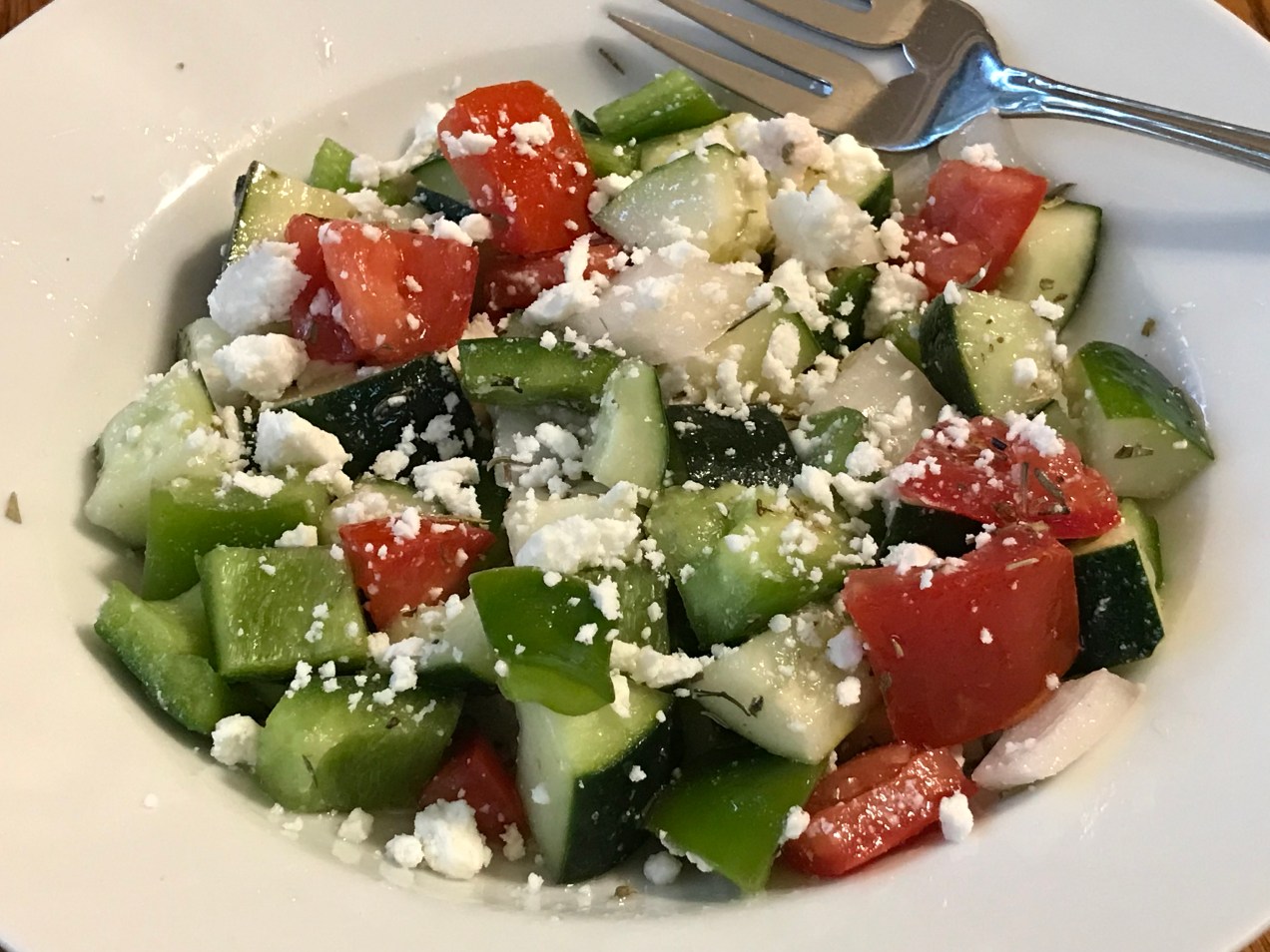
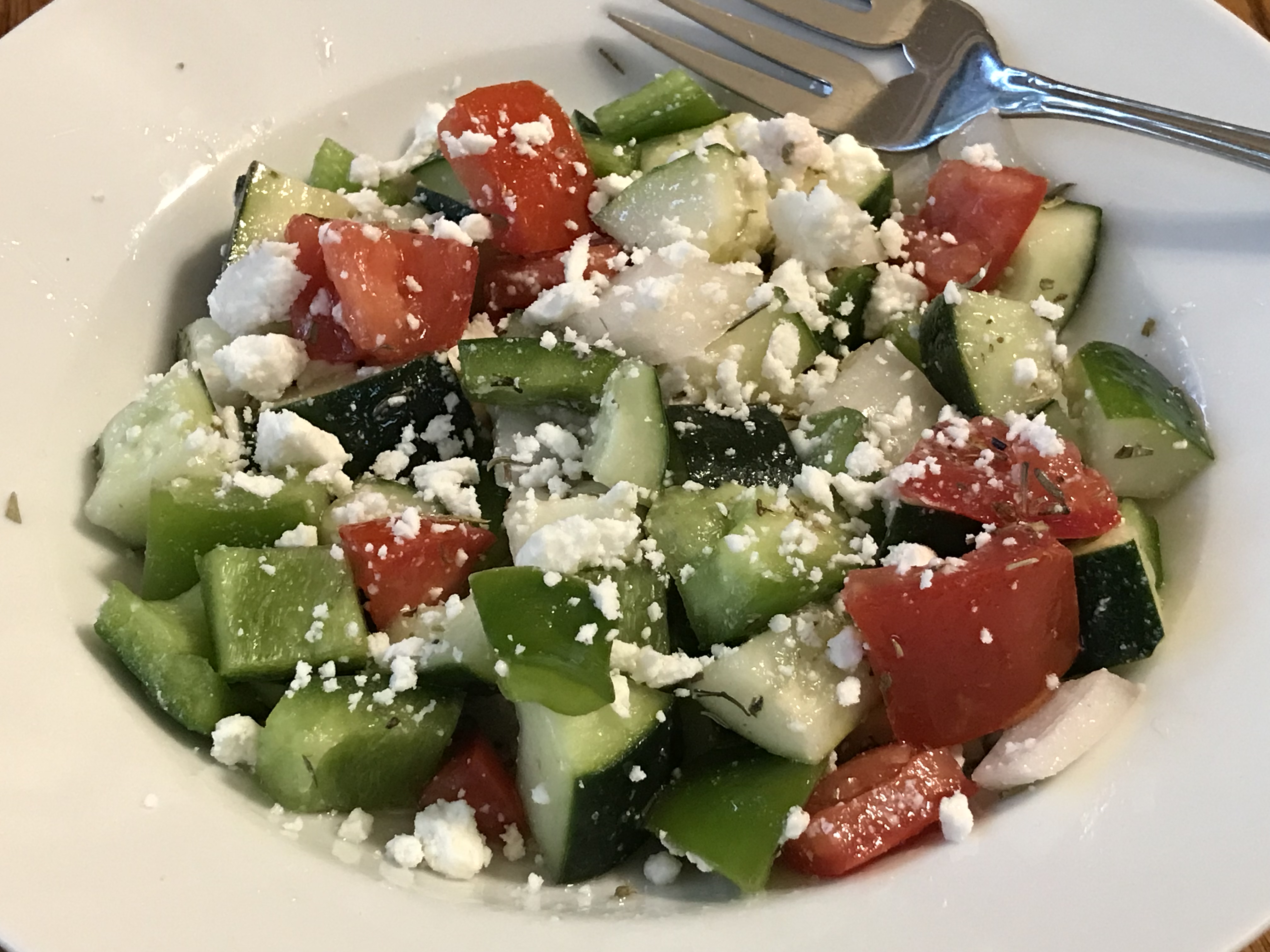
            Another popular vegetable dish in Bulgaria in Shopska Salata, a brightly-colored salad topped with feta cheese. Loaded with cucumber, tomato, green pepper, and onion, it’s a crunchy and flavorful blend that invokes summer (or early fall, when there are still fresh vegetables in season). This mixture is enhanced with salt, pepper, garlic, vinegar, oil, and the herb savory, which is called chubritsa in Bulgarian. The oil can be olive or sunflower. In a region at the juncture of the Mediterranean and Eastern Europe, either would be common.

            One factor that often distinguishes particular cuisines is the type of fat used to cook with. Around the Mediterranean, olive oil has been predominant for millennia. In Northern and Central Europe, lard was the primary fat, supplemented with butter. The same was true in Eastern Europe, but there was an issue. While the Catholic Church allowed butter during Lent from the Late Middle Ages onward, the various Eastern Orthodox churches continued to prohibit it. This was a problem in mostly Orthodox regions north of where olives could grow, such as Russia and Ukraine. When a cheerful plant with lots of oily seeds was introduced from the Americas, it quickly filled entire fields.

            Sunflowers are annuals. Since they go through their entire life cycle in one growing season, cold winters don’t matter. As long as there is good soil, adequate water and space, and plenty of sun during the summer, they will be ready to harvest in a matter of months. Sunflower oil is popular in salad dressings across Eastern Europe, which is a custom worth copying. It’s low in saturated fat, and more oil production means more fields of joy. Any cut for decoration last for several days in a vase (or at least mine did), and sunflowers can even remove toxins from the soil. Once the spent heads dry out, I’m hoping to save the seeds for next year. Then I’ll need to find space for them. Not to produce my own oil, just to have.

            Feta cheese enriches the chopped vegetables nicely. It makes the salad more substantial, adds a nice salty/tart flavor, and the white topping contrasts with the red and green vegetables. Bulgarian cheesemakers produce their own version of feta, similar to the Greek method. Usually made from sheep’s milk, the cheese is submerged in a salty brine to cure and preserve it. I had the opportunity to try Bulgarian feta at the farmers’ market but didn’t care for its strong, funky flavor. Here I used a milder feta from the goat’s milk cheese stand and it worked really well.

Standard
Uncategorized

Kitchen Sink Vegetable Stew: Ghivetch

Source: 1000 Foods (pgs. 383 – 385)

            Before modern shipping and preservation, fresh vegetables were only available for part of the year. From late fall into the following spring, people had to rely on canned, frozen, dried, salted, and pickled options. Sometimes roots, cabbages, and apples could be kept over the winter in a cold cellar. After months of a monotonous diet, variety reappeared as fresh produce came into season. By late summer, there were so many vegetables people had to search for creative ways to use them. Even with modern technology, some things have not changed.

            In Romania and Bulgaria, one way to take advantage of/use up the late summer bounty is to make the vegetable stew ghivetch. The specific vegetables can vary, but according to the text, ideally there should be at least 20 of them. I counted 18 in the recipe which is supposed to serve 12 as a side dish. The side dish portions must be huge, because even after eliminating the okra and reducing the quantity of leeks and cabbage, the recipe still made enough to fill an entire roasting pan 6 to 8 inches deep. Even after putting half in the freezer and giving a container of it to a neighbor, it was hard to eat it all. Fortunately it tasted good, especially with a sprinkle of feta cheese.

Standard
Uncategorized

Georgian Dinner

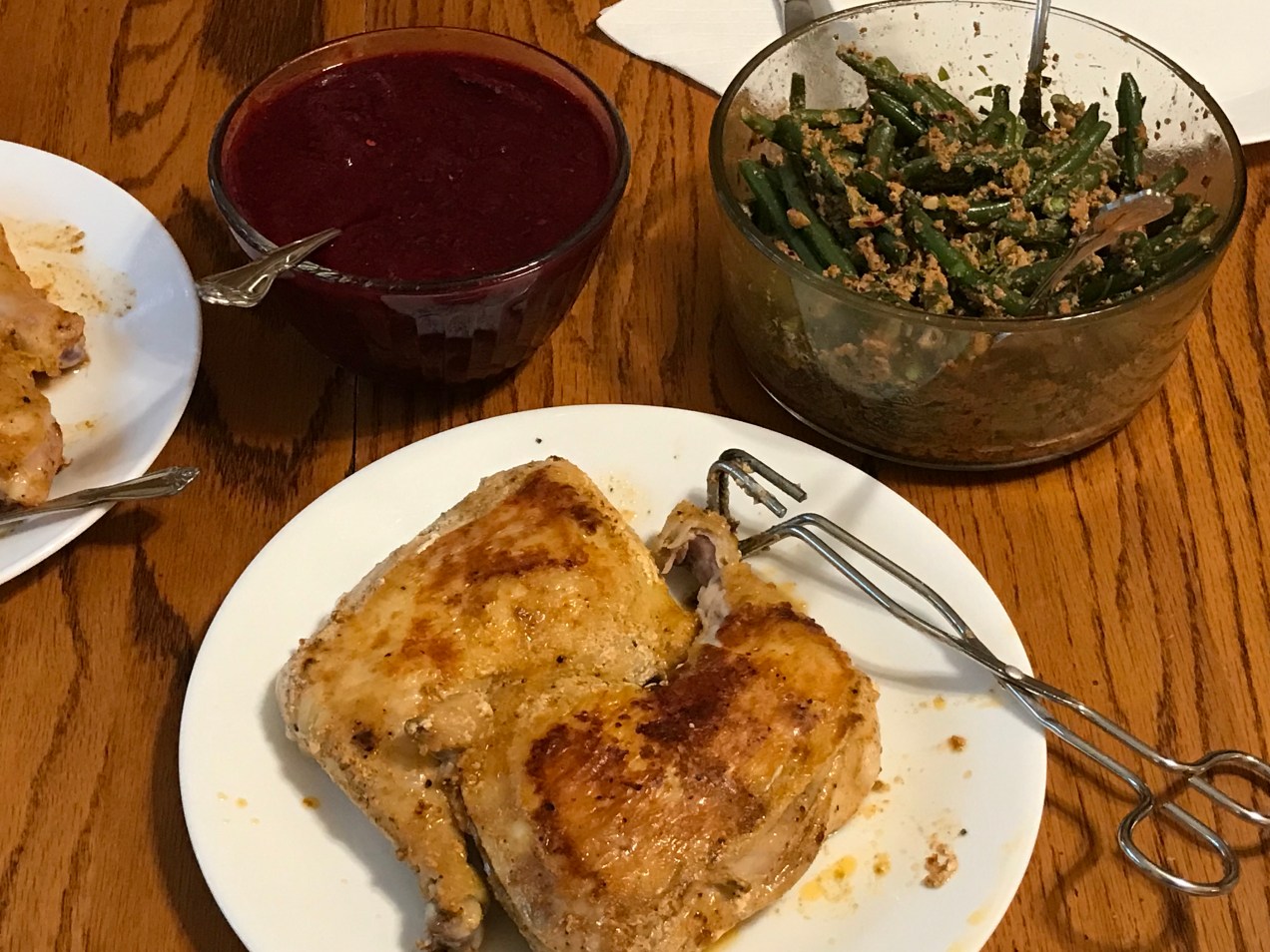
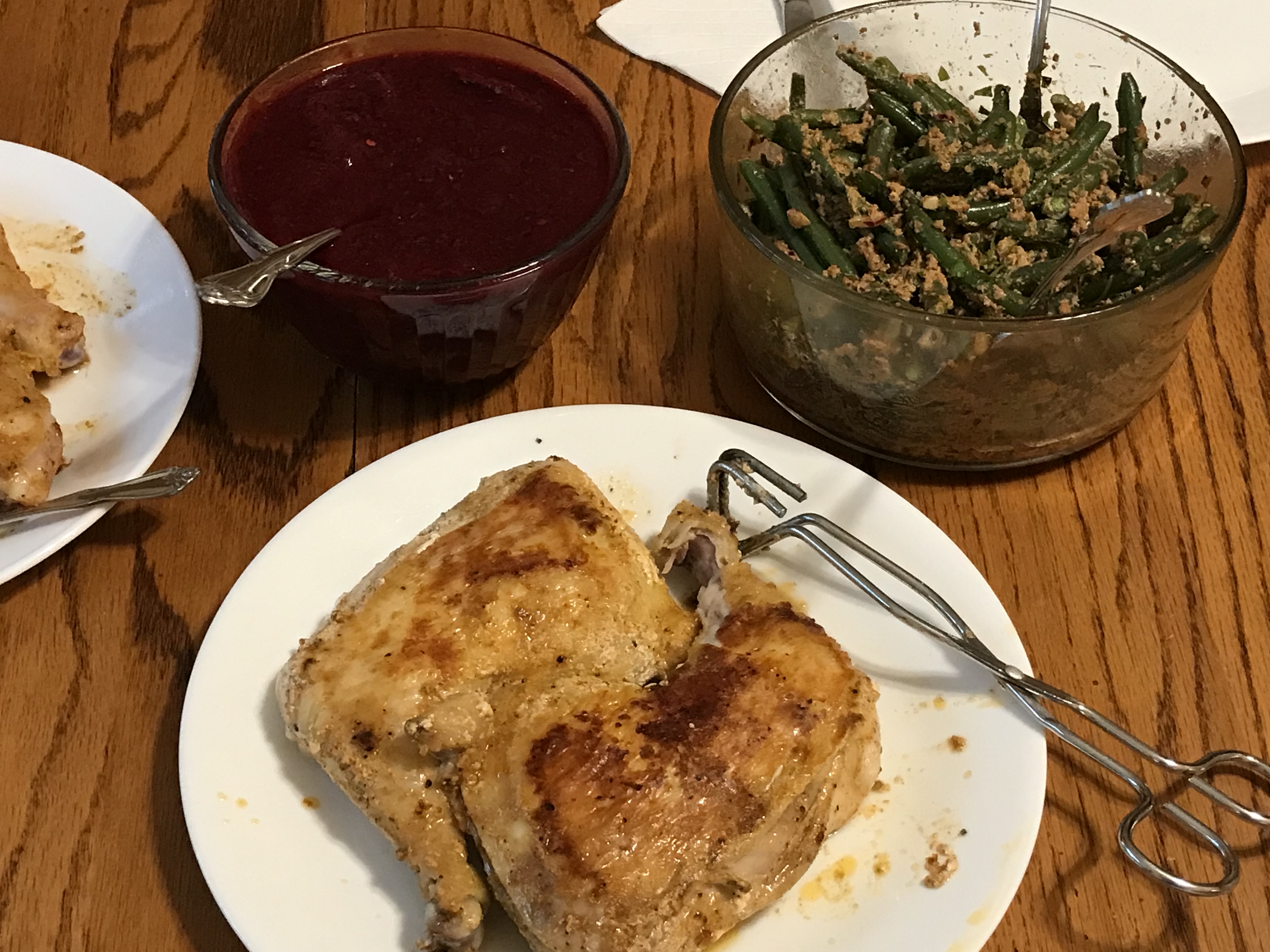
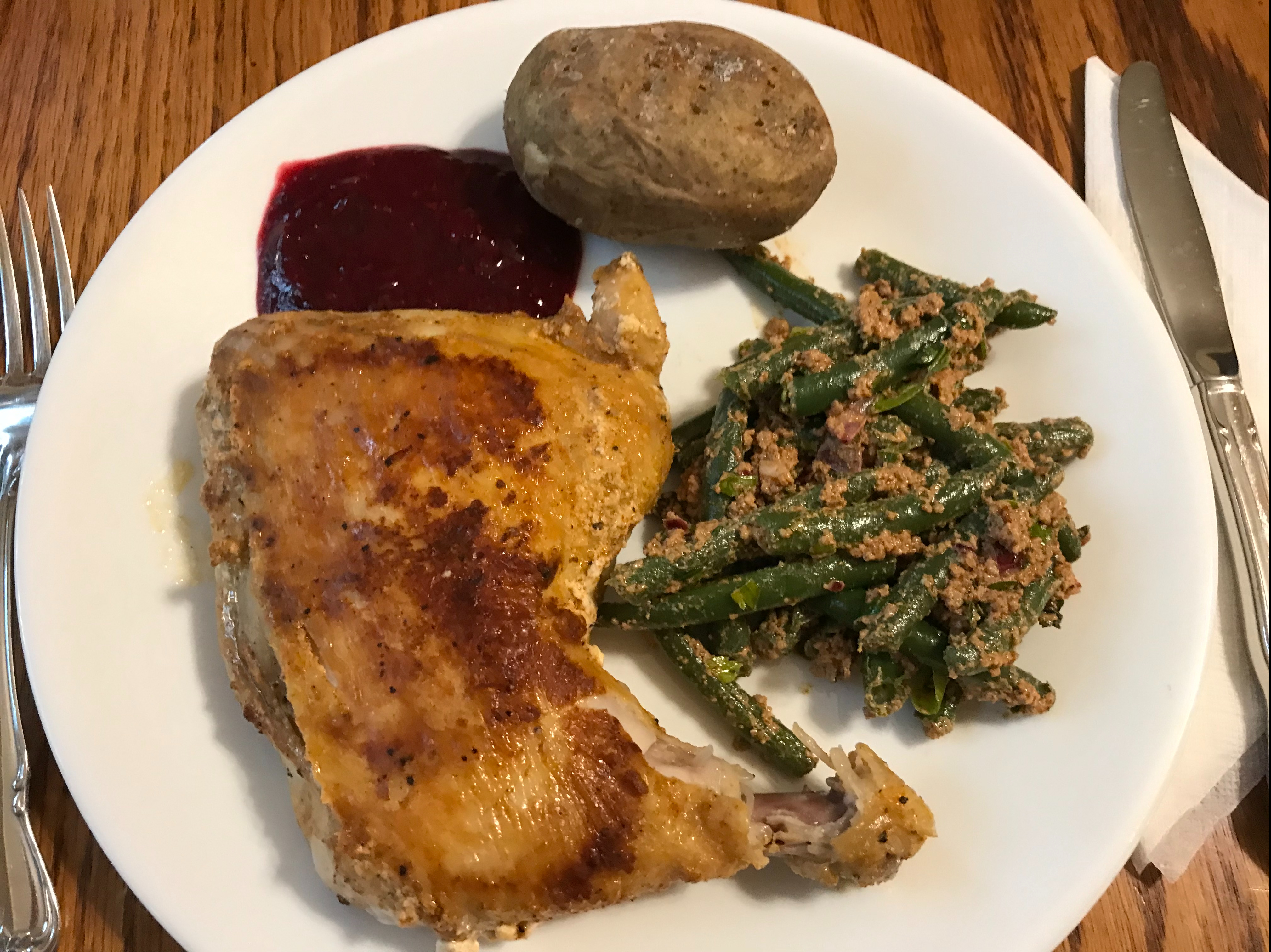
Menu: Chicken Tabaka with Tkemali (plum sauce), Lobio Satsivi (green beans with walnut sauce)

Source: 1000 Foods (pgs. 389 – 392)

            In this case, the word Georgian does not refer to the British historical period of the 18th and early 19th Centuries. Nor does it refer to the state in the Southeastern United States known for its peaches. Rather, we are referring to the country of Georgia, located in the Caucasus on the eastern edge of the Black Sea, between Russia, Turkey, Armenia, and Azerbaijan. The terrain is mountainous, but the climate is moderated by proximity to the sea, creating a favorable environment for growing vegetables, fruits, and nuts.

            Sour plums are the base of Georgia’s most popular sauce, tkemali. Ms. Sheraton refers to it as a sort of “Georgian ketchup” that can be used with pretty much anything. The sweet-tart plums are cooked and combined with garlic, fresh herbs, spices, and chili pepper for a fascinating mix of sweet, savory, and aromatic. Based on the recipes I looked at, it is not a major issue if the usual sour plums are not available. The sauce didn’t taste overly sweet, probably because the plums are cooked with the skin, where most of the sour flavor is. Another benefit of cooking plums with the skin is to release the red and purple pigments found there.

            An interesting thing about the tkemali was how its flavor evolved over a few days in the fridge. At first the garlic and cilantro were the strongest flavors, but gradually it became fruitier and more minty. I’m not sure why this happened, but at all points the sauce was a flavorful accompaniment to the chicken. While adding a fruity sauce to vegetables is uncommon in the US, it is often added to green beans in Georgian cuisine (text, pg. 390). They already had walnut sauce here, but the idea sounds good. It even worked well with baked potatoes.

            The chicken was less successful, but improved on the second day. A flattened whole chicken is rubbed with salt, garlic, hot paprika, and sour cream, placed in a skillet to fry, and another skillet is placed on top, weighted down with something heavy. Since I didn’t feel comfortable trying to flatten a whole chicken, I used thigh/drumstick quarters and weighted them down with a heavy pot half full of water.

            For some reason, after the given amount of time plus a little extra, the chicken was nowhere near done. At first I was confused, since the quarters are smaller than whole chickens, but I think there is a scientific explanation. Water has a very high specific heat, meaning that it can absorb (or release) a lot of energy without its temperature changing much. That makes it a great industrial coolant, but probably not the best choice for weighting down chicken being cooked. Most likely, some of the heat that was supposed to be going into the chicken went into the water instead. This process might have worked if the water was heated first, but after some time in the oven to reheat the texture and flavor were much better.

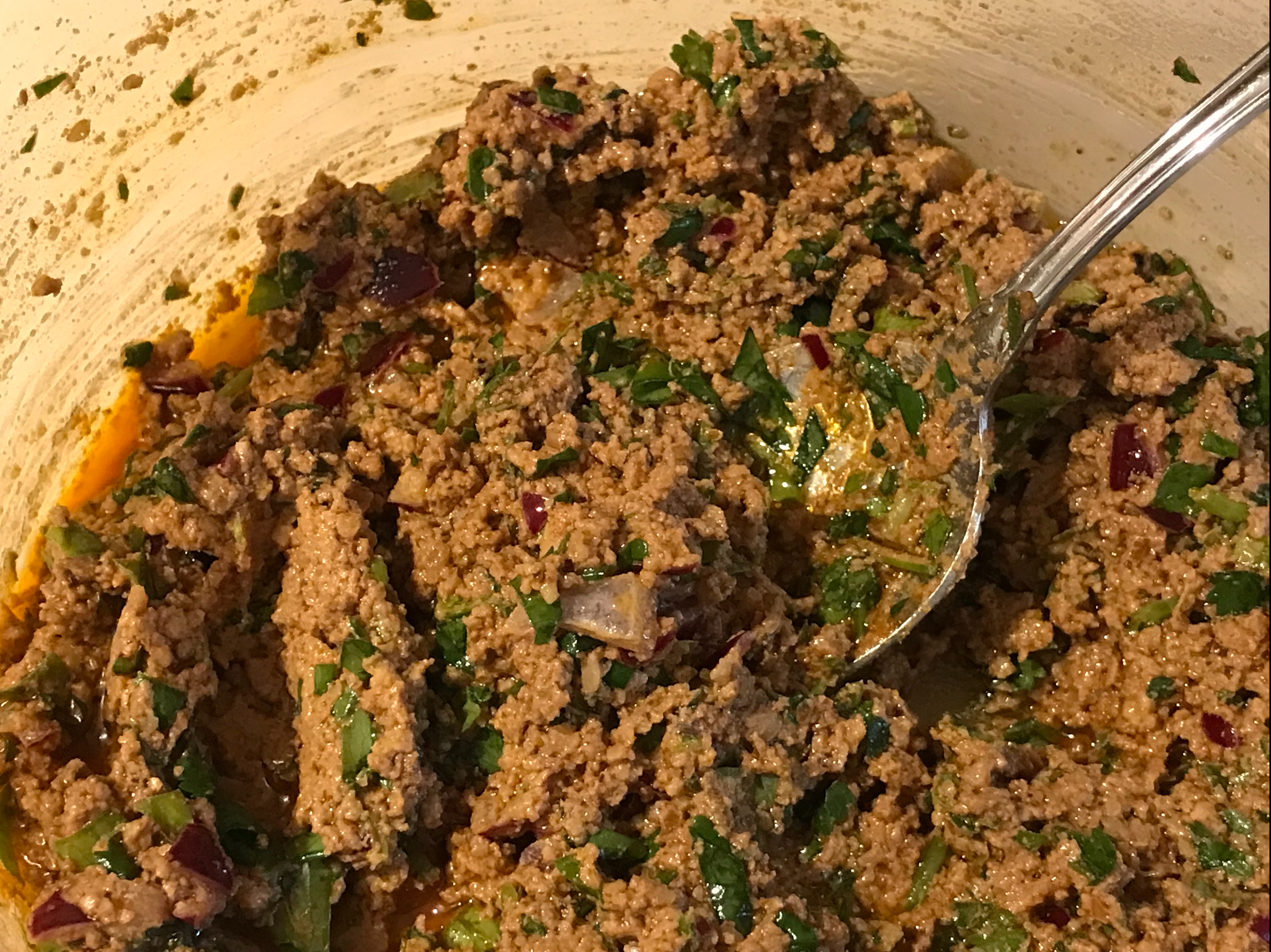
            My favorite dish here was the green beans. After being lightly cooked, they are tossed with a sauce that resembles pesto without the basil. These types of sauces, where ingredients are chopped or ground together with a small amount of liquid, have a long history. Ancient Romans combined things like herbs, spices, dried fruit, vinegar, oil, and the fish sauce garum with a mortar and pestle to make thick, strongly-flavored sauces. Medieval cooks did much the same, but ditched the garum and often added almonds, walnuts, or bread crumbs as thickeners. At a time when people ate with their fingers, this all made perfect sense. Thinner sauces would be a lot messier.

Not cat food

            The walnuts are dominant in the sauce, enhanced by garlic, cilantro, and paprika, which seem to be core flavors in Georgian cuisine. Vinegar and oil add another layer of flavor, and bits of chopped red onion and parsley add extra crunch and color. The sauce was amazing on fresh seasonal beans, and would probably make out-of-season frozen beans a lot more interesting. Ms. Sheraton suggests serving them with “southern fried chicken or barbecued beef and pork in the other Georgia.” (Pg. 389) This good idea becomes even better when compared to salads coated in the bacterial breeding ground known as mayonnaise.

Standard
Uncategorized

Looking Back at Summer in America: Corn on the Cob, Watermelon

Source: 1000 Foods (pgs. 549 – 550, 636 – 637)

            Corn on the cob is a classic taste of summer. Or is it? Outside of the US, and even in some parts of this country, it is uncommon. This interesting quirk of regional cuisine was brought up at a family reunion recently. Relatives from New York and Virginia were especially excited about the fresh corn on the cob because it is harder to come by there. We were even told that if you imagine the worst corn in Wisconsin, you’re also imagining the best corn in New York. I was surprised, but it does make sense. Sweet corn becomes starchy very quickly after being picked, so getting it to market as soon as possible is essential. With cities more sprawled together on the East Coast, there are fewer places to grow corn and those places are farther from the markets. This means less availability and longer transport times, with the sugar turning to starch all along the way.

            Meanwhile, one of the stereotypes about the Midwest is true. There really are cornfields everywhere. Though most of this is field corn destined to feed animals, particularly cows, sweet corn is widely grown. While there are big cities, they tend to be more spaced out and often have cornfields in between, making timely shipping feasible. Very good corn is available in supermarkets from late July through August, and farm stands sell corn picked only hours ago. Some will even peel it for you. Then you can go home, melt some butter while the corn cooks, and dig in. It does tend to be a bit messy, but that’s part of the fun. Enjoy it while the season lasts.

            Another particularly seasonal treat is watermelon. Originating in Southern Africa, it gradually made its way north, eventually reaching Europe and the Americas. Over the centuries, it was bred to be larger, sweeter, and more brightly colored. The reasons for its popularity are clear. It’s sweet, juicy, and generally refreshing in hot weather. Prices are fairly low during the summer. Before it is cut, the rind provides protection against spoilage, another benefit in the hot Southeast and Midwest before widespread refrigeration. As mentioned in a previous post, watermelon is one of the best healthy desserts out there. But like summer, watermelon season eventually comes to an end. The expensive, out-of-season melons just don’t compare. Come fall, you’re better off switching to apples.

Standard