

Source: 1000 Foods (pgs. 123, 102 – 103, 99 – 100)
As promised, here is a brief(ish) explanation of Lothringia, from which the region of Lorraine got its name. The tradition among Frankish kings was to divide their territory among their sons upon their death. As you might imagine, this led to kingdoms fracturing and going to war with each other almost every generation. The Merovingians, who ruled the Franks from the late 5th Century to 751 AD, weakened themselves this way, and Charlemagne’s dynasty, the Carolingians, followed a similar pattern. Charlemagne’s father Pepin usurped the throne in 751 and died in 768, dividing his kingdom between Charles (Charlemagne) and his brother Carloman. Upon Carloman’s death a few years later, the realms were reunited.
Charlemagne had three legitimate sons reach adulthood, but by the time of his death in 814, only Louis the Pious survived. While this was unfortunate for the other two sons, it was probably fortunate for the empire (Charlemagne had been crowned Holy Roman Emperor in 800), which held together for another generation. Louis had three sons, Lothar, Louis, and Charles, and they didn’t like each other. Even before Louis’ death in 840, they began to fight. The whole story is a complicated mess of shifting alliances, and Lothar and the younger Louis even imprisoned Louis the Pious on two separate occasions. The disorder opened the door for Viking attacks, particularly from the 830s onwards.
In 843, a settlement was reached at the Treaty of Verdun. Lothar, the eldest, got the imperial title and a territory wedged between the other two. His kingdom, not-so-creatively called Lothringia, encompassed the Low Countries, the northeast corner of modern France, part of Burgundy in eastern France, part of Switzerland, and most of Italy. Louis got East Francia, which encompassed most of Germany and Austria, and Charles got West Francia, centered on France. Over time the West and East Frankish kingdoms developed separate French and German identities. Later in the 9th Century the king of Lothringia died without an heir, setting the stage for a over a millennium of fighting over his territory. The Holy Roman Empire centered on the increasingly disunified German states, France often sparred with the Empire, and Lorraine was caught in the middle.
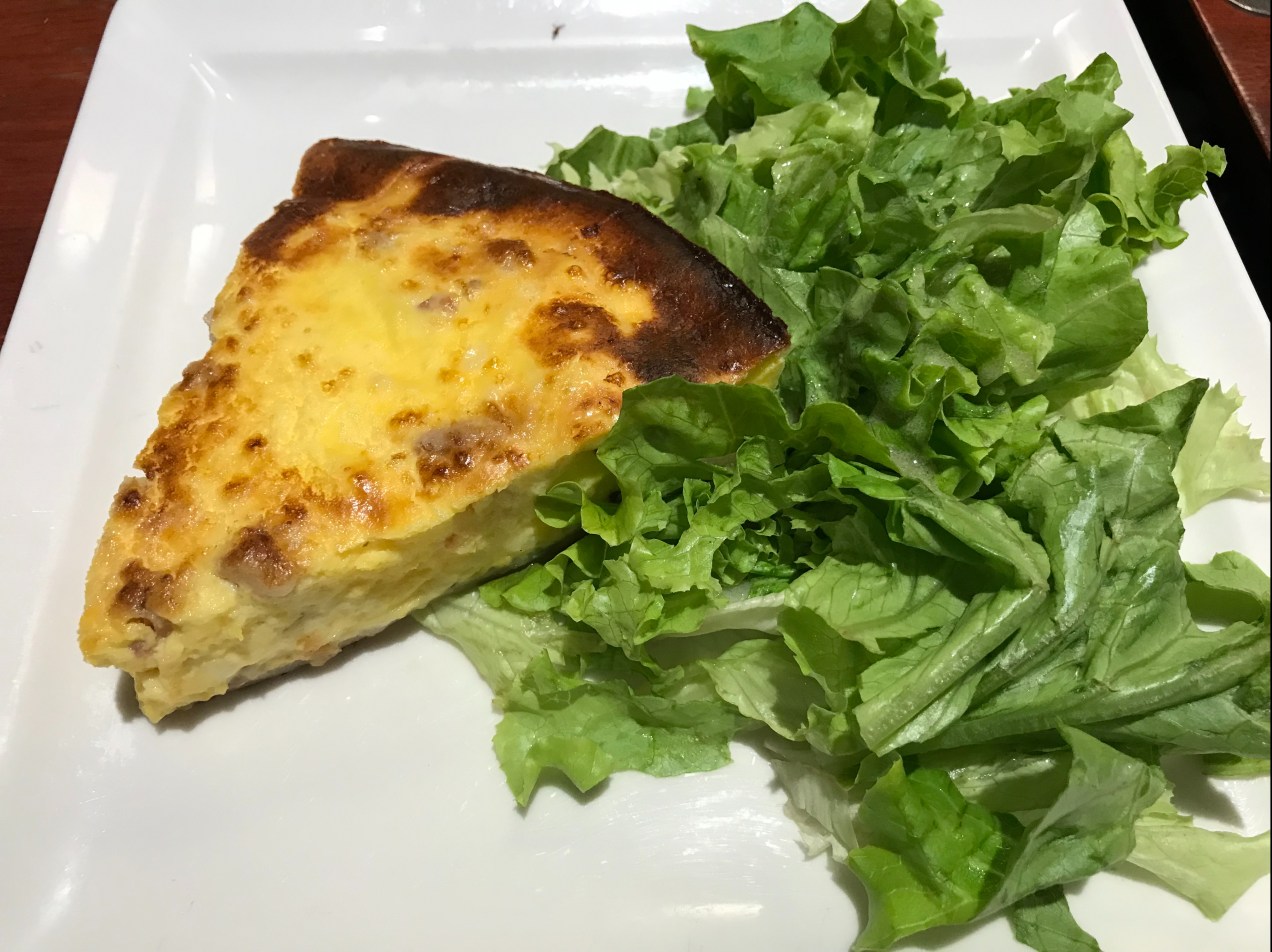
Now part of France, Lorraine and Alsace to the east have both French and Germanic influences in the local culture. Some dishes there, particularly in Alsace, have clear German origins and even names (particularly baeckeoffe, a mixed-meat stew with sauerkraut, bireweche, a spicy Christmas bread, and kugelhopf, a yeast coffee cake). The origin of Quiche Lorraine is a lot less certain. At its simplest it is just a nutmeg-scented custard in a pastry crust, both elements widespread across Europe. Bacon is usually added, but authentically a Quiche Lorraine does not have cheese, onions, or leeks, which would make it Alsatian. None of the additions give much of a clue on cultural origin, but ultimately, it doesn’t matter. Quiche Lorraine, and other variations, have an appeal that goes far beyond their native regions.
While in Amboise, a few of us came upon a café with a reasonably priced lunch special, which included dessert. The pastry and custard in the Quiche Lorraine were both very good, but to be honest I prefer the Alsatian version. Onions or leeks add an extra layer of flavor, and are often included in American versions. The great thing about quiche is that you can customize it to your taste. Onions, broccoli and cheddar, spinach and feta, dates and bone marrow, anything can be added as long as it doesn’t have too much water, which could make the custard split. The last option might not be very popular today, but it was a common Medieval recipe called “Lombard custard.” Whatever strikes your fancy is available, as long as you have an oven. It might not be Quiche Lorraine, but it will probably be delicious.
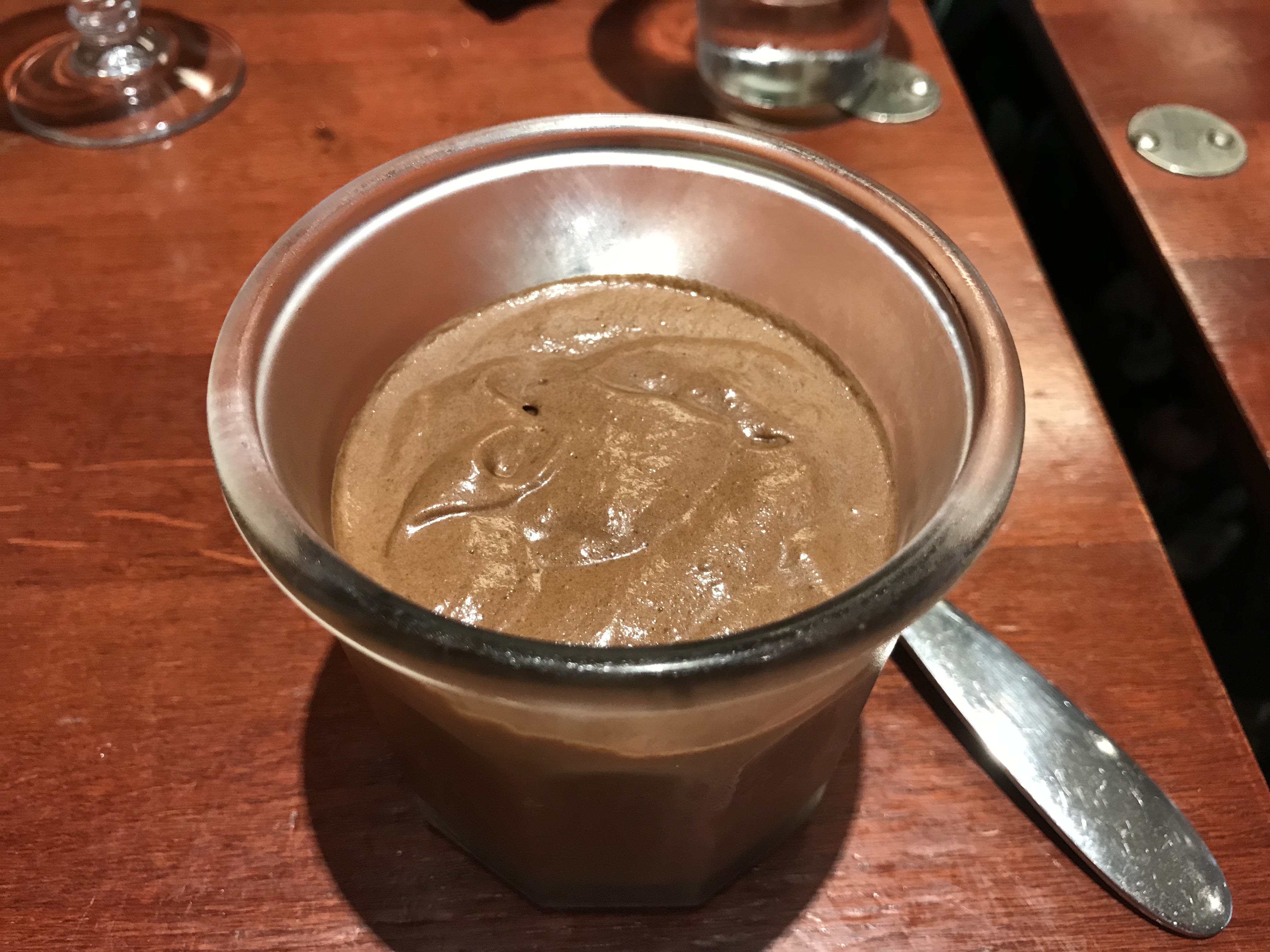
Also relatively easy to make at home is chocolate mousse. The trick is to whip tiny air bubbles into egg whites and/or cream and avoid deflating them when adding the other ingredients. Follow the recipe (I like the food network recipe but omit the espresso powder), gently fold in the egg whites or cream until just combined with the other ingredients, and in the worst-case scenario it will be more like a pudding. Just be careful if the recipe contains raw eggs, which many do. Often the egg yolks are cooked a bit with the chocolate while the whites are left completely raw. This is no worse than eating cookie dough, but it does need to be mentioned.
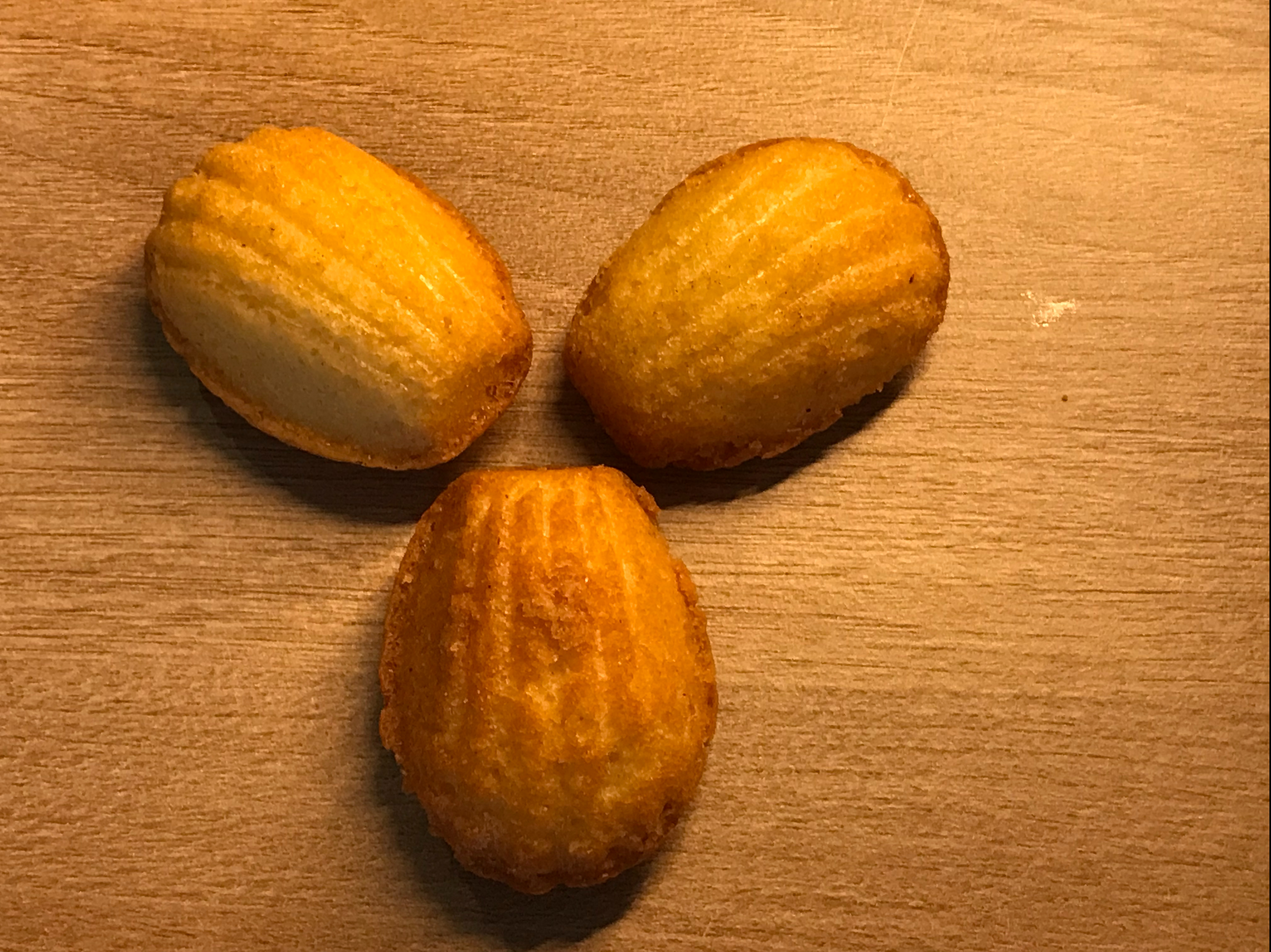
Madeleines are sort of a cross between a cookie and a cake. They are basically a sponge cake batter baked in small, scallop-shaped molds, which produces a browned outside and soft interior. They are mildly flavored, usually with vanilla or lemon peel. Marcel Proust was particularly fond of them, or at least had fond memories of them from his childhood, and why not? Like a good pound cake, madeleines have a nice flavor on their own, but they also lend themselves to embellishment. A bit of almond extract, a dip in chocolate, or a sprinkle of cinnamon would all be interesting additions.
If you enjoy this blog, please consider making a donation. Any contribution is appreciated.
Make a one-time donation
Make a monthly donation
Make a yearly donation
Choose an amount
Or enter a custom amount
Your contribution is appreciated.
Your contribution is appreciated.
Your contribution is appreciated.
DonateDonate monthlyDonate yearly Feasting Through Time
I really enjoy quiche of any kind. I will add all that I have tried. I have yet to make any for myself. My daughter Sherry used to make some very good quiche for family lunches. I have had madeleines, they sound like a flavor profile, I would very much enjoy.