Uncategorized

Foods Not Eaten: Combined Reasons

Boulud Burger, Fugu (pufferfish)

1000 Foods (pgs. 533, 802 – 803)

            A properly made burger, whether seared in the skillet or grilled, is almost always enjoyable. Cheese, onions, sauteed mushrooms, pickles, or lettuce can take it to the next level, but adding a chunk of foie gras (and black truffles) to the middle of the patty seems like expensive overkill. But that’s what’s in the Boulud Burger, a specialty of chef Daniel Boulud. It seems like such an expensive ingredient would be better savored on its own, or since the liver is a toxin filter, not eaten at all, but maybe that’s my lack of sophistication showing. On another note, based on the picture, the burger looks way too thick to eat in a civilized manner. But if you want to try it and can’t get to Boulud’s restaurant, he has a demonstration video online.

            One food I definitely won’t be trying is fugu, or pufferfish. You’re probably aware that some species are super poisonous. Specifically, they produce tetrodotoxin, which paralyzes the muscles, including those needed to breathe. Some species are safe, and farm-raised fugu does not contain the toxin, but for some reason, the more toxic varieties are the most highly prized. Supposedly, the taste is worth the risk, but I’m skeptical.

            To give you an idea of how dangerous fugu is, Japanese law requires several years of study and a detailed final test for chefs to be licensed to prepare it. The best fugu chefs are able to leave a tiny bit of the poison behind, just enough to make the diner’s lips tingle, but any mistake can be fatal. Several people die from eating fugu every year, many more end up in the hospital, and the emperor is forbidden from consuming it. The pufferfish innards are so toxic that after the fish are cleaned, law requires chefs to store the entrails in a locked box until they can be incinerated under the supervision of city authorities. I’m not even kidding.

            The specialized training required to prepare fugu explains why it’s so expensive, but not why people take the risk. Regardless, paying top dollar to risk getting poisoned isn’t for me. Between writing and cooking for this blog, setting up an associated YouTube channel, writing articles, and my day job, I don’t have time for it. Plus, fugu is illegal in much of the US, and only available in a few big cities. A final irony here: in 1000 Foods to Eat Before You Die, one of the entries could very well be the last thing you ever eat.

Standard
food history

Foods Not Eaten: Personal Taste Part 2 (Aspics and Miscellaneous)

Meat/Fish Aspics: Boeuf a la Mode en Gelee (beef and vegetables in aspic), Compote de Caille en Gelee (quail in aspic), Oeufs en Gelee (eggs in aspic), Sulze (pork in aspic), Carpe a la Juive/Jedisch Fisch (jellied carp), Gefilte Fish (freshwater fish dumplings in aspic), P’tcha (jellied calf’s foot)

Miscellaneous: Pasta Pagliata (with chopped calf or lamb intestines), Okroshka, Kholodynk, and Botvinia (Russian and Ukrainian cold soups), Tuna Salad Sandwich, Snoek (oily fish), Natto (fermented soybeans)

1000 Foods (pgs. 60, 68, 105 – 106, 314, 430 – 431, 436 – 437, 459 – 460, 219, 416 – 417, 633 – 634, 744, 811)

            For centuries, people have made gelatin by simmering meat and fish scraps. The time and effort necessary to strain and chill it made jellies and aspics high-status foods in the past, but times have changed. Perhaps people are still scarred by midcentury monstrosities full of hot dogs, canned fish, and mayonnaise. There are seven aspic dishes in the book, three French, one German, and three Ashkenazi Jewish. None of them sound appealing. In my mind, aspic seems like a broth or gravy that no one bothered to reheat. Cold soups have the same problem, even if they’re supposed to be cold.

            There are some dishes that, no matter how good they taste, I have trouble eating if they contain certain ingredients. This makes sense for the calf/lamb intestines in pasta pagliata (that’s where it gets its cheesy flavor), but I don’t understand why I have such a problem with ketchup, mayonnaise, and most bottled salad dressings. A dislike of mayonnaise means no tuna salad sandwiches (and the canned fish looks too much like cat food). For ketchup, the issue is so bad that I have trouble eating a dish if I think it might possibly contain ketchup (ex. sweet and sour pork at a buffet). Even watching someone else eating ketchup is difficult. I won’t say anything, but mentally I’m gagging. When I was little, I actually tried to train myself to eat it, but that went about as well as training myself to write with my left hand. That is to say, not well at all.

            Finally, I don’t like most strong-smelling, fermented ingredients. Mimi Sheraton compares the smell of natto, Japanese fermented soybeans, with the notoriously stinky Swedish herring surstromming. That alone is reason enough not to try it. Supposedly, a man in Germany got evicted after spilling a can of surstromming in his apartment hallway. When he took the landlord to court, the landlord won the case by opening a can in the courtroom. Whether the story is true or not, I would rather not risk eviction over fermented soybeans.

Standard
beverages, egyptian cuisine

Accompanying the Ful Medames: Egyptian Mint Tea

1000 Foods (pg. 704) for information, recipe is my own creation

            Mint tea is popular across North Africa, with numerous regional variations. Mimi Sheraton discusses this in the text on page 704. We’ve already discussed the Moroccan variety, with lots of mint and a bit of green tea. Egyptian mint tea has less mint, more tea, and uses black tea instead of green. It’s similarly sweet, and is sometimes flavored with warm spices. I use a clove, a piece of cinnamon stick, and a pinch of cardamom for a flavor that’s present without overwhelming the mint. Note that black tea is brewed at a slightly higher temperature than green, so it can be added to the hot water right away.

            Ingredients:

  • 2 or 3 sprigs fresh mint
  • 2 teaspoons black tea leaves
  • Sugar to taste
  • 1 piece cinnamon stick, 3 to 4 inches
  • 1 whole clove
  • Small pinch ground cardamom

            Directions:

  1. Bring 2 cups of water to a boil. Remove, tear, and bruise the mint leaves. Place in a teapot or strainer cup with the tea leaves and spices.
  2. Add boiling water to the mint, tea leaves, and spices, and steep for 3 to 5 minutes.
  3. Strain into teacups, adding a pinch of sugar or more to taste.

            In Egypt, the tea is usually a lot sweeter, kind of like the sweet tea popular in the US Southeast, but served hot. Personally, I don’t like that much sugar, and prefer tea unsweetened in most cases. Flavored teas like this one are an exception, but a pinch of sugar per teacup or a few per mug is plenty.

Standard
egyptian cuisine, food history, recipes, stew, vegetarian

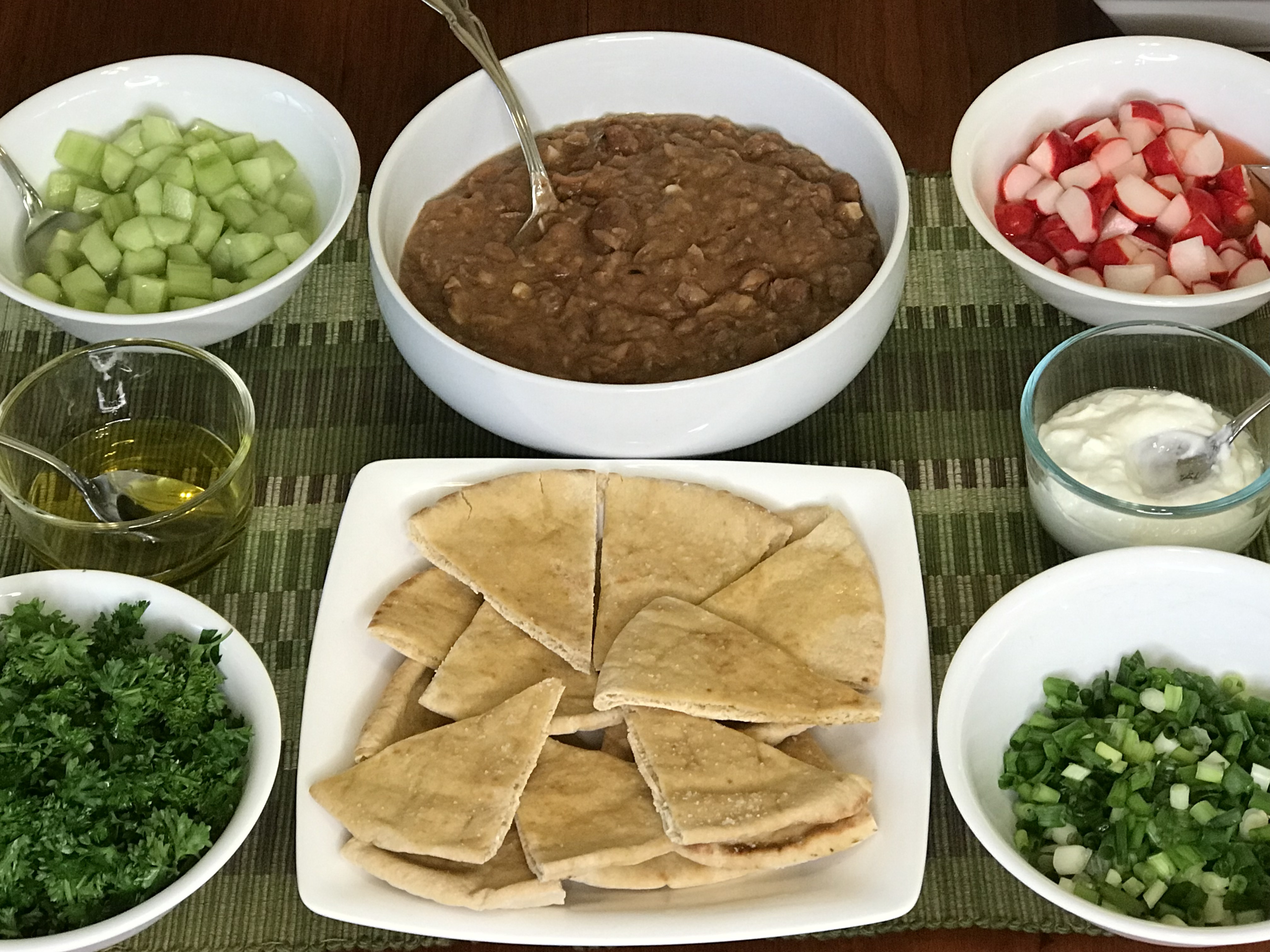
Egyptian “Tacos”: Ful Medames (fava bean stew)

1000 Foods (pgs. 708 – 709) for information, recipe is my own creation

            There’s no liver or chianti with these fava beans. To be honest, neither sounds appealing. The purpose of the liver is to filter toxins from the body, and supposedly chianti is a fairly dry wine. But fava beans on their own sound much better. Historically, most people across the Mediterranean and Middle East ate a largely vegetarian diet by necessity. Beans of all sorts provided essential protein and vitamins, which brings to mind an interesting story. Supposedly, the Ancient Greek mathematician Pythagoras hated beans but advocated a vegetarian diet. Balanced nutrition would still be possible if eggs and dairy were allowed, but Pythagoras definitely made things more difficult for himself.

            Supposedly, he even thought that beans were evil. Crazy as that probably sounds, there might have been a logical (okay, semi-logical) explanation. A small percentage of people don’t produce a particular enzyme that breaks down a chemical naturally occurring in fava beans. If someone with this gene does eat them, they become ill. Since this gene is most common in people living near the Mediterranean, Pythagoras likely knew a few people who suffered from it. It’s unclear why he decided that other types of beans were also evil, but maybe it was just a phobia. At a time and place where legumes were an essential source of protein, it would have been an unfortunate one.

            Fava beans, also called broad beans, have a long history in Egypt as a staple food, especially for the poor. Sometimes, when prices were high, the government would even subsidize them to ensure they remained affordable. Ful medames, a basic fava bean “porridge,” is often eaten for breakfast with a variety of toppings. The beans can be enhanced with butter, oil, onions, boiled eggs, and/or herbs, depending on what’s available and affordable. It seems like a strange choice for breakfast, but the protein helps keep you full until lunchtime. Some bread provides carbs for balance, as well as a vehicle for soaking up the juice. Pitas are the traditional choice.

            The beans, flavored with garlic and cumin and cooked until partially broken down, come to resemble refried beans. Combined with pita bread and assorted toppings, they bear a distinct resemblance to vegetarian tacos in a way, hence the description. While it’s a bit messy and time-consuming for breakfast, ful medames make a great vegetarian lunch or dinner, filling but fresh. And it’s customizable. Each person can add the toppings they wish.

            Ingredients:

  • 1 large can (about 30 ounces) fava beans, drained and rinsed
  • Water or broth
  • 2 cloves garlic, crushed and minced
  • ½ teaspoon cumin
  • Pinch hot pepper flakes, to taste
  • Salt and pepper to taste
  • Bread for serving (especially pitas, lightly warmed in oven with olive oil and salt)

Toppings (optional):

  • Flaxseed, olive, or untoasted sesame oil, or butter
  • Chopped parsley and/or cilantro
  • Minced onions, raw or sauteed, or scallions
  • Lemon juice
  • Plain yogurt
  • Vegetables (I used radishes and cucumbers), chopped, with vinegar and lemon juice to cover and a pinch of salt, and marinated in refrigerator for a few hours
  • Chopped hard-boiled eggs (I do not like them, but they are a common accompaniment, so enjoy (?) if desired)

            Directions:

  1. Place drained beans, garlic, cumin, and hot pepper flakes in a small to medium saucepan. Add enough water or broth to cover, about 1 ½ cups.
  2. Bring to a soft boil over medium heat, then reduce heat to low and simmer, uncovered, for about 20 minutes, stirring occasionally and gently breaking up the beans.
  3. When the beans have the texture of refried beans, remove from heat and serve in bowls. Pass desired toppings and plenty of bread.
  4. This recipe makes two good-sized servings, but is easy to multiply for larger groups. Make sure to have at least one pita per person.

            For free posts and recipes sent straight to your inbox, be sure to subscribe.

Standard
beverages, moroccan cuisine

Accompanying the Shakshuka: Moroccan Mint Tea

1000 Foods (pg. 704) for information, recipe is my own creation

            Moroccan cuisine is famous for its mint tea. Along with bunches of fresh mint, the tea requires green tea leaves and lots of sugar. A bit of rosewater can be added for even more flavor. Typically, the tea is served in tiny glass cups as a gesture of hospitality. The preferred serving method is to hold the teapot high while pouring, so the liquid froths as it hits the cups. Traditionally, the tea is served hot, regardless of the temperature outside. In fact, drinking hot beverages in the summer heat is common from Morocco to Italy to India. Supposedly, this encourages sweating to help cool the body, but since most people sweat anyway in the heat, I’m skeptical about its usefulness. Maybe it’s different when it’s a dry heat. Interestingly, even though iced tea seems to be uncommon in the Middle East, people there enjoy cold lemonade.

            Humans have been eating mint for thousands of years. It is mentioned in the Bible, various Ancient Greek texts, and in Apicius, the most complete cookbook to survive from Ancient Rome. Mint is a perennial and one of the easier herbs to grow. In fact, when left to its own devices, it’s notorious for taking over garden beds. Always cool and aromatic, there are two main varieties. Spearmint is the most versatile and widely used, while peppermint is a bit sweeter and spicier. At local garden centers, I’ve seen lemon, cinnamon, and chocolate mint. I’m not sure how much the flavors of these resemble their names, but they are interesting.

            When brewing green tea, it’s essential not to put the tea leaves in boiling water, which can draw out the tannins and make it bitter. Let it cool for a minute or two first. If using rosewater, add it immediately before serving to preserve its aroma.

            Ingredients:

  • Several sprigs (about ¼ ounce) fresh mint
  • 1 teaspoon green tea leaves
  • Sugar to taste
  • A few drops rosewater, if desired

            Directions:

  1. Bring two cups of water to a boil. Remove, tear, and bruise the mint leaves. Place the mint in a teapot or strainer cup.
  2. Pour the boiling water over the mint and allow to steep for five minutes.
  3. Add the tea leaves and allow to steep for another three minutes. Strain into teacups, ideally holding the spout 2 or 3 feet above the cups.
  4. Add a pinch of sugar to each cup, and a drop of rosewater, if desired.

Coming soon, I’ll have a recipe for Egyptian-style mint tea, so make sure to subscribe. Whenever there’s a new post, you’ll be notified right away.

Standard
middle eastern cuisine, recipes, vegetarian

Lent Friday Special: Shakshuka (eggs in tomato sauce)

1000 Foods (pg. 697) for information, recipe is my own creation

            Lent recently ended, along with its associated dietary restrictions. Fortunately for those of us inclined to follow Lent Friday fasting rules, eggs and dairy products have been permitted for the last few hundred years. Fish fries are always an option, but for an easy dinner at home that follows both the letter and spirit of Lent, it’s hard to beat eggs. (Or cheese, but that’s a topic for another post. Seriously, instead of fried fish sandwiches, fast food places should offer fried cheese as a meat alternative. I guarantee there’s a market for it.) They’re quick-cooking and versatile, perfect for an evening when you’re tired after the work week. An easy, quick-cooking egg recipe is the Middle Eastern dish shakshuka.

            Tomatoes aren’t just for Italian food. Once they were introduced to the Mediterranean, they were widely adopted across the Middle East and North Africa. The plants thrive in the abundant sunshine, as do sweet and hot peppers. One use for them is in shakshuka, a thick, spicy tomato sauce used to poach or scramble eggs. It’s often a breakfast dish in the Middle East, but also makes a great vegetarian lunch or dinner. The prettiest appearance comes from poaching the eggs whole, producing a mix of red, white, and yellow. Personally, I prefer to scramble the eggs and pour them into wells in the sauce. Either way, a sprinkle of cilantro brightens it up and adds even more color. If you happen to have the gene that makes cilantro taste like soap, I’m sure chopped parsley would be a good substitute. This should be served alongside some bread.

            Ingredients:

  • 1 – 2 tablespoons olive oil
  • 1 onion, chopped
  • 1 green pepper, chopped
  • 2 garlic cloves, smashed and minced
  • ½ teaspoon red pepper flakes
  • ½ teaspoon cumin
  • 1 can (about 15 – 16 oz) crushed tomatoes (not tomato sauce)
  • 4 eggs
  • 2 tablespoons milk
  • 1 bunch cilantro (also called fresh coriander), chopped
  • Bread, for serving

            Directions:

  1. Heat the olive oil in a large skillet over medium heat, then add the onions and peppers with a pinch of salt, sautéing until soft.
  2. Add the garlic, red pepper flakes, and cumin, stirring for about a minute. Stir in the crushed tomatoes.
  3. Reduce the heat to medium-low. Cook for about 10 minutes, stirring occasionally, until the sauce thickens.
  4. Meanwhile, beat the eggs with the milk and a pinch of salt.
  5. Make four “wells” in the sauce, then pour in the eggs, dividing evenly. If the wells overflow a bit, that’s fine. Cover the pan and cook until the eggs are set, about 5 – 8 minutes.
  6. Sprinkle with about half the cilantro, setting aside the remainder for anyone who wants extra. Serve with bread.

This quantity serves two people, but to feed more, just add another two eggs and one tablespoon milk per person. If serving more than four, double the sauce and use two skillets. And for more fun facts and recipes, make sure to subscribe for free.

Standard