
When we left off with the history of the Balkans at the end of the 5th Century AD, most of the region was secure under the Eastern Roman Empire. The Huns vanished from history shortly after Attila’s death in 453, and the Germanic confederations had moved into the former Western Roman Empire. Meanwhile, the Eastern Empire became increasingly Greek. Justinian I was the last emperor to speak Latin and seriously attempt to reconquer the West, so after his death in 565, most scholars call the empire Byzantine, even though the term wasn’t used at the time. War against the Vandals in North Africa, Ostrogoths in Italy, Visigoths in Spain, and Persian Sassanids in Syria didn’t affect the Byzantine territory in the Balkans much. Even the Arab conquests of the 7th Century, which essentially cut imperial territory in half, were far away in Syria and Egypt.
Pulling troops away to fight on the frontiers left the Balkans vulnerable, and in the 8th and 9th Centuries, new groups of peoples moved in, including nomadic Avars, Magyars, and Bulgars. Magyars settled in the Carpathian Basin and became Hungarian, while the Bulgars settled north and east of Greece. Eventually they adopted the language and customs of another new group, the Slavs, and became Bulgarian. Even Vikings made their way down the rivers of Eastern Europe to trade in Constantinople, though they didn’t stay.
By 1000 AD, the Balkans were home to Greeks, Romanians (who continued to speak a language descended from Latin), Albanians, Hungarians, and Slavic-speaking Croatians, Bosnians, Serbians, and Bulgarians. Residents traded and exchanged ideas with Italian and German merchants. Over the next few centuries, Byzantine control weakened, particularly as most of their territory in modern Turkey was seized by the Seljuk Turks, originally from Central Asia. Hungary, Romania, and Croatia were never under Byzantine authority, and the non-Greek border regions broke away repeatedly. By the 14th Century, when the Ottoman Turks, descendants of the Seljuks, crossed the Bosporus into Europe, the Balkans was a patchwork of independent kingdoms.
In the 1350s the Ottomans made their first incursion into Europe, gaining momentum in the 1390s. In 1453, the captured Constantinople, ending the Byzantine Empire. The emperor at the time, Mehmed II, was fascinated by the different lands and cultures under his control, and had a highly cosmopolitan court. He even hired Venetian painters to decorate his palaces. For the next 400 years, the Ottoman court and bureaucracy remained diverse. Among the cultural practices shared, food was one of them.
Foods like phyllo dough and coffee were introduced by the Turks, and they loved their sweets and rosewater. Many of the dishes introduced during this time remained popular even after the Ottoman Empire declined in the 19th Century, often with a local twist. Such is the case with Scordolea. Where the walnut sauce originated is unclear, but variations were spread far and wide by the Ottomans. The main ingredients are walnuts, soaked stale bread, and garlic, usually. Occasionally, almonds replace walnuts, and in the most popular Greek version, usually spelled as skordalia, nuts are sometimes omitted and the bread replaced with potatoes.
Getting the recipe right involved some trial and error. At first, I used too many walnuts, not enough bread, and tried to thin the paste with oil rather than water, resulting in a broken emulsion. The paste was sticky, the oil collected on top, and the standard white supermarket bread, which I thought would be neutral, gave the sauce a distinctive flavor. It’s good with barbecue, grilled cheese, peanut butter, and as French toast, but not for this. I needed an unsweetened, less “squishy” white bread. Fortunately, the grocery store bakery carries such loaves at a reasonable cost.
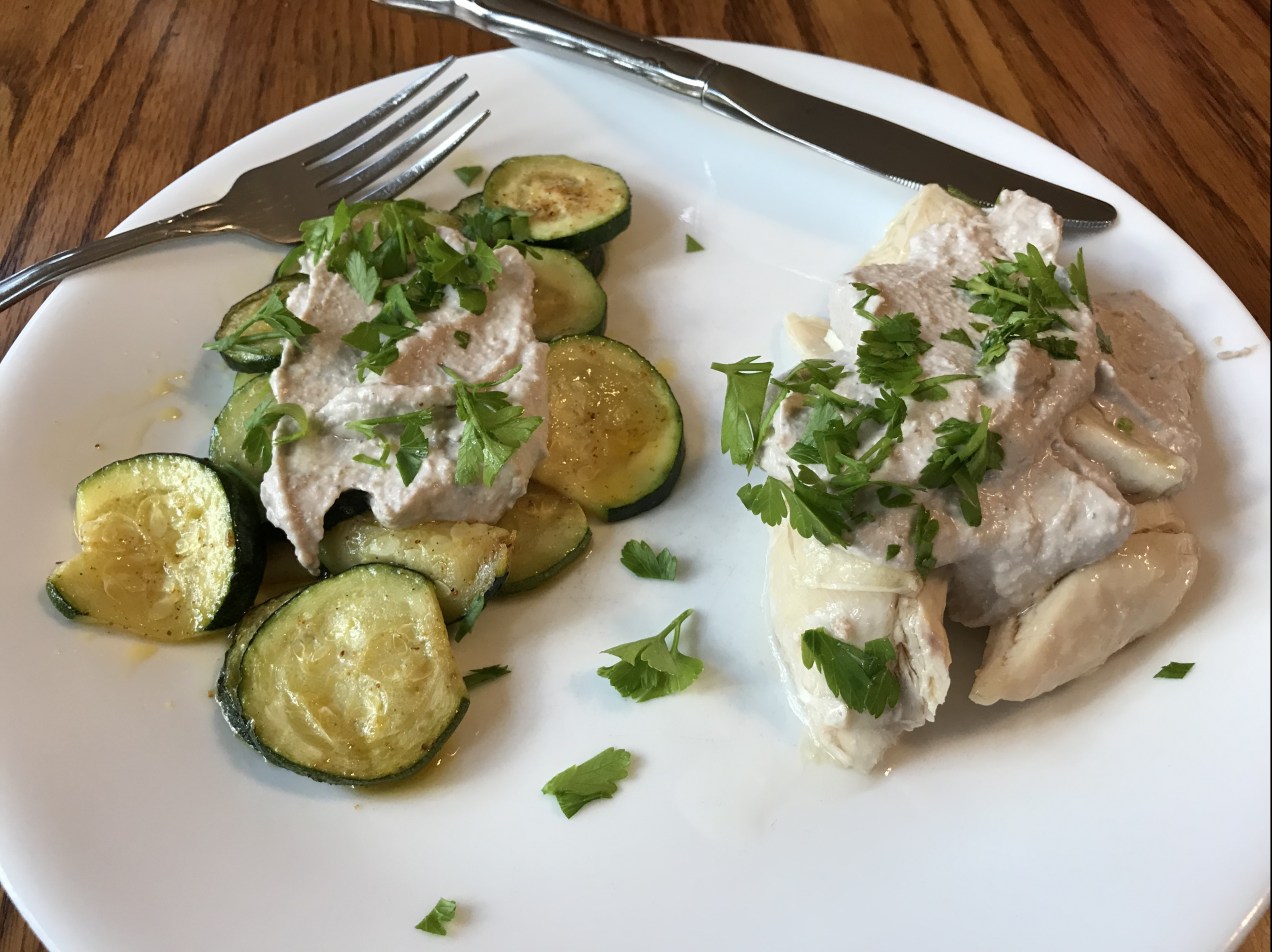
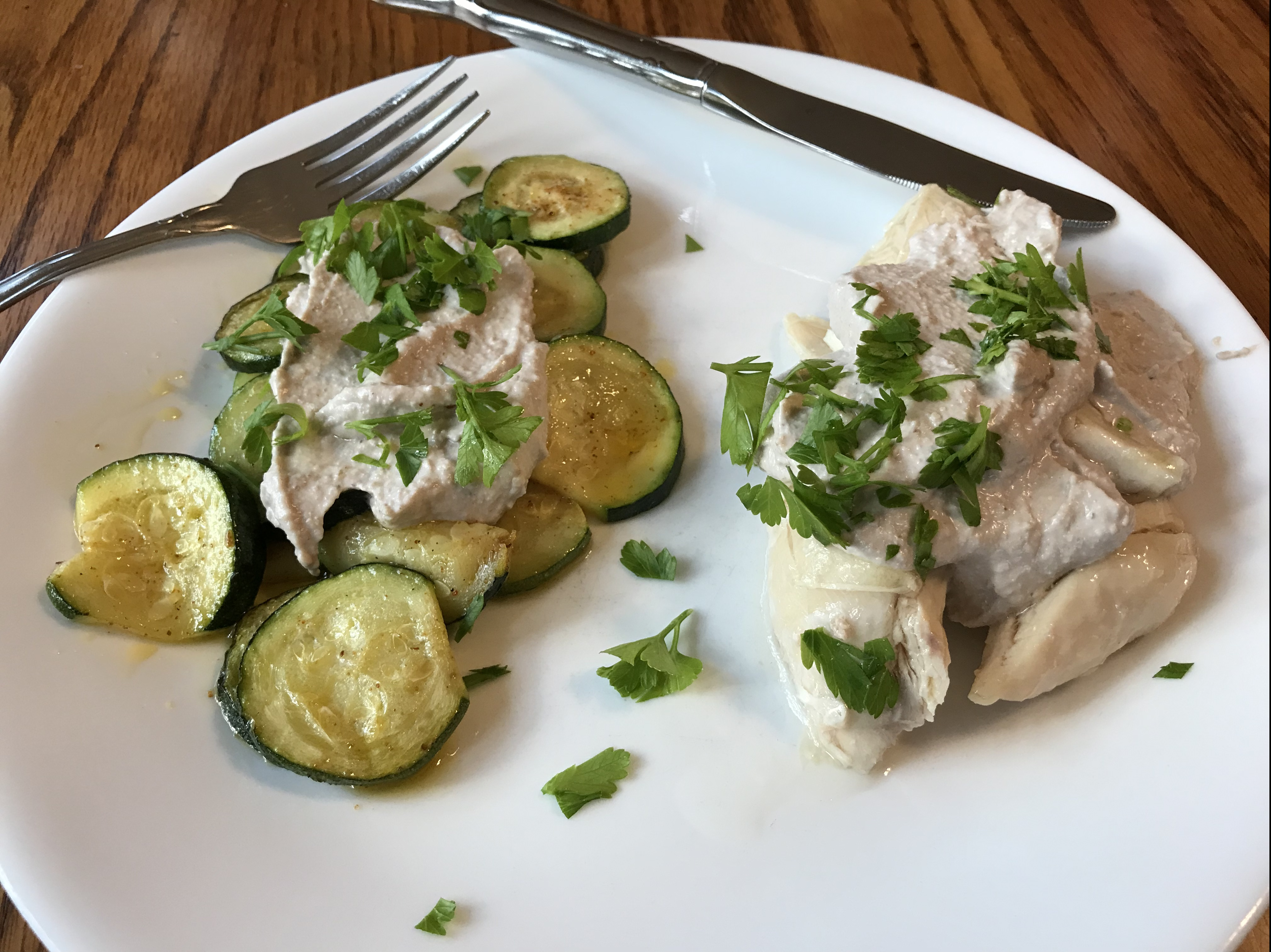
The second attempt had less walnuts, more bread and milk, and I made sure to drizzle the oil in slowly while the food processor was running. This scordolea had a nice balance of walnut and garlic flavors, with a hint of lemon, though it looked like thick cream of wheat on its own. A garnish of some parsley I picked for my brother’s rabbit and forgot to send home with him improved the presentation significantly.
Scordolea is eaten with a wide variety of foods. Since the sauce has its own strong, delicious flavor, it’s great for enhancing neutral-tasting foods, in this case, cold chicken and sauteed zucchini. Pretty much any affordable, easy-to-cook staple is transformed by scordolea. It is easy to see why Mimi Sheraton classified it as one of her 1000 Foods to Eat Before You Die in the book by the same name.
Ingredients:
- 1 cup walnuts
- 2 slices good-quality bakery white bread, crusts removed
- ¼ cup milk
- 2 garlic cloves, peeled, crushed with the side of a knife, and coarsely chopped
- Juice of ½ lemon
- ¼ cup olive oil
- Chopped parsley, for garnish
- Cooked chicken, seafood, vegetables, or anything else you would like to eat with the sauce
Directions:
- Place the bread slices in a bowl and drizzle the milk over them. Let the milk absorb for at least 5 minutes.
- Place the walnuts in a dry skillet over medium heat. Cook, shaking pan occasionally, until the nuts smell toasty. This won’t take more than a few minutes, so watch carefully.
- Put the toasted nuts into the food processor, pulse a few times, then add the bread, any extra milk from the bowl, the garlic, and a pinch of salt. Process to form a smooth paste.
- Add the lemon juice to the walnut paste and process until blended.
- With the motor running, slowly add the olive oil through the food processor’s feed tube to incorporate. Taste for salt, adding more if necessary.
- Run the motor again, and slowly add about ¼ cup water to thin the sauce. It should be on the thick side, but for a thinner sauce, slowly add more water until the desired consistency is reached.
- For serving, garnish the scordolea with chopped parsley. Serve with your desired protein and/or vegetables.
And as always, subscribe for free posts and recipes, sent right to your inbox.
Make a one-time donation
Make a monthly donation
Make a yearly donation
Choose an amount
Or enter a custom amount
Your contribution is appreciated.
Your contribution is appreciated.
Your contribution is appreciated.
DonateDonate monthlyDonate yearly Feasting Through Time