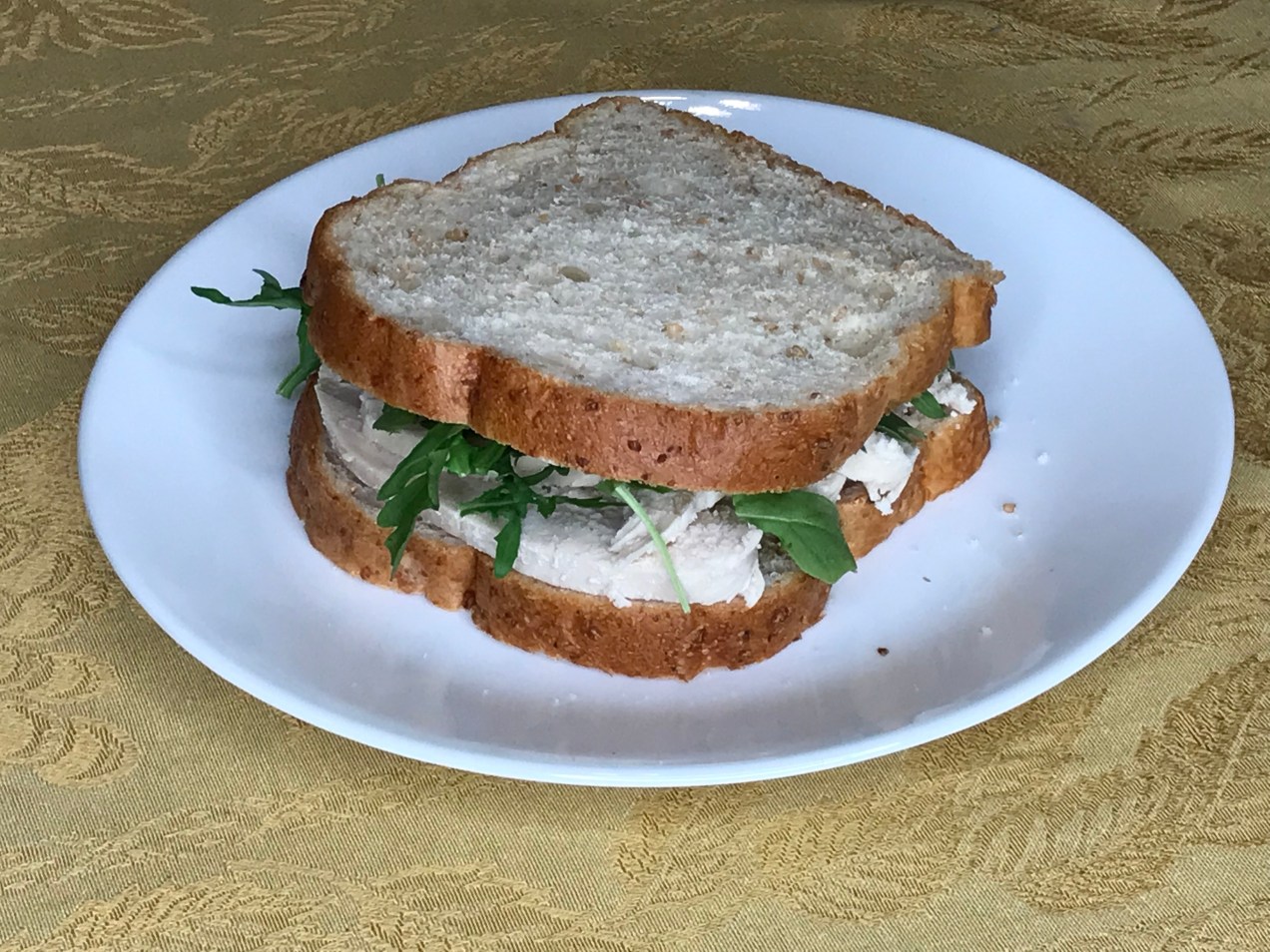
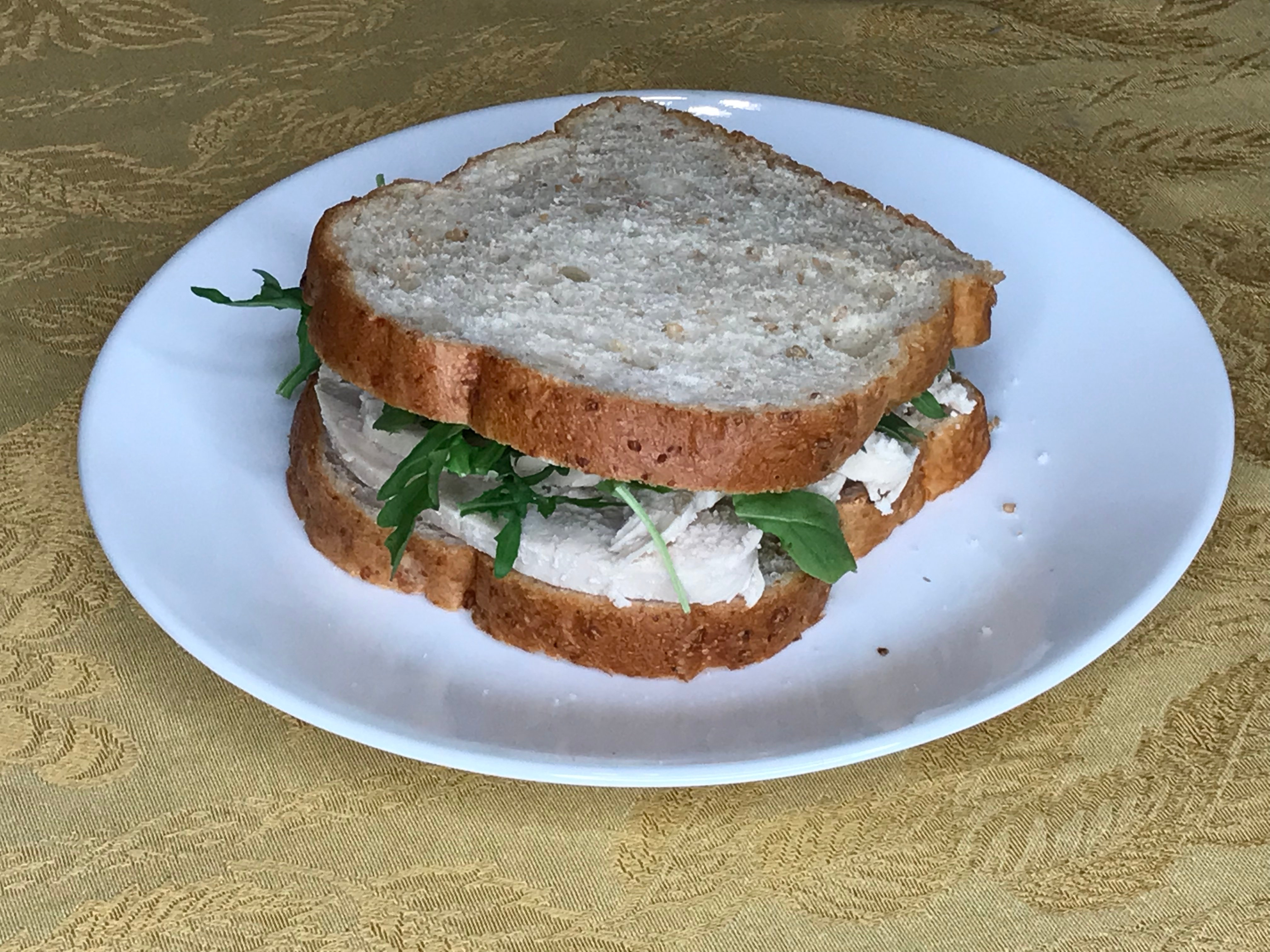
Not all of the foods in 1000 Foods to Eat Before You Die are complicated. A basic chicken sandwich (description on pages 543 – 544) is quite simple and easy to make. All you need are roasted or poached chicken breast, good-quality bread, butter, and maybe some greens. It isn’t particularly exciting, but it does make a great lunch and is a nice change of pace from lunch meat and peanut butter. The only trick is making sure the chicken is tender.
At a recent cooking demonstration, I learned a new trick for poaching chicken. For a whole chicken, you just boil in enough water to cover for fifteen minutes, turn off the heat, and let the pot sit, covered, for three hours. During that time, the residual heat will cook the meat all the way through without making it tough. Chicken pieces only need to be boiled for five minutes. To be on the safe side, I did ten.
To poach about 3 pounds of chicken pieces (I did half boneless skinless breasts and half boneless skinless thighs), place them in a large pot with half a teaspoon salt. Add enough water to cover, about 6 to 8 cups. Bring to a soft boil, boil for 10 minutes, then turn off the heat and cover the pot. Let stand for 3 hours. Then the chicken is ready to enjoy, hot or cold. Save the broth for another use (like risotto).
For each sandwich, spread two slices of bakery white or whole grain bread with softened butter. Add chicken, either sliced across the grain or pulled into chunks (slicing only seems to work well for the chicken breasts). If desired, add a sprinkle of sea or kosher salt, and/or some greens. Arugula has a nice peppery flavor. Then enjoy!
I’ll admit, I was a little skeptical when I first read about chicken Marbella. Prunes, olives, capers, vinegar, and brown sugar seemed like an odd combination with chicken. The dish was originally developed by the Silver Palette catering company in New York in the late 1970s/early 1980s. It’s very much in the 80s style, vaguely Italian or Mediterranean, and sophisticated for the time. Since the ingredients are fairly inexpensive, I decided to give it a try. Omit the olives (which aren’t generally my favorite) and it’s essentially sweet-and-sour chicken.
There’s actually a long history of serving meat with sweet, sour, and fruity sauces, that goes beyond turkey with cranberry sauce or duck with orange sauce. Ancient Romans loved complex sauces with any combination of honey, vinegar, wine, fruit, herbs, spices, and the fermented fish sauce garum. Medieval cooks ditched the garum but added sugar, verjuice (pressed from unripe grapes), and citrus juices. If their sauces contained broth or meat juices, they would be combined with these other, strongly-flavored ingredients. Add a few spices and possibly some breadcrumbs to thicken, and the sauce for chicken Marbella sounds positively medieval. And it bears more than a passing resemblance to the agrodolce sauce still popular in Sicily today.
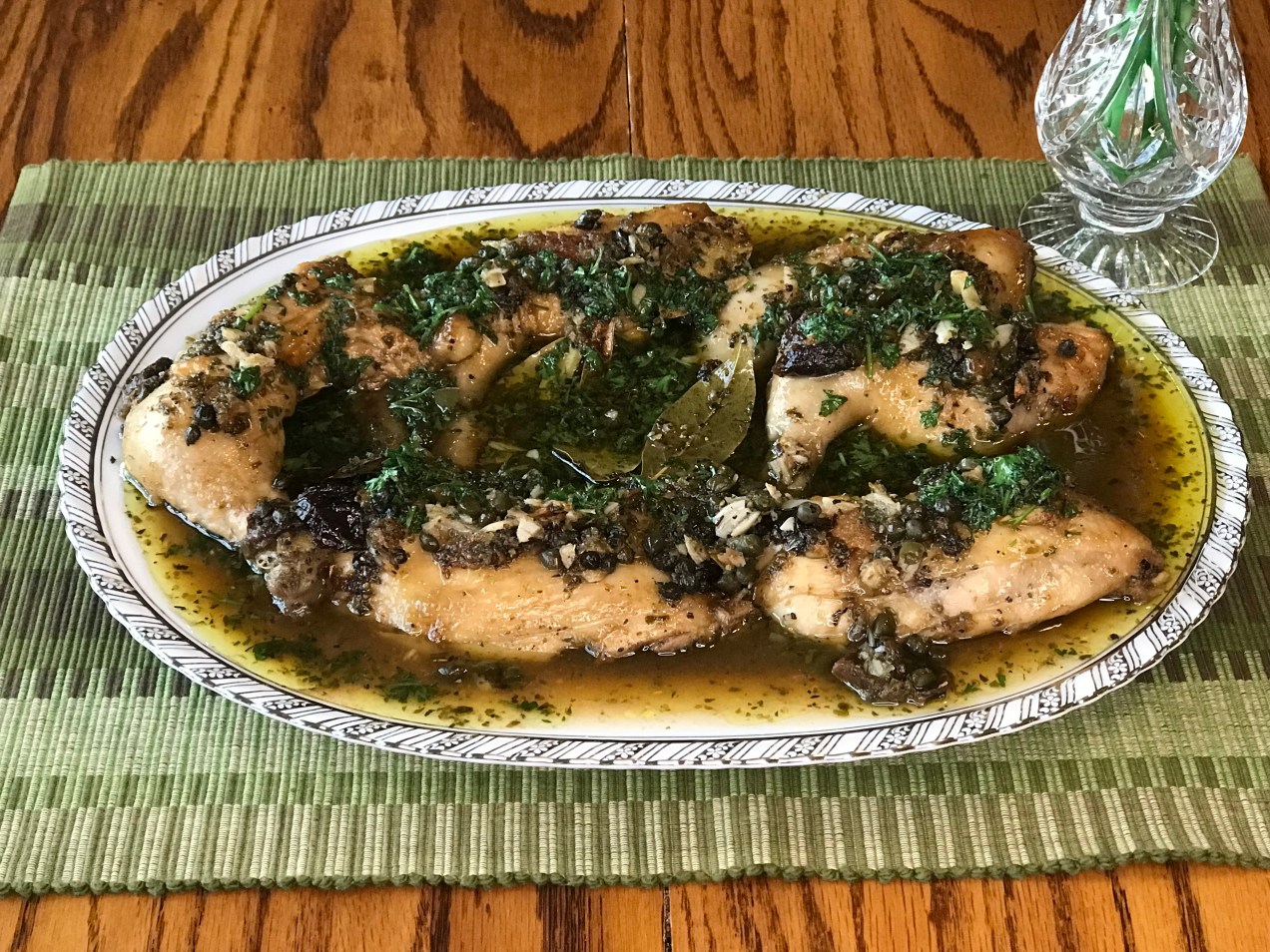
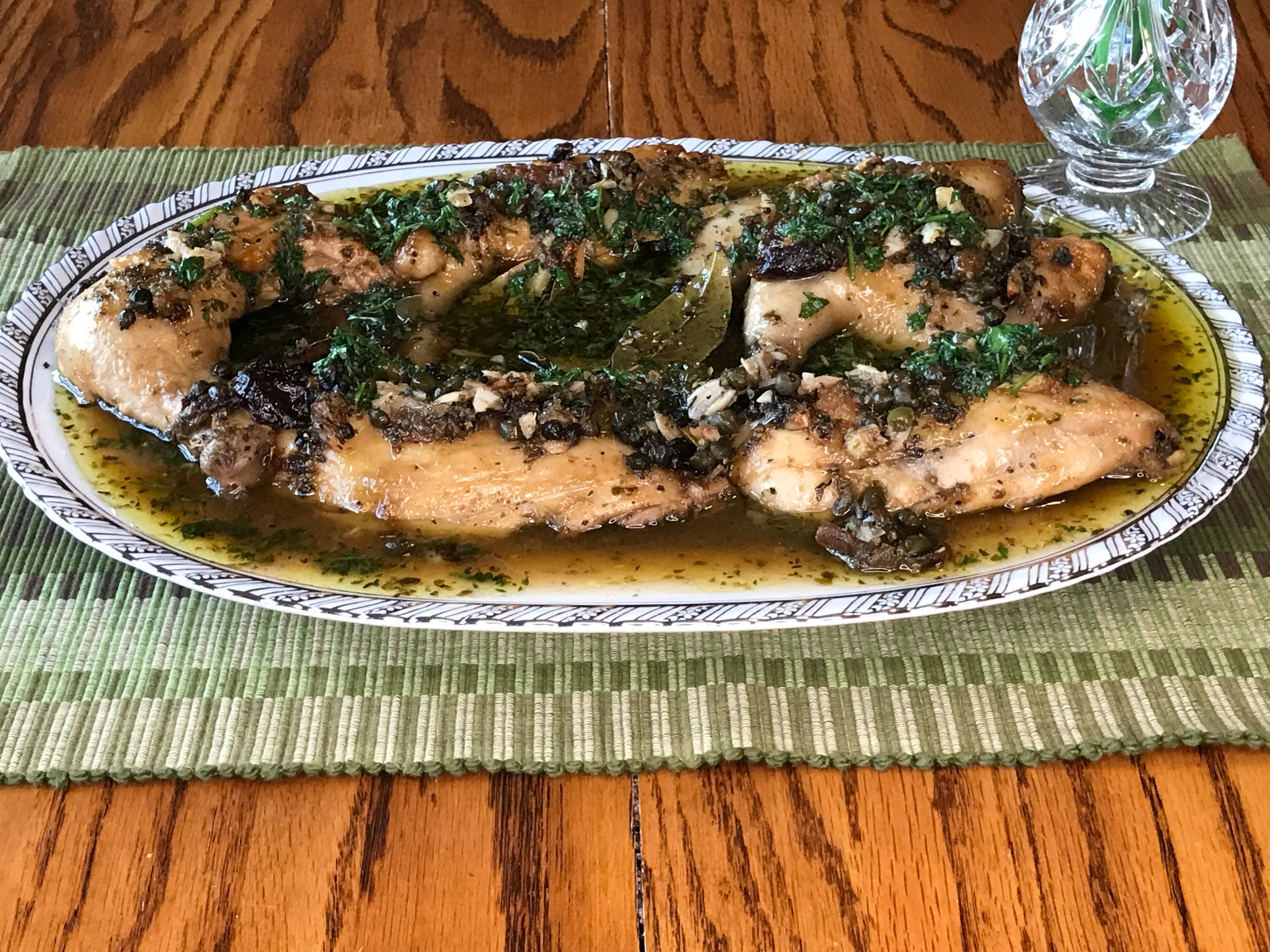
The recipe on pages 542 – 543 of 1000 Foods to Eat Before You Die by Mimi Sheraton, originally from the Silver Palette Cookbook, was delicious and smelled amazing. The only changes I made were to skip the olives and use chicken leg quarters instead of quartered whole chickens, but I would tweak it a little further. Between the amount of marinade and the amount of liquid released by the chicken while cooking, the serving platter was swimming in sauce. The flavor was great, and the sugar gave the chicken a nice crunchy “crust,” but the mix was extremely sweet. That was despite the dramatic reduction in the quantity of prunes, for the simple reason that the bag, which I had bought for and used in another recipe, wasn’t as full as I thought.
For a second attempt, I made a few changes. Because I only used about half the amount of chicken, I cut the other quantities in half, producing a pool of sauce instead of a lake. Reducing the amount of sugar from one half to one third cup created a better balance with the vinegar, capers, garlic, and oregano. And pretty much any dried fruit will work. I used a mix of dried apricots, golden raisins, and Zante currants (because that was what I had on hand), to successful results. Turns out the 80s culinary experimenters had some good ideas. I still don’t understand the pasta salads with bottled dressing, though. Or nouvelle cuisine.
Tomorrow is the Preakness Stakes, the second leg in the Triple Crown. The Preakness is always run on the third Saturday in May at Pimlico in Baltimore. Some trainers say the two-week turnaround time is not enough for the horses to recuperate, and sometimes the Kentucky Derby winner won’t race. Sovereignty will not race tomorrow, meaning there will not be a Triple Crown winner this year. While not as famous as the Derby, the Preakness is still an interesting event, with two associated food traditions. Since Maryland is associated with blue crab from the Chesapeake Bay, it’s no surprise that the Preakness is known for crab cakes.
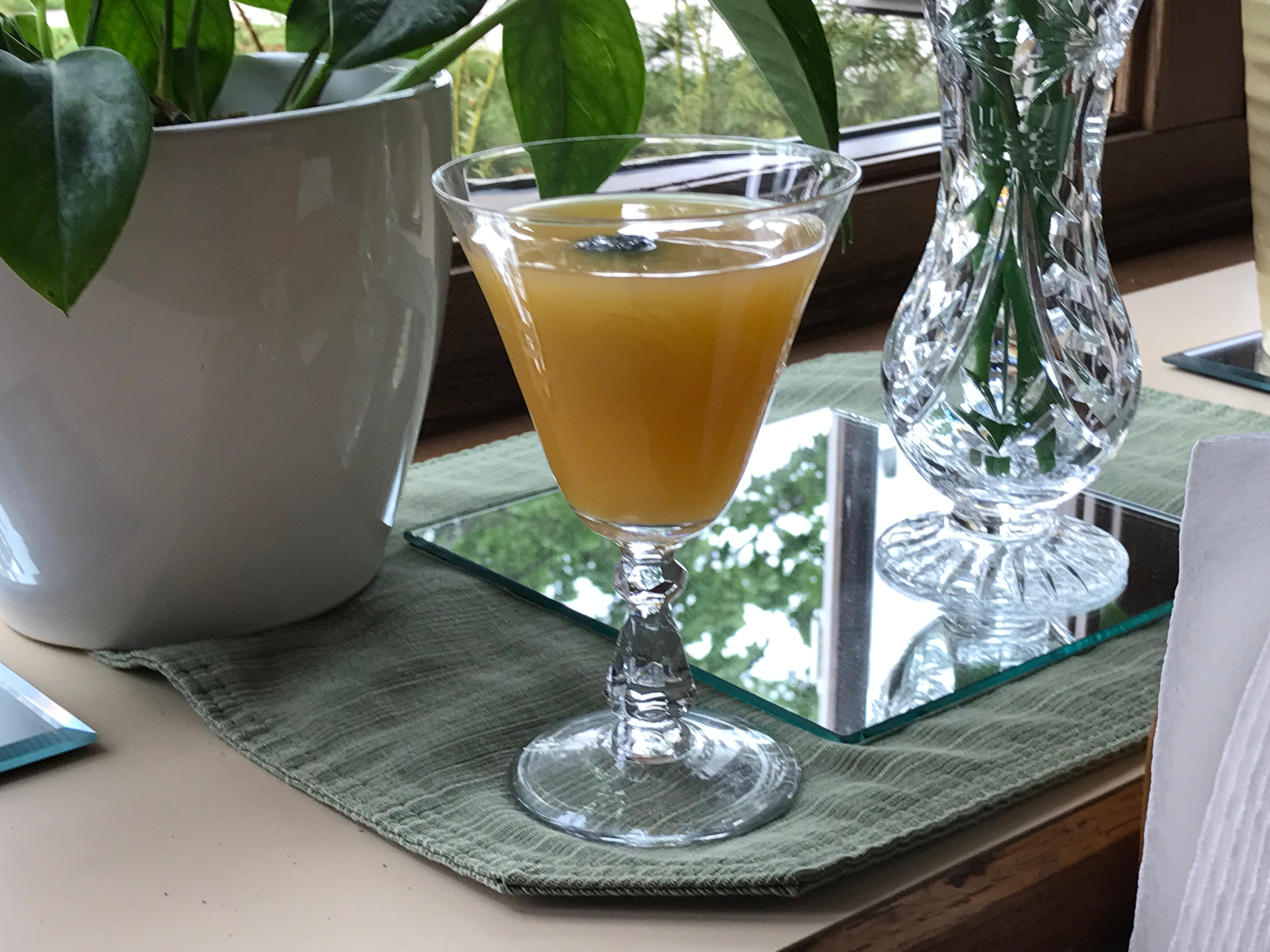
The Preakness Stakes also has its own signature cocktail, called the black-eyed Susan. Most likely, it was named for the blanket of flowers draped over the winner. The Kentucky Derby has red roses, the Preakness has black-eyed Susans, and the Belmont Stakes has white carnations. Ideally, the cocktail will be about the same yellow-orange color as the flowers. Interestingly, black-eyed Susans are not yet blooming in Maryland.
Unlike the mint julep, the black-eyed Susan never seems to have had an “official” recipe. Invented in the 1970s, ingredients varied over time, even at Pimlico, and according to the drinker’s personal taste. The only constants are orange juice and vodka. Other ingredients might include pineapple juice, grapefruit juice, peach schnapps, rum, or bourbon. Frequently the drink will be finished with a blueberry or blackberry for the characteristic “black eye.” As long as there are at least two fruit flavors, pretty much anything goes.
Black eye demonstrated here. Definitely a resemblance, in an abstract way.
Fruity cocktails lend themselves well to non-alcoholic variations. For my own version, I keep things simple with equal parts orange juice, pineapple juice, and tonic water with a bit of peach syrup. The tonic water is the “secret ingredient” that makes non-alcoholic cocktails more complex, and its bitter edge tastes a bit like grapefruit.
Here’s how to make it:
For each serving, combine 1/3 cup orange juice, 1/3 cup pineapple juice, and 1/3 cup tonic water with a few ice cubes. Stir in a tablespoon of peach syrup (like what’s used in Italian sodas), or more to taste. For a low-alcohol but not completely alcohol-free cocktail, the syrup can be replaced with peach schnapps. If desired, add a blueberry or blackberry. It’s that simple, unlike the system for betting on the race.
To get notifications of new posts sent straight to your inbox, make sure to subscribe for free. Of course, if you want to make a contribution, you’re more than welcome to.
1000 Foods (pgs. 31 – 32) for information, recipe is my own creation
While British cuisine doesn’t have a great reputation abroad, desserts are an exception to this rule. Drool-worthy examples abound on the Great British Baking Show (which you should never watch while hungry), and one of the classics is trifle. Trifles also appear multiple times in the Harry Potter series, typically at celebrations, and in the second book, Harry even ends up wearing one.
The specifics vary by recipe, but they always include cake or ladyfinger biscuits, custard and/or whipped cream, and fruit and/or jam. Basically something starchy, something creamy, and something fruity. British versions usually include sherry or another fortified wine. Originally, this was to help revive stale cake. With modern recipes this is unnecessary, but a lot of people like the taste. I omit this for a family-friendly version and clearer fruit flavor, bursting with berries and vanilla.
Wine and liquor were once extremely common dessert flavorings. Since the 19th Century, perhaps because of the temperance movement, vanilla has largely taken their place. Despite its boring reputation, vanilla blends extremely well with fruit, chocolate, caramel, cream, and pretty much anything else you might put in a dessert. For a beautiful, fresh, and surprisingly easy centerpiece, the essentials are a good pound cake, seasonal or frozen fruit, vanilla pudding, and homemade whipped cream.
Strawberries make a particularly good trifle, because as the trifle sits in the refrigerator, the lightly sugared berries release lots of flavorful juice that soaks into the cake. If they aren’t in season, it’s better to use frozen, which tend to have a better flavor (and price) than the out-of-season fresh berries, which are usually picked underripe so they ship better and last longer on the shelf. This applies for any fruit, not just strawberries.
Pound cake is another crucial ingredient, and you don’t have to make your own for success. The frozen Sara Lee pound cakes are excellent quality. I like to make my own vanilla pudding, but an instant mix still produces a special dessert if you’re crunched for time. Just avoid the sugar-free kind, and don’t make it with skim milk. And make your own whipped cream. It makes a huge difference, and with the cost of the spray bottles, it’s actually cheaper when you need a lot.
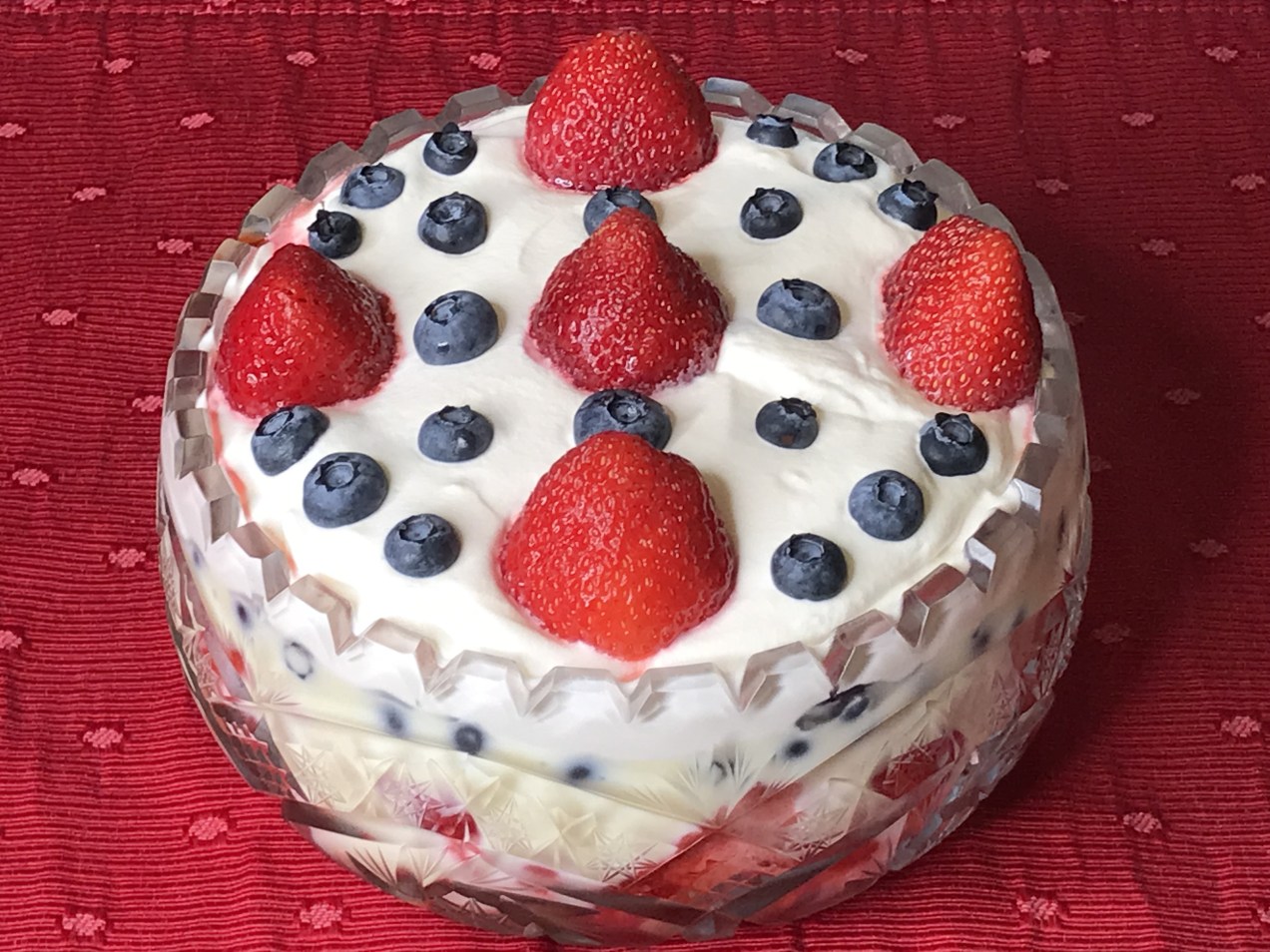
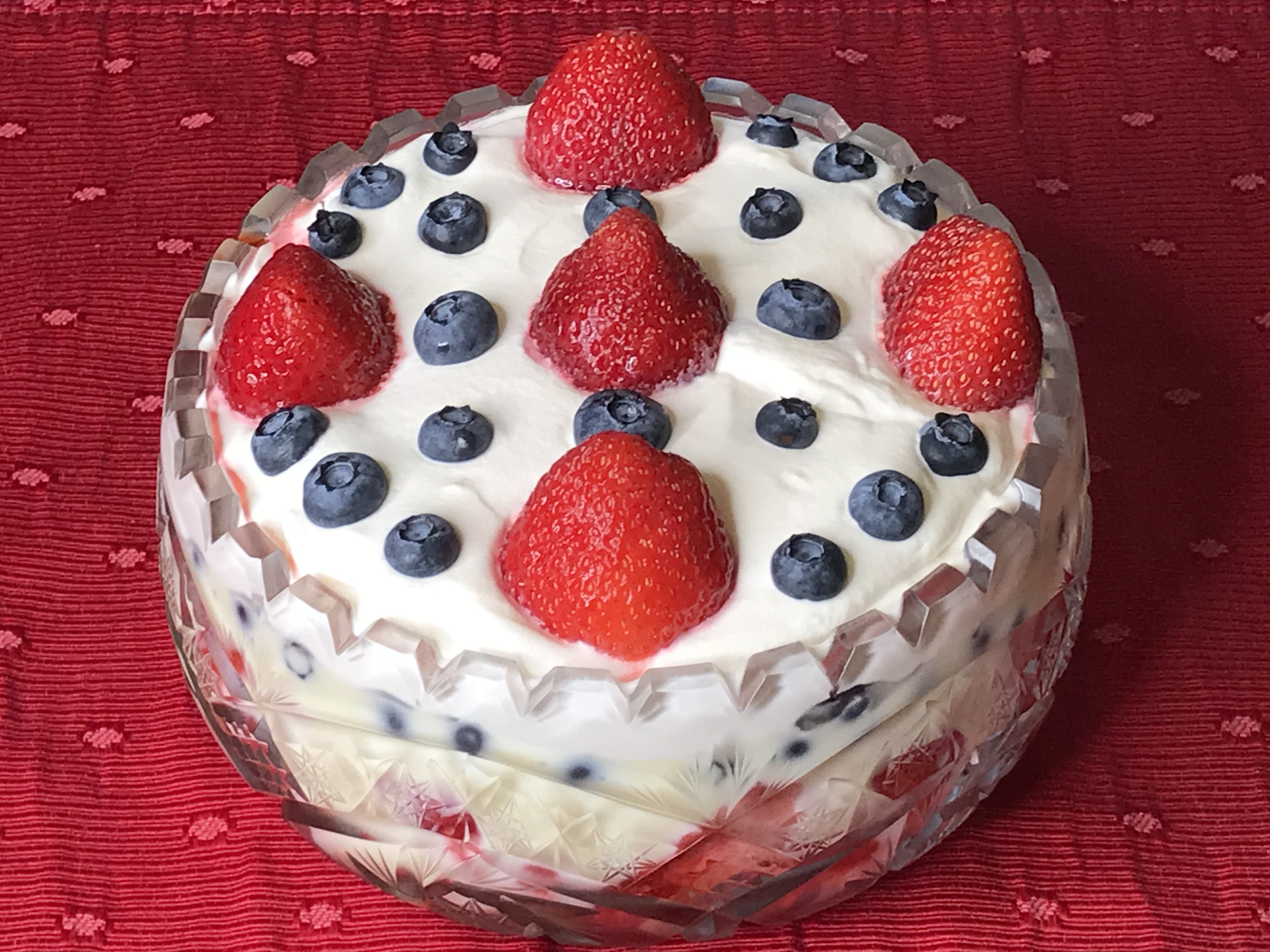
For a full red, white, and blue effect, blueberries can be sprinkled over the top of the trifle or added between the layers. Since they don’t produce much juice, I usually stick with a strictly strawberry trifle, but I added them this time because they were in season and it was for the 4th of July. Just make sure to layer the trifle in a glass bowl if at all possible, to show it off to full effect.
To impress your guests, decorate the top with fruit.
Note that the quantities in the recipe are not always specified. This is because different serving bowls have varying capacity, and everyone has their own preference for how much of each ingredient to add.
Ingredients:
1 pound cake, homemade or Sara Lee
Strawberries
2 tablespoons sugar per quart of strawberries
Vanilla pudding, homemade or from a mix
Blueberries, optional
1 cup whipping cream
1 tablespoon powdered sugar per cup whipping cream
½ teaspoon vanilla per cup whipping cream
Directions:
Hull and halve the strawberries, cutting any larger berries into quarters. Toss with the sugar and let stand while you prepare the other ingredients.
Cut enough of the pound cake into cubes to cover the bottom of the serving bowl.
Whip the cream with the powdered sugar and vanilla until soft peaks form.
Layer the cake cubes in the bottom of the serving dish. Top with the strawberries and drizzle any liquid over all.
Add the pudding over the strawberries, and top with the blueberries if using.
Finish the trifle with the whipped cream, decorating the top with fruit if desired.
If strawberry season is over but you have fresh peaches or raspberries, I’m sure they would also make an excellent trifle. And as always, don’t forget to subscribe to get posts sent to your inbox for free.
1000 Foods (pg. 547) for information, recipe is my own creation
This upcoming weekend is supposed to be hot. At times like these, most people don’t want to heat up the kitchen by turning the oven on. Grilling, quick-cooking pasta, and stir-fry are all popular options for home cooks, as are a variety of cold salads.
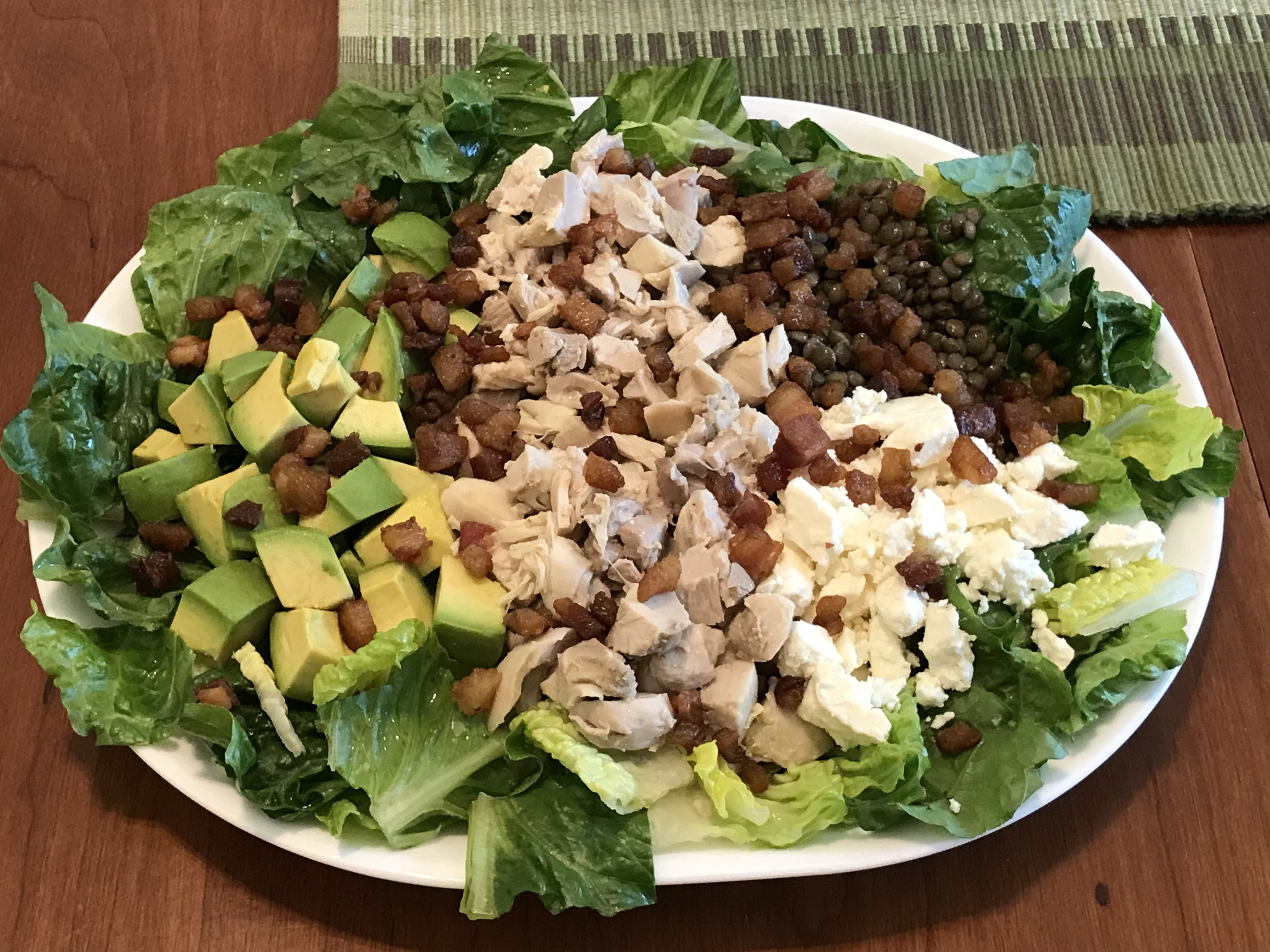
Supposedly, cobb salad was invented in California in the 1930s as a way to use up leftovers. Turning leftovers into salads was just as common then as now, though inexplicably this often involved mayonnaise and/or gelatin. Thankfully, cobb salad avoided this in favor of a vinaigrette flavored with lemon juice, Worcestershire sauce, and garlic. Original ingredients included hard-boiled eggs, blue cheese, chicken, bacon, avocado, and tomatoes, presented in rows for a striped effect.
Inevitably, cobb salad’s popularity in Hollywood spread the recipe nationwide, with some variations. Since avocados were harder to find outside California, they were frequently omitted, and sometimes other diced ingredients like ham were added. Shredded cheese might replace the blue cheese, and some cooks might use the mayonnaise-based dressings popular at the time.
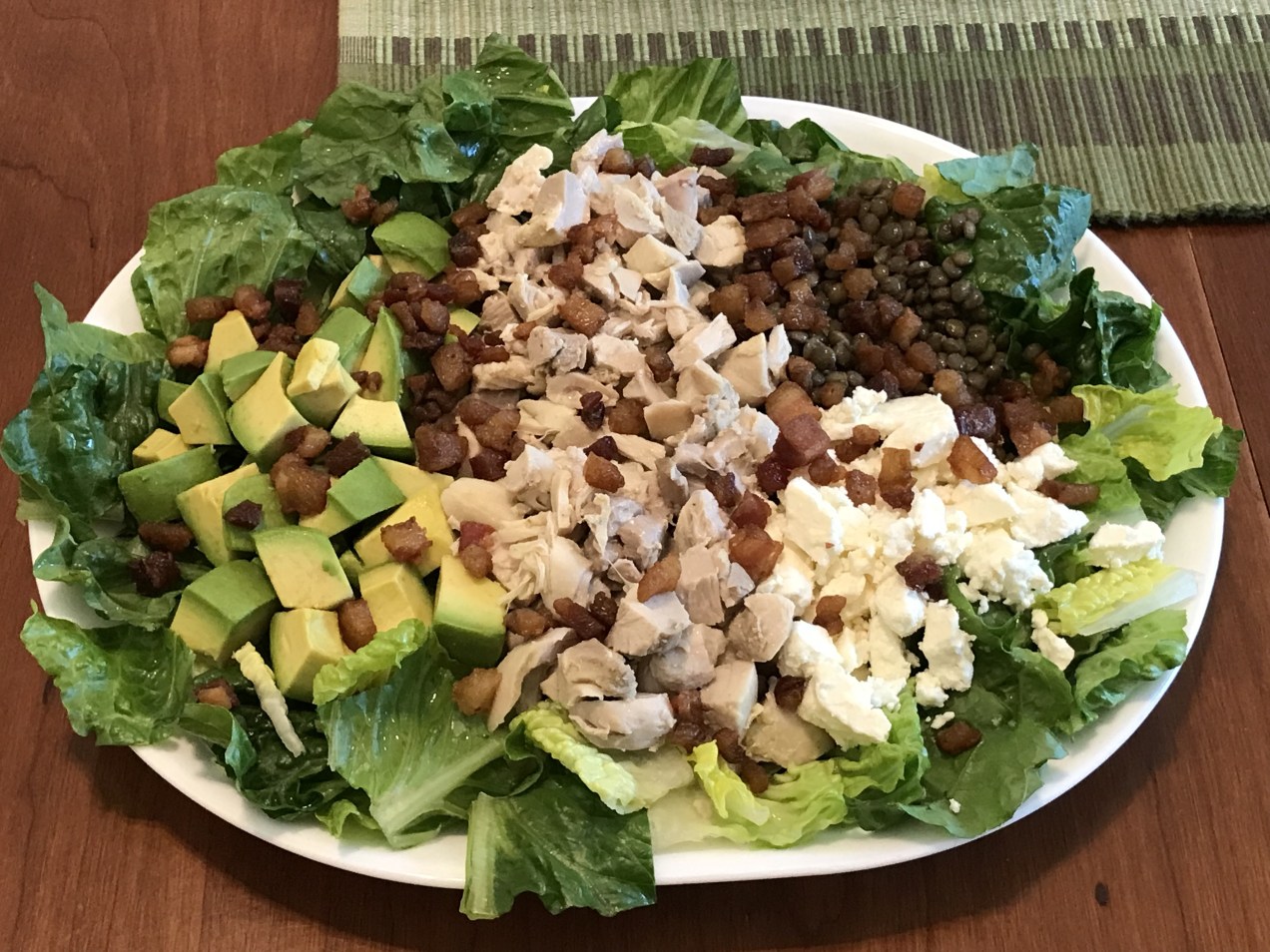
For my own recipe, I made three adjustments. Since I don’t like boiled eggs or blue cheese, I replaced them with feta and lentils. The French-style green lentils I found at Woodman’s were particularly good, with an almost meaty flavor. And I omitted the tomatoes because they are not yet in season fresh.
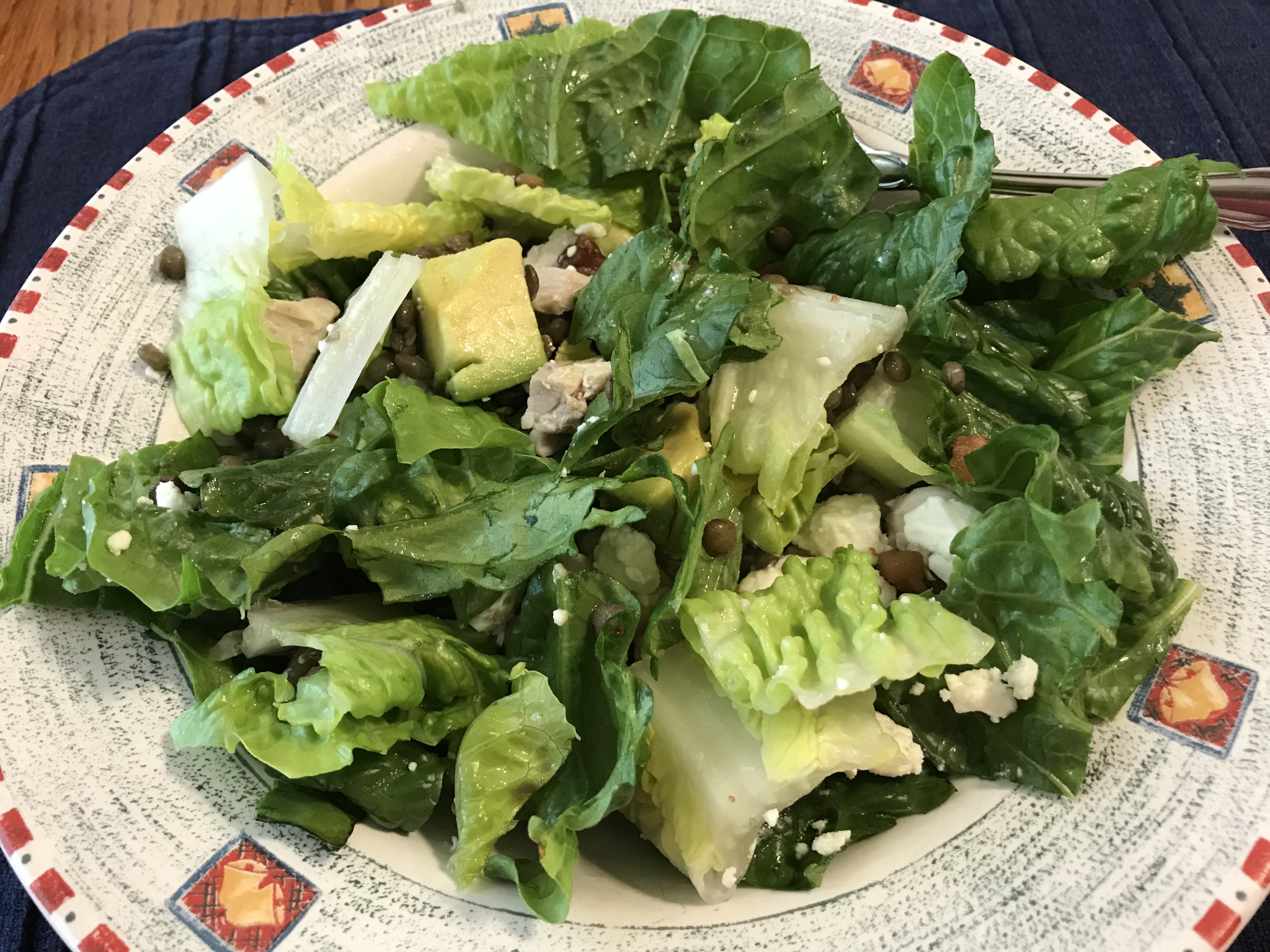
The final result was a mix of chicken, avocados, bacon, feta cheese, lentils, and romaine lettuce with a flavorful vinaigrette. All the different textures and flavors contrasted well with each other, and the platter was just so pretty.
Ingredients:
1 head romaine lettuce, washed and torn into bite-sized pieces
About 1 pound boneless skinless chicken breasts or thighs, cooked, cooled, and cut into cubes
About 8 oz feta or blue cheese
About 8 oz bacon, sliced across the grain into roughly 1-inch pieces, cooked, drained, and cooled
1 cup French-style green lentils (I used Bob’s Red Mill brand) cooked and cooled, or a few chopped hard-boiled eggs
2 ripe avocados, halved, seeded, and cut into cubes
Sliced ripe tomatoes, if in season
Juice of ½ lemon
1 tbsp red or white wine vinegar
4 tbsp olive oil
1 or 2 cloves garlic, peeled and crushed with the side of a knife
A few dashes Worcestershire sauce
Salt and pepper to taste
Directions:
For the dressing: combine the lemon juice, vinegar, olive oil, garlic, Worcestershire sauce, salt, and pepper in a bowl and beat together with a fork. Let rest for at least an hour to infuse the garlic flavor.
Arrange the remaining ingredients either on a platter or individual plates. Rows are the most traditional, but feel free to let your creativity run wild.
Remove the garlic cloves from the dressing. Whisk the dressing and pour over the salad before the liquids separate. Serve.
To get posts sent directly to your inbox, don’t forget to subscribe. And if you want to support my work with a one-time or recurring donation, I’m not going to complain.
Benedictine sandwiches to enjoy during the Kentucky Derby
The Saturday before last, a lot of people who don’t normally follow horse racing tuned into the Kentucky Derby. Personally, I like to see all the brightly-colored suits and over-the-top hats that aren’t worn anywhere else. And of course, the segments on the food, both at Churchill Downs and elsewhere. Hot brown sandwiches, strawberries and cream, chocolate walnut pie, and most of all mint juleps are associated with the first leg of the Triple Crown.
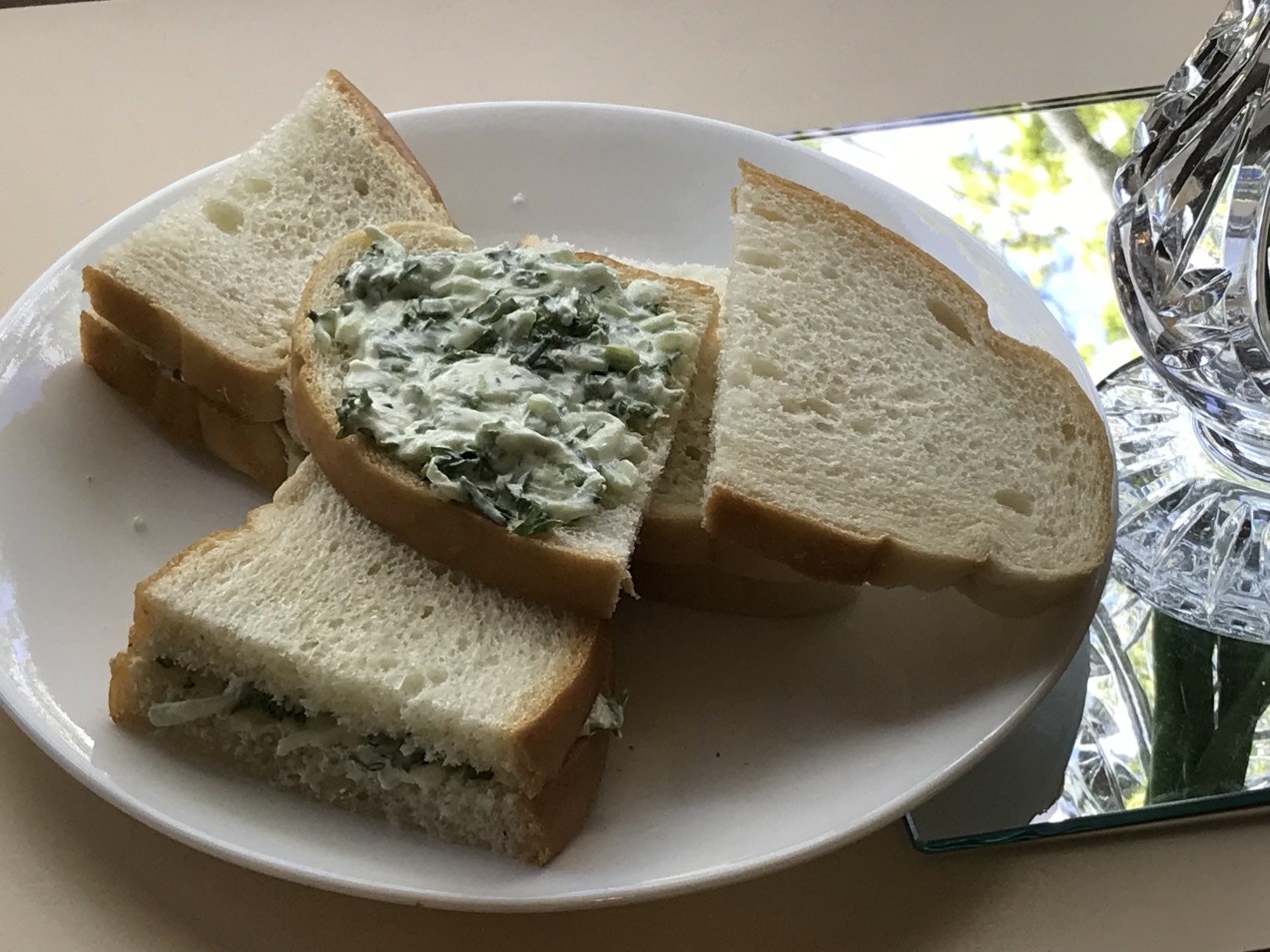
So is benedictine, which has evolved a bit over the decades. At first, it was cream cheese flavored with onion and cucumber juice, maybe colored with green food coloring, served between white bread triangles as tea sandwiches. Supposedly, the name comes from the green color, which was similar to an herbal liqueur made by Benedictine monks in France. Modern recipes tend to skip the food coloring and use grated cucumbers and onions, not just the juice, and serve the benedictine as a dip.
My recipe uses the modern approach. The grated cucumber and minced scallions give it a bit of texture, and parsley adds extra freshness and color. Spread it over bread, eat it with crackers, and/or vegetables, or, if you’re feeling fancy, put it in a sandwich with some cucumber slices and channel your inner Downton Abbey character. It’s also a great alternative to mayonnaise or miracle whip on more substantial sandwiches. This recipe is loaded with cucumber and herbs, but if you want a higher proportion of cream cheese, feel free to use two packages, or cut the other ingredients in half.
Note: The easiest way to seed cucumbers is to cut them in half lengthwise after peeling. Then it’s easy to remove the seeds with a spoon. The fresh aroma released in the process is nice too.
Ingredients:
1 8oz package cream cheese, softened
1 medium cucumber, peeled, seeded, grated, and squeezed to remove extra moisture
1 bunch green onions/scallions, minced
1 bunch parsley (I use curly for this recipe, but flat leaf is fine too), minced
Pinch salt
Directions:
Beat cream cheese until smooth. Mix in the grated cucumber until evenly combined.
Stir in the minced scallions and parsley, mixing until evenly distributed. Add salt to taste.
Refrigerate for at least an hour, preferably longer, to give flavors time to meld.
Over a few days in the fridge, a bit of extra liquid will probably form in pockets on the dip. This is just liquid from the cucumbers and is nothing to worry about. I prefer to pour it off, but if you want a thinner texture, feel free to mix it back in.
And as always, if you subscribe for free, you’ll get notifications of new posts in your inbox. Of course, if you do want to support my work with a monetary donation, I won’t complain about that either.
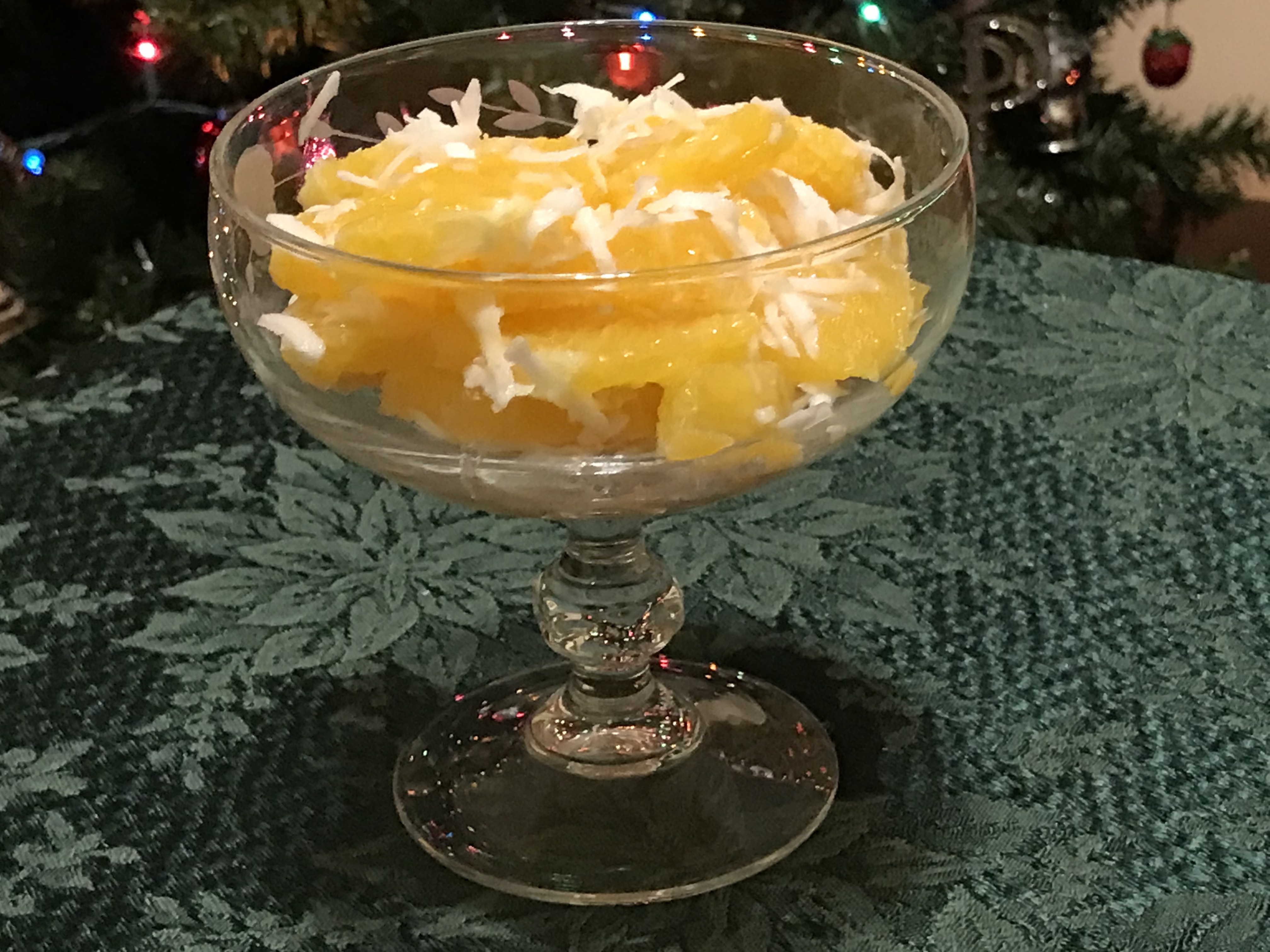
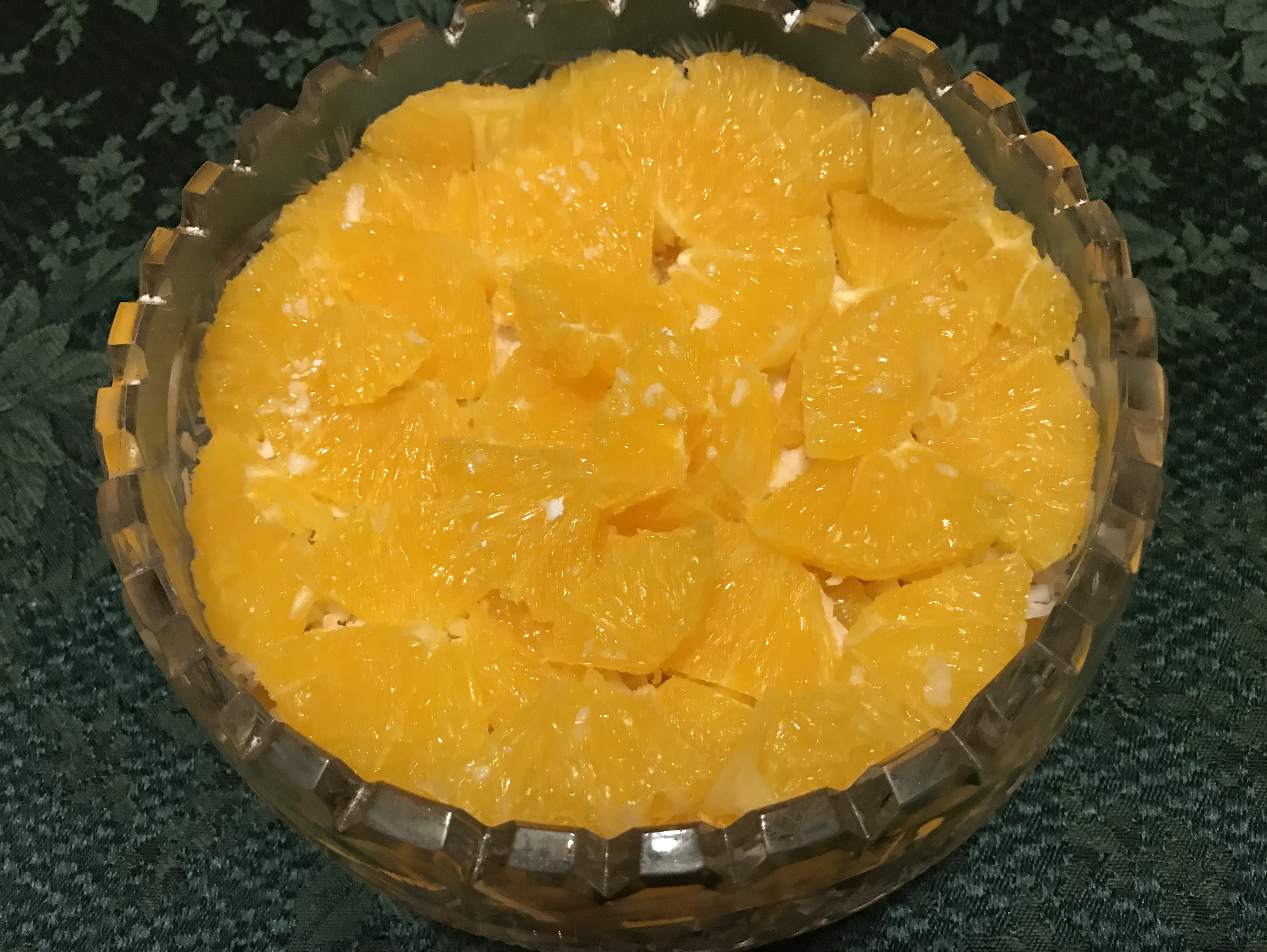
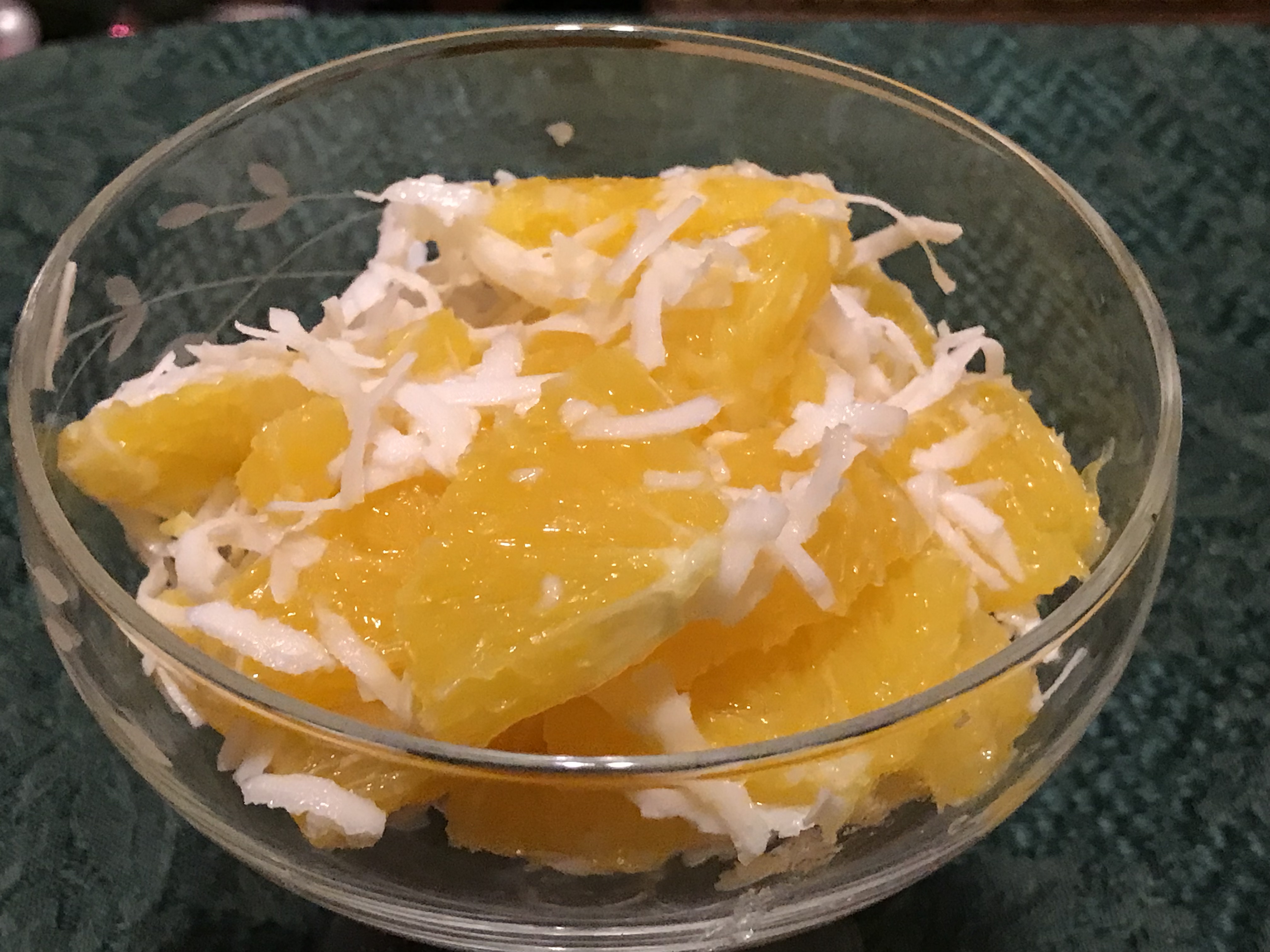
According to Greek mythology, ambrosia was what the gods ate on Mt. Olympus. In the US, particularly the Southeast, it came to mean a mixture of oranges and grated coconut. It’s especially popular at Christmastime, peak season for oranges. In the past, difficulties with transportation made oranges and other citrus fruits relatively expensive in areas where they couldn’t be grown. As transportation improved in the late 19th Century and prices dropped, cooks in the US Southeast developed a layered dessert with sliced oranges and shredded coconut. A bit of powdered sugar helps the orange slices release some of their juices.
Sometimes other fruits or a bit of liquor is added, but the oranges and coconut are always central. Presumably, this is the type of ambrosia featured in To Kill a Mockingbird, set in Alabama in the 1930s. Along with the ambrosia, Aunt Alexandra fixed three kinds of meat and two cakes. Presumably there was also bread, rolls, biscuits, or cornbread, and some sort of vegetables. In the 1950s, with the explosion in available convenience food, a mix of canned fruit, coconut, sometimes pecans and/or marshmallows, cool whip, and occasionally mayonnaise was developed. Without the mayonnaise, that actually sounds pretty good, but here we have the original, basic version.
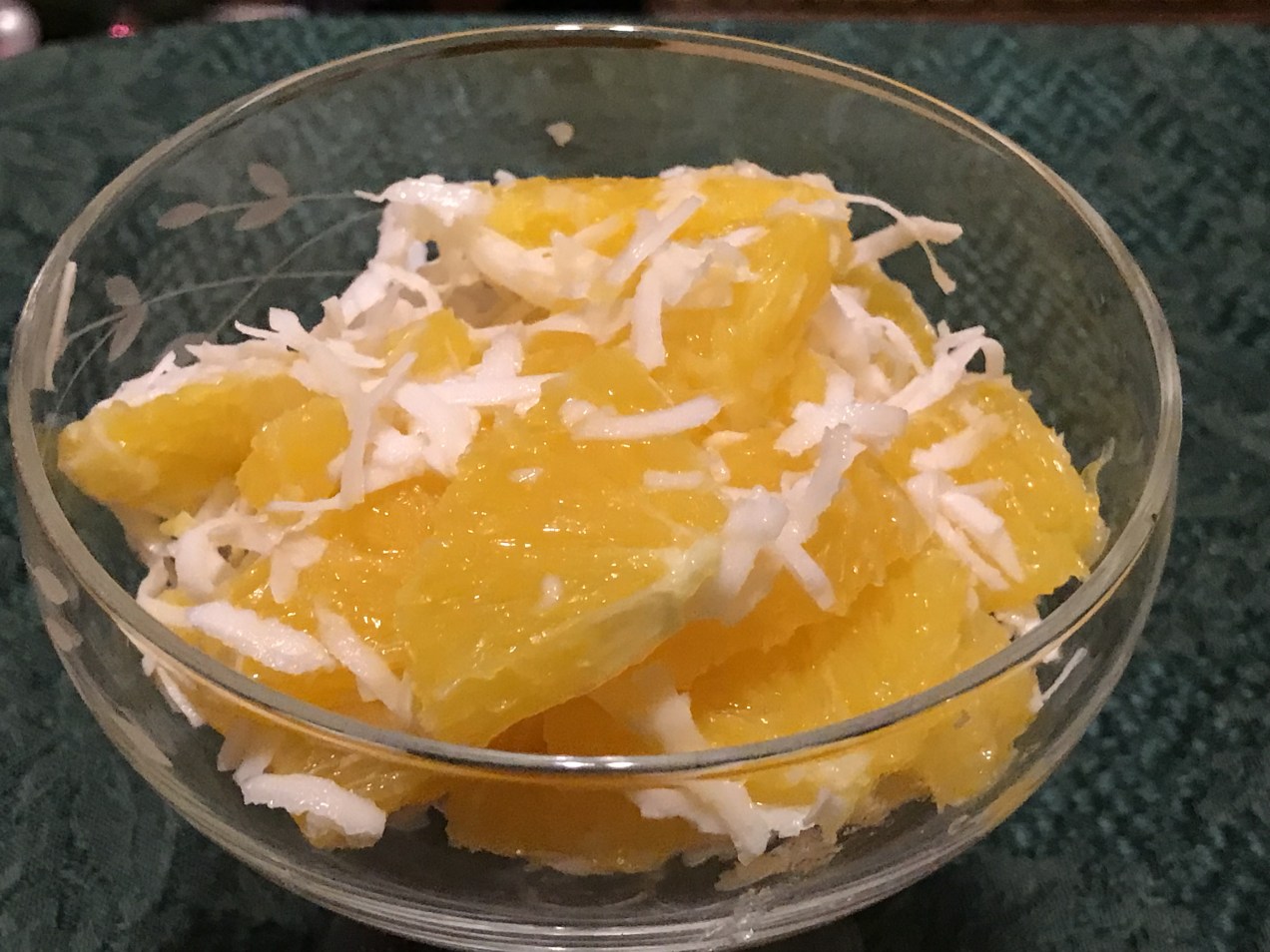
Doesn’t that look divine?
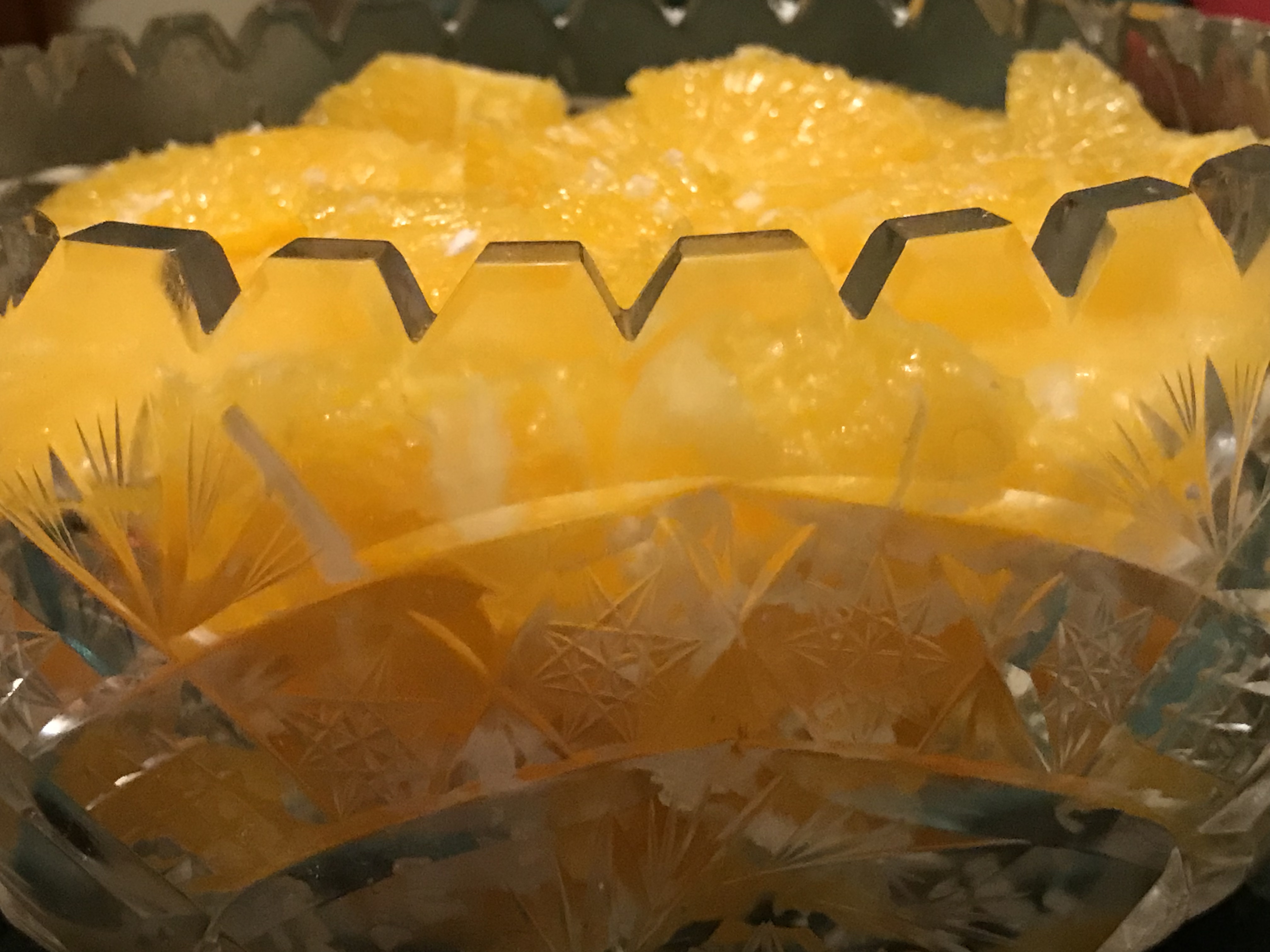
It’s super simple to make. All you need are oranges, shredded coconut, and powdered sugar. I used five oranges and about a cup of coconut, soaked in hot water for about fifteen minutes to soften. The oranges are peeled, quartered, sliced, and layered in a glass serving dish. The slices are sprinkled with a bit of powdered sugar, then a layer of coconut, repeated until the oranges are used up. On the last layer of oranges is just the powdered sugar. The ambrosia is so pretty, and tastes just as good.






 Feasting Through Time