

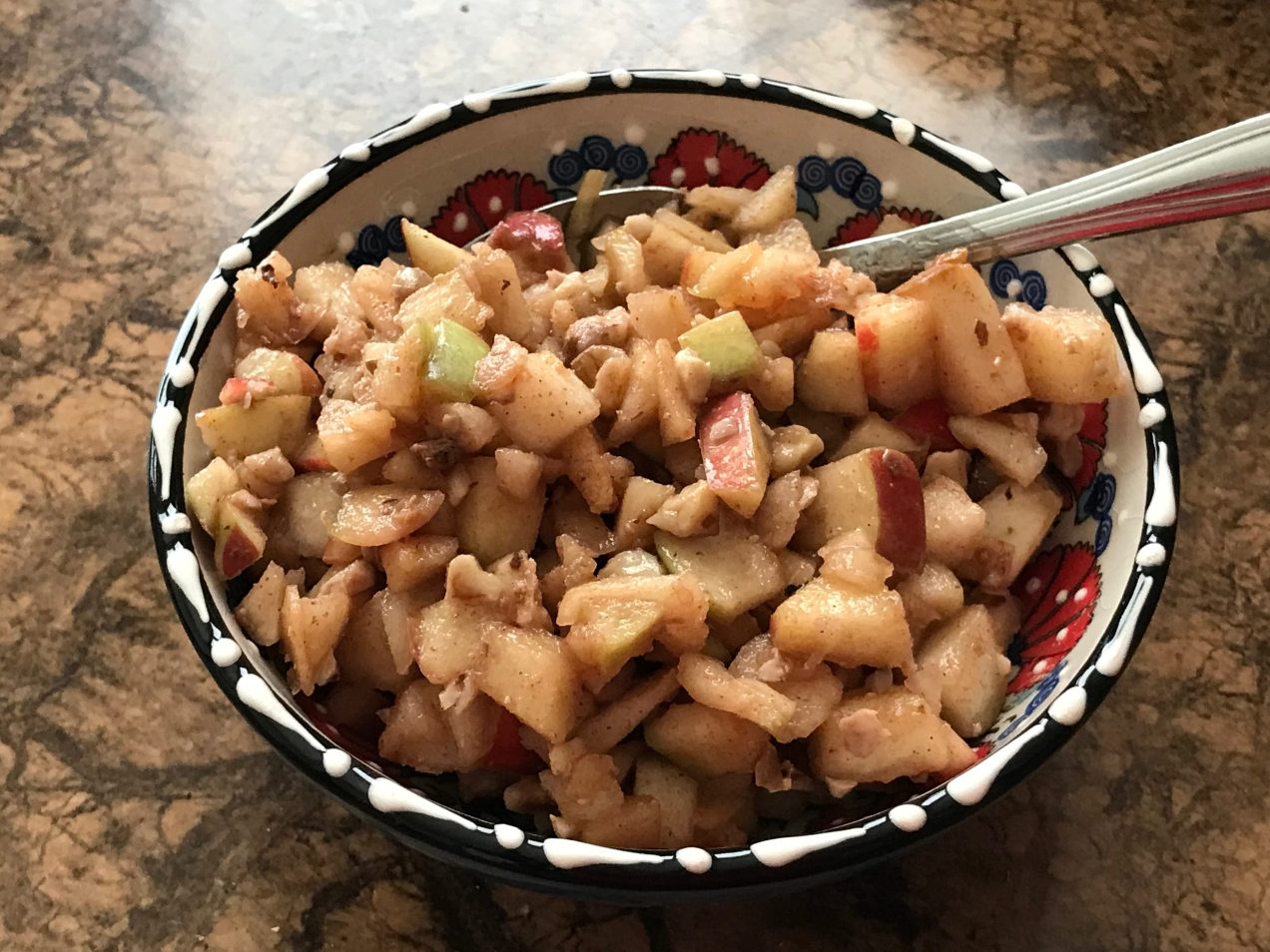
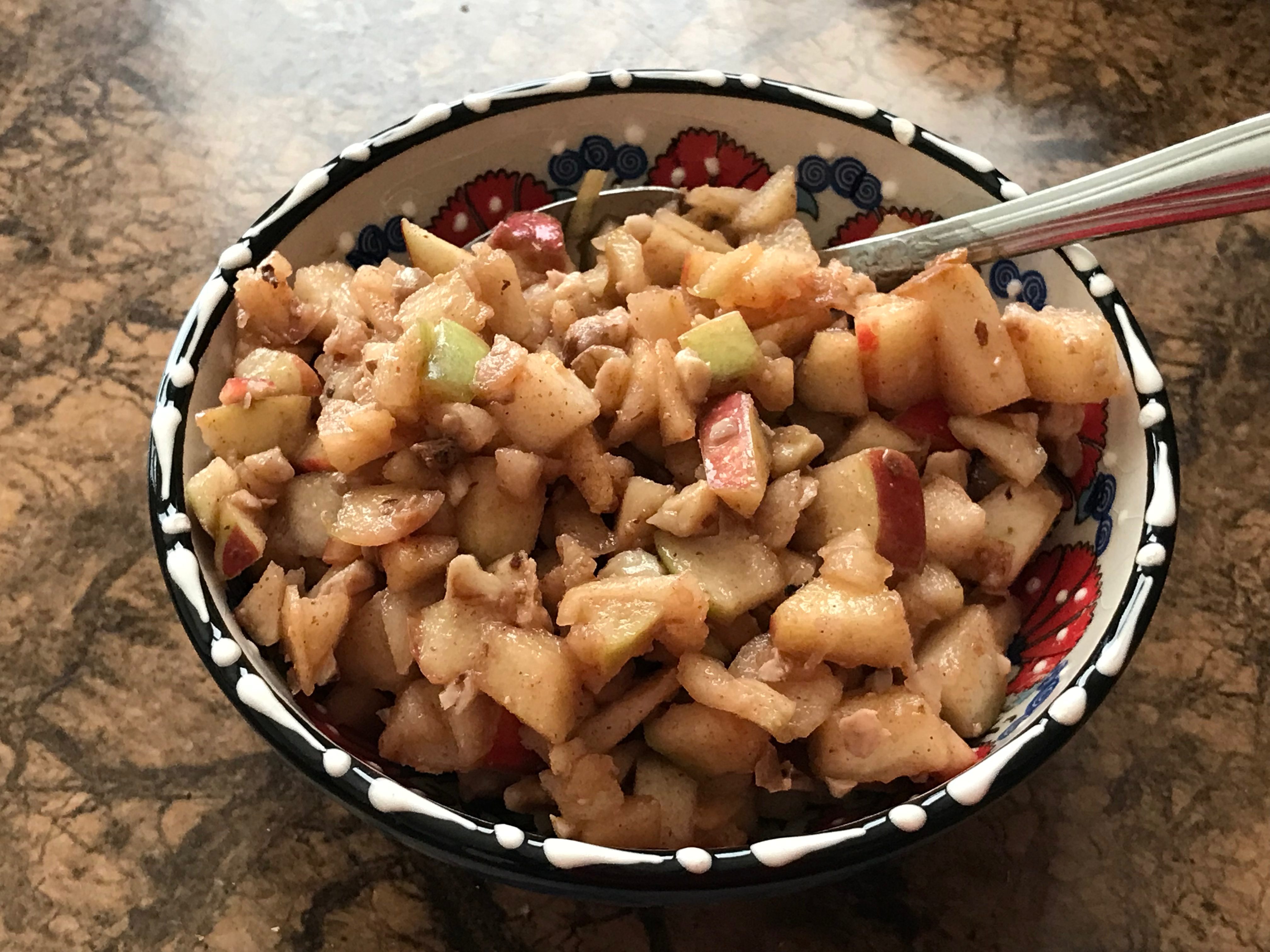
Ashkenazi charoset
dessert, fall, jewish cuisine, recipes, spring

Healthy Spring (or fall) Dessert: Ashkenazic Charoset

Ashkenazi charoset

            At first, it might seem strange to have apples in a dish for a spring holiday. Passover, the most important holiday on the Hebrew calendar, celebrates the Israelites’ Exodus from Egypt. It always occurs in the spring (in the Northern Hemisphere), while apples are a symbol of fall. On further reflection, the use of apples actually does make sense.

            Charoset is a blend of chopped fruit and nuts, representing the mortar enslaved Israelites used in Egypt, and is an essential element on the Passover Seder plate. Historically, most Ashkenazi Jews lived in Central and especially Eastern Europe. Not many fruits are in season there in March or April, but apples could be stored in a cold cellar over the winter. The only other option might be rhubarb, at least when there is plenty of sugar to counter the acid. Holiday food traditions seem to change more slowly than what people eat every day, so even with modern shipping and preservation, apples remain the base fruit.

            There are many recipes out there, typically including walnuts, sugar, spices, and an acidic liquid to keep the apples from oxidizing and turning brown. Most common is sweet, kosher red wine. Not all kosher wines are sweet, but Manischewitz, the most common brand (for all sorts of kosher products, in fact), is. With at least 51% concord grapes and a bit of extra sweetener, it tastes exactly like the classic non-fermented grape juice, with the alcohol flavor only coming in at the end. Naturally, grape juice would be the perfect non-alcoholic substitute.

Advertisements

            If you’re wondering why wine isn’t all kosher (as I was), it’s because ancient pagan people often used it in their rituals. To ensure their wine hadn’t previously been used in these rituals, the production from picking to transportation to serving had to be done by kosher-observant Jews. Unless, if I understand things correctly, it gets heated, which renders it unsuitable for pagan rituals. Once that’s done, anyone can handle it.

            Ashkenazi charoset is delicious, regardless of faith or season. It’s sweet, tart, two different kinds of crunchy, juicy, and especially tasty during the fall, when apples are freshest. Walnuts make the mix more substantial, and spices like cinnamon and ginger make it taste like crustless apple pie.

Ingredients:

  • 4 medium sweet-tart apples (I used 2 cortlands and 2 zestars)
  • ½ cup walnut pieces
  • A few drops of lemon juice, if desired
  • ½ teaspoon ground cinnamon
  • ¼ teaspoon ground ginger
  • ¼ cup (4 tablespoons) sweet kosher red wine or red concord grape juice
  • Sugar to taste

Directions:

  1. Core the apples, slice, and mince as finely as you can with a knife. (One of those devices that cores an apple and cuts it into 8 or 10 slices works perfectly for the first part, and I don’t bother peeling. If using a food processor for the second part, be careful not to overprocess.) Place in a large bowl. Toss with a few drops of lemon juice if desired.
  2. Mince the walnuts and stir in, distributing evenly. Add the spices and wine and stir again.
  3. Taste for sweetness. Depending on the apples, you may or may not need sugar. If the mix needs it, add sugar a tablespoon at a time, tasting as you go.
  4. Let rest in the refrigerator for 24 hours for the best flavor.

            If you enjoyed this, please like, share, and/or subscribe.

One-Time
Monthly
Yearly

Make a one-time donation

Make a monthly donation

Make a yearly donation

Choose an amount

$5.00
$15.00
$100.00
$5.00
$15.00
$100.00
$5.00
$15.00
$100.00

Or enter a custom amount

$

Your contribution is appreciated.

Your contribution is appreciated.

Your contribution is appreciated.

DonateDonate monthlyDonate yearly
Standard
appetizers, fall, recipes, salad

Guess the Color: Pumpkin Seed Oil (dressing recipe for potato or kale salad)

pumpkin seed kurbiskernol vinaigrette
Looks more appetizing on the kale

            Over the course of my culinary exploration, I’ve been amazed by just how many different types of oil there are. Some are pretty standard and widespread. Canola and vegetable (often soybean) oils are neutrally flavored, easy-to-find, affordable, and widely used in baking and frying. Some cooks prefer corn or peanut oil for deep frying. For sautéing and salad dressings, olive oil is a favorite. In a well-stocked grocery store, you often find sunflower, sesame, flaxseed, grapeseed, avocado, and coconut oils.

            Certain oils are largely restricted to particular cuisines or uses. Sunflower is popular in Eastern Europe due to Orthodox fasting rules and the inability to grow olives. Toasted sesame oil is common in East Asia, especially China, while Middle Easterners prefer untoasted. Nut oils like almond or walnut are sometimes used in European salad dressings. And bright reddish-orange palm oil gives many West African dishes their distinctive flavor.

Advertisements

            In Austria, a local specialty is pumpkin seed oil, called kurbiskernol, made from the appropriately-named oilseed pumpkin. It’s typically used in salad dressings and as a dip for bread. Due to its low smoke point, it’s not suitable for cooking, which damages its distinctive flavor. But here’s a question for you. If the stereotypical pumpkin is orange and inner seed kernels (pepitas) are green, what color is pumpkin seed oil?

            Answer: It’s a lovely deep purple, with yellow-green undertones.

            In 1000 Foods to Eat Before You Die (pgs. 323 – 324), Mimi Sheraton describes pumpkin seed oil as resembling liquid amethysts. If it had been available during the Middle Ages, sophisticated diners would have been all over it. They loved bright, even tacky colors, and very few foods are naturally that shade of purple. For people who created elaborate gilded dishes with egg yolks and saffron, liquid jewels sound right up their alley.

            Pumpkins arrived in Europe after Columbus. Exactly when Europeans began eating them or pressing their seeds is unclear, but the oil makes a great vinaigrette base. To boost its color, I added red wine vinegar, minced shallots, a little salt, and a dash of mustard and honey to keep the dressing from separating. If you find the flavor of the pumpkin seed oil a little strong, try replacing about half of it with sunflower oil, which is typically pale, for a lighter shade of amethyst. Yellow or greenish olive oil will make it look muddy.

            Thinner layers of the oil can look muddy anyway, but the taste, clearly that of roasted pumpkin seeds, is worth it. It’s a fantastic complement to potatoes, and makes salads much more satisfying. Kale is especially good, because its strong flavor is less likely to be overwhelmed. It also holds up in the fridge for a few days, even with dressing.

Advertisements

            To dress about six medium potatoes or one bunch of kale, just combine 6 tablespoons of pumpkin seed oil, 2 tablespoons red wine vinegar, a minced shallot, and a little salt. Mix in a teaspoon each of Dijon mustard and honey and whisk until combined. Toss with cubes of hot cooked potatoes (waxy varieties like reds or Yukon golds are best, peeled or not is up to you) or chopped kale and let rest for an hour at room temperature. Store leftovers in refrigerator, bringing potato salad back to room temperature before serving. If desired, rewarm for about 30 seconds in the microwave. The kale salad is ready right out of the fridge.

            Vinaigrette-based vegetable salads are perfect year-round. They stay crisp (if applicable) better than lettuce, are more interesting than a veggie tray, and provide a pleasantly light counterpoint to grilled or roasted meats, heavy sides, and desserts. With no egg or dairy, they’re safer on hot days than those with mayonnaise. And during the winter, sturdy vegetables like potatoes and kale (or even frozen vegetables like green beans) are more consistent than fresh sweet corn, tomatoes, or lettuce.

            And with how popular pumpkin spice is, pumpkin seed dressing would be perfect on a fall or Halloween theme menu. Perhaps a kale or other cabbage salad with pumpkin seed vinaigrette and toasted pumpkin seeds to start, followed by pumpkin or squash ravioli with butter and sage, and concluding with a pumpkin or apple dessert. With plain coffee or tea, though. Pumpkin spice belongs in desserts, not beverages.

One-Time
Monthly
Yearly

Make a one-time donation

Make a monthly donation

Make a yearly donation

Choose an amount

$5.00
$15.00
$100.00
$5.00
$15.00
$100.00
$5.00
$15.00
$100.00

Or enter a custom amount

$

Your contribution is appreciated.

Your contribution is appreciated.

Your contribution is appreciated.

DonateDonate monthlyDonate yearly
Standard
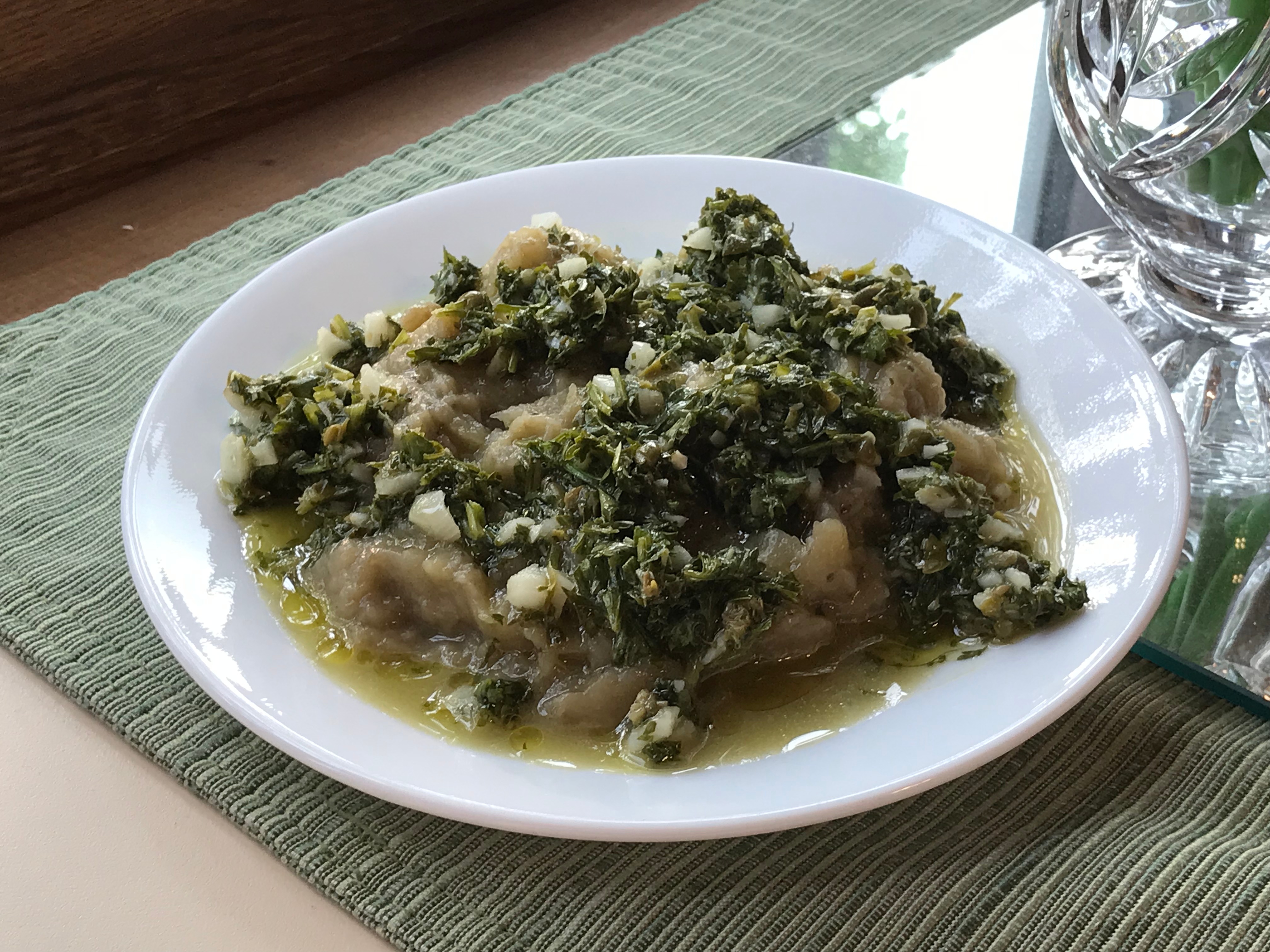
Aubergine en caton
appetizers, french cuisine, recipes, summer, vegetarian

French Baba Ghanoush: Aubergine en Caton

Aubergine en caton

            By European standards, France is a large country. As with any nation with varied terrain and climate, it has a number of regional specialties. There are the dairy-heavy cuisines of Normandy and Brittany, Germanic-inspired dishes of Alsace in the northeast, and wine-based sauces and stews from the wine-growing regions of Burgundy and Bordeaux. And in the south, along the Mediterranean, is Provence, where many dishes resemble those from neighboring Liguria in Italy.

            Provence is one of the few French regions where olive trees can produce fruit. The oil is ubiquitous, including in a sauce for roasted eggplant. Other Mediterranean flavors come from lemon juice, capers, and a bit of anchovy. Before you get grossed out, it’s just a small amount of paste used as a flavor booster, not enough to make it taste “fishy.” All these other flavors, which are rather strong on their own, plus garlic and plenty of fresh parsley, balance it out.

            Aubergine is the French word for eggplant. Here it is cooked and pureed just like in baba ghanoush, except in the oven instead of over a wood fire, producing a lighter color and mild, slightly sweet flavor. Rather than mixed into the puree, the sauce is served over the top, for a greater contrast.

            As Mimi Sheraton suggested in 1000 Foods to Eat Before You Die on page 54, a simple description is sufficient to compose a recipe, at least for the sauce. It was the eggplant itself that gave me trouble. When cooking whole, which is necessary to keep the pulp a greenish color instead of browning, it takes a surprisingly long time to soften. At 400 degrees Fahrenheit (or just under 205 degrees Celsius), it took nearly an hour. Since it was a cool day that was fine, but on a hot summer day that would never be an option. Plus, using the oven for that long for one fairly small item doesn’t seem energy efficient.

            I considered ways to “pre-cook” the eggplant before finishing it off in the oven. After poking holes all over (to release steam and avoid an explosion), boiling or steaming would probably introduce too much water. But what about the microwave? They work by making water molecules move faster, creating friction and raising the temperature. And since the rays pass through the food, the center warms up much faster than with other cooking methods.

            For a vegetable like eggplant, which has a high water content, this worked like a charm. To avoid an explosion and mess, I poked the holes all the way through with the pointy end of a meat thermometer, giving plenty of openings for steam to escape. Just heat on a microwave safe plate, turn every two minutes, and be careful when handling. The eggplant steams inside the skin, creating the perfect silky texture with just the right amount of moisture.

            As it turned out, the oven wasn’t even required, making this interesting dish perfect for a hot day. When the eggplant is cool enough to handle, just cut in half, scoop out the pulp, puree it, and serve warm or at room temperature with the sauce. Accompany with bread, crackers, or crunchy vegetables.

            The sauce recipe is easy to double and can be kept in the refrigerator for several days. Don’t worry if the oil solidifies; it will turn liquid again as it warms up. This is common for vinaigrette-type dressings and sauces. Just get them out of the fridge half an hour to an hour or so before using, and they’ll be fine.

Ingredients:

  • 1 large eggplant, about 2 pounds
  • 3 tablespoons olive oil
  • Juice from ½ lemon
  • 1 clove garlic, minced
  • 2 tablespoons capers, minced
  • ¼ teaspoon anchovy paste
  • ½ bunch parsley, minced
  • Salt to taste

Directions:

  1. Combine all ingredients except eggplant, parsley, and salt in a bowl and whisk to dissolve anchovy paste and combine.
  2. Whisk in the parsley and taste for salt. The anchovy paste and capers are both salty, so you might not need it.
  3. Set sauce aside at room temperature, or refrigerate overnight. Bring to room temperature before serving.
  4. Poke holes all over the eggplant, all the way through. Place on a microwave-safe plate and cover with a paper towel. Microwave on high for 8 to 10 minutes, turning every 2 minutes, until a skewer slides easily into the flesh. Let rest until cool enough to handle.
  5. Cut eggplant in half and scoop flesh into bowl of a food processor. Process until smooth.
  6. Scoop eggplant puree onto a plate, spoon sauce over, and serve with bread, raw vegetables, and/or crackers.

            For more recipes and food history, sent right to your inbox, please like, subscribe, and/or share.

One-Time
Monthly
Yearly

Make a one-time donation

Make a monthly donation

Make a yearly donation

Choose an amount

$5.00
$15.00
$100.00
$5.00
$15.00
$100.00
$5.00
$15.00
$100.00

Or enter a custom amount

$

Your contribution is appreciated.

Your contribution is appreciated.

Your contribution is appreciated.

DonateDonate monthlyDonate yearly
Standard
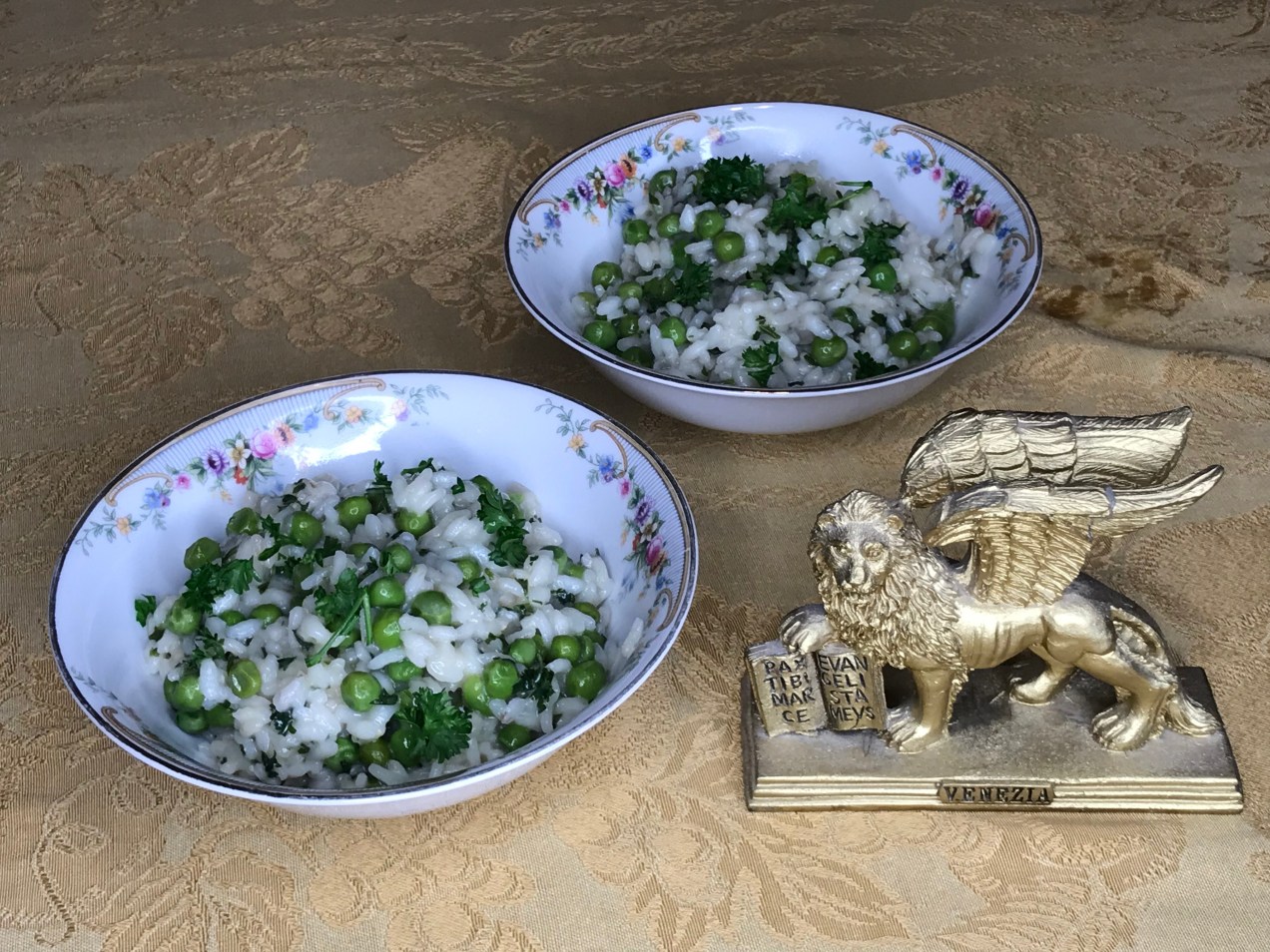
Risotto verde
food history, italian cuisine, recipes, rice, spring, vegetarian

Risotto Verde: The Taste of Spring

Risotto verde

            Among the numerous varieties of risotto, there are a few classics, as detailed in 1000 Foods to Eat Before You Die on pages 233 – 234. Risotto bianco is the basic kind, made simply with rice, butter, a little onion or shallot, white wine, broth, parmesan cheese, and maybe some pancetta or bacon. Milanese is colored a bright golden yellow with saffron. Nero is colored black with squid ink. Piedmontese is enhanced with white truffles. Other varieties might include seafood, mushrooms, or vegetables.

            As you can probably guess, risotto verde is meant to be green. Frequently a spring specialty, it gets its color from parsley and either sweet green peas or asparagus. It’s very fresh-tasting and, when made with frozen peas, surprisingly quick and easy to prepare. To keep everything bright and fresh, I didn’t use any pancetta for my own recipe.

            Technically, you’re not “supposed” to reheat risotto, because it thickens upon standing and can become “gluey.” I’ve never had this problem, or maybe the texture upon reheating just doesn’t bother me. Just add a few drops of water before putting it in the microwave. It will still be a great accompaniment to your chicken sandwich for lunch, and it’s way healthier than chips.

Ingredients:

  • 4 tablespoons (or ¼ cup) butter, or 2 tablespoons each butter and olive oil
  • 1 shallot or ¼ onion, minced
  • 1 ½ cups arborio or other short-grain rice
  • 4 tablespoons (or ¼ cup) dry white wine (something light like pinot grigio), or replace with extra broth
  • 4 – 5 cups chicken or vegetable broth (broth made from poaching chicken works great here)
  • 1 10-ounce bag frozen peas
  • Half bunch parsley, large stems removed, minced
  • 1 cup grated parmesan cheese

Directions:

  1. Combine the broth and peas in a medium saucepan and bring to a boil. Turn off heat, but leave on the stove.
  2. Melt the butter in a large skillet over medium heat. When bubbling, add shallot or onion and sauté for about 2 minutes, until softened.
  3. Add the rice and cook, stirring constantly, until coated and translucent, about 2 minutes.
  4. Stir in the wine and cook, stirring constantly, until evaporated, another 2 or 3 minutes.
  5. Add the broth and peas, a ladleful at a time, stirring constantly, waiting for each to absorb before adding the next. Stir in the parsley about halfway through, saving a little to sprinkle on top at serving time.
  6. After adding 4 cups of broth, the risotto should be slightly liquid. If it seems too thick, add a little more broth.
  7. Remove from the heat, stir in the parmesan, sprinkle with remaining parsley, and serve immediately.

For more recipes, history, and fun facts sent directly to your inbox, please like, subscribe, and/or share.

One-Time
Monthly
Yearly

Make a one-time donation

Make a monthly donation

Make a yearly donation

Choose an amount

$5.00
$15.00
$100.00
$5.00
$15.00
$100.00
$5.00
$15.00
$100.00

Or enter a custom amount

$

Your contribution is appreciated.

Your contribution is appreciated.

Your contribution is appreciated.

DonateDonate monthlyDonate yearly
Standard
hungarian cuisine, recipes, stew

Hungary’s National Dish: Goulash

            If asked to name a Hungarian dish, goulash is probably what most people would come up with first. And that isn’t a bad thing. It’s flavorful, soothing, and endlessly customizable. Plus, like most stews, it reheats extremely well. For Sunday dinner with leftovers for lunches, it’s perfect.

            According to Mimi Sheraton in 1000 Foods to Eat Before You Die, goulash was originally a cowboys’ stew. Beef is the most common meat, but pork is also widely used. Since pork is typically half the cost of beef or less, and makes excellent goulash, that is what I use in the recipe, though beef cubes will also work.

            The critical ingredient is paprika, which is actually a relative newcomer to Hungarian cuisine. It is made of dried and ground peppers, which originally came from the Americas. Most likely, peppers arrived in Hungary during the reign of Holy Roman Emperor Charles V, whose empire included Spain, the Low Countries, parts of Italy, Austria, Bohemia, and Hungary, though it took a few centuries for Europeans to accept them.

            By the 19th Century, paprika was a central flavor in Hungarian cuisine, and indispensable in goulash. Besides the meat (or occasionally beans) and paprika, other ingredients might include onions, garlic, potatoes, carrots, tomatoes, or green peppers. In other words, the usual suspects in stew. Some versions include caraway seeds, sage, sauerkraut, or even grated apple.

            For my version, I settled on all the usual suspects except green pepper, for the simple reason that it was the only one I didn’t have on hand, needing to be used up. That’s one of the nice things about goulash. The ingredients are affordable, easy to find, and often already in the kitchen. Caraway and sage add a nice extra flavor, and a bit of apple cider vinegar brightens everything up. If using fresh tomatoes, don’t worry about peeling or seeding them. With the long cooking time, they break down into the broth, leaving just their flavor, vitamins, and lovely red color.

Ingredients:

  • 4 pounds pork butt, shoulder, or assorted bone-in chops
  • 2 onions, chopped
  • 2 garlic cloves, minced
  • 8 ounces carrots, sliced
  • 4 tablespoons (¼ cup) unsmoked sweet paprika (This is not a typo. It sounds like a lot, but goulash is supposed to be very paprika-forward, not subtle.)
  • 1 tablespoon caraway seeds, lightly crushed
  • Dash cayenne pepper
  • 2 pounds fresh chopped tomatoes (about 7 – 8 Roma tomatoes), or 1 15-ounce can crushed tomatoes and 1 can of water
  • 6 small red or gold potatoes, unpeeled, cut into roughly ¾ inch cubes
  • 8 sage leaves, thinly sliced
  • 1 tablespoon apple cider vinegar

Directions:

  1. Trim the extra fat from the pork, mince it, and cook over medium heat until it’s mostly melted and rendered.
  2. Cut as much meat from the bones as you can, cut into roughly ¾ inch cubes, and set aside the meaty bones.
  3. Add the pork cubes and bones to the fat and cook over medium heat, stirring occasionally, until most of the pink is gone and the remaining fat has begun to render, about 10 minutes.
  4. Add the onions, garlic, carrots, paprika, and caraway, with salt and a dash of cayenne pepper. Cook roughly 10 more minutes, until the onions start to cook down.
  5. Add the tomatoes (and water if using canned) and cook for another 10 minutes.
  6. Reduce heat to simmer. Add the potatoes and sage leaves, cover the pot, and cook until everything is tender, ½ hour to an hour.
  7. Remove the bones, pull any pork from them, and return the meat to the pot. Discard the bones.
  8. Immediately before serving, stir in the vinegar. Serve alone or with mashed potatoes, egg noodles, dumplings, or bread.

Rating: 9/10

For more recipes and fun facts, make sure to subscribe for free. Of course, any contributions to buy more pork chops would make me very happy.

One-Time
Monthly
Yearly

Make a one-time donation

Make a monthly donation

Make a yearly donation

Choose an amount

$5.00
$15.00
$100.00
$5.00
$15.00
$100.00
$5.00
$15.00
$100.00

Or enter a custom amount

$

Your contribution is appreciated.

Your contribution is appreciated.

Your contribution is appreciated.

DonateDonate monthlyDonate yearly
Standard
Black-Eyed Susan Cocktail
american cuisine, beverages, food history, recipes

Preakness Stakes Mocktail: The Black-Eyed Susan

Black-Eyed Susan Cocktail

            Tomorrow is the Preakness Stakes, the second leg in the Triple Crown. The Preakness is always run on the third Saturday in May at Pimlico in Baltimore. Some trainers say the two-week turnaround time is not enough for the horses to recuperate, and sometimes the Kentucky Derby winner won’t race. Sovereignty will not race tomorrow, meaning there will not be a Triple Crown winner this year. While not as famous as the Derby, the Preakness is still an interesting event, with two associated food traditions. Since Maryland is associated with blue crab from the Chesapeake Bay, it’s no surprise that the Preakness is known for crab cakes.

            The Preakness Stakes also has its own signature cocktail, called the black-eyed Susan. Most likely, it was named for the blanket of flowers draped over the winner. The Kentucky Derby has red roses, the Preakness has black-eyed Susans, and the Belmont Stakes has white carnations. Ideally, the cocktail will be about the same yellow-orange color as the flowers. Interestingly, black-eyed Susans are not yet blooming in Maryland.

Photo from Pexels.com

            Unlike the mint julep, the black-eyed Susan never seems to have had an “official” recipe. Invented in the 1970s, ingredients varied over time, even at Pimlico, and according to the drinker’s personal taste. The only constants are orange juice and vodka. Other ingredients might include pineapple juice, grapefruit juice, peach schnapps, rum, or bourbon. Frequently the drink will be finished with a blueberry or blackberry for the characteristic “black eye.” As long as there are at least two fruit flavors, pretty much anything goes.

Black-Eyed Susan Cocktail
Black eye demonstrated here. Definitely a resemblance, in an abstract way.

            Fruity cocktails lend themselves well to non-alcoholic variations. For my own version, I keep things simple with equal parts orange juice, pineapple juice, and tonic water with a bit of peach syrup. The tonic water is the “secret ingredient” that makes non-alcoholic cocktails more complex, and its bitter edge tastes a bit like grapefruit.

Here’s how to make it:

            For each serving, combine 1/3 cup orange juice, 1/3 cup pineapple juice, and 1/3 cup tonic water with a few ice cubes. Stir in a tablespoon of peach syrup (like what’s used in Italian sodas), or more to taste. For a low-alcohol but not completely alcohol-free cocktail, the syrup can be replaced with peach schnapps. If desired, add a blueberry or blackberry. It’s that simple, unlike the system for betting on the race.

            To get notifications of new posts sent straight to your inbox, make sure to subscribe for free. Of course, if you want to make a contribution, you’re more than welcome to.

One-Time
Monthly
Yearly

Make a one-time donation

Make a monthly donation

Make a yearly donation

Choose an amount

$5.00
$15.00
$100.00
$5.00
$15.00
$100.00
$5.00
$15.00
$100.00

Or enter a custom amount

$

Your contribution is appreciated.

Your contribution is appreciated.

Your contribution is appreciated.

DonateDonate monthlyDonate yearly
Standard
Pork Chop Marengo
food history, french cuisine, italian cuisine, recipes

Napoleonic Entree: Chicken or “Veal” (Pork) Marengo

Pork Chop Marengo
Pork Chop Marengo

            Despite his remarkable career, Napoleon Bonaparte had several close calls on his rise to power. One such case was at the Battle of Marengo in June 1800. Napoleon had seized power in a coup the previous year. To secure his rule, he needed military victories. At the time, he was fighting the Austrians for control of northern Italy. They met in battle near the city of Alessandria, in the Piedmont region.

            At first, the battle didn’t go well for the French, but Napoleon managed to snatch victory from the jaws of defeat. His control over Italy was secured, skeptics in France were reassured, and other ambitious generals were discouraged from turning on him. To celebrate, or simply because he was hungry after a long and no doubt stressful battle, Napoleon requested a special dish. Or so the story goes.

            Recipes for chicken marengo vary enormously. The only constants seem to be chicken (or occasionally veal) browned in olive oil, onions, and tomatoes, braised together to make a sort of stew. There’s usually garlic, mushrooms, and white wine. Many recipes include shallots and parsley, and a few use brandy instead of wine. Great chef Auguste Escoffier recommended including fried eggs and crayfish. Regardless of specifics, toasts fried in butter traditionally accompany chicken marengo.

            To make things even more complicated, there seems to be a debate about whether chicken marengo is French or Italian. In Mimi Sheraton’s 1,000 Foods to Eat Before You Die, it’s in the French section, but I’ve also seen recipes in Italian cookbooks. Since the Piedmont region was historically part of the Duchy of Savoy, a realm straddling the Alps between France and Italy and right on the trade routes between them, it’s hardly surprising that a Piedmontese dish would be adopted into French cuisine, or vice-versa. And it’s fitting that an entrée associated with Napoleon should be considered both French and Italian. After all, he himself was a native of Corsica, then ruled by Genoa, but made his career in France.

            For my own recipe, I combined the different strands into one, with no eggs or crayfish. The nice thing about chicken or “veal” marengo is that after browning the meat and making the “sauce,” it can be kept overnight and cooked the following day. Everything can be done in a Dutch oven, but if you don’t have one, a skillet and slow-cooker will also work. If you want to reduce fat and calories, the bread can be toasted dry in the oven or toaster, instead of in the buttered skillet. Or don’t toast it, if you prefer, but whatever you do, don’t skip it. You need bread to soak up the sauce.

Here’s how to make it:

Ingredients:

  • 1 chicken, cut up, or roughly 3 pounds bone-in pork (or veal) chops
  • 2 tablespoons olive oil
  • 4 tablespoons butter, plus more to brown toasts
  • 1 medium onion, quartered and thinly sliced
  • 2 shallots, halved and thinly sliced
  • 4 garlic cloves, crushed with the side of the knife and minced
  • 1 bunch parsley, thick stems separated from leaves and thinner stems, and both parts minced separately (don’t discard the thick stems)
  • 3 tablespoons dry white wine, mixed with 1 tablespoon brandy
  • 2 tablespoons flour
  • 1 (roughly 15 oz) can crushed tomatoes, or about 2 lbs fresh tomatoes, chopped
  • 1 pound mushrooms, cut into thick slices, with larger pieces halved
  • Baguette or Italian bread, to serve

Directions:

  1. Brown meat in the olive oil and two tablespoons of the butter in the skillet or Dutch oven over medium heat. Set aside on a plate.
  2. Add onion and shallots and sauté, stirring frequently, for about 5 minutes, or until they start to turn golden. Add the garlic and parsley stems and cook for 2 more minutes (garlic is added later because it cooks faster and burns more easily).
  3. Stir in the wine/brandy mix, making sure to scrape up any browned bits at the bottom of the pan. Cook until the liquid is mostly evaporated, 5 to 10 minutes.
  4. Add the flour and stir until incorporated. Follow with the tomatoes, and water if using canned. Bring sauce mixture to a boil. If using fresh tomatoes, reduce heat and simmer for 10 to 15 minutes, until the tomatoes break down and release their juice. Add salt and pepper to taste.
  5. Place the meat, skin side up if using chicken, in the Dutch oven or slow-cooker, and cover with the sauce. At this point, the chicken/pork/veal marengo can be refrigerated overnight if desired.
  6. Preheat oven to 325 degrees Fahrenheit, if using Dutch oven. Bake for 2 to 3 hours, until the meat is tender (if the stew was chilled overnight, it will probably be at the longer end of the time range).
  7. If using a slow-cooker, cook for about 4 hours on high or 6 – 8 on low. If it’s a little longer, like if you put it on before leaving for work, that’s completely fine.
  8. Half an hour before serving (with either cooking method), melt the remaining butter in a skillet over medium heat. Add the mushrooms and a little salt and cook, stirring frequently, until soft and aromatic, about 10 to 15 minutes. Add to the stew, pressing them down into the sauce, and leave to cook while browning the toasts (or for 15 minutes if you decide to use untoasted bread).
  9. Toast the bread pieces in a buttered skillet over medium low heat until browned.
  10. Sprinkle the stew with the parsley leaves and serve, toasts on the side.

And as always, please like, subscribe, and/or share to support my work.

One-Time
Monthly
Yearly

Make a one-time donation

Make a monthly donation

Make a yearly donation

Choose an amount

$5.00
$15.00
$100.00
$5.00
$15.00
$100.00
$5.00
$15.00
$100.00

Or enter a custom amount

$

Your contribution is appreciated.

Your contribution is appreciated.

Your contribution is appreciated.

DonateDonate monthlyDonate yearly
Standard
Arter med Flask - Swedish yellow pea soup
food history, recipes, soup, swedish cuisine

Swedish Thursday Night Special: Yellow Pea Soup and Swedish Pancakes with Lingonberries (with soup recipe)

Information is found in 100 Foods to Eat Before You Die pages 366, 371 – 372, and 340 – 341, soup recipe is my own

            Sometimes, it’s hard to figure out where food traditions come from. According to legend, the Swedish tradition of eating yellow pea soup on Thursday nights came about because on one Thursday night in 1577, that’s how King Eric XIV was poisoned, which raises a few questions. Is eating pea soup a way to memorialize a good king, or the assassination of a bad one? Why was a king eating pea soup anyway? In most countries that was commoner’s fare. Kings and princes, especially in northern Europe, favored piles of meat and fish. Perhaps his doctor recommended a lighter diet, which would add a layer of irony to the story. And how did pancakes become the traditional dessert?

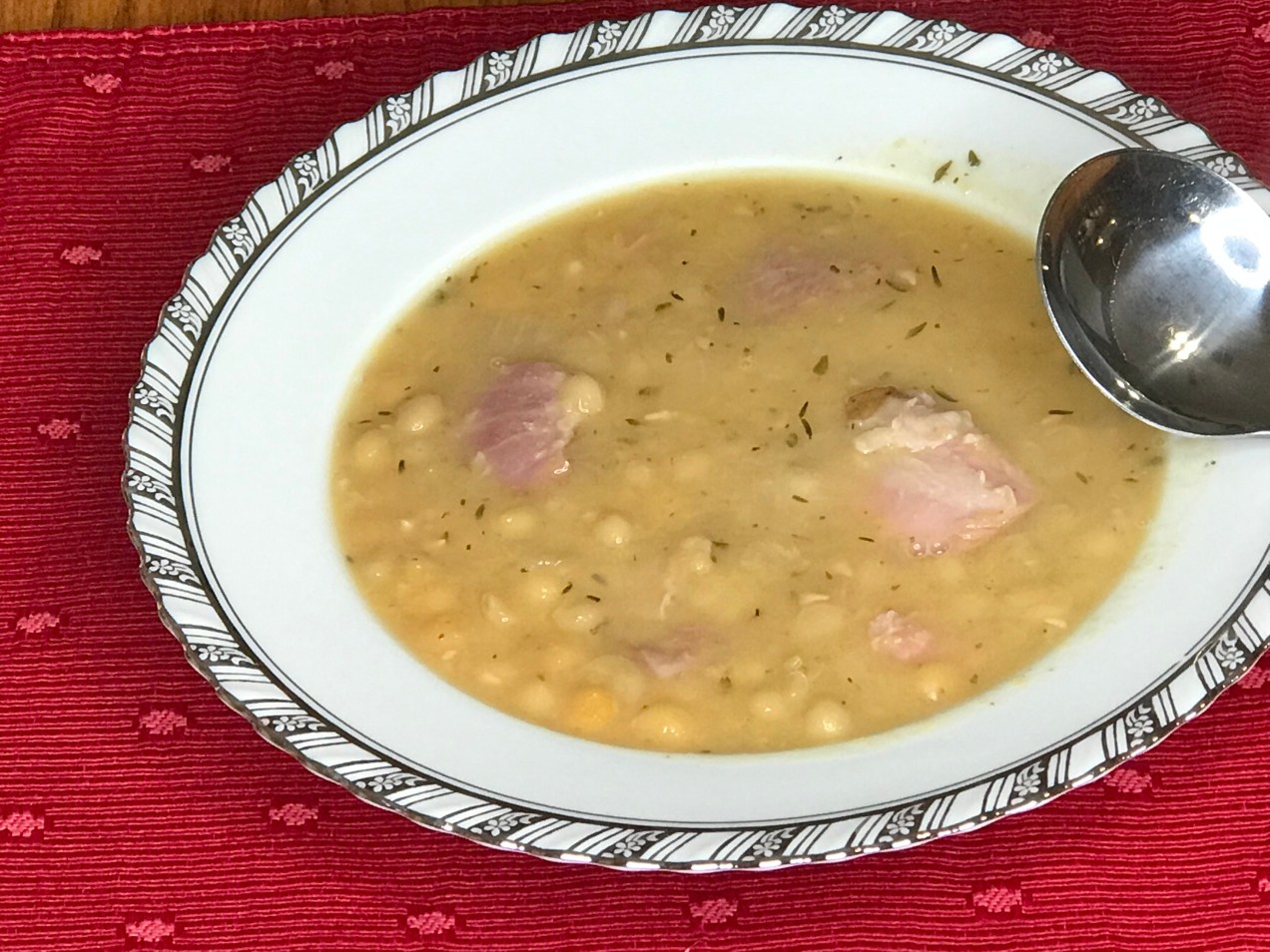
            Regardless of how it happened, yellow pea soup and pancakes are still a Swedish Thursday night tradition, even if not every week. And why not? The soup is a simple mix of dried yellow peas, water, onions, salt, dried thyme, and a little ginger, with optional pork. The recipe on the bag suggested pork ribs, Mimi Sheraton mentioned cured pork in her description on page 366 in 1000 Foods to Eat Before You Die, so I used a smoked ham shank. It added an incredible richness of flavor to the soup, though it would still be good without it.

Arter med Flash - Swedish yellow pea soup
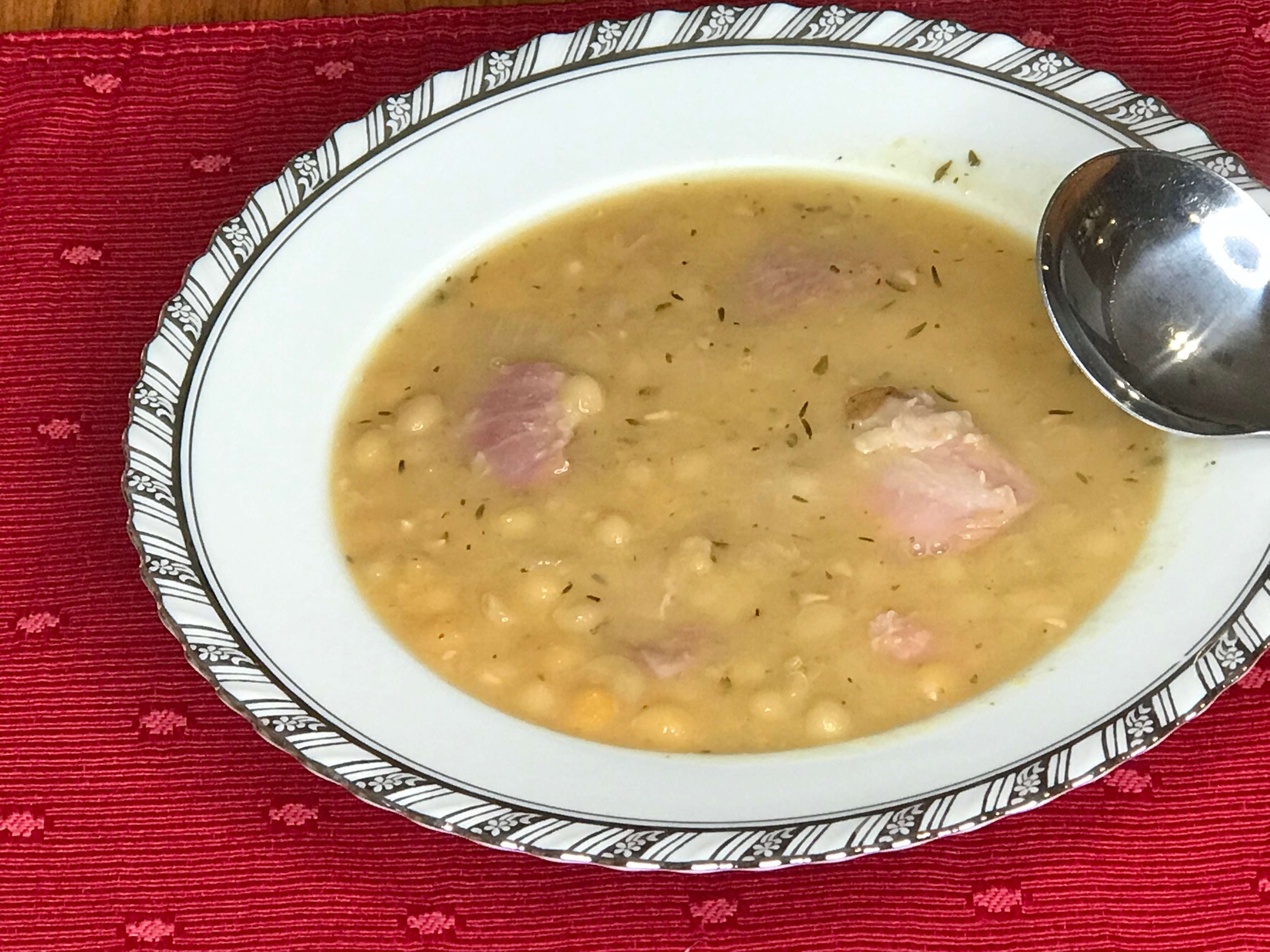
Yellow pea soup with ham

            An interesting thing about the dried peas, aside from being yellow when many Americans are more used to green, is that they aren’t hulled or split. They take a bit longer to cook, but give the soup a much better texture and appearance. The flecks of thyme and ham pieces also improve the presentation. The soup was delicious as is, though a few rye crisps certainly wouldn’t hurt.

            I had a slight problem with the Swedish pancakes. Because the batter is so thin, making multiple small pancakes at once wasn’t working. They just ran together, making one big crepe-like pancake. Since browning is more important, I rolled with it. The finished pancakes are served with lingonberry jam and often whipped cream.

            Lingonberries are small, very tart berries native to Scandinavia. The best way to describe their flavor is about two thirds cranberry, one third sour cherry. Preserved lingonberries have a texture sort of like cranberry sauce, but the berries have softer skins. Jars of lingonberry preserves are available at most stores with an international aisle, and at some larger supermarkets next to the jam. The whole dessert, with lightly browned pancakes, reddish-purple lingonberries, and off-white whipped cream, is just beautiful.

Platter - Swedish pancakes with Lingonberries
Whipped cream is optional, but highly recommended with Swedish pancakes and lingonberries

            Here’s how to make the soup. You will need:

  • 1 lb (or 500g, which is fairly close) dried yellow peas, soaked overnight
  • 1 package (2 pieces, roughly 2 lbs) smoked ham shanks (optional)
  • 1 medium yellow onion, finely chopped
  • 1 tbsp salt (reduce to 1 ½ tsp if using the ham shanks)
  • 1 tsp dried thyme
  • Dash powdered ginger
  • Rye crisps or rye bread to serve, optional but recommended
  1. Combine all ingredients in a pot with 8 cups of water and bring to a boil.
  2. Reduce heat and simmer, with the lid tilted, until peas start to fall apart and ham shanks are tender, about 1 hour. Stir a few times toward the end of cooking.
  3. Turn off the heat, remove the ham shanks to a cutting board, and cover the pot.
  4. Once the ham shanks have cooled enough to handle, pull meat from the bone and cut into bite-sized pieces. Return ham chunks to pot.
  5. Bring soup back to a simmer over low heat, stirring frequently.
  6. Ideally serve with rye bread or crisps, even more ideally followed by Swedish pancakes.

As always, subscribe for free for recipes and trivia, sent right to your inbox. And if you want to buy me another jar of lingonberry preserves, I would be most grateful.

One-Time
Monthly
Yearly

Make a one-time donation

Make a monthly donation

Make a yearly donation

Choose an amount

$5.00
$15.00
$100.00
$5.00
$15.00
$100.00
$5.00
$15.00
$100.00

Or enter a custom amount

$

Your contribution is appreciated.

Your contribution is appreciated.

Your contribution is appreciated.

DonateDonate monthlyDonate yearly

    Standard
    Flaeskeaeggekage - Danish bacon and egg pancake
    breakfast/brunch, danish cuisine, food history, recipes

    Danish Bacon-Egg Pancake (Flaeskeaeggekage)

    Flaeskeaeggekage - Danish bacon-egg pancake whole
    Just look at how pretty it is. And it tastes as good as it looks.

    Information found in 1000 Foods to Eat Before You Die (pg. 347), recipe is my own

                Bacon and eggs have been combined for centuries, probably because they both cook quickly on the stove. Most likely, this is why they are often considered breakfast food. I’m not going to get up early enough to make eggs and bacon for breakfast, but some morning people might. It will taste just as good for brunch, lunch, or dinner.

                There are a number of recipes for this difficult-to-pronounce Danish recipe. Variations include the amount of milk to use and whether or not to dice the bacon. I went with Mimi Sheraton’s suggestion to leave the bacon strips whole and arrange them in a star pattern. Another unique touch is to use a bit of potato starch as a binder instead of the flour used in most of the online recipes. It gives the pancake a special, subtle flavor that makes it stand out from all the other recipes involving eggs and bacon.

                According to the internet, most Danish bacon is leaner than American bacon and is sold in cans. When using American bacon, it’s a good idea to pour off about half of the fat from the skillet after cooking it. The egg mixture cooks in the bacon fat, but it doesn’t need the full amount. This is particularly true if you’re cooking the whole package and not just the six slices needed for the recipe. You may as well and have some extra to munch on, since everyone nearby will be drawn to the smell.

    Flaeskeaeggekage - Danish bacon-egg pancake wedge
    Can’t you just smell the bacon through the screen?

                Traditionally, the pancake is flavored with white pepper, sprinkled with chives, and served with buttered rye bread. Depending on what you have, black pepper, green onions, and regular toast with butter and jam are other good options. Such an easy, comfort food dish like this shouldn’t require an extra trip to the store.

                To make it, I simply combined six eggs, a quarter cup 2% milk, a tablespoon potato starch, and a bit of salt and pepper to taste. The omelet/pancake cooks in the still-hot bacon fat over low heat until the bottom starts to brown and the top is almost set. Then add the bacon strips in a star pattern, sprinkle with chives or scallions, and cover the pan to help it set completely. Slice into wedges and serve with toast or rye bread. As a main course, each “pancake” serves two people.

    One-Time
    Monthly
    Yearly

    Make a one-time donation

    Make a monthly donation

    Make a yearly donation

    Choose an amount

    $5.00
    $15.00
    $100.00
    $5.00
    $15.00
    $100.00
    $5.00
    $15.00
    $100.00

    Or enter a custom amount

    $

    Your contribution is appreciated.

    Your contribution is appreciated.

    Your contribution is appreciated.

    DonateDonate monthlyDonate yearly

    Standard
    british cuisine, recipes, soup, stew, welsh cuisine, winter

    Medieval-Inspired Welsh Soup: Leek Broth

    Idea comes from 1000 Foods to Eat Before You Die, pg. 35, recipe is my own

                For some reason, leeks are a Welsh symbol. They are particularly associated with St. David’s Day, dedicated to Wales’s patron saint. Exactly how this happened is unclear, and history doesn’t provide many clues. At some point after 500 BC, Celtic peoples came to dominate the British Isles, including Wales. Starting in 43 AD, the Roman Empire conquered England and Wales, staying until the 5th Century.

                During these centuries, the native population became somewhat Romanized, adopting many Roman customs and, from the 4th Century onward, Christianity. These Romano-Britons spoke a Celtic language similar to Welsh. After the legions left to deal with everything else going on in the 5th Century, Anglo-Saxons from modern Germany began invading the island. The Romano-British chieftains put up a spirited defense, but were gradually pushed west into Wales, which is why the land to the east came to be called “Angle-Land,” later England. Did the proto-Welsh use leeks, which were a favorite of the Romans, to distinguish themselves from the Saxons? It’s possible.

                One of these proto-Welsh chieftains became the basis of the King Arthur legends. In other words, the man behind the myth was Welsh, not English. Perhaps because Wales is hillier and less fertile than England, or perhaps because they were busy fighting first each other and later the Vikings, the Anglo-Saxons mostly left the Welsh alone. After the Norman Conquest in 1066, so did the descendants of William the Conqueror. They were busy fighting rebellious Saxons, building an empire in France larger than what was controlled by the French king, and fighting their relatives over shares in that empire. There were some incursions into Wales, Scotland, and Ireland, but the Anglo-Norman kings of England were mostly occupied elsewhere.

                This changed in the 13th Century, probably because the kings of England lost most of their land in France. With the French kings much stronger than before, reconquest was a difficult proposition. So the English kings turned their energy towards the rest of the British Isles. King Edward I conquered Wales in the 1280s, and from then on heirs to the English throne were called the Prince of Wales. One story goes that the Welsh asked King Edward for a prince that spoke neither English nor French, so he presented them with his infant son, the future Edward II, who did not yet speak any language.

                Unlike Scotland and Ireland, Wales merged into the English monarchy with only a few early rebellions. It remained a culturally distinct backwater, but Welsh longbowmen played an essential role in the Hundred Years’ War. Without them, the English could not have won so many battles against much larger French forces.

                In Wales’s cool, wet climate, raising livestock was more profitable than growing most crops. Oats, barley, rye, and root vegetables grow more easily than wheat. Traditional Welsh dishes tend to be homey and comforting, not spicy and exciting. Not many Welsh specialties are known outside the British Isles, but one of the more famous is leek broth, called cawl cennin in Welsh. It’s a simple mix of leeks, carrots, potatoes, and cabbage, flavored with bacon and thickened with oatmeal.

                Except for the potatoes, this sounds a lot like the thick soups, called pottages, eaten by most medieval Europeans. The ingredients varied by social class and the occasion, but for the common people, vegetable-based soups and bread were the core of the diet. These were supplemented with butter and cheese, some meat and fish (usually salted), fruit in season, and beer, cider, or wine, depending on the region. Leeks and salted pork products like ham or bacon gave pottages more flavor, and vegetables like carrots and cabbages kept reasonably well over the winter. Grains, particularly those like oats and barley that were less useful for making bread, were often added as thickeners.

                Once potatoes became common in the 17th Century, they went into the pot too. Before soup bases and bouillon cubes, water would have been the liquid. Until the 20th Century, chicken was more expensive than beef, mutton, or pork, so there would be no chicken broth in a common, everyday dish. Today, a bit of bouillon or soup base is typical in leek broth, adding extra flavor for just a few cents.

                As far as affordable home cooking goes, leek broth is a great choice. The root vegetables are full of vitamins, and the oats make it taste sort of creamy and surprisingly filling. The soup/stew has a fair amount of starch, but carbohydrates are not the enemy, especially in the form of carrots and whole grains like oats. A chunk of whole grain bread would be a great accompaniment, maybe with a piece of cheese or glass of milk for extra protein. And don’t skip the bacon. Per serving, it does not add that much fat, and a little bit adds a ton of flavor. Which makes a popular New Year’s resolution a bit easier.

    Ingredients:

    • About 8 ounces bacon, diced
    • 2 large leeks, halved lengthwise, cleaned, and thinly sliced crosswise
    • 8 ounces carrots, thinly sliced
    • 6 medium-sized red potatoes, cut into roughly ½ inch cubes
    • Half of a small green cabbage, thinly sliced
    • About ½ cup to 1 cup rolled oats (not steel-cut or instant)
    • Chicken broth or water (broth from a soup base is perfectly good here)

    Directions:

    1. Place the bacon in a large soup pot over medium heat. Cook until starting to crisp, then add the leeks, carrots, and potatoes. Do not drain the fat. All the other ingredients are healthy, and it is essential for the best flavor.
    2. Cook the root vegetables in the bacon fat with the bacon, stirring occasionally, until the vegetables start to cook down and release their moisture.
    3. Add enough water to cover, about 12 cups. If desired, add 1 teaspoon soup base or bouillon per cup of water.
    4. Bring the soup to a boil, then reduce the heat and simmer, stirring occasionally, until the potatoes are soft.
    5. Stir in the cabbage and oats. Cook on low heat, stirring frequently, until the cabbage softens and the soup begins to thicken.
    6. Ladle the soup into bowls and serve hot. Don’t worry about presentation; leek broth tastes a lot better than it looks.

                For more warming recipes over the next few months, don’t forget to subscribe for free.

    One-Time
    Monthly
    Yearly

    Make a one-time donation

    Make a monthly donation

    Make a yearly donation

    Choose an amount

    $5.00
    $15.00
    $100.00
    $5.00
    $15.00
    $100.00
    $5.00
    $15.00
    $100.00

    Or enter a custom amount

    $

    Your contribution is appreciated.

    Your contribution is appreciated.

    Your contribution is appreciated.

    DonateDonate monthlyDonate yearly
    Standard