As summer fades, so do basil plants. After bringing my plants inside, a fall batch of pesto is in order to use them up. There are a million and one different ways to make it. I like the classic. Adding a bit of parsley or arugula might add some extra flavor, but the basil should dominate, supported by garlic. With those two strong flavors plus parmesan cheese, there’s no point in using expensive pine nuts. Walnuts are a common substitution, giving the final sauce a similar taste and texture. And some recipes even add a little butter along with the olive oil.
Note that while this recipe uses a food processor, connoisseurs prefer a mortar and pestle. If you have a big enough mortar and pestle and sufficient patience, by all means use it. Either way, smelling your fingers after handling the basil is optional, but highly encouraged. The aroma has a way of sticking, like that of lemon or orange peels.
Ingredients:
2 cups loosely packed fresh basil leaves
Several springs fresh parsley, if desired (seems to help reduce discoloration)
3 cloves fresh garlic, peeled, crushed with the side of a knife, and coarsely chopped
½ teaspoon salt
½ cup walnuts and/or almonds
½ cup parmesan and/or Romano cheese
½ cup olive oil
Pasta and/or vegetables, for serving
Directions:
If desired, place the walnuts in a small skillet over medium heat and toast, watching carefully, until aromatic. This will only take a few minutes.
Place the basil, optional parsley, and salt in the bowl of a food processor, and pulse several times to mince.
Add the garlic, salt, and walnuts, and blend to form a paste. Add the cheese and blend again.
With the motor running, slowly add the olive oil through the processor’s feed tube.
To thicken, add more cheese, a spoonful at a time. To thin, slowly add warm water until desired consistency is reached.
Taste for salt, adding more if necessary. Serve as soon as possible with hot pasta and/or vegetables.
Pesto can be kept in the refrigerator for a few days, but the surface will darken and brown. This is just a chemical reaction between the basil and the oxygen in the air, and will not affect the flavor. The discoloration can be slowed by covering the surface with a thin layer of olive oil. If the color change bothers you, just scrape off the top layer before serving.
To get upcoming fall recipes and posts sent directly to your inbox, be sure to subscribe. And if you liked this recipe (I hope you did), I would appreciate if you hit “like.”
Steak with chimichurri is a delicious summer treat
Across central Argentina, grasslands called the Pampas cover a vast area. Ever since Spaniards arrived in the 16th Century with cattle, beef has been a major industry. The region even had its own cowboys, called gauchos. Naturally, Argentine cuisine has developed a number of excellent beef recipes over the last five centuries, but the most famous is actually a sauce that goes with the meat. It doesn’t even have to be paired with beef, though it usually is.
Chimichurri belongs to an ancient tradition of green sauces made of chopped or ground herbs moistened with vinegar and/or oil. They were eaten in Ancient Rome, across Medieval Europe, and modern variations include pesto, salsa verde, and the North African chermoula. Chimichurri is based on parsley, cilantro, and garlic, combined with other herbs and often peppers or tomatoes. In the Spanish/Mediterranean tradition, the liquids are olive oil and vinegar.
When Spaniards first reached the Americas, they struggled to adjust to the available food options. In particular, they missed wheat bread and wine. To remedy their homesickness, the Spanish and Portuguese introduced a variety of plants and animals, with varied success. The Pampas were perfect for grazing cattle, sheep, and horses. Salted beef was an essential provision for the long voyages of discovery and trade. To produce it, an entire gaucho or cowboy culture evolved.
Grapevines grew well in other parts of Argentina, a huge boon for Spaniards used to wine and vinegar. This made Argentina the natural birthplace for beef with chimichurri, which took a surprisingly long time to become popular in the US. As far as I can tell, it’s only become trendy in the last decade or so, and is still uncommon on restaurant menus. Admittedly, I don’t eat out much and definitely not at fashionable restaurants, so maybe I’m mistaken. But “fancy” South American steak sauce is easier to make at home than excellent hashbrowns, so I’ll stick to diners and making my own chimichurri at a fraction of the cost.
Summer (or the hot days of early fall) is grilling and fresh herb season, making grilled steak with chimichurri a nice hot weather treat. In 1000 Foods to Eat Before You Die, Mimi Sheraton provides a recipe, which I adjusted to my taste. The essential ingredients for a bright, verdant flavor are cilantro, parsley, garlic, vinegar, and oil. Beyond that, some people include oregano, thyme, bay leaves, sweet and/or hot red pepper, or tomatoes. My recipe just uses oregano for depth and hot pepper flakes for a bit of kick. For the right texture the ingredients should be finely minced together. If using a food processor, watch carefully while pushing the pulse button. You want visible pieces of herbs, not a puree.
Ingredients:
1 bunch cilantro
1 bunch Italian or flat-leaf parsley
Leaves from 2 sprigs oregano
¼ yellow onion
2 garlic cloves, peeled and crushed with the side of a knife
Pinch red pepper flakes
2 tablespoons red wine vinegar
½ cup (8 tablespoons) olive oil
Salt
Directions:
Coarsely chop the cilantro, parsley, oregano, onion, and garlic.
Combine the herbs, onion, garlic, and red pepper flakes on the cutting board. Mince together.
Place the herb mixture in a bowl, add the vinegar, olive oil, and a pinch of salt, and stir.
Let the chimichurri rest at room temperature for at least an hour.
Serve with beef, another protein, potatoes, or eggs. Bring any leftovers to room temperature before enjoying.
Any leftovers are especially good with scrambled eggs. Chimichurri keeps well for several days. The herbs will eventually lose their color due to the acid in the vinegar, but this will not affect the taste. A similar meat, poultry, vegetable, or anything sauce is the North African chermoula, which I will be making soon. To get this and other recipes sent straight to your inbox, make sure to subscribe.
When we left off with the history of the Balkans at the end of the 5th Century AD, most of the region was secure under the Eastern Roman Empire. The Huns vanished from history shortly after Attila’s death in 453, and the Germanic confederations had moved into the former Western Roman Empire. Meanwhile, the Eastern Empire became increasingly Greek. Justinian I was the last emperor to speak Latin and seriously attempt to reconquer the West, so after his death in 565, most scholars call the empire Byzantine, even though the term wasn’t used at the time. War against the Vandals in North Africa, Ostrogoths in Italy, Visigoths in Spain, and Persian Sassanids in Syria didn’t affect the Byzantine territory in the Balkans much. Even the Arab conquests of the 7th Century, which essentially cut imperial territory in half, were far away in Syria and Egypt.
Pulling troops away to fight on the frontiers left the Balkans vulnerable, and in the 8th and 9th Centuries, new groups of peoples moved in, including nomadic Avars, Magyars, and Bulgars. Magyars settled in the Carpathian Basin and became Hungarian, while the Bulgars settled north and east of Greece. Eventually they adopted the language and customs of another new group, the Slavs, and became Bulgarian. Even Vikings made their way down the rivers of Eastern Europe to trade in Constantinople, though they didn’t stay.
By 1000 AD, the Balkans were home to Greeks, Romanians (who continued to speak a language descended from Latin), Albanians, Hungarians, and Slavic-speaking Croatians, Bosnians, Serbians, and Bulgarians. Residents traded and exchanged ideas with Italian and German merchants. Over the next few centuries, Byzantine control weakened, particularly as most of their territory in modern Turkey was seized by the Seljuk Turks, originally from Central Asia. Hungary, Romania, and Croatia were never under Byzantine authority, and the non-Greek border regions broke away repeatedly. By the 14th Century, when the Ottoman Turks, descendants of the Seljuks, crossed the Bosporus into Europe, the Balkans was a patchwork of independent kingdoms.
In the 1350s the Ottomans made their first incursion into Europe, gaining momentum in the 1390s. In 1453, the captured Constantinople, ending the Byzantine Empire. The emperor at the time, Mehmed II, was fascinated by the different lands and cultures under his control, and had a highly cosmopolitan court. He even hired Venetian painters to decorate his palaces. For the next 400 years, the Ottoman court and bureaucracy remained diverse. Among the cultural practices shared, food was one of them.
Foods like phyllo dough and coffee were introduced by the Turks, and they loved their sweets and rosewater. Many of the dishes introduced during this time remained popular even after the Ottoman Empire declined in the 19th Century, often with a local twist. Such is the case with Scordolea. Where the walnut sauce originated is unclear, but variations were spread far and wide by the Ottomans. The main ingredients are walnuts, soaked stale bread, and garlic, usually. Occasionally, almonds replace walnuts, and in the most popular Greek version, usually spelled as skordalia, nuts are sometimes omitted and the bread replaced with potatoes.
Getting the recipe right involved some trial and error. At first, I used too many walnuts, not enough bread, and tried to thin the paste with oil rather than water, resulting in a broken emulsion. The paste was sticky, the oil collected on top, and the standard white supermarket bread, which I thought would be neutral, gave the sauce a distinctive flavor. It’s good with barbecue, grilled cheese, peanut butter, and as French toast, but not for this. I needed an unsweetened, less “squishy” white bread. Fortunately, the grocery store bakery carries such loaves at a reasonable cost.
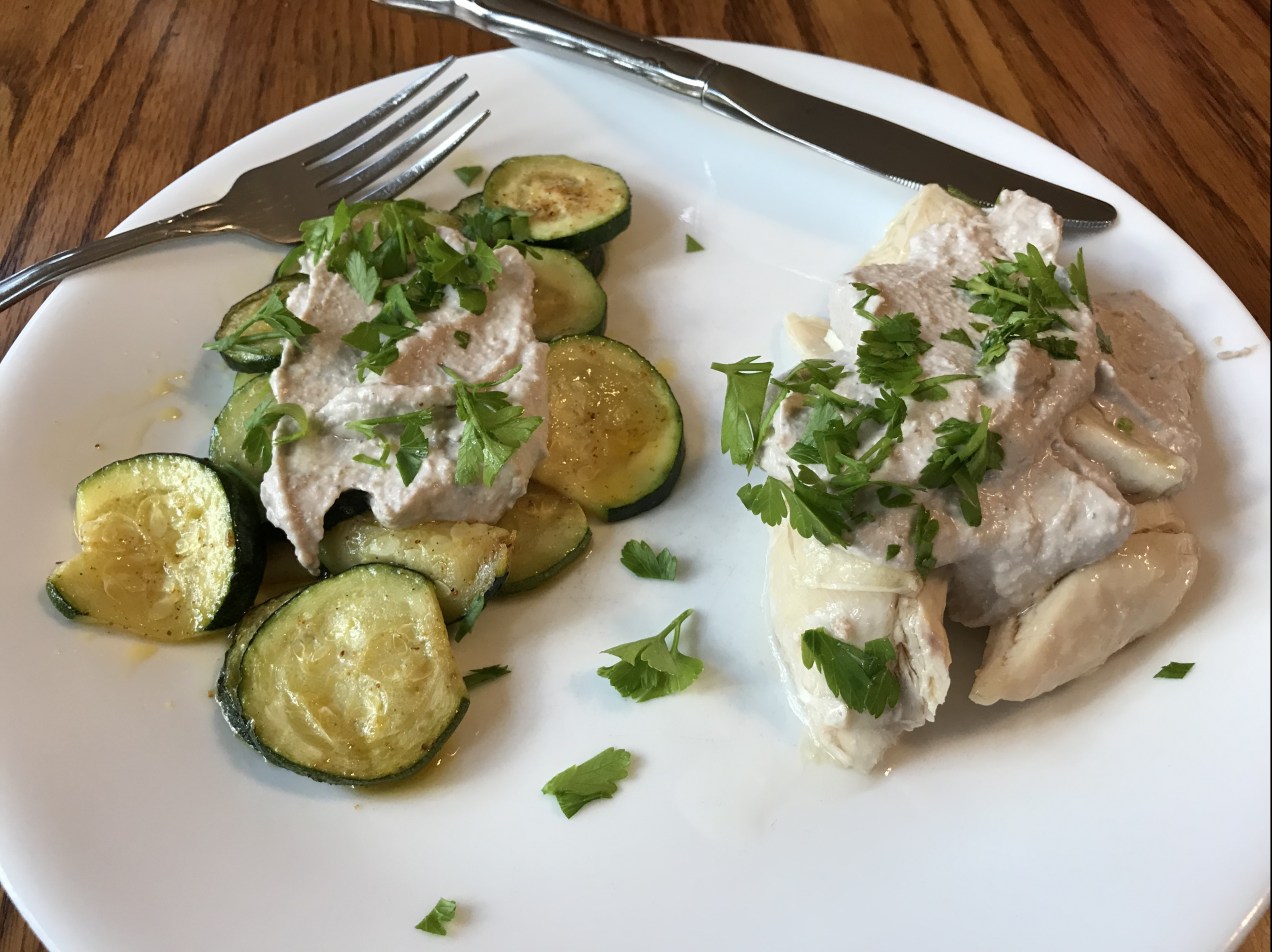
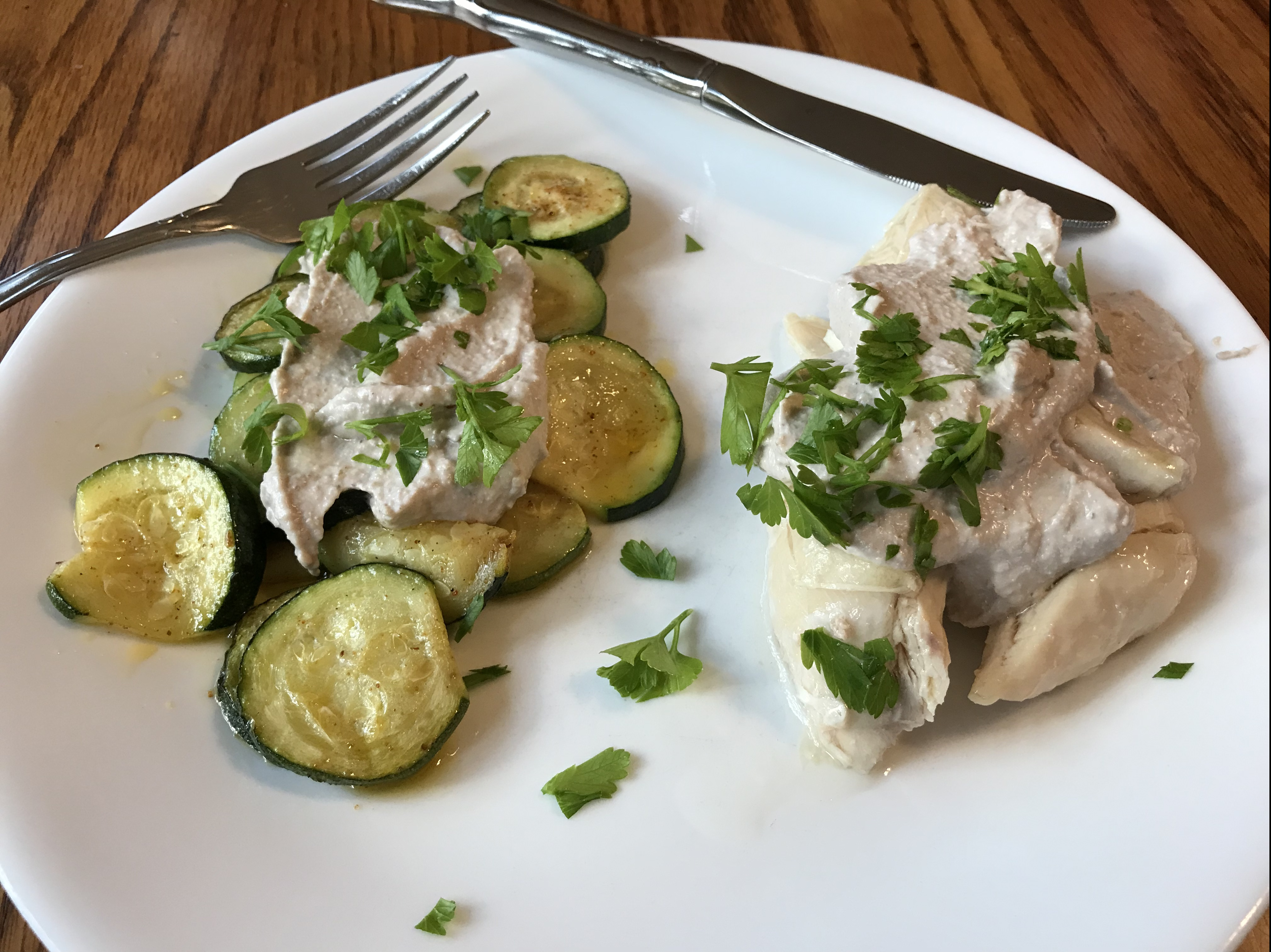
The second attempt had less walnuts, more bread and milk, and I made sure to drizzle the oil in slowly while the food processor was running. This scordolea had a nice balance of walnut and garlic flavors, with a hint of lemon, though it looked like thick cream of wheat on its own. A garnish of some parsley I picked for my brother’s rabbit and forgot to send home with him improved the presentation significantly.
Scordolea is eaten with a wide variety of foods. Since the sauce has its own strong, delicious flavor, it’s great for enhancing neutral-tasting foods, in this case, cold chicken and sauteed zucchini. Pretty much any affordable, easy-to-cook staple is transformed by scordolea. It is easy to see why Mimi Sheraton classified it as one of her 1000 Foods to Eat Before You Die in the book by the same name.
Ingredients:
1 cup walnuts
2 slices good-quality bakery white bread, crusts removed
¼ cup milk
2 garlic cloves, peeled, crushed with the side of a knife, and coarsely chopped
Juice of ½ lemon
¼ cup olive oil
Chopped parsley, for garnish
Cooked chicken, seafood, vegetables, or anything else you would like to eat with the sauce
Directions:
Place the bread slices in a bowl and drizzle the milk over them. Let the milk absorb for at least 5 minutes.
Place the walnuts in a dry skillet over medium heat. Cook, shaking pan occasionally, until the nuts smell toasty. This won’t take more than a few minutes, so watch carefully.
Put the toasted nuts into the food processor, pulse a few times, then add the bread, any extra milk from the bowl, the garlic, and a pinch of salt. Process to form a smooth paste.
Add the lemon juice to the walnut paste and process until blended.
With the motor running, slowly add the olive oil through the food processor’s feed tube to incorporate. Taste for salt, adding more if necessary.
Run the motor again, and slowly add about ¼ cup water to thin the sauce. It should be on the thick side, but for a thinner sauce, slowly add more water until the desired consistency is reached.
For serving, garnish the scordolea with chopped parsley. Serve with your desired protein and/or vegetables.
And as always, subscribe for free posts and recipes, sent right to your inbox.


 Feasting Through Time