With Thanksgiving just finished and Christmas around the corner, let’s talk about turkey. As one of the few domesticated livestock native to the Americas, it was a favorite treat for the Aztecs. They often ate it in tamales. When Columbus brought the first turkeys to Europe, they were immediately added to poultry yards. Not all Europeans knew where they came from, hence the names like “Turkey cock” or “Indian chicken.” But their origin didn’t matter. European diners knew that a previously unknown type of edible fowl had appeared from somewhere. It was big and showy, tasted good, and therefore belonged on holiday tables. By the time English settlers in Virginia and Massachusetts saw wild turkeys in North America, their domestic cousins were widespread in England.
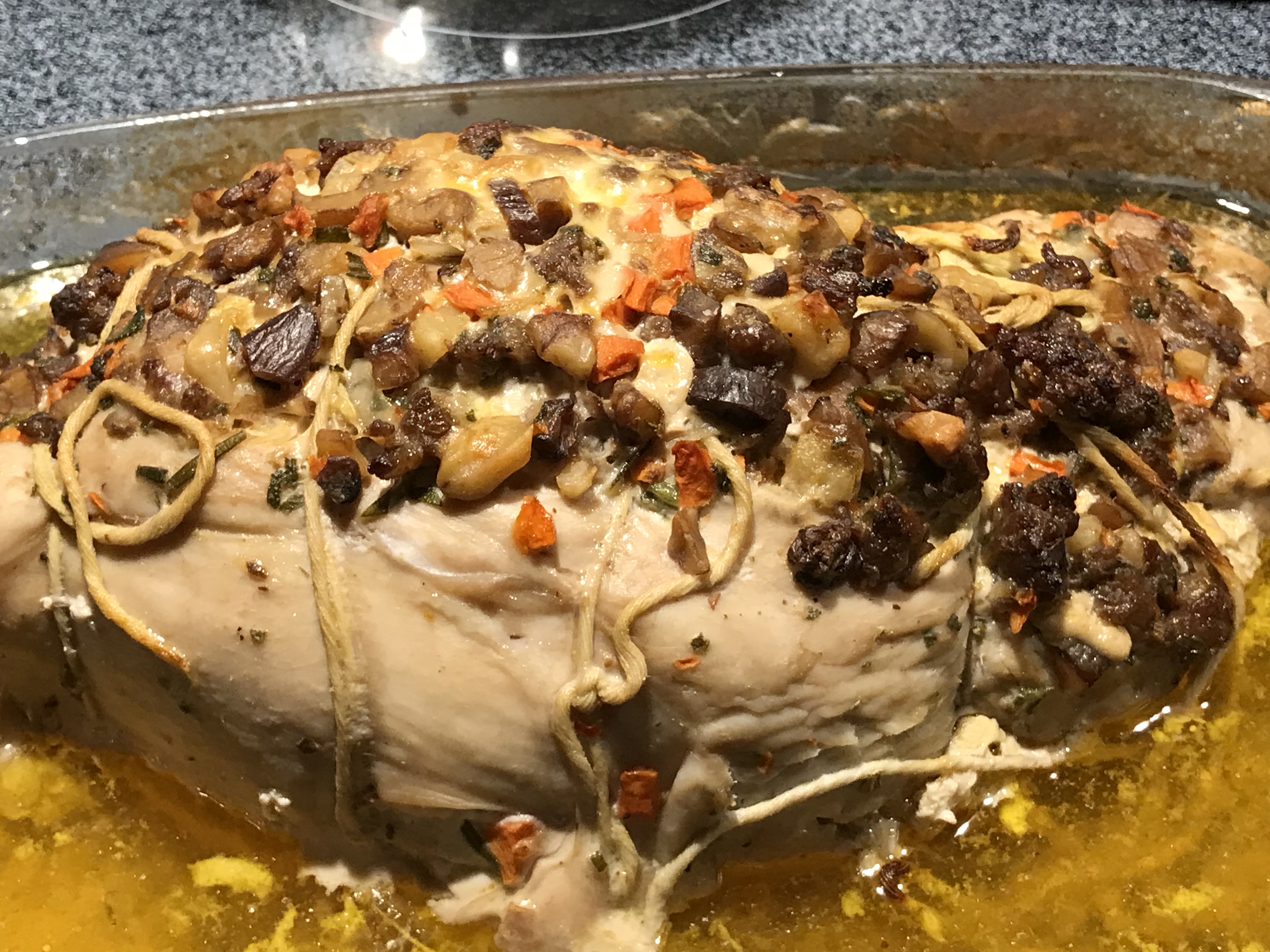
Roasting and stuffing a whole turkey is just one way of preparing it. Another showy presentation comes from flattening a boned turkey breast, adding a stuffing, and rolling everything up like a giant jelly roll. In this particular recipe, popular in Lombardy (around Milan), the stuffing includes sausage meat, chestnuts, walnuts, vegetables, and herbs. After baking, the roast is sliced to reveal the spiral pattern and served with a sauce of slightly-thickened pan drippings. I didn’t manage to flatten the meat enough to get a spiral roll, just a stuffed circle, but it still tasted good. Steamed broccoli complemented the meat without overpowering it. The turkey roll was too complicated to make regularly, but would be great for a small Thanksgiving or Christmas.
If you enjoy this blog, please consider making a donation. Any contributions help offset the cost of ingredients and help make more posts possible.
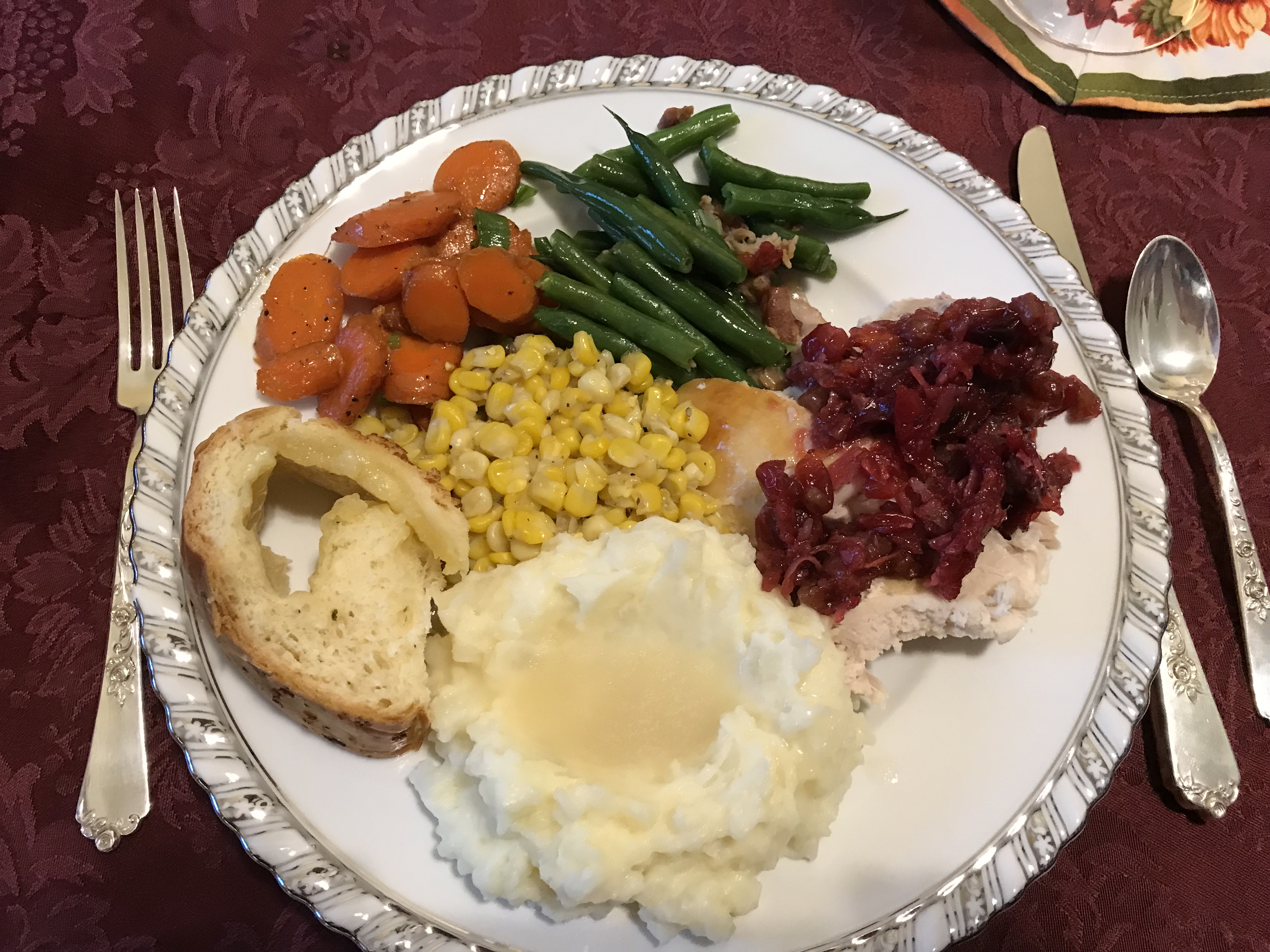
For non-American readers, the Thanksgiving holiday might seem a little strange. Celebrating what we’re thankful for with a feast is straightforward enough. The odd part is that tradition dictates a number of specific dishes. In a large country with a huge variety of terrain, climate, and natural vegetation, not to mention national origins, millions of people are eating pretty much the same thing. Turkey is almost always the centerpiece and is the symbol of Thanksgiving. Some households will opt for ham or a vegetarian option, but that’s usually as far as variety goes. Gravy and cranberry sauce accompany the turkey. Sides include potatoes, usually mashed, stuffing, and a few vegetables, particularly corn, carrots, and green beans. Pies are the favorite dessert. The most common flavors are apple and pumpkin.
A fairly typical Thanksgiving plate. Not pictured: pie for dessert.
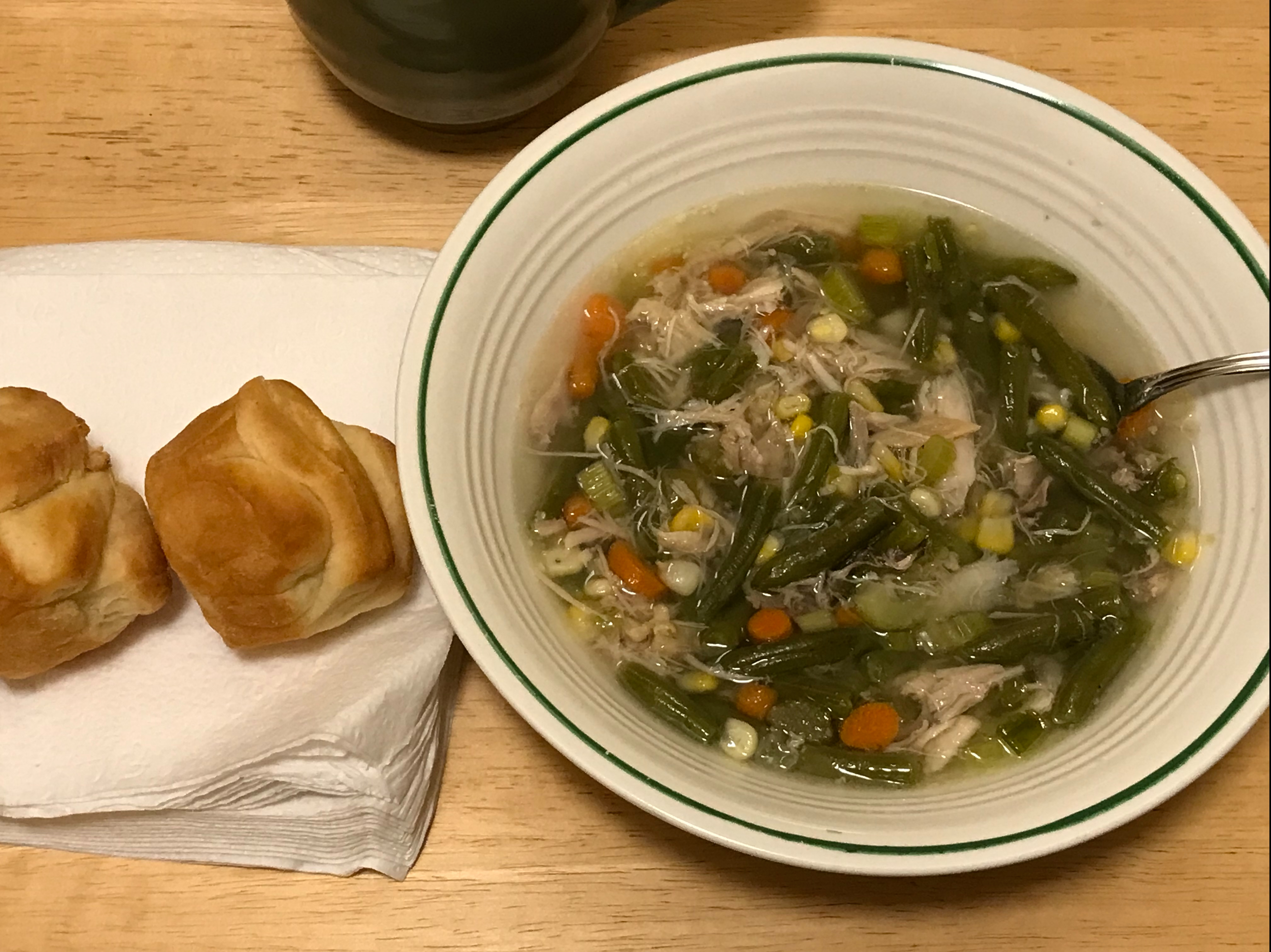
Not every menu will necessarily have every item on the list, and there is some regional variation. One feature of Thanksgiving that’s pretty universal is the large quantity of leftovers. Turkeys are massive. Even after sending leftovers home with their guests, most cooks will have quite a bit of carved meat, plus a large carcass. Usually, a fair amount of meat is stuck to the bones. One way to get it off is to make soup. Slow simmering keeps the lean turkey tender while deeply flavoring the broth. Throw in a selection of fresh and leftover vegetables, and you have an easy way to minimize waste. It’s especially great for anyone who catches a respiratory infection from a Thanksgiving get-together.
Turkey vegetable soup and leftover rolls. The soup worked – I didn’t get a sinus infection.
Soup actually does help with cold and flu-type illnesses. The hot liquid and the moisture evaporating from it help to open up the airways. Other common home remedies like tea and a warm shower work in the same way. While this won’t do anything against a cold or flu virus, it does help loosen up any mucus and allow it to drain more easily. This is important because mucus that gets stuck becomes a breeding ground for bacteria, leading to a sinus infection or pneumonia, depending on its location. Plus, soup is easy to eat with a sore throat. There’s a reason societies from North America to Europe to China rely on it to soothe whatever winter throws at them.
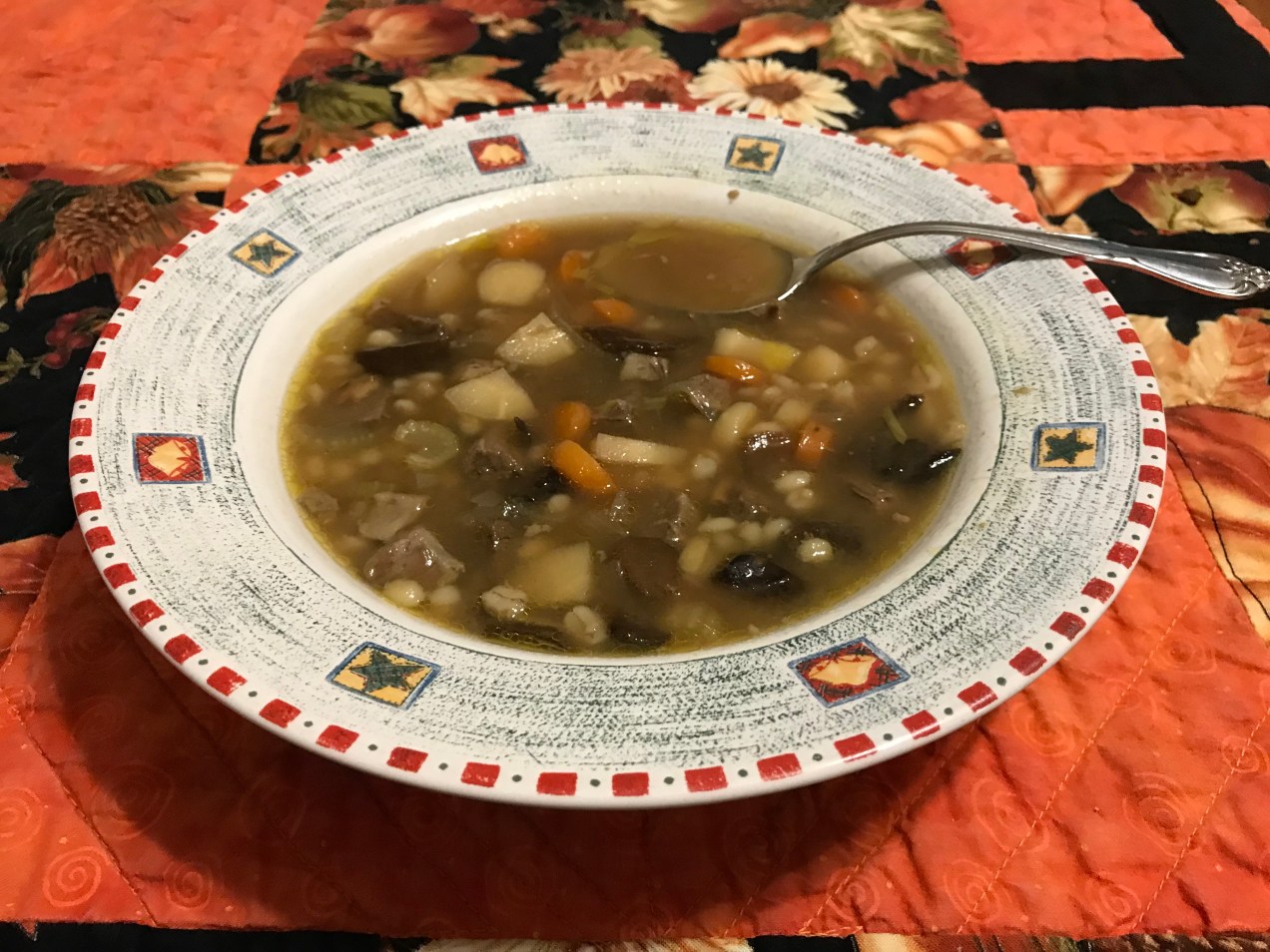
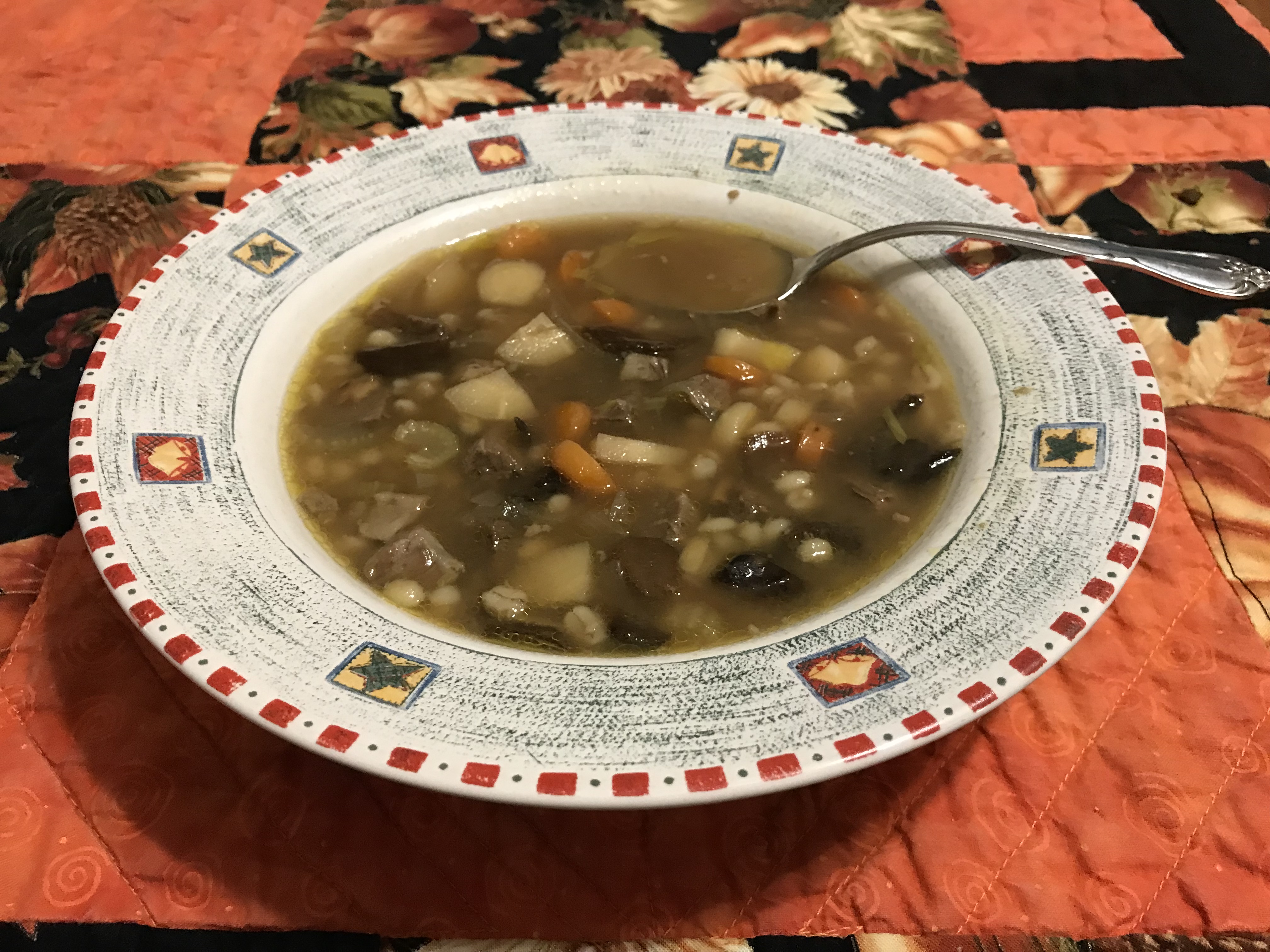
After failing to soften the leftover tafelspitz beef by re-simmering, using the leftovers in salads, as suggested in the book, was definitely out. Fortunately, I’d been planning on using them in mushroom barley soup, since it uses many of the same vegetables (which I had extra of) needed to flavor the tafelspitz. With the failure of the emperor’s favorite lunch, I just had more beef and broth to work with. The idea was that chopping up the beef would increase its surface area, meaning more edges in contact with the broth as it re-cooked. New root vegetables plus dried mushrooms would add more flavor, while barley added substance. This time, everything went according to plan.
Barley is one of the oldest crops cultivated by humans, deliberately planted no later than 8,000 BC, and possibly as early as 10,000 BC. A specific date is hard to come by, since the switch from gathering the wild plants, to deliberately spreading the seed, to building villages by designated fields was a gradual one. In some cases, the archaeology suggests that villages preceded agriculture, at least where there was a lot of wild grain to harvest. But whenever the process happened, barley was domesticated around the same time as wheat. The Sumerians, in modern Iraq, used barley as a form of money. Almost 3000 years before coinage, it was the perfect currency. A goat herder in need of a clay pot might not be able to find a potter in need of a goat, but everyone accepted payment in barley. The seller could eat the barley themselves, or trade it for something else they needed. Money didn’t grow on trees, but it did grow in fields.
For almost as long as they have been growing grain, people have been turning it into alcohol. Our friends the Sumerians brewed lots of beer and even worshipped a beer goddess. From Egypt to Northern Europe, people fermented their grain. Often, they would drink their barley and eat their wheat. The reason for this is simple: wheat has more gluten than any other grain, which means it makes better bread. Most cultures seem to have preferred bread over other ways of preparing grain, creating a preference for wheat. Since wheat was usually more expensive, it made little sense to use it for beer, where its gluten would be of no use. Barley became the primary grain for brewing, and was used in soup, porridge, and cheaper bread.
Barley is particularly good in soup. As it cooks, it swells up, taking on the flavor of the broth and creating substantial morsels. There’s a reason beef barley soup is a cold-weather classic. Mushroom barley (with beef) is another variation. I’m not sure why it’s in the Jewish food chapter, but the essential dried mushrooms provide a clue. Dried mushrooms are popular across Eastern Europe, and many of the Ashkenazi Jews who immigrated to the US in the early 20th Century came from this region. I’ll admit that I’m not very familiar with the kosher specialties associated with New York City, but the origin theory makes sense.
Dried mushrooms have two major benefits: a long shelf life and concentrated flavor. To make the most of this flavor, don’t discard the soaking liquid. After letting the grit settle out (or straining through a coffee filter), it can be added to the dish. Mushrooms in the boletus family are particularly favored, but most varieties will work. I used some from a medley I found at Woodman’s, and they were great. All the other ingredients are available at any supermarket, making this a perfect home-cooked delight. You could order it at a restaurant, but it’s so easy to make at home, and the leftovers are as good if not better upon reheating. Over the course of a few days, they all got eaten. The tafelspitz redeemed itself.
Austrian Emperor Franz Joseph had an eventful and often tragic life. He ascended the throne at 18 in 1848, a year of revolutions across Europe. The emperor at the time was his uncle Ferdinand, who suffered from various health issues, probably as a result of Habsburg inbreeding. Although revolution was quickly suppressed in Austria, there were concerns about his ability to handle any future unrest. Supposedly, when told that the people were revolting, he asked an advisor “are they allowed to do that?” Emperor Ferdinand was persuaded to abdicate, and since he was childless, Franz Joseph became emperor, with his mother Sophie of Bavaria acting as the power behind the throne.
Between industrialization, continuing political unrest, a disastrous war with Prussia, the rise of anarchism, rising tensions in the Balkans, and eventually WWI, Franz Joseph had a lot to deal with during his reign. In 1889, his only son died in a murder-suicide with his mistress. Nine years later, his wife, the famously beautiful Empress “Sisi,” was fatally stabbed by an anarchist. In 1914, his heir Franz Ferdinand (nephew, I believe) was assassinated in Sarajevo, starting WWI. With all the stress ruling must have involved, it’s no wonder former Emperor Ferdinand’s health improved during his retirement in Prague.
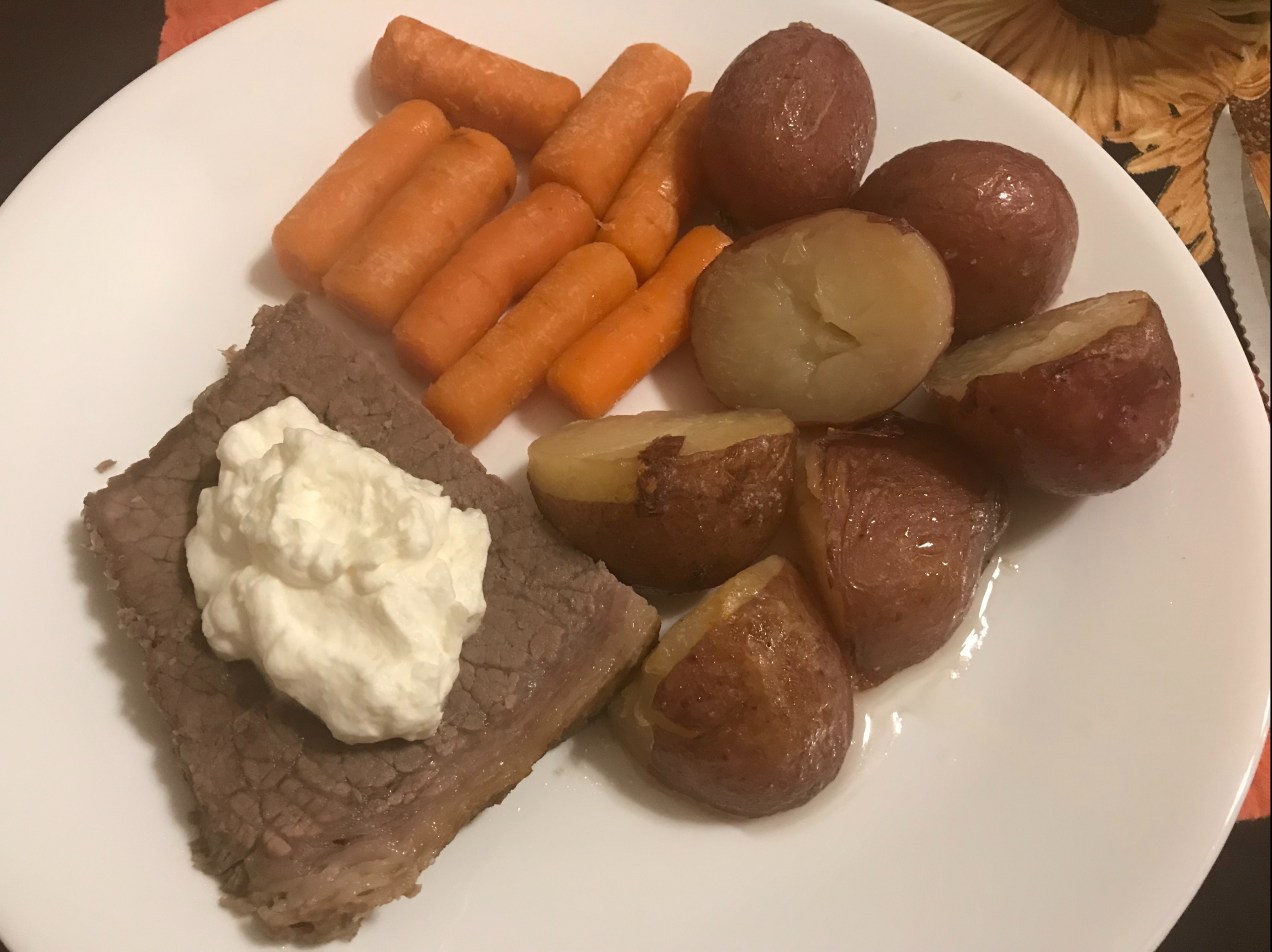
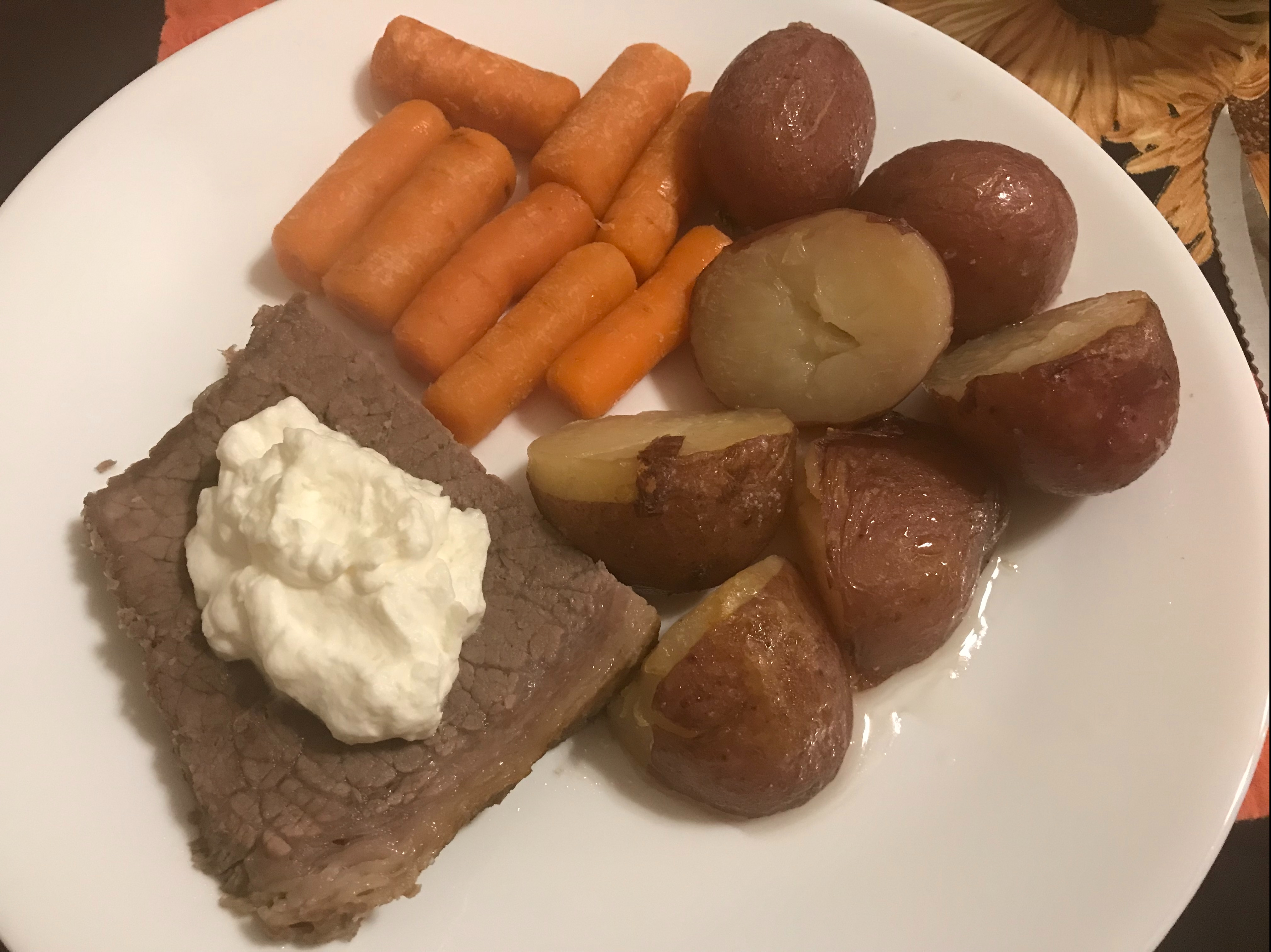
Perhaps all the stress and heartbreak he endured drove Franz Joseph to comfort foods. One of his favorites was tafelspitz. A large piece of beef is slowly braised with root vegetables, tenderizing the meat and producing a rich consommé. Constant skimming is supposed to ensure a clear bouillon to serve in cups as a first course. The beef is then served with potatoes, vegetables, and some form of a horseradish sauce. I oven-roasted some leftover red potatoes with oil and salt to crisp them up and added fresh carrots, cooked in a bit of broth, to the plate (the braising vegetables get too soft for serving). Other options might include braised onions or leeks, or pickled beets. I followed the recommendation to mix the horseradish with unsweetened whipped cream, adding grated apples to half, chives to the other half. Either is typical, as is plain horseradish.
Things did not go according to plan. Despite frequent skimming, the broth was not as clear as it was supposed to be, but that was a minor issue. It was also somewhat bland, though definitely not bad. The much bigger problem was the beef. I used a piece of chuck, which is common for tafelspitz, and slowly simmered it, which is supposed to make it tender. This didn’t work at all. The beef was extremely tough, almost like leather, and was even difficult to cut. I’m not sure what went wrong. Was the water too close to a boil? Did it need more cooking time? Whatever the problem was, slicing and simmering the meat again didn’t help much. Even without the texture issue, the flavor was a bit boring. The horseradish cream sauce was good, but it didn’t help the beef much. Exactly why the emperor loved tafelspitz so much is still a mystery.
I hadn’t expected this, but I was prepared. Temperatures were dropping rapidly and respiratory illnesses were spreading, so I already had plans to make beef mushroom barley soup with the leftovers. With less eaten on the first night, there was extra meat and broth for a bigger batch of soup. Three or four meals for two people, as it turned out, so it wasn’t all bad.
If you like this blog, please consider making a donation to help the fun continue.
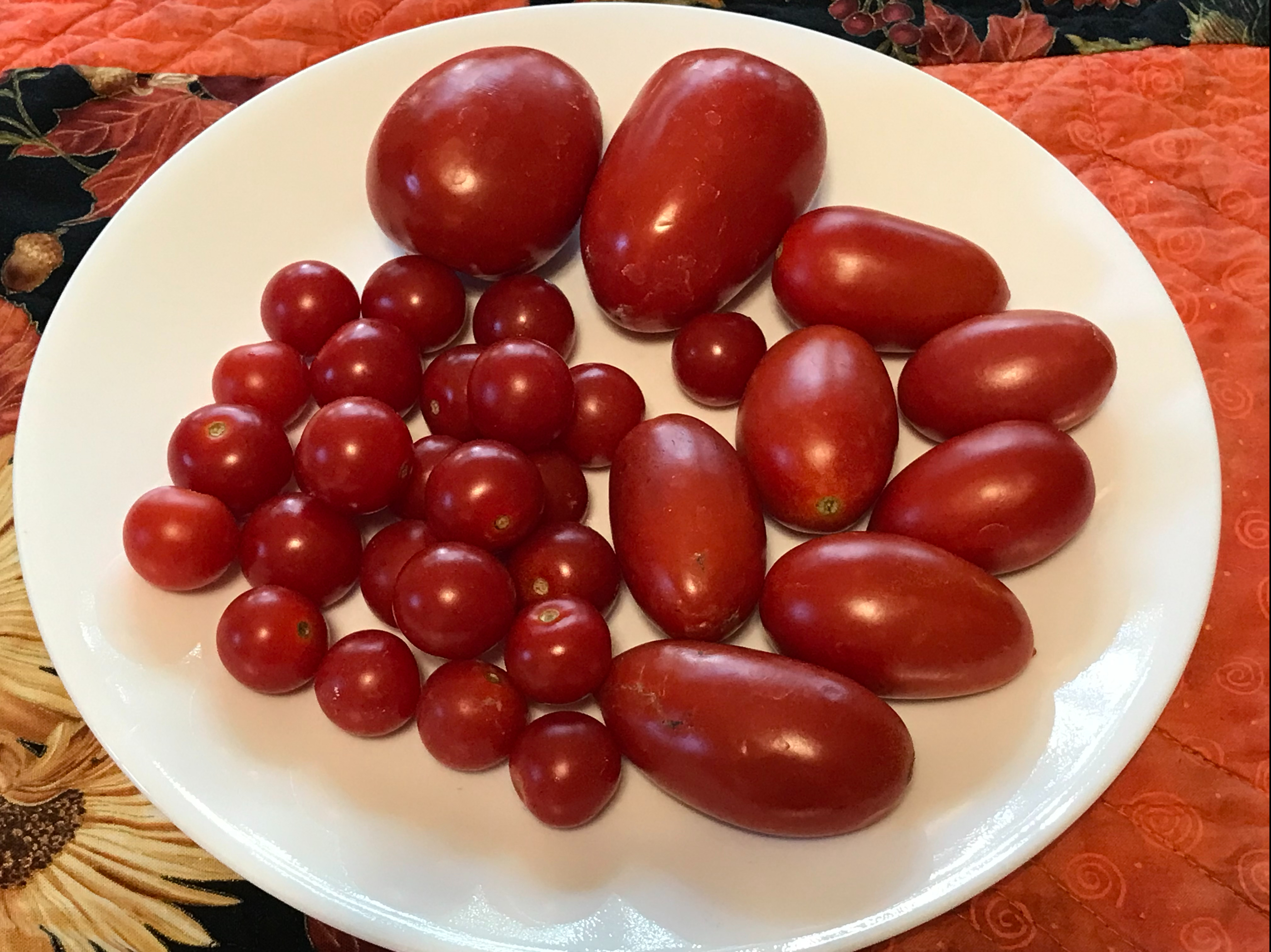
Clockwise from the top: Roma, San Marzano, and cherry tomatoes
1000 Foods (pgs. 220, 223 – 224, 235 – 236)
This last summer, after removing part of the deck that was in disrepair, I had a small garden bed to use. For my birthday back in March one of my aunts gave me a gift card for a seed savers catalog, which had some particularly interesting selections, including two types of sunflowers, giant zinnias, arugula, and cress. After buying more herb plants than necessary and planting them in pots, I had a plan for the new garden bed. The larger type of sunflowers would go in the back row. Three tomato plants would get half of the middle row instead of their usual 5-gallon buckets. On the other side I had a bean plant given to me by a student after an experiment to determine where plants get their mass from as they grow. (Answer: it’s mostly the carbon and oxygen in the air.) I planted a few leftover seeds in the row to keep it company. In the corner was an unknown plant from a different student (turned out to be mustard greens). The front row was half arugula, almost half cress. Marigolds on the sides would hopefully keep rabbits away. It sounded tidy and organized.
Plants don’t necessarily do tidy and organized. With plenty of space, the tomato plants spread out and covered much of the arugula. The bean plants, which I was not aware were pole beans (it didn’t say on the package) grew in every direction. By the time I got the stakes in it was too late to manage the chaos. They didn’t produce many beans and those few were tough, but the plants themselves may have had an additional benefit. The sunflowers on that side of the garden were taller than those on the side with the tomatoes. Since the change was gradual it may have had as much to do with drainage patterns, but the nitrogen-fixing bacteria that live on bean roots may well have enriched the soil and given them a boost. Finally, the marigolds ended up about two feet tall. Whether they or the fence was more effective at rabbit control is an open question.
Along with Roma and cherry tomatoes, I planted a San Marzano plant. Technically, to be 100% authentic, the tomatoes would need to be grown in the rich volcanic soil near Naples, but this was a way to taste them fresh. The plants are scraggly-looking with long, thin, pointy fruits, but they are said to be one of the best tomatoes for canning. In fact, the use of tomatoes in Italian cuisine increased significantly once the canning industry developed. I couldn’t taste much difference in the three types of fresh tomatoes, but I’m not normally a fresh tomato fan. They seemed to work well in the various soups and salsas over the course of the season. It will be interesting to compare canned San Marzanos with other varieties at some point in the future.
I probably could have managed with one basil plant instead of two. They were small when I got them, and so had me fooled. Each in their own pot, with lots of sunshine and daily watering, they thrived to the point of my not knowing what to do with all the basil. With a potent, distinctive aroma, basil is widespread around the world. In its homeland of South and Southeast Asia, it has religious as well as culinary significance. Pesto is perhaps basil’s most popular use in the West, but it can also be used in sauces, salads, and even lemonade and sorbet. It actually works as well with strawberries as it does with tomatoes.
What’s interesting about pesto is that while pesto-type sauces have existed since Ancient Rome and basil was introduced to the Mediterranean in the Medieval era, the two were not combined until well into the Early Modern period. Perhaps the speed at which basil oxidizes once cut made people suspicious of it. (The darkening/browning is oxidation. The same process happens with guacamole.) Or maybe Medieval cooks were underwhelmed, since they didn’t like to serve raw ingredients and basil loses much of its flavor when cooked. Fortunately for us, the Italians eventually figured out the best way to use it, and many other cuisines followed.
Like most popular foods, pesto has a number of variations. The classic form has basil, salt, garlic, olive oil, and pine nuts. Usually a hard cheese such as Parmesan or Romano is included, but not always. Some or all of the basil might be replaced with parsley or arugula, reducing the discoloration on the surface but changing the flavor. One modification that does not affect the flavor much is to substitute almonds or especially walnuts for the pine nuts. With all the garlic and basil, it’s hard to tell the difference, and walnuts are a lot more affordable. They thicken and enrich the mixture just as well. Some versions, like the one in the book, even replace part of the olive oil with butter. Garlic is a constant, as is salt. In addition to adding flavor, the salt is *supposed* to reduce discoloration, but that was not my experience. A reliable solution is to scrape off the discolored part. The pesto below will be as green and aromatic as ever.
In the meantime, winter is here. For next year, I’ve embarked on some seed saving of my own, gathering hundreds of sunflower seeds, along with a few small bags of marigold and one of zinnia seeds. I’m not sure where the petunias that appeared in the garden bed with the small sunflowers and zinnias came from. Most likely, some petunia seeds got mixed in with the other seeds by mistake, or some seeds blew over from another plant. However it happened, they grew so well and lasted so long into the fall that I saved some of their seeds too. Planting slightly earlier and starting some of the sunflowers inside should ensure an even better display next summer. Just not a tidy one.
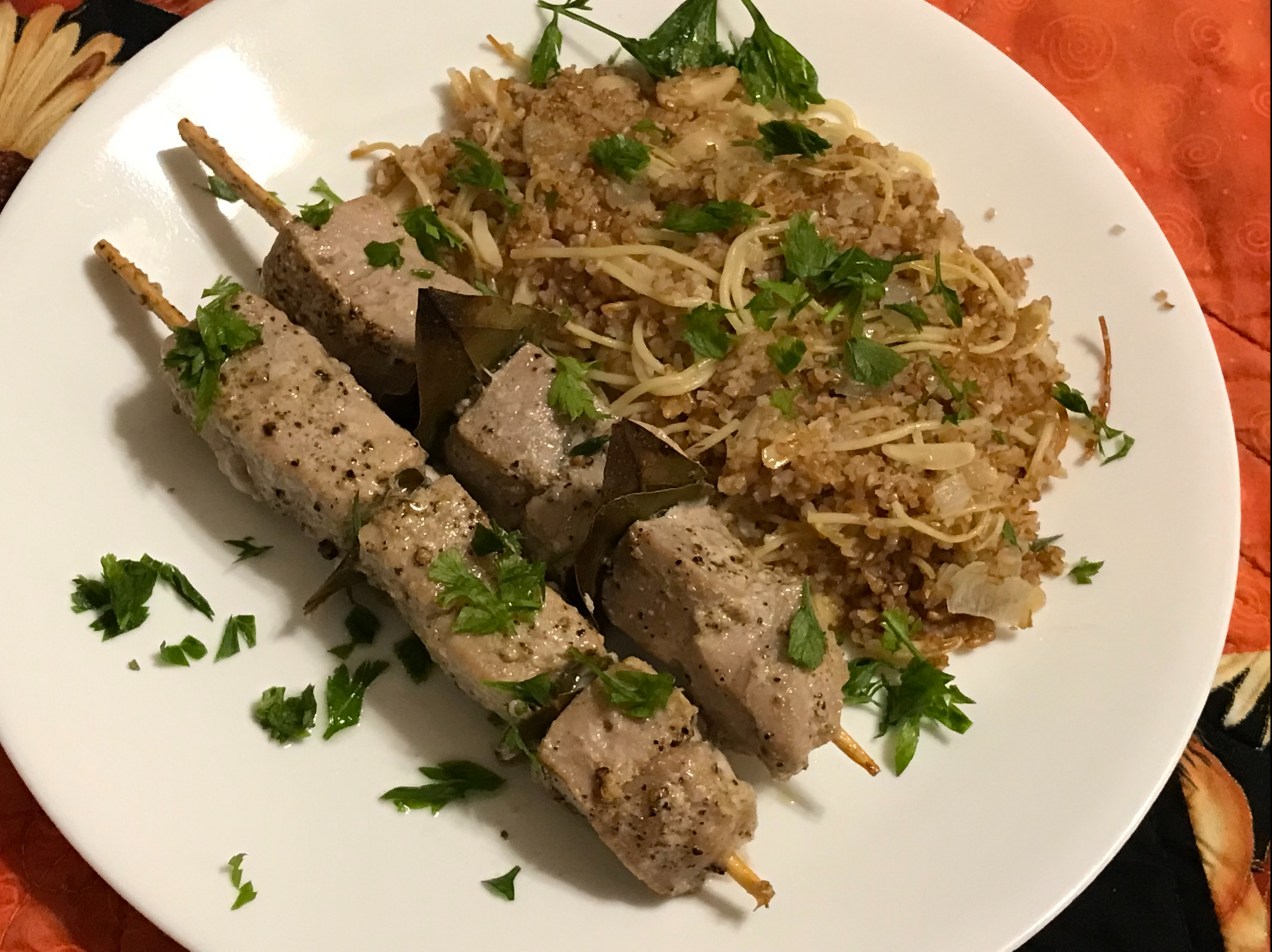
Venturing to the Middle East again, we have two Turkish specialties: kebabs and pilaf. Specifically, swordfish kebabs (tuna is used here, for a reason detailed below), and bulgur pilaf. The fish is marinated in olive oil and lemon juice and flavored simply with bay leaves, while the bulgur fills in for rice, adding some extra flavor and texture. Both dishes were easy to make. Due to rain, the kebabs were broiled instead of grilled. For the pilaf, just toast the bulgur in the skillet with butter, minced onion, and broken vermicelli (angel hair) pieces, then add broth to finish the cooking process. Both lamb or chicken are authentic options. Since I already had chicken soup base on hand and wasn’t about to make a lamb stock/broth, I used chicken broth. The end result was one of the best things I’ve made in a while.
For why this was an impromptu Turkish dinner, here’s the story. On a rainy Saturday, I was using up some of the herbs I’d brought in from outside. From my two basil plants, I made a big batch of pesto. After taking some to the neighbors, I took some downstairs to put in the deep freeze. When covered with a layer of oil, it can supposedly be kept for about a month. Upon opening the freezer, I noticed a strange, unpleasant smell. A bag of pulp from garden tomatoes wasn’t frozen, but it smelled fine. Then I realized that nothing in the top layer was frozen. The interior of the freezer was cool, but nowhere near where it was supposed to be, as evidenced by the fact that I could comfortably place my hand against the freezer wall. A quick look around revealed the problem. Somehow, the freezer cord had become unplugged from the extension cord, probably when some nearby bins holding decorations were moved around.
After plugging it back in, I had to figure out which items were salvageable. Since the temperature was still around refrigerator level, the number was higher than expected. The corn, strawberries, cherries, and jam from last summer were fine, and a large chunk of pork butt I’d gotten on sale was still mostly frozen. After pulling everything out, drying it off, and cleaning up the water that had gathered in the bottom, everything was handled. The source of the smell was most likely some leftover corned beef and cabbage. One lingering question was with some tuna skewers that had thawed out. Since they were in an unopened, vacuum-packed bag I decided that they were okay, but wanted to cook them that day.
After glancing through the recipes in both A Cook’s Tour of Italy and 1,000 Foods to Eat Before You Die, I settled on the Turkish fish kebabs. Swordfish is the traditional choice, but since the text suggests some alternatives if swordfish is unavailable, I subbed in the tuna. What’s special about this dish is that the fish is cooked with bay leaves on the skewers. This makes sense, since bay leaves grow abundantly in Turkey and their flavor complements pretty much anything. The dried variety can actually be used, as long as they are soaked in hot water to soften first. Since the kebabs are typically served with either rice or bulgur pilaf, this was a great opportunity to try out another recipe from the text. The best part of it was being able to turn a potential mini catastrophe into a thoroughly enjoyable dinner.
As promised, here is a brief(ish) explanation of Lothringia, from which the region of Lorraine got its name. The tradition among Frankish kings was to divide their territory among their sons upon their death. As you might imagine, this led to kingdoms fracturing and going to war with each other almost every generation. The Merovingians, who ruled the Franks from the late 5th Century to 751 AD, weakened themselves this way, and Charlemagne’s dynasty, the Carolingians, followed a similar pattern. Charlemagne’s father Pepin usurped the throne in 751 and died in 768, dividing his kingdom between Charles (Charlemagne) and his brother Carloman. Upon Carloman’s death a few years later, the realms were reunited.
Charlemagne had three legitimate sons reach adulthood, but by the time of his death in 814, only Louis the Pious survived. While this was unfortunate for the other two sons, it was probably fortunate for the empire (Charlemagne had been crowned Holy Roman Emperor in 800), which held together for another generation. Louis had three sons, Lothar, Louis, and Charles, and they didn’t like each other. Even before Louis’ death in 840, they began to fight. The whole story is a complicated mess of shifting alliances, and Lothar and the younger Louis even imprisoned Louis the Pious on two separate occasions. The disorder opened the door for Viking attacks, particularly from the 830s onwards.
In 843, a settlement was reached at the Treaty of Verdun. Lothar, the eldest, got the imperial title and a territory wedged between the other two. His kingdom, not-so-creatively called Lothringia, encompassed the Low Countries, the northeast corner of modern France, part of Burgundy in eastern France, part of Switzerland, and most of Italy. Louis got East Francia, which encompassed most of Germany and Austria, and Charles got West Francia, centered on France. Over time the West and East Frankish kingdoms developed separate French and German identities. Later in the 9th Century the king of Lothringia died without an heir, setting the stage for a over a millennium of fighting over his territory. The Holy Roman Empire centered on the increasingly disunified German states, France often sparred with the Empire, and Lorraine was caught in the middle.
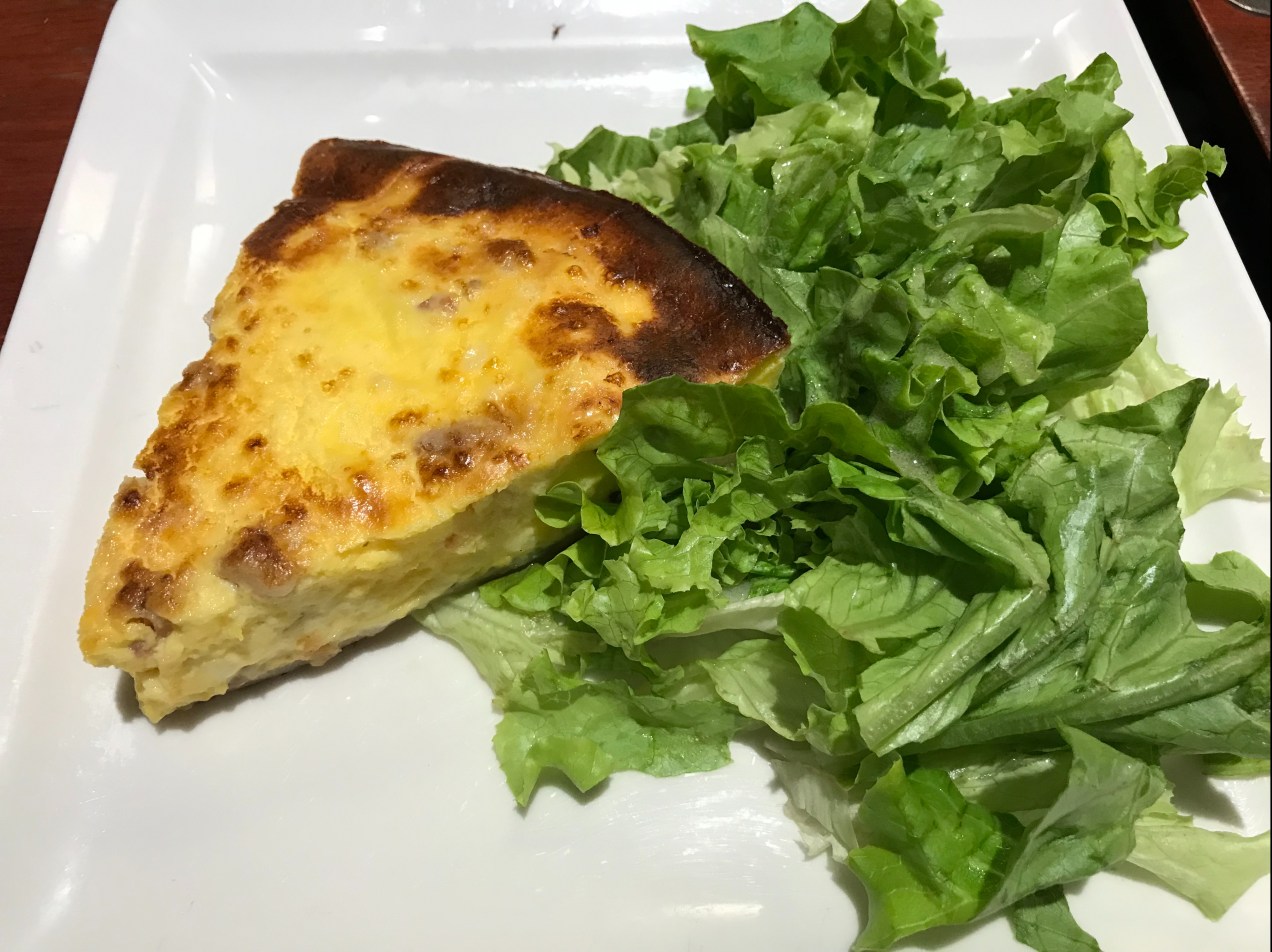
Now part of France, Lorraine and Alsace to the east have both French and Germanic influences in the local culture. Some dishes there, particularly in Alsace, have clear German origins and even names (particularly baeckeoffe, a mixed-meat stew with sauerkraut, bireweche, a spicy Christmas bread, and kugelhopf, a yeast coffee cake). The origin of Quiche Lorraine is a lot less certain. At its simplest it is just a nutmeg-scented custard in a pastry crust, both elements widespread across Europe. Bacon is usually added, but authentically a Quiche Lorraine does not have cheese, onions, or leeks, which would make it Alsatian. None of the additions give much of a clue on cultural origin, but ultimately, it doesn’t matter. Quiche Lorraine, and other variations, have an appeal that goes far beyond their native regions.
While in Amboise, a few of us came upon a café with a reasonably priced lunch special, which included dessert. The pastry and custard in the Quiche Lorraine were both very good, but to be honest I prefer the Alsatian version. Onions or leeks add an extra layer of flavor, and are often included in American versions. The great thing about quiche is that you can customize it to your taste. Onions, broccoli and cheddar, spinach and feta, dates and bone marrow, anything can be added as long as it doesn’t have too much water, which could make the custard split. The last option might not be very popular today, but it was a common Medieval recipe called “Lombard custard.” Whatever strikes your fancy is available, as long as you have an oven. It might not be Quiche Lorraine, but it will probably be delicious.
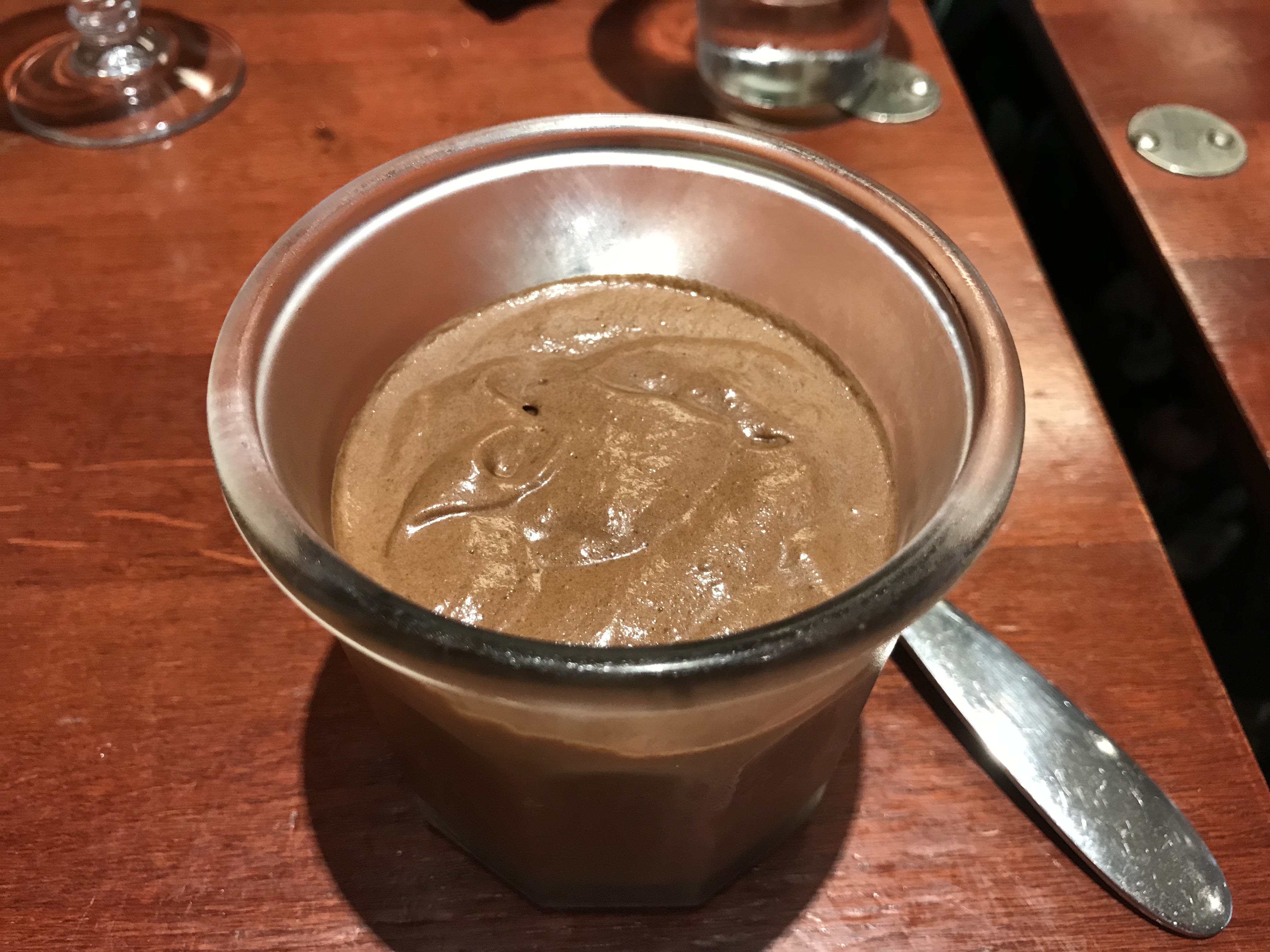
Also relatively easy to make at home is chocolate mousse. The trick is to whip tiny air bubbles into egg whites and/or cream and avoid deflating them when adding the other ingredients. Follow the recipe (I like the food network recipe but omit the espresso powder), gently fold in the egg whites or cream until just combined with the other ingredients, and in the worst-case scenario it will be more like a pudding. Just be careful if the recipe contains raw eggs, which many do. Often the egg yolks are cooked a bit with the chocolate while the whites are left completely raw. This is no worse than eating cookie dough, but it does need to be mentioned.
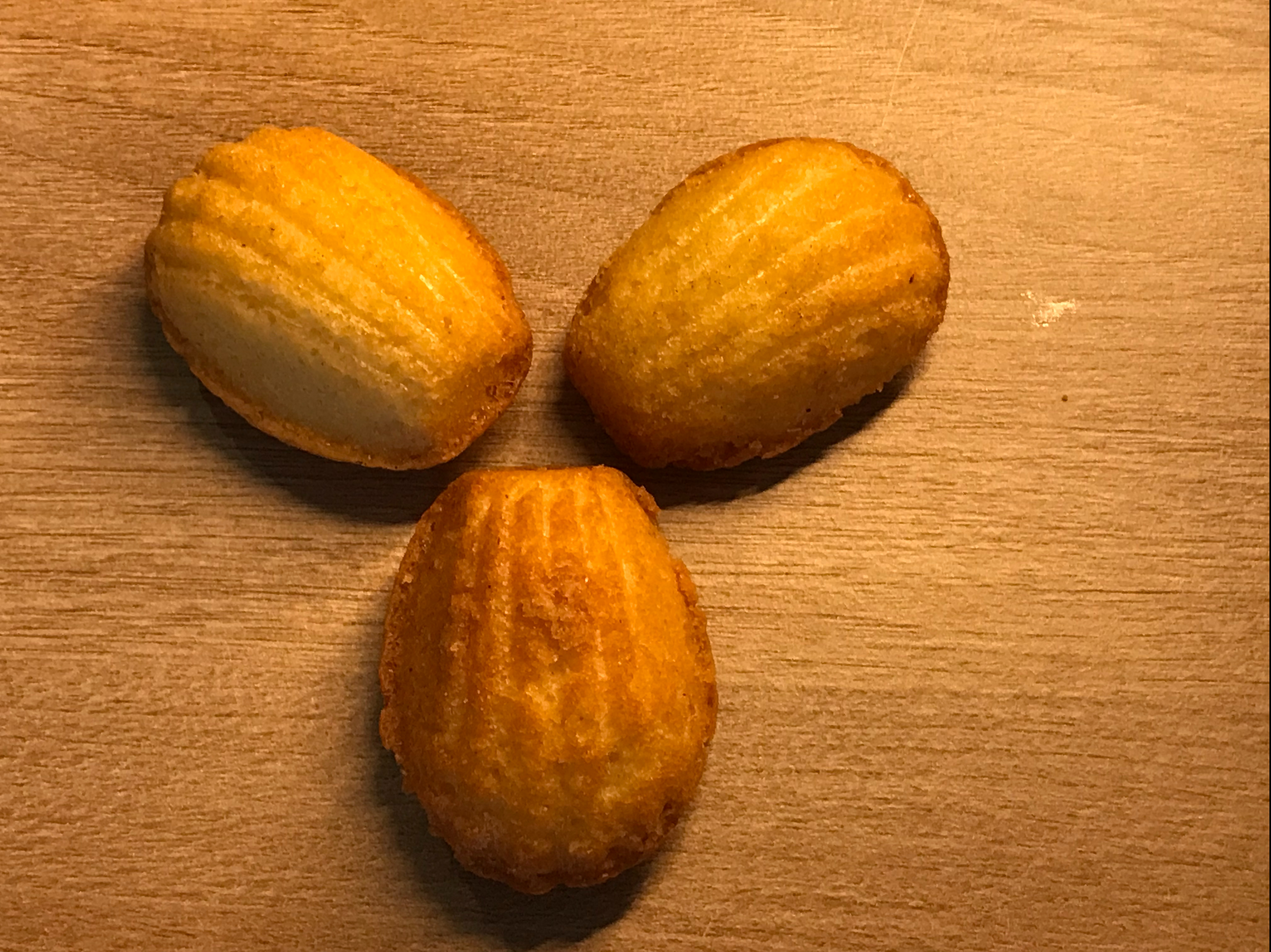
Madeleines are sort of a cross between a cookie and a cake. They are basically a sponge cake batter baked in small, scallop-shaped molds, which produces a browned outside and soft interior. They are mildly flavored, usually with vanilla or lemon peel. Marcel Proust was particularly fond of them, or at least had fond memories of them from his childhood, and why not? Like a good pound cake, madeleines have a nice flavor on their own, but they also lend themselves to embellishment. A bit of almond extract, a dip in chocolate, or a sprinkle of cinnamon would all be interesting additions.
If you enjoy this blog, please consider making a donation. Any contribution is appreciated.
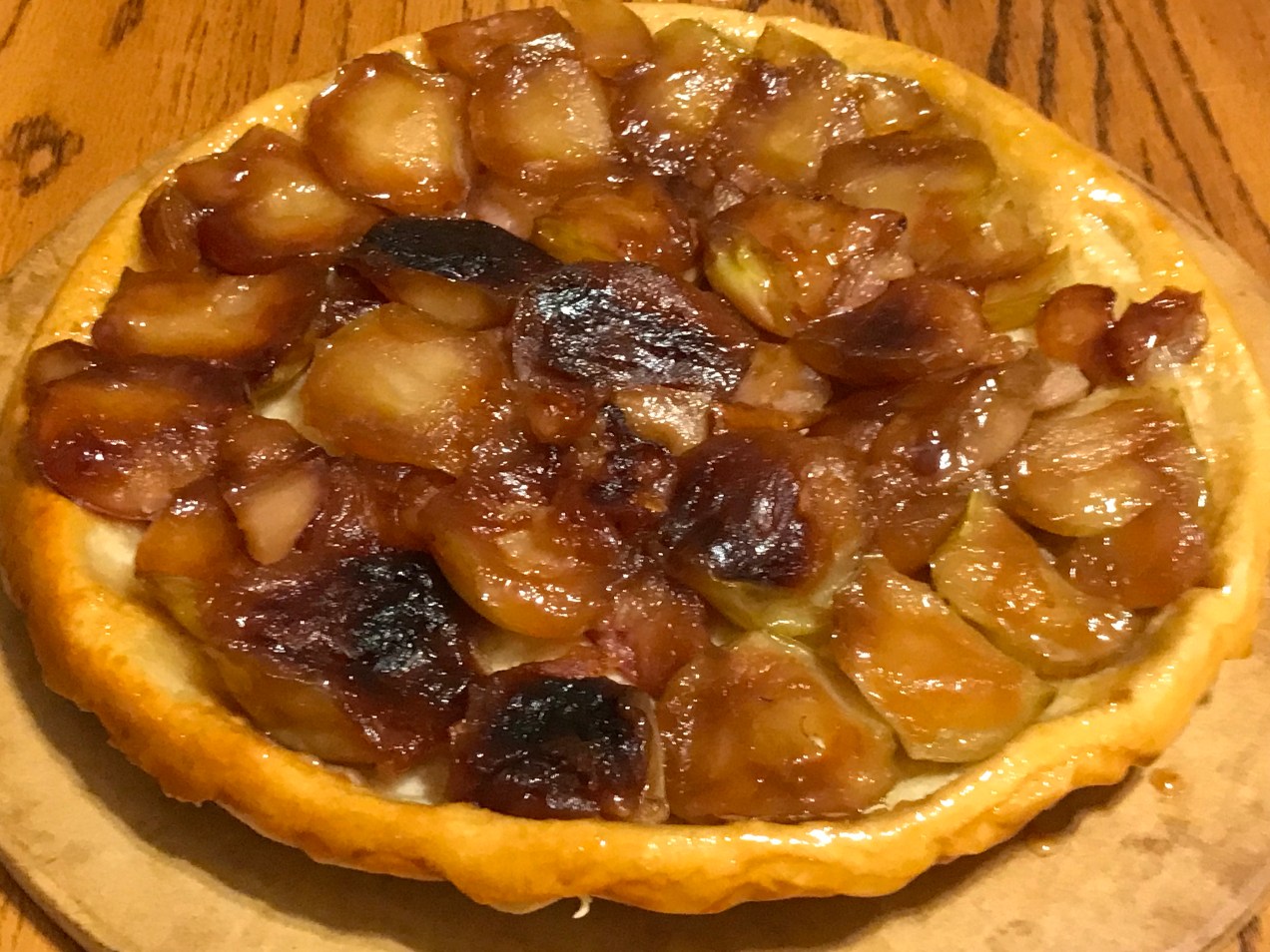
Cider isn’t the only use for apples. Aside from eating them fresh, people have been baking them into pies and tarts for centuries. Early examples used an inedible crust to cook and preserve the filling, which often only had a little sugar. Over time, edible “short crust” pastry, made with butter and/or lard, became common, the amount of sugar increased, and a huge number of varieties were developed. Some omit the top crust for an open tart, or contain a sugary crumble topping. One particular French variant, Tarte Tatin, is baked upside down to keep the crust from getting soggy.
The origin story goes something like this. In the 19th Century, the two Tatin sisters ran an inn. During one busy hunting season, an apple tart got dropped and landed upside-down. Rather than discard it, the cook served it upside-down and called it a new house specialty. No matter what the truth is, the French take Tarte Tatin seriously. There is even a website dedicated to it. According to the website, the tarte should be served by itself, without whipped cream or ice cream. What I found more interesting is that in the website’s recipe, there is no spice. While it is listed as an optional addition, my understanding is that the earliest recipes just included apples, crust, and the caramel formed in the pan.
The first step is to make the pastry. If you’re going to be making bread or pastry with any regularity, you will want a stand mixer. While I’m not usually in the business of advertising products, my KitchenAid mixer has been so helpful I wanted to mention it. They’re a bit of an investment, but their quality and durability make them worth it. The pastry is surprisingly easy to make. Cold butter is combined with the flour until the mixture is crumbly, then just enough ice water is mixed in for the dough to stick together. The dough is then kneaded a few times before being allowed to rest. One thing to be careful about, especially if you’re using a stand mixer, is not to overmix, which can make the pastry tough.
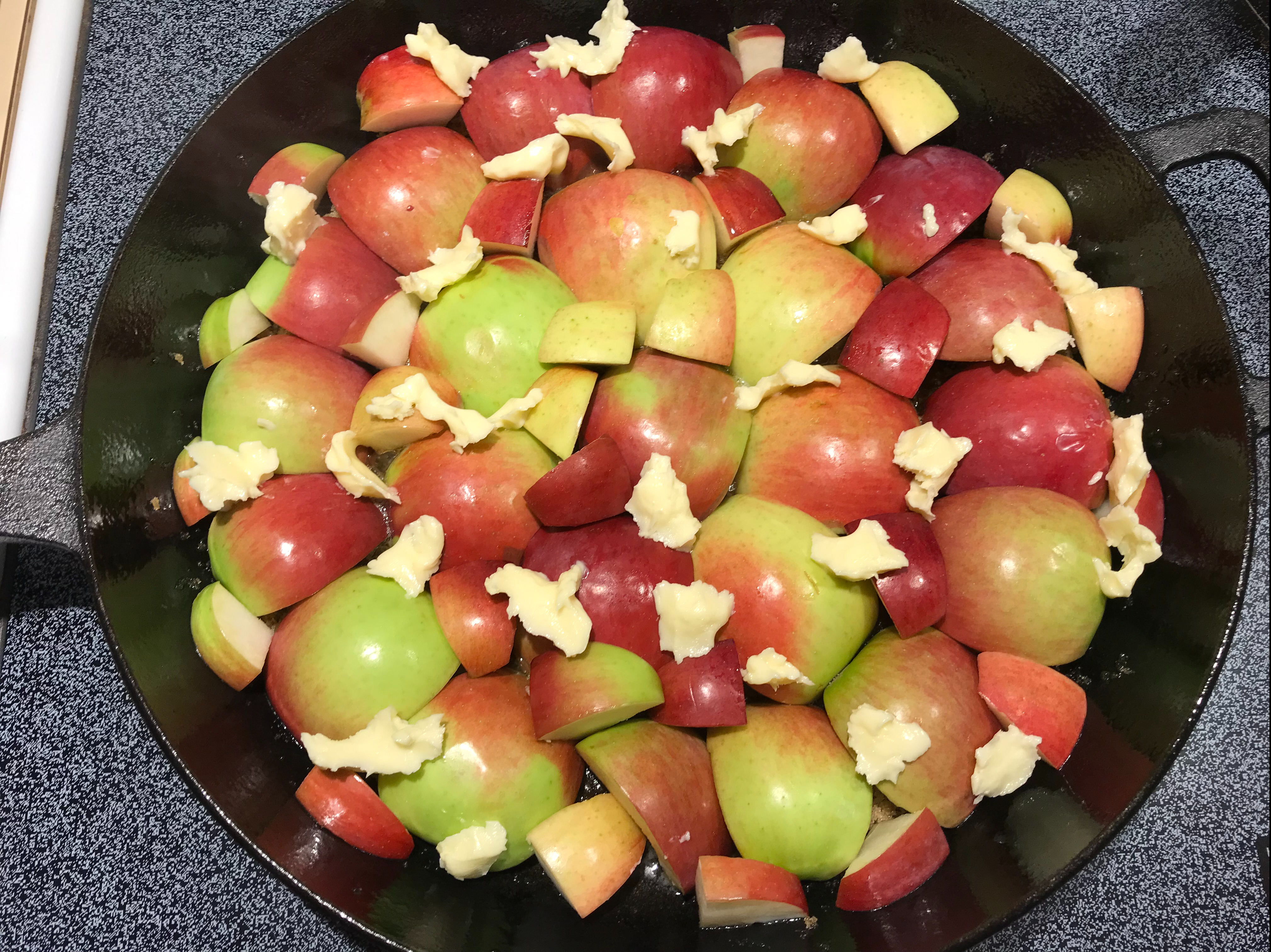
A caramel is produced by layering sugar and apples in a buttered oven-safe skillet, ideally cast iron. What’s great about this particular recipe is that you don’t have to peel the apples. Not only does this save time, but the pectin in the skin improves the texture of the caramel. The only issue was that the cast iron skillet I used is wider than the burner, resulting in the caramel forming and browning faster in the middle than around the edges. Lightly shaking the pan a few times helped, but the outside edge was not quite as caramelized as I would have liked. Since the apples seemed to be mostly cooked and I didn’t want to risk burning the middle by keeping it on the stove, I added the crust and put the skillet in the oven.
The reason for cooking the apples first is to release some of their moisture, which could make the crust soggy and inhibit browning. As for the type of apples, the website suggests either some particular varieties most common in France or golden delicious. Ms. Sheraton has two suggestions. For the prettiest appearance, golden delicious are still the best choice. For extra flavor, Cortlands are one of the best varieties. Since I care more about flavor, I used Cortlands. They’re easy to find in the fall, both sweet and tart, juicy but firm enough to hold up in the oven without disintegrating, and all around an excellent baking apple.
If you decide to make Tarte Tatin, be very careful taking the skillet out of the oven, and make sure your oven mitts or pot holders are dry and hole-free. Wet cloth conducts heat a lot better than dry cloth, which is what you’re trying to avoid. And as it turned out, one of my pot holders had a hole. It was hard to see without looking for it, but the intense pain made me aware of it within a split second. Fortunately, the natural human reflex is to let go before the brain can even make a conscious decision. The pain eventually went away after running my hand under cold water, and I only ended up with a small blister. Inverting the skillet onto a pizza stone did not result in any further burns.
The Tarte Tatin was delicious. With a thicker pastry and higher crust to apple ratio than most pies have, it was definitely different, but the caramel really made it. A bit of cinnamon might have enhanced the tarte, but the flavor was surprisingly complete without it. Apples, caramel, and buttery pastry worked together to make a dessert worthy of its status as a classic. And it was actually easier to make than a typical apple pie. By the time it comes out of the oven, the peels have broken down enough to be barely noticeable, saving a step. And baking with the crust on top avoids, in the words of the Great British Baking Show, a soggy bottom.
Menu 40 (Pgs. 128 – 132): Bachelor Party with Romeo, Verona
Region: Veneto
Menu: Shrimp and Radicchio with a Sweet and Sour Sauce, Fried “Soft-Shell Crabs,” Asparagus with Oil, Vinegar, and Fried Eggs on Radicchio, Sweet Semolina Cookies with Grana and Honey
Recommended Wine: Frontego (Soave, bright yellow with citrus aroma)
If you’ve ever read Romeo and Juliet, you’ll know that the title characters’ secret wedding did not allow for a bachelor party, but here we can imagine one. Pizza, hot wings, and lots of beer seem more likely fare for such a party, but maybe Romeo preferred the specialties of the Veneto region. These include fish, shellfish, and cephalopods of all sorts, including soft-shell crabs and cuttlefish, a variety of sweet and sour sauces, and radicchio. While this menu does not match up to the story’s Medieval origins very well, it was tasty and interesting.
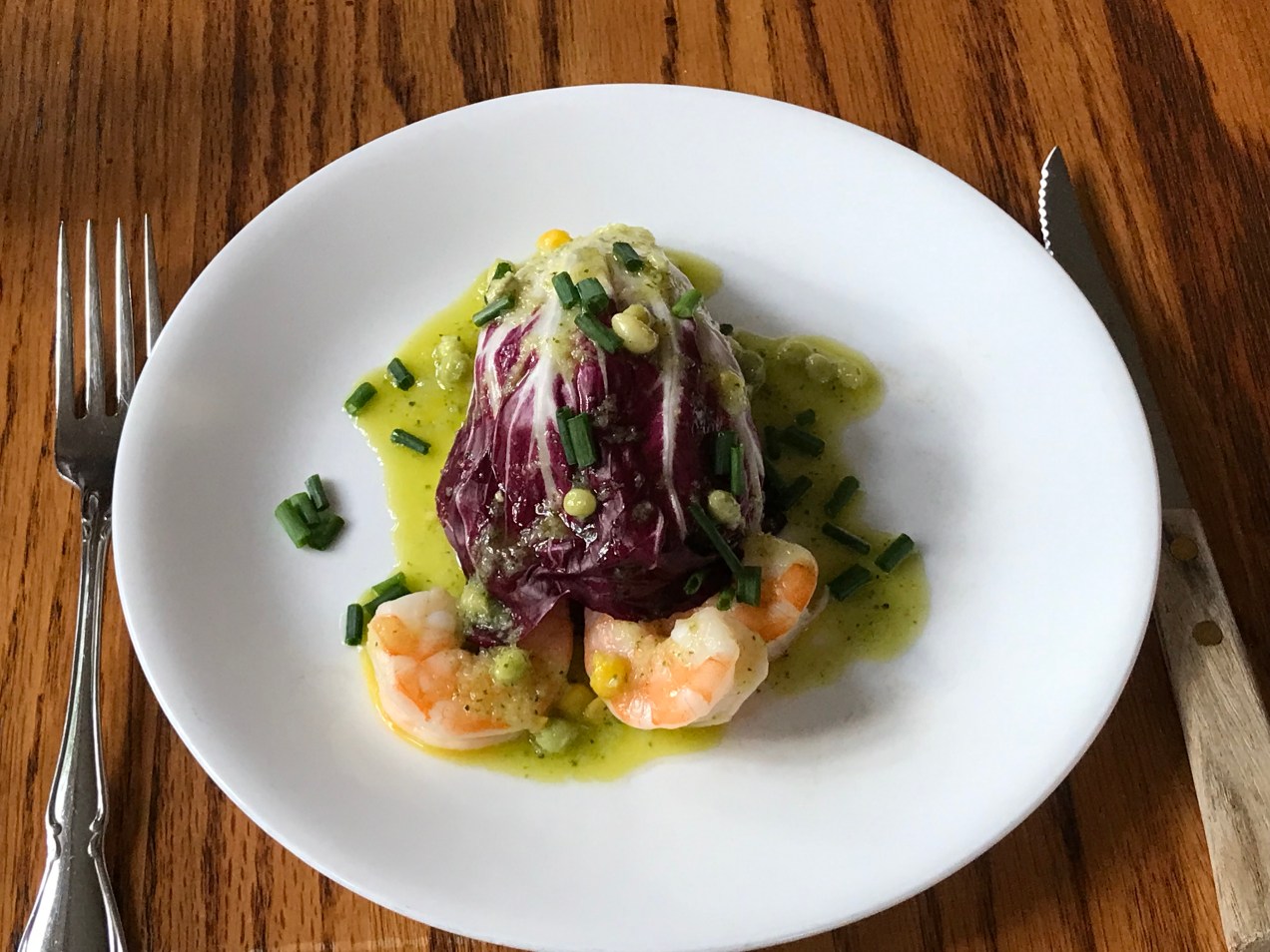
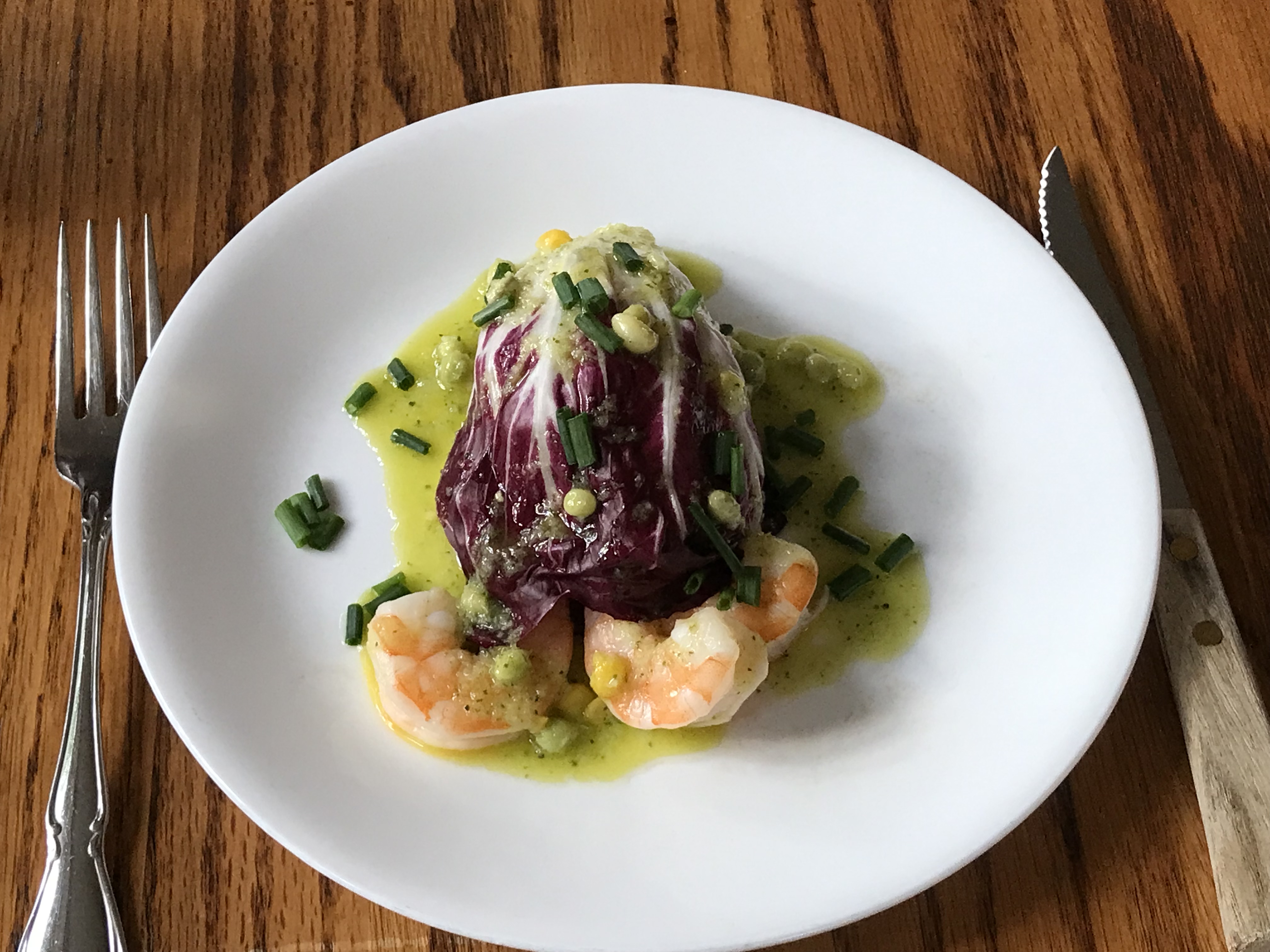
Note that I did make a few substitutions for economy, convenience, and personal preference. The recipe called for using smoked salmon to form a “cornucopia” for the shrimp and vegetable pieces, but with all the other flavors in the mix it would be hard for the fish to shine. While the smoky flavor probably would have been a nice contrast with the sweet corn, peas, and sauce, the benefit didn’t justify the added cost. The contrast was provided by radicchio instead. Its bitter flavor worked well with the other ingredients, and it looked pretty on the plate. Even though I care more about how food tastes, having it look good is a nice bonus.
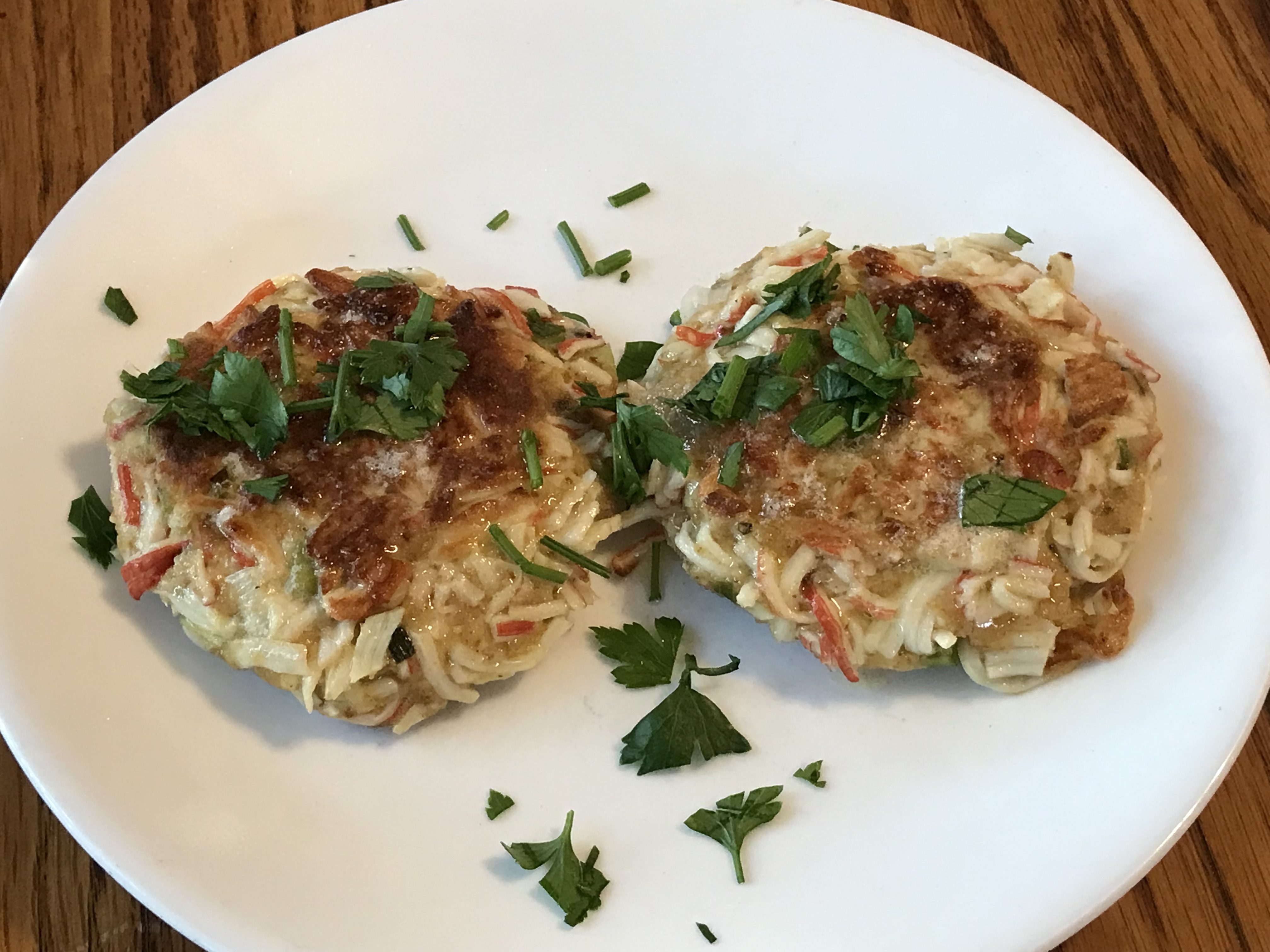
Soft-shell crabs are hard to come by when you live several states away from the nearest ocean. The two options are 1) have them delivered (which is impractical unless buying a large quantity of items) or 2) drive three hours to one of the fish markets in Chicago (possibly at night to accommodate their early hours). As neither option was feasible, I decided to make crab cakes instead. Specifically, imitation crab cakes, because frozen crab was too expensive and I didn’t trust the canned variety. So I combined chopped imitation crab, bread crumbs, and eggs, shaped them into cakes about the width of a palm (roughly the size of actual soft-shell crabs), and made those the main course. They were delicious.
The asparagus was closer to the recipe in the book. I cooked and marinated it as directed and plated it on radicchio. The difference was in the topping. The recipe calls for working chopped hard-boiled egg into the sauce. Since I don’t like hard-boiled eggs, I used another common method mentioned in the recipe: topping the asparagus with butter, fried eggs, and parmesan cheese. This all worked very well together and isn’t as weird for a bachelor party as it might seem.
Asparagus has been viewed as an aphrodisiac since the days of Ancient Rome. After falling out of favor for several centuries, it became popular again in the Renaissance. There was even a way to tell if someone was eating it in secret: by the distinctive odor it left in their chamber pot. People have noticed for centuries that asparagus made their urine smell funny. Both Benjamin Franklin and Marcel Proust mention it at least once in their writings, and one 18th Century club insisted that gentlemen not urinate in the coat rack during asparagus season. Why that was too much to ask for during the rest of the year is unclear, but it was a different time.
Moving on from aphrodisiacs and asparagus pee, we have dessert. These cookies are made crunchy and slightly gritty with semolina flour, flavored with rum and raisins, and served with parmesan-like grana cheese and honey. I’m not usually a raisin fan, but they were a good match with the light sweetness of the cookie and texture from the semolina. There is actually a Medieval connection here. At the end of a feast, it was common to serve wafers and cookie-like sweets, along with aged cheese, dried fruit, and spiced wine sweetened with honey. While the idea that this helped close the stomach and aid digestion was incorrect, the cookies, cheese, and honey worked surprisingly well together for a treat that stands the test of time.
Menu: Taranto-Style Baked Oysters, Grilled Red Pepper Shrimp, Whipped Potatoes with Olive Oil, Farm-Style Zucchini in a Hot Sauce, Blueberry Ice with Melon Ball Spears
Recommended Wine: Rosa del Golfo (rosé from Apulia, coral pink with berry aroma)
Like many other cities in Southern Italy, Taranto was originally founded by the Greeks. For centuries, the inhabitants fished, traded, and fought with other city-states. The first two activities remained important after the region was conquered by the expanding Roman Republic in the 3rd Century BC. The Romans were followed by the Visigoths, Byzantines, Lombards, Holy Roman Empire, Normans, French, Spanish, and finally the unified nation of Italy. Through all the changes in control, the inhabitants looked to the sea for an essential part of their diet.
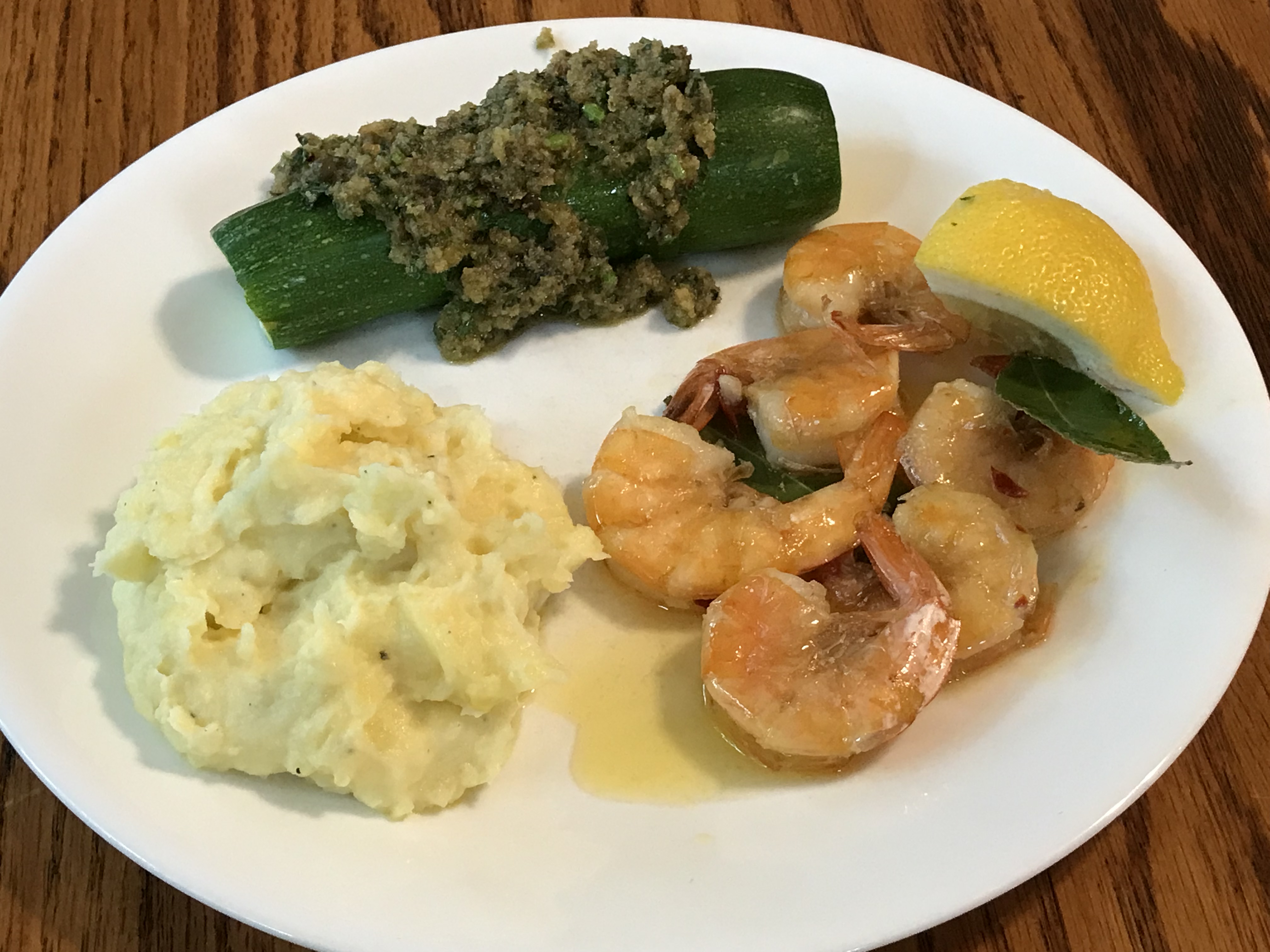
Oysters have a complicated history. The Ancient Romans prized them and they are a luxury today, but for centuries they were peasant food. Perhaps this was because they were abundant by the coast and could not safely be transported inland as transportation networks broke down. Oysters did not become popular again until the Early Modern Era, with the exact date varying from place to place. As population rose and more oysters were eaten, they went from cheap protein, to mid-priced staple, to special treat, at least for some people. I’m not usually an oyster fan. They have an odd flavor and slimy texture, but baking them with bread crumbs was a significant improvement. The oysters tasted good, but were not spectacular. The shrimp was much better, with a nice garlic flavor and just a bit of spice.
What’s interesting about this menu is how much it relies on ingredients originally from the Americas. The red pepper on the shrimp, potatoes, and zucchini were all part of the Columbian Exchange. While potatoes became much more important in Northern Europe, their high yields helped them achieve a place in Italian cuisine as well. Here they are whipped with olive oil, cream, and pecorino cheese. I wouldn’t have thought of putting olive oil in mashed potatoes or serving them with seafood, but the combination worked surprisingly well.
Zucchini is everywhere is Italian cuisine. Exactly when it caught on is unclear, but since Europeans were already growing vine crops like melons and cucumbers when zucchini arrived from the Americas, it seems unlikely that there was much resistance. There is a joke in the US that you can’t leave your car unlocked in late summer or someone might put zucchini in it, which points to two of its virtues. It’s easy to grow and famously (or infamously) productive, hence the number of different recipes to use up the bounty.
This is one of the more interesting recipes. The zucchini is simply boiled, but then it’s served with a sauce made from vinegar and oil, flavored with herbs and hot pepper flakes, and thickened with breadcrumbs. While the pepper flakes are a New World introduction, the sauce has a definite Medieval character. Most sauces at the time were strongly flavored with spices, herbs, and/or vinegar, contrasting with rather than complementing whatever they were served with. Because roux and flour were not yet used as thickeners, breadcrumbs filled that role, producing thicker sauces with much more texture. I was expecting a soggy sludge, but was pleasantly surprised. The flavor was the perfect balance for the neutral zucchini, and the thicker texture helped the sauce stay where it was supposed to rather than spill all over the plate.
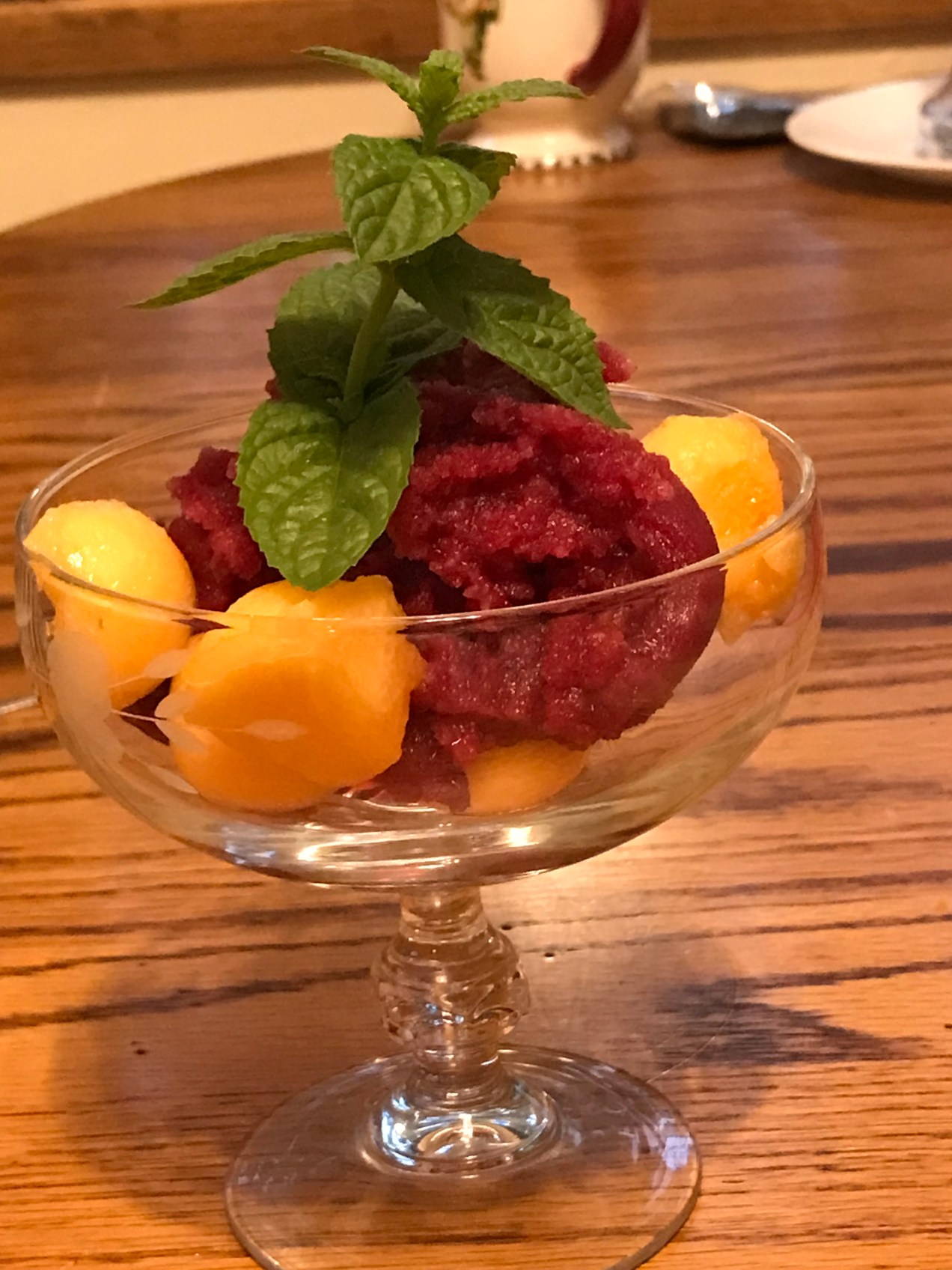
For dessert was blueberry sorbet. I didn’t think that there were many blueberries in Southern Italy, but the recipe looked interesting and I was excited to try out my new ice cream maker. The flavor was unique and tasty, but what really stood out was the deep purple color. Just look how pretty it is.









 Feasting Through Time