Uncategorized

Cook’s Tour of Italy Menu 20 (Pgs. 72 – 74): Lunch for 6 at Home, Genoa

Region: Liguria/Piedmont

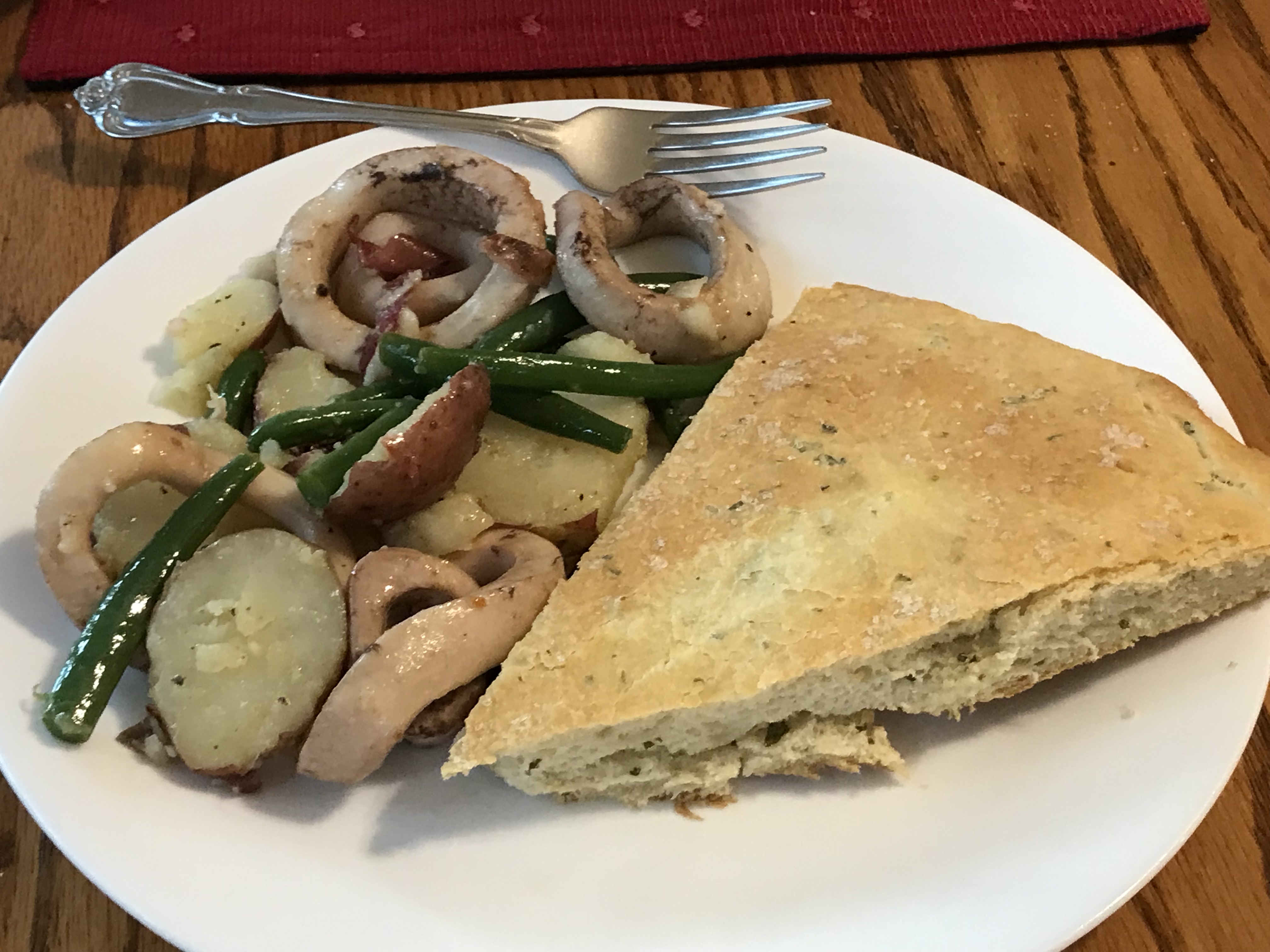
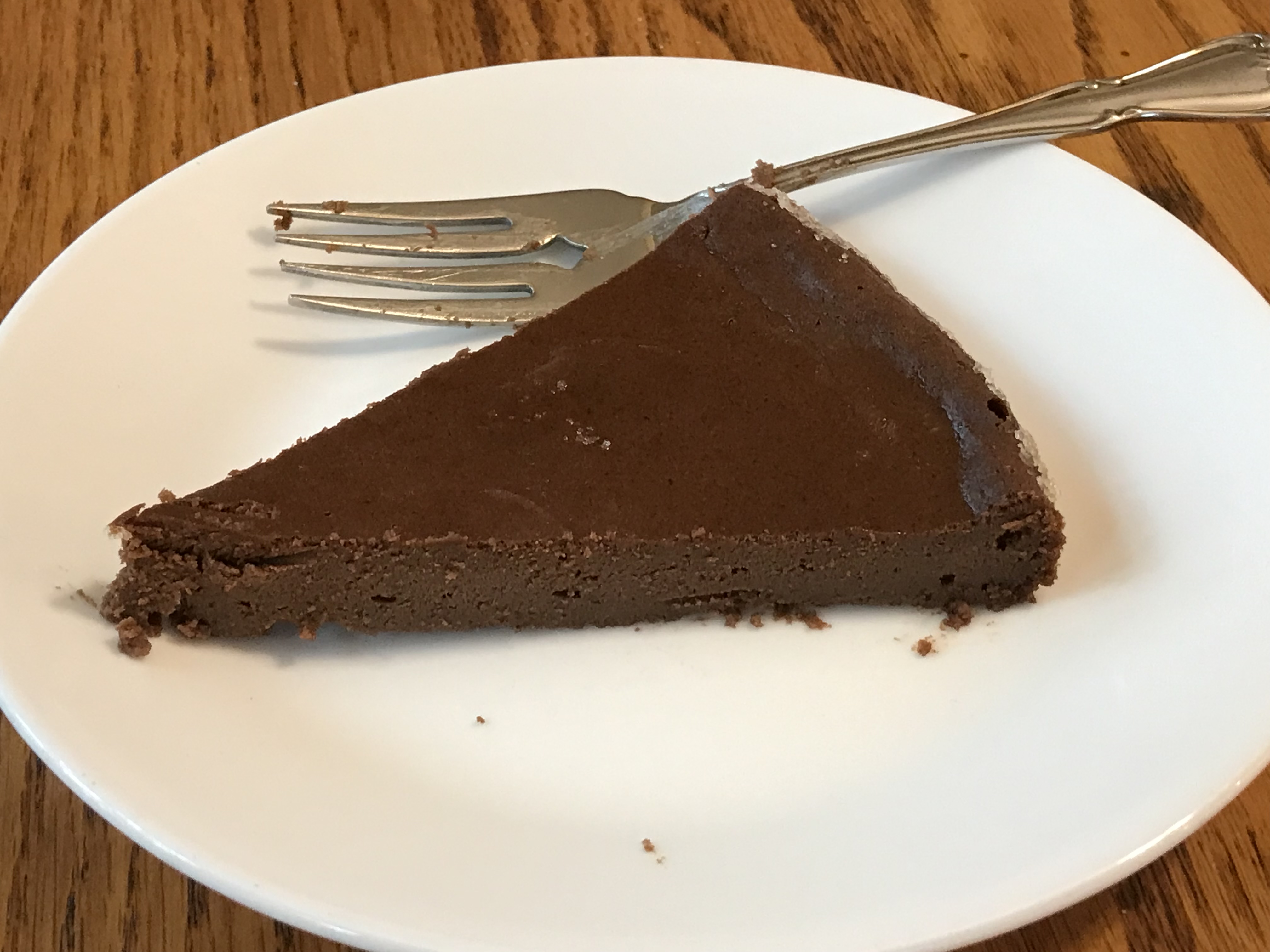
Menu: Genovese Squid Salad with Vegetables, Focaccia with Sage, Chocolate Mocha Ricotta Cheesecake

Recommended Wine: Cinque Terre

            Squid might seem like a strange salad ingredient, but various seafood salads are common in Genoa and the rest of Liguria. With hilly terrain and mountains close to the sea limiting grazing land, seafood has long been a staple in the Ligurian diet. One of the most elaborate preparations is a Christmas Eve specialty called cappon magro, or “lean capon.” At one time, Christmas Eve was a “lean” or meatless day, as was the rest of Advent. To compensate for the lack of meat, cooks for wealthy clients created numerous elaborate seafood dishes. Some of these specialties included “ham” made of salmon, “bacon” made with different colors of fish layered together, “game birds” made of spiced pike, and custard made with fish and almond milk.

            Liturgical fasting has a fascinating history. As Christianity spread around the Mediterranean, meat was more of a luxury than fish, so replacing meat with fish made sense. This changed once Christianity reached Northern Europe, especially inland regions, and over the centuries those who could afford to do so increasingly followed the letter of the law, but not its spirit. By the Late Middle Ages, what could be considered “fish” was truly mind-boggling.

            Considering whales and dolphins as fish was probably an honest mistake, but I’m not sure how the confusion persisted. Surely whoever was responsible for preparing them noticed that they lacked gills and had lungs like a cow or pig, but maybe animals were classified by where they lived rather than how they breathed. Other “fish” included beavers and barnacle geese, which were believed to come from barnacles instead of eggs, though this was doubted by many people, including at least one Pope. If you’re wondering, barnacle geese do hatch from eggs, but since they nest in the Arctic no Europeans saw the evidence until the 16th Century. By the time that confusion was cleared up, Spanish settlers in South America had decided that the capybara counted as a fish because it spends a lot of time in the water. Apparently, the fact that they look more like giant guinea pigs than fish was irrelevant.

            There is no doubt, however, that squid counts as a fish. In this salad, it is baked, combined with potatoes, cooked vegetables, and a vinaigrette dressing, and served slightly warm. While the dish didn’t stand out like some that I’ve tried, it had a nice balance between protein, starch, and vegetable, none of the flavors overpowered the others, and the leftovers were almost as good cold the next day. And based on everything I’ve learned, the mix of seafood and fresh vegetables is very Ligurian.

            So is the focaccia, with lots of olive oil and herbs. Personally, I had some trouble with it. Despite following the recipe exactly, it wasn’t thick and spongy like what you find in the store and see on cooking shows. It was thinner and crispy, almost like a hand-tossed pizza crust. It still tasted great, but I couldn’t figure out what went wrong. Maybe the recipe is for a different variety of focaccia. With the number of bread varieties in Italy, that would not be surprising.

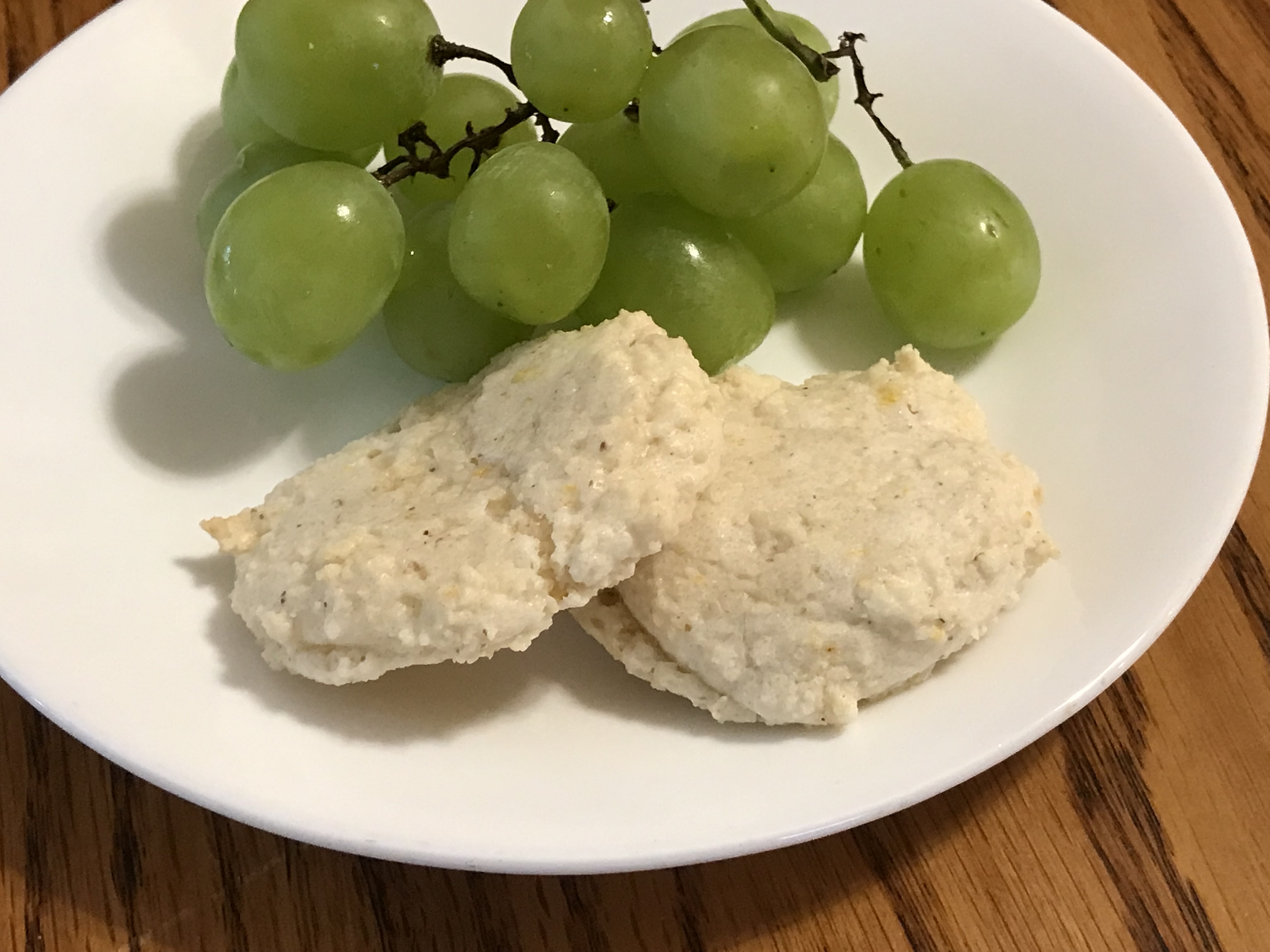
            I do know what went wrong with the cheesecake. The recipe called for a 6-inch springform pan, which I do not have. Rather than buy a new piece of equipment, I just used a regular springform pan, set the timer for less, and kept a close eye on the progress. It was good that I did, because even the shorter time was plenty. Many people would probably consider it overbaked, but it wasn’t burnt and I liked the firmer texture. The mocha flavor was excellent and it was a generally nice dessert.

Standard
Uncategorized

Cook’s Tour of Italy Menu 64 (Pgs. 204 – 207): Neapolitan Macaroni Menu

Region: Naples/Adriatic Coast

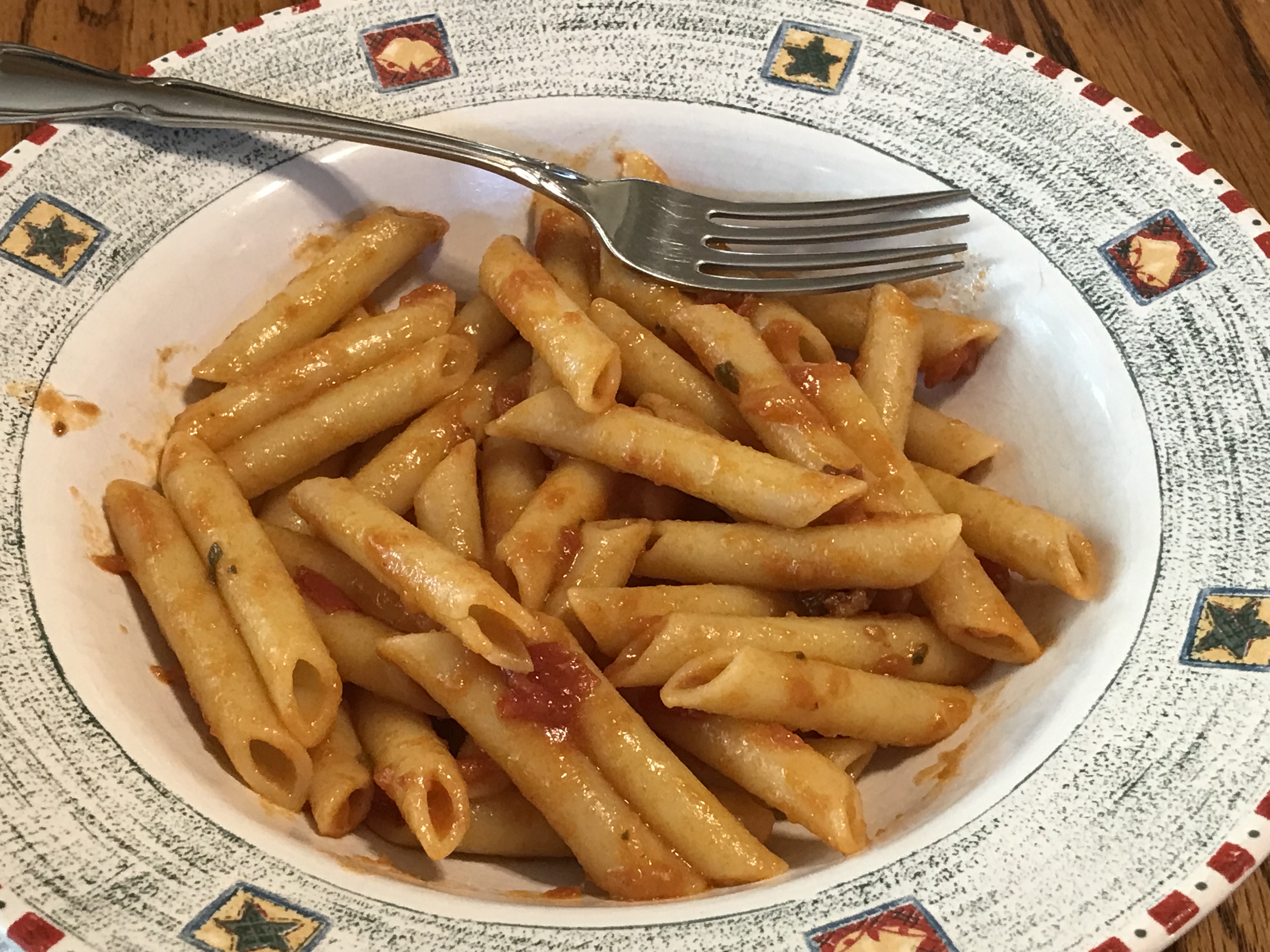
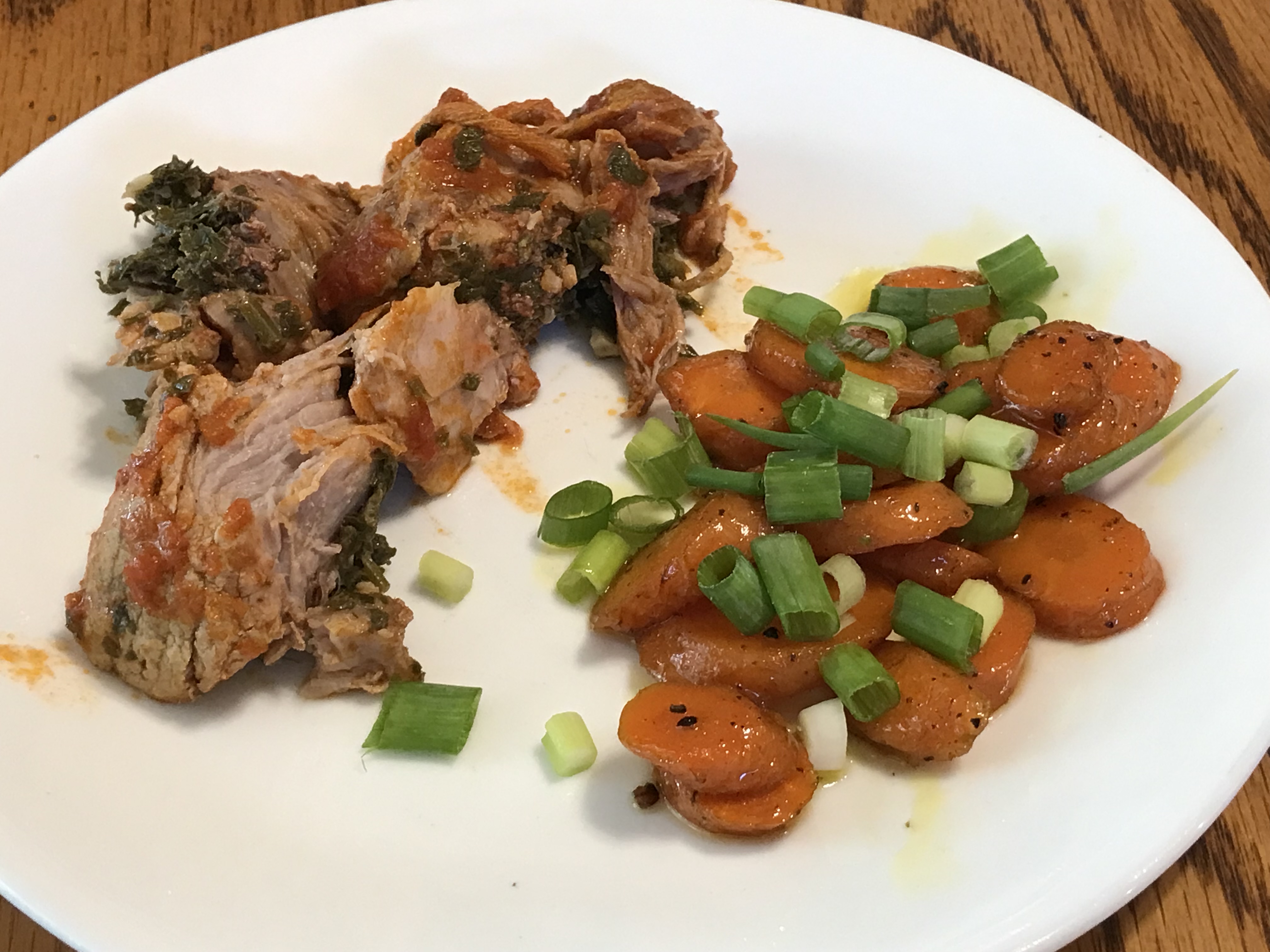
Menu: Penne with Pork Tomato Sauce, Sliced Pork, Carrots with Marsala, Romaine Watercress and Snow Peas with Lemon, Almond-Orange Meringue Cookies

Recommended Wine: Gragnano

            Ragu, a rich sauce with tomatoes and meat, is popular all over Italy, but two main styles are most famous. The first, Bologna-style, is more of a meat sauce flavored with tomatoes and is popular across the North. The second, Neapolitan-style, is a tomato sauce flavored with meat, which is then served as a separate course. Variations of this second style are prevalent across the South, and here we have a basic version, flavored with pork shoulder. The difference in the two styles probably has to do with the fact that in the historically less affluent South, there was more incentive for diners to fill up on pasta before serving the meat.

            This brings up an important point about typical Italian meal structure. The number of courses included depends on if it is an everyday or celebratory meal, but they usually follow a specific sequence: antipasti (appetizers), primi (pasta, risotto, polenta, or another starch or soup), secondi (meat or fish) with contorni (vegetable sides), salad, fruit and cheese (the most typical dessert), and dolci (sweets). If meat or fish is included (it may or may not be), it is always served after the starch. Here we have pasta with the tomato sauce as a first course, sliced pork for the second with carrots as a side, followed by salad, then cookies.

            Humans and pigs have a fascinating history. First domesticated around 8000 BC, pigs quickly proved their value to early farming peoples. While they didn’t provide wool, surplus milk for human use, or pull plows, pigs mature quickly and breed much faster than sheep, goats, or cattle. This made them the most efficient source of meat, making up for their shortcomings in other regards. Plus, they could eat almost anything. Despite all this, pork taboos have been widespread across the Middle East for thousands of years.

            At first glance, this is baffling. After all, this is where pigs were first domesticated. People in the earliest Mesopotamian civilizations ate pork without issue. Evidence suggests it was fed to workers building the pyramids. But over time, more and more taboos appeared, particularly after 1000 BC. There were some complete prohibitions like in the Hebrew Bible. In other cases, pork was seen as an inferior food for those who couldn’t afford meat otherwise, or an unclean food that was fine for the common people but unfit for priests and nobles. At the same time in Europe, where pigs had been introduced, and in China, where they were domesticated independently, no such problems arose and pork continued to be eaten widely.

            There are a number of theories for this. One is that centuries of environmental damage in the Middle East reduced the area suitable for raising pigs. Another is that the introduction of chickens, which eat similar food, are small enough to eat at a single meal, and also produce eggs, made pigs unnecessary. Regardless, pigs remained essential in Europe, where they had plenty of woodland to forage in. Plus, in the cooler climate, preserving the meat as bacon, ham, or sausage was easier to do.

            In cuisines where meat is limited, pork often acts as much as a flavoring as a source of protein. Cured pork products are frequently used for this, but here fresh pork shoulder or butt is used. After the meat is cooked, it is kept warm while the sauce is eaten with the pasta. If serving pasta first is to encourage people to fill up before having any meat, this dish did its job. The pork flavor was clearly present and provided an incredible richness to the sauce. Saving room for the other courses took substantial willpower. As expected, the sliced pork that followed was excellent; very tender and flavorful.

            Carrots might seem surprising in an Italian menu, but they were eaten as far back as Ancient Rome, though they might not have been orange. New varieties were introduced from the east in the Middle Ages, though the story about the orange carrot being created by the Dutch to honor their ruling family in the 17th Century seems unlikely to be true. A drawing in a 6th Century manuscript clearly shows an orange carrot, though during the Renaissance white, yellow, red and purple carrots were also common. These other colors have recently regained popularity in a big way, even becoming trendy. Hopefully this particular trend sticks, as each of the varieties has a slightly different flavor, and they are just so pretty. But for this menu, we have regular orange carrots, cooked with a bit of sugar and marsala, and topped with minced scallions.

            Every now and then, there is a dish that makes me think “Whoa, I made this?” This was one of those dishes. The marsala worked a lot better with carrots than with oranges, and the sugar produced a lightly browned glaze, and everything worked together for an incredible depth of flavor. A sprinkling of scallions on top added a nice contrast in taste and color. Though made with affordable ingredients, these would fit right in on a fancy restaurant menu. The advantage of making them at home is that you can have a normal portion size, leftovers, and avoid the restaurant markup in cost.

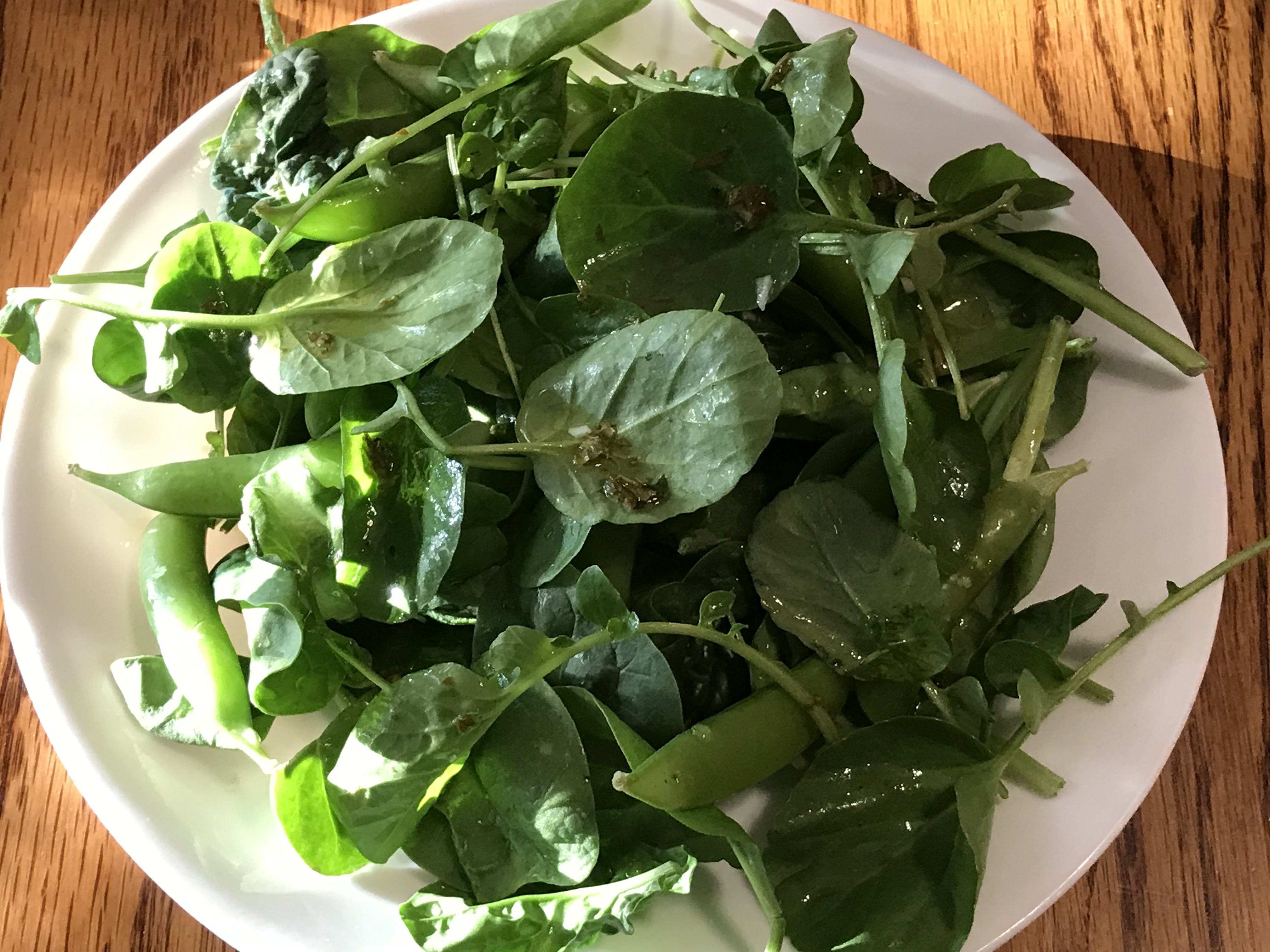
            Watercress and snow peas provided interesting contrasts for the salad; peppery for the watercress, sweet and crunchy for the snow peas. The dressing was a bit too sour, but in small quantities worked fine.

            The cookies were based on a meringue, which is a whipped mixture of sugar and egg whites. As pointed out in the book, these were sort of like the ricciarelli from Siena, with almonds and orange peel. They reminded me of macarons, with a crispy outside and chewy inside, though these were supposed to be crunchy. I suspect that humidity may have played a role in the texture not quite matching up, since meringue is known to be touchy on humid days. However they were supposed to turn out, they were delicious. Maybe I’ll tackle actual macarons at some point in the future.

Standard
Uncategorized

Cook’s Tour of Italy Menu 76 (Pgs. 235 – 238): Lunch in Potenza

Region: South Mainland/Islands (Basilicata)

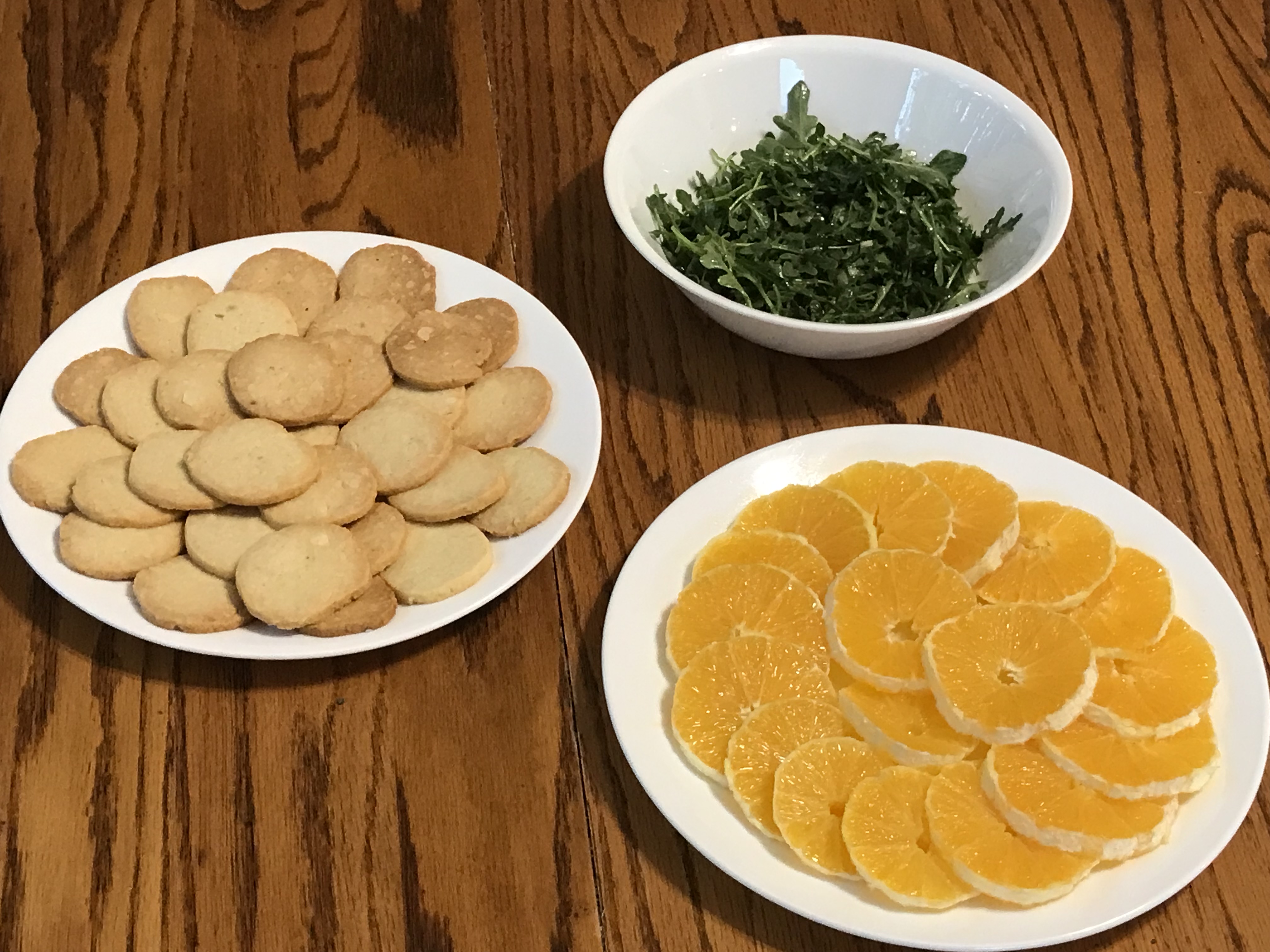
Menu: Spaghetti with Ginger and Garlic, Chicory Salad Mimosa, Sliced Oranges with Marsala, Enriched and Crisped Vanilla-Almond Cookies

Recommended Wine: Calabrian Red Ciro

            South of Naples and Amalfi is Basilicata, one of Italy’s least known and least developed regions. Between the rugged terrain and often harsh taxation, life has historically been difficult here. The traditional diet includes pasta, vegetables, olive oil and fruit, all of which are featured here. In a nod to increasing prosperity in the area, this menu ends with buttery almond cookies.

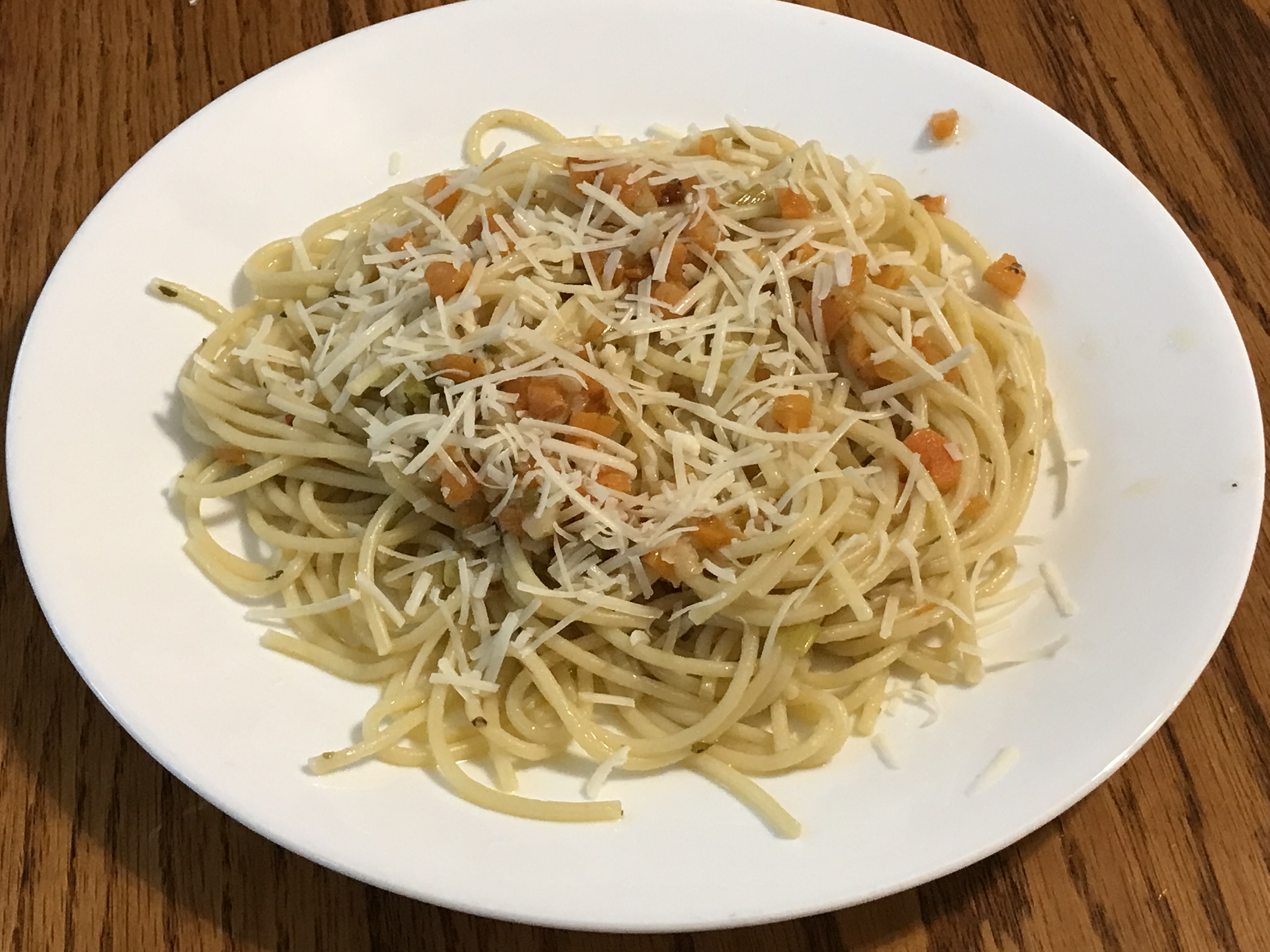
            Adding ginger to a pasta dish sounds strange at first, but it does give it an interesting flavor. Ginger and garlic work together to flavor the pasta, enhanced by oregano and hot pepper flakes, sweetened with carrots and vermouth, and enriched with olive oil, butter, and Romano cheese. The flavor was good, but the amount of water called for in the sauce made it very thin, causing it to pool at the bottom on the serving platter instead of sticking to the pasta. It was also a bit sweet from the vermouth.

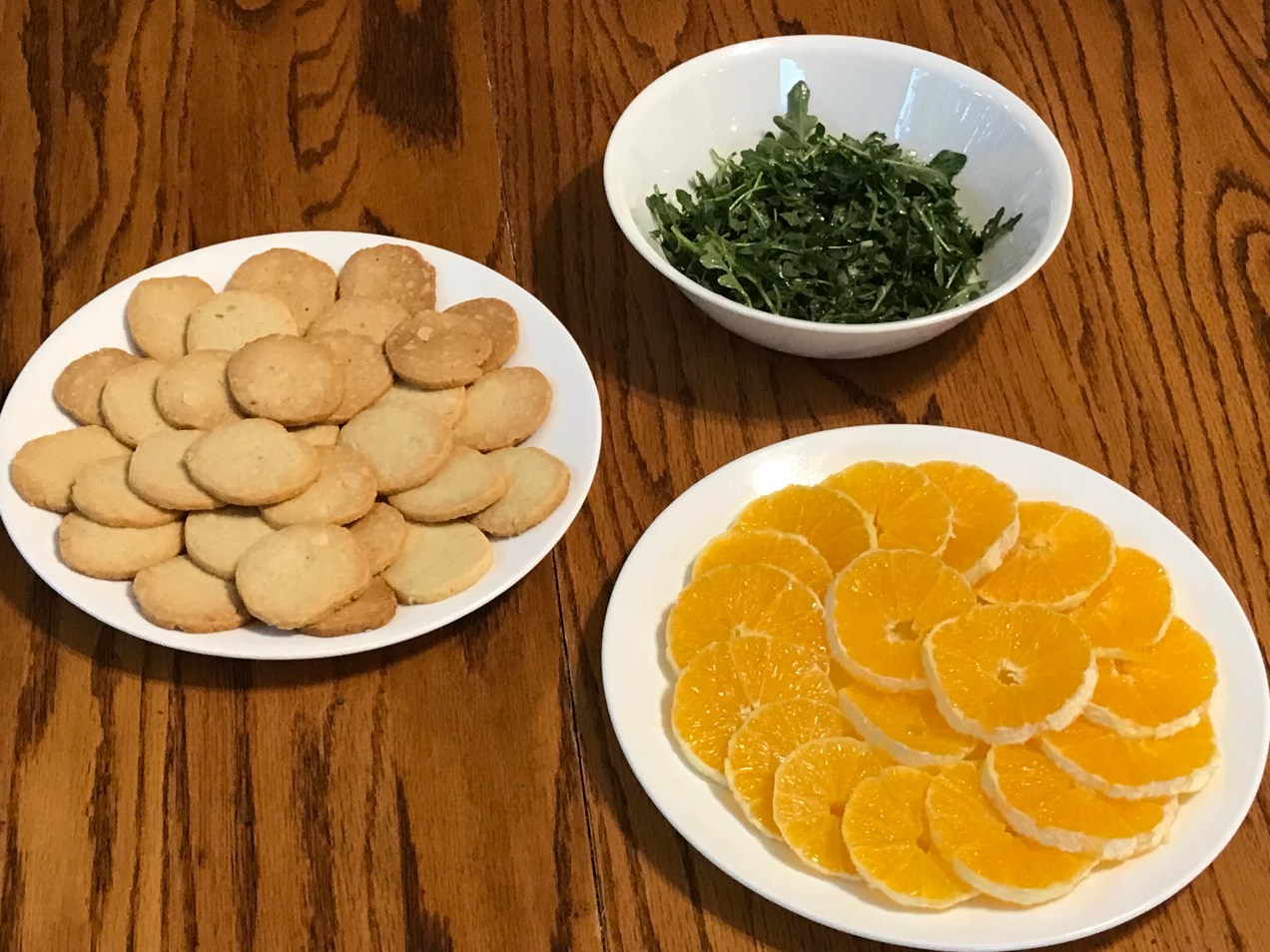
            The reason the salad is called “mimosa” is because of chopped hard-boiled egg yolks sprinkled over it. I omitted this here because of my dislike for hard-cooked eggs, particularly the yolks. I also substituted arugula for the chicory because it is not quite as bitter. The lemon juice dressing was still pretty sour, but it was a decent salad.

            Oranges grow all over southern Italy and are a popular dessert, especially in the winter. While they are often eaten plain, they can be embellished, as they are here with Marsala wine. Marsala is unique in that it is partially “cooked,” killing the yeast in the wine. As a result, it stays in good condition even after the bottle has been opened, at least for a while. This process also gives it a unique flavor. While I don’t drink much alcohol and am hardly a wine connoisseur, even I could pick out what seemed like briny and nutty flavors. Unfortunately, those flavors clashed with the oranges. A non-alcoholic experiment, with pineapple juice replacing the wine, was much better.

            Dessert had a slight glitch in the preparation. A buttery dough was rolled into logs, chilled, sliced, and baked on buttered baking sheets. That was all fine, but one thing I didn’t realize was that if the cookies weren’t removed from the sheets almost immediately after coming out of the oven they would stick. The first sheet of cookies ended up as a bunch of broken pieces. They were still delicious, but not exactly photo-worthy. The cookies from the second sheet were able to be removed intact, but an experiment a few days later with leftover dough proved that parchment paper worked better.

            Overall, this was a well-rounded menu, though I’m not sure if I’d make the pasta or salad again. The oranges and cookies, however, would be perfect for a Christmas spread. After the typically heavy main course and sides, the oranges would be a nice contrast; light and sweet with a bit of tartness. A little later, after everyone’s food has settled a bit, the cookies could be eaten with whatever other desserts are on offer.

Standard
Uncategorized

Taste of Normandy: Apples and Dairy

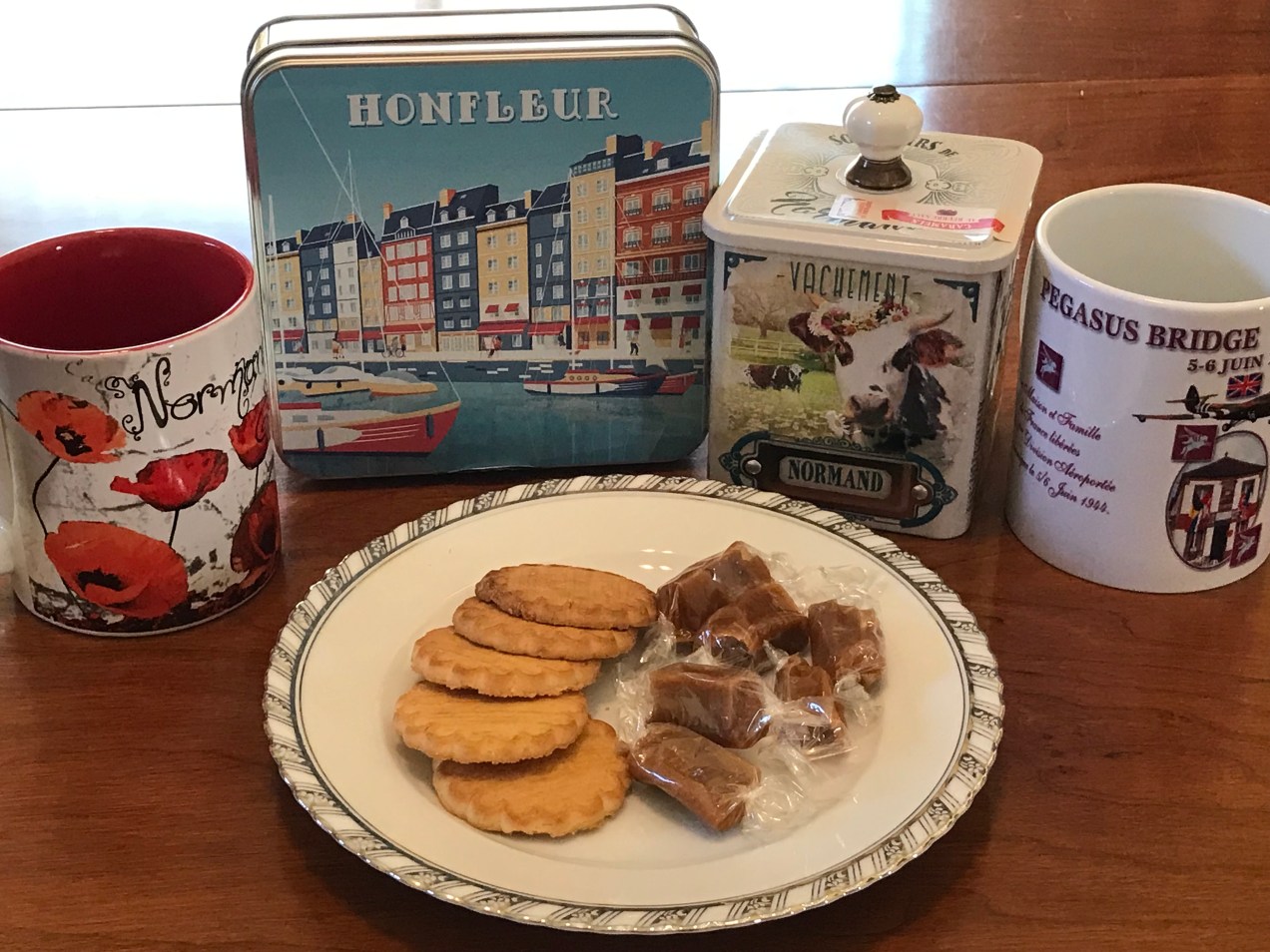
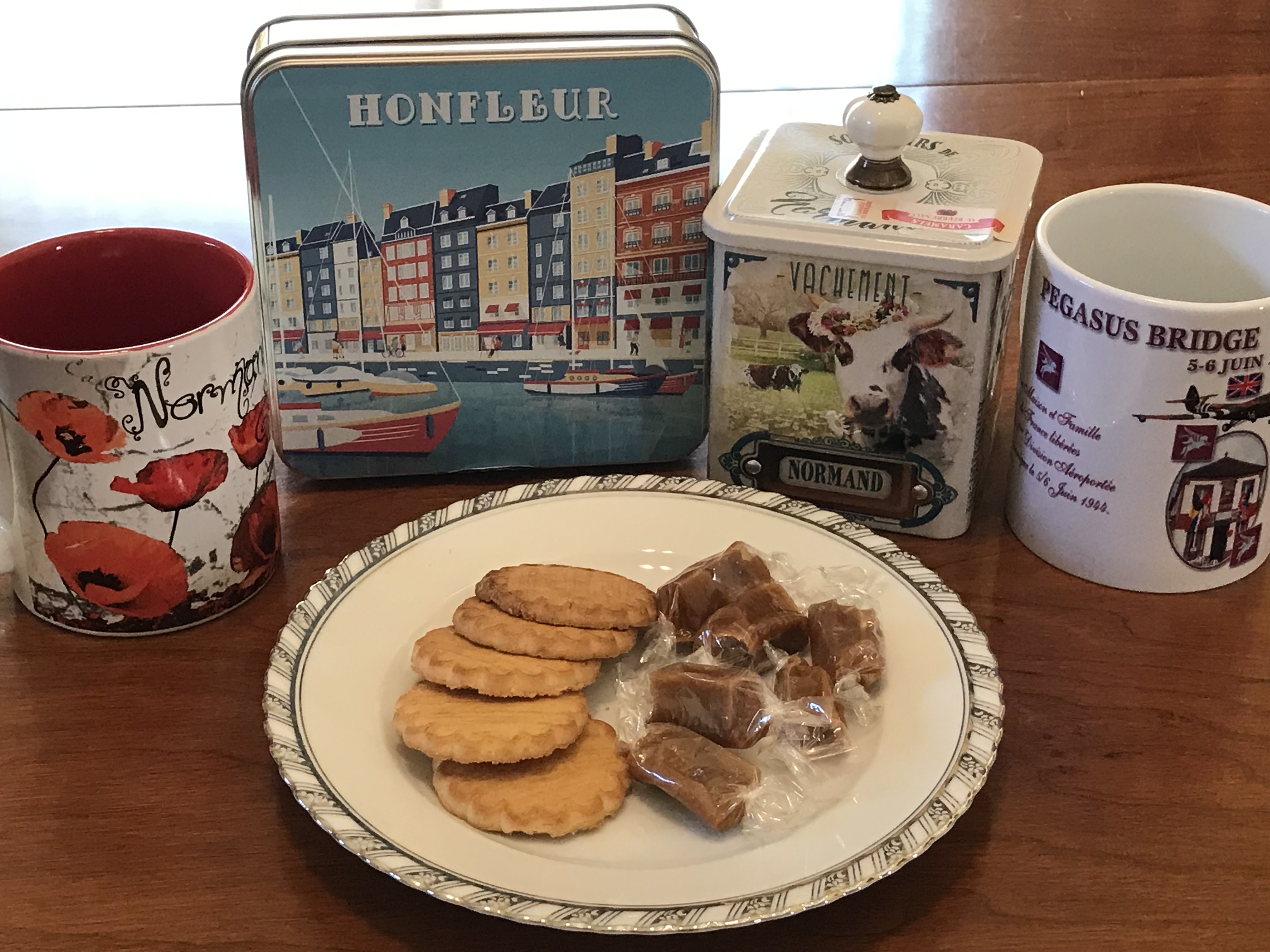
Butter cookies and salted butter caramels, souvenir tins and mugs

            Continuing from a previous post, let’s talk about apples. Actually, let’s talk about Normandy, then we’ll talk about apples. The history of Normandy starts out like that of the rest of France. Agriculture was introduced several thousand years ago, followed by bronze working and horses. At some point after 1000 BC, so was iron working. Celtic peoples arrived a few hundred years after that and came to dominate much of Central and Western Europe. By the time of Julius Caesar, modern France, which the Romans called Gaul, was covered by a patchwork of chiefdoms. While not yet literate, the people there were expert metalworkers, had a complex social hierarchy, and often lived in large towns. This was the world conquered by Julius Caesar in the 50s BC.

            After the initial conquest, the citizens of Gaul offered surprisingly little resistance to Roman rule. Most likely, the people saw certain benefits. The presence of the Roman army protected the frontier and stopped tribal warfare, reducing the chance of looting, slave raids, and destroyed harvests. Occasional heavy taxation probably seemed like a reasonable trade off. The Celts also had some things in common with the Romans. They spoke an Indo-European language and were farmers. The Romans introduced and spread new crops and built roads, which helped get those crops to market. Aqueducts provided water to the developing cities, and there were even water mills to grind grain into flour. Trade flourished, bringing wealth and new goods from across the Roman Empire and beyond. While not everyone benefitted equally and some suffered, most residents probably saw their standard of living rise.

            There was another benefit, too. Unlike the Greek city-states, the Roman Empire was generous with granting citizenship. If someone learned to speak Latin (or Greek, which was the language of the upper class in the East since the days of Alexander the Great three centuries earlier) and adopted Roman customs, they were considered Roman and could often get citizenship. Since they were not permanently trapped with the status of subjects, the Gauls had an incentive to cooperate with the Romans. Like other elites in the Western Empire, the upper classes in Gaul became Romanized. Gradually the Latin language spread down the social scale. By the time the Western Empire began to collapse in the 5th Century, the residents of modern France mostly spoke a dialect of Latin, considered themselves Roman, and were ready to defend the Empire.

            But it was not to be. First the Visigoths conquered much of Southern Gaul, along with most of modern Spain. Then the Franks moved in, pushing the Visigoths south and eventually controlling almost all of modern France, the Low Countries, and part of Germany. Over time, Frankish culture and language came to influence the dialect of Latin spoken, gradually giving rise to French. In fact, modern France takes its name from the Franks. Frankish influence was weaker in the South, where Latin evolved into Occitan, Provencal, and Gascon and the Roman way of life was able to continue for longer. By the time of Charlemagne in the late 8th Century, the Franks in the North were well on their way to becoming French.

            In Normandy the story has another twist. Starting in the 9th Century, as Charlemagne’s empire fractured, Vikings began attacking the coasts of the Frankish kingdoms. West Francia, which would become France (East Francia would become Germany, while Lothringia was a complicated situation I’ll get into in a later post), had it especially bad. Viking longships could sail up rivers and frequently raided the settlements along the Seine, which had prospered under Charlemagne and the other members of his dynasty, the Carolingians. At one point, even Paris was besieged. Eventually, the situation got so bad that the king granted one Viking leader land between Paris and the English Channel in exchange for help fending off other Vikings. While this could easily have backfired, it actually worked. Over time, the area became known as Normandy, from “Land of the Northmen.”

            The Vikings in Normandy quickly became Christian and learned to speak their own variety of French. The dukes of Normandy became powerful and often had a tense relationship with the French kings in Paris. In fact, in a book I picked up in France, I learned that 1) William the Conqueror didn’t consider himself French and hated them and 2) the Norman Conquest was not to the benefit of the French kings. Quite the opposite, in fact. Having one of their most powerful vassals become a king in his own right caused almost 400 years of headaches.

            I’ll go into the history of Normandy since the Hundred Years’ War in a later post, but until then, let’s consider the culture. While the Vikings were never a majority of the population and became mostly French, they left their mark on the region. In some places, particularly Rouen and Honfleur, there are many colorful timber-framed buildings that look like they belong in Amsterdam or Scandinavia. Part of this is due to the lack of quality building stone in Normandy, but the extra Germanic influence there is also a factor. As for the food, the terrain, climate, Celtic, and Germanic influences all favor dairy products and apples.

            Unlike the drier, hillier lands around the Mediterranean, the North European Plain is favorable for cattle. Most cultures that raise cattle make cheese to preserve the milk, but it seems to have been especially important here. In a climate with long, cold winters, storing food in preparation was essential. Along with smoked and salted meats, cheese was a useful source of protein that could be kept for months in a cool place. Salted butter could also be stored for much of the winter. While the Ancient Greeks and Romans saw butter as a “barbarian” food and considered cow’s milk cheeses inferior to those made with sheep’s and goat’s milk, Northern Europeans consumed both widely. The Vikings seem to have been particularly fond of their dairy products.

            For better or worse, humans have always enjoyed consuming alcohol. The specifics varied by culture and what was available to ferment. Beer was common in Mesopotamia and Egypt, with rich grain crops but too hot for most grape varieties. The Ancient Greeks, chronically short of land to grow grain but able to grow vines on hillsides and terraces, preferred wine so much that they considered beer drinkers barbarians. Other things that could get someone labeled a barbarian included drinking milk, drinking wine without mixing it with water, and speaking a language other than Greek. Mead was made anywhere honey was available. With few or no grape vines, Germanic and Celtic peoples drank beer and cider.

            The apple was historically king of fruits in Northern Europe. Celts in particular had a lot of mythology about apples and apple trees. One crucial benefit was that unbruised apples could be stored in a cool place over the winter. Their texture and flavor might suffer a bit, and a few would go bad, but most would remain edible. Pigs could be fattened up by scavenging the windfall apples, fertilizing the orchards in the process. And of course, the fruits were fermented to make cider. Even as new cultures evolved and rulers came and went, cider remained popular in Normandy and the British Isles.

Standard
Uncategorized

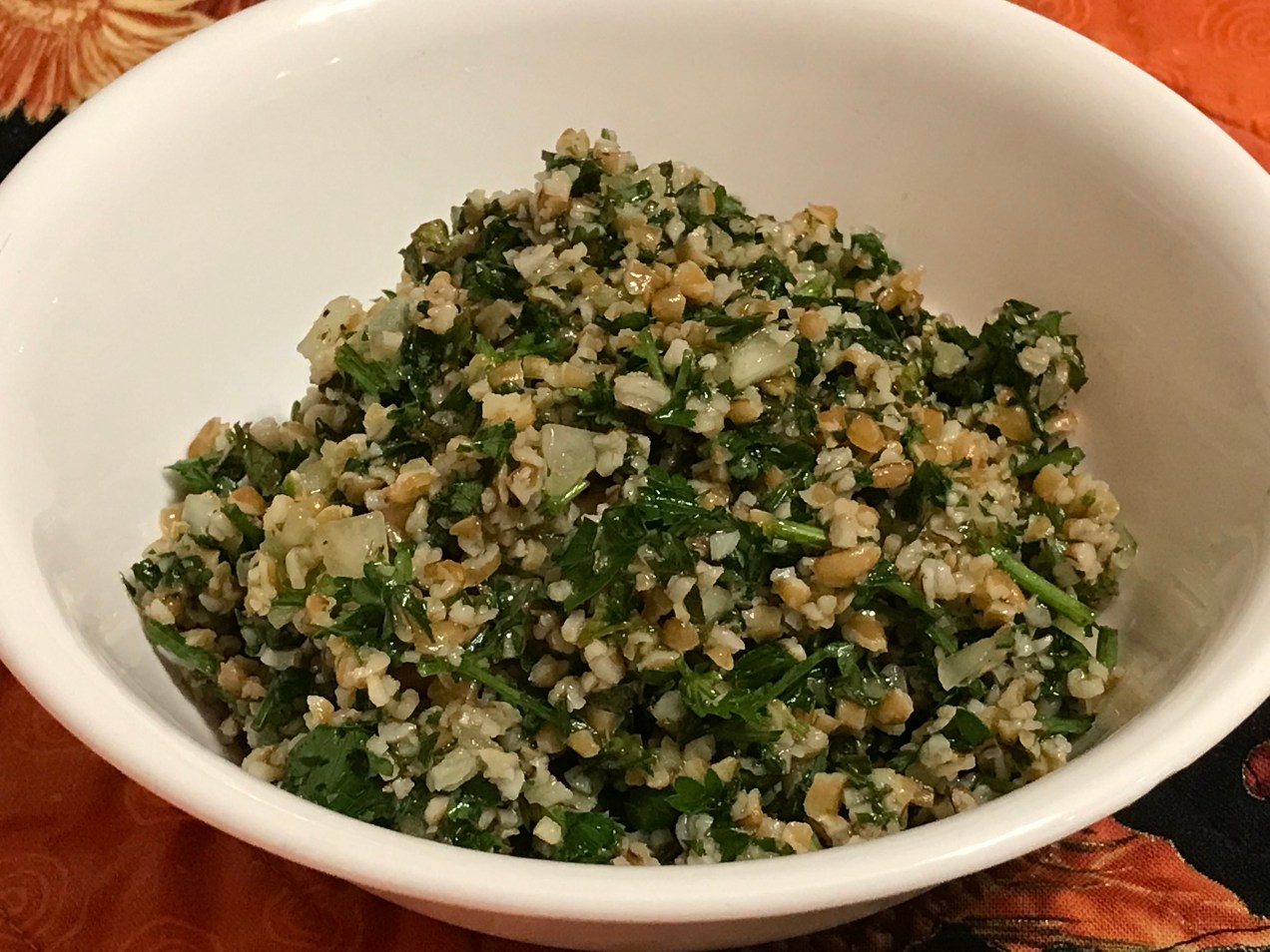
Tabbouleh (bulgur and herb salad)

Source: 1000 Foods (pgs. 503 – 504)

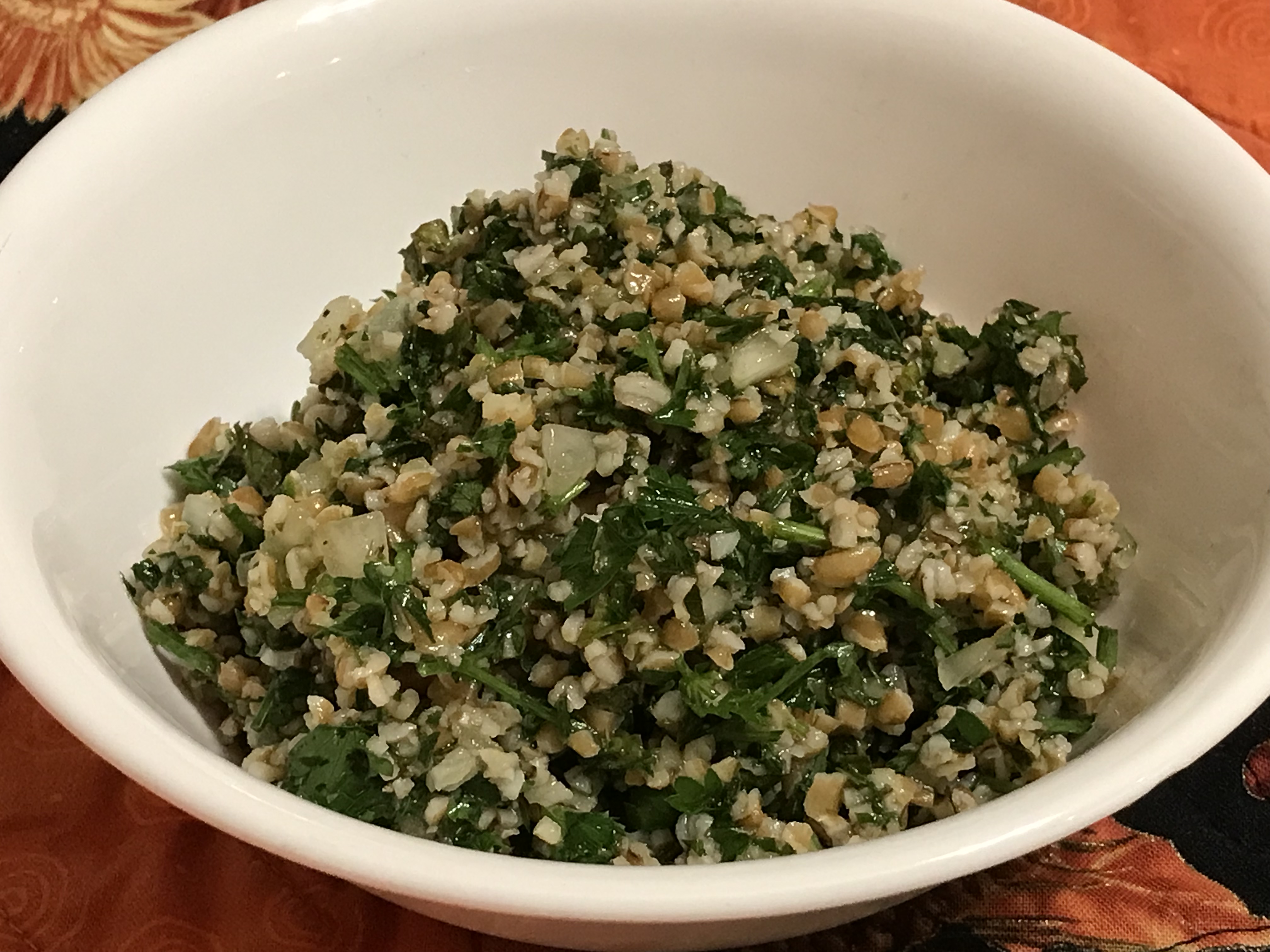
            As you’ve probably noticed, all the dishes I’ve made from this book so far have been American or European. Much of this has to do with what I cook on a regular basis and am familiar with. While I will occasionally make dishes from other parts of the world, availability of ingredients does impose some limits. Finding cassava, soursops, and yuzu will probably be difficult, for example. Fortunately, there are many recipes from other continents that use easy-to-find ingredients. An excellent example is the middle eastern salad tabbouleh. Based on bulgur wheat (basically chopped wheat grains) and parsley, flavored with onion and mint, and dressed with lemon and olive oil, it’s both interesting and familiar at the same time.

            It’s unfortunate that parsley is mostly used as a garnish in the US. A sprinkle over almost any dish adds an extra layer of flavor and texture, as well as looking nice. Tabbouleh goes one step further. Instead of just freshening up the mix, the parsley plays a central role. In the late 1960s, tabbouleh became popular in the US among the growing number of vegetarians and had a bit of a reputation as “hippie food.” Whether you’re a vegetarian or not, the wonderfully fresh mix of herbs and grain is an excellent healthy snack or side dish. Just make sure to floss afterwards. Parsley tends to get stuck.

Standard
Uncategorized

An Excess of Tomatoes: Red Gazpacho (Gazpacho Andaluz)

Also White Gazpacho (Ajo Blanco)

Source: 1000 Foods (pg. 260)

            In early summer, I did not expect much from my tomato plants. There weren’t many blossoms, and I was losing a lot of the first tomatoes to blossom end rot. I still can’t figure out what was wrong. Later in the summer and into the fall the problem went away without me doing anything differently. Yields began increasing in August, and by the end of the month there were so many I didn’t know what to do with all of them. The plants kept yielding heavily until the first frost, even as they became stressed by shortening days.

            One way to use up the tomatoes before they start attracting fruit flies is to make gazpacho. Interestingly, while we think of tomatoes as a central ingredient, gazpacho has been made since well before there were tomatoes in Spain. Some sources suggest that the Ancient Romans introduced a version based on stale bread, flavored with garlic, vinegar, and oil, and moistened with water as necessary. Until recently, bread and other grain products were the center of the diet in pretty much every culture. In the days before effective preservatives, bread would go stale in a day or two. You can observe this today with fresh bakery bread.

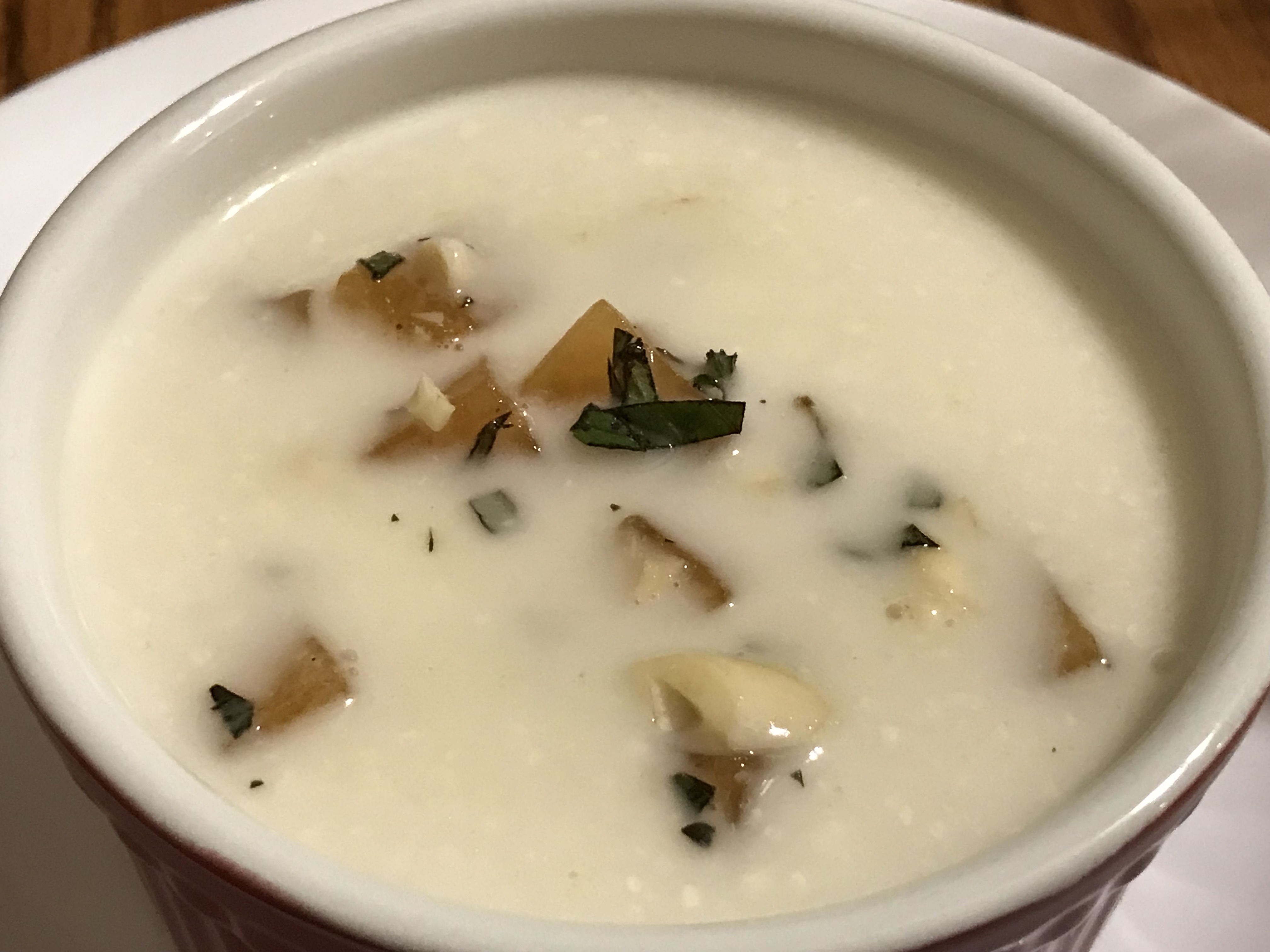
            Exactly how the Ancient Romans revived their stale bread is not clear, but there are a few possibilities. They might have pounded the ingredients with a mortar and pestle to make a puree, or cut the bread into cubes to toss with the other ingredients. Maybe the bread was toasted first, maybe not. In the Middle Ages, a white pureed version based on almonds appeared. Today it is called ajo blanco (translates as “white garlic”) and is usually served with green grapes or slices of melon, interestingly enough. This might sound weird, but until Early Modern times there was no real distinction between “sweet” and “savory” dishes. The timing of this division varied from place to place, but appears to have been earlier in France than elsewhere in Europe.

            At least in America, the sweet/savory divide is incomplete. Think of barbecue sauce, which is a combination of sour, spicy, and usually sweet. At Thanksgiving, turkey is served with sweet and sour cranberry sauce, often alongside a sweet potato casserole topped with marshmallows. Christmas and Easter hams are frequently glazed with honey or brown sugar. As dishes from cuisines that never made the distinction become more popular, the sweet/savory line appears to be blurring again, at least in some cases. Examples of this phenomenon include Chinese takeout with sweetened sauces, bacon with a sugary glaze, or desserts with crystals of sea salt. And honestly, the white gazpacho with melon was a surprisingly good combination. The texture was better with the melon, and the flavor seemed incomplete without it. Green grapes are another possible garnish.

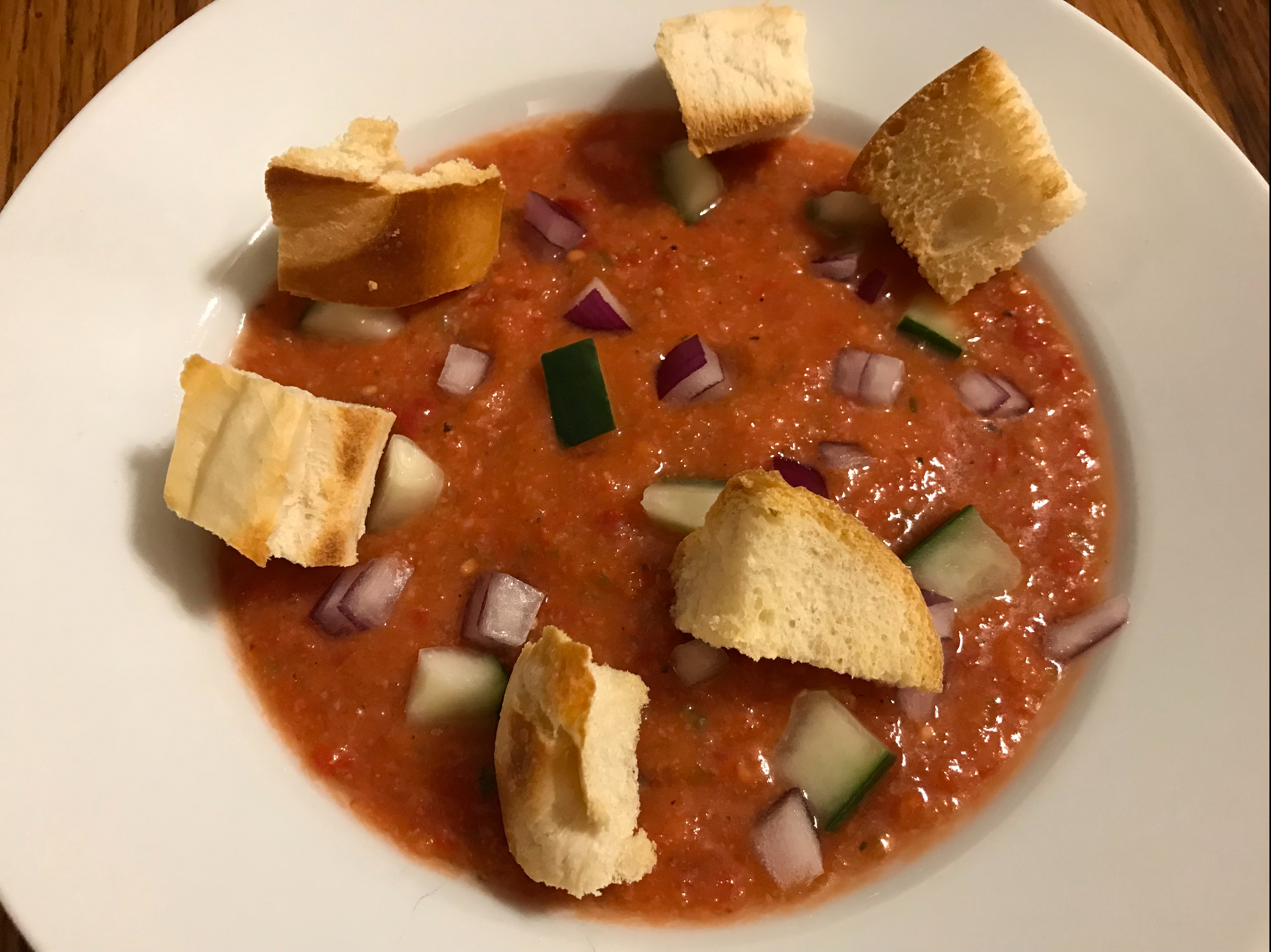
            Spaniards first encountered tomatoes in Mexico and transplanted them to Europe. They grew very well in Spain and at some point in the next few centuries, people realized that they were not poisonous. In the southern region of Andalusia, they became an essential part of gazpacho. Ms. Sheraton indicates on pg. 260 that the earliest versions were a sort of salad with tomatoes, vegetables, and croutons, but today a pureed version is most common. It can be served in a bowl with chopped vegetables and croutons as a garnish. In Andalusia, where summer temperatures often surpass 100 degrees Fahrenheit, people often serve their gazpacho in a glass over ice cubes and drink it with a straw.

            In theory, gazpacho is a good idea. It’s semi-filling but refreshing on hot summer days and is full of healthy vegetables. But I didn’t care for the red version. While I understand the appeal, I’m not a big fan of tomatoes on their own. The gazpacho tasted like pureed salsa in a bowl, and the texture was weird, even with the crunchy garnishes. But if I liked pureed soups, I probably would have enjoyed it.

Standard
Uncategorized

Foods Not Eaten: Species Concerns

Angulas (baby glass eels), Jellied Eel, Paling in ‘t Groen (smoked eel), Caspian “000” Beluga Caviar, Payusnaya (pressed caviar), Yan Wo Tang (bird’s nest soup)

Source: 1000 Foods (pgs. 254, 16, 157, 407 – 409, 418, 794 – 795)

            Despite my enjoyment of and devotion to this project, I’m not going to put a vulnerable species in any more danger to check off a box, especially when it would also involve breaking the bank. Thus I will not be sampling glass or European eels, any type of caviar, or bird’s nest soup. The invasive lampreys (a type of eel) in the Great Lakes might be an option if I ever get my hands on one, but there’s no guarantee. Plus, a lot of the foods involving threatened species sound gross.

            A key example are angulas, or 3- to 4-inch-long glass eels, which are a delicacy in northern Spain. They are typically eaten whole after a brief sauté in olive oil with garlic. The text compares them to strands of pasta, but I would rather have pasta. It also goes well with garlic oil, isn’t endangered, and can get a bit of “oceanic” flavor from anchovy paste, if so desired. Jellied eel is exactly what it sounds like: chunks of eel cooked in liquid to extract the collagen, then cooled so the broth congeals. It was once commoner’s food and inexplicably is enjoying a renaissance in popularity in Britain. Smoked eel, a Dutch specialty, sounds a bit better, but not worth the cost, both to the wallet and the ecosystem. Plus, eating eel is linked to the death of an English king.

            In 1135, King Henry I of England had lived for 67 eventful years. The youngest son of William the Conqueror, he had fought with his brothers over the succession. Henry took Normandy from his oldest brother Robert when he was away on a crusade and subsequently imprisoned him, and probably had his other brother William killed in a “hunting accident” to gain the throne of England. He reformed the legal code and fathered something like 20 illegitimate children. Despite this, he only had two children by his first wife, a son and a daughter. A few years after the death of his first wife, his son, William Adelin, died in a drunken ship accident in 1120, leaving only his daughter Matilda. At the time she was married to the Holy Roman Emperor and living in Germany.

            King Henry married again, but his second marriage was childless. The reason is unclear, since his second wife remarried after his death and had several children. Regardless of why, the lack of a legitimate son put the succession in doubt, so when the Holy Roman Emperor died Henry recalled his daughter Matilda and had his barons swear loyalty to her as his successor. While she was capable, having ruled Germany as regent during her husband’s absence, and female rulers were not unheard of, guaranteeing her succession was going to be a challenge. A particular issue was that she was a childless widow. To remedy this, Henry married her to a French count named Geoffrey of Anjou, whose lands bordered his own. While the marriage got off to a rocky start, eventually the couple had three sons. In 1135, the eldest, the future Henry II, was 2 years old.

            This is where the lampreys come in. After spending some quality time with his grandchildren and going hunting, the king was hungry. For dinner, he requested lampreys, a parasitic eel with a scary-looking mouth. The story goes that his doctors warned him against it, but King Henry ignored them. Soon after, he became ill and died. Whether the lampreys had anything to do with it or if he simply caught one of the many infectious diseases rampant at the time is unclear, but ultimately doesn’t matter. His death touched off almost 20 years of civil war called The Anarchy, pitting Matilda against her cousin Stephen. Eventually a settlement was reached. Stephen kept the throne but recognized Matilda’s son Henry as his heir, setting the stage for almost 250 years of Plantagenet kings.

            While there are no such stories tied to caviar, obtaining it would not only break the bank, but also international sanctions, at least for the most highly-prized beluga variety. At one time, caviar was less desirable than the sturgeon it came from and so was sold cheap. In some cases, it was even served as a thirst-inducing bar snack, sort of like pretzels or peanuts are today. With multiple people sticking their hands in and with hand washing rates lower than today without running water, I shudder to think of how gross the dishes got. As sturgeon stocks became depleted and people living far from the Caspian Sea became interested in caviar, the price rose. This encouraged overfishing and worsened the problem.

            The shift in interest from the fish to its eggs had another consequence. When the fish were hunted primarily for their flesh, both male and female specimens were equally valuable. While the flesh was still eaten and appreciated, the rising value of caviar created an economic incentive to focus on the females. The resulting imbalance made it harder for the population to recover. Another difficulty is that the prehistoric-looking sturgeon takes a long time to reach maturity. While fishing quotas and breeding programs have been established, and there has even been some success in live-harvesting eggs for market, illegal fishing keeps the species’ future in doubt.

            Then there’s the issue of international sanctions. Only Russia and Iran have sturgeon fishing rights in the Caspian Sea, and as you’re probably aware, both have atrocious human rights’ records. Many countries have rightfully banned or restricted imports from the two countries. Thus beluga caviar, both the regular and pressed (made from eggs damaged in shipping) varieties, is difficult to find. And really, how could fish eggs be a better salty appetizer than cheese, potato chips, or salted nuts? Not only are these a tiny fraction of the cost, they come with the added benefit of not supporting aggressive, murderous dictators. That is something we should all be able to get behind.

            Finally, we come to bird’s nest soup. It has nothing to do with a pile of twigs that robins keep trying to set up behind the porch light. Rather, it is made with the gelatinous saliva of a bird native to Southeast Asia, which hardens to form their nests. While congealed bird spit does not have much flavor on its own, bird’s nest soup is beloved in much of China for its texture. Personally the gelatinous texture sounds unappealing, but different cultures have different tastes, just like different people.

            Here’s how the process works, or is at least supposed to. Tiny swiftlets build their nests in bat caves during the spring. In summer, when the birds are done using them, the nests are harvested from the cave walls. Most commonly they are cleaned, simmered in chicken broth with a few other flavorings, and served for at least $40 per bowl (text, pg. 795). That’s in 2014 dollars, so the number now is probably even higher. The rarity accounts for the cost, as does the danger in harvesting the nests. In addition to being found in bat caves, the nests are built high on the walls. Essentially, the harvesters are risking both falls and rabies.

            If the process works like it’s supposed to, no birds are harmed and the harvesters are well-paid for the danger they face. But with such high profits to be made (the nests cost hundreds to thousands of dollars per pound), there are often unethical characters involved. There are reports of knocking baby birds out of the nests to harvest them earlier, and there is always the concern about workers being exploited by whoever runs the operation. Even if both situations are uncommon, I’m not comfortable with it. Then there’s the issue of paying exorbitant fees for wild animal saliva.

Standard
Uncategorized

Foods Not Eaten: Brains and More Brains

Cervelles au Beurre Noir, Cervello Arreganata, Hirn mit Ei

Source: 1000 Foods (pgs. 72 – 73, 178 – 179, 295)

            The above dishes are brains with blackened butter, brains baked with breadcrumbs, and brains with scrambled eggs. Personally I think they all sound gross, but through much of history, brains were a delicacy. Supposedly their high fat content gives them a rich flavor and creamy texture, but no matter how delicious they are, I’m not risking Mad Cow and other prion diseases. Even a very low chance of infection is not worth it. Health regulators seem to agree. Cow brains in particular are very hard to come by in the US, at least in an edible form.

            It’s considerably easier to get them as lab specimens. Preserved in formaldehyde, brains are available to order from lab supply companies. While potentially dangerous chemicals have restrictions on who can buy them and where they can be delivered, anyone with a credit card can order a cow brain and have it delivered to their doorstep. It would be even more inedible than it was before, but observing the cells with a microscope is an interesting experiment. I clearly remember comparing cells from pig brains with other cells in high school biology, but had no desire to eat them. They were slimy and generally didn’t look like anything like food.

            While I understand the virtue of nose to tail eating, eating brains is going way too far. Whatever goes into hot dogs is fine, since it’s salted, seasoned, and ground up to mask any weird flavors and textures. Oxtails are no problem. They make great stew. I could do pigs’ feet. They seem like a lot of work for not that much meat, but that’s no different than chicken wings. Even liver is a possibility if it’s cooked properly and heavily seasoned. Maybe. But brains are different. Once the animal is slaughtered, the brains belong in a lab, not on a plate.

Standard
Uncategorized

More Stale Bread and Tomatoes: Crostini

Source: 1000 Foods (pg. 185)

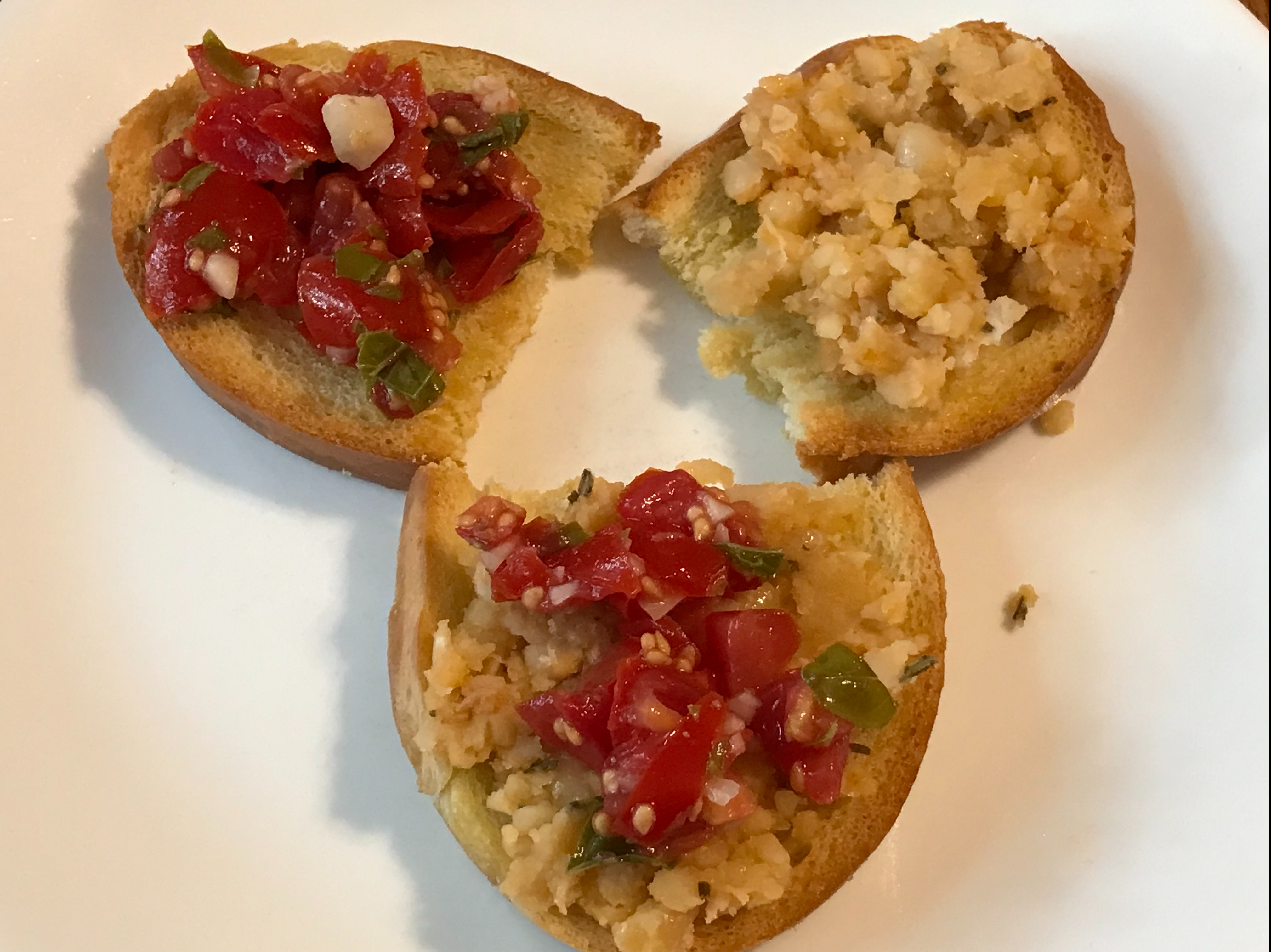
            In many cultures, toast is a common breakfast food. This probably originated with people wanting to revive and use up the previous day’s bread that was starting to get stale. It’s also quick and easy to make before the morning’s work, whether in a field or an office. Toasting causes the Maillard Reaction, which browns the bread and adds flavor. In Italy, small, thin slices are called crostini, while slightly thicker ones are called bruschetta.

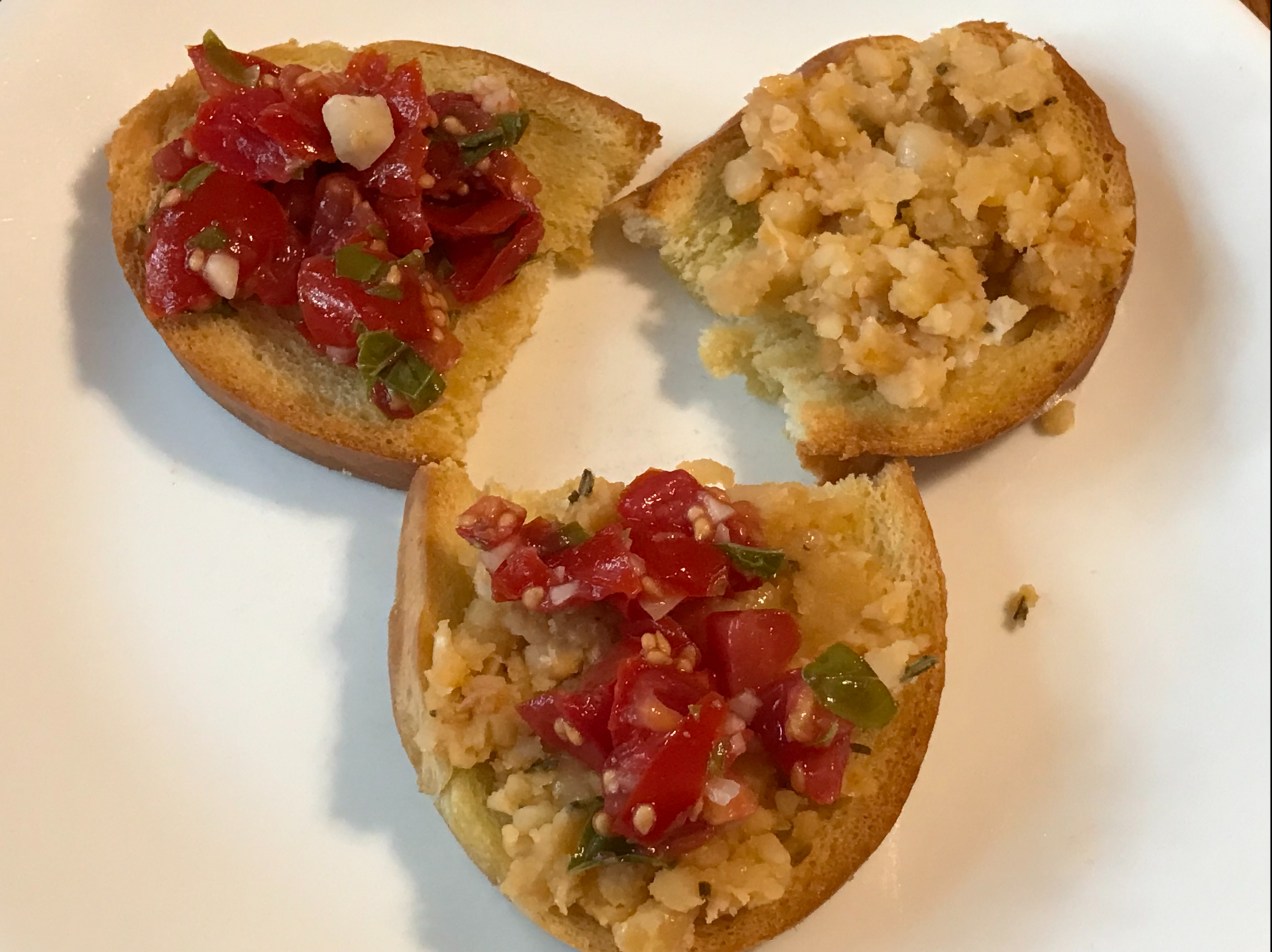
            Whatever you call it, toasted bread is a great vehicle for whatever toppings might be desired. One of the most popular toppings is a mixture of tomatoes, basil, and garlic. Southern French tapenade is made from olives. In Tuscany, one popular topping is made from chicken livers. Another is made from white beans, which Tuscans are famous for consuming in all sorts of ways. While the book was full of praise for the chicken liver version, I couldn’t bring myself to try it. Maybe I’ll manage it someday in the future, but with what they look like and knowing what the liver does, we’ll see.

            The white bean version was very tasty. Roughly mashing the beans with olive oil, garlic, lemon juice, herbs, and a bit of tomato and hot pepper produces a wonderful savory spread. The soft beans and crisp crostini contrast and complement each other. Despite my usual dislike of tomato-forward dishes, I even enjoyed the tomato-basil version. It was at once sweet and sour from the tomatoes, aromatic from the basil, and pungent from the garlic. I probably added a bit too much garlic, but it was still delicious. The best crostini, however, had some of both toppings. The richness of the beans with the intensity of the tomato mixture was just about the perfect combination. Just make sure to brush your teeth after.

Standard
Uncategorized

Bulgarian Chopped Salad: Shopska Salata (with feta)

Source: 1000 Foods (pgs. 386 – 387)

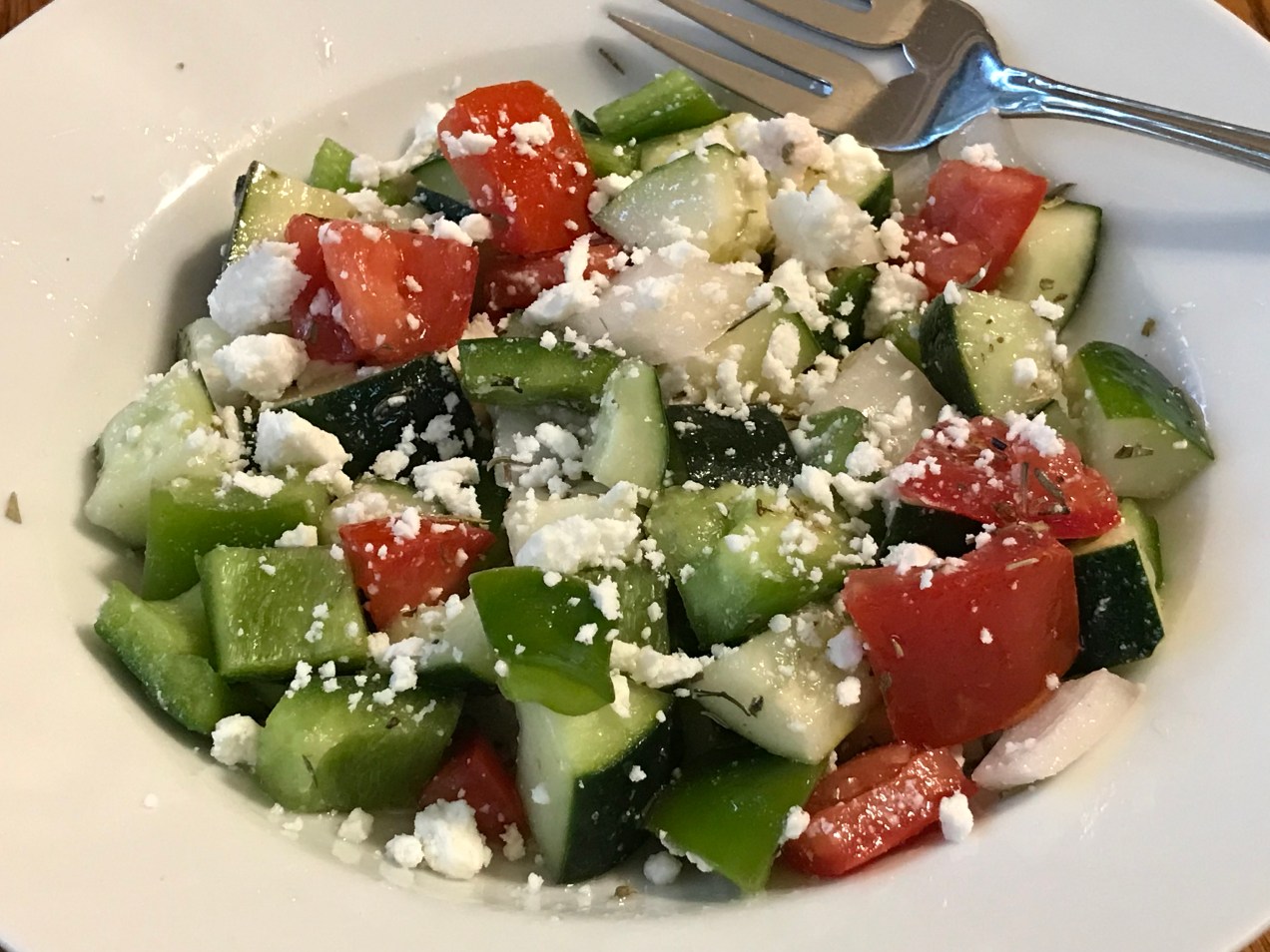
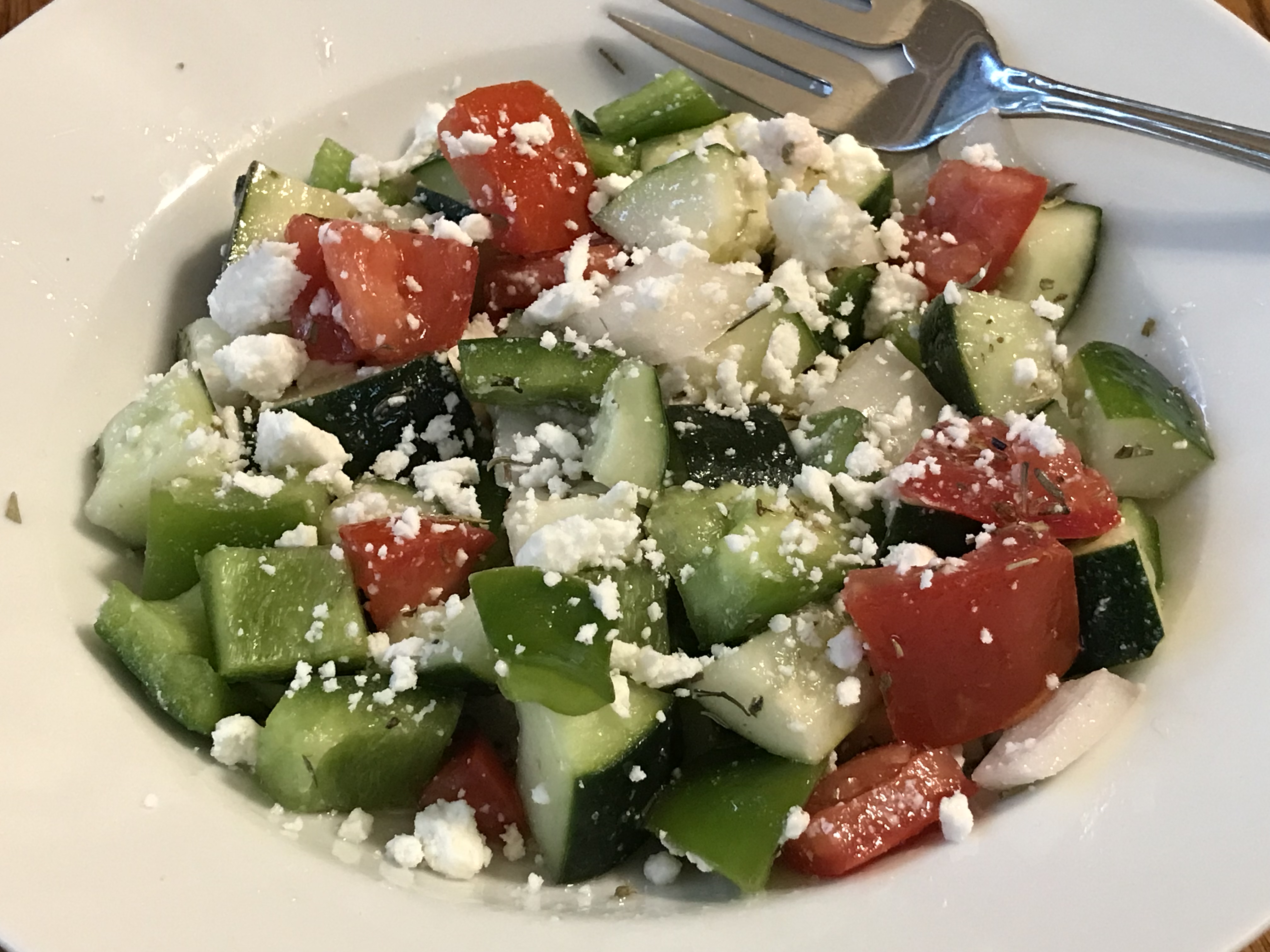
            Another popular vegetable dish in Bulgaria in Shopska Salata, a brightly-colored salad topped with feta cheese. Loaded with cucumber, tomato, green pepper, and onion, it’s a crunchy and flavorful blend that invokes summer (or early fall, when there are still fresh vegetables in season). This mixture is enhanced with salt, pepper, garlic, vinegar, oil, and the herb savory, which is called chubritsa in Bulgarian. The oil can be olive or sunflower. In a region at the juncture of the Mediterranean and Eastern Europe, either would be common.

            One factor that often distinguishes particular cuisines is the type of fat used to cook with. Around the Mediterranean, olive oil has been predominant for millennia. In Northern and Central Europe, lard was the primary fat, supplemented with butter. The same was true in Eastern Europe, but there was an issue. While the Catholic Church allowed butter during Lent from the Late Middle Ages onward, the various Eastern Orthodox churches continued to prohibit it. This was a problem in mostly Orthodox regions north of where olives could grow, such as Russia and Ukraine. When a cheerful plant with lots of oily seeds was introduced from the Americas, it quickly filled entire fields.

            Sunflowers are annuals. Since they go through their entire life cycle in one growing season, cold winters don’t matter. As long as there is good soil, adequate water and space, and plenty of sun during the summer, they will be ready to harvest in a matter of months. Sunflower oil is popular in salad dressings across Eastern Europe, which is a custom worth copying. It’s low in saturated fat, and more oil production means more fields of joy. Any cut for decoration last for several days in a vase (or at least mine did), and sunflowers can even remove toxins from the soil. Once the spent heads dry out, I’m hoping to save the seeds for next year. Then I’ll need to find space for them. Not to produce my own oil, just to have.

            Feta cheese enriches the chopped vegetables nicely. It makes the salad more substantial, adds a nice salty/tart flavor, and the white topping contrasts with the red and green vegetables. Bulgarian cheesemakers produce their own version of feta, similar to the Greek method. Usually made from sheep’s milk, the cheese is submerged in a salty brine to cure and preserve it. I had the opportunity to try Bulgarian feta at the farmers’ market but didn’t care for its strong, funky flavor. Here I used a milder feta from the goat’s milk cheese stand and it worked really well.

Standard