Uncategorized

Cook’s Tour of Italy Menu 42 (Pgs. 136 – 137): Layered, Baked Polenta, Venetian Style (Venice)

Menu: Polenta Layered with Vegetables, Salt Pork, and Parmesan

IMG_2648

Remaining in Venice, we now focus on another Venetian staple, polenta. As mentioned in the last post, polenta is at least as popular as pasta in various parts of Northern Italy. While evidence suggests that a form of polenta existed since at least Roman times, likely made of barley, millet or spelt, corn became the grain of choice after it was introduced in the 16th Century. Exactly why corn caught on in the North while pasta caught on sooner and more thoroughly in the South is unclear, but regardless, polenta is a Northern staple.

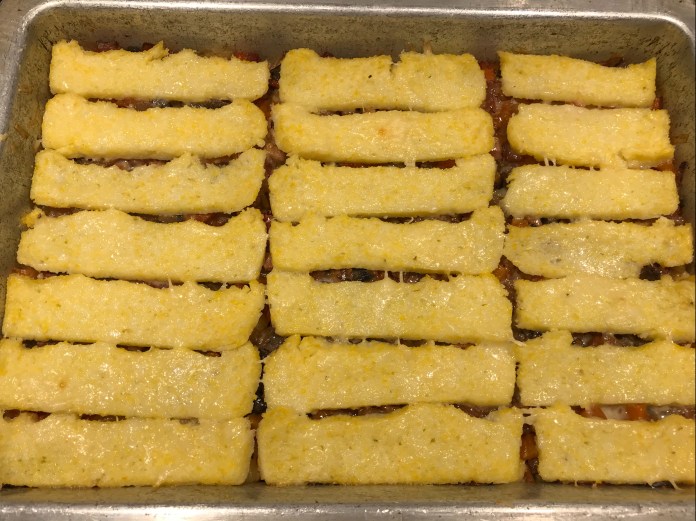
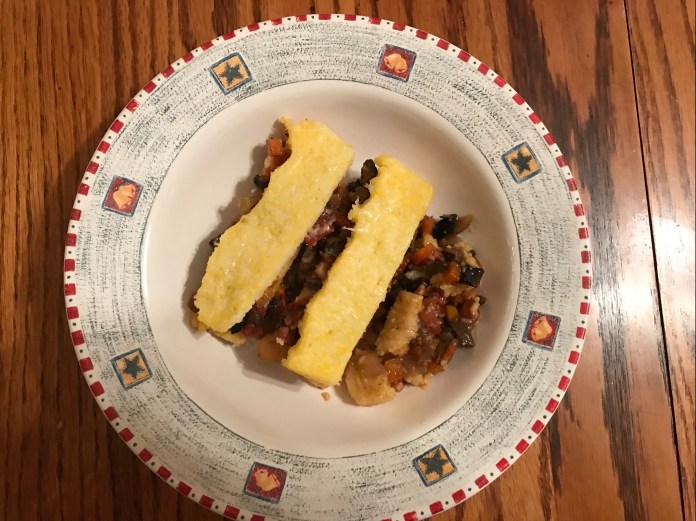
Though often a side dish, frequently served alongside meat, here it is a main course. After the corn mixture is cooked, it is poured into loaf pans to chill and firm up before being sliced. The slices are layered in a pan with a sauce made of salt pork (which looks and tastes a lot like unsmoked bacon), carrot, onion, celery, and rehydrated dried mushrooms with their soaking liquid. The three layers of polenta and two layers of sauce are topped with a layer of grated parmesan cheese.

IMG_2649

This wasn’t particularly difficult to make, but was a bit time-consuming and fiddly. It is necessary to stir really well as you are adding the polenta to the boiling water or it will get lumpy, and sometimes it still does. Meanwhile, you need to watch out for steam as the bubbles rise to the surface and pop. Finally, you need to slice the polenta really thin to get three layers in the pan. The sauce, which has a texture kind of like chunky salsa, came together without difficulty. Overall, it was pretty good; balanced and flavorful. I didn’t like it as much as some of the other recipes, but most of the other recipes set a pretty high bar.

Standard
Uncategorized

Cook’s Tour of Italy Menu 44 (Pgs. 138 – 139): Chicken Risotto with Vegetables, Venetian Style (Venice)

Menu: Risotto with Chicken and Vegetables

IMG_2647

Heading northeast, we cross Emilia-Romagna to the Veneto region, most well-known for Venice, but also home to Verona, Vicenza, Trieste, and other notable cities. Unlike Rome, Florence, Milan, Naples, or their historical rival Genoa, Venice was not an established city in the Roman era. Exact dates of foundation vary, but the most common story seems to be that the city was established in the 5th Century AD by those fleeing barbarian raids on the mainland. After a century and a half or so of Byzantine rule in the 6th and 7th Centuries, the first Doge was elected either at the end of the 7th or start of the 8th Century (the jury is still out on whether the first Doge was real or legendary) and the republic began its rise.

From its earliest days, Venice relied on trade, and in his work The Venetians, author Paul Strathearn explains why. Essentially, it boiled down to the fact that space was limited on the islands in the lagoon, limiting how much food could be grown and, to a lesser degree, how many goods could be produced. Trade both provided the necessary food and made the republic wealthy. For centuries, Venice was the main point of import for “exotic” goods from Asia, including spices, sugar, incense, and silk.

Another luxury import during the Middle Ages was rice, which gradually began to be cultivated in Italy as its popularity grew. The wealthy loved it, particularly cooked in almond milk. As supply expanded, the price dropped, making rice widely available to all classes. Today, in many parts of Northern Italy, risotto and polenta are more popular than pasta, and this includes Venice. Rice, polenta, vegetables, and seafood in various combinations are staples in Venetian cookery, which is very different from what is typically thought of as “Italian.”

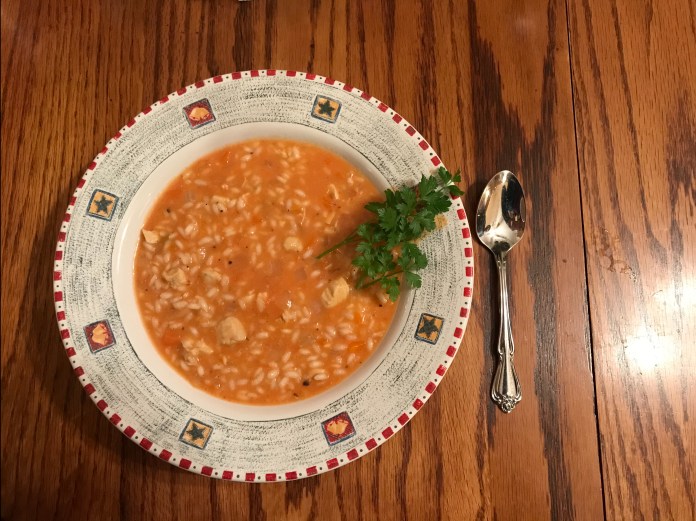
The best way to think of this dish is probably “Venetian chicken and rice.” With a flavoring base of carrot, onion, and celery, which occurs in many recipes in the book, the risotto includes chicken, chicken broth, tomato puree, butter, and parmesan cheese. The end result is creamy but not too rich, and flavorful without being overpowering. The tomato flavor is present but not dominant, melding into all the other flavors. Additional virtues for this recipe are that it is not very difficult to make and uses easy to find, affordable ingredients. I would definitely make this again.

Standard
Uncategorized

Cook’s Tour of Italy Menu 19 (Pgs. 69 – 70): White Beans and Mushrooms (Tuscany)

Menu: White Beans and Mushrooms, Orange and Grapefruit Salad

IMG_2641

Remaining in Tuscany, we have another bean-based stew, served with bruschetta and parmesan cheese. Like elsewhere in Italy, the pre-modern population of Tuscany ate little meat, getting much of their protein from legumes. Even now, when meat is more widely consumed, beans remain a central part of the diet. Prior to Columbus, this would have been mainly peas, lentils, and fava beans, with white navy and cannellini beans becoming favored after their introduction from the New World. They are part of antipasti, side dishes, and most of all, soups and stews with a variety of ingredients. Here, they are included in a vegetarian stew with fresh and dried mushrooms.

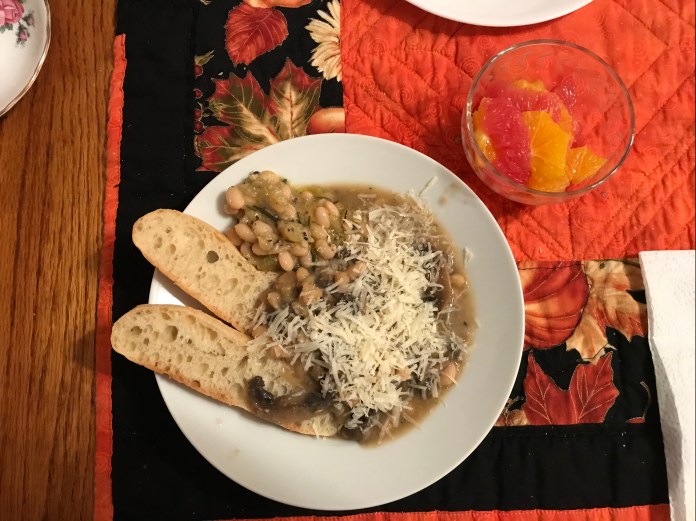
This has to be one of the most satisfying meatless entrées I’ve ever tried. After the beans are cooked with celery, onions, garlic, and vegetable broth, some are removed and marinated with vinegar, olive oil, and rosemary. The rest are mashed or partially pureed in the pot before adding sautéed mushrooms. Each dish of beans and mushrooms is served with a spoonful of the marinated beans, a couple pieces of garlic-rubbed toast, and a sprinkle of parmesan cheese.

All of the flavors were balanced, with a nice contrast between the somewhat rich “stew” and acidic and herbal qualities of the marinated beans. The mix of protein from the beans, carbohydrates from the bread, and fat from the olive oil made the dish filling and satisfying, with the toasted bread adding a crunchy contrast to the otherwise soft dish. Really, I can’t praise this dish highly enough. It’s great as is, but the optional orange and grapefruit salad is a good accompaniment.

Standard
Uncategorized

Cook’s Tour of Italy Menu 17 (Pg. 68): Chicken, Kale, and Chickpea Stew (Tuscany)

Menu: Chicken Kale and Chickpea Stew, Bruschetta

IMG_2639

Traveling back south but not quite to Rome, we reach the region of Tuscany, a name which conjures up images of picturesque towns atop rolling hills, their sides covered in vineyards and olive groves, dotted with cypress trees. Or perhaps one imagines the Florence’s iconic Duomo, the works of Michelangelo, Da Vinci, and the other Renaissance masters, or the strife between and even within city-states featured so prominently in the works of Dante. Tuscany is all of this, and more.

The first recorded inhabitants (though there is archaeological evidence of others previously) were the Etruscans, whose presence is attested from around 1000 BC or slightly before. Though they lived only a short distance northwest of the Romans and other Latin peoples, they were a distinct people with a completely unrelated language. Only a handful of Etruscan words have been deciphered, though they wrote extensively, so most information about them comes from Greek, Roman, and Phoenician/Carthaginian records. What is known is that they made fine pottery, were skilled metalworkers, and greatly influenced the early Romans.

Despite gradually assimilating into Roman culture and adopting the Latin language, the Etruscans’ descendants never lost their importance. As with Venice and Genoa, trade and banking brought great prosperity to Tuscany during the High and Late Middle Ages. This prosperity, along with the feuding cities’ constant desire to outdo each other, both on and off the battlefield, led to a blossoming of arts and culture from the 13th century onward.

Piggybacking off of the continent-wide cultural and economic boom in the 12th century, which brought, among other things, chivalric romance and Gothic architecture from France, the cultural dominance of Late Medieval Italy began to emerge in the 13th. The artistic innovations of Duccio, Giotto, Cimabue, and Bernini paved the way for the artists of the Renaissance. The works of Dante, Petrarch, and Bocaccio, written in the vernacular, helped ensure that the Tuscan language/dialect (rather than, say, Venetian or Neapolitan) would become the basis of the modern Italian language. And all of this was before the start of the Renaissance in the 15th century.

Clearly, there is a lot for Tuscany to take pride in in its history, but Tuscans also take pride in their cuisine. Far from stereotypically Italian, it features grilled and roasted meats, lots of beans in various preparations, unsalted bread, soups, leafy green vegetables, olive oil, and red wine. Pasta is present but not as popular as bread and polenta, game like boar and rabbit is common, and there is a focus on quality ingredients and straightforward flavors.

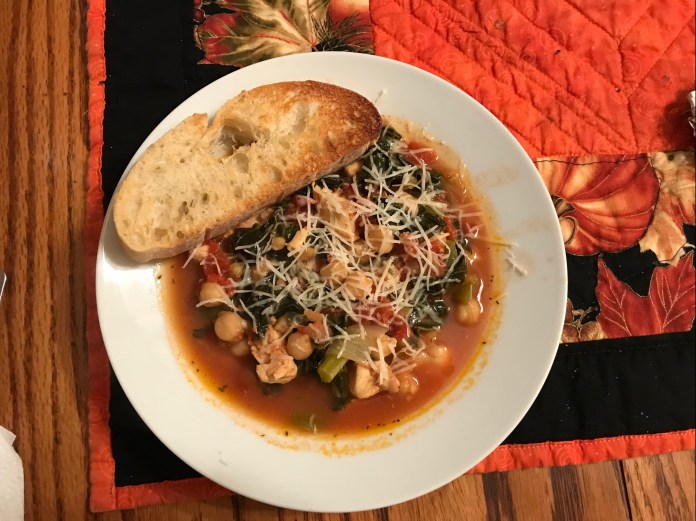
This one-dish meal has four features of Tuscan cuisine; beans (in this case chickpeas), bread, soup, and green vegetables. The soup was easy to put together, with a variety of ingredients, some out of cans, coming together into something delicious. The little bit of cumin in the mix is unique and not stereotypically Italian (though the ancient Romans used it a fair amount), but all of the flavors melded well. A sprinkle of parmesan cheese and a few pieces of garlic-rubbed toast (bruschetta) finished the dish off perfectly.

Standard
Uncategorized

Cook’s Tour of Italy Menu 25 (Pg. 89): Polenta with Fontina Cheese, Tomatoes and Roasted Peppers (Piedmont)

Menu: Polenta with Cheese, Peppers, Tomatoes and Basil

IMG_2636

We now journey to the northwest corner of Italy, to the Piedmont region. Combined in a chapter with Liguria directly to the south, the two regions nonetheless seem to have notably different food traditions. Piedmont, historically part of the Kingdom of Savoy, is a region of mountains crisscrossed by fertile valleys. Like neighboring Lombardy, Piedmont is north of the olive-growing zone and has thus historically relied on the animal fats butter and lard. The Alpine pastures of the region have long produced a relative abundance of beef, veal, butter, and cow’s milk cheeses, including the fontina featured here.

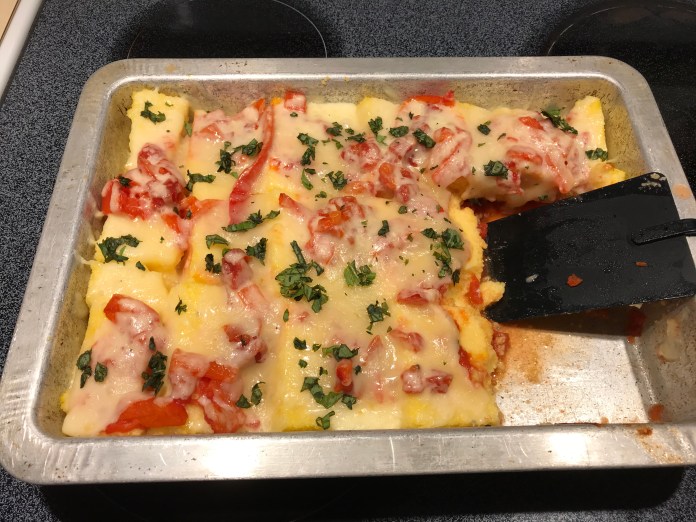
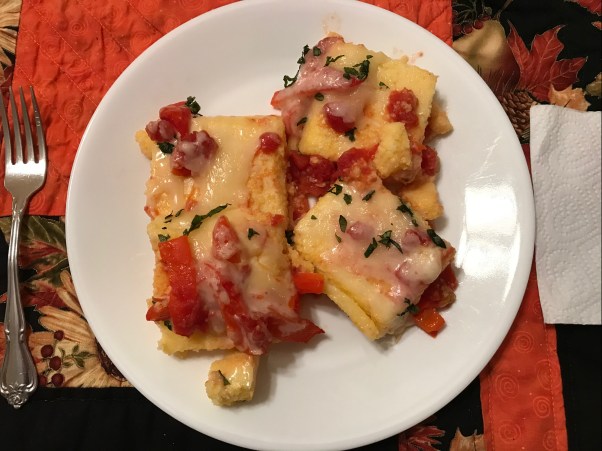
Polenta is more common than pasta here, as in much of Northern Italy, and can be eaten in a variety of different ways. It can be poured out of the saucepan as is, or it can be cooled to firm up, sliced, and baked or fried, enhanced by any number of toppings. Here it is baked with a straightforward sauce of roasted red peppers and tomatoes, a liberal sprinkle of fontina cheese, then topped with chopped basil upon being removed from the oven. Aside from setting off the smoke alarm a few times roasting the peppers under the broiler (the skin has to get quite dark and blistered for the insides to soften properly), this was quite easy to prepare.

IMG_2637

Admittedly, I found this menu a bit disappointing, which is a first for this project. I think a lot of it has to do with personal taste. The flavors were not bad by any means, but seemed a little bland and uninteresting. The sauce seemed like it needed something, maybe some garlic and/or herbs, and the creamy but mild fontina would have been enhanced by a bit of parmesan. Then there’s the fact that polenta is essentially grits, which are not my favorite. That’s not to say there aren’t good things going on in this one-dish meal. It all comes down to personal taste.

Standard
Uncategorized

Cook’s Tour of Italy Menu 29 (Pgs. 94 – 98): Menu for 6, Albavilla (Near Lake Como, Lombardy)

Menu: Poached Eggs and Parmesan in Broth, Milan-Style “Veal” Cutlet, Arugula Salad with Lemon Dressing, Apple/Pear/Ginger Milan Charlotte

Recommended Wine: Sassella, Grumello, or Inferno (Reds)

Heading north again, we arrive in Lombardy. Like Emilia-Romagna, most of the region is a fertile, relatively flat plain (part of the same river valley, actually, just upriver to the northwest). As the largest river valley in Italy, the Po Valley has long been one of its granaries, particularly in recent centuries as drainage methods have improved. Bordered by the Alps, dotted by glacial lakes and with adequate rainfall, the land around Milan, Pavia, Cremona, and Bergamo is remarkably different from Lazio and Tuscany, as is its history. Held by Celtic peoples until the 3rd century BC, it was occupied by Germanic Ostrogoths and Lombards (hence the name Lombardy) from the 5th to 8th centuries AD. Perhaps due to similar terrain and history, there are a number of similarities between the cuisines of Lombardy and Emilia-Romagna, particularly in the larger presence of meat, use of butter instead of olive oil, and large variety of cow’s milk cheeses.

Compared to those from regions further south, the recipes in the Lombardy chapter are distinctly less “Mediterranean” and to many Americans, more “familiar.” Unlike the last menu, which used a substantial quantity of olive oil, this one is full of butter. Without pasta, tomatoes or garlic, this meal of a rich soup, schnitzel-style “veal” cutlet, arugula salad, and a dessert of apples and pears stuffed in buttered bread is far from stereotypically Italian. It was delicious, though, perhaps my favorite menu so far.

Besides pasta, soup is a common first course in Italian cuisine. Along with many varieties of minestrone, there are soups and stews with vegetables, legumes and/or meat in various combinations, tortellini in broth, seafood chowders, and creamed vegetable soups, to name a few. This is one of the more unique ones. Called Zuppa Pavese in Italian, there is no direct English translation, but Mr. Famularo translates it as poached eggs and parmesan in broth. Layering a buttered piece of toast, a poached egg, and a sprinkle of parmesan cheese, then pouring a mix of chicken and beef broth over them, this interesting combination proves that broth-based soups can indeed be decadent.

IMG_2626

Zuppa Pavese

This soup also has an interesting backstory. It is said to have been created in 1525 for Francis I of France, who had recently been taken prisoner at the Battle of Pavia. The French had been fighting the Spanish over rival dynastic claims to Burgundy, Naples, and, most pertinently here, Milan. The backstories to these claims are fascinating, stretching back to the 13th Century and including a Sicilian rebellion against French rule backed by Aragon, various French incursions in the 14th Century, the first diamond engagement ring in 1477, and the various dynastic successes and mishaps of the children of Ferdinand and Isabella.

The Italian Wars, as they came to be called, started when Charles VIII of France invaded Naples in 1494. The king of Naples called in his ally/relative/eventual successor Ferdinand of Aragon. Hostilities continued under their respective successors until 1559. In 1525 the French monarch in question was Francis I, an energetic, boisterous figure with a love of all things Renaissance. Anyway, in the battle, Francis made the mistake of fighting in person. Though by all accounts he fought bravely, things didn’t go as planned and he was captured by the forces of his rival, the Holy Roman Emperor Charles V, who also happened to be Ferdinand and Isabella’s grandson. The conflict would outlive both of them, only being resolved (mostly in Spain’s favor) by their sons Henry II and Philip II in 1559.

While I don’t normally like poached eggs, they definitely made this soup. The buttery toasts, mixed broth, and parmesan cheese were good on their own, but the egg added richness and body. While there are broth recipes in the book, I used the alternate suggestion of low-sodium broth from cartons. Homemade is always nice, but also a lot of work in straining and freezing in manageable portions. The store brand was perfectly good, with a nice depth of flavor and not too much salt.

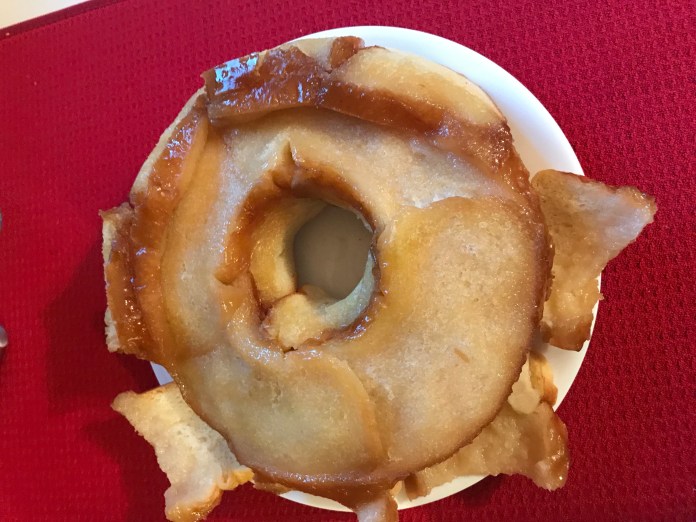
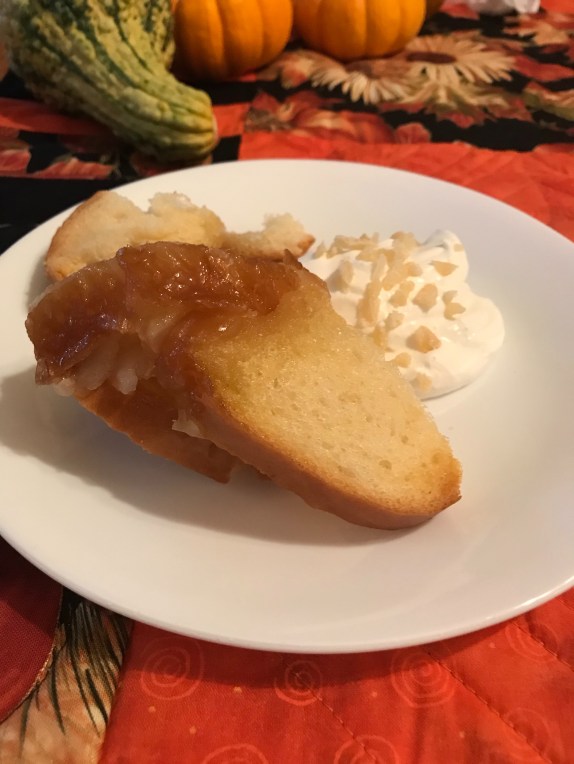
Due to a timing miscalculation, dessert was next: an apple and pear Charlotte, flavored with candied ginger. What is that, you may ask? There are actually two types of desserts known as “Charlottes.” One type, which you may have seen on the Great British Baking Show, is mostly composed of fruit, cream, and gelatin, with a border of ladyfingers or cake. The type here, however, has a fruit filling somewhat resembling pie filling and a “crust” of buttered bread. In the Milanese original version, buttered and sugared French bread is used to line a ring mold, which is filled with apples, raisins, and pine nuts, baked, and flambeed with rum. (Text, pg. 97) Mr. Famularo’s variation omits the rum and flambé (“too French for my Italian taste”), uses crustless white bread with just butter, replaces the raisins and pine nuts with pears and ginger, and is baked in timbale molds.
IMG_2628

Since I don’t actually have timbale molds (I’m not entirely sure what they are, but they sound like cone-shaped molds with the point removed), I used a ring mold. As I had already bought Italian bread for the soup, I used that to line the molds, but otherwise followed the recipe as written. It took a while to figure out how to line the mold, but once I did and got it filled and in the oven, it seemed like smooth sailing. Or so I thought. Since the bottom of the pan was removeable, some of the melting butter and juice from the baking fruit managed to leak out through the tiny gaps and made a mess in the oven.

The final dessert wasn’t necessarily pretty, but it tasted great. I was expecting soggy bread, but parts were crisp, other parts pleasantly sticky but holding together. The ginger was an interesting and delicious change of pace from the cinnamon/pie spice normally associated with apple desserts, though I’m sure either of those would have been good. Unsweetened whipped cream (which seems to be the norm in Italy as far as I can tell) and a sprinkle of chopped candied ginger balanced things perfectly. The recipe also called for a bit of softened gorgonzola cheese to be swirled into the whipped cream, but that was one thing I was not up to trying.
IMG_2632

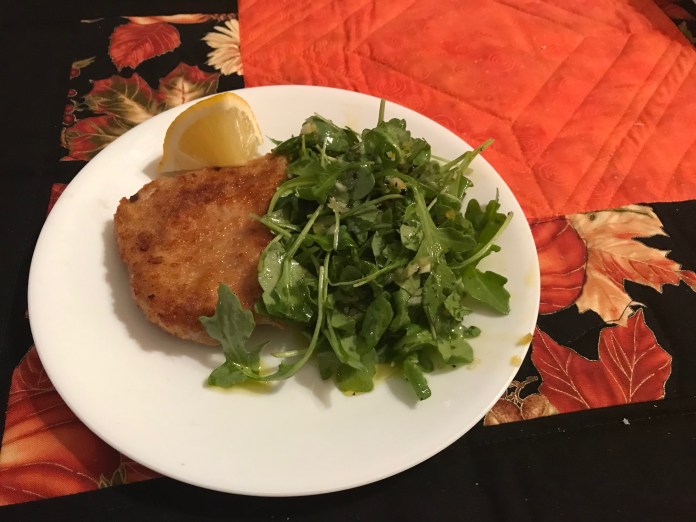
Though pretty full by this point, we managed to make room for a bit of Milan-style “veal” cutlet and arugula salad with lemon dressing. Due to concerns about raising methods and veal being hard to find, I replaced the veal chops with pork chops. Though beef might seem a more likely replacement for veal, pork is often used as a substitute in the similar German/Austrian dish schnitzel, so that is what I ended up using. Plus, pork chops are much more affordable than pretty much any cut of beef. After pounding the bone-in chops to flatten then, they are soaked in milk for an hour, then dried, dipped in egg then breadcrumbs, and fried in butter.

Supposedly they should cook for 2-3 minutes per side then 5 more minutes to cook the middle (Text, pg. 96). Maybe for veal that would be the case, but I found it took noticeably longer. Most likely, the reason for this is that while red meat is often not cooked all the way through, I am weirded out by pork that isn’t, even though, with modern food safety standards, it is not strictly necessary. At any rate, when cooked, the chops are served with a lemon wedge.

They are good with just lemon, but with a bit of the salad dressing they are even better. Due to not wanting to wash more plates/bowls than necessary, I ended up putting the salad on the plates with the pork chops, where a bit of the dressing inevitably ended up on the meat. With lemon juice instead of vinegar, smoothed out by olive oil and a tiny bit of sugar, and made aromatic with lemon zest and minced garlic, the dressing, along with the peppery arugula, made a wonderful contrast to the rich, buttery pork. If you wish, a few different red wines from Lombardy are suggested to go with this menu.
IMG_2635

Standard
Uncategorized

Cook’s Tour of Italy Menu 5 (Pgs. 27 – 31): Al Fresco Meal for 6 (Rome)

Menu: Eggplant with Capers and Anchovies, Roasted Chicken Salad in a Loaf of Italian Bread, Country Style Fava Beans, Fresh Seasonal Fruit and Italian Cheeses

IMG_2551

Recommended Wine: Frascati (Fragrant, Dry, Semisweet)

Returning to Rome, we are invited to imagine a picnic on the outskirts of the city. For a major metropolitan area, Rome has a surprising amount of green space, even within the city itself. Part of the reason for this, according to the tour guides, was that over the centuries Popes and influential families dedicated a number of parks and gardens. Combined with potted plants and flowerbeds in piazzas and a profusion of flowers and greenery on apartment windowsills and balconies, the urban oasis feeling is rarely far away.

With eggplant marinated in a vinaigrette-type sauce, a chicken salad full of greens, sautéed fava beans, cheese, and lots of fresh fruit, this produce-heavy picnic provides another great insight into history. As a society that took pride in its agricultural roots, the Ancient Romans enjoyed and valued a variety of fresh produce. Incidentally, by the time of Julius Caesar and his contemporaries, the small family farms that society idealized had largely fallen victim to the circumstances of the times.

To *very* briefly summarize this aside, what basically happened is as follows. In the 3rd Century BC, wars with Celtic peoples in Northern Italy and Carthage in Sicily, Corsica, Sardinia and Spain led to the acquisition of several new provinces and a massive influx of slaves. After some of the recently conquered land was given out to reward veterans, wealthy Romans bought large estates, worked by the surge in slave labor. These profit-driven latifundias could produce goods more cheaply than the smaller farms, many of which were either damaged during Hannibal’s campaign in Italy or had fallen into disrepair when their owners were in the army on campaign, pushing many small farmers out of business. Worsening this problem was a surge in cheap grain from Sicily and later from North Africa and Egypt. As massive slave-run estates swallowed up many family farms, landless poor surged into the cities, unrest rose, and yearning for an older, simpler way of life captured the popular imagination. Fun fact: the Gracchi brothers, who spearheaded a reform movement and were assassinated for their troubles, were the grandsons of Scipio Africanus, who ultimately defeated Hannibal. Their mother Cornelia was seen by many as the ideal Roman matron and was one of their greatest supporters.

As mentioned before, due to lack of meat in the diet, pre-modern Romans historically ate substantial quantities of legumes. Even Apicius, more focused on upper- and middle-class Imperial Era cookery, includes several recipes for fava beans, chickpeas, and lentils. (Cannellini, navy, and kidney beans and their relatives only arrived after Columbus.) Given that olive oil, oregano, salt and pepper were widely available, it is entirely conceivable that dishes like the fava beans here were eaten 2000 or 2500 years ago. Fava beans were quite hard to find, but I managed to find both canned and frozen at a local Mediterranean/Middle Eastern grocery.

IMG_2548

Ancient-style fava beans?

Chickens may not have been available in the early Roman Republic (they are believed to have reached Greece during Classical times, c. 5th century BC), but certainly were plentiful in Rome by Imperial times. I am not sure when arugula became available, but most of the other ingredients in the salad, including celery (based on Apicius’ references to celery seed), Pecorino Romano cheese, cured ham (if not prosciutto), vinegar, oil, and eggs, were available as well at this time.

IMG_2549

The ultimate chicken salad

The dessert has similar antiquity. Pears, plums, the pecorino cheese again, and the ricotta were all present in ancient times. Adding cinnamon, sugar and coffee granules to the ricotta would be a more recent innovation, since evidence suggests that before medieval times, cinnamon was an incense or perfume and sugar was medicinal. Coffee was not introduced until the 16th of 17th century (sources disagree). The watermelon is even more recent. Another medieval introduction is the eggplant, introduced to Sicily when the island was under Arab control between the 9th and 11th centuries, though the anchovies seem to harken back to the ancient tradition of garum.

The best part of this menu was definitely the chicken salad. Ordinarily I don’t like chicken/egg/tuna salad because of the mayonnaise, but with a vinaigrette dressing it is really good. The mix of chicken, arugula, cheese and a bit of prosciutto blended really well together and turned out to be great on sandwiches made from the hollowed-out bread serving bowl. I did skip the hard-boiled eggs the recipe called for as a garnish since when it comes to eggs, I prefer them either mixed into a recipe, scrambled, or in an omelet. This salad was different than what Americans might imagine when we think of chicken salad, with plenty of arugula and celery mixed in and flavored with cheese and ham, but personally I think it’s a tasty way to eat more vegetables. The only thing I would change is to replace the pecorino Romano with fresh or firm mozzarella. After making the salad again at a later date (with bacon pieces instead of ham because that’s what I had on hand), this was confirmed as a perfecting improvement.

The eggplant was also good, though in the future, rather than eating it on its own, I’d try Mr. Famularo’s alternative suggestion of putting pieces on toasted bread, topping with cheese, and heating in the oven. I was admittedly underwhelmed by the beans, but they were decent hot. The issue was more being weirded out, for lack of a better term, by eating beans cold. For the dessert, the fresh ricotta with cinnamon sugar was rather enjoyable, though it took a little getting used to eating sweetened cheese that wasn’t cheesecake. I wasn’t quite so keen on the pecorino Romano, which again, is great grated and cooked, but not what I’d want to eat for dessert. In the reverse of the Italian custom, I tend to think of sweets for dessert and fruits like pears and plums for a snack, but the watermelon, the ultimate healthy summer dessert, was a fine ending to a summer picnic.

IMG_2546

Eggplant is under the herbs

IMG_2547

Dessert

Standard
Uncategorized

Cook’s Tour of Italy Menu 46 (Pgs. 143 – 145): Specialty Food Shop Tart Menu for 6 (Bologna)

Menu: Parmesan Custard Tart, Sliced Cucumbers with Mint, Baked Peaches Stuffed with Amaretti and AlmondsIMG_2543

Recommended Wine: Cinque Terre Bianco (Liguria), Dry and Full-Flavored

We now travel to Emilia-Romagna, a region a distance northeast of Rome, centered on the fertile Po River Valley. According to the tour guides again, olive trees do not grow north of Tuscany except along the coast, hence butter is more commonly used here. Though the tour didn’t stop in any of the cities there, we traveled through the region on our way from Florence to Venice. The land is a fairly flat, fertile plain, with numerous vineyards, orchards and, interestingly enough, fields of sunflowers. Said sunflowers were pretty dried out by the time we passed through in mid-September, but their heavy tops, bending from their abundance of oily seeds, were nonetheless distinctive. We were told when I asked about them that sunflower oil is often used as a replacement or supplement to the more expensive olive oil in applications like frying where a more neutral flavor is acceptable. Despite the massive number of olive trees, Italy does not produce enough for even its own use.

Major cities here include Bologna, Parma, Modena and Ravenna. The region was conquered by the Romans in the 3rd Century BC from various Celtic peoples, known to have a diet richer in meat and dairy than the newcomers. This influence lingers to this day, with an abundance of butter, cheeses, veal, and pork, both fresh and cured. (text, pg. 142) The most famous are parmesan cheese and prosciutto. There is also fresh pasta, often stuffed, balsamic vinegar, and a variety of tree fruits and vegetables. To be sure, historically few people would have enjoyed these things on a regular basis, at least in large quantities, but they do tell us about the region’s tastes and preferences.

This menu was both rich and balanced. It is based around a quiche-like tart available for take-out at a specialty food shop in Bologna. Omelets and custards have been eaten in Italy at least since Apicius, the famous Roman gourmet, was published in the early centuries AD, but the crumbly, buttery pastry is a more recent invention. The ancient Romans considered butter a barbarian food and made what pastry they had (which according to the recipes of Apicius was surprisingly little) with oil or lard, while medieval pastry was usually a thick, inedible pie crust used to cook, serve and preserve the filling.

This pastry was strong enough to stand up on its own without a tin or baking dish and supposedly, as long as it stayed dry and didn’t crack, could preserve the fillings for months. (On a side note, that is one food history experiment I have no intention of trying. I wonder how often people got food poisoning in the past from pastry that wasn’t as dry or airtight as they thought.) Until edible “short crust” pastry was introduced during the 16th Century, it was the normal practice to remove the pastry lid, eat the filling, and either discard the bottom crust or feed it to the dogs or pigs. Man’s best friend or nature’s delicious garbage disposals, respectively.

Thankfully, that was not the pastry featured today. With more than four times the amount of butter as water (icy to help keep the butter from melting during mixing), the crust was so crumbly I couldn’t lay it in the pan without it falling apart. (In retrospect, I probably should have added an extra tablespoon of water.) Eventually I managed to patch the pieces together in the bottom of the pan before adding the filling, a rich, creamy custard spiked with parmesan cheese and white pepper with little pieces of pancetta on the bottom. Since I didn’t have a tart pan with a removeable bottom, I had to use an ordinary 9-inch round cake pan, resulting in the crust crumbling as each piece was removed. They were delicious crumbs, though, with a delicious filling, even if the serving presentation was lacking.

The cucumbers and baked peaches provided a nice contrast. Cucumbers and mint go well together, and mixing them with ice and salt and leaving them for some time both flavors and sort of pickles the cucumbers. They ended up a little salty, but were still enjoyable. The peaches were another surprise, stuffed with a mix of crushed amaretti, almonds, and cocoa, topped with a little mascarpone cheese. I would not have thought of peaches as one of the fruits that go with chocolate, but this mixture really worked. I suppose that just goes to show that sometimes what we think of as “what goes together” is surprisingly arbitrary. Why do strawberries, bananas or oranges go with chocolate, but not pears or peaches?

Standard
Uncategorized

Cook’s Tour of Italy Menu 1 (pg. 14-17): Lunch for 6 “On a Rooftop Overlooking the Spanish Steps” (Rome)

Menu: Artichokes Cooked in a Saucepan, Sweet Macaroni and Cheese, Sour Cherry Jam TartIMG_2540

Featuring some of Rome’s classic dishes, this menu of artichokes, pasta and a jam tart is, according to the text, relatively simple to prepare. Matters were somewhat complicated for me by a lack of experience with artichokes, lack of access to fresh ricotta, and somewhat dull knives (that have since been sharpened). While many Italian cheeses are available at the larger supermarkets, I have been unable to find a store that sells fresh ricotta and the nearest Italian grocery is 2 hours away, so I decided to make my own. I still haven’t mastered it, but if I make it a day or two ahead I can make a new batch if one doesn’t work out. Vinegar and salt are a negligible cost, and milk has been on sale at the nearest grocery store for $1.99/gallon for the last several months.

If you’re wondering about this last point, Wisconsin is having a crisis in the dairy industry at the moment and prices are down as a result. In theory, you can make about 2 pounds or 4 cups of soft cheese from a gallon of milk. I haven’t gotten to that level of yield quite yet and my results are inconsistent, but nevertheless, it seemed like this would be more like fresh ricotta than the ricotta in tubs.

Much of the preparation time was spent wrestling with the artichokes, although the result was most satisfying. Stuffing the insides with a mixture of chopped mint and parsley, minced garlic, salt and pepper and braising in water and olive oil yielded a well-flavored vegetable with a buttery texture and almost meaty taste. These were even better the next day, after the flavors had had time to meld. Just make sure to have plenty of napkins on hand, since these are messy to eat.

The pasta was yet another pleasant surprise. The mix of fresh ricotta, sugar, cinnamon and chives sounded a bit strange, but it tasted kind of like a sweet alfredo sauce and was surprisingly good. A little extra salt helped it make more “sense,” for lack of a better term, and bring the flavors together. It wasn’t as good as the other pasta dishes from the book, but it still made some nice leftovers for lunch the next day.

The star of the show, if you will, was the tart. There is an option to use a prepared pie crust rather than the homemade pastry provided in the recipe, but I would not do so. Said pastry, slightly sweetened with powdered sugar and flavored with a bit of lemon zest, was the best part, even if it did keep melting between my fingers as I was trying to weave the thin pieces of dough into a lattice top. It was about 90 degrees that day, so I ultimately rolled the top pieces into ropes and laid the horizontal strips across the vertical ones and it turned out fine. Jam fills in for fruit or pie filling here, I used a jar of Door County Cherry Jam and it worked beautifully. Though the recipe did not include this, a scoop of vanilla ice cream was a nice addition.

If you wish, Mr. Famularo again suggested serving this menu with Frascati, a white wine for which Rome is famous. Supposedly fresh-tasting, easy to drink and affordable, it is recommended for several menus in the Rome/Lazio chapter. According to the tour guides on a trip to Italy, this region tends to produce and drink more white wines, as does the area around Venice. I’m not sure if I actually had any Frascati in Rome but it is supposedly fairly typical of the area, so I’d imagine a lot of the table wine blends (which I think is what the tour gave us each night at dinner) are somewhat similar. If that’s the case, they are quite enjoyable, not too strong or too dry.


Standard
Uncategorized

Cook’s Tour of Italy Menu 4 (pg. 25-27): Lunch for 4, Grottaferrata (Rome/Lazio)

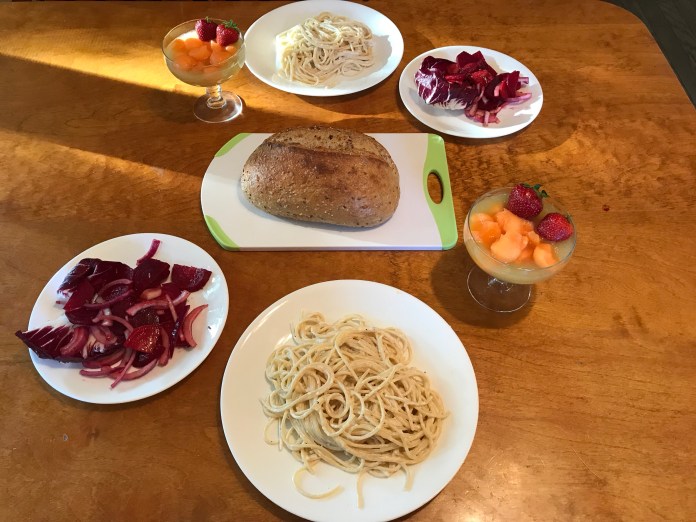
Menu: Roasted Beet Salad with Red Onions and Dried Fennel, Spaghetti with Lemon Sauce, Cantaloupe Melon Balls in Honeydew Puree, Bread

IMG_2525Still around Rome (maybe it’s just my imagination, but the menus and recipes seem, in many cases, to become more complicated as the book progresses), Mr. Famularo invites us to imagine lunch at a café after visiting a little-known gem in Grottaferrata, a town not far from Rome. There are numerous beautiful settings to imagine throughout the book, all wonderfully descriptive. Here, after being shown around a monastery museum by one of the monks, we can sit down to a lunch of a roasted beet salad, spaghetti with a lemon cream sauce, and a unique take on fruit salad for dessert.

To cook the beets, they are washed and scrubbed, rubbed with olive oil, sprinkled with salt, pepper and fennel seeds, and roasted in the oven in their own individual foil packets. I’ll admit, I cheated on this part a little bit by putting them all in one packet to save time and energy. After cooling enough to touch, they are peeled, sliced, and mixed with red onions, vinegar, oil and more fennel seeds. The salad is served on a few radicchio leaves. Except for this garnish, the beet salad can be prepared ahead of time. So can the fruit dessert, though again, assembly should be last minute. Cantaloupe melon balls, sprinkled with lemon juice and salt, are served in a honeydew puree and garnished with strawberries.

The spaghetti comes together fairly quickly. Essentially, garlic is sautéed in a bit of butter with grated lemon zest, then adding half and half as the pasta is cooking to al dente. Once the pasta is cooked, it is added to the pan with the sauce, followed by lemon juice. The acid slightly curdles the half and half, thickening the sauce without any flour, starch or eggs. Incidentally, that is also why it is uncommon to add both milk and lemon to tea, as the acid curdles the milk and essentially makes a hot sludge of homemade ricotta. Not what you want in tea, but the concept is used to great effect here.

This menu demonstrates two important features of many Italian regional cuisines: citrus fruits and the abundance of fruits and vegetables. Fitting into the ancient tradition of sweet and sour sauces (in Imperial times usually based on vinegar and honey), lemon and orange juice and the fruits’ aromatic peels were quickly adopted upon their introduction in the Medieval era, along with sugar. Though the taste for sweet and sour declined somewhat during the Early Modern era, particularly in the North, lemons and oranges remain ubiquitous throughout the peninsula.

The other notable feature is the attention given to produce. In the English-speaking world, vegetables in particular were historically an afterthought, often boiled and served with butter as a side dish or thrown into a soup or stew. In many parts of Italy, particularly the South, people have historically eaten less meat, providing extra incentive to make vegetables enjoyable. As far as I can tell, many Italians do enjoy them, judging by the number and diversity of recipes in Italian cookbooks. In addition, fruit and cheese are the most common everyday dessert, with many of the desserts we know (gelato, tiramisu, cannoli, etc.) eaten more commonly as afternoon snacks with coffee or on holidays. (Text, pg. 17)

The pasta was great, as I expected, as was the rest of the food. With both “salads,” I was admittedly skeptical but pleasantly surprised. I didn’t think I liked beets and maybe I still wouldn’t like the canned variety from the grocery store, but roasted with fennel seeds they are remarkable. If I make the salad again I would let the onions marinate in the vinegary dressing for a while before serving to reduce their potency, but I would just as soon just peel and slice the beets and roast them on their own with the mentioned seasonings in a foil packet. As a “sauce” for the cantaloupe and strawberries, the honeydew puree was good as well. I had a little trouble with the melon baller for the cantaloupe, but it did help provide a striking visual. I might skip the salt on the cantaloupe next time. If the cook wishes, a Frascati wine, classic and typical of the Rome/Lazio region, is recommended.

Standard