As summer fades, so do basil plants. After bringing my plants inside, a fall batch of pesto is in order to use them up. There are a million and one different ways to make it. I like the classic. Adding a bit of parsley or arugula might add some extra flavor, but the basil should dominate, supported by garlic. With those two strong flavors plus parmesan cheese, there’s no point in using expensive pine nuts. Walnuts are a common substitution, giving the final sauce a similar taste and texture. And some recipes even add a little butter along with the olive oil.
Note that while this recipe uses a food processor, connoisseurs prefer a mortar and pestle. If you have a big enough mortar and pestle and sufficient patience, by all means use it. Either way, smelling your fingers after handling the basil is optional, but highly encouraged. The aroma has a way of sticking, like that of lemon or orange peels.
Ingredients:
2 cups loosely packed fresh basil leaves
Several springs fresh parsley, if desired (seems to help reduce discoloration)
3 cloves fresh garlic, peeled, crushed with the side of a knife, and coarsely chopped
½ teaspoon salt
½ cup walnuts and/or almonds
½ cup parmesan and/or Romano cheese
½ cup olive oil
Pasta and/or vegetables, for serving
Directions:
If desired, place the walnuts in a small skillet over medium heat and toast, watching carefully, until aromatic. This will only take a few minutes.
Place the basil, optional parsley, and salt in the bowl of a food processor, and pulse several times to mince.
Add the garlic, salt, and walnuts, and blend to form a paste. Add the cheese and blend again.
With the motor running, slowly add the olive oil through the processor’s feed tube.
To thicken, add more cheese, a spoonful at a time. To thin, slowly add warm water until desired consistency is reached.
Taste for salt, adding more if necessary. Serve as soon as possible with hot pasta and/or vegetables.
Pesto can be kept in the refrigerator for a few days, but the surface will darken and brown. This is just a chemical reaction between the basil and the oxygen in the air, and will not affect the flavor. The discoloration can be slowed by covering the surface with a thin layer of olive oil. If the color change bothers you, just scrape off the top layer before serving.
To get upcoming fall recipes and posts sent directly to your inbox, be sure to subscribe. And if you liked this recipe (I hope you did), I would appreciate if you hit “like.”
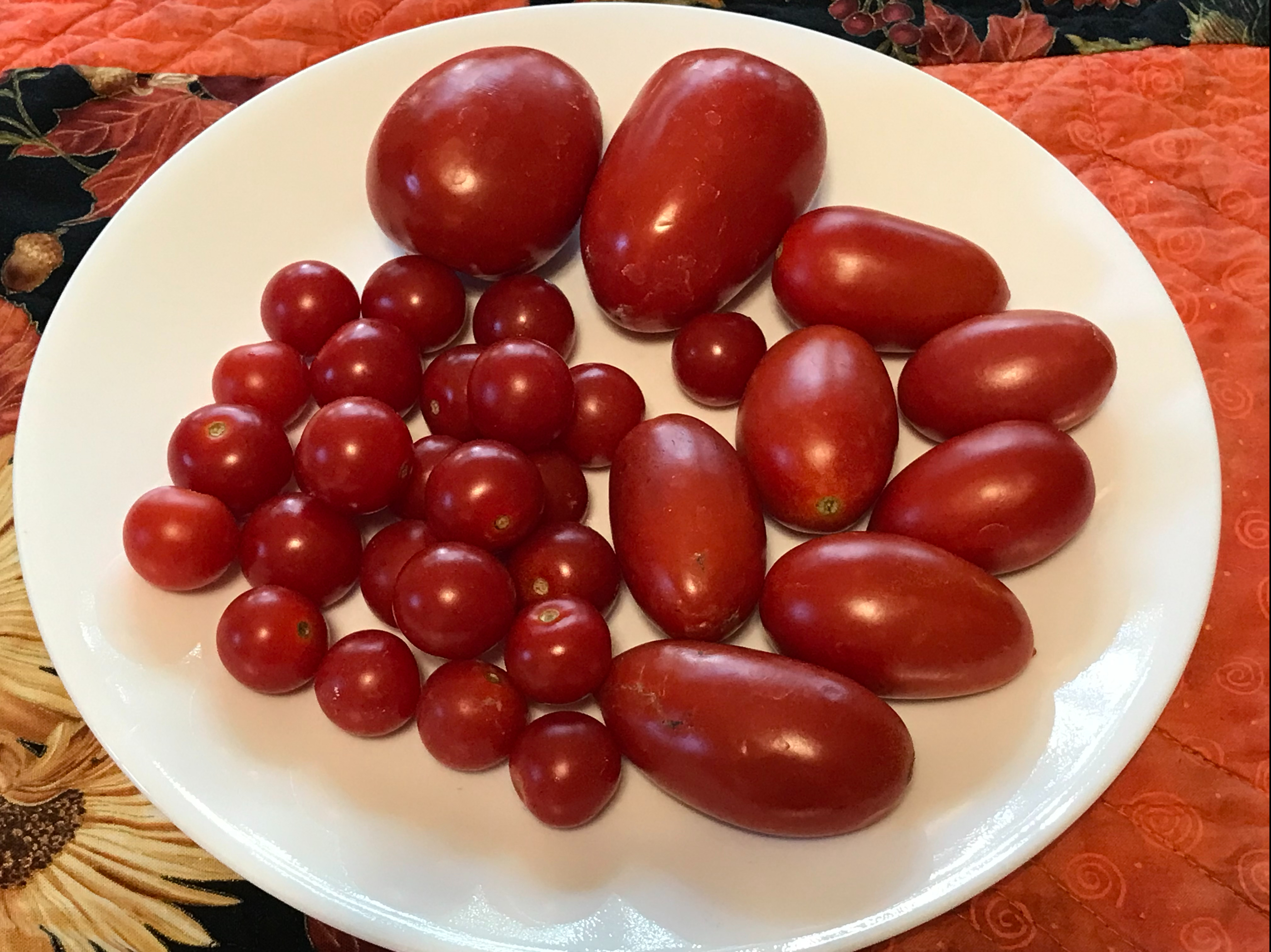
Clockwise from the top: Roma, San Marzano, and cherry tomatoes
1000 Foods (pgs. 220, 223 – 224, 235 – 236)
This last summer, after removing part of the deck that was in disrepair, I had a small garden bed to use. For my birthday back in March one of my aunts gave me a gift card for a seed savers catalog, which had some particularly interesting selections, including two types of sunflowers, giant zinnias, arugula, and cress. After buying more herb plants than necessary and planting them in pots, I had a plan for the new garden bed. The larger type of sunflowers would go in the back row. Three tomato plants would get half of the middle row instead of their usual 5-gallon buckets. On the other side I had a bean plant given to me by a student after an experiment to determine where plants get their mass from as they grow. (Answer: it’s mostly the carbon and oxygen in the air.) I planted a few leftover seeds in the row to keep it company. In the corner was an unknown plant from a different student (turned out to be mustard greens). The front row was half arugula, almost half cress. Marigolds on the sides would hopefully keep rabbits away. It sounded tidy and organized.
Plants don’t necessarily do tidy and organized. With plenty of space, the tomato plants spread out and covered much of the arugula. The bean plants, which I was not aware were pole beans (it didn’t say on the package) grew in every direction. By the time I got the stakes in it was too late to manage the chaos. They didn’t produce many beans and those few were tough, but the plants themselves may have had an additional benefit. The sunflowers on that side of the garden were taller than those on the side with the tomatoes. Since the change was gradual it may have had as much to do with drainage patterns, but the nitrogen-fixing bacteria that live on bean roots may well have enriched the soil and given them a boost. Finally, the marigolds ended up about two feet tall. Whether they or the fence was more effective at rabbit control is an open question.
Along with Roma and cherry tomatoes, I planted a San Marzano plant. Technically, to be 100% authentic, the tomatoes would need to be grown in the rich volcanic soil near Naples, but this was a way to taste them fresh. The plants are scraggly-looking with long, thin, pointy fruits, but they are said to be one of the best tomatoes for canning. In fact, the use of tomatoes in Italian cuisine increased significantly once the canning industry developed. I couldn’t taste much difference in the three types of fresh tomatoes, but I’m not normally a fresh tomato fan. They seemed to work well in the various soups and salsas over the course of the season. It will be interesting to compare canned San Marzanos with other varieties at some point in the future.
I probably could have managed with one basil plant instead of two. They were small when I got them, and so had me fooled. Each in their own pot, with lots of sunshine and daily watering, they thrived to the point of my not knowing what to do with all the basil. With a potent, distinctive aroma, basil is widespread around the world. In its homeland of South and Southeast Asia, it has religious as well as culinary significance. Pesto is perhaps basil’s most popular use in the West, but it can also be used in sauces, salads, and even lemonade and sorbet. It actually works as well with strawberries as it does with tomatoes.
What’s interesting about pesto is that while pesto-type sauces have existed since Ancient Rome and basil was introduced to the Mediterranean in the Medieval era, the two were not combined until well into the Early Modern period. Perhaps the speed at which basil oxidizes once cut made people suspicious of it. (The darkening/browning is oxidation. The same process happens with guacamole.) Or maybe Medieval cooks were underwhelmed, since they didn’t like to serve raw ingredients and basil loses much of its flavor when cooked. Fortunately for us, the Italians eventually figured out the best way to use it, and many other cuisines followed.
Like most popular foods, pesto has a number of variations. The classic form has basil, salt, garlic, olive oil, and pine nuts. Usually a hard cheese such as Parmesan or Romano is included, but not always. Some or all of the basil might be replaced with parsley or arugula, reducing the discoloration on the surface but changing the flavor. One modification that does not affect the flavor much is to substitute almonds or especially walnuts for the pine nuts. With all the garlic and basil, it’s hard to tell the difference, and walnuts are a lot more affordable. They thicken and enrich the mixture just as well. Some versions, like the one in the book, even replace part of the olive oil with butter. Garlic is a constant, as is salt. In addition to adding flavor, the salt is *supposed* to reduce discoloration, but that was not my experience. A reliable solution is to scrape off the discolored part. The pesto below will be as green and aromatic as ever.
In the meantime, winter is here. For next year, I’ve embarked on some seed saving of my own, gathering hundreds of sunflower seeds, along with a few small bags of marigold and one of zinnia seeds. I’m not sure where the petunias that appeared in the garden bed with the small sunflowers and zinnias came from. Most likely, some petunia seeds got mixed in with the other seeds by mistake, or some seeds blew over from another plant. However it happened, they grew so well and lasted so long into the fall that I saved some of their seeds too. Planting slightly earlier and starting some of the sunflowers inside should ensure an even better display next summer. Just not a tidy one.


 Feasting Through Time