Ashkenazi charoset
dessert, fall, jewish cuisine, recipes, spring

Healthy Spring (or fall) Dessert: Ashkenazic Charoset

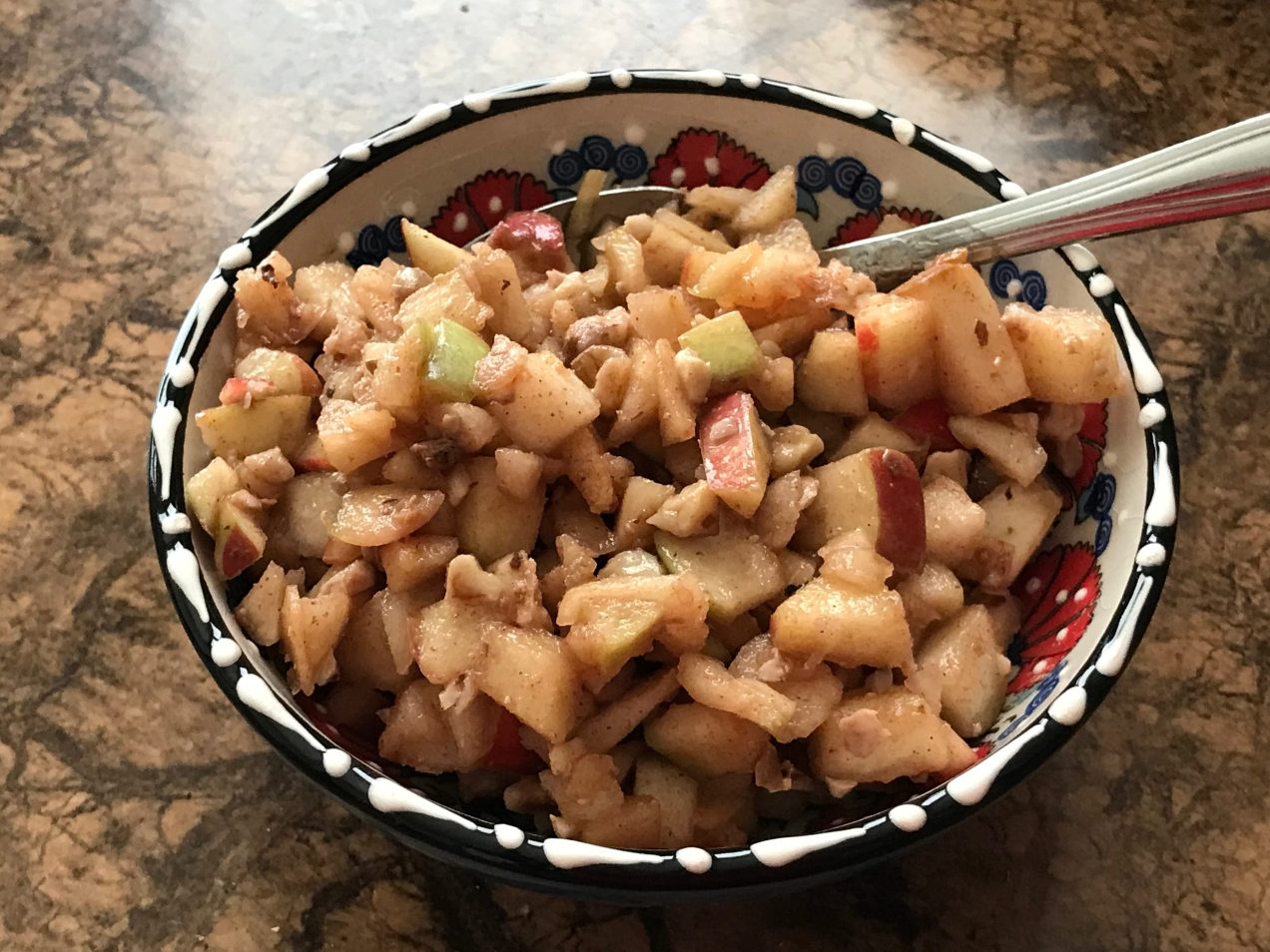
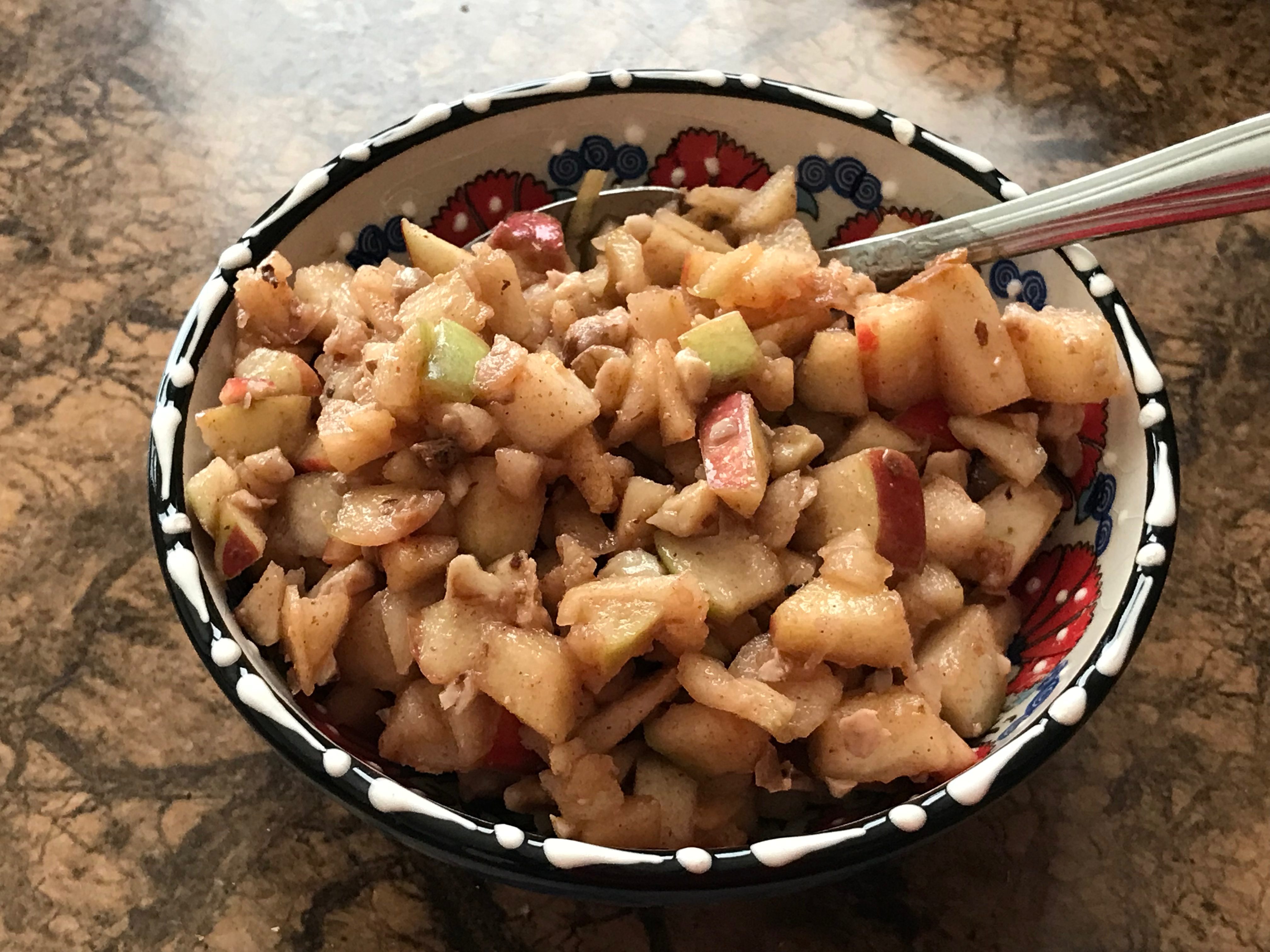
Ashkenazi charoset

            At first, it might seem strange to have apples in a dish for a spring holiday. Passover, the most important holiday on the Hebrew calendar, celebrates the Israelites’ Exodus from Egypt. It always occurs in the spring (in the Northern Hemisphere), while apples are a symbol of fall. On further reflection, the use of apples actually does make sense.

            Charoset is a blend of chopped fruit and nuts, representing the mortar enslaved Israelites used in Egypt, and is an essential element on the Passover Seder plate. Historically, most Ashkenazi Jews lived in Central and especially Eastern Europe. Not many fruits are in season there in March or April, but apples could be stored in a cold cellar over the winter. The only other option might be rhubarb, at least when there is plenty of sugar to counter the acid. Holiday food traditions seem to change more slowly than what people eat every day, so even with modern shipping and preservation, apples remain the base fruit.

            There are many recipes out there, typically including walnuts, sugar, spices, and an acidic liquid to keep the apples from oxidizing and turning brown. Most common is sweet, kosher red wine. Not all kosher wines are sweet, but Manischewitz, the most common brand (for all sorts of kosher products, in fact), is. With at least 51% concord grapes and a bit of extra sweetener, it tastes exactly like the classic non-fermented grape juice, with the alcohol flavor only coming in at the end. Naturally, grape juice would be the perfect non-alcoholic substitute.

Advertisements

            If you’re wondering why wine isn’t all kosher (as I was), it’s because ancient pagan people often used it in their rituals. To ensure their wine hadn’t previously been used in these rituals, the production from picking to transportation to serving had to be done by kosher-observant Jews. Unless, if I understand things correctly, it gets heated, which renders it unsuitable for pagan rituals. Once that’s done, anyone can handle it.

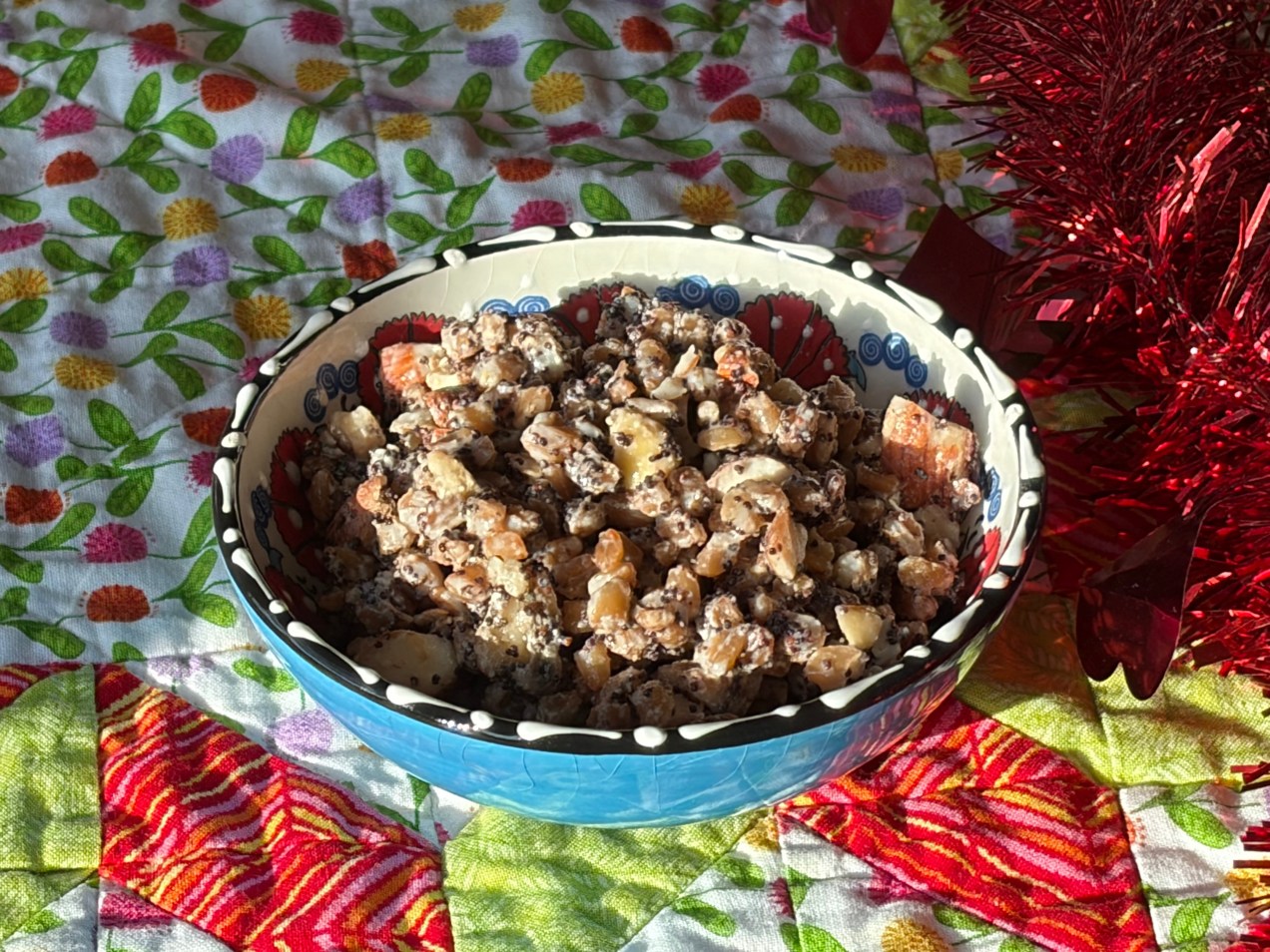
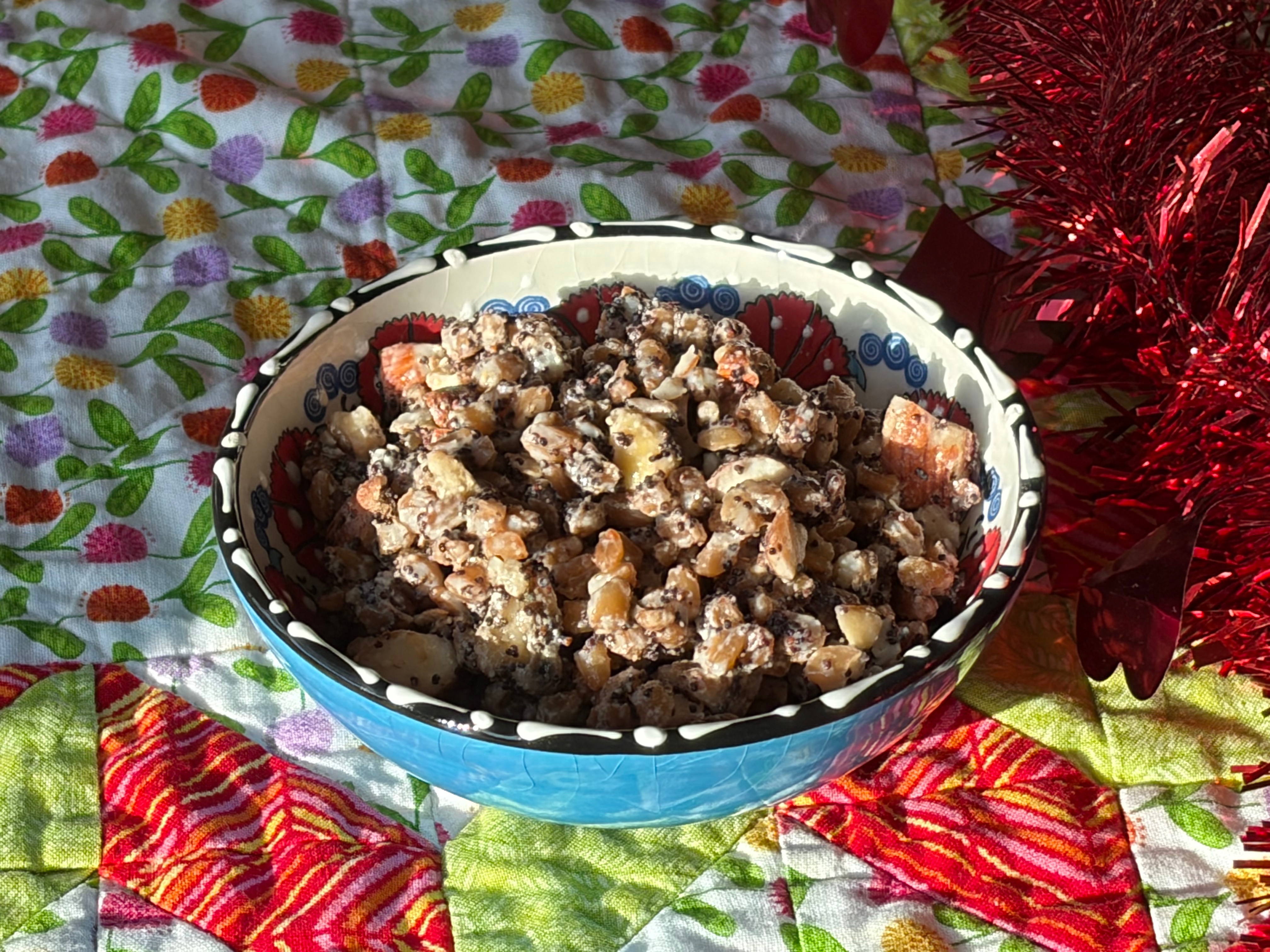
            Ashkenazi charoset is delicious, regardless of faith or season. It’s sweet, tart, two different kinds of crunchy, juicy, and especially tasty during the fall, when apples are freshest. Walnuts make the mix more substantial, and spices like cinnamon and ginger make it taste like crustless apple pie.

Ingredients:

  • 4 medium sweet-tart apples (I used 2 cortlands and 2 zestars)
  • ½ cup walnut pieces
  • A few drops of lemon juice, if desired
  • ½ teaspoon ground cinnamon
  • ¼ teaspoon ground ginger
  • ¼ cup (4 tablespoons) sweet kosher red wine or red concord grape juice
  • Sugar to taste

Directions:

  1. Core the apples, slice, and mince as finely as you can with a knife. (One of those devices that cores an apple and cuts it into 8 or 10 slices works perfectly for the first part, and I don’t bother peeling. If using a food processor for the second part, be careful not to overprocess.) Place in a large bowl. Toss with a few drops of lemon juice if desired.
  2. Mince the walnuts and stir in, distributing evenly. Add the spices and wine and stir again.
  3. Taste for sweetness. Depending on the apples, you may or may not need sugar. If the mix needs it, add sugar a tablespoon at a time, tasting as you go.
  4. Let rest in the refrigerator for 24 hours for the best flavor.

            If you enjoyed this, please like, share, and/or subscribe.

One-Time
Monthly
Yearly

Make a one-time donation

Make a monthly donation

Make a yearly donation

Choose an amount

$5.00
$15.00
$100.00
$5.00
$15.00
$100.00
$5.00
$15.00
$100.00

Or enter a custom amount

$

Your contribution is appreciated.

Your contribution is appreciated.

Your contribution is appreciated.

DonateDonate monthlyDonate yearly
Standard
Chocolate roll
food history, italian cuisine

Cook’s Tour of Italy Menu 32 (Pgs. 107 – 111): Menu for 4, Bergamo

Chocolate roll
Dessert, the star of the show

Region: Lombardy

Menu: Bergamo-Style Ravioli, Rabbit Roasted in Red Wine, Bergamo-Style Polenta, Cheese with Mixed Salad, Sambuca-Flavored Cocoa Roll (orange flavor instead)

Recommended Wine: Spumante

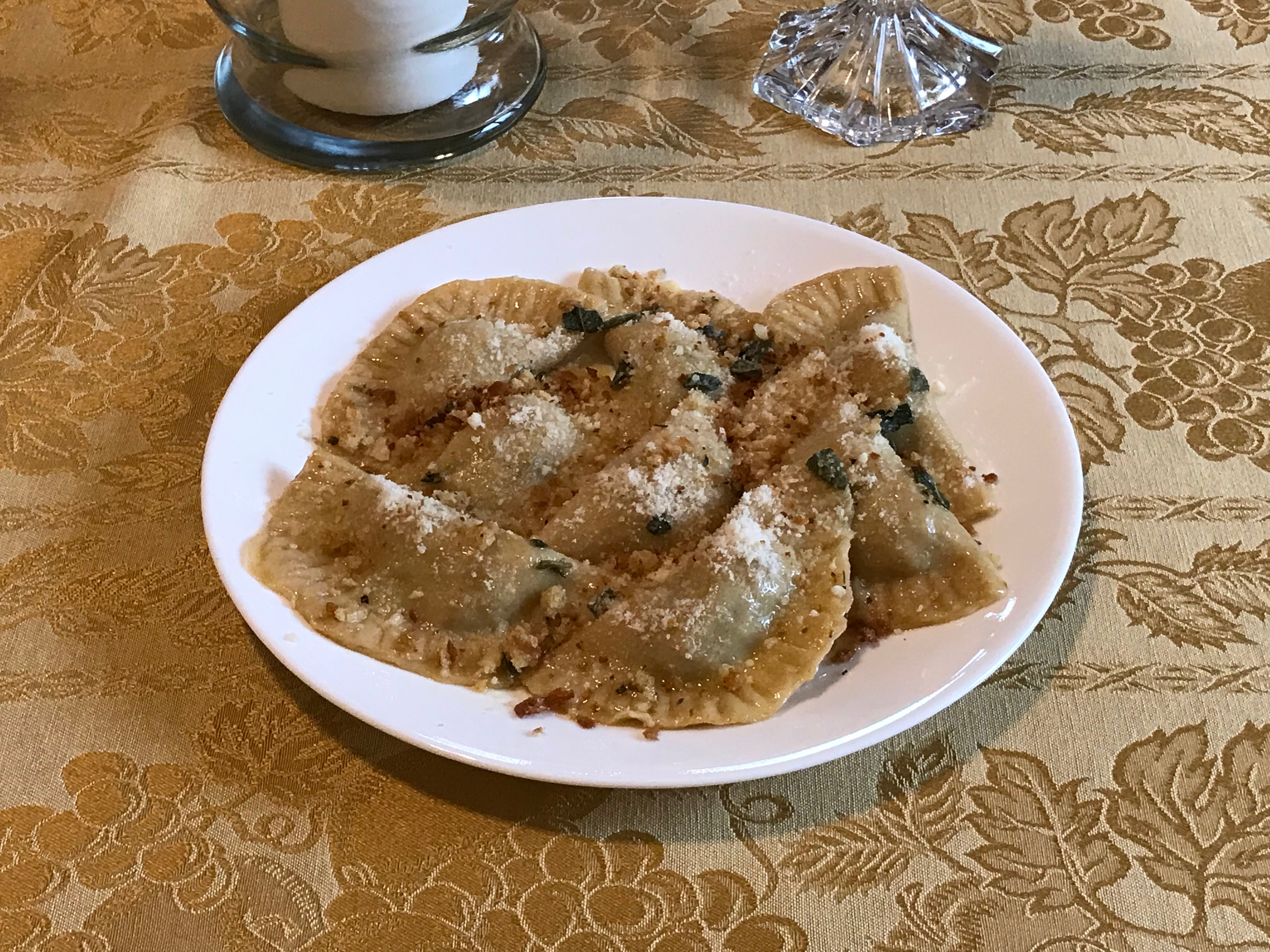
            Bergamo is in the northern Italian province of Lombardy, north of Milan. As in the rest of northern Italy, there is a lot of fresh pasta and polenta, butter often replaces olive oil, and there are plentiful cow’s milk cheeses like fontina, gorgonzola, parmesan, and mascarpone. While generally overshadowed by its larger neighbor, Bergamo has its own specialties. One of these is a unique ravioli, filled with a mix of chicken, pork, salami, vegetables, and a little cheese. They are dressed in melted butter and sage, parmesan cheese, and toasted bread crumbs.

Bergamo ravioli

            This was my first attempt at making my own pasta, and it went surprisingly well. Since I don’t have a pasta roller, I rolled little pieces of dough into circles with a rolling pin and folded them around the filling in a half-moon shape. It was a slow process, but making the ravioli bigger sped things along. The meat-and-vegetable filling was deliciously different from the usual cheese-heavy varieties, though there’s nothing wrong with those.

            The only thing I would change is to cook the larger ravioli for an extra minute or two. Having thicker pasta kept the ravioli from bursting open, but not factoring it into the cooking time left it a little tough. It was still delicious, and the extras are in the freezer for whenever a quick homemade dinner is desired.

Advertisements

            Another first for this menu was the rabbit. The idea was a little tough at first, until I reminded myself that this rabbit (which according to the package was a product of Spain) was bred and raised exclusively for food. It was never someone’s pet, or a former resident of the nearby farm/petting zoo. Besides, people have been eating rabbits for a lot longer than they’ve been keeping them as pets. They were a common protein into the 20th Century, and one 1930s menu even had rabbit pot pie as an economical alternative to chicken.

Rabbit and polenta

            Rabbit does, in fact, taste sort of like dark meat chicken, but a little different and very lean. The fact that chicken is easier to farm on an industrial scale probably explains why rabbit isn’t as popular as it used to be. Or maybe it’s just that people didn’t grow up with the Easter Chicken. Or the fact that chickens won’t stand on their hind legs like a prairie dog when offered a banana chip.

Black rabbit
Not the second course…and I wasn’t rabbit sitting when I made this menu either.

            Regardless, most rabbit recipes seem to involve slow-cooking it in liquid and/or adding some extra fat. In this case, the fat came from a bit of Italian sausage, and the liquid was red wine. It did taste very good, though in the future I would probably just use chicken thighs, which are cheaper and easier to find. At least for this recipe.

            Upon reading the recipe, I was surprised at how quickly the polenta cooked. Once the salted water was boiling, the corn grits/polenta only had to cook for about five minutes. It required frequent but not constant stirring, and didn’t get lumpy, which is a common problem. Was the addition of a little buckwheat flour the key to a good consistency? Perhaps, and either way, the addition of butter, sage, and fontina cheese gave the final mix a pleasant rich but mild flavor that contrasted well with the stronger flavors in the rest of the meal.

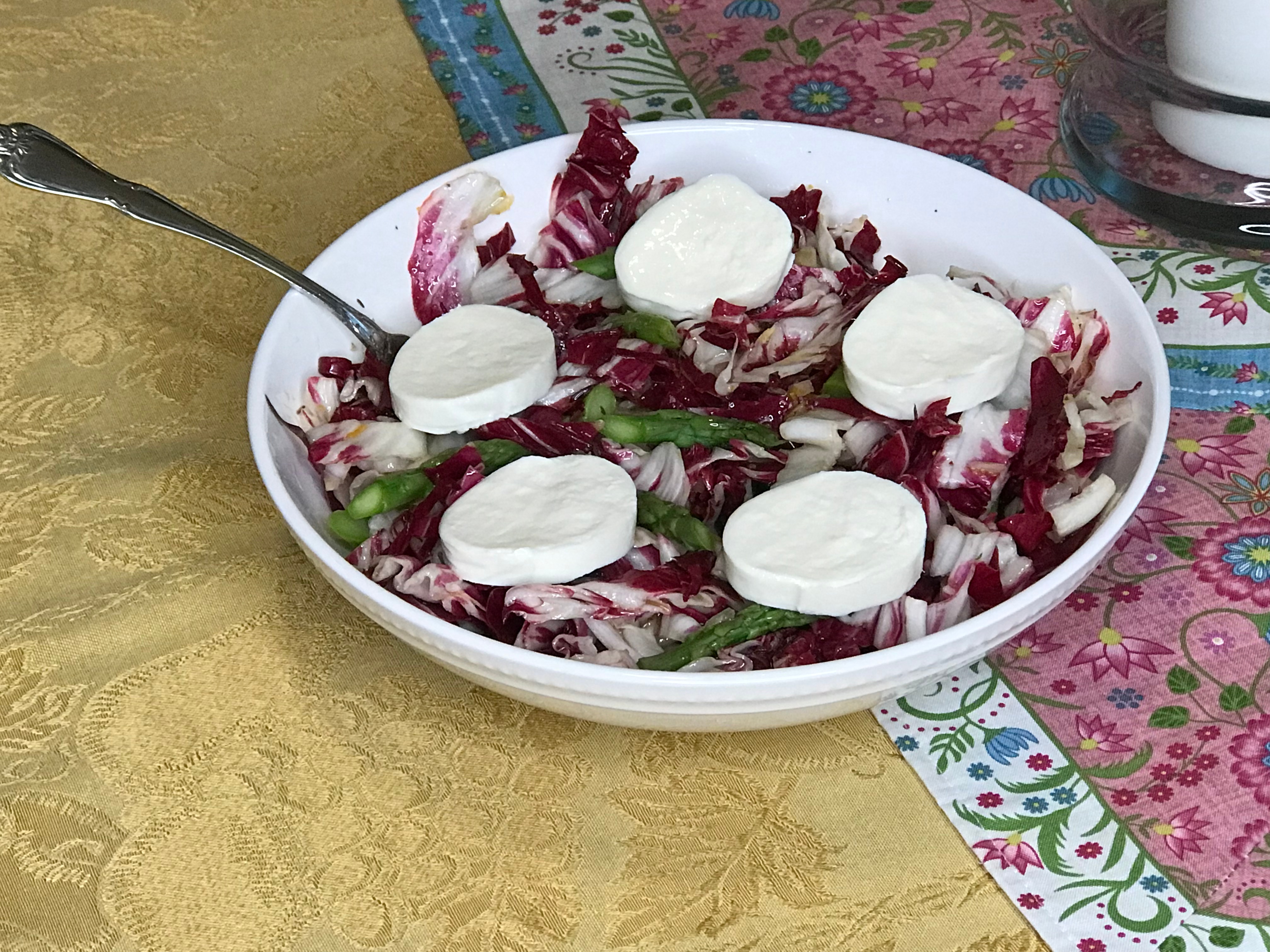
            The salad was similar to many others in the book; a mix of greens dressed with a flavorful homemade dressing. The store didn’t have the endive called for in the recipe, so I just used the arugula and radicchio. Unlike other lemon juice and oil “vinaigrettes,” a little bit of orange zest and some minced shallots seemed to sweeten the mix, keeping it from becoming too sour and letting it balance the bitter radicchio. Don’t worry if the oil solidifies in the refrigerator. Fifteen to thirty minutes at room temperature will take care of that.

Mixed salad

            For the cheese, I used fresh mozzarella instead of taleggio because that’s what was available at the store. Even though it’s a southern Italian cheese not native to the Bergamo area, it went very well with the salad, especially when served on the dressed greens instead of next to them. The bitter arugula and radicchio, sour and slightly sweet dressing, and mild mozzarella all contrasted beautifully without clashing.

            Dessert was one of the best things I’ve made in a while. The “cake” is a mix of egg yolks whipped with sugar, melted chocolate, a bit of flavoring, and separately whipped egg whites folded in at the end. The original recipe calls for three tablespoons of sambuca to be mixed in with the chocolate. Since I didn’t want to buy a whole bottle that I would be unlikely to drink or use in other recipes, I considered replacing it with a teaspoon of anise extract mixed into some cream, until I remembered that replacing wine with milk caused a previous attempt at zabaglione to fail. To keep the chemistry similar, I initially settled on a teaspoon of anise extract mixed into three tablespoons brandy.

Advertisements

            Then I considered that anise (the flavor of black licorice) is not generally my favorite flavoring. Trying a bit over a scoop of ice cream with a sprinkle of coffee granules is one thing. It’s a single serving that takes two minutes to make. Even though that turned out well, I was hesitant to put anise flavoring into an entire cake that was a bit fiddly to make. Other extract options were vanilla, almond, and orange. Since I was already making an almond cheesecake for a different event, I settled on orange for something different. A teaspoon went into the “cake,” and half a teaspoon went into the whipped cream filling.

Chocolate roll

            The cake was spectacular. The texture ended up somewhere between a brownie and a mousse, intensely chocolate lightened with a touch of orange. While the cake did crack slightly as I rolled it up, the inside still formed a recognizable spiral. Not pastry shop window perfect, and it wouldn’t pass muster on the Great British Baking Show, but still a pretty special occasion dessert. And of course, it’s the taste that counts. From time to time it’s well worth the effort.

Standard
Summer Pudding
british cuisine, food history

Summer Pudding: Britain’s No-Bake Specialty (and let’s talk about currants)

Summer Pudding

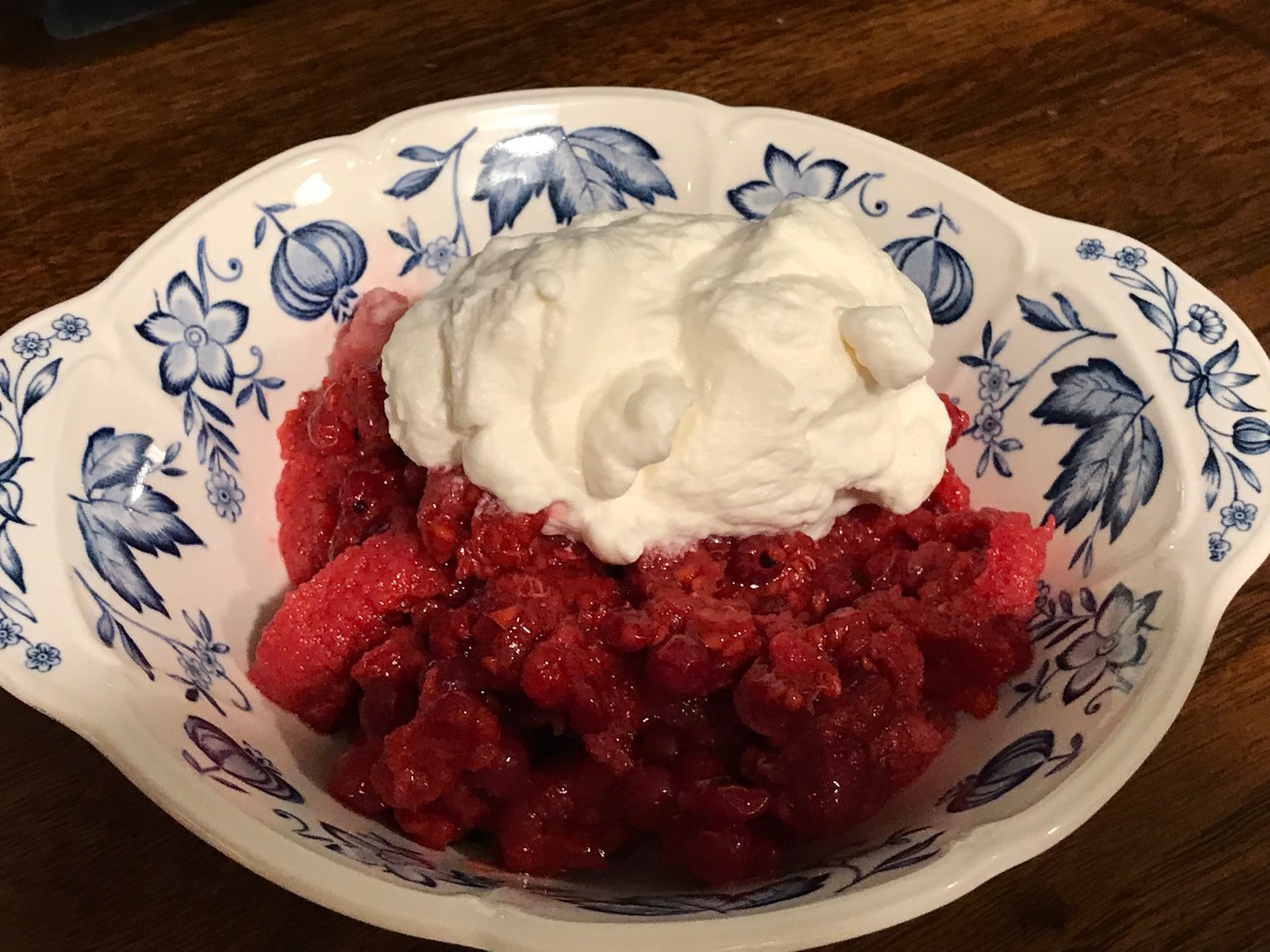
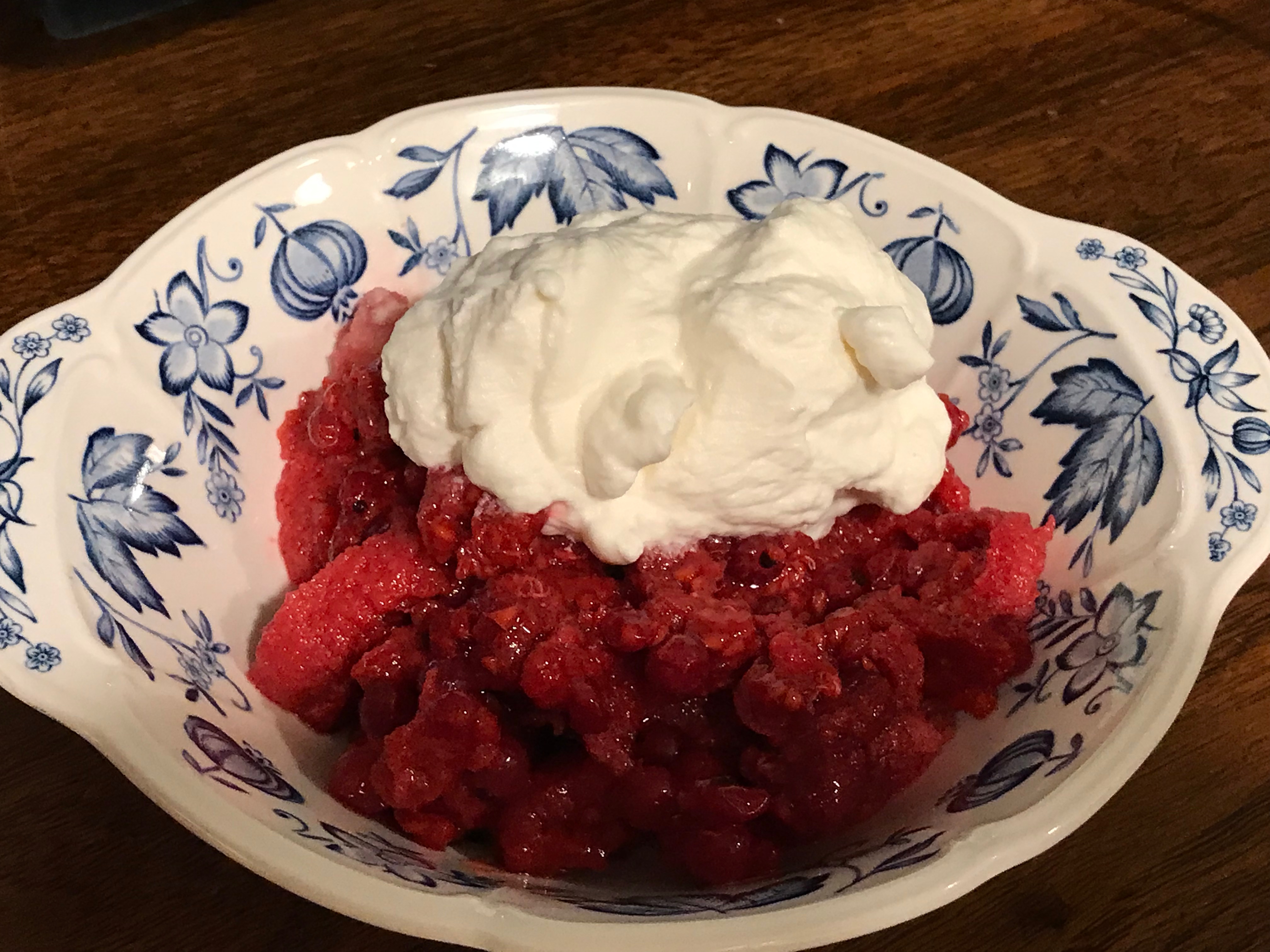
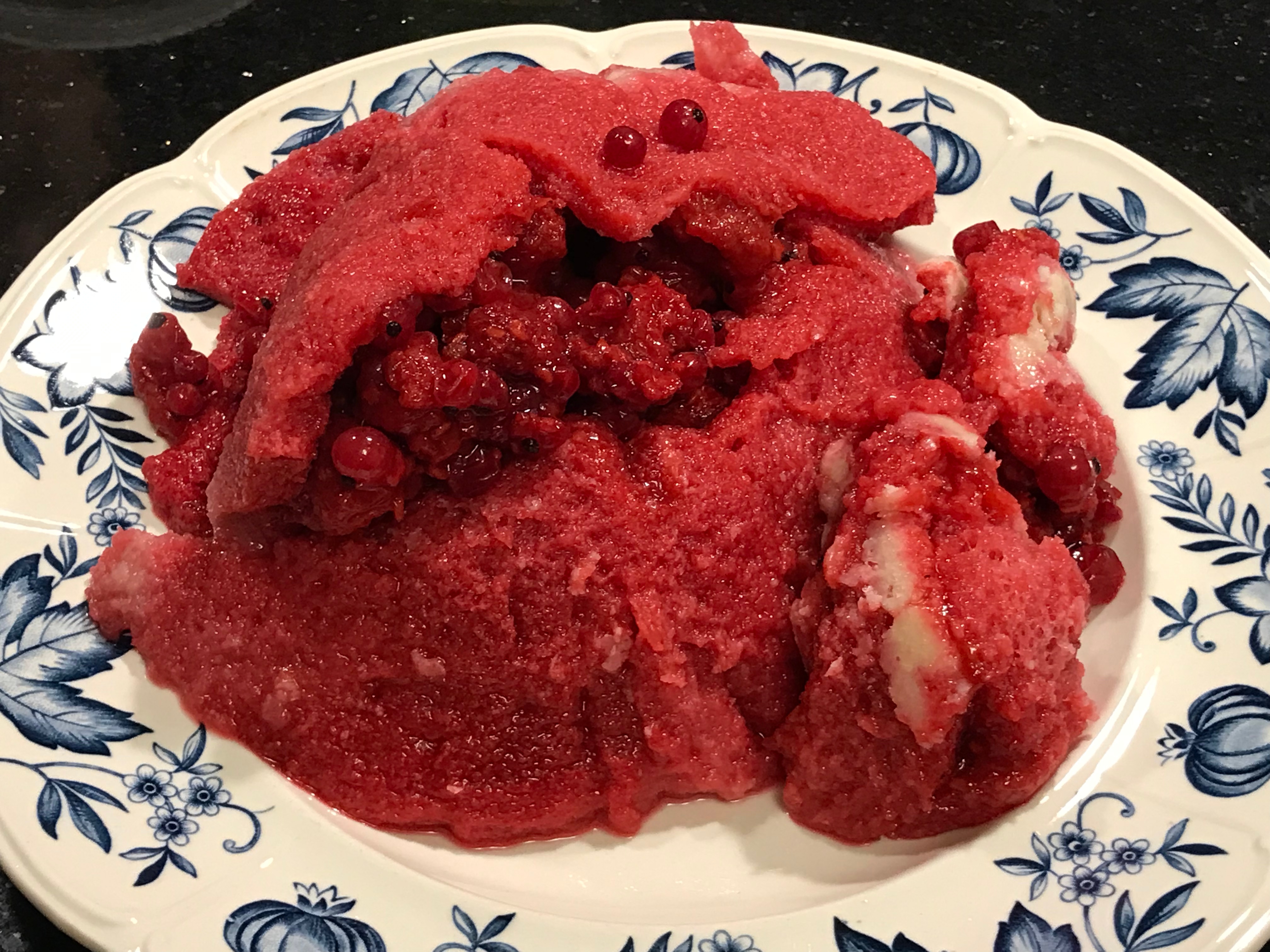
            No-bake desserts are great for special occasions during the summer. I’ve already discussed strawberry trifle, which uses frozen pound cake for beautiful and delicious results. Another showy use for berries and their juices is the British dessert summer pudding. It involves lining the bottom and sides of a bowl with white bread slices, filling the center with a mix of berries and sugar, covering the top with more bread, and pressing everything together with another bowl overnight. Excess juices are thus forced into the bread, coloring it a lovely hue between red, pink, and purple, depending on what fruit you use.

            I was a little skeptical at first. It sounded like a recipe for soggy bread, but if summer pudding is popular in the British Isles, there had to be a reason. After finding red currants at the farmer’s market, I decided to give it a try. If the bread part wasn’t good, the berry filling could be scooped out and served on its own with whipped cream.

            This turned out to be unnecessary. Odd as it sounded, the bread worked perfectly. Due to its gluten structure, it soaked up the juices like a sponge and held together even when fully saturated. Cake would typically fall apart in a similar situation. Beyond that, the bread balanced out the tart currants and raspberries very well. It was indeed soggy, but in a good way.

Advertisements

            Let’s pause here to talk about currants. The dried currants you can buy in boxes are not true currants at all. They are actually a type of small raisin. Most boxes now specifically refer to their contents as Zante currants to avoid confusion. These Zante currants are worth trying in their own right in scones, oatmeal, and the like. But they’re not what we’re talking about today.

            True currants come in three common colors: red, white, and black. All are much more common in Europe than in the US, though the red kind is occasionally found fresh in farmers’ markets and backyard gardens. White currants are a mutant form of the red variety. Black currants are even harder to find, and were in fact banned for several decades because they could carry white pine blister rust, which threatened the US logging industry. Even with new disease-resistant varieties, black currants are still illegal to grow in several states. Which is a pity, because they make great jams and juices.

Red currants
Red currants, with my hand for scale

            This history could explain the rarity of currants in the US. So too could be the fact that red currants, which were never banned, have to compete with native cranberries. Both are tart red fruits that make excellent juices and sauces, but cranberries are a lot cheaper and easier to store. And in the Midwest, where growing conditions are favorable for currant bushes, people prefer sour cherries in jams and desserts. Red and occasionally black currant jam can be found at stores and farmer’s markets, but beyond that, there are few traditional (or modern) American recipes for the fruit.

            British cuisine, by contrast, has plenty of uses for currants, especially, it seems, for the black variety, which are in fact dark purple. Blackcurrant jam is one of the favorite varieties. Many candies use the flavor. A sweetened concentrate called Ribena (which is not uncommon in the international food aisles in the US, at least in big stores) makes what tastes like currant-flavored Kool-Aid. It would taste better with a little less sugar, but is enjoyable nonetheless. And of course, there are numerous desserts made with all varieties of currant.

            One of the favorites is summer pudding, which Mimi Sheraton suggests is best made with a mix of red currants and raspberries. Taking the expert’s advice, I picked up some frozen raspberries, scaled down the recipe on pages 29 – 30 in 1000 Foods to Eat Before You Die by half, and got started. (Information about currants can be found on pages 12 – 13). Whether or not to cook the fruit or just briskly stir it with the sugar depends on how soft and/or ripe the fruit is. Since currants are firmer and tarter, even when ripe, I decided to cook them with the sugar for a few minutes, then stir in the raspberries, which are more prone to fall apart, after. This worked perfectly.

            The biggest challenge turned out to be finding a bowl that would fit perfectly inside the bowl with the pudding. This is important because pressing down on the surface with adequate weight (provided by a few cans of food) is what forces the excess syrup into the bread. The other issue was unmolding. I’m not sure why the recipe called for buttering the main bowl, since the butter completely solidifies when everything is chilled, unless it’s for flavor. The now-solid butter stuck the bread to the bowl, making for a slightly messy presentation.

            Messy or not, the juice-stained bread and red fruits were pretty in their own way, especially with a contrast of whipped cream. Brits often serve summer pudding with either clotted or whipped cream. I’m not sure how the former is, but the latter is perfect, especially if you make it yourself. Homemade whipped cream is super easy to make, and it makes the odd-sounding but delicious summer pudding even better. To be honest, it makes any dessert better.

Standard
dessert, food history, recipes

Medieval Fall Treat: Baked Apple Compote

            Apples have been associated with fall and the harvest for thousands of years. Many varieties can be kept in a cool cellar over the winter, but they are at their best when fresh and crisp. In a historical fiction book I’m in the process of writing, Marguerite of France enjoys a variety of apple dishes when she arrives at the English court to marry King Edward I in September 1299. Apple pies already existed, but the pastry crust was not meant to be eaten. It was used as a vessel to cook and store the filling.

            With that in mind, I opted to recreate the recipe in a covered ceramic dish. The apples steam just like they would in a pastry crust, with a lot less effort. Medieval cooks baked apples with cinnamon just like cooks do today, but it wasn’t the only spice. The 14th Century cookbook The Forme of Cury features a recipe seasoned with cinnamon, sugar, ginger, and dates. Presumably the dates balanced the flavor at a time when apples were not as sweet and less sugar was used.

            As strange as ginger and dates sound with baked apples, they’re actually delicious. Minced candied ginger is especially good, creating little bits of aromatic heat. It can be found in many grocery stores with the little bags of bulk spices.

            Like with a pie, the apples take a while to bake, at least 45 minutes, but are worth the wait. They taste a lot like apple pie without the crust. And with only 1.5 teaspoons of sugar per apple, plus a little bit in the ginger, they are pretty healthy too. As far as peeling the apples, I prefer not to. The pectin in the peel helps thicken the syrup as the compote stands.

Ingredients:

  • 4 large apples (I like Cortlands, but any relatively firm, not-too-sweet apple will do)
  • 6 pitted dates, halved and chopped
  • 2 tablespoons cinnamon sugar
  • 4 pieces candied ginger, minced

Directions:

  1. Preheat the oven to 350 degrees.
  2. Peel the apples if desired, and cut into large cubes, about ¾ inch to 1 inch. If you have one of the tools that cores an apple and cuts it into wedges, that’s perfect. Cut each wedge into 3 or 4 pieces.
  3. Place the chopped apples into an oven-proof ceramic dish. Sprinkle with the cinnamon sugar, dates, and ginger, and stir to combine.
  4. Cover the dish with a glass cover or aluminum foil and bake for 45 minutes to an hour. For semi-authenticity, do not stir while baking.
  5. When the apple mixture is soft and aromatic, remove from the oven. Carefully remove the lid. Stir to distribute the liquid collected at the bottom of the dish.

            For more recipes, stories, fun facts, and maybe some historical fiction excerpts, make sure to subscribe for free.

One-Time
Monthly
Yearly

Make a one-time donation

Make a monthly donation

Make a yearly donation

Choose an amount

$5.00
$15.00
$100.00
$5.00
$15.00
$100.00
$5.00
$15.00
$100.00

Or enter a custom amount

$

Your contribution is appreciated.

Your contribution is appreciated.

Your contribution is appreciated.

DonateDonate monthlyDonate yearly
Standard
Anoush Aboor - Armenian wheat and apricot pudding
armenian cuisine, dessert, food history

Armenian Christmas Pudding: Anoush Aboor (wheat berry and dried apricot pudding)

1000 Foods (pgs. 507 – 508), recipe is in the text

            If you’re wondering why I made a Christmas pudding in the middle of summer, it’s because I had all the ingredients in the pantry and wanted to use up what I could. The mix of wheat berries, dried apricots and golden raisins, nuts, and honey sounded like a healthy, tasty alternative to heavy desserts while still satisfying the craving for something sweet and starchy.

            Particularly popular at Christmas, anoush aboor is eaten year-round in both Armenia and Turkey. With the exception of the sugar and cinnamon, all the ingredients have been grown in the region for thousands of years. Situated in eastern Anatolia, near the headwaters of the Tigris and Euphrates rivers, this area was home to some of the earliest farmers. They grew wheat, barley, peas, and beans, raised sheep, goats, and cattle, and soon began selectively breeding and cultivating a variety of fruits, vegetables, and nuts.

            Apricots, an essential part of the dish, were originally domesticated somewhere in Turkey or Armenia. When the fruit was introduced to Rome, the Romans called it prunus armeniacus, meaning roughly “Armenian plum,” or praecox for early, since they ripen before most other stone fruits. Fresh apricots are delicious in the early summer, but are highly perishable and rarely available out of season. To have apricots year-round, people have been sun-drying them for millennia. In the Middle East’s hot dry summers, this was easy and didn’t require the use of often-scarce fuel. Even today, Turkey produces much of the world’s supply.

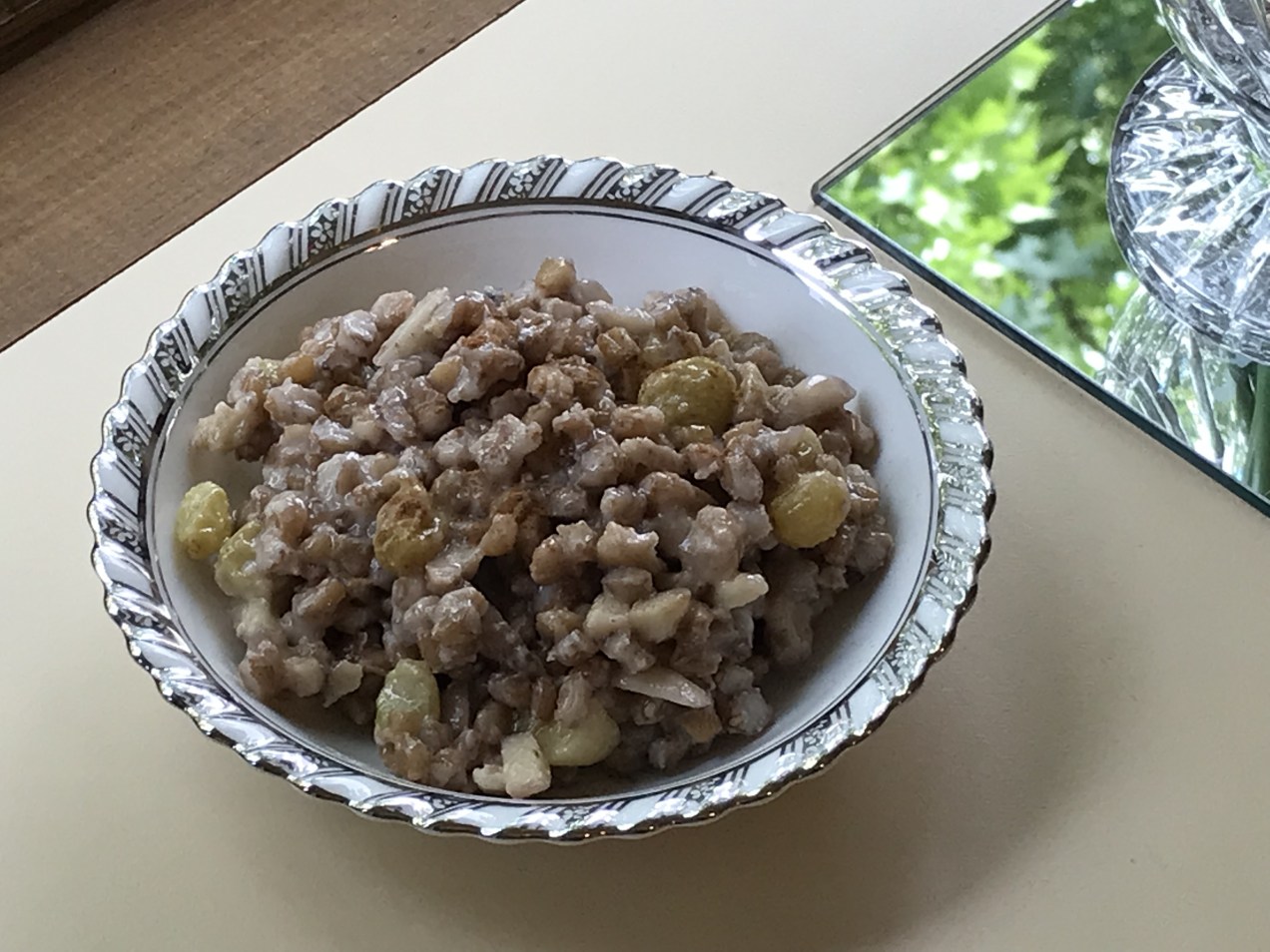
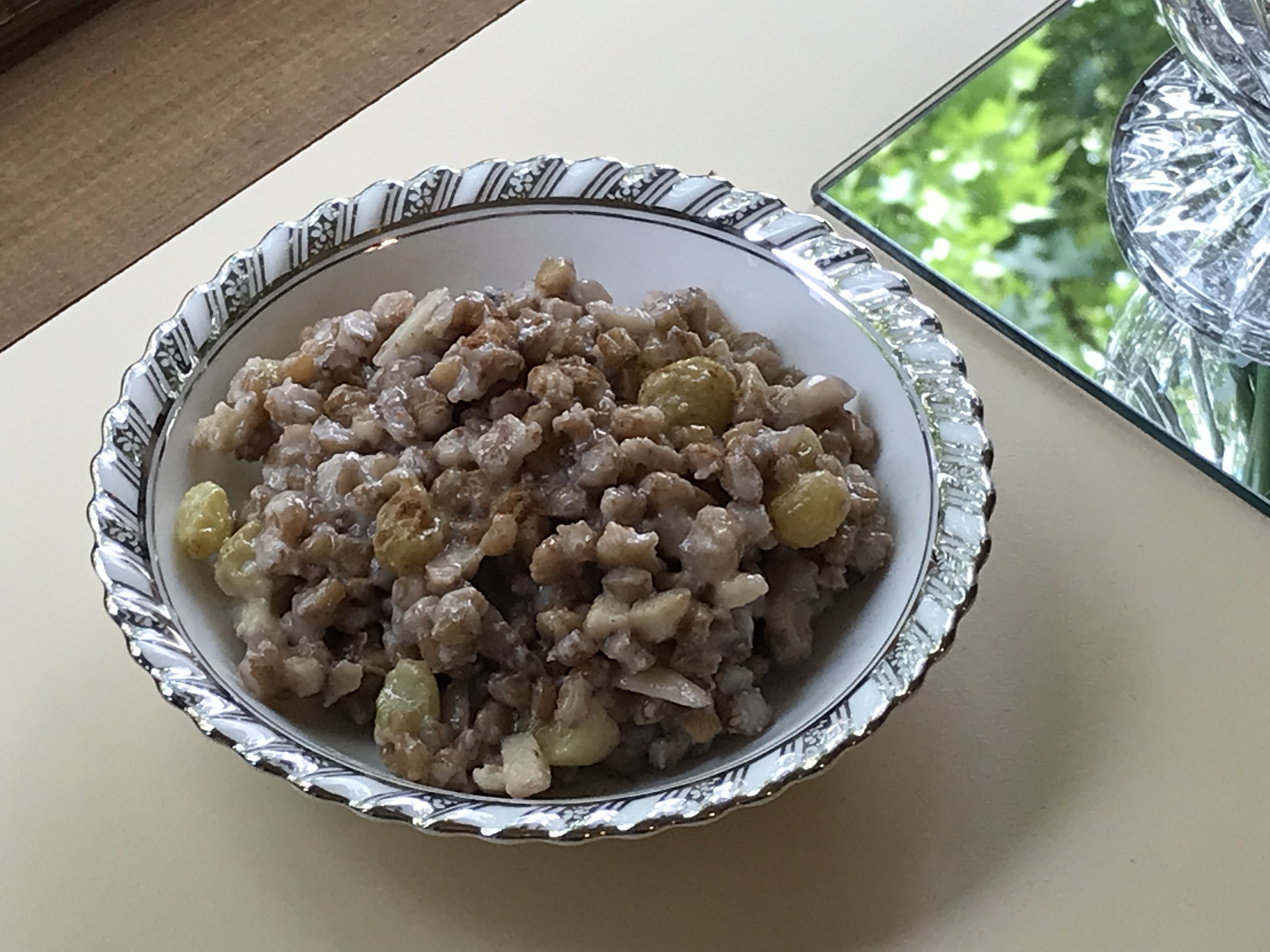
            Literally, the name anoush aboor translates to “sweet soup,” probably because of its porridge-like consistency. The wheat berries are cooked until they “pop” and release their starch into the water, thickening it. Despite being cooked in just water, the pudding had an almost creamy texture and even taste, sweetened with a mix of sugar, honey, and dried fruit. Chopped almonds and walnuts (I skipped the pine nuts and added extra of the others) gave it a nice crunch, and a sprinkle of cinnamon was a nice finishing touch.

            I had one problem with the recipe. It called for a teaspoon of salt. Since I made a half batch, I used half a teaspoon, which didn’t sound like much. Unfortunately, even that amount made the pudding taste distinctly briny and a bit unpleasant. The pudding was much better stirred into unsalted hot wheat cereal to cut the salt while adding texture, but to be honest, I don’t think I would make this again. Back before modern cakes, cookies, and brownies it might have been a nice treat. Today, it’s pretty lackluster.

One-Time
Monthly
Yearly

Make a one-time donation

Make a monthly donation

Make a yearly donation

Choose an amount

$5.00
$15.00
$100.00
$5.00
$15.00
$100.00
$5.00
$15.00
$100.00

Or enter a custom amount

$

Your contribution is appreciated.

Your contribution is appreciated.

Your contribution is appreciated.

DonateDonate monthlyDonate yearly
Standard
Patriotic pound cake trifle
american cuisine, british cuisine, dessert, food history, recipes

Patriotic Trifle: An American Spin on a British Classic

1000 Foods (pgs. 31 – 32) for information, recipe is my own creation

            While British cuisine doesn’t have a great reputation abroad, desserts are an exception to this rule. Drool-worthy examples abound on the Great British Baking Show (which you should never watch while hungry), and one of the classics is trifle. Trifles also appear multiple times in the Harry Potter series, typically at celebrations, and in the second book, Harry even ends up wearing one.

            The specifics vary by recipe, but they always include cake or ladyfinger biscuits, custard and/or whipped cream, and fruit and/or jam. Basically something starchy, something creamy, and something fruity. British versions usually include sherry or another fortified wine. Originally, this was to help revive stale cake. With modern recipes this is unnecessary, but a lot of people like the taste. I omit this for a family-friendly version and clearer fruit flavor, bursting with berries and vanilla.

            Wine and liquor were once extremely common dessert flavorings. Since the 19th Century, perhaps because of the temperance movement, vanilla has largely taken their place. Despite its boring reputation, vanilla blends extremely well with fruit, chocolate, caramel, cream, and pretty much anything else you might put in a dessert. For a beautiful, fresh, and surprisingly easy centerpiece, the essentials are a good pound cake, seasonal or frozen fruit, vanilla pudding, and homemade whipped cream.

            Strawberries make a particularly good trifle, because as the trifle sits in the refrigerator, the lightly sugared berries release lots of flavorful juice that soaks into the cake. If they aren’t in season, it’s better to use frozen, which tend to have a better flavor (and price) than the out-of-season fresh berries, which are usually picked underripe so they ship better and last longer on the shelf. This applies for any fruit, not just strawberries.

            Pound cake is another crucial ingredient, and you don’t have to make your own for success. The frozen Sara Lee pound cakes are excellent quality. I like to make my own vanilla pudding, but an instant mix still produces a special dessert if you’re crunched for time. Just avoid the sugar-free kind, and don’t make it with skim milk. And make your own whipped cream. It makes a huge difference, and with the cost of the spray bottles, it’s actually cheaper when you need a lot.

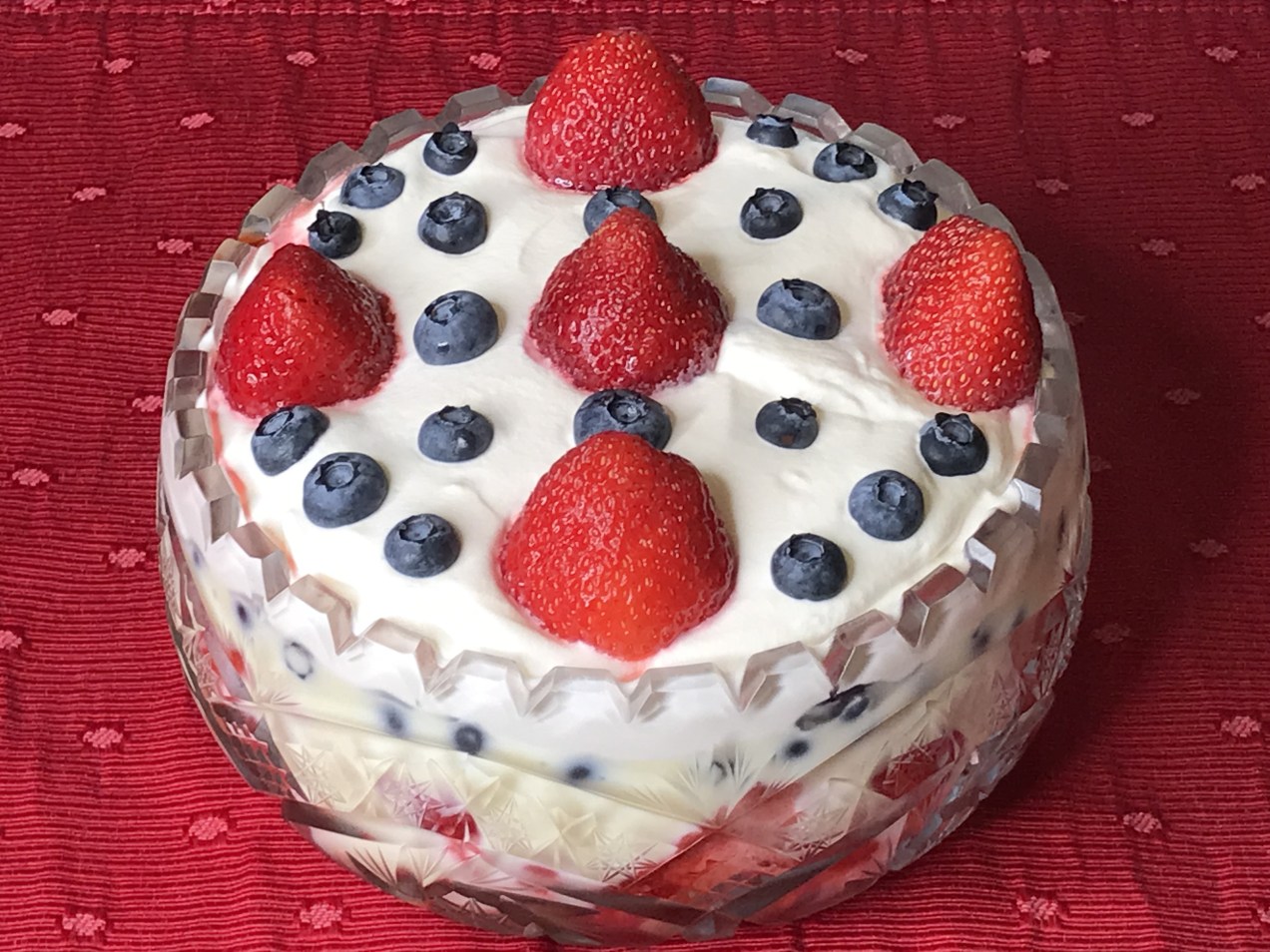
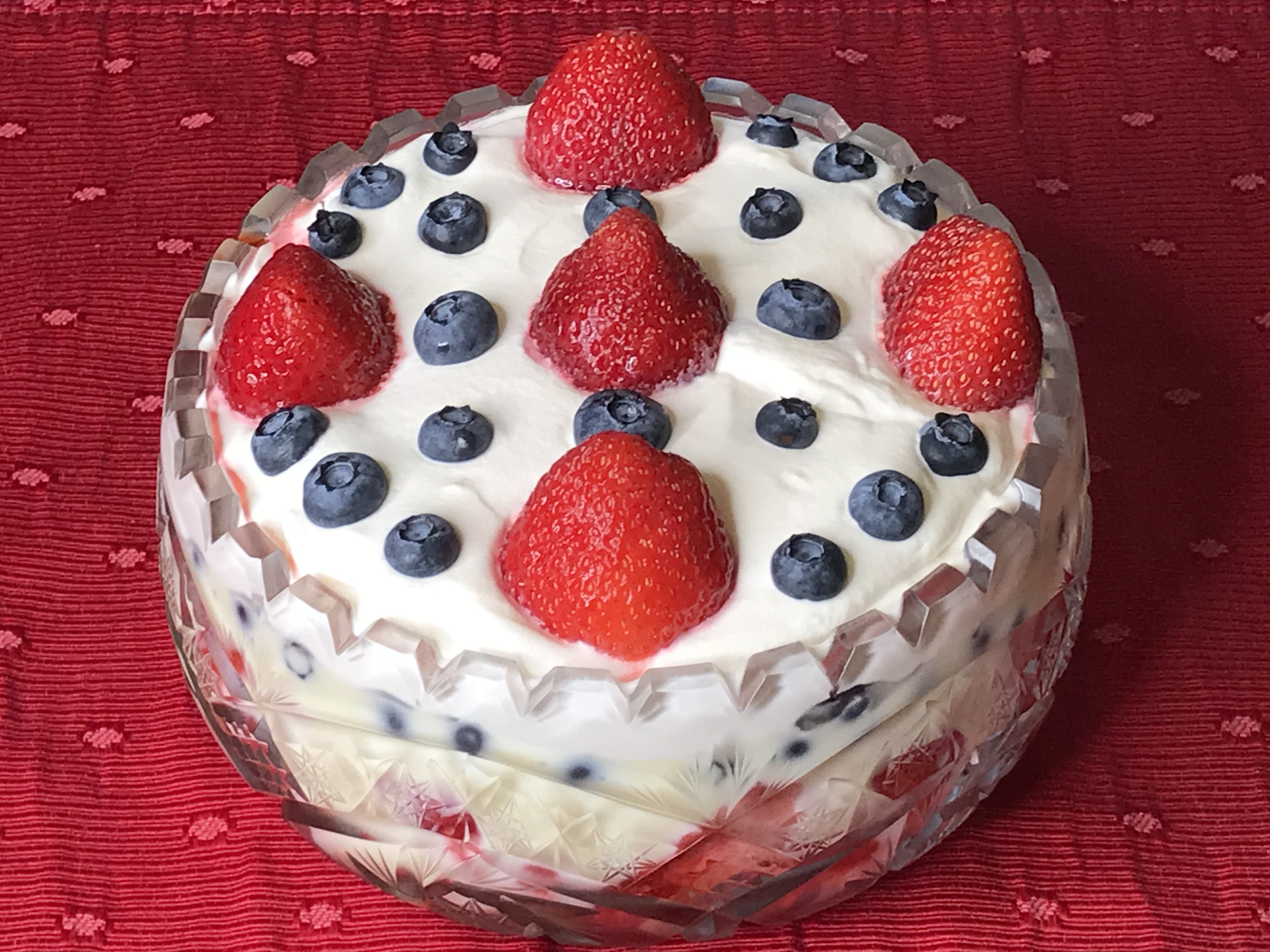
            For a full red, white, and blue effect, blueberries can be sprinkled over the top of the trifle or added between the layers. Since they don’t produce much juice, I usually stick with a strictly strawberry trifle, but I added them this time because they were in season and it was for the 4th of July. Just make sure to layer the trifle in a glass bowl if at all possible, to show it off to full effect.

To impress your guests, decorate the top with fruit.

            Note that the quantities in the recipe are not always specified. This is because different serving bowls have varying capacity, and everyone has their own preference for how much of each ingredient to add.

            Ingredients:

  • 1 pound cake, homemade or Sara Lee
  • Strawberries
  • 2 tablespoons sugar per quart of strawberries
  • Vanilla pudding, homemade or from a mix
  • Blueberries, optional
  • 1 cup whipping cream
  • 1 tablespoon powdered sugar per cup whipping cream
  • ½ teaspoon vanilla per cup whipping cream

            Directions:

  1. Hull and halve the strawberries, cutting any larger berries into quarters. Toss with the sugar and let stand while you prepare the other ingredients.
  2. Cut enough of the pound cake into cubes to cover the bottom of the serving bowl.
  3. Whip the cream with the powdered sugar and vanilla until soft peaks form.
  4. Layer the cake cubes in the bottom of the serving dish. Top with the strawberries and drizzle any liquid over all.
  5. Add the pudding over the strawberries, and top with the blueberries if using.
  6. Finish the trifle with the whipped cream, decorating the top with fruit if desired.

            If strawberry season is over but you have fresh peaches or raspberries, I’m sure they would also make an excellent trifle. And as always, don’t forget to subscribe to get posts sent to your inbox for free.

One-Time
Monthly
Yearly

Make a one-time donation

Make a monthly donation

Make a yearly donation

Choose an amount

$5.00
$15.00
$100.00
$5.00
$15.00
$100.00
$5.00
$15.00
$100.00

Or enter a custom amount

$

Your contribution is appreciated.

Your contribution is appreciated.

Your contribution is appreciated.

DonateDonate monthlyDonate yearly
Standard
dessert, lebanese cuisine, middle eastern cuisine

Dessert from the Desert: Dates in Clove Syrup (Murabba El Balah)

Not bad dates, if you’ll pardon the Indiana Jones reference.

1000 Foods (pg. 514) for information, recipe is my own creation

            For a unique dessert, we have dates in clove syrup. Date palms are more tolerant of heat and drought than most other plants, making them essential in the hot deserts of the Middle East and North Africa. The fruit is sweet, high in nutrients, and calorie-dense, a useful feature in the past. Before sugar, dates were the main sweetener in the region, added to a variety of breads, porridges, and sweet cakes in Ancient Egypt and Mesopotamia. Usually, they were preserved by drying in the hot sun, a method still widely used.

            People have been stuffing dates for at least two thousand years, and probably for even longer. Once the pit is removed, the fruit has a hollow center. Dates were a popular luxury in the Roman Empire. Since the trees don’t produce fruit in Italy, they had to be imported from the Middle East and North Africa. Almonds, which fit into the centers almost perfectly, were a favorite filling, either on their own or in a more complex mixture. Murabba El Balah, a Lebanese specialty, also uses almonds for a nice contrast in flavor and texture.

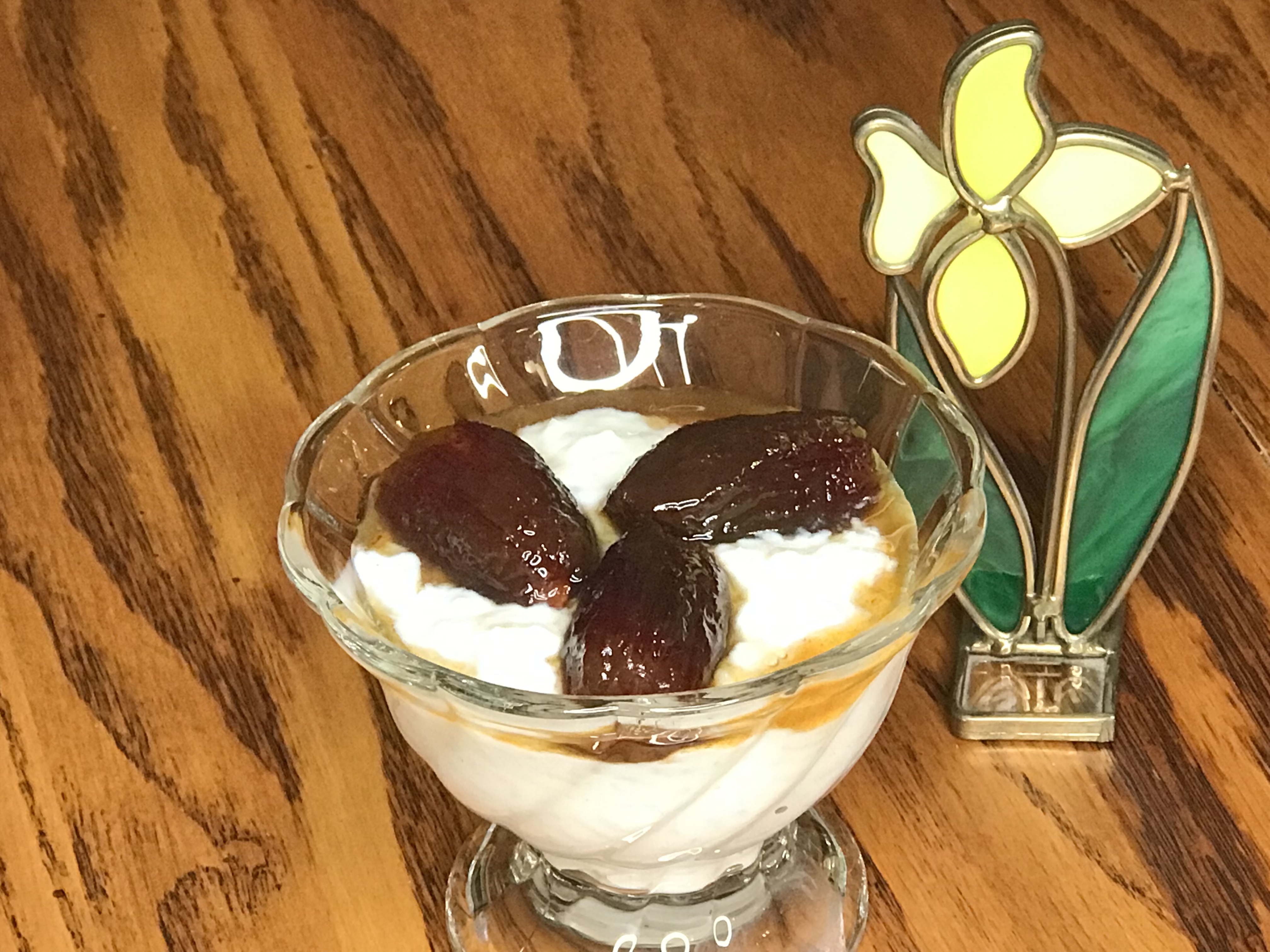
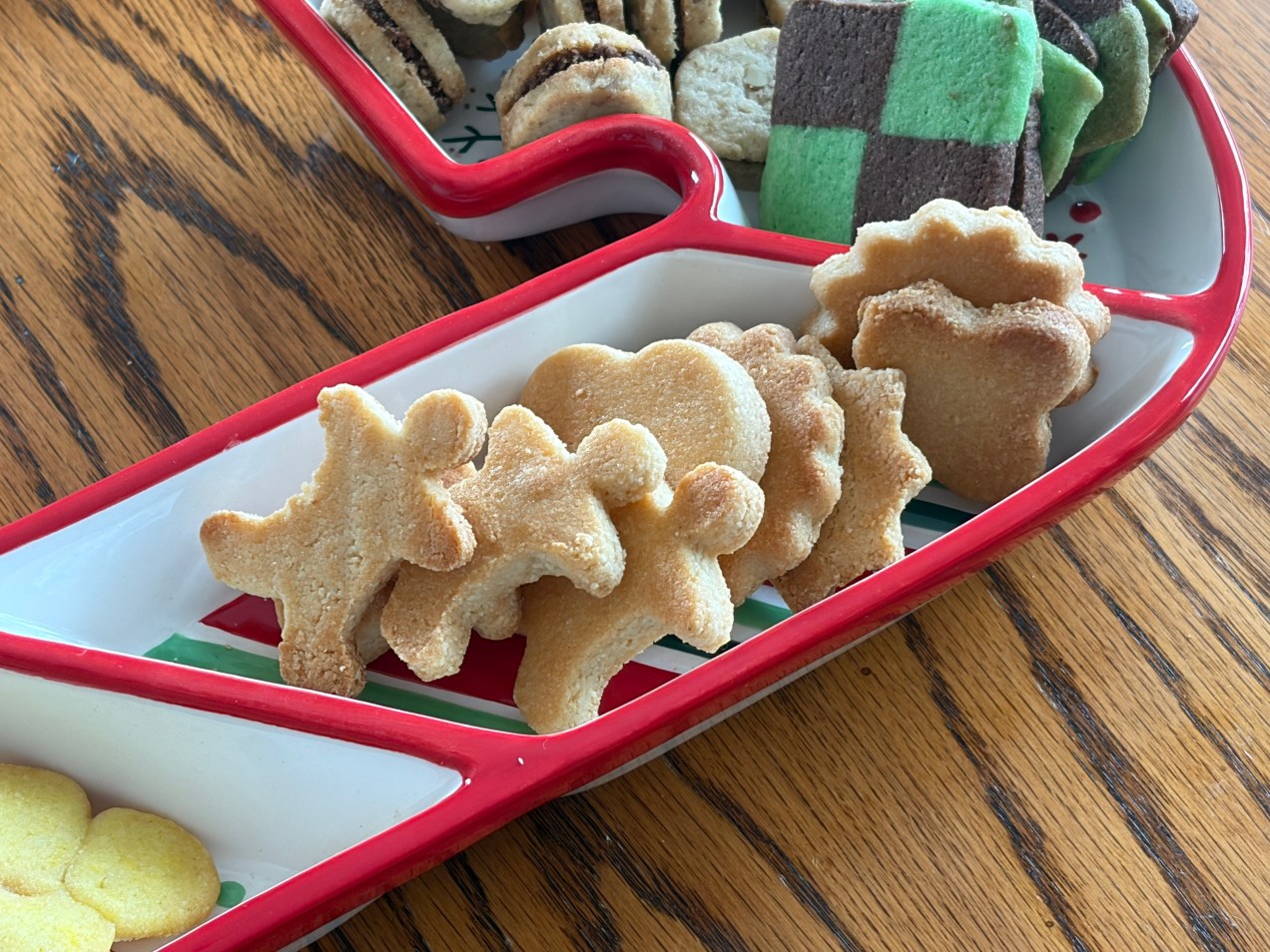
            Normally the dish uses fresh dates. Since those are extremely hard to find, I developed a recipe using the dried variety. After soaking in hot water the dates can be peeled, and the pits removed with a nut pick or knitting needle. I put two almonds in each date, toasted for extra flavor. After steeping for several days, the fruit is chewy and extremely sweet. To avoid being overwhelming, I’ve included a recipe for lightly sweetened rice pudding. The syrupy dates are a popular garnish for puddings of all sorts.

            They have a great flavor and nice crunch, but are a bit of a sugar bomb, for lack of a better term. Dates are already very sweet, and a sugar syrup only increases it. Because of this, they go even better with pancakes, oatmeal, cream of wheat, and the like, which aren’t usually pre-sweetened. Plain yogurt would be another excellent choice.

            Note that the dates need to soak in the clove syrup for at least four days, so plan ahead. The rice pudding is very thick, because that’s the way I prefer it, but you can thin it with a bit more milk once it’s cooled. No vanilla or cinnamon is included because the clove syrup would overpower it, but if you want to add some, by all means go ahead.

            Ingredients:

  • 20 – 24 dates (about 1 pound dried with pits, less if pitted)
  • 40 – 48 toasted unsalted almonds (2 per date)
  • 24 whole cloves
  • 1 ½ cups sugar

For rice pudding (if desired)

  • 4 cups (1 quart) whole or 2% milk
  • 6 tablespoons white rice, long or short grain (short grain makes a thicker pudding)
  • 1 tablespoon sugar

            Directions:

  1. Place dates in a medium saucepan with just enough water to cover, about 2 cups. Bring water to a boil, shaking pan occasionally. Remove from heat, cover, and let stand for at least an hour, or until cool.
  2. Peel dates, starting from areas where the peel has bubbled up. Remove pits with nut pick or knitting needle if necessary. Set fruit aside, discarding peels and pits. Strain cooking liquid and return to pan.
  3. Add the cloves to the cooking liquid and bring it back to a boil. When boiling, add the 1 ½ cups sugar and boil, stirring, for two or three minutes, or until the sugar is dissolved. Remove from heat.
  4. While the syrup partially cools, stuff two whole almonds into each date. Pour the warm syrup over the stuffed dates and gently stir. Let cool to room temperature, then marinate in the refrigerator for at least four days. Due to the sugar content, these will stay good for a few weeks.
  5. Remove the cloves and serve with rice pudding, ice cream, or yogurt.
  6. For the pudding, heat the milk, rice, and tablespoon sugar in a saucepan over medium heat, stirring frequently, until mixture simmers. Turn down heat to medium low, then cook for about 15 minutes until thickened, stirring frequently to prevent scorching. Chill before serving if desired.

            Don’t worry if you accidentally eat a clove. It might dull your sense of taste a for a few minutes, but that’s as far as side effects go. As usual, make sure to subscribe to get free posts and recipes sent right to your inbox. If you’re feeling extra generous and want to donate a few bucks to support my work, you can do that too.

One-Time
Monthly
Yearly

Make a one-time donation

Make a monthly donation

Make a yearly donation

Choose an amount

$5.00
$15.00
$100.00
$5.00
$15.00
$100.00
$5.00
$15.00
$100.00

Or enter a custom amount

$

Your contribution is appreciated.

Your contribution is appreciated.

Your contribution is appreciated.

DonateDonate monthlyDonate yearly
Standard
food history, italian cuisine

Italian Christmas Treats After Christmas

Panettone, Pandoro, Panforte

1000 Foods (pgs. 214, 215)

            Looking at the names of these three treats, you probably noticed something. The all start with the word part “pan,” Italian (and Spanish) for bread. Festive breads, especially sweet enriched breads, have long been Christmas specialties. Before baking powder was invented, breads and cakes were strictly leavened with yeast. As sugar was much more expensive in the past, dried fruits were a frequent addition to make them sweeter. Panforte isn’t actually a bread at all, but still has the name.

            Panettone is a perfect example of these sweet, special occasion breads. Its exact origin is unclear, and there are many stories, but one thing is certain: it was invented in Milan. The dough is enriched with lots of butter and egg yolks, which give the finished panettone a lovely golden color. Flavor comes from a combination of sugar, assorted dried and candied fruit, and warm spices. Occasionally saffron is included to make the yellow color even stronger. Over time, panettone spread from Milan to the rest of Italy, then to the rest of the world. In most places, people seem to purchase their panettone, rather than make it themselves. At World Market, I’ve seen pumpkin spice and chocolate varieties, but decided to stick to the original. They even have mini versions, for those who want a taste without a lot of extra.

            There were also mini versions of pandoro, native to Verona. It’s a vanilla-scented bread/cake, whose named literally translates to “golden bread.” Verona is located in the Veneto region of northern Italy along the Adige River, about halfway between Milan and Venice. In the Middle Ages, Verona was an influential city in its own right, trading and fighting with the other city-states that ruled most of Italy north of Rome. At one point, Milan ruled Verona, allowing another opportunity for Milanese culinary influences to spread. The Veronese not only adopted panettone, but developed their own variation.

            Further south is Siena, home of panforte. In the 13th and early 14th centuries, Siena vied with Florence and Pisa to dominate Tuscany. Florence pretty much always came out on top, but Siena managed to put up quite a fight. Some of the greatest artists of the Late Middle Ages, whose work would eventually pave the way for the Renaissance, lived and worked there. By 1348, construction was underway on what was to be the largest cathedral in Europe. Then the plague struck.

Not a rice cake

            The Black Death first arrived in Sicily in late 1347. Over the next six years, it reached every corner of Europe. Mortality rates varied, but tended to be higher in urban areas, where there were enough hosts for the bacteria responsible to keep circulating. Heavily urbanized Italy was among the worst affected. Many of the large cities had death tolls of 50 or 60 percent, compared to the continental average of about one third. Records suggest that Siena lost about 80 percent of its population. Even if some losses came from citizens fleeing to the countryside, the death toll was devastating. Siena never fully recovered. The cathedral remains unfinished to this day. Tuscany as a whole suffered greatly, but the story wasn’t over.

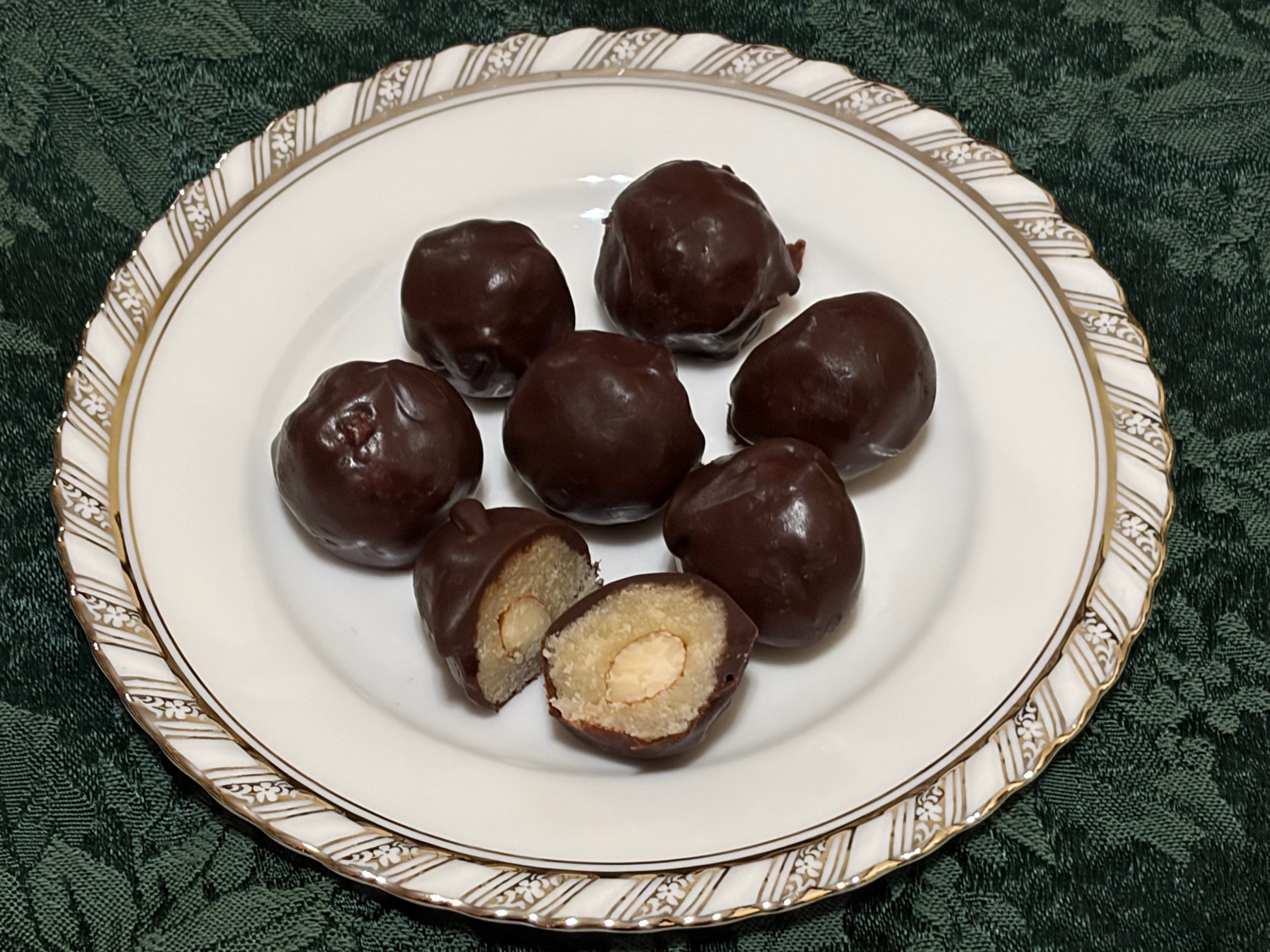
            Florence rebounded, becoming the birthplace of the Renaissance. Even Siena, despite its setbacks, produced a few more great artists of its own. In the culinary sphere, Siena contributed the almond cookies called riciarelli, and panforte. Despite its name, panforte is made of nuts and dried fruit, not bread. The mix is spiced much like panettone, and honey holds everything together. Conveniently, World Market also carries those in miniature.

            All three were pleasantly sweet and festive. It took a while to get used to the panettone and pandoro, since they were kind of a cross between bread and cake. With the exception of cinnamon rolls, sweet yeast-leavened breads are not as common in America as in Europe. The rich vanilla pandoro and warmly spicy, fruity panettone and panforte were enjoyable, but I still prefer the usual holiday treats – peppermint cookies, buttery cutouts, brownies with peppermint ice cream, the toffee-coated cereal the neighbors brought over, etc. And candy. Lots of candy.

Standard
food history, french cuisine

Delights of the Duty-Free Store: Paris

Macarons, Calissons, Nougat

1000 Foods (pgs. 80 – 82)

            Many people like to buy alcohol at the duty-free store. The Charles de Gaulle airport in Paris appears to be no exception, based on the relative amount of shelf space occupied. There were also an assortment of cheeses, pates, dried sausages, and confectionary. A few of the cheeses featured in 1000 Foods were in the cooler, but I wasn’t sure if they would be allowed through customs. Plus, the smell upon opening the cooler door was, for lack of a better term, “weird.” Kind of the like the camembert that I didn’t like. Attempting to carry it in my backpack for the 8-hour flight home, layover in Chicago, and then back to Green Bay didn’t seem like the best plan. Especially when there were so many amazing-looking sweet items. After perusing and admiring the displays, I settled on calissons and Montelimar nougat, which can be hard to find, plus macarons and a box of assorted mini chocolate batons, for good measure.

            Macarons have been extremely fashionable for the last decade or so. Their bright colors are cheerful, and the flavor possibilities are endless. The exact origin or macarons is unclear, but cookies have been made with ground almonds, sugar, and egg whites for centuries. At some point, the cookies became lighter and more meringue-like, and they began to be sandwiched together with a buttercream or ganache filling. As for the difference between macaron and macaroon, macaron = these colorful sandwich cookies, and macaroon = a simpler mix of almonds or coconut, sugar, and egg white. Usually. Both macarons or macaroons are easily made gluten-free, and the lack of wheat flour and chemical leavening make them a popular Passover dessert, when Jewish dietary laws forbid both.

            Properly made macarons are amazing, but are supposedly quite touchy to make. Relying on whipped egg whites for leavening is part of this. Another issue is that gluten makes it easier for a batter to trap air bubbles, which expand in the oven. Both of these factors increase the risk of the macarons not rising properly. Adding the fact they are based on expensive almond flour, macarons can be quite pricey. While a reasonably-priced, pre-packaged box cannot compare to the bakery variety, this mix of strawberry, lemon, and pistachio was pretty good.

Color-coded for your convenience

            Calissons are also almond-based. In addition to almond paste, their defining ingredient is candied melon. The gold standards are calissons d’Aix, made in the Provence region of southern France for hundreds of years. To legally use the coveted name, the calissons can only include almonds, sugar, and the candied cantaloupe-like melon, egg whites as a binder, plus a royal icing of egg white and sugar. Sometimes a bit of rose or orange flower water is added, but no other flavorings are permitted. While the ones I got weren’t calissons d’Aix, the primary ingredients were almonds and candied melon, making them a good representation of the confection. The different icing colors all have a different flavor. The white is the plain original. The other flavors are chocolate, raspberry, tangerine, lemon, and pistachio. At first, I wasn’t sure if I liked them. The melon is hard to taste, the almond is very subtle, and the texture was stickier than I expected. But as I kept chewing, the almond flavor and somewhat marzipan-like texture came through. I’d rather have marzipan, but the calissons were not bad at all.

            Continuing on a similar theme, traditional nougat is based on egg whites and sugar, loaded with toasted almonds. It isn’t actually in the book, but the nougat looked good. The variety from Montelimar, which this was, happens to be a particular favorite, so was definitely worth trying. It was nice and chewy, with the almonds cutting the sweetness and adding a pleasant crunch. Hands down, it was the best of the three. All three of the almond/sugar/egg white confections were enjoyable, explaining why those ingredients have been used together for so long. The chocolate was good too. Who needs alcohol when you can have sugar?

Seriously, who can resist?
Standard