hungarian cuisine, recipes, stew

Hungary’s National Dish: Goulash

            If asked to name a Hungarian dish, goulash is probably what most people would come up with first. And that isn’t a bad thing. It’s flavorful, soothing, and endlessly customizable. Plus, like most stews, it reheats extremely well. For Sunday dinner with leftovers for lunches, it’s perfect.

            According to Mimi Sheraton in 1000 Foods to Eat Before You Die, goulash was originally a cowboys’ stew. Beef is the most common meat, but pork is also widely used. Since pork is typically half the cost of beef or less, and makes excellent goulash, that is what I use in the recipe, though beef cubes will also work.

            The critical ingredient is paprika, which is actually a relative newcomer to Hungarian cuisine. It is made of dried and ground peppers, which originally came from the Americas. Most likely, peppers arrived in Hungary during the reign of Holy Roman Emperor Charles V, whose empire included Spain, the Low Countries, parts of Italy, Austria, Bohemia, and Hungary, though it took a few centuries for Europeans to accept them.

            By the 19th Century, paprika was a central flavor in Hungarian cuisine, and indispensable in goulash. Besides the meat (or occasionally beans) and paprika, other ingredients might include onions, garlic, potatoes, carrots, tomatoes, or green peppers. In other words, the usual suspects in stew. Some versions include caraway seeds, sage, sauerkraut, or even grated apple.

            For my version, I settled on all the usual suspects except green pepper, for the simple reason that it was the only one I didn’t have on hand, needing to be used up. That’s one of the nice things about goulash. The ingredients are affordable, easy to find, and often already in the kitchen. Caraway and sage add a nice extra flavor, and a bit of apple cider vinegar brightens everything up. If using fresh tomatoes, don’t worry about peeling or seeding them. With the long cooking time, they break down into the broth, leaving just their flavor, vitamins, and lovely red color.

Ingredients:

  • 4 pounds pork butt, shoulder, or assorted bone-in chops
  • 2 onions, chopped
  • 2 garlic cloves, minced
  • 8 ounces carrots, sliced
  • 4 tablespoons (¼ cup) unsmoked sweet paprika (This is not a typo. It sounds like a lot, but goulash is supposed to be very paprika-forward, not subtle.)
  • 1 tablespoon caraway seeds, lightly crushed
  • Dash cayenne pepper
  • 2 pounds fresh chopped tomatoes (about 7 – 8 Roma tomatoes), or 1 15-ounce can crushed tomatoes and 1 can of water
  • 6 small red or gold potatoes, unpeeled, cut into roughly ¾ inch cubes
  • 8 sage leaves, thinly sliced
  • 1 tablespoon apple cider vinegar

Directions:

  1. Trim the extra fat from the pork, mince it, and cook over medium heat until it’s mostly melted and rendered.
  2. Cut as much meat from the bones as you can, cut into roughly ¾ inch cubes, and set aside the meaty bones.
  3. Add the pork cubes and bones to the fat and cook over medium heat, stirring occasionally, until most of the pink is gone and the remaining fat has begun to render, about 10 minutes.
  4. Add the onions, garlic, carrots, paprika, and caraway, with salt and a dash of cayenne pepper. Cook roughly 10 more minutes, until the onions start to cook down.
  5. Add the tomatoes (and water if using canned) and cook for another 10 minutes.
  6. Reduce heat to simmer. Add the potatoes and sage leaves, cover the pot, and cook until everything is tender, ½ hour to an hour.
  7. Remove the bones, pull any pork from them, and return the meat to the pot. Discard the bones.
  8. Immediately before serving, stir in the vinegar. Serve alone or with mashed potatoes, egg noodles, dumplings, or bread.

Rating: 9/10

For more recipes and fun facts, make sure to subscribe for free. Of course, any contributions to buy more pork chops would make me very happy.

One-Time
Monthly
Yearly

Make a one-time donation

Make a monthly donation

Make a yearly donation

Choose an amount

$5.00
$15.00
$100.00
$5.00
$15.00
$100.00
$5.00
$15.00
$100.00

Or enter a custom amount

$

Your contribution is appreciated.

Your contribution is appreciated.

Your contribution is appreciated.

DonateDonate monthlyDonate yearly
Standard
Chicken Marbella
american cuisine, food history

Medieval Meets the 80s: Chicken Marbella

Chicken Marbella

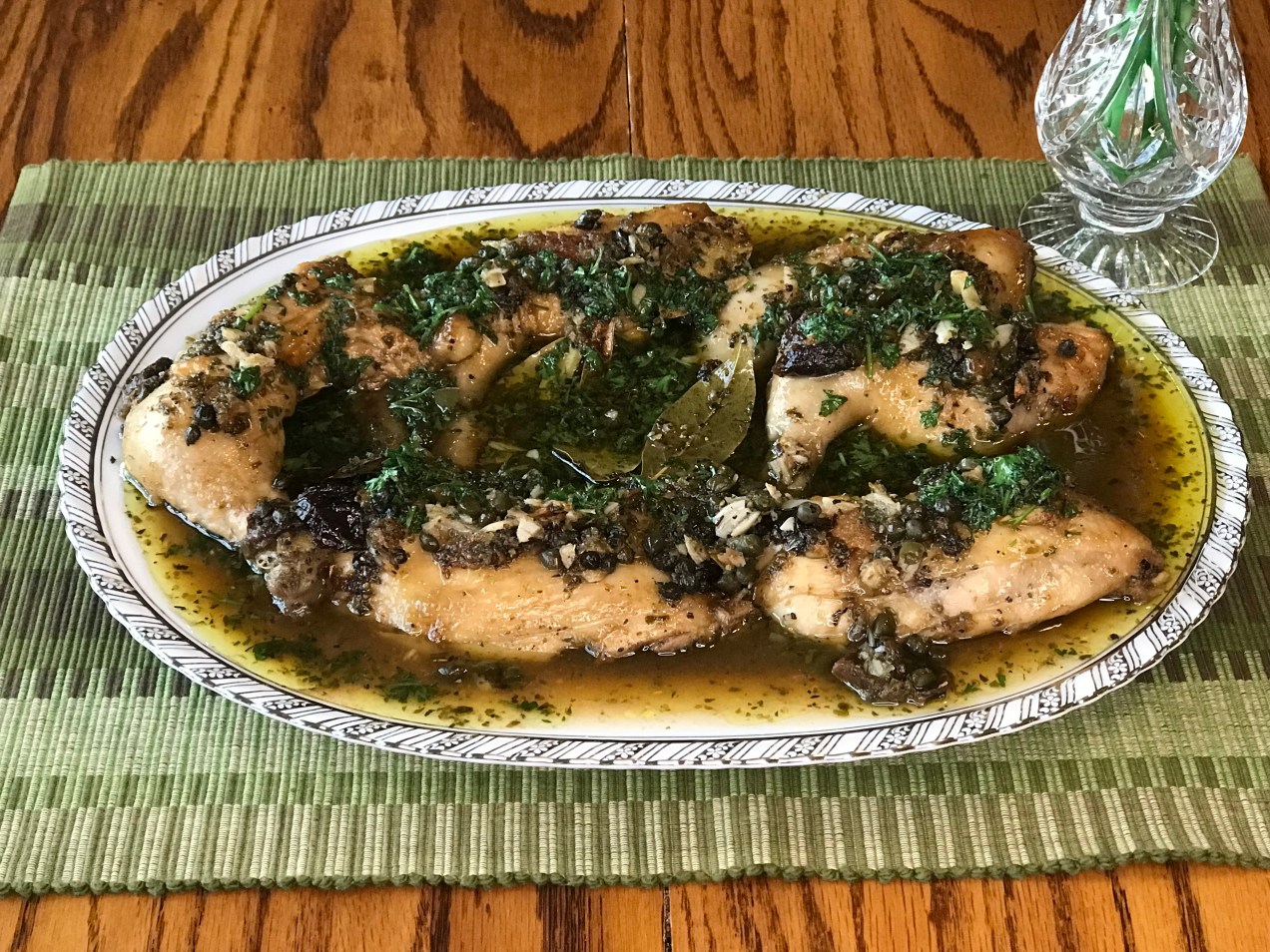
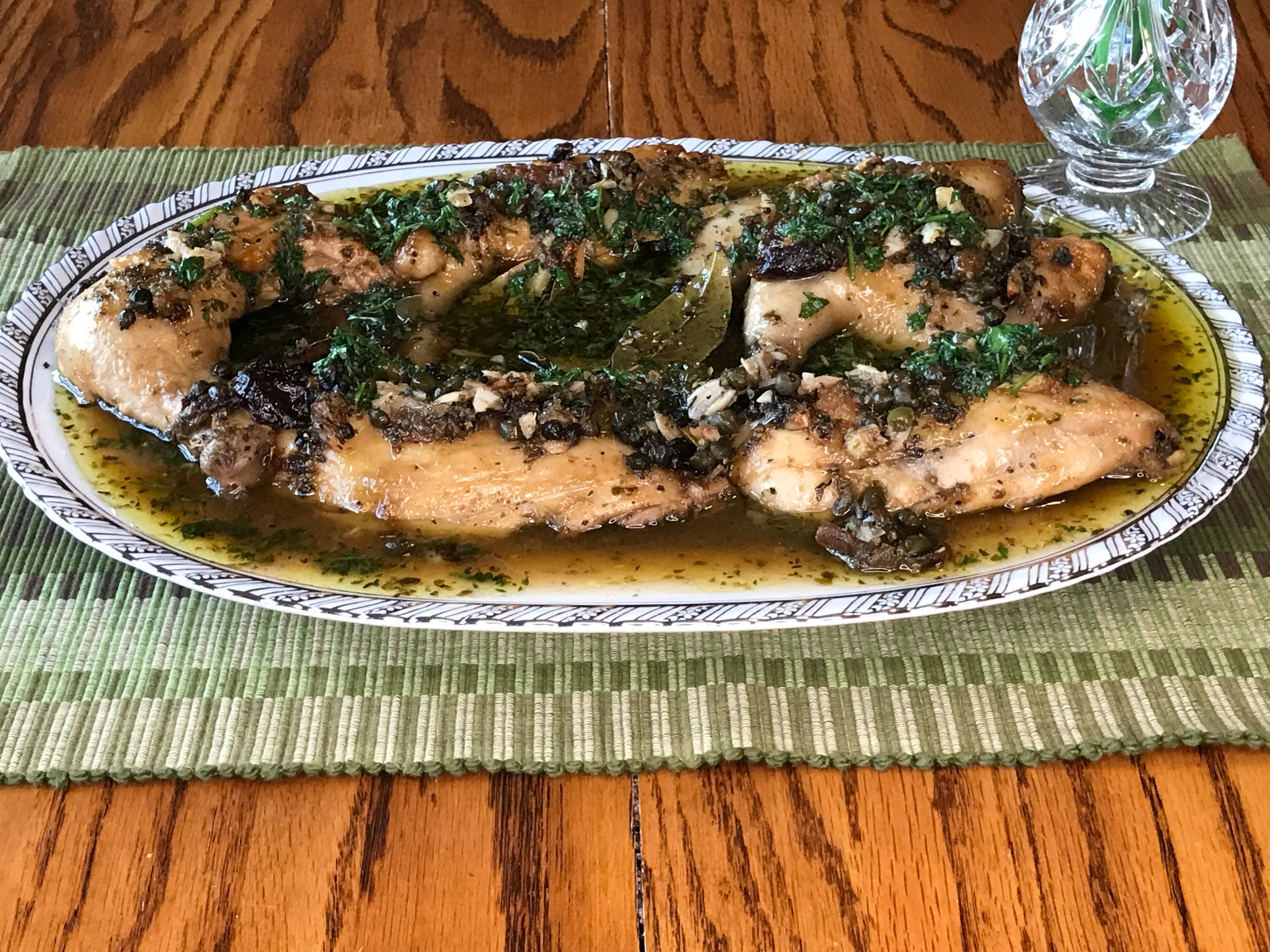
            I’ll admit, I was a little skeptical when I first read about chicken Marbella. Prunes, olives, capers, vinegar, and brown sugar seemed like an odd combination with chicken. The dish was originally developed by the Silver Palette catering company in New York in the late 1970s/early 1980s. It’s very much in the 80s style, vaguely Italian or Mediterranean, and sophisticated for the time. Since the ingredients are fairly inexpensive, I decided to give it a try. Omit the olives (which aren’t generally my favorite) and it’s essentially sweet-and-sour chicken.

            There’s actually a long history of serving meat with sweet, sour, and fruity sauces, that goes beyond turkey with cranberry sauce or duck with orange sauce. Ancient Romans loved complex sauces with any combination of honey, vinegar, wine, fruit, herbs, spices, and the fermented fish sauce garum. Medieval cooks ditched the garum but added sugar, verjuice (pressed from unripe grapes), and citrus juices. If their sauces contained broth or meat juices, they would be combined with these other, strongly-flavored ingredients. Add a few spices and possibly some breadcrumbs to thicken, and the sauce for chicken Marbella sounds positively medieval. And it bears more than a passing resemblance to the agrodolce sauce still popular in Sicily today.

            The recipe on pages 542 – 543 of 1000 Foods to Eat Before You Die by Mimi Sheraton, originally from the Silver Palette Cookbook, was delicious and smelled amazing. The only changes I made were to skip the olives and use chicken leg quarters instead of quartered whole chickens, but I would tweak it a little further. Between the amount of marinade and the amount of liquid released by the chicken while cooking, the serving platter was swimming in sauce. The flavor was great, and the sugar gave the chicken a nice crunchy “crust,” but the mix was extremely sweet. That was despite the dramatic reduction in the quantity of prunes, for the simple reason that the bag, which I had bought for and used in another recipe, wasn’t as full as I thought.

            For a second attempt, I made a few changes. Because I only used about half the amount of chicken, I cut the other quantities in half, producing a pool of sauce instead of a lake. Reducing the amount of sugar from one half to one third cup created a better balance with the vinegar, capers, garlic, and oregano. And pretty much any dried fruit will work. I used a mix of dried apricots, golden raisins, and Zante currants (because that was what I had on hand), to successful results. Turns out the 80s culinary experimenters had some good ideas. I still don’t understand the pasta salads with bottled dressing, though. Or nouvelle cuisine.

Standard
Eggplant Timbale
food history, italian cuisine, pasta, vegetarian

Cook’s Tour of Italy Menu 84 (Pgs. 264 – 265): Timbale of Eggplant and Pasta

Eggplant Timbale

Region: South Mainland/Islands (Sicily)

            As far as I can tell, the plain English definition of timbale is “food, encased in a different type of food, cooked in a mold, then turned out onto a platter to serve.” Timbales, or timballos in Italian, are popular in Sicily, probably originating in the kitchens of wealthy aristocrats. Elaborate versions might include a pastry crust, or rice molded precariously around a complex filling of meats, cheeses, vegetables, and eggs.

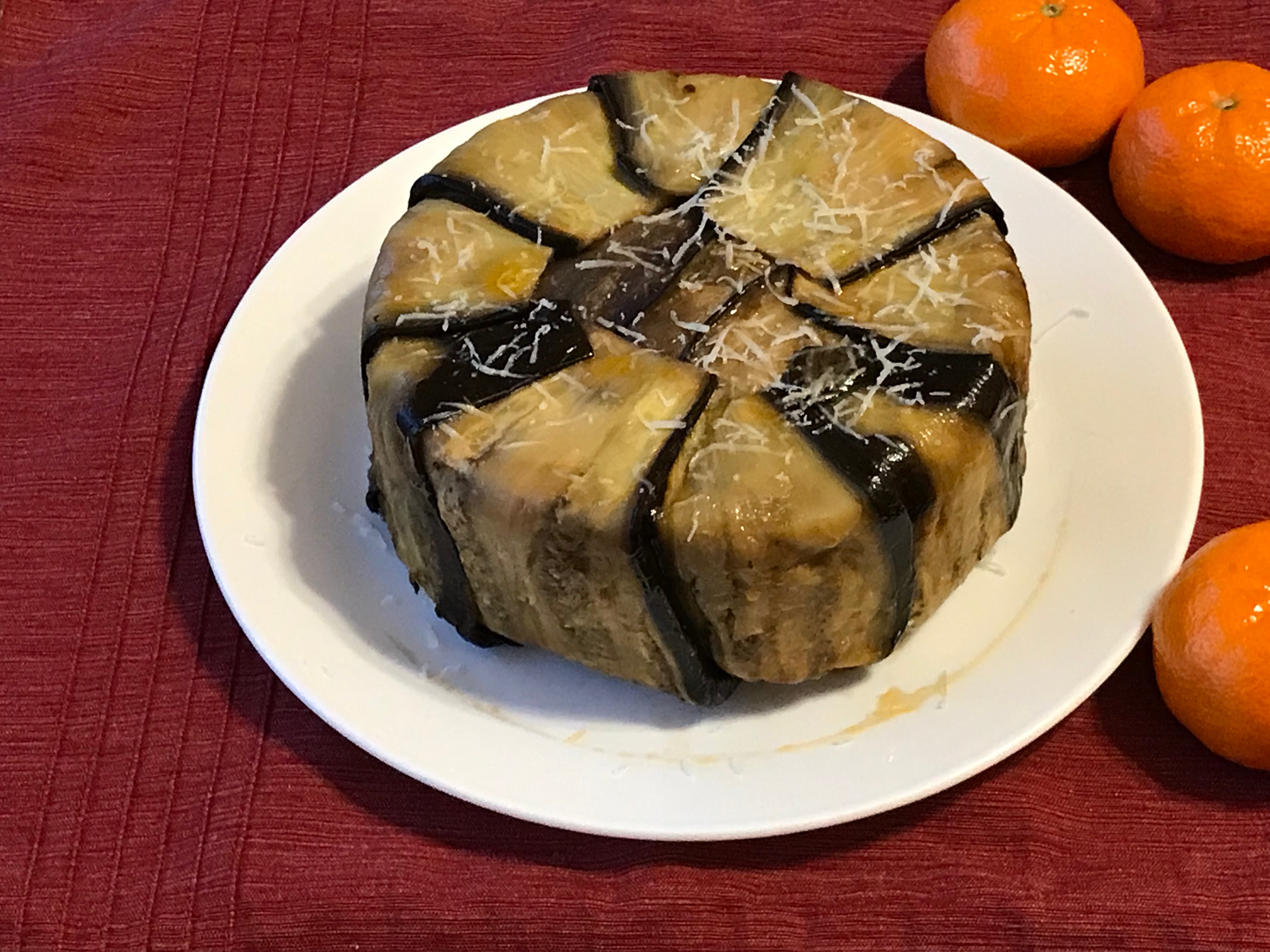
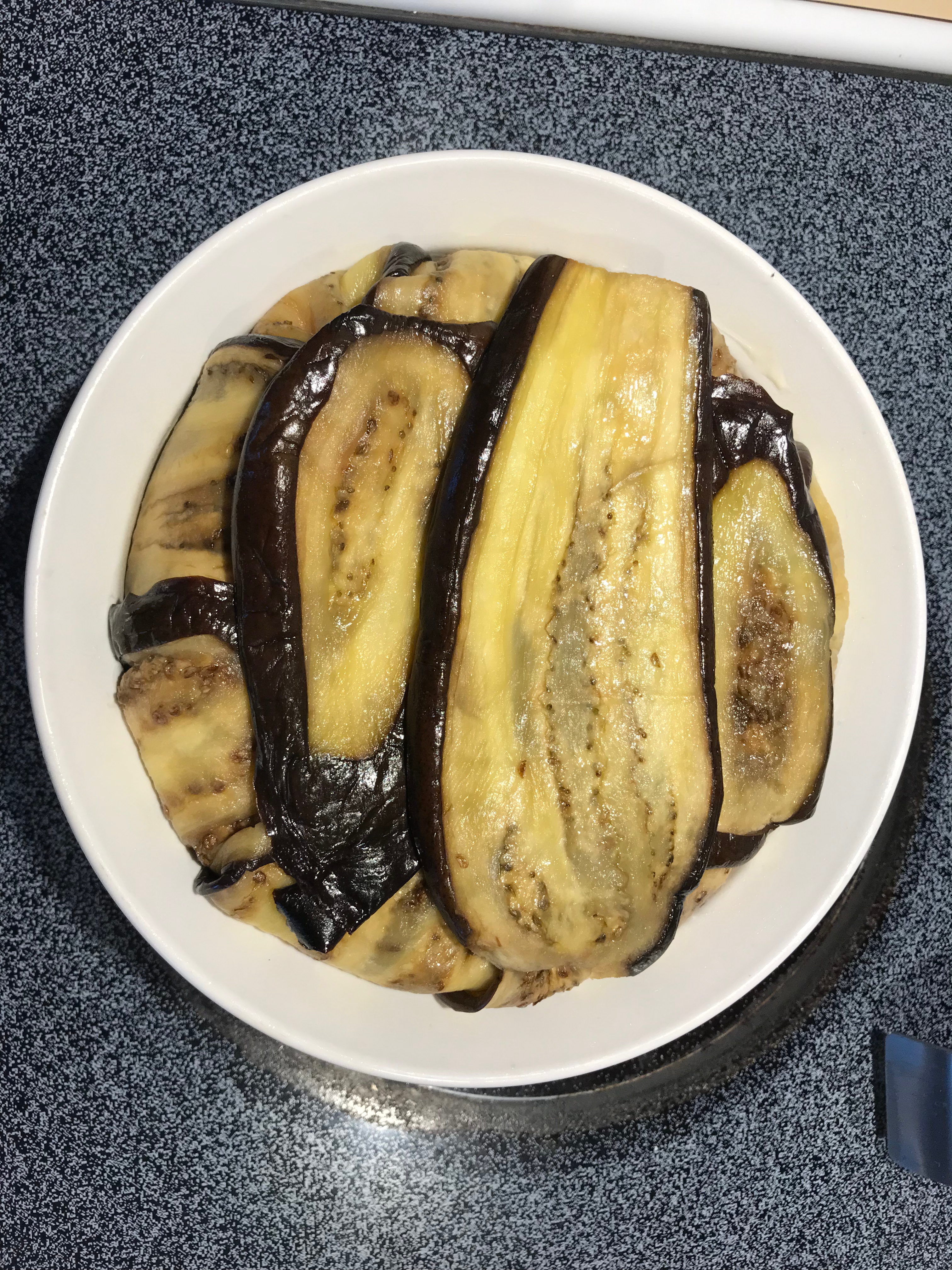
            The recipe here is much simpler, a mix of pasta, tomato sauce, cheese, and eggs, stuffed into an eggplant “shell.” There are two time-consuming steps, preparing the eggplant (slicing super thin, salting, and broiling) and making the homemade tomato sauce, but both can be done ahead of time. In fact, it isn’t a bad idea to make extra sauce, set aside what’s needed for the timbale, and have the rest with meatballs (and the gnocchi you made to clear the semolina flour out of the pantry). It’s also helpful to grate the cheese a day ahead. (And make the hard-boiled eggs the recipe calls for but I omitted.)

            If all of this is done, this fancy-looking timbale is actually feasible for a weeknight. While the water boils and the pasta cooks, you can butter the baking dish, line it with overlapping eggplant slices, and warm the tomato sauce. Then it’s just a matter of mixing the filling, packing it into the mold, covering it with more eggplant slices, and baking.

            Just look how pretty the end result is. It didn’t fall apart when unmolded, and tasted as good as it looked. The timbale isn’t necessarily for every day, but it was easier than I expected and would no doubt be a great way to show off for guests. Just beware that the slices aren’t as pretty as the whole.

Standard
Black-Eyed Susan Cocktail
american cuisine, beverages, food history, recipes

Preakness Stakes Mocktail: The Black-Eyed Susan

Black-Eyed Susan Cocktail

            Tomorrow is the Preakness Stakes, the second leg in the Triple Crown. The Preakness is always run on the third Saturday in May at Pimlico in Baltimore. Some trainers say the two-week turnaround time is not enough for the horses to recuperate, and sometimes the Kentucky Derby winner won’t race. Sovereignty will not race tomorrow, meaning there will not be a Triple Crown winner this year. While not as famous as the Derby, the Preakness is still an interesting event, with two associated food traditions. Since Maryland is associated with blue crab from the Chesapeake Bay, it’s no surprise that the Preakness is known for crab cakes.

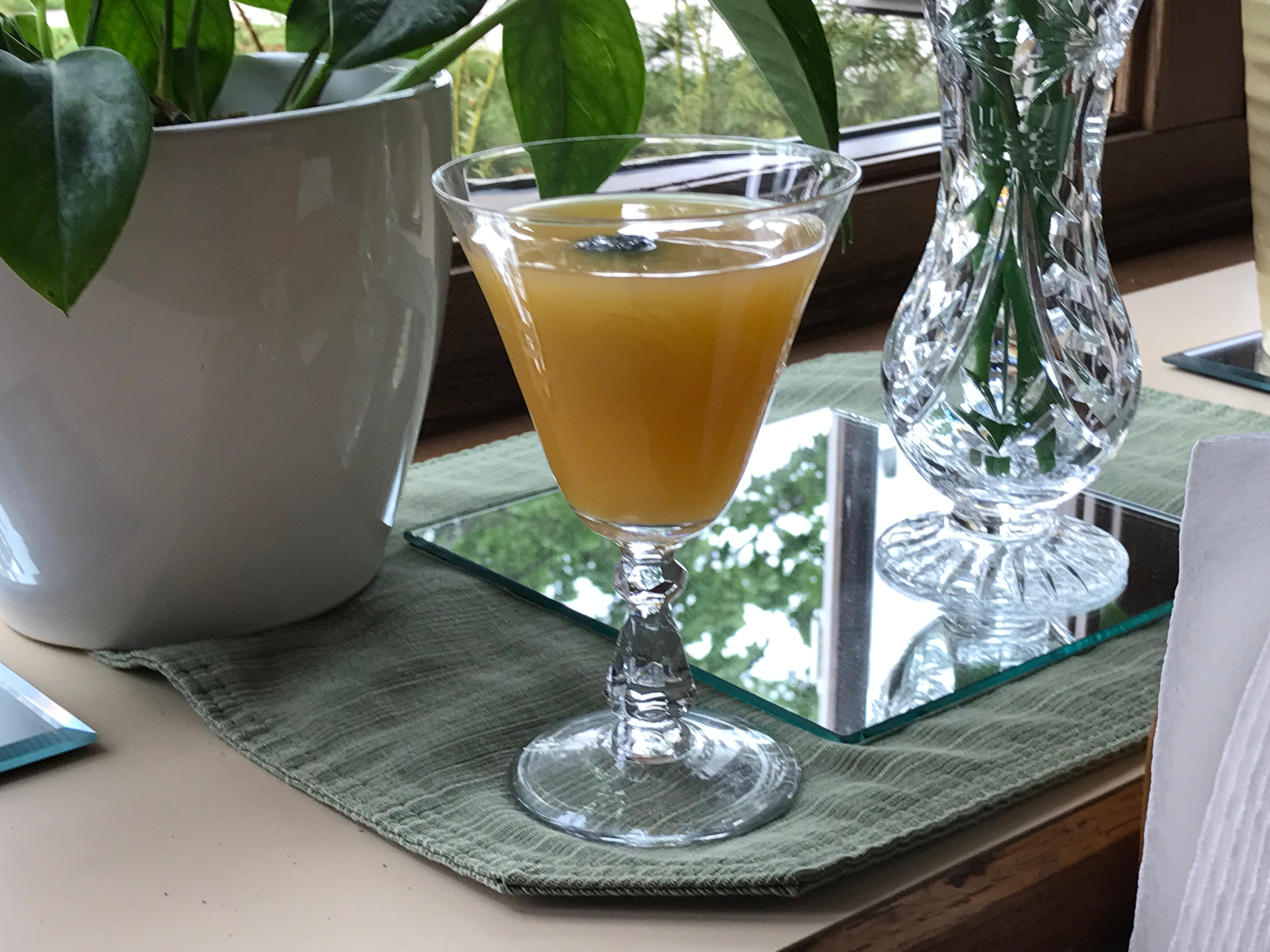
            The Preakness Stakes also has its own signature cocktail, called the black-eyed Susan. Most likely, it was named for the blanket of flowers draped over the winner. The Kentucky Derby has red roses, the Preakness has black-eyed Susans, and the Belmont Stakes has white carnations. Ideally, the cocktail will be about the same yellow-orange color as the flowers. Interestingly, black-eyed Susans are not yet blooming in Maryland.

Photo from Pexels.com

            Unlike the mint julep, the black-eyed Susan never seems to have had an “official” recipe. Invented in the 1970s, ingredients varied over time, even at Pimlico, and according to the drinker’s personal taste. The only constants are orange juice and vodka. Other ingredients might include pineapple juice, grapefruit juice, peach schnapps, rum, or bourbon. Frequently the drink will be finished with a blueberry or blackberry for the characteristic “black eye.” As long as there are at least two fruit flavors, pretty much anything goes.

Black-Eyed Susan Cocktail
Black eye demonstrated here. Definitely a resemblance, in an abstract way.

            Fruity cocktails lend themselves well to non-alcoholic variations. For my own version, I keep things simple with equal parts orange juice, pineapple juice, and tonic water with a bit of peach syrup. The tonic water is the “secret ingredient” that makes non-alcoholic cocktails more complex, and its bitter edge tastes a bit like grapefruit.

Here’s how to make it:

            For each serving, combine 1/3 cup orange juice, 1/3 cup pineapple juice, and 1/3 cup tonic water with a few ice cubes. Stir in a tablespoon of peach syrup (like what’s used in Italian sodas), or more to taste. For a low-alcohol but not completely alcohol-free cocktail, the syrup can be replaced with peach schnapps. If desired, add a blueberry or blackberry. It’s that simple, unlike the system for betting on the race.

            To get notifications of new posts sent straight to your inbox, make sure to subscribe for free. Of course, if you want to make a contribution, you’re more than welcome to.

One-Time
Monthly
Yearly

Make a one-time donation

Make a monthly donation

Make a yearly donation

Choose an amount

$5.00
$15.00
$100.00
$5.00
$15.00
$100.00
$5.00
$15.00
$100.00

Or enter a custom amount

$

Your contribution is appreciated.

Your contribution is appreciated.

Your contribution is appreciated.

DonateDonate monthlyDonate yearly
Standard
Pork Chop Marengo
food history, french cuisine, italian cuisine, recipes

Napoleonic Entree: Chicken or “Veal” (Pork) Marengo

Pork Chop Marengo
Pork Chop Marengo

            Despite his remarkable career, Napoleon Bonaparte had several close calls on his rise to power. One such case was at the Battle of Marengo in June 1800. Napoleon had seized power in a coup the previous year. To secure his rule, he needed military victories. At the time, he was fighting the Austrians for control of northern Italy. They met in battle near the city of Alessandria, in the Piedmont region.

            At first, the battle didn’t go well for the French, but Napoleon managed to snatch victory from the jaws of defeat. His control over Italy was secured, skeptics in France were reassured, and other ambitious generals were discouraged from turning on him. To celebrate, or simply because he was hungry after a long and no doubt stressful battle, Napoleon requested a special dish. Or so the story goes.

            Recipes for chicken marengo vary enormously. The only constants seem to be chicken (or occasionally veal) browned in olive oil, onions, and tomatoes, braised together to make a sort of stew. There’s usually garlic, mushrooms, and white wine. Many recipes include shallots and parsley, and a few use brandy instead of wine. Great chef Auguste Escoffier recommended including fried eggs and crayfish. Regardless of specifics, toasts fried in butter traditionally accompany chicken marengo.

            To make things even more complicated, there seems to be a debate about whether chicken marengo is French or Italian. In Mimi Sheraton’s 1,000 Foods to Eat Before You Die, it’s in the French section, but I’ve also seen recipes in Italian cookbooks. Since the Piedmont region was historically part of the Duchy of Savoy, a realm straddling the Alps between France and Italy and right on the trade routes between them, it’s hardly surprising that a Piedmontese dish would be adopted into French cuisine, or vice-versa. And it’s fitting that an entrée associated with Napoleon should be considered both French and Italian. After all, he himself was a native of Corsica, then ruled by Genoa, but made his career in France.

            For my own recipe, I combined the different strands into one, with no eggs or crayfish. The nice thing about chicken or “veal” marengo is that after browning the meat and making the “sauce,” it can be kept overnight and cooked the following day. Everything can be done in a Dutch oven, but if you don’t have one, a skillet and slow-cooker will also work. If you want to reduce fat and calories, the bread can be toasted dry in the oven or toaster, instead of in the buttered skillet. Or don’t toast it, if you prefer, but whatever you do, don’t skip it. You need bread to soak up the sauce.

Here’s how to make it:

Ingredients:

  • 1 chicken, cut up, or roughly 3 pounds bone-in pork (or veal) chops
  • 2 tablespoons olive oil
  • 4 tablespoons butter, plus more to brown toasts
  • 1 medium onion, quartered and thinly sliced
  • 2 shallots, halved and thinly sliced
  • 4 garlic cloves, crushed with the side of the knife and minced
  • 1 bunch parsley, thick stems separated from leaves and thinner stems, and both parts minced separately (don’t discard the thick stems)
  • 3 tablespoons dry white wine, mixed with 1 tablespoon brandy
  • 2 tablespoons flour
  • 1 (roughly 15 oz) can crushed tomatoes, or about 2 lbs fresh tomatoes, chopped
  • 1 pound mushrooms, cut into thick slices, with larger pieces halved
  • Baguette or Italian bread, to serve

Directions:

  1. Brown meat in the olive oil and two tablespoons of the butter in the skillet or Dutch oven over medium heat. Set aside on a plate.
  2. Add onion and shallots and sauté, stirring frequently, for about 5 minutes, or until they start to turn golden. Add the garlic and parsley stems and cook for 2 more minutes (garlic is added later because it cooks faster and burns more easily).
  3. Stir in the wine/brandy mix, making sure to scrape up any browned bits at the bottom of the pan. Cook until the liquid is mostly evaporated, 5 to 10 minutes.
  4. Add the flour and stir until incorporated. Follow with the tomatoes, and water if using canned. Bring sauce mixture to a boil. If using fresh tomatoes, reduce heat and simmer for 10 to 15 minutes, until the tomatoes break down and release their juice. Add salt and pepper to taste.
  5. Place the meat, skin side up if using chicken, in the Dutch oven or slow-cooker, and cover with the sauce. At this point, the chicken/pork/veal marengo can be refrigerated overnight if desired.
  6. Preheat oven to 325 degrees Fahrenheit, if using Dutch oven. Bake for 2 to 3 hours, until the meat is tender (if the stew was chilled overnight, it will probably be at the longer end of the time range).
  7. If using a slow-cooker, cook for about 4 hours on high or 6 – 8 on low. If it’s a little longer, like if you put it on before leaving for work, that’s completely fine.
  8. Half an hour before serving (with either cooking method), melt the remaining butter in a skillet over medium heat. Add the mushrooms and a little salt and cook, stirring frequently, until soft and aromatic, about 10 to 15 minutes. Add to the stew, pressing them down into the sauce, and leave to cook while browning the toasts (or for 15 minutes if you decide to use untoasted bread).
  9. Toast the bread pieces in a buttered skillet over medium low heat until browned.
  10. Sprinkle the stew with the parsley leaves and serve, toasts on the side.

And as always, please like, subscribe, and/or share to support my work.

One-Time
Monthly
Yearly

Make a one-time donation

Make a monthly donation

Make a yearly donation

Choose an amount

$5.00
$15.00
$100.00
$5.00
$15.00
$100.00
$5.00
$15.00
$100.00

Or enter a custom amount

$

Your contribution is appreciated.

Your contribution is appreciated.

Your contribution is appreciated.

DonateDonate monthlyDonate yearly
Standard
Chicken Waterzooi - Belgian chicken stew with egg, lemon, and cream
belgian cuisine, food history, soup, stew

Belgian Chicken Stew: Waterzooi a la Gantoise

Chicken Waterzooi - Belgian chicken stew with egg, lemon, and cream

            Variants of chicken soup are eaten all over the world. Flavorings might vary, but the concept seems to be pretty universal for non-vegetarians. Historically, this usually involved a rooster or hen past their mating or egg-laying prime. Tough but flavorful, the chicken would be slow-cooked in liquid to tenderize the meat and produce a rich broth.

            One Belgian recipe, called Waterzooi a la Gantoise, involves stewing the chicken with leeks, celery, and parsley root or parsnips, flavoring the mixture with lemon and cream, and thickening it with beaten egg yolks. Odd as this mix might sound, the recipe from 1000 Foods to Eat Before You Die, pages 151 – 152, had a nice flavor.

            Belgium has a long and complicated history. Composed of Dutch-speaking Flanders and French-speaking Wallonia, it was a battleground between France and the Holy Roman Empire for centuries. During the Middle Ages, Flanders in particular grew wealthy from cloth production. Since they needed English wool, attempts by the French kings to shut down the trade during their many conflicts with England predictably let to unrest. So did the kings’ attempts to centralize power in general and levy taxes.

            In the late 14th Century, most of the Low Countries came under control of the Dukes of Burgundy, followed by the Habsburgs a hundred years later. Charles V, the most powerful Holy Roman Emperor in centuries, was born in Flanders in 1500. By the time of his retirement in 1556, his empire included Spain, the Low Countries, Austria, Naples, Sicily, Milan, and Spain’s growing New World empire. All except Austria and the imperial title itself went to his son Philip II.  Charles V’s brother Ferdinand I, who had been his deputy in Austria for years and gained Bohemia and Hungary through marriage, received these, creating the Habsburgs’ Austrian branch.

            Just the Spanish Habsburg territories were a monumental task to control, as Philip II soon found out. He was hardworking but struggled to delegate, which made managing the far-flung provinces difficult. A particular issue was the spread of the Reformation in the Netherlands. Philip was not inclined to compromise on matters of religion, and unlike his father, didn’t spend much time outside of Spain after taking the throne. Feeling alienated by a “foreign” ruler, the Dutch revolted in the 1560s, leading to Eighty Years’ War. They were aided by England, which was part of why Philip sent the Spanish Armada.

            When the dust settled, the modern Netherlands became independent, while modern Belgium remained part of the Spanish Empire. It was transferred to the Austrian Habsburgs in 1714, after the War of the Spanish Succession, and became part of the Revolutionary French Empire in the 1790s. After the defeat of Napoleon, Belgium was ruled by the restored Dutch monarchy. A few decades later, Belgium became independent under Leopold I, an uncle of Queen Victoria.

            After everything they went through, Belgium tried to remain neutral in the 19th and 20th Centuries. With British support, this worked until 1914. When World War 1 broke out, Belgium had a problem. Specifically, Germany’s war plans. Since German high command knew they would be fighting on two fronts, they sought to defeat France quickly, before Russia managed to mobilize its army. The issue was that the French-German border was heavily fortified. The idea, called the Schlieffen Plan, was to go around these defenses by invading through neutral Belgium.

            When Belgium refused military access, Germany declared war on them. Belgian forces put up a tougher fight than expected, giving the French time to reorganize their defense and for British support to land. By December, the Western Front was more or less stabilized, running right through Flanders, where it would remain for roughly three-and-a-half years.

            The initial German advance, the years of occupation, and the eventual retreat in 1918 did a number of Belgium, especially Flanders. Attempts to stay neutral during World War 2 also failed, resulting in another multi-year occupation. Afterwards, finally, Belgium has finally enjoyed several decades of peace.

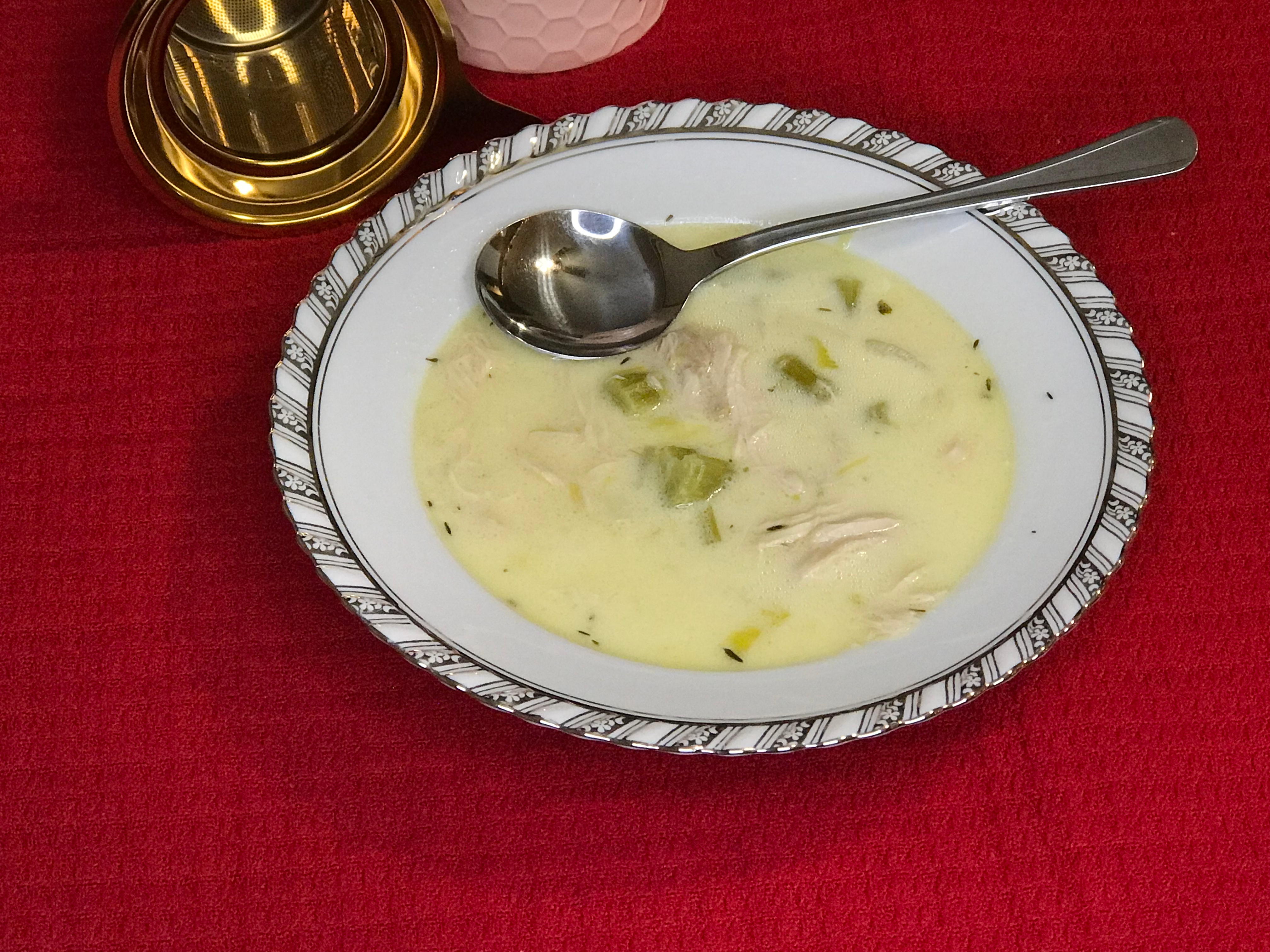
            Evidence of prosperity can be seen the soup recipe, which uses chicken, eggs, cream, and vegetables that are not ultimately eaten. Since using vegetables to flavor the stock but then discarding them offends my sensibilities, I ended up returning them to the pot after removing the chicken skin and bones and straining the broth. The celery and leeks were a little overcooked, but still added some nice extra texture to the soup.

            Immediately before serving, some of the hot broth is whisked into the egg yolks to temper them, then the mixture is returned to the pot to thoroughly heat but not boil. This is the same technique used in making custard, but for some reason the waterzooi didn’t thicken as much as I anticipated. Maybe I used too much water (the recipe said just enough to cover the chicken, which I thought I did). Maybe I didn’t heat the soup long enough after adding the egg yolks for fear of them curdling. Or maybe the issue was my expectations. Custards thickened with egg alone and not boosted with cornstarch are very thin.

            Overall, the soup was very good, but not necessarily worth the trouble of making again as is. Perhaps pureeing the slightly overcooked vegetables into the broth as additional thickening would give it some extra body. (An immersion blender would be great for this.) On a scale of 1 to 10, I would probably give it a 7.

Standard
Arter med Flask - Swedish yellow pea soup
food history, recipes, soup, swedish cuisine

Swedish Thursday Night Special: Yellow Pea Soup and Swedish Pancakes with Lingonberries (with soup recipe)

Information is found in 100 Foods to Eat Before You Die pages 366, 371 – 372, and 340 – 341, soup recipe is my own

            Sometimes, it’s hard to figure out where food traditions come from. According to legend, the Swedish tradition of eating yellow pea soup on Thursday nights came about because on one Thursday night in 1577, that’s how King Eric XIV was poisoned, which raises a few questions. Is eating pea soup a way to memorialize a good king, or the assassination of a bad one? Why was a king eating pea soup anyway? In most countries that was commoner’s fare. Kings and princes, especially in northern Europe, favored piles of meat and fish. Perhaps his doctor recommended a lighter diet, which would add a layer of irony to the story. And how did pancakes become the traditional dessert?

            Regardless of how it happened, yellow pea soup and pancakes are still a Swedish Thursday night tradition, even if not every week. And why not? The soup is a simple mix of dried yellow peas, water, onions, salt, dried thyme, and a little ginger, with optional pork. The recipe on the bag suggested pork ribs, Mimi Sheraton mentioned cured pork in her description on page 366 in 1000 Foods to Eat Before You Die, so I used a smoked ham shank. It added an incredible richness of flavor to the soup, though it would still be good without it.

Arter med Flash - Swedish yellow pea soup
Yellow pea soup with ham

            An interesting thing about the dried peas, aside from being yellow when many Americans are more used to green, is that they aren’t hulled or split. They take a bit longer to cook, but give the soup a much better texture and appearance. The flecks of thyme and ham pieces also improve the presentation. The soup was delicious as is, though a few rye crisps certainly wouldn’t hurt.

            I had a slight problem with the Swedish pancakes. Because the batter is so thin, making multiple small pancakes at once wasn’t working. They just ran together, making one big crepe-like pancake. Since browning is more important, I rolled with it. The finished pancakes are served with lingonberry jam and often whipped cream.

            Lingonberries are small, very tart berries native to Scandinavia. The best way to describe their flavor is about two thirds cranberry, one third sour cherry. Preserved lingonberries have a texture sort of like cranberry sauce, but the berries have softer skins. Jars of lingonberry preserves are available at most stores with an international aisle, and at some larger supermarkets next to the jam. The whole dessert, with lightly browned pancakes, reddish-purple lingonberries, and off-white whipped cream, is just beautiful.

Platter - Swedish pancakes with Lingonberries
Whipped cream is optional, but highly recommended with Swedish pancakes and lingonberries

            Here’s how to make the soup. You will need:

  • 1 lb (or 500g, which is fairly close) dried yellow peas, soaked overnight
  • 1 package (2 pieces, roughly 2 lbs) smoked ham shanks (optional)
  • 1 medium yellow onion, finely chopped
  • 1 tbsp salt (reduce to 1 ½ tsp if using the ham shanks)
  • 1 tsp dried thyme
  • Dash powdered ginger
  • Rye crisps or rye bread to serve, optional but recommended
  1. Combine all ingredients in a pot with 8 cups of water and bring to a boil.
  2. Reduce heat and simmer, with the lid tilted, until peas start to fall apart and ham shanks are tender, about 1 hour. Stir a few times toward the end of cooking.
  3. Turn off the heat, remove the ham shanks to a cutting board, and cover the pot.
  4. Once the ham shanks have cooled enough to handle, pull meat from the bone and cut into bite-sized pieces. Return ham chunks to pot.
  5. Bring soup back to a simmer over low heat, stirring frequently.
  6. Ideally serve with rye bread or crisps, even more ideally followed by Swedish pancakes.

As always, subscribe for free for recipes and trivia, sent right to your inbox. And if you want to buy me another jar of lingonberry preserves, I would be most grateful.

One-Time
Monthly
Yearly

Make a one-time donation

Make a monthly donation

Make a yearly donation

Choose an amount

$5.00
$15.00
$100.00
$5.00
$15.00
$100.00
$5.00
$15.00
$100.00

Or enter a custom amount

$

Your contribution is appreciated.

Your contribution is appreciated.

Your contribution is appreciated.

DonateDonate monthlyDonate yearly
    Standard
    "Sea Bass" in wine with saffron
    food history, italian cuisine

    Cook’s Tour of Italy Menu 56 (Pgs. 178 – 180): “Sea Bass” Menu Near Ancona

    Italian Marches fish dinner

    Region: Umbria/Marches

    Menu: Poached “Sea Bass” with Wine and Saffron, Bruschetta, Broccoli Cooked in Garlic-Flavored Oil, Ricotta with Honey and Thyme

    Recommended Wine: Orvieto (a dry or slightly sweet white)

                In the 8th Century BC, rising population in their homeland led many Greeks to set out and establish colonies. They settled along the coasts of southern Italy, Sicily, Turkey, and the Black Sea, in some cases going as far as southern France, the Spanish coast, and north Africa. Over time, these colonies began setting up their own colonies. For some reason, the process slowed to a trickle by 500 BC. Had the Greeks run out of favorable locations? Did grain imports from Egypt and the Black Sea reduce population pressure in their city-states? Were local populations getting better at resisting the colonists? Or were the colonies, now grown into city-states in their own right, too busy fighting each other to keep expanding?

                Whatever the reason, most colonization was finished when the Golden Age of Athens began in the 470s BC. There were a few exceptions. One of these was the city of Ancona, on Italy’s central Adriatic coast. It was founded by colonists from Syracuse in the 4th Century BC, several decades after the Syracusans crushed the Athenian invasion of Sicily. Ancona prospered but was never a great power, and was absorbed into the expanding Roman Republic in the 3rd Century BC.

                Along Italy’s Adriatic (eastern) coast, various cities and regions feature seafood stews in their cuisine. Supposedly this is a remnant of Greek influence. Regardless, they are an interesting change of pace from grilled, fried, and baked fish, and cook much faster than meat or bean-based stews. It’s typical to serve these fish stews and chowders with bruschetta, to soak up the broth.

    Fish chowder from the Italian Marche region

                Since I couldn’t find sea bass, I used tilapia (I think). With the strong flavors of wine, tomatoes, garlic, and saffron, any affordable white fish would probably work. As promised in the introduction, this is one of the easiest main dishes in the book. Prep is just chopping a few vegetables, and cooking time is under 30 minutes. Personally, saffron is not my favorite flavoring, but the other ingredients balanced its somewhat medicinal flavor. Broccoli, lightly precooked and sauteed in garlic-infused oil, was a pleasant accompaniment, and the green was a pretty contrast with the red tomatoes and yellow saffron.

                Dessert was rather interesting, fresh ricotta drizzled with honey and sprinkled with thyme. I have no problem with supermarket ricotta in lasagna, stuffed pasta, cheesecake, or cannoli filling, but don’t necessarily want to eat straight spoonfuls of it. Since fresh Italian-style ricotta was unavailable, I made my own. To serve, I had a trio of Italian honeys from World Market, chestnut, acacia, and millefiori (wildflower).

    Fresh ricotta with honey and thyme
    Notice the three different colors of honey

                The acacia and millefiori honeys both paired well with the cheese (honestly, I couldn’t tell much difference). The chestnut took some getting used to. It’s dark in color, almost like maple syrup, and has a distinctly bitter edge. Like the saffron, it wasn’t my favorite, but overall, this was a tasty and balanced dinner.

    Standard
    Lindt chocolate bars and truffles
    dessert

    Lindt Chocolate: Mardi Gras Treat

    Lindt chocolate bars and truffles

                Valentine’s Day was a few weeks ago, which meant chocolate was on sale everywhere. With Swiss Lindt chocolate half-price at the grocery store, I couldn’t resist getting a selection. According to Mimi Sheraton on pages 331 – 332 in 1000 Foods to Eat Before You Die, only the plain dark chocolate bars and those with sea salt are worth buying, as are the liquor-filled batons the company makes. Flavored bars and especially milk chocolate are not, apparently. But for the ultimate chocolate experience, the super-dark 90 or 95 percent cocoa bars are the most complex, if you can get past the bitterness.

                Personally, I disagree. No matter how complex and interesting, barely-sweetened chocolate doesn’t taste good. The bitter flavor is unbalanced on its own. It needs enough sugar to counteract it. The idea isn’t to overwhelm the chocolate, but to create a sweet-bitter harmony. Milk chocolate adds another layer of complexity, being sweet, bitter, and creamy. It is no better or worse than dark chocolate, just different.

                I also disagree about the flavored bars and confections. The Lindt dark chocolate with sea salt does taste good, but so does the dark chocolate orange and dark chocolate chili. The milk chocolate is delicious with chopped hazelnuts. And the chocolate truffles are spectacular, with a crunchy shell and smooth, creamy filling. My personal favorite are the dark chocolate ones (in the dark blue bags), but the milk chocolate and a few of the flavored varieties are also worth trying. A bowl full of Lindt truffles, color-coded in brightly-colored wrappers, would be great fun at a holiday party.

                Adults might also enjoy the batons. As far as I can tell, current varieties are filled with kirsch, plum brandy, or orange liqueur. The fruit flavors sound like they would work with the chocolate, but I worry about the alcohol overwhelming the taste. Since they’re only available online in the US and are quite pricey, I didn’t bother. Not when Lindt truffles are easy-to-find.

                During the 19th Century, Swiss confectioners were among the first to produce solid chocolate, and they are still among the best. I would hold off on the chocolate sandwich, though. Supposedly, alpine skiers sometimes snack on a piece of chocolate between two pieces of sourdough bread. If it was a baguette or ciabatta, sure, but not sourdough. And between trips down the bunny hill, not world-class slopes.

    Rating: 10/10 for the truffles, 9.5/10 for the various chocolate bars

    Standard
    Flaeskeaeggekage - Danish bacon and egg pancake
    breakfast/brunch, danish cuisine, food history, recipes

    Danish Bacon-Egg Pancake (Flaeskeaeggekage)

    Flaeskeaeggekage - Danish bacon-egg pancake whole
    Just look at how pretty it is. And it tastes as good as it looks.

    Information found in 1000 Foods to Eat Before You Die (pg. 347), recipe is my own

                Bacon and eggs have been combined for centuries, probably because they both cook quickly on the stove. Most likely, this is why they are often considered breakfast food. I’m not going to get up early enough to make eggs and bacon for breakfast, but some morning people might. It will taste just as good for brunch, lunch, or dinner.

                There are a number of recipes for this difficult-to-pronounce Danish recipe. Variations include the amount of milk to use and whether or not to dice the bacon. I went with Mimi Sheraton’s suggestion to leave the bacon strips whole and arrange them in a star pattern. Another unique touch is to use a bit of potato starch as a binder instead of the flour used in most of the online recipes. It gives the pancake a special, subtle flavor that makes it stand out from all the other recipes involving eggs and bacon.

                According to the internet, most Danish bacon is leaner than American bacon and is sold in cans. When using American bacon, it’s a good idea to pour off about half of the fat from the skillet after cooking it. The egg mixture cooks in the bacon fat, but it doesn’t need the full amount. This is particularly true if you’re cooking the whole package and not just the six slices needed for the recipe. You may as well and have some extra to munch on, since everyone nearby will be drawn to the smell.

    Flaeskeaeggekage - Danish bacon-egg pancake wedge
    Can’t you just smell the bacon through the screen?

                Traditionally, the pancake is flavored with white pepper, sprinkled with chives, and served with buttered rye bread. Depending on what you have, black pepper, green onions, and regular toast with butter and jam are other good options. Such an easy, comfort food dish like this shouldn’t require an extra trip to the store.

                To make it, I simply combined six eggs, a quarter cup 2% milk, a tablespoon potato starch, and a bit of salt and pepper to taste. The omelet/pancake cooks in the still-hot bacon fat over low heat until the bottom starts to brown and the top is almost set. Then add the bacon strips in a star pattern, sprinkle with chives or scallions, and cover the pan to help it set completely. Slice into wedges and serve with toast or rye bread. As a main course, each “pancake” serves two people.

    One-Time
    Monthly
    Yearly

    Make a one-time donation

    Make a monthly donation

    Make a yearly donation

    Choose an amount

    $5.00
    $15.00
    $100.00
    $5.00
    $15.00
    $100.00
    $5.00
    $15.00
    $100.00

    Or enter a custom amount

    $

    Your contribution is appreciated.

    Your contribution is appreciated.

    Your contribution is appreciated.

    DonateDonate monthlyDonate yearly
    Standard