
Canada geese with goslings
food history, spring

Foods Not Eaten: Animal Welfare Concerns

Canada goose and goslings

Foie Gras, Truite au Bleu (blue trout)

Source: 1000 Foods to Eat Before You Die (pgs. 89 – 90, 141 – 142)

            Look how cute those goslings are. Adorable right? These are wild geese, but some domestic species are raised on farms. People still do eat goose and it’s something of a specialty item, but the real money in raising geese is for their livers. Specifically, the fatty livers that result from forcibly overfeeding the birds, which is called foie gras. Geese naturally store extra fat in their livers right before migration, but I’m not comfortable with the force-feeding done commercially. Besides, foie gras is expensive, hard to find, and, again, is liver. Do you recall what the liver does? (It cleans toxins from the blood, which is why most people don’t need cleansing tea/juice/supplements. Your liver has you covered.)

Pair of Canada geese and goslings
Semi-wild, anyway. They’re definitely not domesticated, but can be found hanging out on golf courses, in corn fields after the harvest, on the football field just through the trees, etc.

            Trout aren’t as cute as fluffy goslings, but the process of preparing truite au bleu is even more horrifying. To get the distinctive blue color and make the whole fish curl into circles, the fish need to be quick-cleaned immediately before cooking, then placed in the boiling water while technically still alive. The curling up comes from automatic nerve impulses, and the blue color from a reaction between still-living skin cells and the boiling acidic water. No matter how much it improves the fish’s flavor, it isn’t worth it. Super-fresh fish is a remarkable ingredient in itself. There’s no reason not to dispatch it quickly and humanely. It will still be good. For a blue color, try food coloring.

Standard
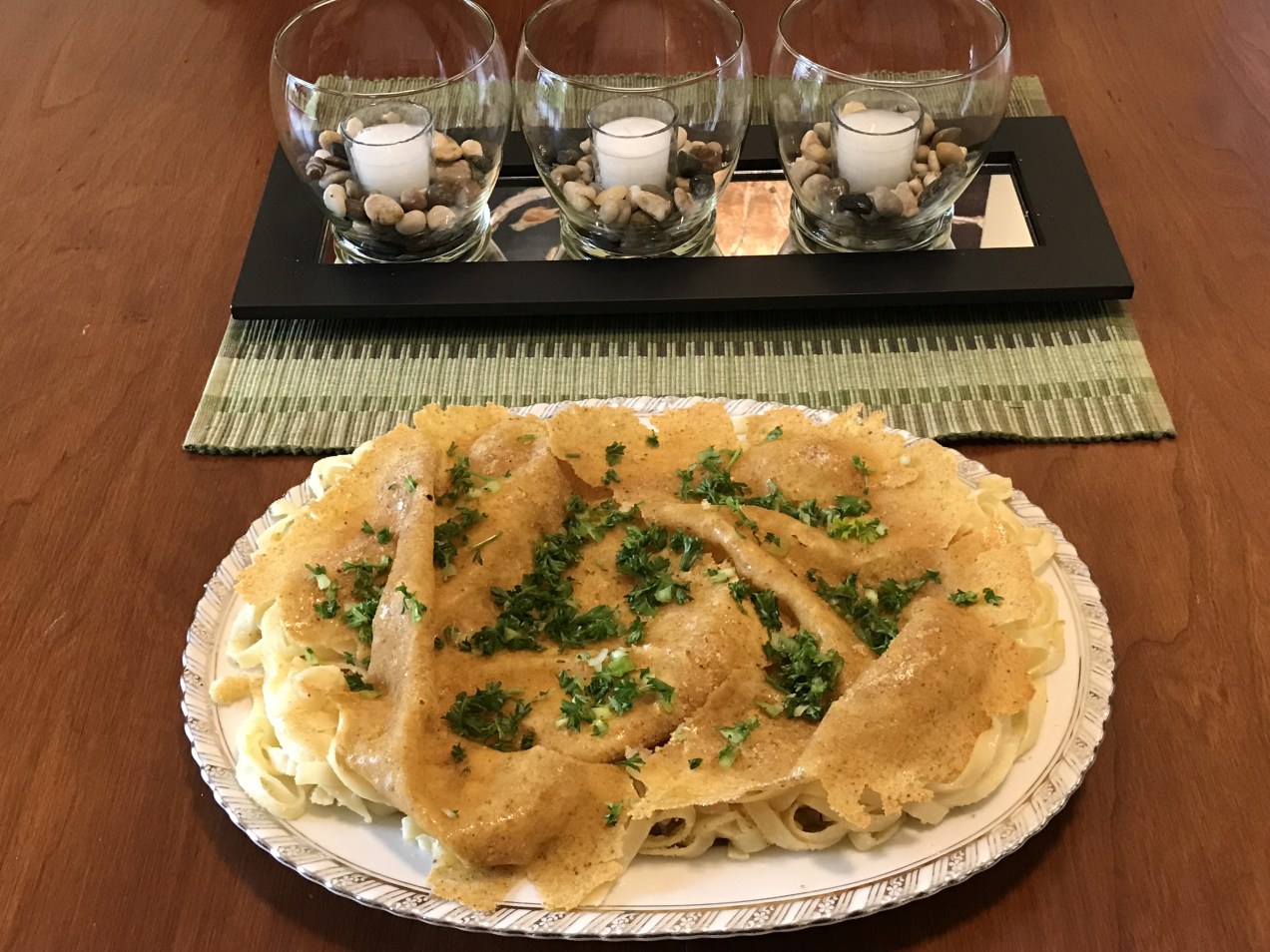
Tagliatelle baked with two cheeses
food history, italian cuisine, pasta

Cook’s Tour of Italy Menu 54 (Pgs. 170 – 171): Tagliatelle Baked with Two Cheeses

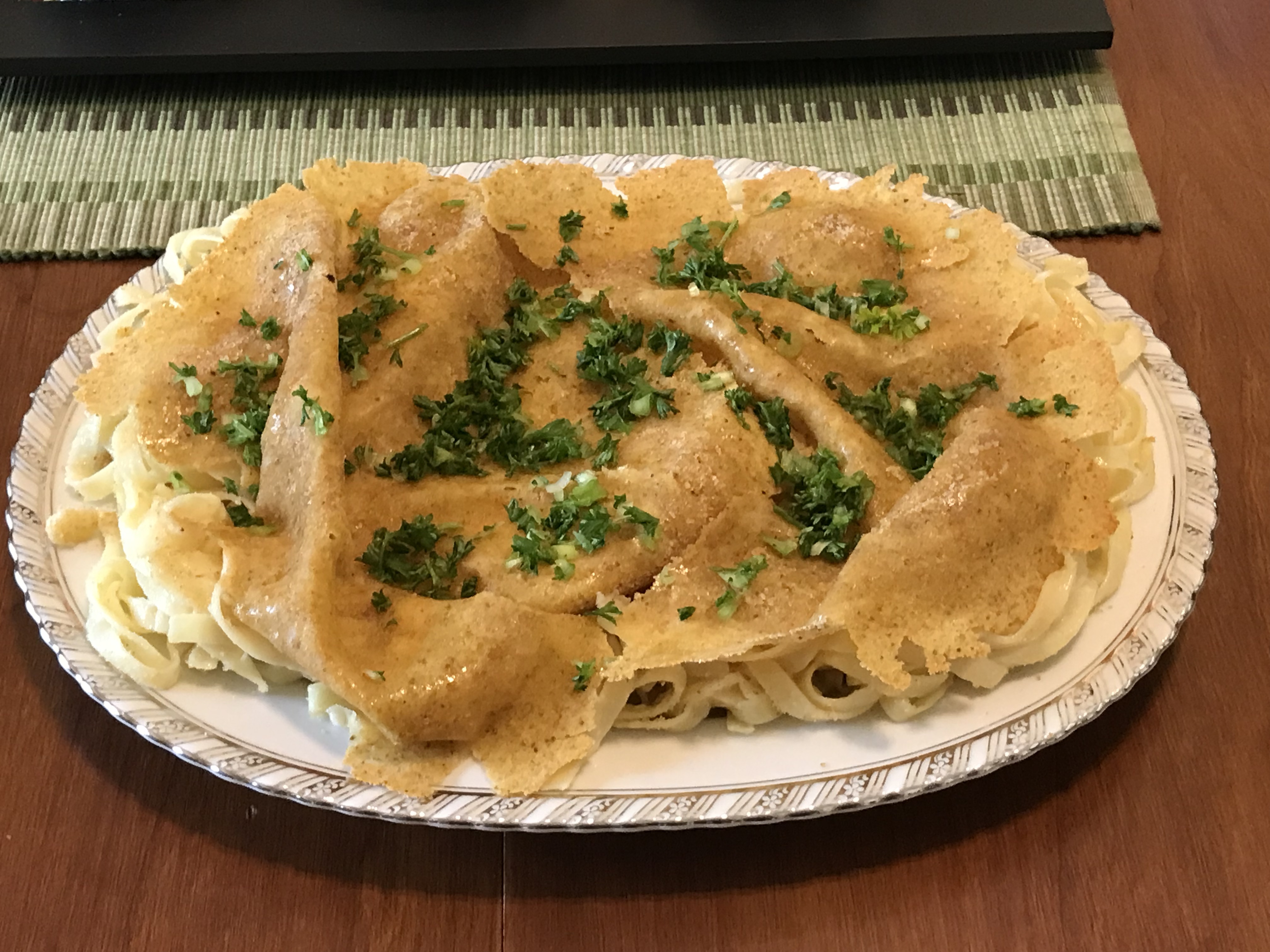
Two cheese baked tagliatelle

Region: Emilia-Romagna

            As mentioned before, Emilia-Romagna is known for its fresh pasta and dairy products. Fettuccine-like tagliatelle is frequently served with Bolognese ragu, which is never served with spaghetti. Wider pasta strands hold the sauce better. Tagliatelle can also be baked with cheese, as it is here. In this case, the two cheeses are Emilia-Romagna’s native parmesan, as well as fontina. More dairy is supplied by butter and cream.

            Parmesan and fontina are both cow’s milk cheeses, which predominate in northern Italy. Here, the cheese is front and center. The only contrast comes from breadcrumbs lining the baking dish and a mix of scallions and parsley minced together. Interestingly, instead of sprinkling the breadcrumbs over the top, the baking pan is buttered, coated in a layer of crumbs, then a layer of egg, then another layer of crumbs. After baking, the whole pan is inverted onto a serving platter.

            I had an issue with the crumb layer sticking to the pan. It was easy to peel off, but the presentation wasn’t as pretty as it could be. And the texture wasn’t what I expected. It was more of an eggy film than the crisp crust I anticipated. Maybe it was supposed to be this way, maybe the extra egg I added because one didn’t fully coat the pan affected the texture. It was good, but in the future, I would just sprinkle the bread crumbs over the top. It’s easier and ensures that they stay crisp.

            This dish reminded me of alfredo pasta, but lighter and with a stronger flavor. The scallions and parsley added a pleasant fresh contrast, and a salad would balance things out nicely. So would a cooked vegetable like green beans, and/or a bowl of fruit for dessert.

Standard
Potted shrimp with toast and greens
british cuisine, food history

Unplanned British Treat: Potted Shrimp

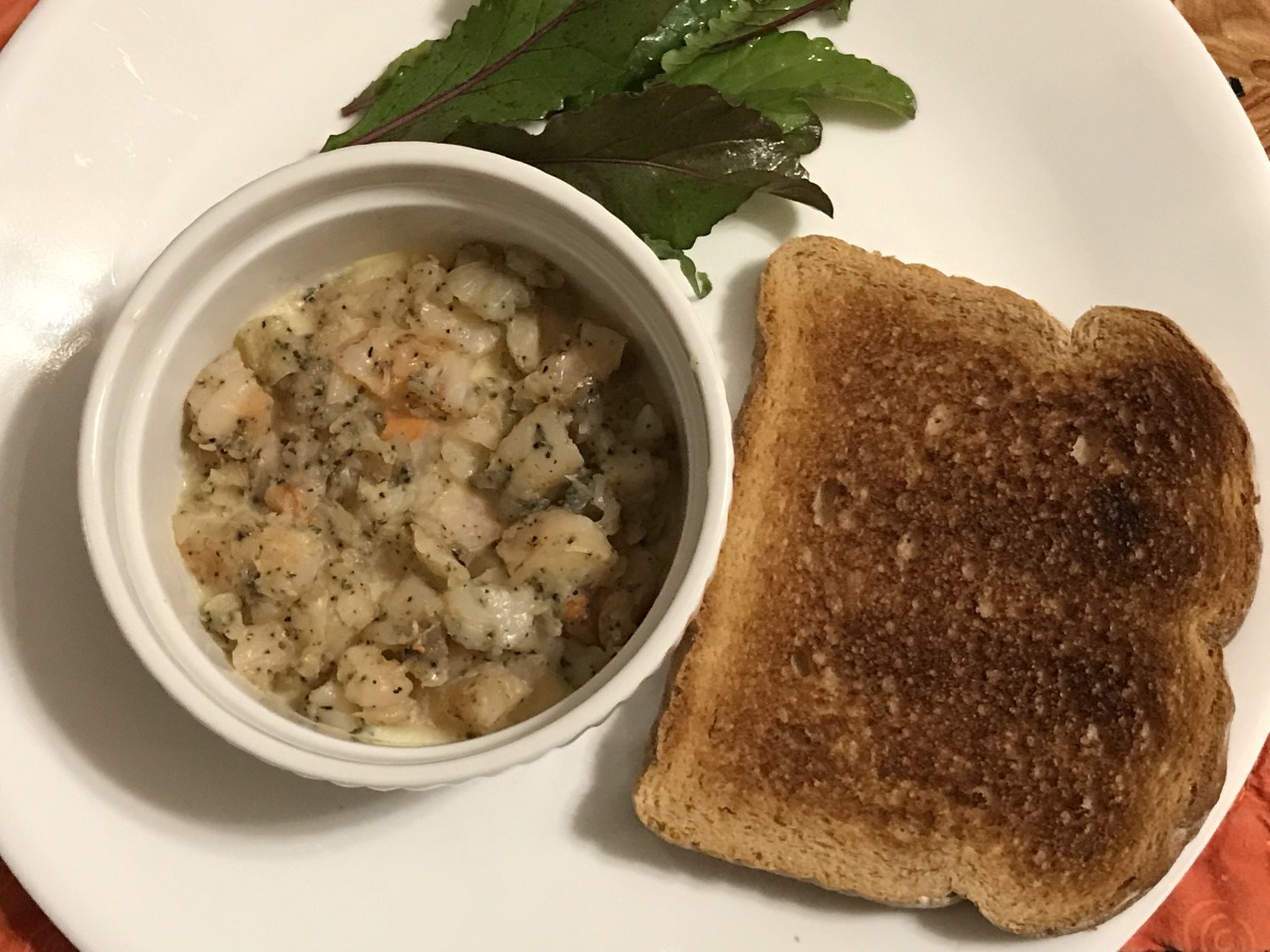
Potted shrimp with toast and greens

Recipe can be found in 1000 Foods to Eat Before You Die on pages 18 – 19

            Before refrigeration, preserving food was always a challenge, particularly for highly perishable things like shellfish. Besides salting, pickling, smoking, and controlled fermentation, cooked meat and fish could be covered in a layer of fat to keep out the oxygen. The French preserved pork in its own fat for rillettes, and duck or goose as confit. For leaner proteins like ham or shrimp, the British “potted” them in ceramic dishes. This process involved mixing the chopped shrimp with melted butter and covering everything with more butter.

            Since shrimp were reduced price for quick sale at the store, I thought I would give this recipe a try. Interestingly, though British cuisine has a reputation for being dull and bland, potted shrimp is traditionally seasoned with cayenne pepper and mace. Once the mixture of shrimp and flavored butter is chilled and solidified, it is served on either salad greens or toast.

            Mace and cayenne pepper might seem odd for a traditional British dish, but both became popular in the 18th Century. Most likely, this has to do with Britain’s growing influence in India. Modified “curry” dishes began to appear in cookbooks, and the long-term Dutch monopoly on nutmeg (mace comes from the same plant) was broken, allowing the British East India Company to bring cargoes of both spices to Europe. A little spice goes a long way in a generally bland diet, especially when fresh food was unavailable for much of the year.

            Note that mace isn’t widely available in grocery stores, but is easy to find in specialty spice stores and online. Because you’ll probably have to buy more than you need, it’s a good idea to buy whole mace and grind it yourself. Whole spices stay fresh for longer.            

The potted shrimp was interesting, but not my favorite preparation. Overnight in the refrigerator, the butter became, for lack of better terms, crumbly and waxy. This may have been due to adding more than the recipe called for, which was not enough to cover the shrimp. Another issue was that the little flecks of ground mace darkened in the refrigerator overnight, which looked alarming since I wasn’t prepared for what looked like ground pepper to appear. Spreading the mixture on hot toast helped with the texture, and the flavor was a nice mix of shrimp, butter, and spice. Not bad at all, though I would prefer the shrimp hot with garlic butter.

Standard
british cuisine, recipes, soup, stew, welsh cuisine, winter

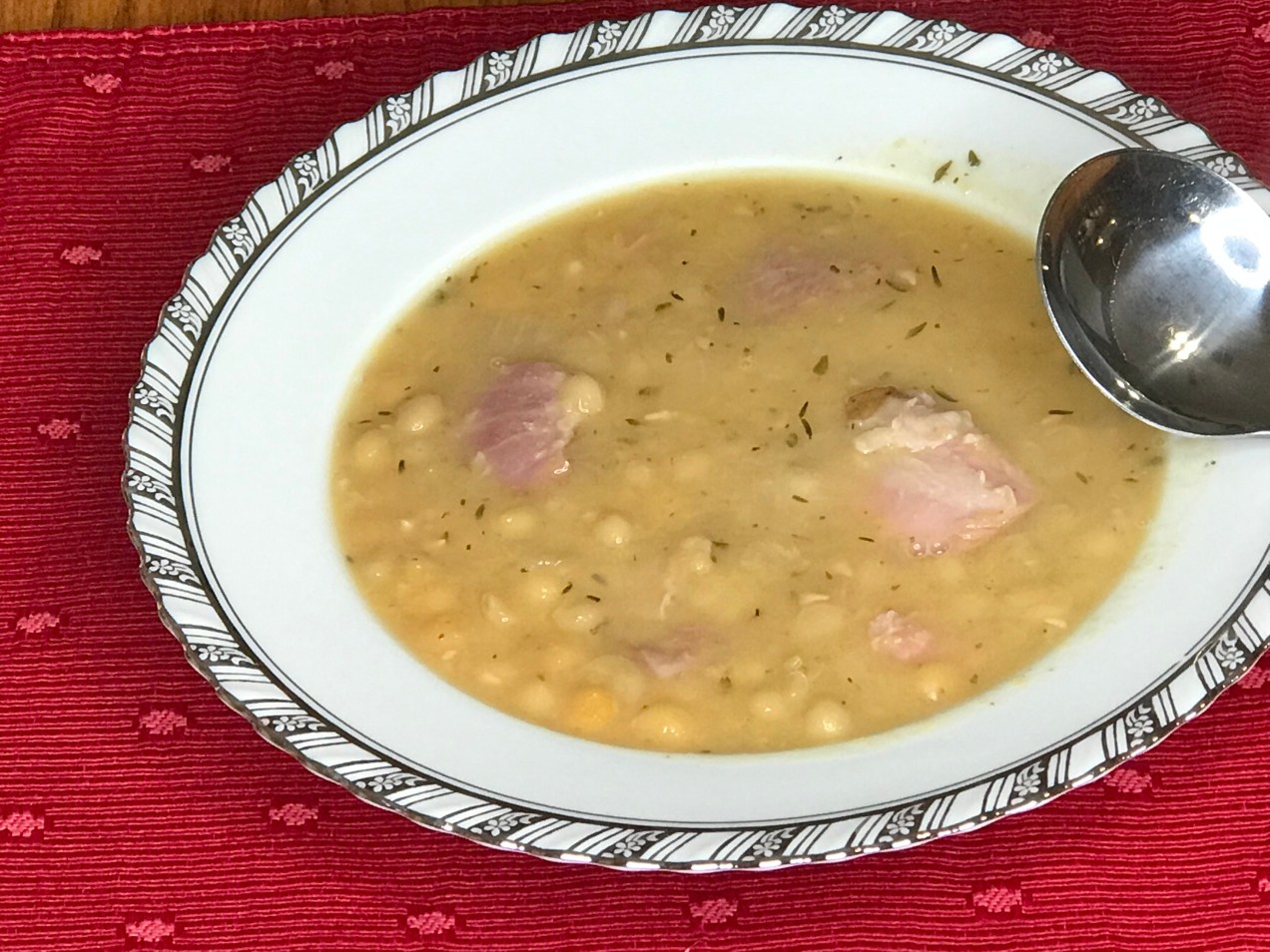
Medieval-Inspired Welsh Soup: Leek Broth

Idea comes from 1000 Foods to Eat Before You Die, pg. 35, recipe is my own

            For some reason, leeks are a Welsh symbol. They are particularly associated with St. David’s Day, dedicated to Wales’s patron saint. Exactly how this happened is unclear, and history doesn’t provide many clues. At some point after 500 BC, Celtic peoples came to dominate the British Isles, including Wales. Starting in 43 AD, the Roman Empire conquered England and Wales, staying until the 5th Century.

            During these centuries, the native population became somewhat Romanized, adopting many Roman customs and, from the 4th Century onward, Christianity. These Romano-Britons spoke a Celtic language similar to Welsh. After the legions left to deal with everything else going on in the 5th Century, Anglo-Saxons from modern Germany began invading the island. The Romano-British chieftains put up a spirited defense, but were gradually pushed west into Wales, which is why the land to the east came to be called “Angle-Land,” later England. Did the proto-Welsh use leeks, which were a favorite of the Romans, to distinguish themselves from the Saxons? It’s possible.

            One of these proto-Welsh chieftains became the basis of the King Arthur legends. In other words, the man behind the myth was Welsh, not English. Perhaps because Wales is hillier and less fertile than England, or perhaps because they were busy fighting first each other and later the Vikings, the Anglo-Saxons mostly left the Welsh alone. After the Norman Conquest in 1066, so did the descendants of William the Conqueror. They were busy fighting rebellious Saxons, building an empire in France larger than what was controlled by the French king, and fighting their relatives over shares in that empire. There were some incursions into Wales, Scotland, and Ireland, but the Anglo-Norman kings of England were mostly occupied elsewhere.

            This changed in the 13th Century, probably because the kings of England lost most of their land in France. With the French kings much stronger than before, reconquest was a difficult proposition. So the English kings turned their energy towards the rest of the British Isles. King Edward I conquered Wales in the 1280s, and from then on heirs to the English throne were called the Prince of Wales. One story goes that the Welsh asked King Edward for a prince that spoke neither English nor French, so he presented them with his infant son, the future Edward II, who did not yet speak any language.

            Unlike Scotland and Ireland, Wales merged into the English monarchy with only a few early rebellions. It remained a culturally distinct backwater, but Welsh longbowmen played an essential role in the Hundred Years’ War. Without them, the English could not have won so many battles against much larger French forces.

            In Wales’s cool, wet climate, raising livestock was more profitable than growing most crops. Oats, barley, rye, and root vegetables grow more easily than wheat. Traditional Welsh dishes tend to be homey and comforting, not spicy and exciting. Not many Welsh specialties are known outside the British Isles, but one of the more famous is leek broth, called cawl cennin in Welsh. It’s a simple mix of leeks, carrots, potatoes, and cabbage, flavored with bacon and thickened with oatmeal.

            Except for the potatoes, this sounds a lot like the thick soups, called pottages, eaten by most medieval Europeans. The ingredients varied by social class and the occasion, but for the common people, vegetable-based soups and bread were the core of the diet. These were supplemented with butter and cheese, some meat and fish (usually salted), fruit in season, and beer, cider, or wine, depending on the region. Leeks and salted pork products like ham or bacon gave pottages more flavor, and vegetables like carrots and cabbages kept reasonably well over the winter. Grains, particularly those like oats and barley that were less useful for making bread, were often added as thickeners.

            Once potatoes became common in the 17th Century, they went into the pot too. Before soup bases and bouillon cubes, water would have been the liquid. Until the 20th Century, chicken was more expensive than beef, mutton, or pork, so there would be no chicken broth in a common, everyday dish. Today, a bit of bouillon or soup base is typical in leek broth, adding extra flavor for just a few cents.

            As far as affordable home cooking goes, leek broth is a great choice. The root vegetables are full of vitamins, and the oats make it taste sort of creamy and surprisingly filling. The soup/stew has a fair amount of starch, but carbohydrates are not the enemy, especially in the form of carrots and whole grains like oats. A chunk of whole grain bread would be a great accompaniment, maybe with a piece of cheese or glass of milk for extra protein. And don’t skip the bacon. Per serving, it does not add that much fat, and a little bit adds a ton of flavor. Which makes a popular New Year’s resolution a bit easier.

Ingredients:

  • About 8 ounces bacon, diced
  • 2 large leeks, halved lengthwise, cleaned, and thinly sliced crosswise
  • 8 ounces carrots, thinly sliced
  • 6 medium-sized red potatoes, cut into roughly ½ inch cubes
  • Half of a small green cabbage, thinly sliced
  • About ½ cup to 1 cup rolled oats (not steel-cut or instant)
  • Chicken broth or water (broth from a soup base is perfectly good here)

Directions:

  1. Place the bacon in a large soup pot over medium heat. Cook until starting to crisp, then add the leeks, carrots, and potatoes. Do not drain the fat. All the other ingredients are healthy, and it is essential for the best flavor.
  2. Cook the root vegetables in the bacon fat with the bacon, stirring occasionally, until the vegetables start to cook down and release their moisture.
  3. Add enough water to cover, about 12 cups. If desired, add 1 teaspoon soup base or bouillon per cup of water.
  4. Bring the soup to a boil, then reduce the heat and simmer, stirring occasionally, until the potatoes are soft.
  5. Stir in the cabbage and oats. Cook on low heat, stirring frequently, until the cabbage softens and the soup begins to thicken.
  6. Ladle the soup into bowls and serve hot. Don’t worry about presentation; leek broth tastes a lot better than it looks.

            For more warming recipes over the next few months, don’t forget to subscribe for free.

One-Time
Monthly
Yearly

Make a one-time donation

Make a monthly donation

Make a yearly donation

Choose an amount

$5.00
$15.00
$100.00
$5.00
$15.00
$100.00
$5.00
$15.00
$100.00

Or enter a custom amount

$

Your contribution is appreciated.

Your contribution is appreciated.

Your contribution is appreciated.

DonateDonate monthlyDonate yearly
Standard
british cuisine, food history, recipes, winter

Shepherd’s and Cottage Pie: The Surprising Reason for a Mashed Potato “Crust”

Idea comes from 1000 Foods to Eat Before You Die, pg. 24, recipe is my own

            Strictly speaking, shepherd’s pie involves mutton or lamb. If ground beef is used, as is often the case, it is technically cottage pie. Technicalities aside, the term shepherd’s pie is widely used for either. The important thing is that the ground meat and vegetable filling is baked under a thick layer of mashed potatoes. Whenever it’s dreary, snowing flakes the size of your palm, or 0 degrees outside, either is a great home-cooked dinner.

            The ingredients are simple enough. As for why what is clearly a casserole is called a pie, the answer has to do with grain shortages in 18th Century Britain. Stick with me, I promise the explanation will be brief. At the time, population was rising rapidly. So were agricultural yields, but not as quickly. This meant higher prices for bread and other flour-based products, the essential staple for most of the population.

            Fortunately, residents of the British Isles accepted the potato earlier than most Europeans. They still preferred grain, but potatoes provided some protection from bad harvests and rising food prices, and became increasingly important during the 18th Century. Most sources suggest that shepherd’s and cottage pie originated then. Cooking a meat filling in a pastry crust had long been popular. As a cost-saving measure, Britons began to ditch the pastry, top the filling with mashed potatoes, and call it a pie. These new “pies” were easy to make, stretched pricey meat with the cheapest foodstuff available, and tasted good.

            Then came the 1790s. The grain harvests of 1794 and 1795 were low, leading to widespread hunger and unrest. Nervous because of the recent French Revolution, Britain’s upper classes decided to voluntarily reduce their consumption of flour, particularly refined white flour. While this would have only been a drop on the bucket in terms of actual grain saved, it was an important symbolic gesture. Even the royal family got in on the action. Not wanting to give up their beloved pies, well-off Britons took the shepherd’s/cottage pie idea and fancied it up, baking the meat and potato mix in ceramic dishes designed to look like elaborately molded pie crusts.

            The popularity of the mashed potato pies continued long after the grain shortage was over. During the Victorian Era, recipes were widespread in the cookbooks targeted toward comfortably off but not wealthy women. At the time, it was common to buy a large piece of meat for a big Sunday roast dinner, then use the leftovers in other dishes for the rest of the week. Since raw meat could not safely be stored in the days before refrigeration, and daily trips to the butcher were a hassle, these recipes utilized leftover cooked meat, typically mutton or beef.

            As one poem put it, “hot on Sunday, cold on Monday, hashed on Tuesday, minced on Wednesday, curried Thursday, broth on Friday, cottage pie Saturday,” was a way to reuse and repurpose leftovers. This seems like an extreme example for several reasons, including the size of a roast needed to last for an entire week, and more importantly, keeping it edible without refrigeration FOR SIX DAYS. Even when cooked, that seems like a tall order, especially during the summer. Why not visit the butcher twice a week, and have more variety with beef for 3 – 4 days, and mutton for the other 3 – 4?

            Today beef is more common for shepherd’s pie, and the meat usually starts out raw. While I enjoy repurposing leftovers, using raw meat allows the beef or lamb fat to flavor the gravy, which is why I don’t drain it in this recipe. This can be made right in the skillet with the meat and vegetables. Just add a bit of flour to form a roux with the fat, then some broth to make a gravy.

            Like many popular British dishes, shepherd’s pie falls firmly in the comfort food category. It can even be assembled ahead of time and refrigerated, though this will mean a longer baking time. Leftovers are equally delicious. Just don’t store them for days at room temperature.

Ingredients:

  • About 1.5 pounds ground chuck (or lamb/mutton)
  • 8 ounces carrots (about 3 large ones), sliced, with larger pieces halved
  • 1 onion, halved and thinly sliced
  • Several sprigs parsley, minced
  • Worcestershire sauce and black pepper to taste
  • Several dried mushrooms, broken into small pieces (optional)
  • 8 oz frozen peas (optional)
  • ¼ cup flour
  • About 2 cups beef broth (I use reduced sodium broth from a carton. It’s convenient, and regular often makes dishes too salty)
  • About 3 pounds potatoes, peeled if desired (I typically peel russets but not red or yellow potatoes)
  • Milk and butter for mashing potatoes
  • Cheddar cheese

Directions:

  1. Cut the potatoes into large chunks and bring to a boil in salted water. Cook until easily pierced with a fork, about 10 – 15 minutes. Drain, return to pot, and mash with butter, milk, and salt to taste. Set aside.
  2. Meanwhile, place the ground meat in a large skillet over medium heat, leaving in one chunk at first. This allows for better browning.
  3. Once the meat is browned on the one side, break it up with a spatula or a potato masher and cook, stirring occasionally, until only a little pink remains. Don’t drain the fat, because it flavors the gravy.
  4. Add the onions, carrots, parsley, and, if desired, peas and mushrooms to the skillet. Season with several dashes or Worcestershire sauce and plenty of freshly-ground black pepper. Cook until vegetables have softened and begun to cook down.
  5. Sprinkle flour over meat and vegetable mix and stir to combine. Add the broth, a little at a time, until a gravy forms. Taste for salt, pepper, and Worcestershire, adding more if desired.
  6. Preheat the oven to 350 (degrees Fahrenheit) if eating right away. Spread the meat mixture evenly over the bottom of a 13 x 9 baking pan. Top with the mashed potatoes, smoothing to the edges with a spatula. Top with the cheese.
  7. Bake for about 20 minutes, until the cheese is melted and bubbly. If made ahead and chilled, this will take 40 – 50 minutes.
  8. Let the shepherd’s pie rest for a few minutes before enjoying.

            More baked and stewed comfort will be coming over the next few months, so be sure to subscribe.

One-Time
Monthly
Yearly

Make a one-time donation

Make a monthly donation

Make a yearly donation

Choose an amount

$5.00
$15.00
$100.00
$5.00
$15.00
$100.00
$5.00
$15.00
$100.00

Or enter a custom amount

$

Your contribution is appreciated.

Your contribution is appreciated.

Your contribution is appreciated.

DonateDonate monthlyDonate yearly
Standard
dessert, food history, recipes

Medieval Fall Treat: Baked Apple Compote

            Apples have been associated with fall and the harvest for thousands of years. Many varieties can be kept in a cool cellar over the winter, but they are at their best when fresh and crisp. In a historical fiction book I’m in the process of writing, Marguerite of France enjoys a variety of apple dishes when she arrives at the English court to marry King Edward I in September 1299. Apple pies already existed, but the pastry crust was not meant to be eaten. It was used as a vessel to cook and store the filling.

            With that in mind, I opted to recreate the recipe in a covered ceramic dish. The apples steam just like they would in a pastry crust, with a lot less effort. Medieval cooks baked apples with cinnamon just like cooks do today, but it wasn’t the only spice. The 14th Century cookbook The Forme of Cury features a recipe seasoned with cinnamon, sugar, ginger, and dates. Presumably the dates balanced the flavor at a time when apples were not as sweet and less sugar was used.

            As strange as ginger and dates sound with baked apples, they’re actually delicious. Minced candied ginger is especially good, creating little bits of aromatic heat. It can be found in many grocery stores with the little bags of bulk spices.

            Like with a pie, the apples take a while to bake, at least 45 minutes, but are worth the wait. They taste a lot like apple pie without the crust. And with only 1.5 teaspoons of sugar per apple, plus a little bit in the ginger, they are pretty healthy too. As far as peeling the apples, I prefer not to. The pectin in the peel helps thicken the syrup as the compote stands.

Ingredients:

  • 4 large apples (I like Cortlands, but any relatively firm, not-too-sweet apple will do)
  • 6 pitted dates, halved and chopped
  • 2 tablespoons cinnamon sugar
  • 4 pieces candied ginger, minced

Directions:

  1. Preheat the oven to 350 degrees.
  2. Peel the apples if desired, and cut into large cubes, about ¾ inch to 1 inch. If you have one of the tools that cores an apple and cuts it into wedges, that’s perfect. Cut each wedge into 3 or 4 pieces.
  3. Place the chopped apples into an oven-proof ceramic dish. Sprinkle with the cinnamon sugar, dates, and ginger, and stir to combine.
  4. Cover the dish with a glass cover or aluminum foil and bake for 45 minutes to an hour. For semi-authenticity, do not stir while baking.
  5. When the apple mixture is soft and aromatic, remove from the oven. Carefully remove the lid. Stir to distribute the liquid collected at the bottom of the dish.

            For more recipes, stories, fun facts, and maybe some historical fiction excerpts, make sure to subscribe for free.

One-Time
Monthly
Yearly

Make a one-time donation

Make a monthly donation

Make a yearly donation

Choose an amount

$5.00
$15.00
$100.00
$5.00
$15.00
$100.00
$5.00
$15.00
$100.00

Or enter a custom amount

$

Your contribution is appreciated.

Your contribution is appreciated.

Your contribution is appreciated.

DonateDonate monthlyDonate yearly
Standard
food history, sauce, summer

Chimichurri: Argentine Steak Sauce

Steak with chimichurri is a delicious summer treat

            Across central Argentina, grasslands called the Pampas cover a vast area. Ever since Spaniards arrived in the 16th Century with cattle, beef has been a major industry. The region even had its own cowboys, called gauchos. Naturally, Argentine cuisine has developed a number of excellent beef recipes over the last five centuries, but the most famous is actually a sauce that goes with the meat. It doesn’t even have to be paired with beef, though it usually is.

            Chimichurri belongs to an ancient tradition of green sauces made of chopped or ground herbs moistened with vinegar and/or oil. They were eaten in Ancient Rome, across Medieval Europe, and modern variations include pesto, salsa verde, and the North African chermoula. Chimichurri is based on parsley, cilantro, and garlic, combined with other herbs and often peppers or tomatoes. In the Spanish/Mediterranean tradition, the liquids are olive oil and vinegar.

            When Spaniards first reached the Americas, they struggled to adjust to the available food options. In particular, they missed wheat bread and wine. To remedy their homesickness, the Spanish and Portuguese introduced a variety of plants and animals, with varied success. The Pampas were perfect for grazing cattle, sheep, and horses. Salted beef was an essential provision for the long voyages of discovery and trade. To produce it, an entire gaucho or cowboy culture evolved.

            Grapevines grew well in other parts of Argentina, a huge boon for Spaniards used to wine and vinegar. This made Argentina the natural birthplace for beef with chimichurri, which took a surprisingly long time to become popular in the US. As far as I can tell, it’s only become trendy in the last decade or so, and is still uncommon on restaurant menus. Admittedly, I don’t eat out much and definitely not at fashionable restaurants, so maybe I’m mistaken. But “fancy” South American steak sauce is easier to make at home than excellent hashbrowns, so I’ll stick to diners and making my own chimichurri at a fraction of the cost.

            Summer (or the hot days of early fall) is grilling and fresh herb season, making grilled steak with chimichurri a nice hot weather treat. In 1000 Foods to Eat Before You Die, Mimi Sheraton provides a recipe, which I adjusted to my taste. The essential ingredients for a bright, verdant flavor are cilantro, parsley, garlic, vinegar, and oil. Beyond that, some people include oregano, thyme, bay leaves, sweet and/or hot red pepper, or tomatoes. My recipe just uses oregano for depth and hot pepper flakes for a bit of kick. For the right texture the ingredients should be finely minced together. If using a food processor, watch carefully while pushing the pulse button. You want visible pieces of herbs, not a puree.

            Ingredients:

  • 1 bunch cilantro
  • 1 bunch Italian or flat-leaf parsley
  • Leaves from 2 sprigs oregano
  • ¼ yellow onion
  • 2 garlic cloves, peeled and crushed with the side of a knife
  • Pinch red pepper flakes
  • 2 tablespoons red wine vinegar
  • ½ cup (8 tablespoons) olive oil
  • Salt

            Directions:

  1. Coarsely chop the cilantro, parsley, oregano, onion, and garlic.
  2. Combine the herbs, onion, garlic, and red pepper flakes on the cutting board. Mince together.
  3. Place the herb mixture in a bowl, add the vinegar, olive oil, and a pinch of salt, and stir.
  4. Let the chimichurri rest at room temperature for at least an hour.
  5. Serve with beef, another protein, potatoes, or eggs. Bring any leftovers to room temperature before enjoying.

            Any leftovers are especially good with scrambled eggs. Chimichurri keeps well for several days. The herbs will eventually lose their color due to the acid in the vinegar, but this will not affect the taste. A similar meat, poultry, vegetable, or anything sauce is the North African chermoula, which I will be making soon. To get this and other recipes sent straight to your inbox, make sure to subscribe.

One-Time
Monthly
Yearly

Make a one-time donation

Make a monthly donation

Make a yearly donation

Choose an amount

$5.00
$15.00
$100.00
$5.00
$15.00
$100.00
$5.00
$15.00
$100.00

Or enter a custom amount

$

Your contribution is appreciated.

Your contribution is appreciated.

Your contribution is appreciated.

DonateDonate monthlyDonate yearly
Standard
food history, recipes, turkish cuisine

Even More Walnuts: Cerkez Tavugu (Turkish chicken with walnut sauce)

            This dish’s name, Cerkez tavugu, literally translates to “Circassian chicken.” Supposedly, the combination of shredded chicken in a creamy walnut sauce originated in Circassia, a region east of the Black Sea and just north of the Caucasus Mountains. Now part of Russia, Circassia was controlled by the Ottoman Empire for much of the Early Modern Era. During those centuries, the recipe was carried around the empire, hence the Turkish name and similarities to Greek skordalia and Balkan scordolea.

            The primary difference between the sauce for Circassian chicken and walnut scordolea is in the flavoring. Both use garlic, but the Turkish version replaces some of it with onion and seasons the dish with paprika. Traditionally, hot paprika is used, but I use sweet paprika and cayenne pepper to better control the heat. That ensures plenty of paprika flavor, with exactly as much bite as desired.

            Paprika, a blend of dried ground peppers, may have reached Turkey in two ways. From 1519 to 1556, Spain, much of the Low Countries, Naples, Sicily, part of Germany, Austria, Bohemia, and Hungary were all part of the empire of Charles V. Sweet and hot peppers might have been brought to Europe by the Spanish, who spread them across the Habsburg Empire. On their eastern frontier, Charles V, his brother Ferdinand I, and their descendants fought the Ottomans off and on for centuries. As the frontier shifted back and forth, peppers and paprika may have entered the Ottoman Empire via Hungary.

            Another possibility is that the Portuguese acquired peppers on their own voyages of exploration or from the Spanish. From there, peppers could be introduced across their vast trade network around the coasts of Africa, India, and into Indonesia and Malaysia. Unlike Europeans, who looked at hot peppers and mostly shrugged, Africans and Asians went crazy for them. Once chili peppers were introduced to Africa, they could have reached the Ottoman Empire through their holdings in Egypt and the North African coast.

            Regardless of how it got to Turkey, paprika and cayenne pepper make for an amazing sauce with an evolving flavor. When you first take a bite, it tastes slightly sweet. Then it’s sour and creamy, followed by a spicy finish.

            Ingredients:

  • 2 chicken breasts, ideally bone-in skin-on
  • A few pieces onion, carrot, and celery
  • 1 cup walnuts
  • 2 slices good-quality bakery white bread, crusts removed
  • ¼ cup milk
  • 1 garlic clove, peeled, crushed with the side of a knife, and coarsely chopped
  • ¼ cup chopped onion
  • Juice of ½ lemon
  • ¼ cup olive oil
  • 1 tbsp sweet paprika (make sure it’s fresh), plus extra to garnish
  • ½ to 1 tsp cayenne pepper
  • Chopped parsley, for garnish

            Directions:

  1. Slow cook the chicken with the onion, carrot, celery, a pinch of salt, and just enough water to cover. In a slow cooker, it typically takes about 4 hours on high or 6 on low.
  2. Remove the skin and bones from cooked chicken and shred the meat, either with two forks or clean hands. Cool completely.
  3. Place bread in a bowl, drizzle with milk, and let rest while you toast the walnuts.
  4. Heat the walnuts over medium heat in a skillet, shaking pan occasionally, until they smell toasty. Watch carefully, this only takes a few minutes.
  5. Place the toasted nuts into a food processor and pulse a few times. Add the bread and any extra milk, the garlic, onion, and a little salt. Process until smooth and blended.
  6. Add the lemon juice, paprika, and ½ teaspoon cayenne pepper and process again. Taste for salt and cayenne, adding more if desired. This usually has a kick but is not overly spicy.
  7. With the motor running, slowly add the oil through the processor’s feed tube.
  8. Slowly add ½ cup water, mixing until incorporated. The sauce should have a thick, creamy texture.
  9. Transfer the sauce to a bowl, add the shredded chicken, and toss to combine. Garnish with additional paprika and chopped parsley.

Soon it will be time for apple and pumpkin dishes! For free recipes and posts sent straight to your inbox, make sure to subscribe.

One-Time
Monthly
Yearly

Make a one-time donation

Make a monthly donation

Make a yearly donation

Choose an amount

$5.00
$15.00
$100.00
$5.00
$15.00
$100.00
$5.00
$15.00
$100.00

Or enter a custom amount

$

Your contribution is appreciated.

Your contribution is appreciated.

Your contribution is appreciated.

DonateDonate monthlyDonate yearly
Standard
Summer meze
food history, middle eastern cuisine, recipes, summer, Uncategorized, vegetarian

Assorted Meze: Perfect Appetizers/Sides for a Barbecue

This spread is way easier than it looks

Menu: Hummus, Tahini Dip, Tomato Salad, Cucumber Salad, French-Style Lentil Salad, Turkish-Style Chicken with Walnut Sauce (last two recipes in subsequent posts)

            Just as Spain has tapas and Italy has antipasti, Greece and the Middle East have meze. Reading through Mimi Sheraton’s description of the different varieties in 1000 Foods to Eat Before You Die (on pages 498 – 500), it became abundantly clear they would be perfect for entertaining a crowd, particularly during the summer. Most of the common varieties are served cold or at room temperature, and so could be made ahead. Only a few need last minute cooking, and many require no cooking at all. For a barbecue, meze would be ideal to either nibble before the other food comes off the grill or to serve alongside the main dishes.

            Because meze are traditional over such a large area, with diverse landscapes, climates, and traditions, the variety is endless. Common options include olives, vegetable and legume salads, sausages, various dips like hummus or baba ghanoush, fish, stuffed grape leaves, fried items, tabbouleh, and phyllo pastry turnovers, alongside more local specialties. A large proportion of meze are flavored with lemon, garlic, olive oil, or fresh herbs.

            Meze usually serve as a leisurely meal on their own, so having a variety with some substantial dishes is important. So is plenty of pita bread. For a representative summer/early fall selection, I chose hummus (a classic and always a favorite), tahini dip (interesting on its own), tomato, cucumber, and lentil salads, and Cerkez tavugu (Turkish chicken with walnut sauce). As long as you have a food processor, this entire menu is easy to put together. It’s a good idea to make the hummus, tahini dip, lentil salad, and chicken dish a day ahead to allow time for flavors to meld.

To make hummus:

            Across the Middle East, hummus is frequently eaten as a main dish with pita bread. The idea makes perfect sense. Historically, people got much more protein from legumes like chickpeas than from meat. Comparatively speaking, the chickpeas and flavorings were relatively affordable staples. True connoisseurs say that the best hummus is made with a mortar and pestle, with dried chickpeas, but to save time, canned chickpeas and a food processor make a delicious, protein and vitamin-packed snack or meal.

            Ingredients:

  • 1 can chickpeas/garbanzo beans (about 15.5 ounces), drained
  • 4 cloves garlic (peeled, crushed with the side of a knife, and roughly chopped
  • ½ cup tahini (sesame seed paste)
  • Juice of ½ to 1 lemon
  • ¼ cup olive oil, plus more to drizzle if desired
  • Chopped parsley to garnish, if desired
  • Pita bread and/or vegetables, for serving

            Directions:

  1. Combine the chickpeas, garlic, tahini, and juice of ½ lemon in the bowl of a food processor with a pinch of salt. Process to make a thick, slightly gritty paste, scraping bowl as necessary.
  2. With the motor running, slowly add the olive oil through the feed tube. Once the oil is incorporated, taste for salt and lemon, adding more if necessary.
  3. Add water to thin hummus to the desired consistency. ¼ cup produces a thick paste, for a thinner paste, use ½ cup.
  4. Spoon hummus into a bowl. If desired, drizzle with olive oil and garnish with parsley, olives, roasted peppers, etc. (In the Middle East, pomegranate seeds are a popular garnish).
  5. Serve with pita bread and/or vegetables for dipping.

To make tahini dip:

            Tahini actually makes a fascinating, although distinctly bitter, dip on its own. Personally I prefer it sweetened for halva or used for hummus, but the bittersweet flavor is beloved across the Middle East. Here its flavor is further enhanced with garlic, salt, and lemon juice. All you have to do is crush 1 garlic clove with ¼ teaspoon salt in a mortar and pestle until it becomes a sticky paste. Stir the garlic paste into ½ cup of tahini, and mix in 2 teaspoons lemon juice and 2 tablespoons water. The paste will appear to “seize,” just keep stirring to smooth it out. Don’t add more water, which will make the oil separate out. Place in a bowl and serve with pita bread and/or vegetables (during the late summer and early fall, fresh carrots are particularly tasty).

To make tomato salad:

            First, make sure you have fresh seasonal tomatoes. If so, cut them into chunks or thin slices, place on a plate, drizzle with olive oil, salt and pepper to taste, and garnish with chopped parsley for a beautiful red and green effect. (If tomatoes aren’t in season, choose a different meze dish for the best flavor.)

To make cucumber salad:

            Cucumbers, with their mild flavor and high water content, are quite refreshing, which reminds me of a story I heard recently. During the early centuries AD, Christian ascetics competed with each other, seeing who could eat the least food, go the longest without sleep, and so on. This was particularly common in the deserts of Egypt and Syria. In one instance, an ascetic tested his resolve by sitting in the hot sun with a cucumber and seeing how long he could go without eating it. He lasted for several days (presumably he had some water), at which point I shudder to think of the condition of the cucumber.

            For a better-tasting salad, use 2 large or 4 small cucumbers. Peel them if desired, and slice thinly. Toss with ¼ red onion, also thinly sliced, 2 tbsp olive oil, 1 tbsp red or white wine vinegar, and a few finely chopped mint leaves. If desired, add a few crumbles of feta cheese.

            Another common way to prepare cucumbers for meze is to combine with yogurt. Next time, I’ll have a recipe for green lentil salad, so be sure to subscribe.

One-Time
Monthly
Yearly

Make a one-time donation

Make a monthly donation

Make a yearly donation

Choose an amount

$5.00
$15.00
$100.00
$5.00
$15.00
$100.00
$5.00
$15.00
$100.00

Or enter a custom amount

$

Your contribution is appreciated.

Your contribution is appreciated.

Your contribution is appreciated.

DonateDonate monthlyDonate yearly

Standard
Scordolea - Balkan creamy walnut sauce
food history, recipes, sauce, vegetarian

Walnuts, Two Ways, Version 2: Scordolea (walnut sauce for cold chicken)

Scordolea, on cold chicken and sauteed zucchini

            When we left off with the history of the Balkans at the end of the 5th Century AD, most of the region was secure under the Eastern Roman Empire. The Huns vanished from history shortly after Attila’s death in 453, and the Germanic confederations had moved into the former Western Roman Empire. Meanwhile, the Eastern Empire became increasingly Greek. Justinian I was the last emperor to speak Latin and seriously attempt to reconquer the West, so after his death in 565, most scholars call the empire Byzantine, even though the term wasn’t used at the time. War against the Vandals in North Africa, Ostrogoths in Italy, Visigoths in Spain, and Persian Sassanids in Syria didn’t affect the Byzantine territory in the Balkans much. Even the Arab conquests of the 7th Century, which essentially cut imperial territory in half, were far away in Syria and Egypt.

            Pulling troops away to fight on the frontiers left the Balkans vulnerable, and in the 8th and 9th Centuries, new groups of peoples moved in, including nomadic Avars, Magyars, and Bulgars. Magyars settled in the Carpathian Basin and became Hungarian, while the Bulgars settled north and east of Greece. Eventually they adopted the language and customs of another new group, the Slavs, and became Bulgarian. Even Vikings made their way down the rivers of Eastern Europe to trade in Constantinople, though they didn’t stay.

            By 1000 AD, the Balkans were home to Greeks, Romanians (who continued to speak a language descended from Latin), Albanians, Hungarians, and Slavic-speaking Croatians, Bosnians, Serbians, and Bulgarians. Residents traded and exchanged ideas with Italian and German merchants. Over the next few centuries, Byzantine control weakened, particularly as most of their territory in modern Turkey was seized by the Seljuk Turks, originally from Central Asia. Hungary, Romania, and Croatia were never under Byzantine authority, and the non-Greek border regions broke away repeatedly. By the 14th Century, when the Ottoman Turks, descendants of the Seljuks, crossed the Bosporus into Europe, the Balkans was a patchwork of independent kingdoms.

            In the 1350s the Ottomans made their first incursion into Europe, gaining momentum in the 1390s. In 1453, the captured Constantinople, ending the Byzantine Empire. The emperor at the time, Mehmed II, was fascinated by the different lands and cultures under his control, and had a highly cosmopolitan court. He even hired Venetian painters to decorate his palaces. For the next 400 years, the Ottoman court and bureaucracy remained diverse. Among the cultural practices shared, food was one of them.

            Foods like phyllo dough and coffee were introduced by the Turks, and they loved their sweets and rosewater. Many of the dishes introduced during this time remained popular even after the Ottoman Empire declined in the 19th Century, often with a local twist. Such is the case with Scordolea. Where the walnut sauce originated is unclear, but variations were spread far and wide by the Ottomans. The main ingredients are walnuts, soaked stale bread, and garlic, usually. Occasionally, almonds replace walnuts, and in the most popular Greek version, usually spelled as skordalia, nuts are sometimes omitted and the bread replaced with potatoes.

            Getting the recipe right involved some trial and error. At first, I used too many walnuts, not enough bread, and tried to thin the paste with oil rather than water, resulting in a broken emulsion. The paste was sticky, the oil collected on top, and the standard white supermarket bread, which I thought would be neutral, gave the sauce a distinctive flavor. It’s good with barbecue, grilled cheese, peanut butter, and as French toast, but not for this. I needed an unsweetened, less “squishy” white bread. Fortunately, the grocery store bakery carries such loaves at a reasonable cost.

            The second attempt had less walnuts, more bread and milk, and I made sure to drizzle the oil in slowly while the food processor was running. This scordolea had a nice balance of walnut and garlic flavors, with a hint of lemon, though it looked like thick cream of wheat on its own. A garnish of some parsley I picked for my brother’s rabbit and forgot to send home with him improved the presentation significantly.

            Scordolea is eaten with a wide variety of foods. Since the sauce has its own strong, delicious flavor, it’s great for enhancing neutral-tasting foods, in this case, cold chicken and sauteed zucchini. Pretty much any affordable, easy-to-cook staple is transformed by scordolea. It is easy to see why Mimi Sheraton classified it as one of her 1000 Foods to Eat Before You Die in the book by the same name.

            Ingredients:

  • 1 cup walnuts
  • 2 slices good-quality bakery white bread, crusts removed
  • ¼ cup milk
  • 2 garlic cloves, peeled, crushed with the side of a knife, and coarsely chopped
  • Juice of ½ lemon
  • ¼ cup olive oil
  • Chopped parsley, for garnish
  • Cooked chicken, seafood, vegetables, or anything else you would like to eat with the sauce

            Directions:

  1. Place the bread slices in a bowl and drizzle the milk over them. Let the milk absorb for at least 5 minutes.
  2. Place the walnuts in a dry skillet over medium heat. Cook, shaking pan occasionally, until the nuts smell toasty. This won’t take more than a few minutes, so watch carefully.
  3. Put the toasted nuts into the food processor, pulse a few times, then add the bread, any extra milk from the bowl, the garlic, and a pinch of salt. Process to form a smooth paste.
  4. Add the lemon juice to the walnut paste and process until blended.
  5. With the motor running, slowly add the olive oil through the food processor’s feed tube to incorporate. Taste for salt, adding more if necessary.
  6. Run the motor again, and slowly add about ¼ cup water to thin the sauce. It should be on the thick side, but for a thinner sauce, slowly add more water until the desired consistency is reached.
  7. For serving, garnish the scordolea with chopped parsley. Serve with your desired protein and/or vegetables.

            And as always, subscribe for free posts and recipes, sent right to your inbox.

One-Time
Monthly
Yearly

Make a one-time donation

Make a monthly donation

Make a yearly donation

Choose an amount

$5.00
$15.00
$100.00
$5.00
$15.00
$100.00
$5.00
$15.00
$100.00

Or enter a custom amount

$

Your contribution is appreciated.

Your contribution is appreciated.

Your contribution is appreciated.

DonateDonate monthlyDonate yearly
Standard