Poularde en Demi-Deuil (chicken with black truffles), Insalata de Ovoli e Tartufi (oval mushroom and white truffle salad), Risotto Piedmontese (with white truffles)
1000 Foods (pgs. 118, 198, 233)
You’ll probably notice a theme here. Truffles, particularly from the Perigord region of France and Piedmont region of Italy, are really expensive. There are two reasons for this. First, they are highly sought after. Second, these varieties have resisted all attempts to farm. Truffles generally only grow among the roots of oak and chestnut trees, but not with any predictability. They must be foraged by truffle hunters with trained dogs. Based on the laws of economics, a limited supply plus high demand equals high prices. Truffles’ reputation as an aphrodisiac, whether accurate or not, only increases their allure.
At one time, truffle hunters used pigs, which are great at sniffing out the elusive fungi, even under several inches of soil. Problem was, pigs also like to eat the truffles, so the industry switched to dogs, who are content with a treat and some petting. Since pigs also disturb the soil when rooting out the truffles, making it harder for the spores to grow new tubers, their use has since been banned in many areas.
While actual truffles from Perigord and Piedmont are too expensive, especially for a fungus that grows in the dirt, the chocolate variety is another story. Made of chocolate and cream and rolled in cocoa powder, they only resemble the fungus in appearance. The great thing about chocolate truffles, aside from how easy they are to make, is how customizable they are. Dark chocolate orange, milk chocolate mint, white chocolate mocha, rolled in chopped almonds, the possibilities are endless.
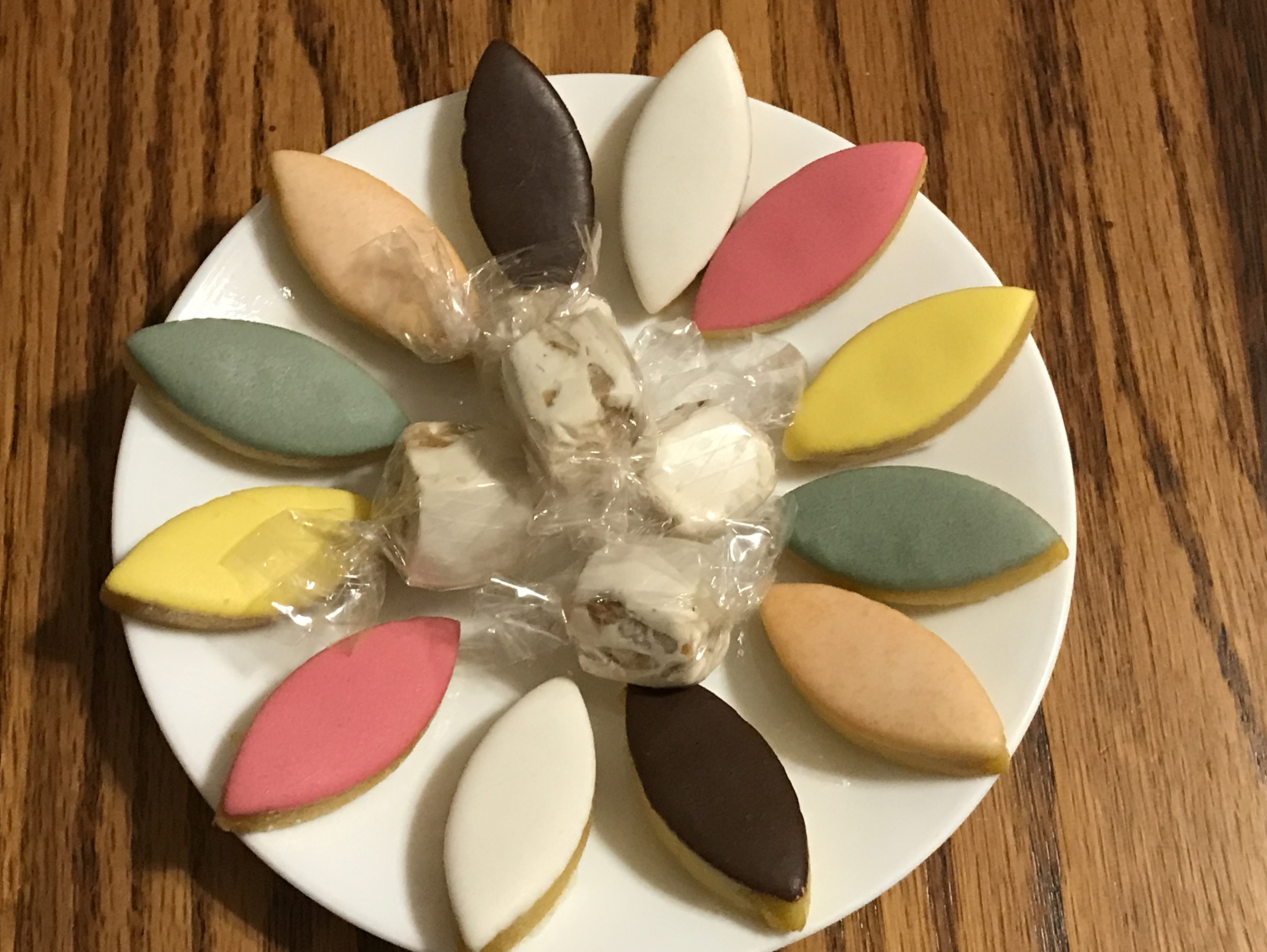
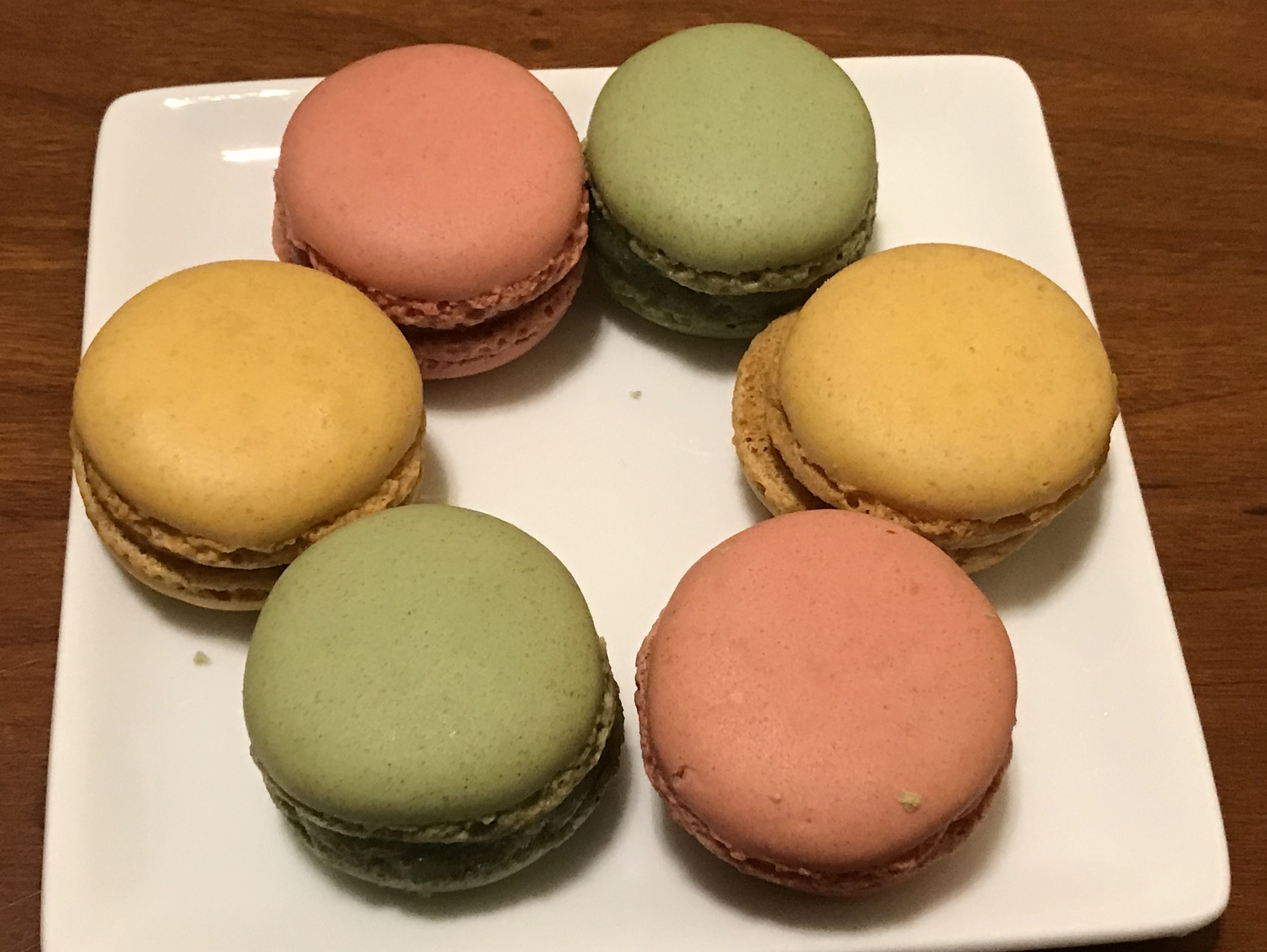
Many people like to buy alcohol at the duty-free store. The Charles de Gaulle airport in Paris appears to be no exception, based on the relative amount of shelf space occupied. There were also an assortment of cheeses, pates, dried sausages, and confectionary. A few of the cheeses featured in 1000 Foods were in the cooler, but I wasn’t sure if they would be allowed through customs. Plus, the smell upon opening the cooler door was, for lack of a better term, “weird.” Kind of the like the camembert that I didn’t like. Attempting to carry it in my backpack for the 8-hour flight home, layover in Chicago, and then back to Green Bay didn’t seem like the best plan. Especially when there were so many amazing-looking sweet items. After perusing and admiring the displays, I settled on calissons and Montelimar nougat, which can be hard to find, plus macarons and a box of assorted mini chocolate batons, for good measure.
Macarons have been extremely fashionable for the last decade or so. Their bright colors are cheerful, and the flavor possibilities are endless. The exact origin or macarons is unclear, but cookies have been made with ground almonds, sugar, and egg whites for centuries. At some point, the cookies became lighter and more meringue-like, and they began to be sandwiched together with a buttercream or ganache filling. As for the difference between macaron and macaroon, macaron = these colorful sandwich cookies, and macaroon = a simpler mix of almonds or coconut, sugar, and egg white. Usually. Both macarons or macaroons are easily made gluten-free, and the lack of wheat flour and chemical leavening make them a popular Passover dessert, when Jewish dietary laws forbid both.
Properly made macarons are amazing, but are supposedly quite touchy to make. Relying on whipped egg whites for leavening is part of this. Another issue is that gluten makes it easier for a batter to trap air bubbles, which expand in the oven. Both of these factors increase the risk of the macarons not rising properly. Adding the fact they are based on expensive almond flour, macarons can be quite pricey. While a reasonably-priced, pre-packaged box cannot compare to the bakery variety, this mix of strawberry, lemon, and pistachio was pretty good.
Color-coded for your convenience
Calissons are also almond-based. In addition to almond paste, their defining ingredient is candied melon. The gold standards are calissons d’Aix, made in the Provence region of southern France for hundreds of years. To legally use the coveted name, the calissons can only include almonds, sugar, and the candied cantaloupe-like melon, egg whites as a binder, plus a royal icing of egg white and sugar. Sometimes a bit of rose or orange flower water is added, but no other flavorings are permitted. While the ones I got weren’t calissons d’Aix, the primary ingredients were almonds and candied melon, making them a good representation of the confection. The different icing colors all have a different flavor. The white is the plain original. The other flavors are chocolate, raspberry, tangerine, lemon, and pistachio. At first, I wasn’t sure if I liked them. The melon is hard to taste, the almond is very subtle, and the texture was stickier than I expected. But as I kept chewing, the almond flavor and somewhat marzipan-like texture came through. I’d rather have marzipan, but the calissons were not bad at all.
Continuing on a similar theme, traditional nougat is based on egg whites and sugar, loaded with toasted almonds. It isn’t actually in the book, but the nougat looked good. The variety from Montelimar, which this was, happens to be a particular favorite, so was definitely worth trying. It was nice and chewy, with the almonds cutting the sweetness and adding a pleasant crunch. Hands down, it was the best of the three. All three of the almond/sugar/egg white confections were enjoyable, explaining why those ingredients have been used together for so long. The chocolate was good too. Who needs alcohol when you can have sugar?
As mentioned previously, despite its stuffy reputation, French cuisine has many unfussy, homestyle dishes. At one point, many of these were regional, country-style fare. Writers like Elizabeth David and especially Julia Child helped popularize them worldwide and make them “respectable.” Today, the likes of quiche, coq au vin, and cassoulet can be found at Michelin-starred restaurants alongside more traditional haute cuisine. Naturally, this means haute cuisine prices for dishes with often affordable ingredients.
Often, cassoulet does contain pricier ingredients like mutton, game birds, or duck confit, but it doesn’t have to. The only necessities are pork, beans, a heavy vessel for a long, slow bake, and a topping of breadcrumbs to form a “crust.” Native to southern France, cassoulet was originally a peasant dish. The cook would toss in whatever meats were available, with white beans to add filler and soak up the flavor. The cassoulet would be taken to the baker, who, in the days before modern kitchens, often had the only oven in town. For a small fee, the baker would bake the mixture for a few hours. Typically, when the cook returned to pick it up, they would buy a loaf of bread to go with it.
The exact recipe for cassoulet varied, no doubt based on personal preferences, what was available, and the economic resources to the family eating it. There are three main variations, all named after towns in southern France: Castelnaudry, Carcassonne, and Toulousain. Often Castelnaudry is pork-based, Carcassonne focuses on mutton and game fowl, and Toulousain on duck confit, or duck preserved in its own fat, but these are not hard and fast rules. If the last sounds strange for a peasant dish, preserving duck and other fowl like goose in its own fat was once a necessity, widespread in the region. More recently, it became trendy.
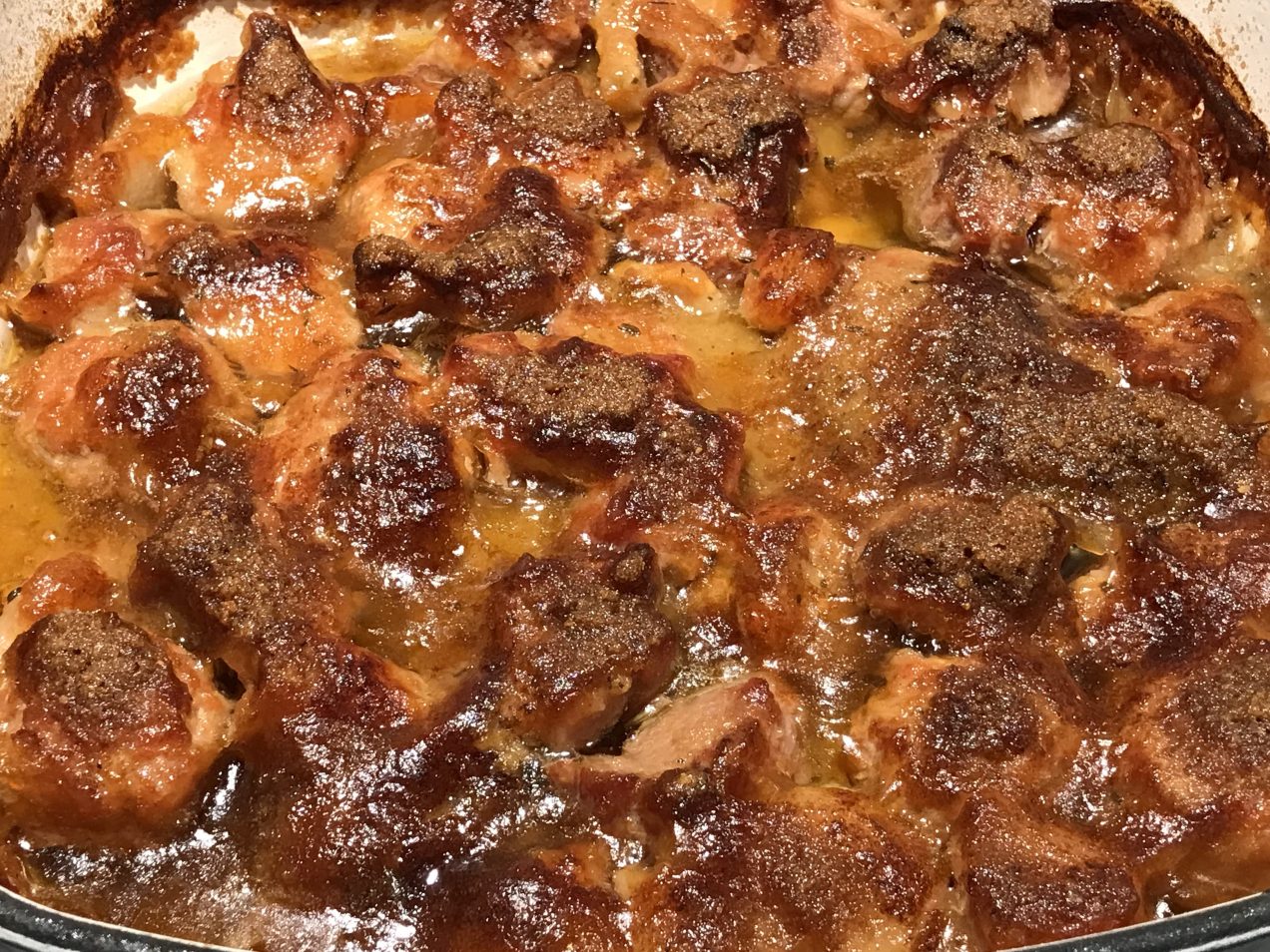
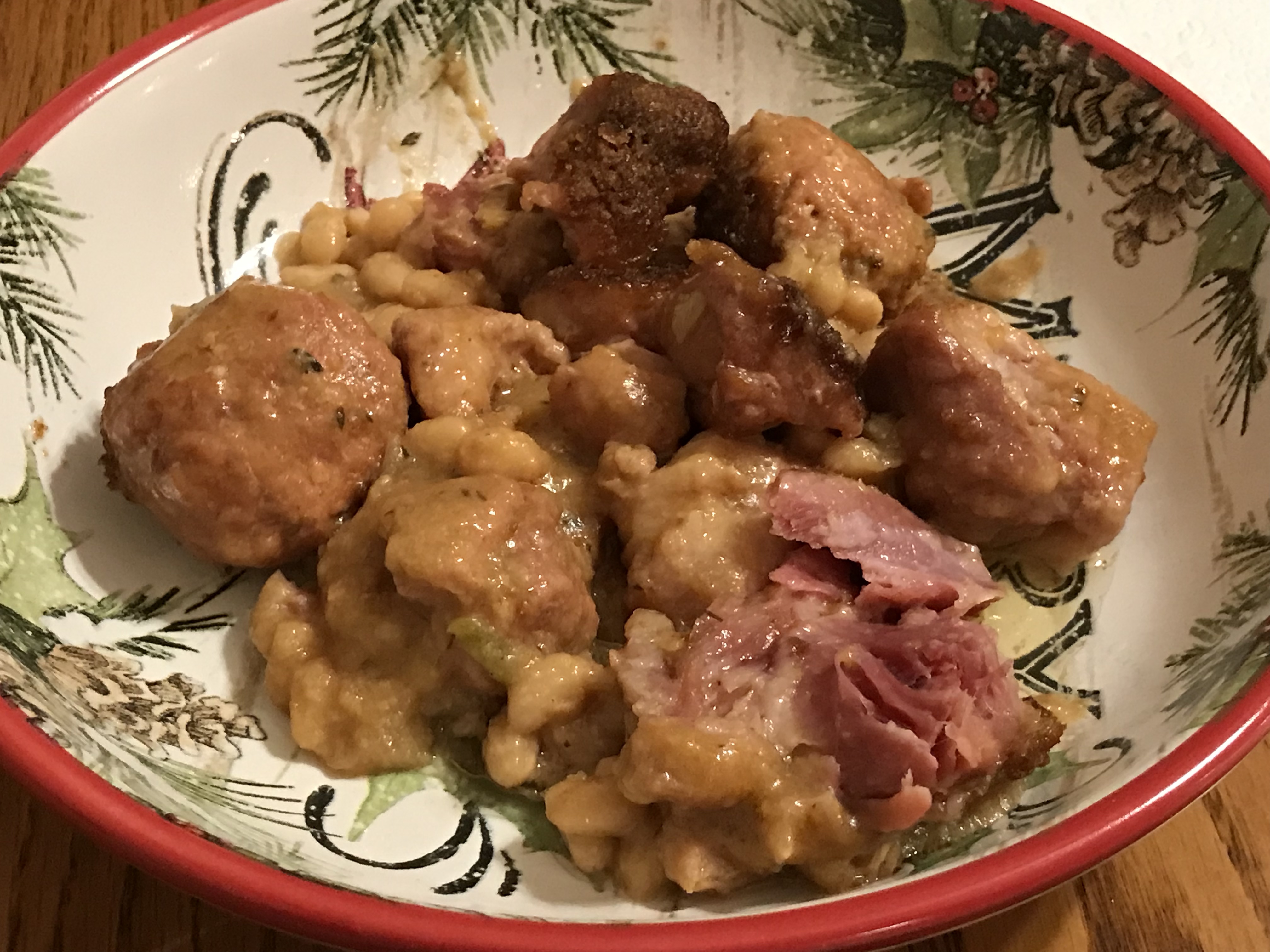
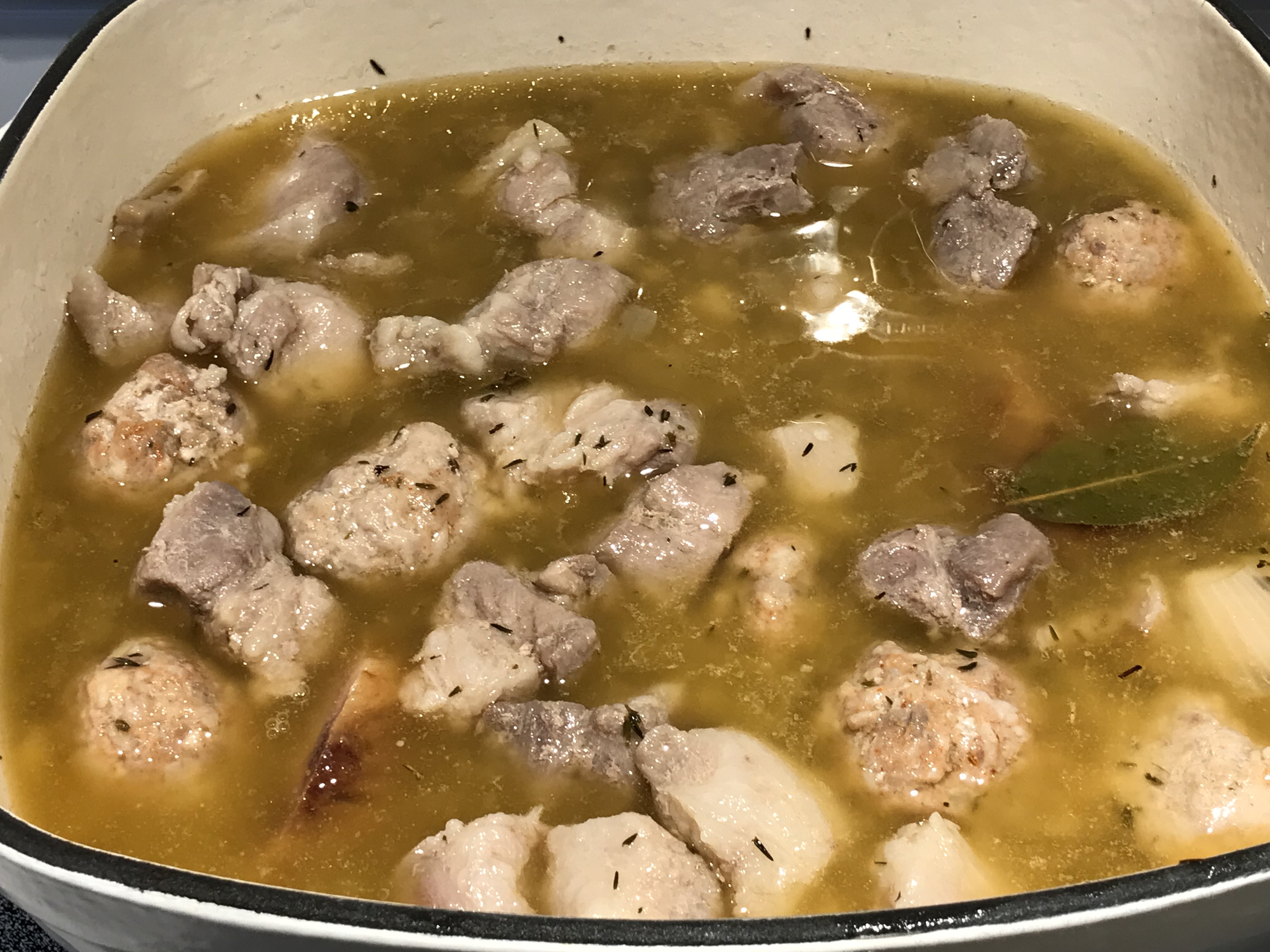
To stay in the spirit of what was once a humble dish, I stuck with pork, partly because of cost, partly because I didn’t want to search high and low for mutton and duck confit. And getting up early to hunt game birds just wasn’t going to happen. For the meats, I thawed out some pork butt from the freezer, brushed the extra salt off a few slices of homemade pancetta/salt pork, and picked up a pack of smoked ham shanks and hot Italian sausage meat from the grocery. To distribute it more evenly but keep it distinct, I formed loose sausage meat into meatballs rather than using whole sausages.
Ready for the oven
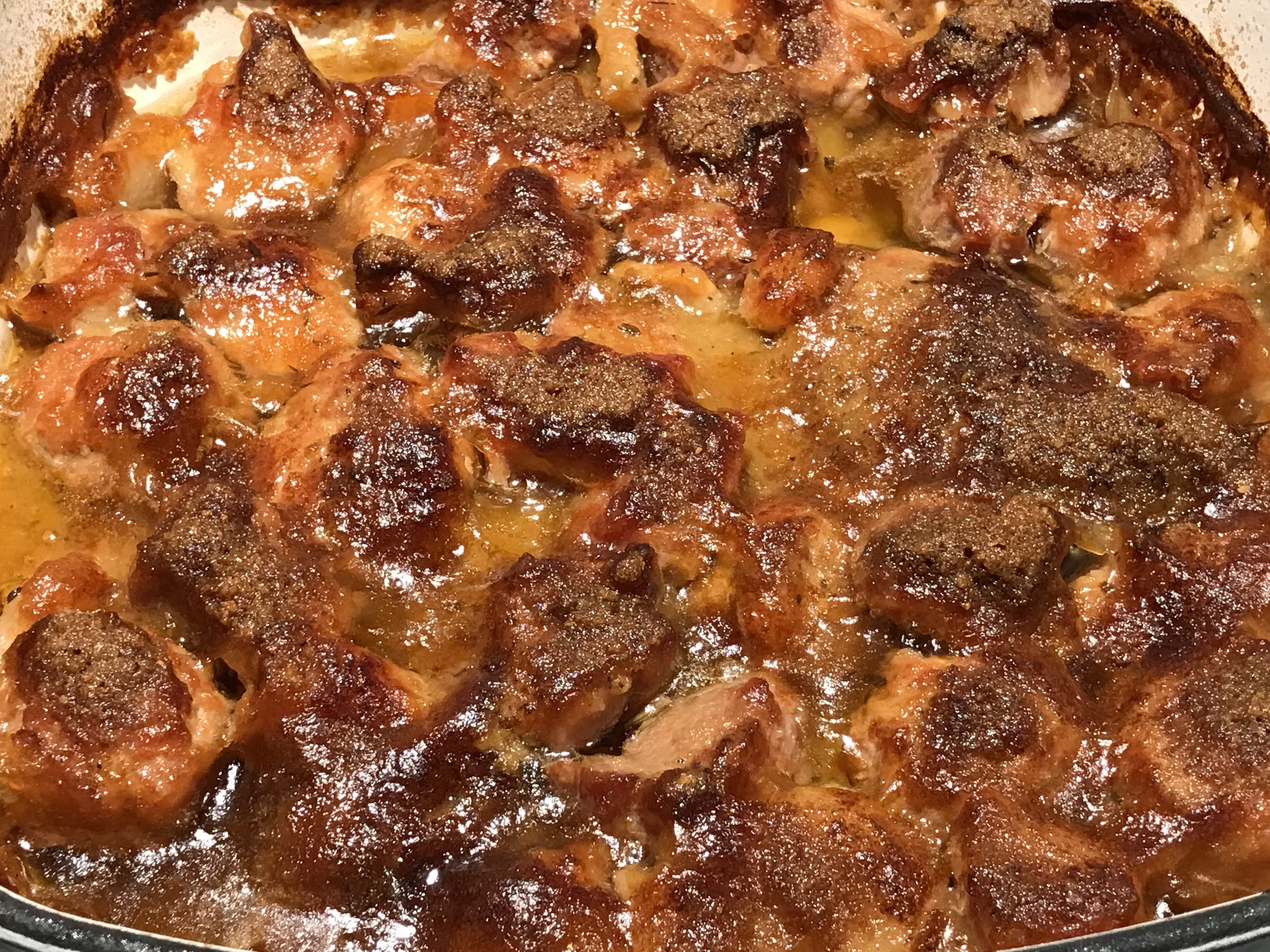
Part of the reason for making cassoulet was to try out my new toy from Christmas – a Dutch oven. What’s great about it is that, because it can go directly from the stove to the oven, the contents don’t need to be transferred from one pan to another. After browning the meat, being careful not to break the meatballs, I added a chopped onion, six minced garlic cloves, three bay leaves, three actual cloves, some pepper, a pound of soaked navy beans, a cup of water, and a quart of low-sodium beef broth. Everything got a topping of plain bread crumbs, then went into the oven at 325 for about three hours.
My new toy, being put to good use
The cassoulet was definitely good, but I still need to perfect the recipe. The only real issue was that it was very salty, even though I didn’t add any extra. The only reason I can think of is the homemade pancetta that I used in place of salt pork. Does it need to be rinsed or even soaked before use? I’m not sure, but with the pork butt and sausage there is plenty of fat, and from the smoked ham shanks the cured pork flavor, making the pancetta unnecessary. A minor problem was that the breadcrumbs tended to sink, thickening the liquid rather than forming a crust. The cassoulet was still nice and crispy on top, but there is work to be done before I have a postable recipe. But with two and a half months of winter ahead, there is plenty of time to experiment. To hear about those experiments, remember to subscribe for free.
As promised, here is a brief(ish) explanation of Lothringia, from which the region of Lorraine got its name. The tradition among Frankish kings was to divide their territory among their sons upon their death. As you might imagine, this led to kingdoms fracturing and going to war with each other almost every generation. The Merovingians, who ruled the Franks from the late 5th Century to 751 AD, weakened themselves this way, and Charlemagne’s dynasty, the Carolingians, followed a similar pattern. Charlemagne’s father Pepin usurped the throne in 751 and died in 768, dividing his kingdom between Charles (Charlemagne) and his brother Carloman. Upon Carloman’s death a few years later, the realms were reunited.
Charlemagne had three legitimate sons reach adulthood, but by the time of his death in 814, only Louis the Pious survived. While this was unfortunate for the other two sons, it was probably fortunate for the empire (Charlemagne had been crowned Holy Roman Emperor in 800), which held together for another generation. Louis had three sons, Lothar, Louis, and Charles, and they didn’t like each other. Even before Louis’ death in 840, they began to fight. The whole story is a complicated mess of shifting alliances, and Lothar and the younger Louis even imprisoned Louis the Pious on two separate occasions. The disorder opened the door for Viking attacks, particularly from the 830s onwards.
In 843, a settlement was reached at the Treaty of Verdun. Lothar, the eldest, got the imperial title and a territory wedged between the other two. His kingdom, not-so-creatively called Lothringia, encompassed the Low Countries, the northeast corner of modern France, part of Burgundy in eastern France, part of Switzerland, and most of Italy. Louis got East Francia, which encompassed most of Germany and Austria, and Charles got West Francia, centered on France. Over time the West and East Frankish kingdoms developed separate French and German identities. Later in the 9th Century the king of Lothringia died without an heir, setting the stage for a over a millennium of fighting over his territory. The Holy Roman Empire centered on the increasingly disunified German states, France often sparred with the Empire, and Lorraine was caught in the middle.
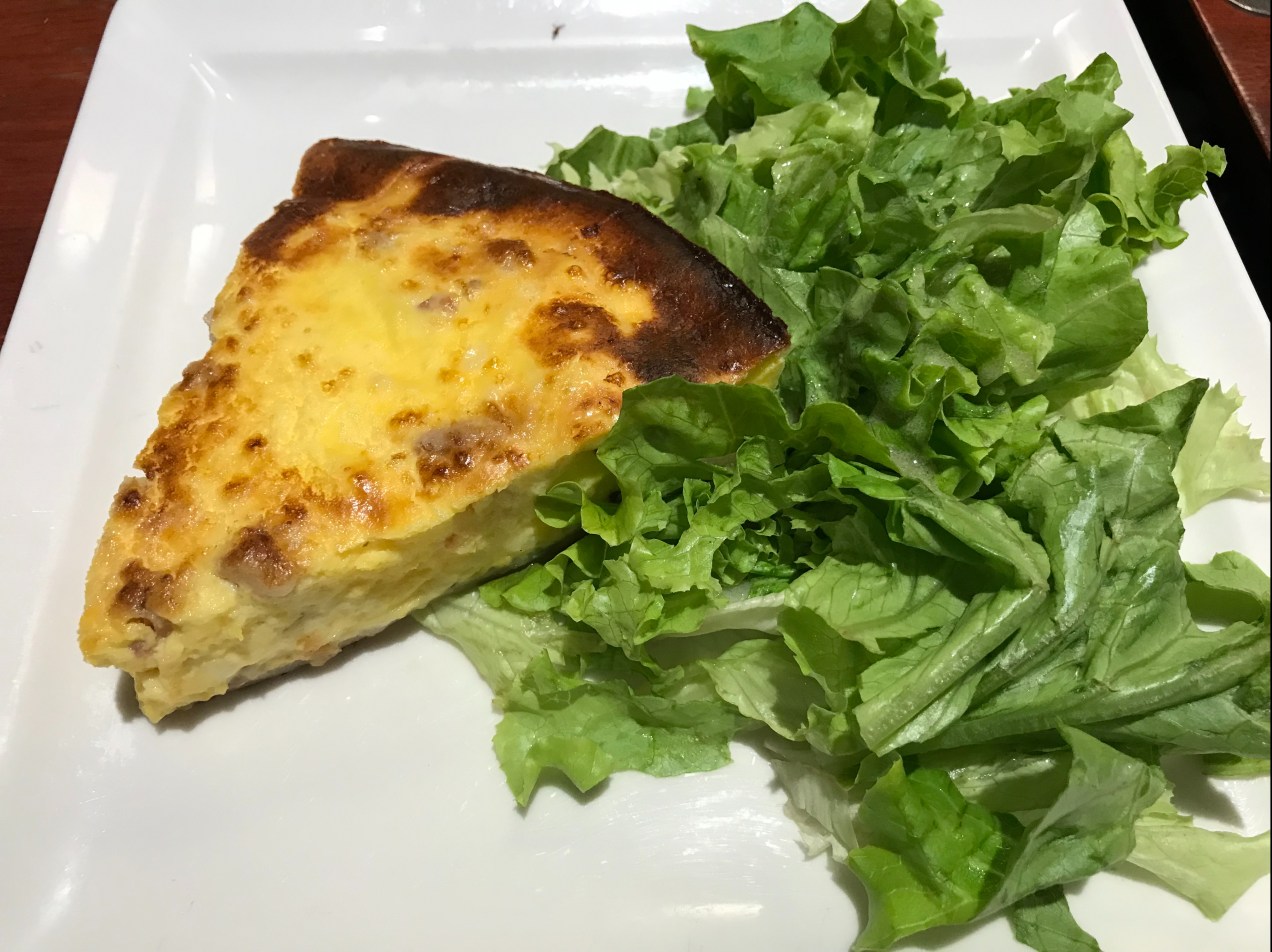
Now part of France, Lorraine and Alsace to the east have both French and Germanic influences in the local culture. Some dishes there, particularly in Alsace, have clear German origins and even names (particularly baeckeoffe, a mixed-meat stew with sauerkraut, bireweche, a spicy Christmas bread, and kugelhopf, a yeast coffee cake). The origin of Quiche Lorraine is a lot less certain. At its simplest it is just a nutmeg-scented custard in a pastry crust, both elements widespread across Europe. Bacon is usually added, but authentically a Quiche Lorraine does not have cheese, onions, or leeks, which would make it Alsatian. None of the additions give much of a clue on cultural origin, but ultimately, it doesn’t matter. Quiche Lorraine, and other variations, have an appeal that goes far beyond their native regions.
While in Amboise, a few of us came upon a café with a reasonably priced lunch special, which included dessert. The pastry and custard in the Quiche Lorraine were both very good, but to be honest I prefer the Alsatian version. Onions or leeks add an extra layer of flavor, and are often included in American versions. The great thing about quiche is that you can customize it to your taste. Onions, broccoli and cheddar, spinach and feta, dates and bone marrow, anything can be added as long as it doesn’t have too much water, which could make the custard split. The last option might not be very popular today, but it was a common Medieval recipe called “Lombard custard.” Whatever strikes your fancy is available, as long as you have an oven. It might not be Quiche Lorraine, but it will probably be delicious.
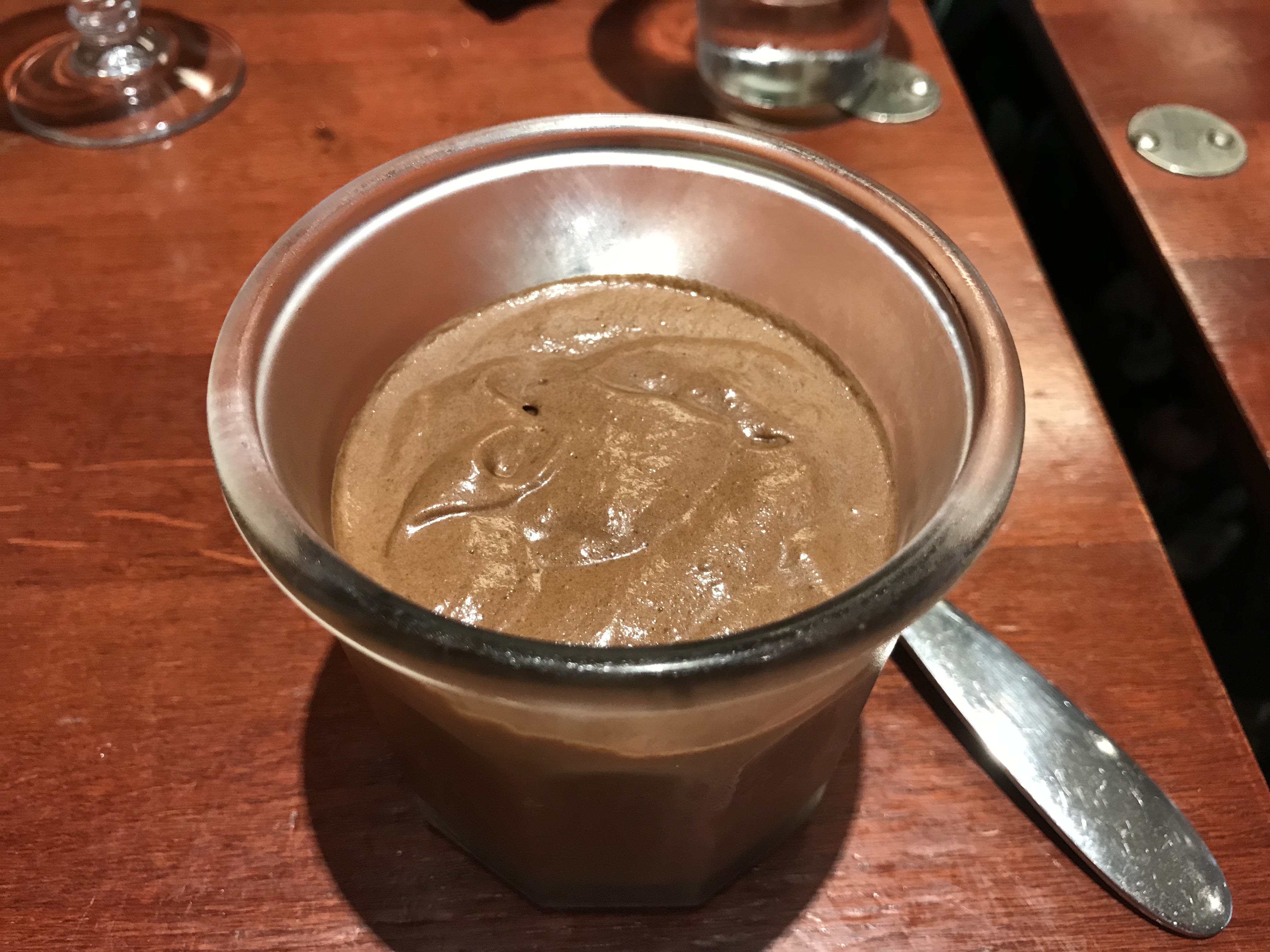
Also relatively easy to make at home is chocolate mousse. The trick is to whip tiny air bubbles into egg whites and/or cream and avoid deflating them when adding the other ingredients. Follow the recipe (I like the food network recipe but omit the espresso powder), gently fold in the egg whites or cream until just combined with the other ingredients, and in the worst-case scenario it will be more like a pudding. Just be careful if the recipe contains raw eggs, which many do. Often the egg yolks are cooked a bit with the chocolate while the whites are left completely raw. This is no worse than eating cookie dough, but it does need to be mentioned.
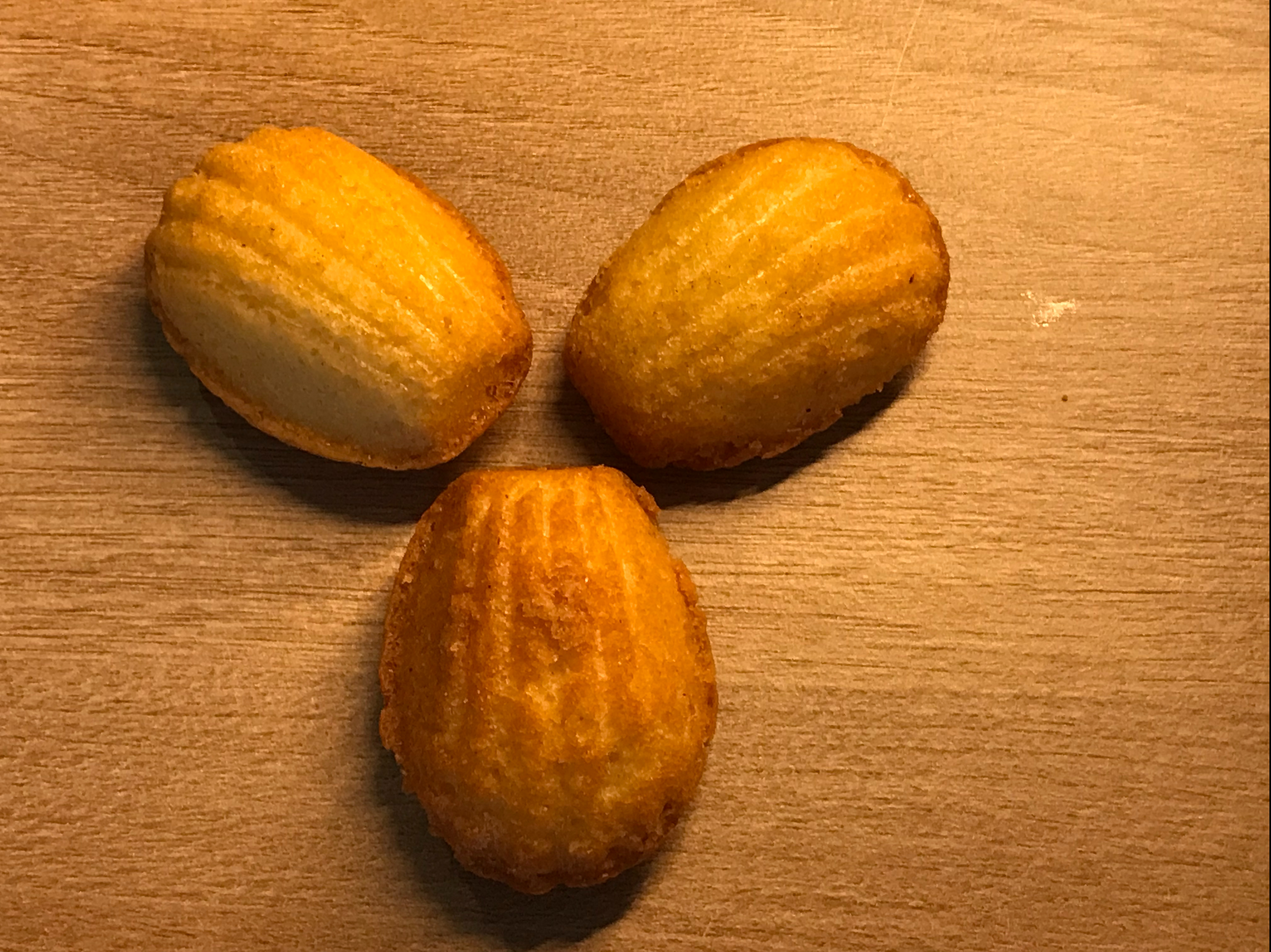
Madeleines are sort of a cross between a cookie and a cake. They are basically a sponge cake batter baked in small, scallop-shaped molds, which produces a browned outside and soft interior. They are mildly flavored, usually with vanilla or lemon peel. Marcel Proust was particularly fond of them, or at least had fond memories of them from his childhood, and why not? Like a good pound cake, madeleines have a nice flavor on their own, but they also lend themselves to embellishment. A bit of almond extract, a dip in chocolate, or a sprinkle of cinnamon would all be interesting additions.
If you enjoy this blog, please consider making a donation. Any contribution is appreciated.
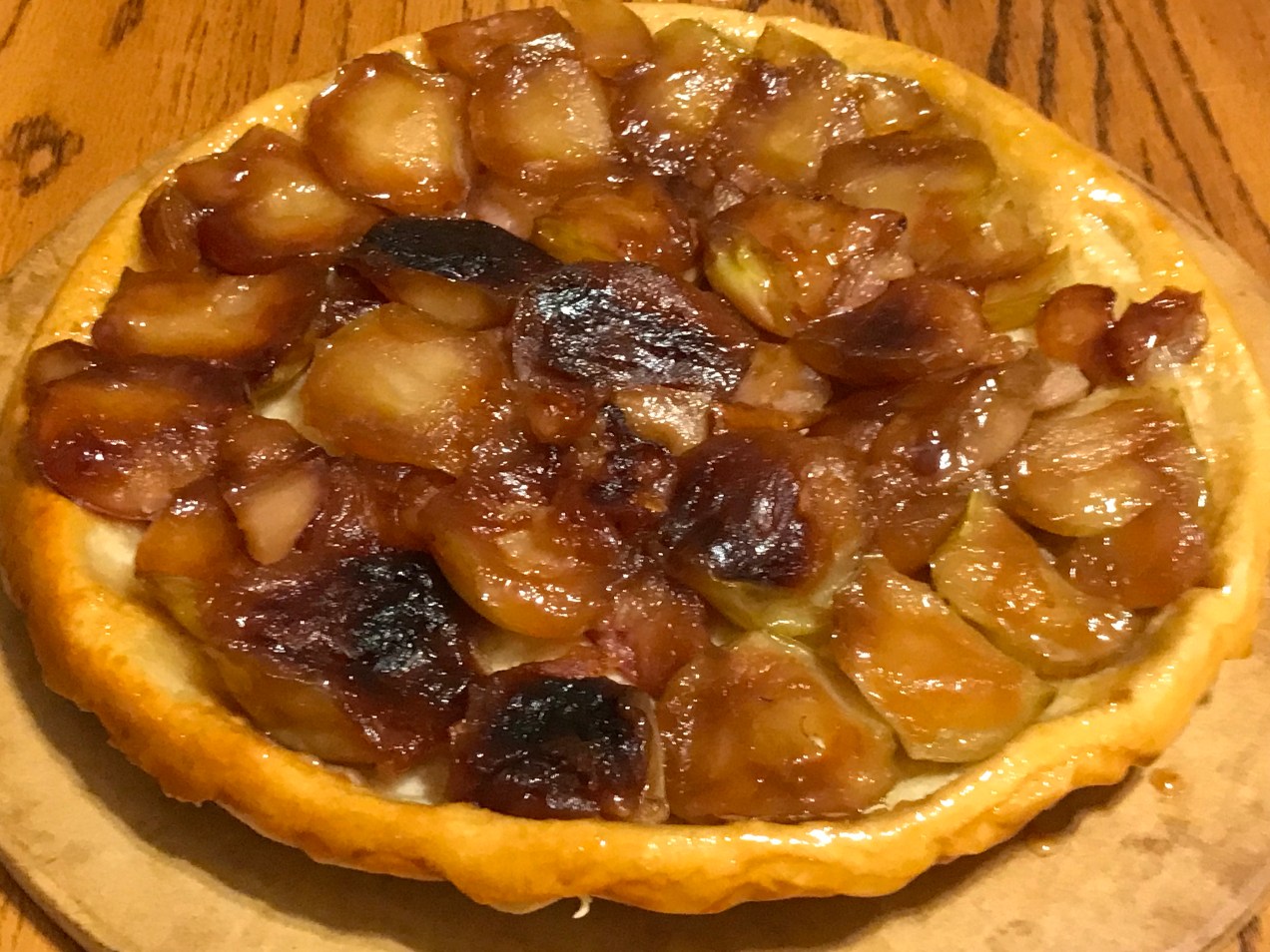
Cider isn’t the only use for apples. Aside from eating them fresh, people have been baking them into pies and tarts for centuries. Early examples used an inedible crust to cook and preserve the filling, which often only had a little sugar. Over time, edible “short crust” pastry, made with butter and/or lard, became common, the amount of sugar increased, and a huge number of varieties were developed. Some omit the top crust for an open tart, or contain a sugary crumble topping. One particular French variant, Tarte Tatin, is baked upside down to keep the crust from getting soggy.
The origin story goes something like this. In the 19th Century, the two Tatin sisters ran an inn. During one busy hunting season, an apple tart got dropped and landed upside-down. Rather than discard it, the cook served it upside-down and called it a new house specialty. No matter what the truth is, the French take Tarte Tatin seriously. There is even a website dedicated to it. According to the website, the tarte should be served by itself, without whipped cream or ice cream. What I found more interesting is that in the website’s recipe, there is no spice. While it is listed as an optional addition, my understanding is that the earliest recipes just included apples, crust, and the caramel formed in the pan.
The first step is to make the pastry. If you’re going to be making bread or pastry with any regularity, you will want a stand mixer. While I’m not usually in the business of advertising products, my KitchenAid mixer has been so helpful I wanted to mention it. They’re a bit of an investment, but their quality and durability make them worth it. The pastry is surprisingly easy to make. Cold butter is combined with the flour until the mixture is crumbly, then just enough ice water is mixed in for the dough to stick together. The dough is then kneaded a few times before being allowed to rest. One thing to be careful about, especially if you’re using a stand mixer, is not to overmix, which can make the pastry tough.
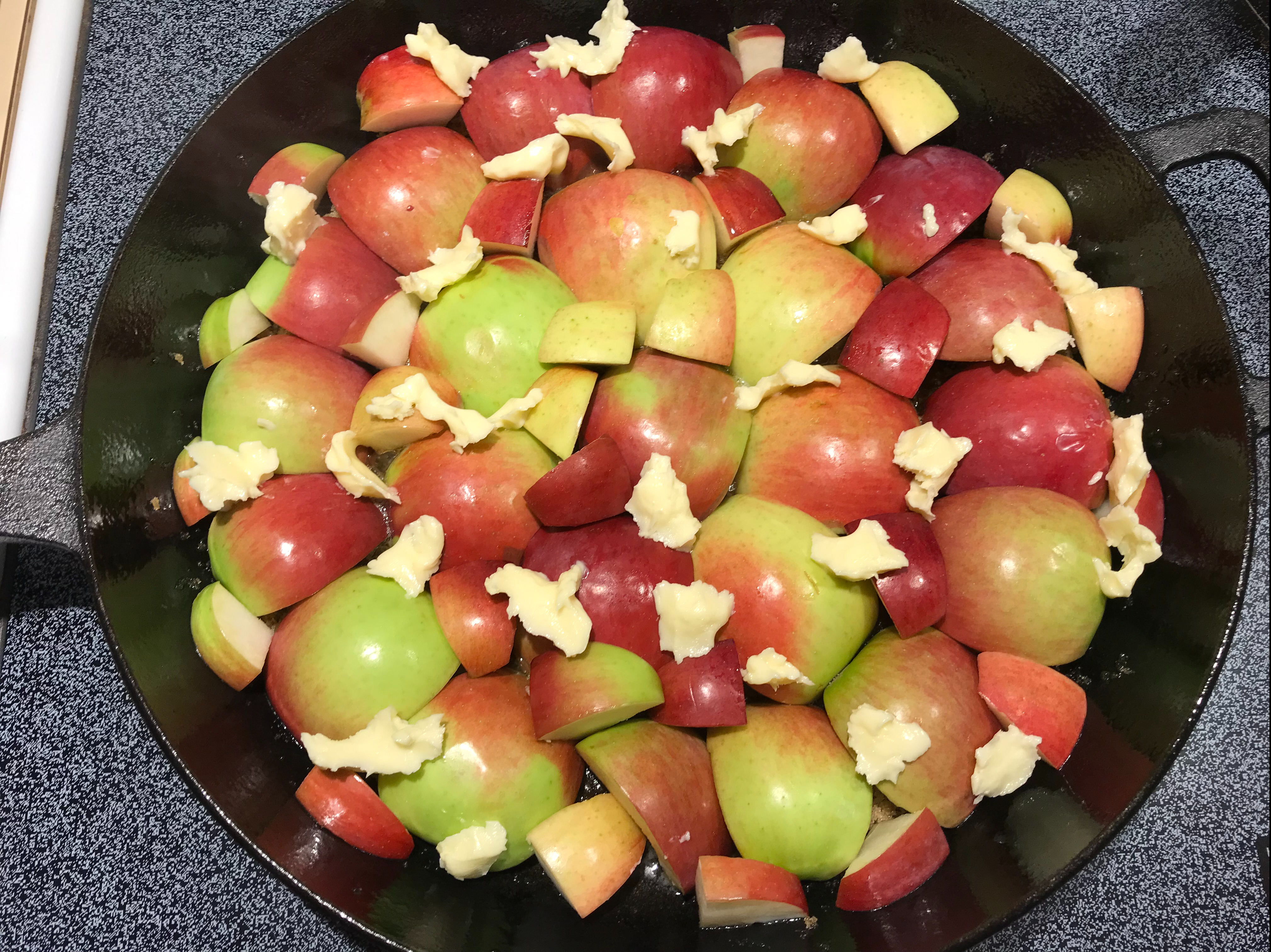
A caramel is produced by layering sugar and apples in a buttered oven-safe skillet, ideally cast iron. What’s great about this particular recipe is that you don’t have to peel the apples. Not only does this save time, but the pectin in the skin improves the texture of the caramel. The only issue was that the cast iron skillet I used is wider than the burner, resulting in the caramel forming and browning faster in the middle than around the edges. Lightly shaking the pan a few times helped, but the outside edge was not quite as caramelized as I would have liked. Since the apples seemed to be mostly cooked and I didn’t want to risk burning the middle by keeping it on the stove, I added the crust and put the skillet in the oven.
The reason for cooking the apples first is to release some of their moisture, which could make the crust soggy and inhibit browning. As for the type of apples, the website suggests either some particular varieties most common in France or golden delicious. Ms. Sheraton has two suggestions. For the prettiest appearance, golden delicious are still the best choice. For extra flavor, Cortlands are one of the best varieties. Since I care more about flavor, I used Cortlands. They’re easy to find in the fall, both sweet and tart, juicy but firm enough to hold up in the oven without disintegrating, and all around an excellent baking apple.
If you decide to make Tarte Tatin, be very careful taking the skillet out of the oven, and make sure your oven mitts or pot holders are dry and hole-free. Wet cloth conducts heat a lot better than dry cloth, which is what you’re trying to avoid. And as it turned out, one of my pot holders had a hole. It was hard to see without looking for it, but the intense pain made me aware of it within a split second. Fortunately, the natural human reflex is to let go before the brain can even make a conscious decision. The pain eventually went away after running my hand under cold water, and I only ended up with a small blister. Inverting the skillet onto a pizza stone did not result in any further burns.
The Tarte Tatin was delicious. With a thicker pastry and higher crust to apple ratio than most pies have, it was definitely different, but the caramel really made it. A bit of cinnamon might have enhanced the tarte, but the flavor was surprisingly complete without it. Apples, caramel, and buttery pastry worked together to make a dessert worthy of its status as a classic. And it was actually easier to make than a typical apple pie. By the time it comes out of the oven, the peels have broken down enough to be barely noticeable, saving a step. And baking with the crust on top avoids, in the words of the Great British Baking Show, a soggy bottom.
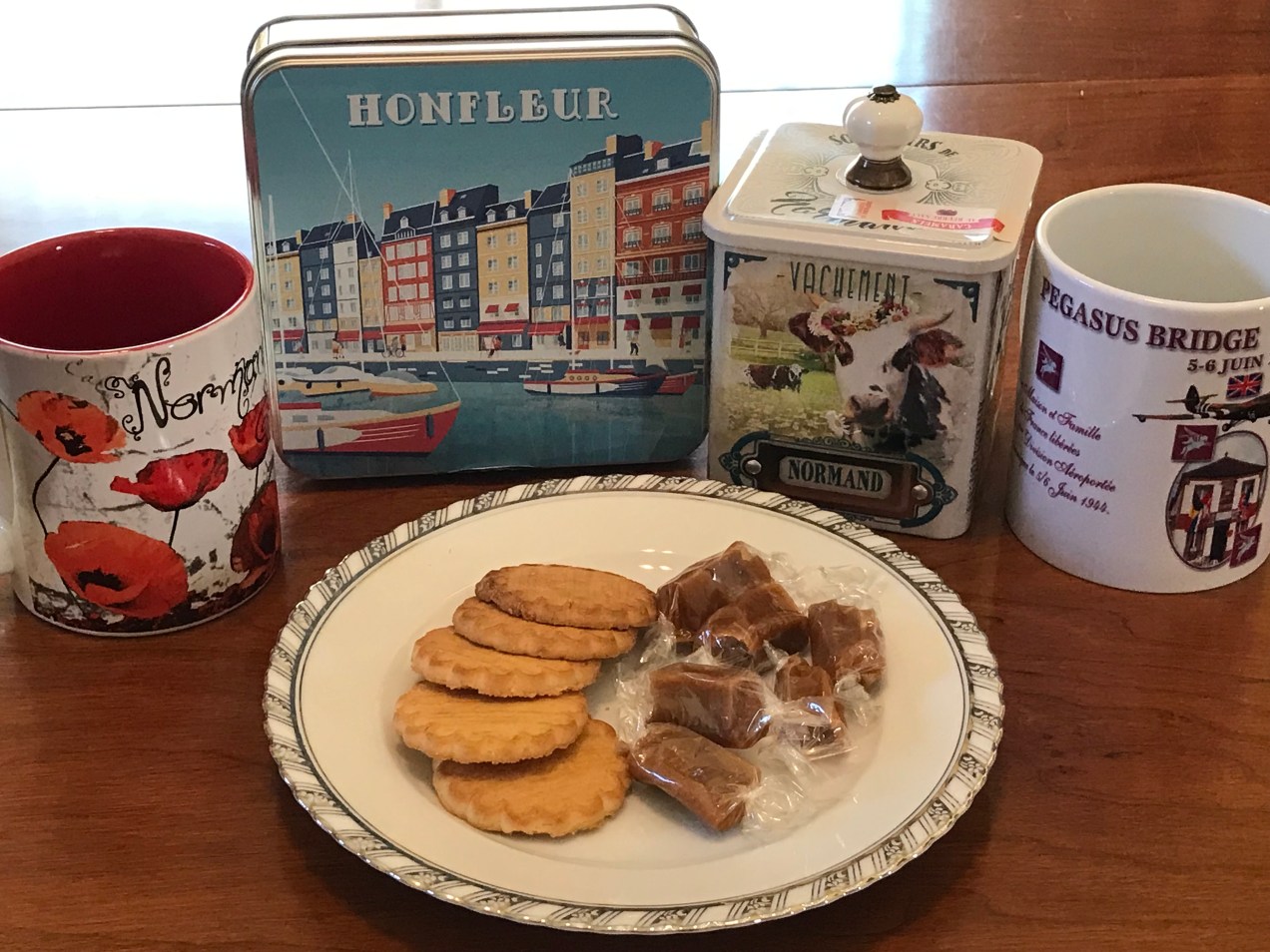
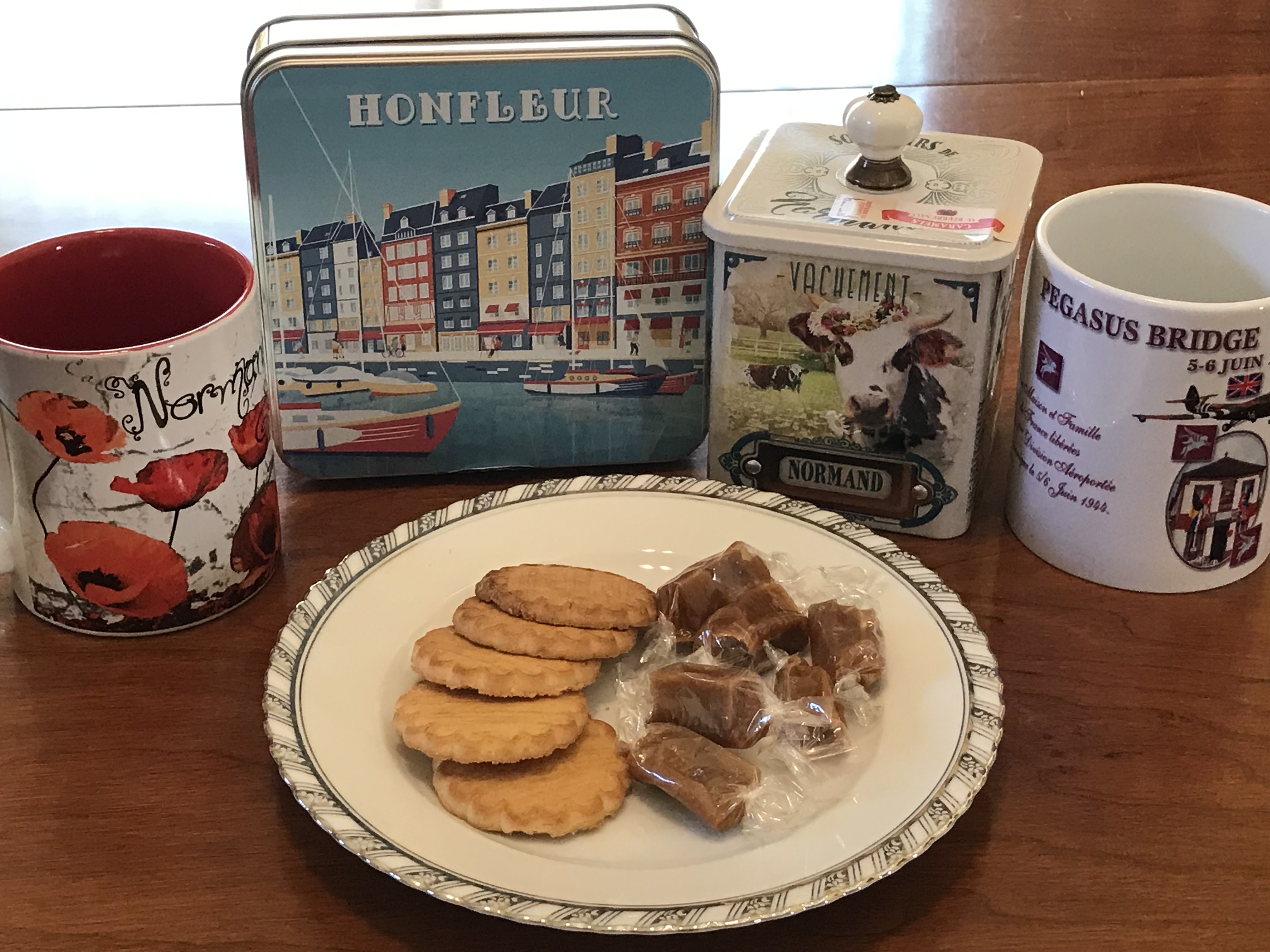
Butter cookies and salted butter caramels, souvenir tins and mugs
Continuing from a previous post, let’s talk about apples. Actually, let’s talk about Normandy, then we’ll talk about apples. The history of Normandy starts out like that of the rest of France. Agriculture was introduced several thousand years ago, followed by bronze working and horses. At some point after 1000 BC, so was iron working. Celtic peoples arrived a few hundred years after that and came to dominate much of Central and Western Europe. By the time of Julius Caesar, modern France, which the Romans called Gaul, was covered by a patchwork of chiefdoms. While not yet literate, the people there were expert metalworkers, had a complex social hierarchy, and often lived in large towns. This was the world conquered by Julius Caesar in the 50s BC.
After the initial conquest, the citizens of Gaul offered surprisingly little resistance to Roman rule. Most likely, the people saw certain benefits. The presence of the Roman army protected the frontier and stopped tribal warfare, reducing the chance of looting, slave raids, and destroyed harvests. Occasional heavy taxation probably seemed like a reasonable trade off. The Celts also had some things in common with the Romans. They spoke an Indo-European language and were farmers. The Romans introduced and spread new crops and built roads, which helped get those crops to market. Aqueducts provided water to the developing cities, and there were even water mills to grind grain into flour. Trade flourished, bringing wealth and new goods from across the Roman Empire and beyond. While not everyone benefitted equally and some suffered, most residents probably saw their standard of living rise.
There was another benefit, too. Unlike the Greek city-states, the Roman Empire was generous with granting citizenship. If someone learned to speak Latin (or Greek, which was the language of the upper class in the East since the days of Alexander the Great three centuries earlier) and adopted Roman customs, they were considered Roman and could often get citizenship. Since they were not permanently trapped with the status of subjects, the Gauls had an incentive to cooperate with the Romans. Like other elites in the Western Empire, the upper classes in Gaul became Romanized. Gradually the Latin language spread down the social scale. By the time the Western Empire began to collapse in the 5th Century, the residents of modern France mostly spoke a dialect of Latin, considered themselves Roman, and were ready to defend the Empire.
But it was not to be. First the Visigoths conquered much of Southern Gaul, along with most of modern Spain. Then the Franks moved in, pushing the Visigoths south and eventually controlling almost all of modern France, the Low Countries, and part of Germany. Over time, Frankish culture and language came to influence the dialect of Latin spoken, gradually giving rise to French. In fact, modern France takes its name from the Franks. Frankish influence was weaker in the South, where Latin evolved into Occitan, Provencal, and Gascon and the Roman way of life was able to continue for longer. By the time of Charlemagne in the late 8th Century, the Franks in the North were well on their way to becoming French.
In Normandy the story has another twist. Starting in the 9th Century, as Charlemagne’s empire fractured, Vikings began attacking the coasts of the Frankish kingdoms. West Francia, which would become France (East Francia would become Germany, while Lothringia was a complicated situation I’ll get into in a later post), had it especially bad. Viking longships could sail up rivers and frequently raided the settlements along the Seine, which had prospered under Charlemagne and the other members of his dynasty, the Carolingians. At one point, even Paris was besieged. Eventually, the situation got so bad that the king granted one Viking leader land between Paris and the English Channel in exchange for help fending off other Vikings. While this could easily have backfired, it actually worked. Over time, the area became known as Normandy, from “Land of the Northmen.”
The Vikings in Normandy quickly became Christian and learned to speak their own variety of French. The dukes of Normandy became powerful and often had a tense relationship with the French kings in Paris. In fact, in a book I picked up in France, I learned that 1) William the Conqueror didn’t consider himself French and hated them and 2) the Norman Conquest was not to the benefit of the French kings. Quite the opposite, in fact. Having one of their most powerful vassals become a king in his own right caused almost 400 years of headaches.
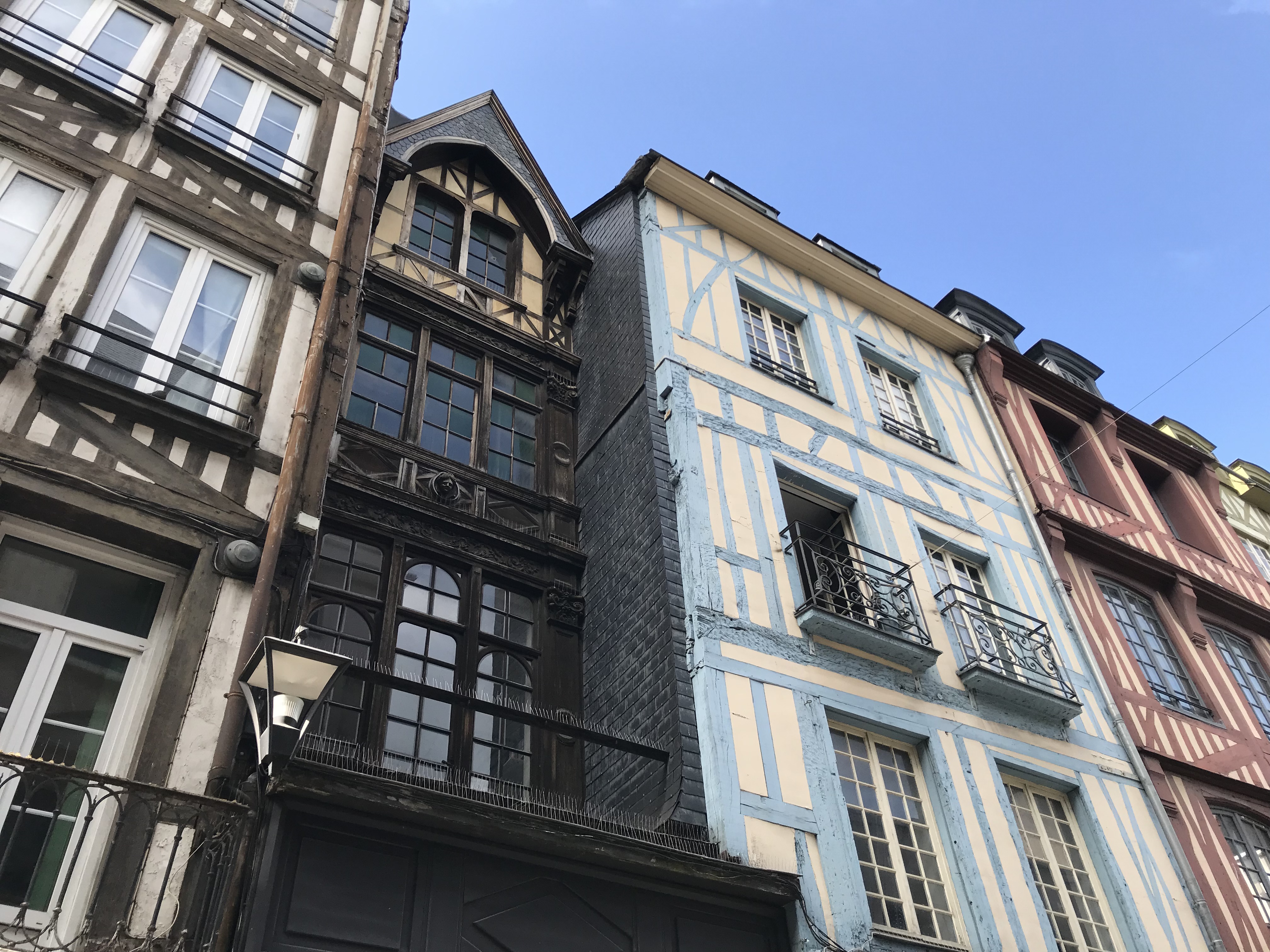
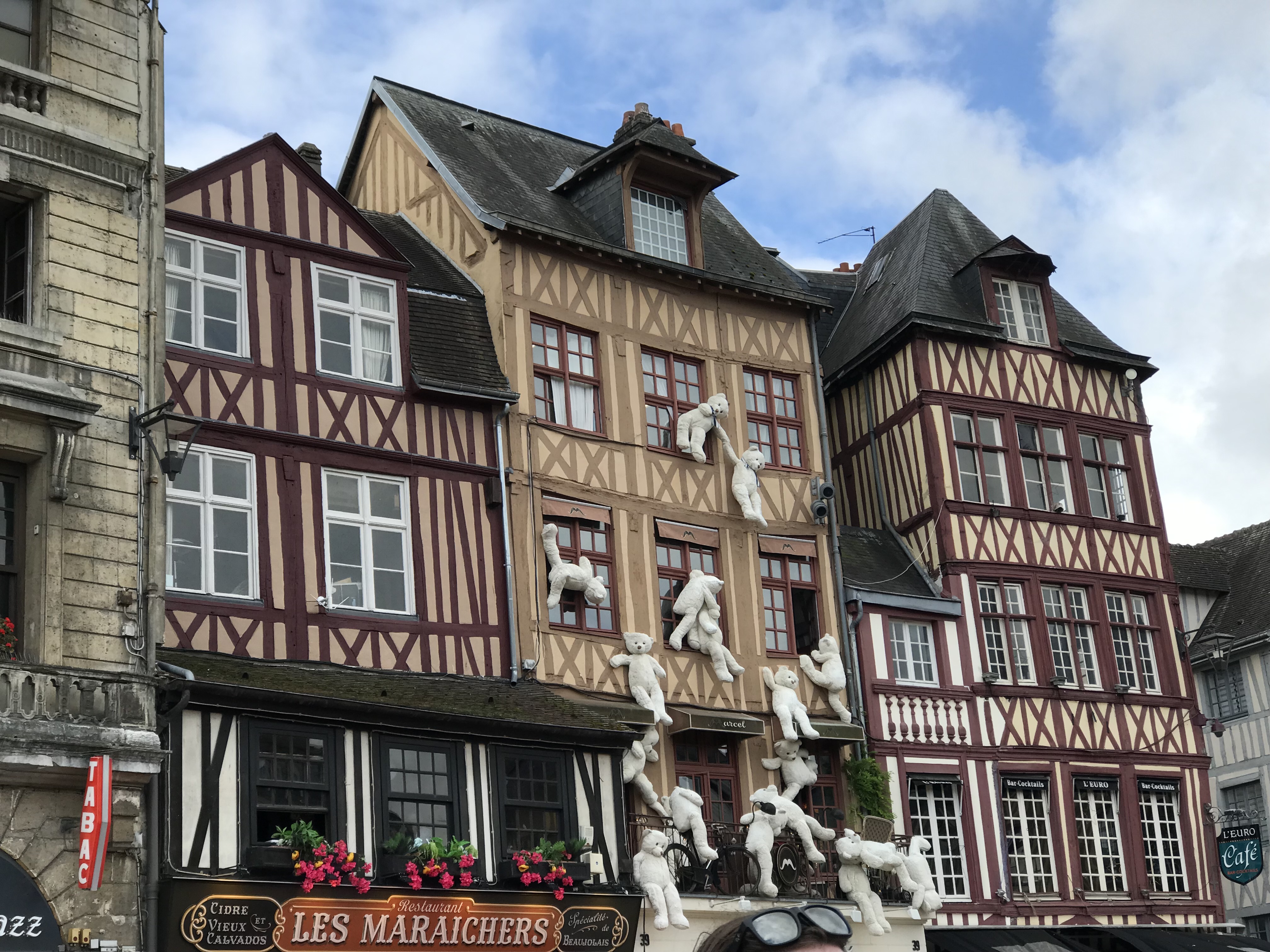
I’ll go into the history of Normandy since the Hundred Years’ War in a later post, but until then, let’s consider the culture. While the Vikings were never a majority of the population and became mostly French, they left their mark on the region. In some places, particularly Rouen and Honfleur, there are many colorful timber-framed buildings that look like they belong in Amsterdam or Scandinavia. Part of this is due to the lack of quality building stone in Normandy, but the extra Germanic influence there is also a factor. As for the food, the terrain, climate, Celtic, and Germanic influences all favor dairy products and apples.
Rouen CathedralGothic Architecture in RouenA Street in Rouen’s CenterStreet Art in RouenHonfleur
Unlike the drier, hillier lands around the Mediterranean, the North European Plain is favorable for cattle. Most cultures that raise cattle make cheese to preserve the milk, but it seems to have been especially important here. In a climate with long, cold winters, storing food in preparation was essential. Along with smoked and salted meats, cheese was a useful source of protein that could be kept for months in a cool place. Salted butter could also be stored for much of the winter. While the Ancient Greeks and Romans saw butter as a “barbarian” food and considered cow’s milk cheeses inferior to those made with sheep’s and goat’s milk, Northern Europeans consumed both widely. The Vikings seem to have been particularly fond of their dairy products.
For better or worse, humans have always enjoyed consuming alcohol. The specifics varied by culture and what was available to ferment. Beer was common in Mesopotamia and Egypt, with rich grain crops but too hot for most grape varieties. The Ancient Greeks, chronically short of land to grow grain but able to grow vines on hillsides and terraces, preferred wine so much that they considered beer drinkers barbarians. Other things that could get someone labeled a barbarian included drinking milk, drinking wine without mixing it with water, and speaking a language other than Greek. Mead was made anywhere honey was available. With few or no grape vines, Germanic and Celtic peoples drank beer and cider.
The apple was historically king of fruits in Northern Europe. Celts in particular had a lot of mythology about apples and apple trees. One crucial benefit was that unbruised apples could be stored in a cool place over the winter. Their texture and flavor might suffer a bit, and a few would go bad, but most would remain edible. Pigs could be fattened up by scavenging the windfall apples, fertilizing the orchards in the process. And of course, the fruits were fermented to make cider. Even as new cultures evolved and rulers came and went, cider remained popular in Normandy and the British Isles.
Clockwise from top: baguette, brioche, comte, brie, pain au chocolat (chocolate croissant)
About two months ago, I took a trip to France. We visited Paris, Normandy, Brittany, and the Loire Valley. Among the highlights were a tour of Paris with a colorful local guide, the Joan of Arc church in Rouen, storytelling by the tour director of his previous tours, the D-Day landing beaches in Normandy, and the Apocalypse Tapestry in Angers. There was a lot of amazing history packed into everything we saw, and that was just the northwest quarter of the country. Naturally there is a lot more to experience on a future trip, but for now, let’s consider the food.
French cuisine is highly regarded around the world and has been for hundreds of years. But even while people speak of classical haute cuisine or classically trained French chefs, there is no single “French” cuisine that covers the whole country. Like any other country with varied terrain and climate, food in France is regional. Each area has its own specialties and preferences, which have persisted even with modern travel and shipping. People in Normandy eat differently than those in Provence, but one food found throughout the country is the baguette.
For something seen as a symbol of French cuisine, the baguette is a relatively recent invention. The story goes that in the 19th century, bakers designed the thin loaves to bake faster, meaning that they didn’t have to get up quite as early to prepare for the breakfast rush. The formula is straightforward: it’s a lean dough (meaning no added butter, oil, milk, or eggs) made of just white flour, water, and yeast. Actually making it is the tricky part, as demonstrated on The Great British Baking Show, but bakeries across France have mastered it. In less than 200 years, baguettes went from something that didn’t exist to a presence in every mini-grocery, café, and hotel breakfast spread. And why not? They’re plain but comforting, and very versatile.
Brioche is completely different. The dough is enriched with butter and eggs and lightly sweetened, which creates a softer texture and finer crumb. Historically, when the price of bread varied dramatically depending on the type of flour and what was added to the dough, it was a luxury or holiday bread. As prosperity increased, brioche became more popular, although it doesn’t seem to have surpassed baguettes and croissants. Of the four hotels we stayed at, they all had the latter two on the breakfast buffets, but I only remember seeing brioche at one, though it’s entirely possible that I missed it at the others.
Croissants are a quintessentially French pastry, but may not have come from France at all. One story is that they were first made in Austria to commemorate the failed Siege of Vienna by the Ottomans in 1683. After the Turkish army was driven off by the forces of King Jan Sobieski of Poland, a new pastry was created in the shape of a crescent, found on the Ottoman flag. Perhaps there was some satisfaction in eating the symbol of their enemy. But however they originated, croissants are made with a yeast puff pastry, where thin layers of yeasted dough are layered with butter, producing a rich, flaky delight. Regular croissants are delicious enough, but adding chocolate to make pain au chocolat takes them to a whole new level.
While I loved the various breads and pastries, I was less impressed with the cheeses in France. Two of the most famous are Brie, from the Ile de France region around Paris, and Camembert, from Normandy. Both are semi-soft cheeses with edible rinds, authentically made with unpasteurized cow’s milk. Because US law does not allow the production or import of raw milk cheeses aged less than 60 days, true Camembert and most Brie are not available stateside. Many connoisseurs bemoan this, but after tasting both cheeses, I struggle to understand what all the fuss is about.
Normandy is famous for its dairy products, as is neighboring Brittany. Grass thrives in the rainy, mild climate, and apples grow much better than grapes. With all its farm fields and cows, the countryside felt very familiar, almost Midwestern, except with more wheat, potatoes, and vegetables than corn. And more medieval churches. You don’t see too many of those in the US. But dairy-heavy food is another story entirely. Cheese toasted on sandwiches, especially the ham and cheese croque monsieur, buttery pastries and cookies, and salted butter caramels are definite cousins to what can be found in Wisconsin.
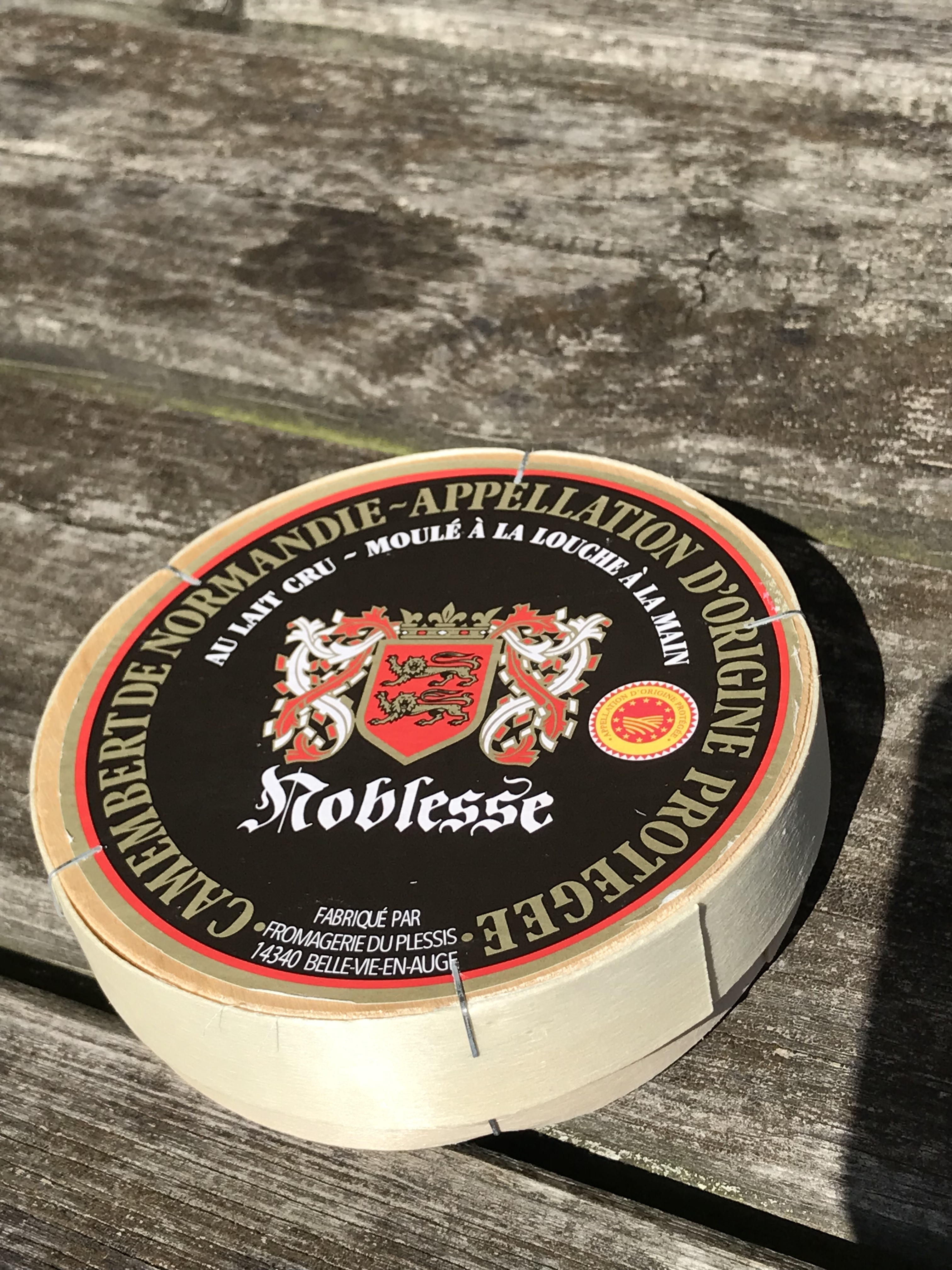
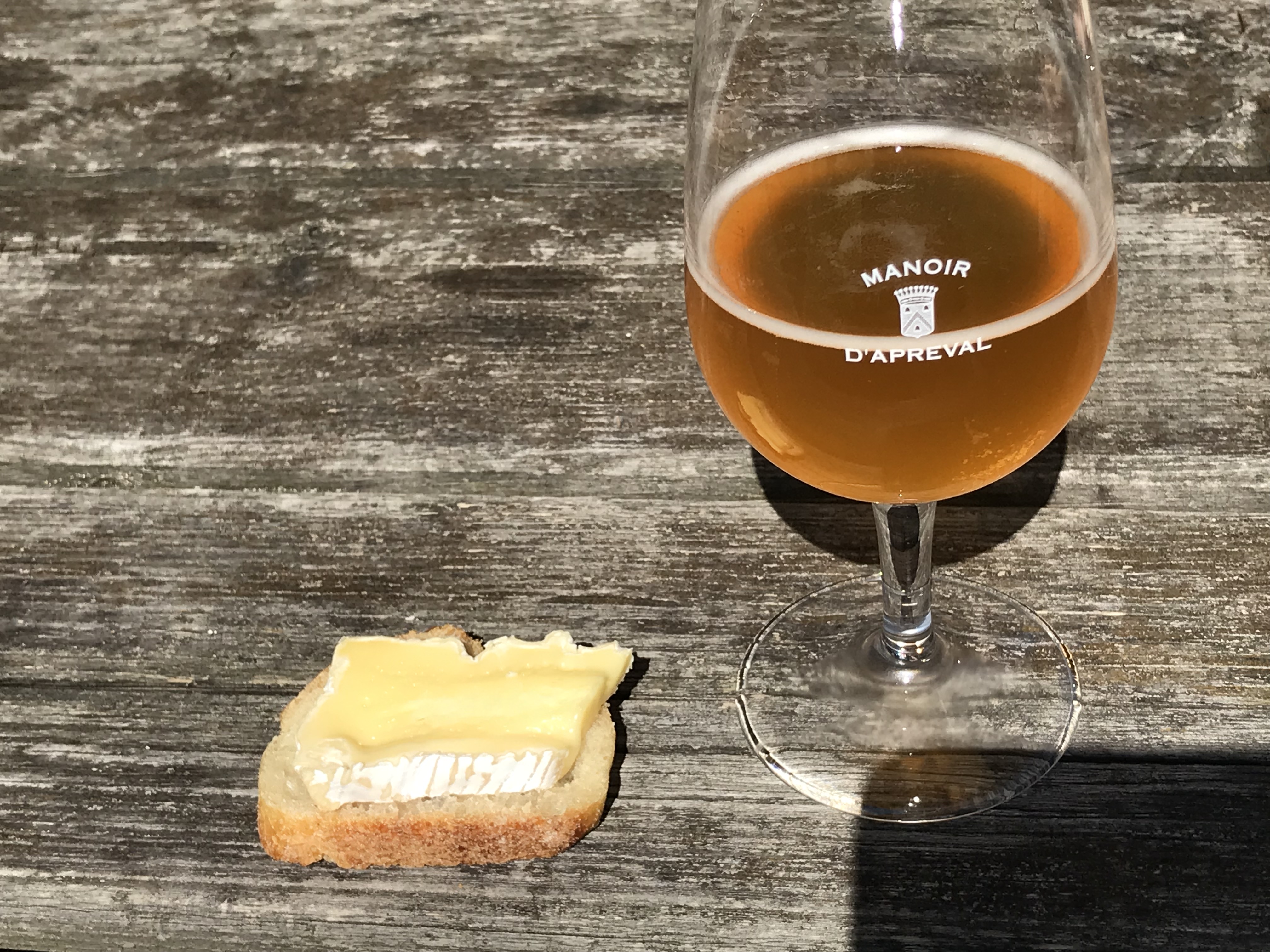
On our first day in Normandy we had an interesting tour of an orchard/cider production facility. The guide talked about how the fermentation process worked, how juice vs. sweet vs. dry cider was made, and how cider could be distilled and aged, producing calvados. This was followed by a cheese and cider tasting. We began with the mildest samples: camembert and sweet cider. In theory, camembert is supposed to be a mushroomy delight, according to Ms. Sheraton. It wasn’t necessarily bad, but I didn’t enjoy it either. It was an ok snack with a bit of bread, but the flavor, though mild, definitely had some “funky” undertones, for lack of a better word. The texture also felt a little off. Part of this might be what I’m used to, but I didn’t care for the camembert or the other two cheeses (I can’t remember the names at the moment).
Markings on container designate authenticityCamembert and cider
The cider was much better; very light and sweet. Fermentation is a chemical reaction where sugars are turned into alcohol. The longer the process continues, the stronger and drier the cider becomes. For sweet cider, the apple juice is only lightly fermented, resulting in an alcohol content of about 2%. Dry cider, which we didn’t taste, is about 5.5%, about the same or slightly stronger than most beer. Pommeau is sort of like apple “wine,” and calvados is a distilled apple brandy. I didn’t care for either of those. The alcohol content made it hard to taste the apple flavor, and was uncomfortably strong for the calvados.
I don’t think the cheese agreed with my stomach either. The disagreement was not enough to make me sick, but I did feel a bit queasy. It’s possible that was just my imagination based on what I was expecting, but I prefer cheese without that effect. Supposedly cheeses with pasteurized milk have less flavor, but if funky/mushroomy is a flavor the process destroys, so be it. A nice cheddar from the local farmer’s market beats the famous Camembert de Normandie, hands down. The same is true with the Brie de Meaux found on one of the breakfast buffets. The Comte cheese from the same buffet was a lot better; much firmer, a bit saltier, and a tasty non-funky bit of morning protein to stick in a baguette.
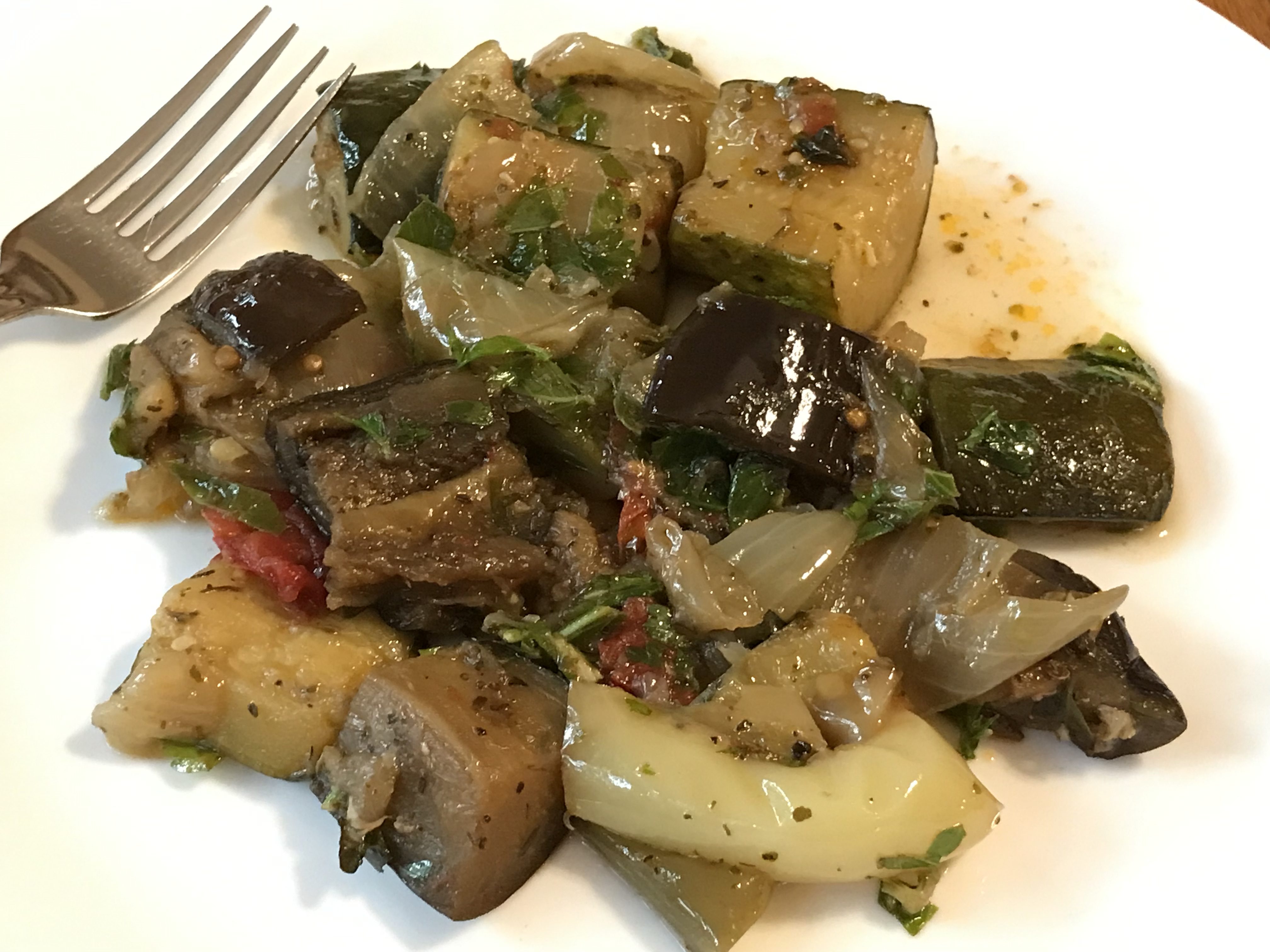
Ratatouille is a hilarious movie. It is also a delicious demonstration of Southern French history in a single dish. The garlic, onions, parsley, and olive oil were all available from the time Rome controlled the region, if not before. During the Middle Ages, dukes and counts in Southern France were as wealthy and powerful as the king in Paris, if not more so. Much of this wealth came from the area’s agricultural productivity, but trade was also important. Eggplants arrived via trade with the Arab world and became widespread around the Mediterranean. Basil also came from the East. The peppers, tomatoes, and zucchini came from the Americas before becoming traditional in Provence.
Clafoutis is sort of like a cross between a cake and a custard. It begins with a batter similar to crepe batter to which fruit is added. Cherries are the most popular, but are not the only option. Unlike in cherry pie or black forest cake, sweet cherries are used. What’s most interesting about clafoutis is that traditionally, the cherries are unpitted to keep the red juice from running into and staining the cake. Supposedly the pits provide a bit of almond flavor due to compounds related to cyanide, which sounds scary but is in such small quantities that it’s not an issue. In fact, the quantities were so small that I couldn’t taste the almond flavor at all, but it wasn’t really necessary. The lightly sweet, soft crepe/custard with just a hint of vanilla was the perfect foil for the stronger flavor of the cherries. Not getting poisoned was nice too.
Southeastern France has a lot in common with the northwest corner of Italy, and it’s not just that they’re both called their country’s Riviera. The neighboring regions share a similar climate and terrain, and even share a lot of history. In 218 BC, Hannibal crossed the region as he marched his army from Carthaginian territory in Spain to Italy. While he is most famous for marching his army and elephants over the Alps, there is an interesting story about when he crossed the Rhone River in Provence. Modern day France was mostly occupied by the Gauls, who were Celtic peoples organized into chiefdoms. Most of the chiefs felt more threatened by Rome than by Carthage (as Rome had recently conquered other Celtic peoples in the Liguria/Piedmont region) so they aided or tolerated Hannibal’s army. The problem was that there was a hostile group near a strategic river crossing and a Roman army was on its way to try and ambush him. A bit of trickery bought Hannibal enough time to get his army across, but when the elephants found themselves on specially-built rafts they freaked out and jumped off and/or capsized them. Fortunately for the Carthaginians, elephants are actually quite good swimmers and all made it across. By the time the Romans arrived, Hannibal and his army had disappeared into the Alps.
Over the course of the war, which lasted from 218 to 202 BC, Rome conquered the French Riviera and most of Spain. It’s not clear how many grapevines were already grown in the region, but the Romans certainly introduced new varieties and encouraged their cultivation, along with olive trees. From Provence (the name came from the Latin provincia) vines spread northward, particularly once Julius Caesar conquered the rest of Gaul (modern France) in the 50s BC. Olive trees, though restricted to the coast that far north, were also introduced and became important to Provence’s economy.
Pesto-type sauces were part of Ancient Roman cuisine and basil appeared in the Medieval Era, but what’s interesting about this soup is that most of the ingredients deemed essential originated in the Americas. White beans, green beans, potatoes, and tomatoes were all introduced after Columbus, and the latter two took a few centuries to catch on. Fortunately they did, because this soup is a balanced meal in a bowl. There’s starch in the potatoes, protein in the beans, vitamins and minerals in the vegetables, and a bit of fat from the olive oil.
Ms. Sheraton explains that as long as there are both types of beans, potatoes, and tomatoes, the other vegetables can vary based on what’s available. Since it sounded like a chef’s choice kind of dish, I created my own plan from the general description. Onions, tomatoes, and white beans went in first, with enough water to cover by about an inch. For meatless vegetable soups it is important not to add too much water to avoid diluting the flavor. I added the potatoes about halfway through, then added the zucchini and green beans in the last few minutes to keep them from overcooking. The pistou, which is like a French pesto without pine nuts or walnuts, is added to the individual bowls at serving time.
The soup was an amazing taste of summer. While the ingredients are generally available out of season, they both taste better and are more affordable at their summer peak. Tomatoes are especially seasonal, since shipping them any distance is much easier when they are underripe. At local farm stands they are ripe and red all the way through, all the vegetables are fresh, and the basil is my own. It thrives during the summer but does not do well when moved inside. I’ve tried that in the past without much success. It’s better to make maximum use of it now.
In temperate climates, strawberries are one of the first fruits to ripen each season. While modern farming and shipping methods have made them available year-round, the fresh, ruby-red berries that come onto the market in early summer are special. Because fully ripe strawberries don’t ship or keep well, they are usually either flash-frozen or picked underripe for grocery store shelves. When the aromatic beauties appear at farm stands and farmers’ markets, people still go crazy for them. Many are eaten plain as a delicious, healthy snack or dessert. To preserve the bounty, they can be turned into jam (freezer jam is easy and maintains the aroma) and freeze very well. In fact, for winter desserts and smoothies, thawed frozen berries usually have a better flavor than out-of-season fresh berries.
Of course, there are many ways to take advantage of the summer berries while they last. Every year I make at least one chocolate-strawberry pie with a cream cheese filling. Not only is it delicious, but it has an important virtue as a summer treat: the oven only needs to be turned on for long enough to bake the pie shell. For the same reason, if serving strawberries with pound cake, I’ve learned not to bake my own. During the winter I can use the oven to my heart’s content, but during summer the hour-long baking time almost inevitably leads to complaints. Luckily Sara Lee pound cakes are readily available in every grocery store, don’t heat up the kitchen, and have a quality level to complement the exquisite fruit.
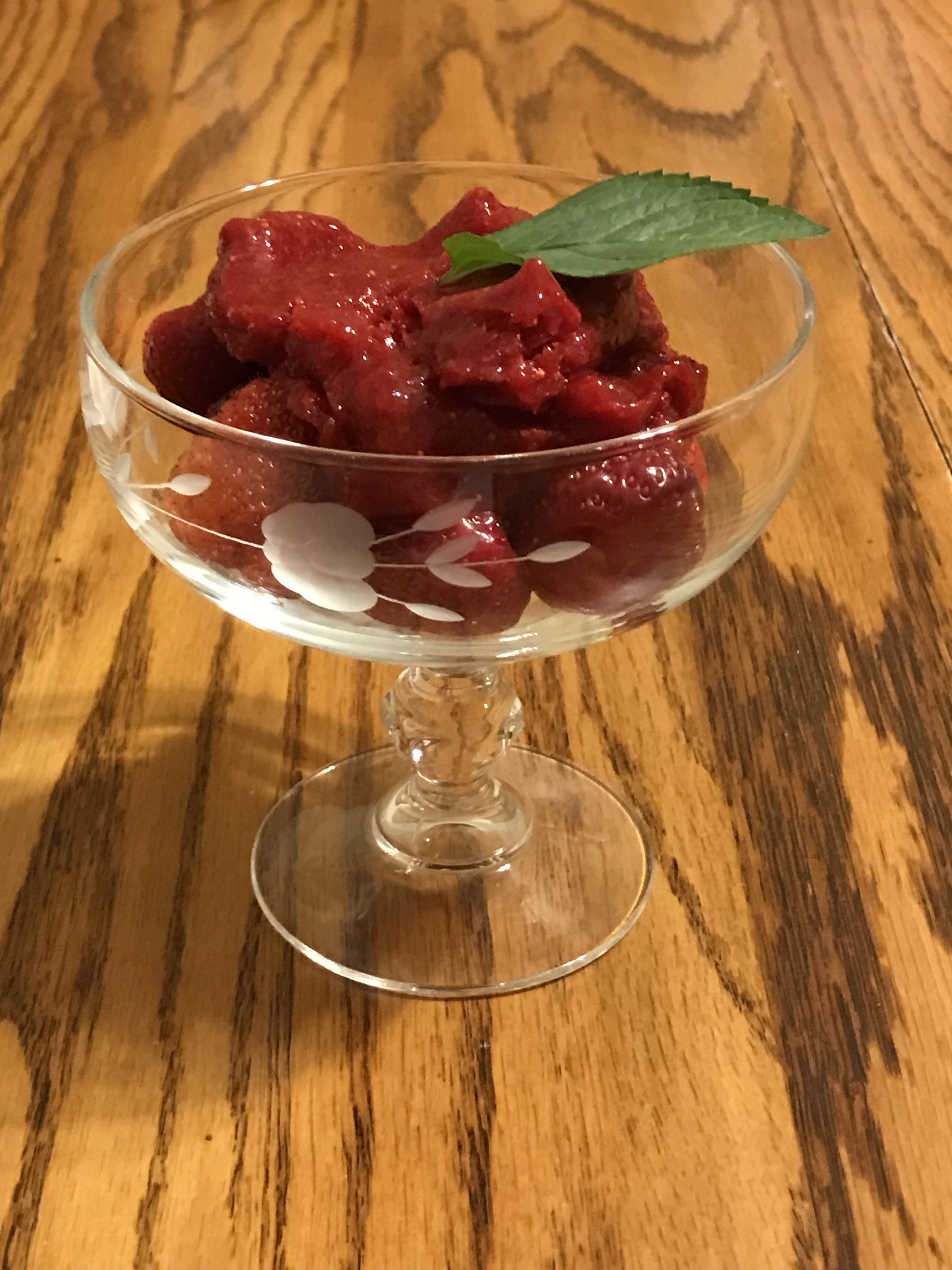
This year, in addition to the aforementioned pie, I tried a new recipe suggested by Mimi Sheraton. Fraises au jus glace (otherwise known as strawberries Ali-Bab) is simple to make, just hull the strawberries, puree a few of the least pretty with a bit of sugar and lemon juice, partially freeze the mix, then toss with the rest of the berries. Adding a bit of orange liqueur to the frozen mix is optional, but I opted not to use any for a pure strawberry flavor. Good quality strawberries are essential, as pointed out by Ms. Sheraton.
When the best strawberries are in season, this recipe was an excellent way to let them shine. Enhanced with just a bit of sugar (a few teaspoons among multiple people), there was nothing to overpower them, and the addition of the frozen puree as a “sauce” was a nice touch for summer. Between the flavor and very limited sugar, this will definitely make it into my annual recipe rotation.












 Feasting Through Time