Add seasonal flowers for a lovely modern still life
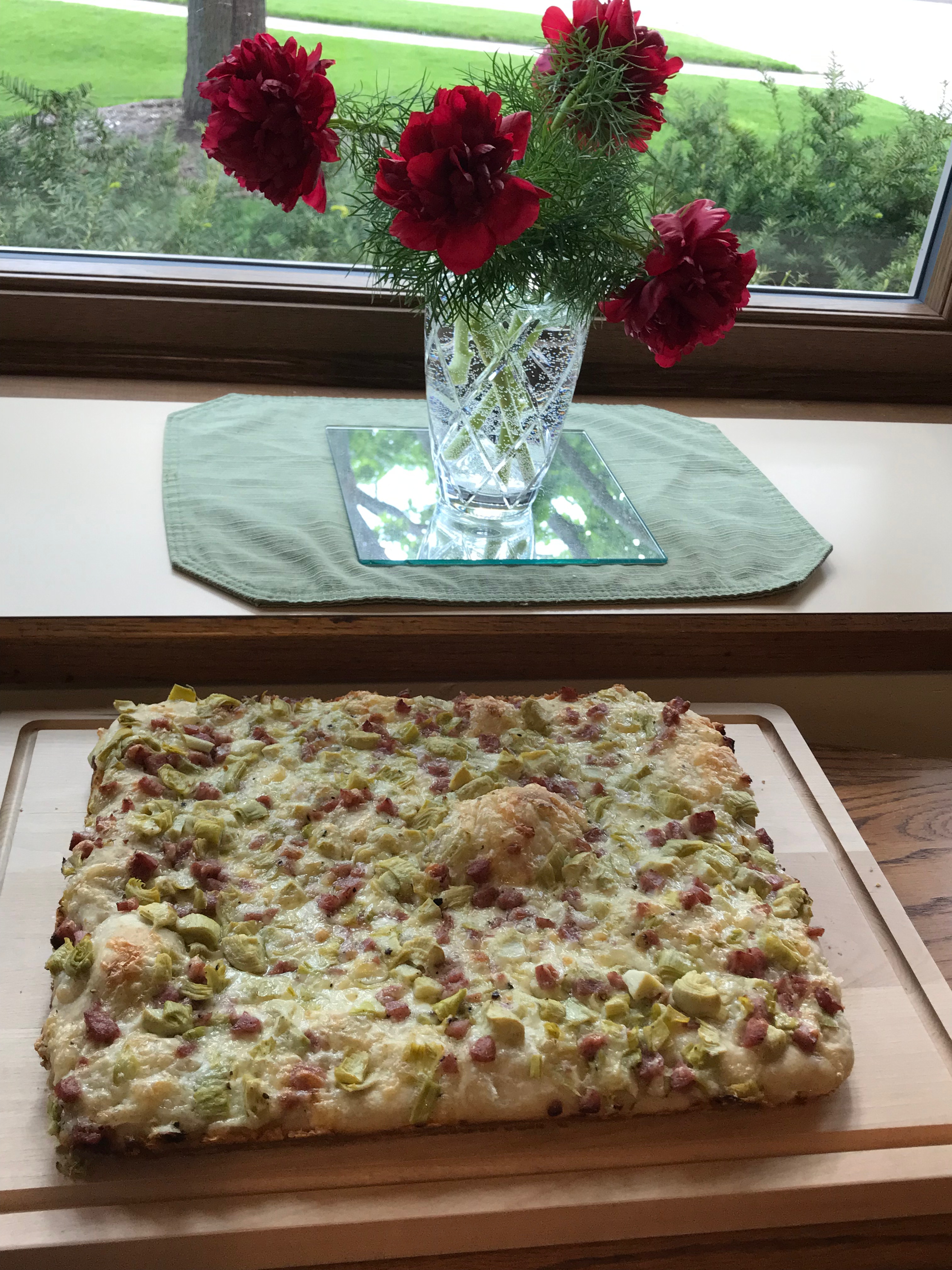
Crazy as it sounds, ring bologna is actually a decent substitute for mortadella in a pinch. After all, mortadella originated in bologna. American “baloney” was an attempt to imitate it. The ring variety is better than the slices, and in either case, crisping it up in a pan gives the bologna a boost in flavor and texture. On this pizza, the oven takes care of that step for you.
If you make the dough the night before and leave it in the fridge, and if you still have garlic oil on hand (the recipe makes enough for several pizzas), this is the easiest pizza in the book. No vegetables need to be precooked; no herbs need to be minced. Just shred the fontina, rinse and chop up the canned artichokes, chop up the mortadella (or bologna) and you’re good to go.
Advertisements
The flavors and textures in this pizza are very well-balanced, between briny, slightly meaty artichokes, peppery bologna, creamy cheese, crispy crust, and garlic. On page 226, author Joe Famularo says the best way to get a good garlic flavor on a pizza without it scorching or being overwhelming is to use garlic-infused oil. And he’s absolutely right. The flavor is definitely there, but it doesn’t overpower the other flavors. Everything is in harmony.
A few months ago, I came across some ricotta salata while browsing at Woodman’s. Remembering that lack of it led me to improvise on sweet pepper pizza a few years ago, I decided to remake the recipe and give it a try. Plus, I had some unbleached flour and quick-rising yeast I wanted to use up before they went bad. At the time, I’d been trying to clear out the pantry, find a use for the ingredients pushed to the back, and therefore avoid food waste.
Recently I started watching Hoarders, which is enough to make anyone want to clean, even if they don’t have a problem. Many of the jam-packed kitchens came about because their owners liked to stock up when preferred items went on sale. There’s nothing wrong with that, as long as you don’t buy more than you can use before it goes bad. Having some extra cereal, pasta, crackers, and canned goods in the basement is handy. Just don’t overdo it.
Some items, like the cornmeal that I bought at the start of Covid, expired two or three years ago and weren’t salvageable. The yeast and unbleached flour were still good, but expiring soon, so it was as good a time as any to make pizza. I made the garlic oil that all the recipes use, stuck it in a jar in the fridge, and decided to start with a white pizza using the leftover provolone and some of the pecorino from the eggplant timbale (and leftover parmesan from some gnocchi, and some mozzarella already in the fridge).
Advertisements
When I went to put the dough in the intended pan, a large round sheet pan with a short “lip,” it wasn’t there. Turns out, it had started flaking and reached the end of its natural life. Looking at my other options, I settled on a roasting pan with slightly higher sides. If I spread the dough all the way to the edge, the surface area would be similar, just in rectangular form. Nothing wrong with that.
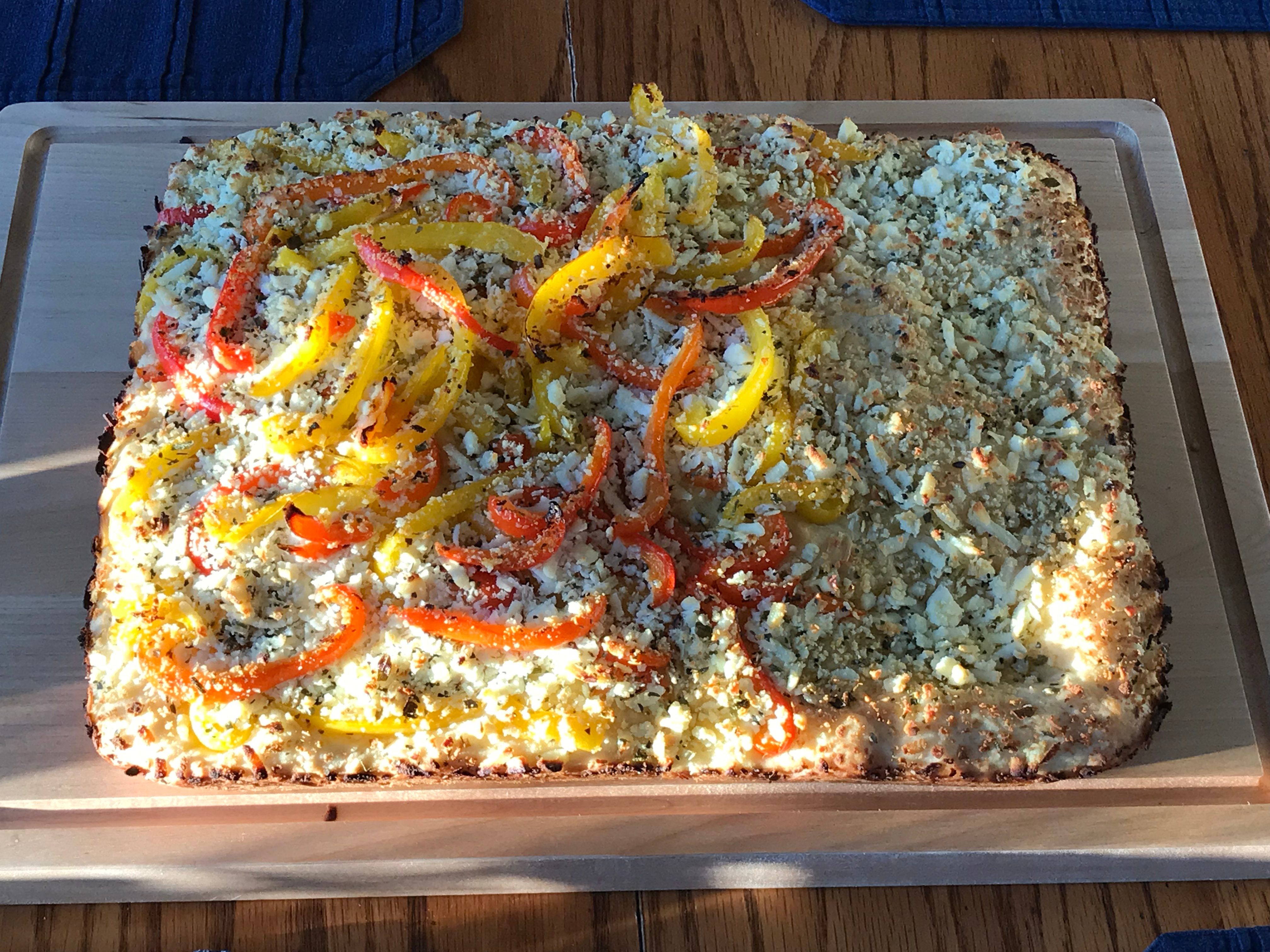
This turned out to be the best culinary misadventure in a while. Because this dough recipe produces a thick crust, I had never spread it to the edge of the pan before, in case the garlic oil in the topping dripped off onto the bottom of the oven. Being able to do so made a huge difference. The crust rose evenly instead of bulging in the middle, and the edges got extra golden and crispy. Everything was delicious, but the edges were phenomenal. And the pizza fit perfectly on the new, giant wooden cutting board.
After this success, I decided to make any future pizzas in this pan. The sweet pepper and ricotta salata pizza was up next, for the simple reason that peppers were on sale at the store. This was good, but a little dry, even with the garlic oil. For pizza, meltier cheeses with a bit more fat seem to be the way to go.
Menu: Bergamo-Style Ravioli, Rabbit Roasted in Red Wine, Bergamo-Style Polenta, Cheese with Mixed Salad, Sambuca-Flavored Cocoa Roll (orange flavor instead)
Recommended Wine: Spumante
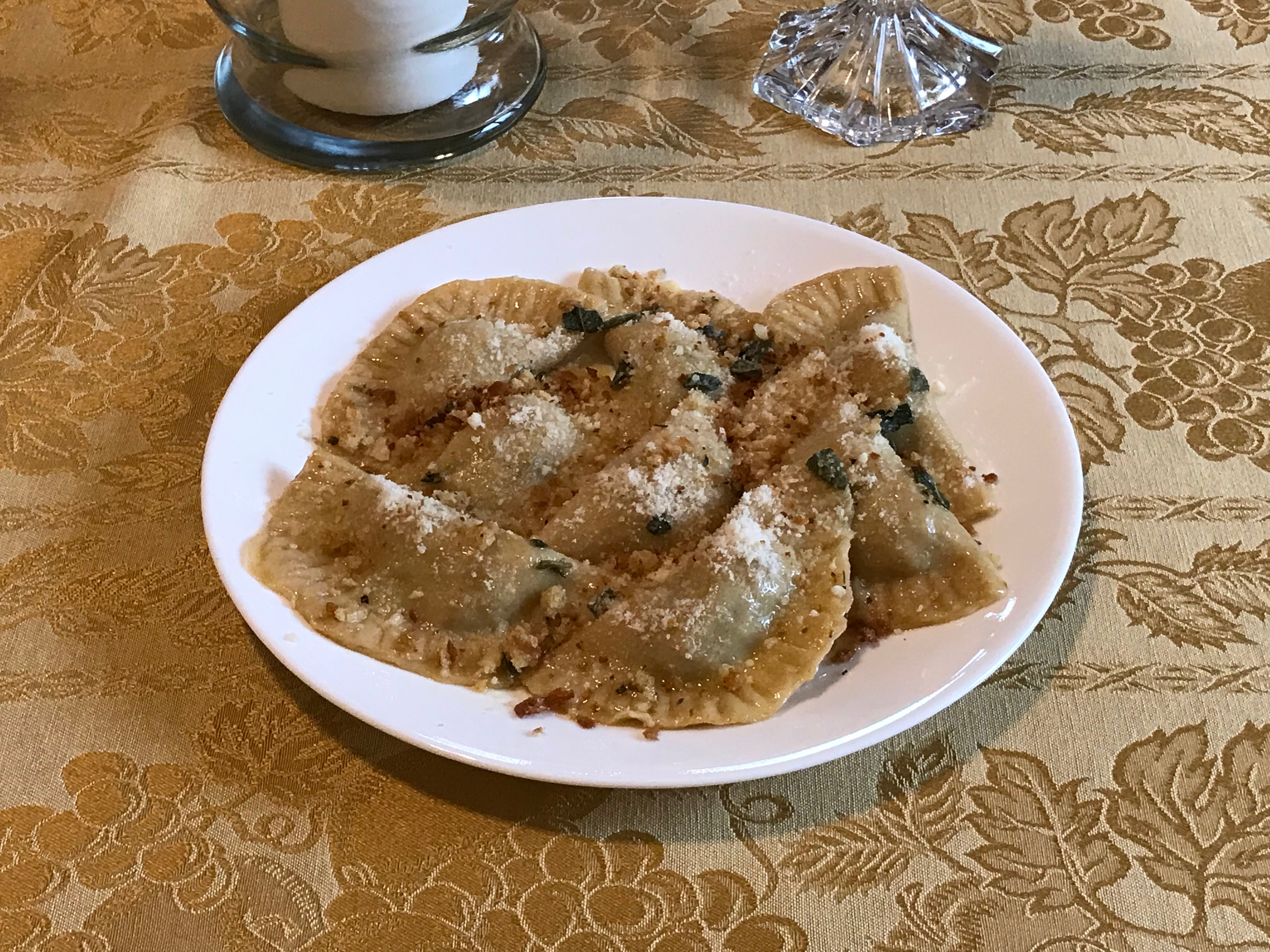
Bergamo is in the northern Italian province of Lombardy, north of Milan. As in the rest of northern Italy, there is a lot of fresh pasta and polenta, butter often replaces olive oil, and there are plentiful cow’s milk cheeses like fontina, gorgonzola, parmesan, and mascarpone. While generally overshadowed by its larger neighbor, Bergamo has its own specialties. One of these is a unique ravioli, filled with a mix of chicken, pork, salami, vegetables, and a little cheese. They are dressed in melted butter and sage, parmesan cheese, and toasted bread crumbs.
This was my first attempt at making my own pasta, and it went surprisingly well. Since I don’t have a pasta roller, I rolled little pieces of dough into circles with a rolling pin and folded them around the filling in a half-moon shape. It was a slow process, but making the ravioli bigger sped things along. The meat-and-vegetable filling was deliciously different from the usual cheese-heavy varieties, though there’s nothing wrong with those.
The only thing I would change is to cook the larger ravioli for an extra minute or two. Having thicker pasta kept the ravioli from bursting open, but not factoring it into the cooking time left it a little tough. It was still delicious, and the extras are in the freezer for whenever a quick homemade dinner is desired.
Advertisements
Another first for this menu was the rabbit. The idea was a little tough at first, until I reminded myself that this rabbit (which according to the package was a product of Spain) was bred and raised exclusively for food. It was never someone’s pet, or a former resident of the nearby farm/petting zoo. Besides, people have been eating rabbits for a lot longer than they’ve been keeping them as pets. They were a common protein into the 20th Century, and one 1930s menu even had rabbit pot pie as an economical alternative to chicken.
Rabbit does, in fact, taste sort of like dark meat chicken, but a little different and very lean. The fact that chicken is easier to farm on an industrial scale probably explains why rabbit isn’t as popular as it used to be. Or maybe it’s just that people didn’t grow up with the Easter Chicken. Or the fact that chickens won’t stand on their hind legs like a prairie dog when offered a banana chip.
Not the second course…and I wasn’t rabbit sitting when I made this menu either.
Regardless, most rabbit recipes seem to involve slow-cooking it in liquid and/or adding some extra fat. In this case, the fat came from a bit of Italian sausage, and the liquid was red wine. It did taste very good, though in the future I would probably just use chicken thighs, which are cheaper and easier to find. At least for this recipe.
Upon reading the recipe, I was surprised at how quickly the polenta cooked. Once the salted water was boiling, the corn grits/polenta only had to cook for about five minutes. It required frequent but not constant stirring, and didn’t get lumpy, which is a common problem. Was the addition of a little buckwheat flour the key to a good consistency? Perhaps, and either way, the addition of butter, sage, and fontina cheese gave the final mix a pleasant rich but mild flavor that contrasted well with the stronger flavors in the rest of the meal.
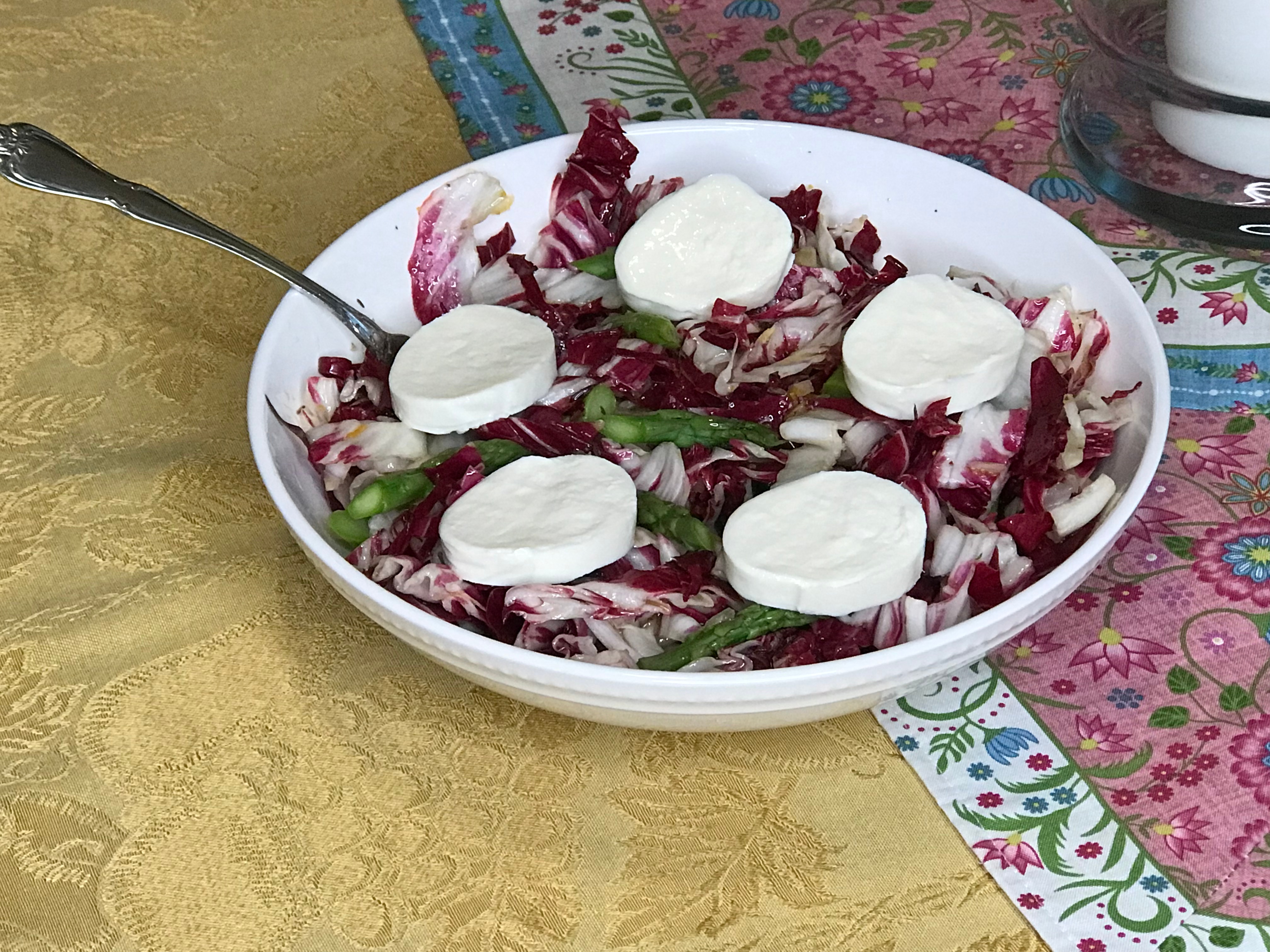
The salad was similar to many others in the book; a mix of greens dressed with a flavorful homemade dressing. The store didn’t have the endive called for in the recipe, so I just used the arugula and radicchio. Unlike other lemon juice and oil “vinaigrettes,” a little bit of orange zest and some minced shallots seemed to sweeten the mix, keeping it from becoming too sour and letting it balance the bitter radicchio. Don’t worry if the oil solidifies in the refrigerator. Fifteen to thirty minutes at room temperature will take care of that.
For the cheese, I used fresh mozzarella instead of taleggio because that’s what was available at the store. Even though it’s a southern Italian cheese not native to the Bergamo area, it went very well with the salad, especially when served on the dressed greens instead of next to them. The bitter arugula and radicchio, sour and slightly sweet dressing, and mild mozzarella all contrasted beautifully without clashing.
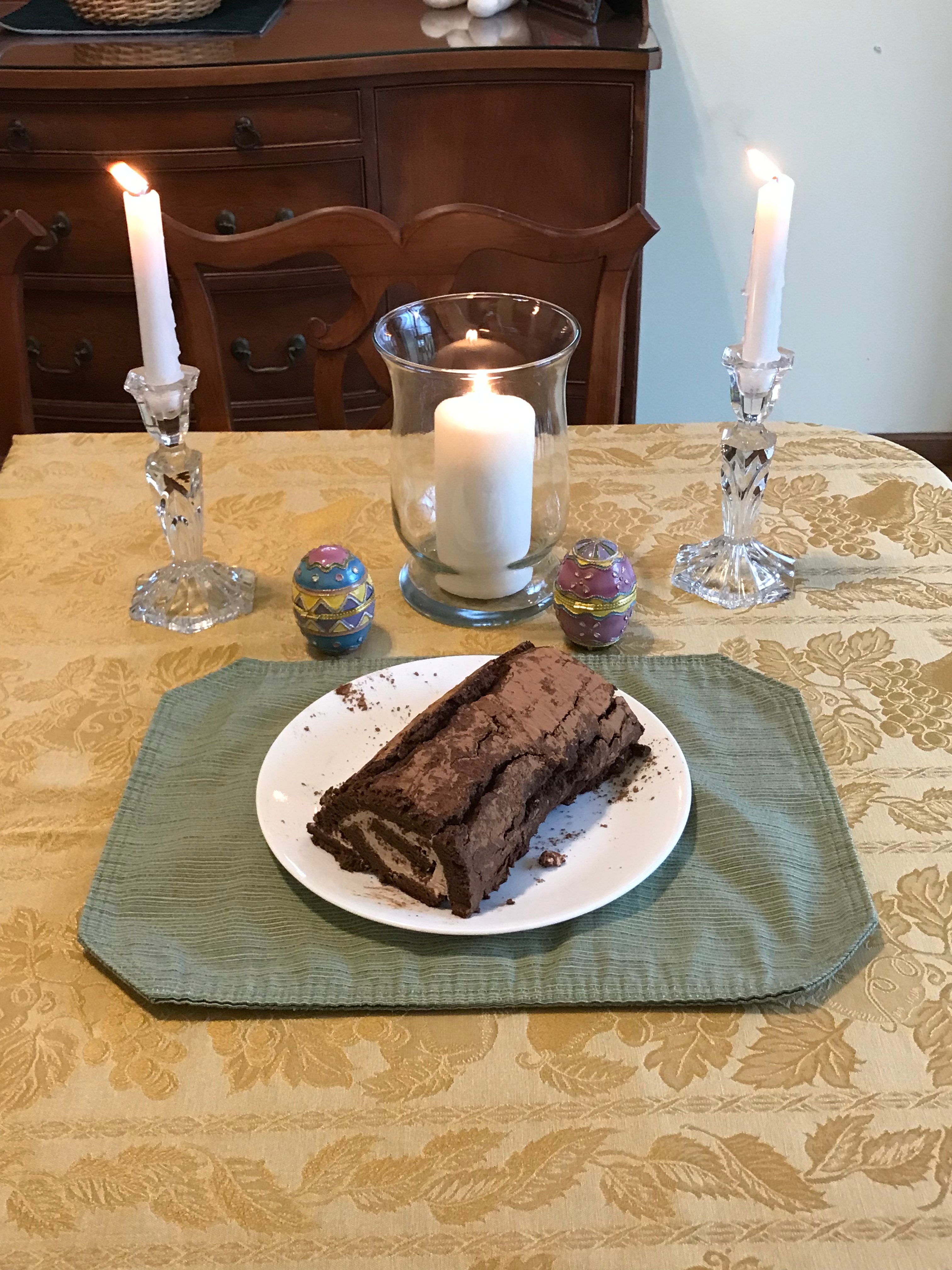
Dessert was one of the best things I’ve made in a while. The “cake” is a mix of egg yolks whipped with sugar, melted chocolate, a bit of flavoring, and separately whipped egg whites folded in at the end. The original recipe calls for three tablespoons of sambuca to be mixed in with the chocolate. Since I didn’t want to buy a whole bottle that I would be unlikely to drink or use in other recipes, I considered replacing it with a teaspoon of anise extract mixed into some cream, until I remembered that replacing wine with milk caused a previous attempt at zabaglione to fail. To keep the chemistry similar, I initially settled on a teaspoon of anise extract mixed into three tablespoons brandy.
Advertisements
Then I considered that anise (the flavor of black licorice) is not generally my favorite flavoring. Trying a bit over a scoop of ice cream with a sprinkle of coffee granules is one thing. It’s a single serving that takes two minutes to make. Even though that turned out well, I was hesitant to put anise flavoring into an entire cake that was a bit fiddly to make. Other extract options were vanilla, almond, and orange. Since I was already making an almond cheesecake for a different event, I settled on orange for something different. A teaspoon went into the “cake,” and half a teaspoon went into the whipped cream filling.
The cake was spectacular. The texture ended up somewhere between a brownie and a mousse, intensely chocolate lightened with a touch of orange. While the cake did crack slightly as I rolled it up, the inside still formed a recognizable spiral. Not pastry shop window perfect, and it wouldn’t pass muster on the Great British Baking Show, but still a pretty special occasion dessert. And of course, it’s the taste that counts. From time to time it’s well worth the effort.
Among the numerous varieties of risotto, there are a few classics, as detailed in 1000 Foods to Eat Before You Die on pages 233 – 234. Risotto bianco is the basic kind, made simply with rice, butter, a little onion or shallot, white wine, broth, parmesan cheese, and maybe some pancetta or bacon. Milanese is colored a bright golden yellow with saffron. Nero is colored black with squid ink. Piedmontese is enhanced with white truffles. Other varieties might include seafood, mushrooms, or vegetables.
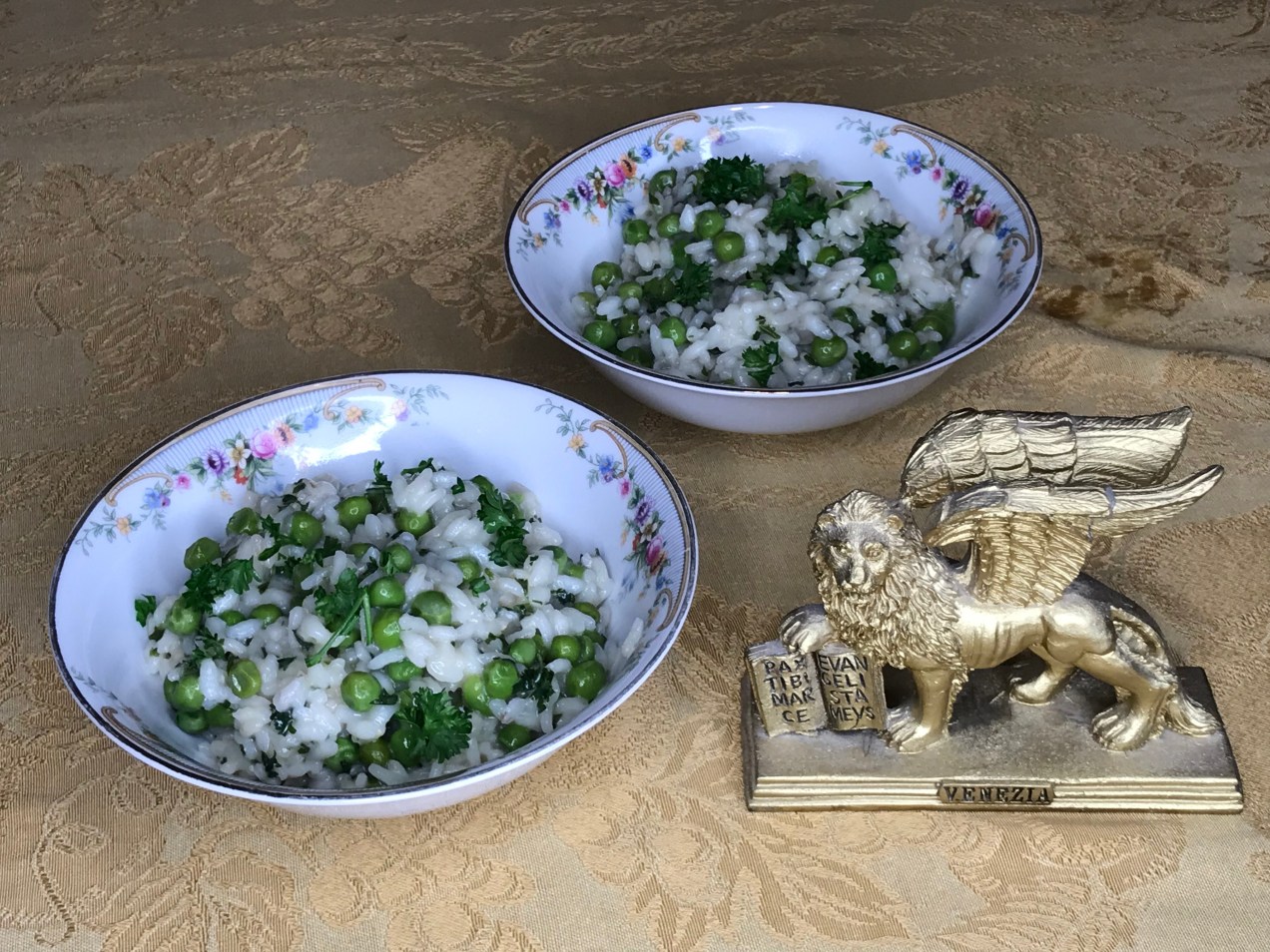
As you can probably guess, risotto verde is meant to be green. Frequently a spring specialty, it gets its color from parsley and either sweet green peas or asparagus. It’s very fresh-tasting and, when made with frozen peas, surprisingly quick and easy to prepare. To keep everything bright and fresh, I didn’t use any pancetta for my own recipe.
Technically, you’re not “supposed” to reheat risotto, because it thickens upon standing and can become “gluey.” I’ve never had this problem, or maybe the texture upon reheating just doesn’t bother me. Just add a few drops of water before putting it in the microwave. It will still be a great accompaniment to your chicken sandwich for lunch, and it’s way healthier than chips.
Ingredients:
4 tablespoons (or ¼ cup) butter, or 2 tablespoons each butter and olive oil
1 shallot or ¼ onion, minced
1 ½ cups arborio or other short-grain rice
4 tablespoons (or ¼ cup) dry white wine (something light like pinot grigio), or replace with extra broth
4 – 5 cups chicken or vegetable broth (broth made from poaching chicken works great here)
1 10-ounce bag frozen peas
Half bunch parsley, large stems removed, minced
1 cup grated parmesan cheese
Directions:
Combine the broth and peas in a medium saucepan and bring to a boil. Turn off heat, but leave on the stove.
Melt the butter in a large skillet over medium heat. When bubbling, add shallot or onion and sauté for about 2 minutes, until softened.
Add the rice and cook, stirring constantly, until coated and translucent, about 2 minutes.
Stir in the wine and cook, stirring constantly, until evaporated, another 2 or 3 minutes.
Add the broth and peas, a ladleful at a time, stirring constantly, waiting for each to absorb before adding the next. Stir in the parsley about halfway through, saving a little to sprinkle on top at serving time.
After adding 4 cups of broth, the risotto should be slightly liquid. If it seems too thick, add a little more broth.
Remove from the heat, stir in the parmesan, sprinkle with remaining parsley, and serve immediately.
For more recipes, history, and fun facts sent directly to your inbox, please like, subscribe, and/or share.
As far as I can tell, the plain English definition of timbale is “food, encased in a different type of food, cooked in a mold, then turned out onto a platter to serve.” Timbales, or timballos in Italian, are popular in Sicily, probably originating in the kitchens of wealthy aristocrats. Elaborate versions might include a pastry crust, or rice molded precariously around a complex filling of meats, cheeses, vegetables, and eggs.
The recipe here is much simpler, a mix of pasta, tomato sauce, cheese, and eggs, stuffed into an eggplant “shell.” There are two time-consuming steps, preparing the eggplant (slicing super thin, salting, and broiling) and making the homemade tomato sauce, but both can be done ahead of time. In fact, it isn’t a bad idea to make extra sauce, set aside what’s needed for the timbale, and have the rest with meatballs (and the gnocchi you made to clear the semolina flour out of the pantry). It’s also helpful to grate the cheese a day ahead. (And make the hard-boiled eggs the recipe calls for but I omitted.)
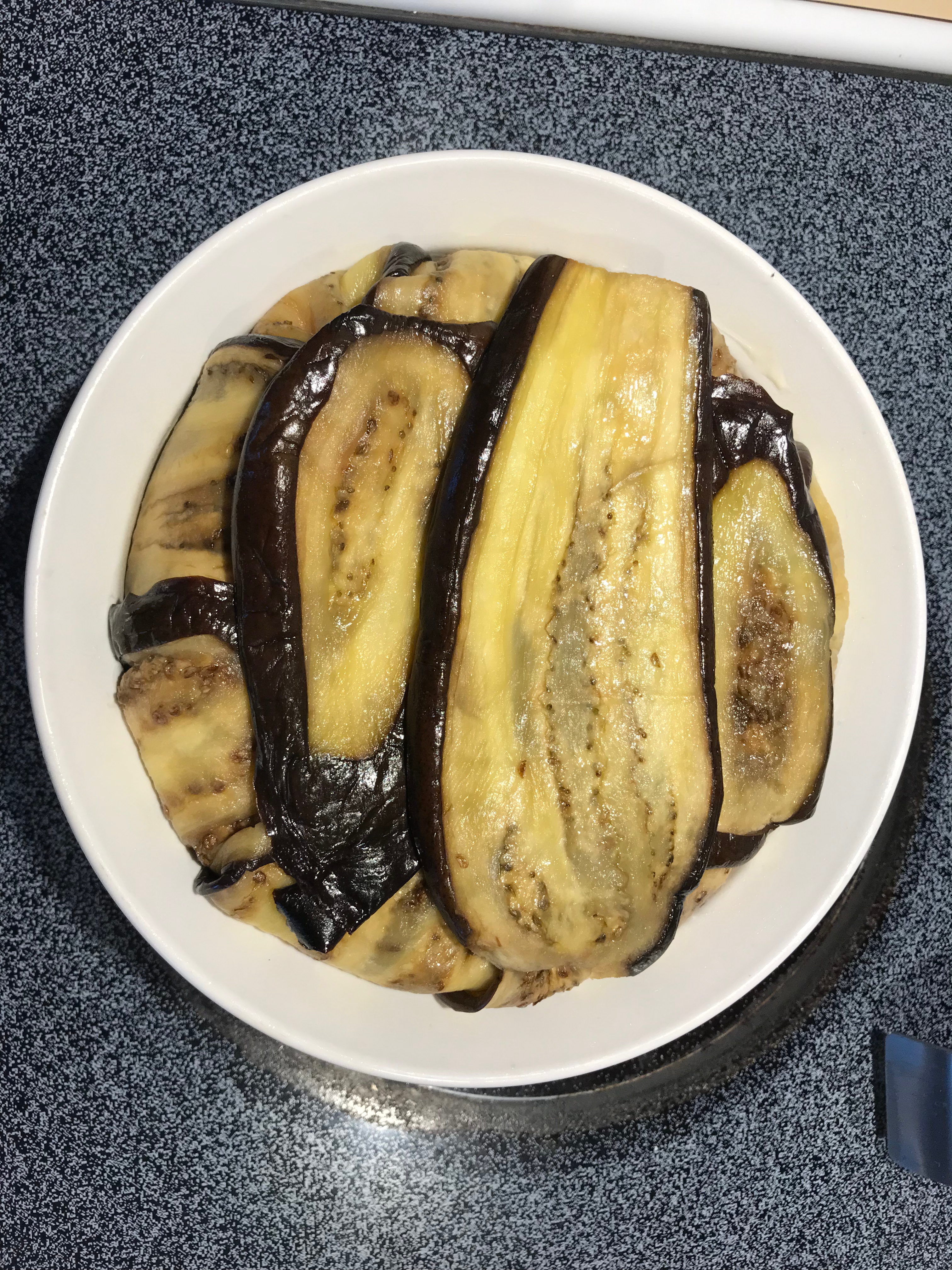
If all of this is done, this fancy-looking timbale is actually feasible for a weeknight. While the water boils and the pasta cooks, you can butter the baking dish, line it with overlapping eggplant slices, and warm the tomato sauce. Then it’s just a matter of mixing the filling, packing it into the mold, covering it with more eggplant slices, and baking.
How the dish is linedReady for the oven
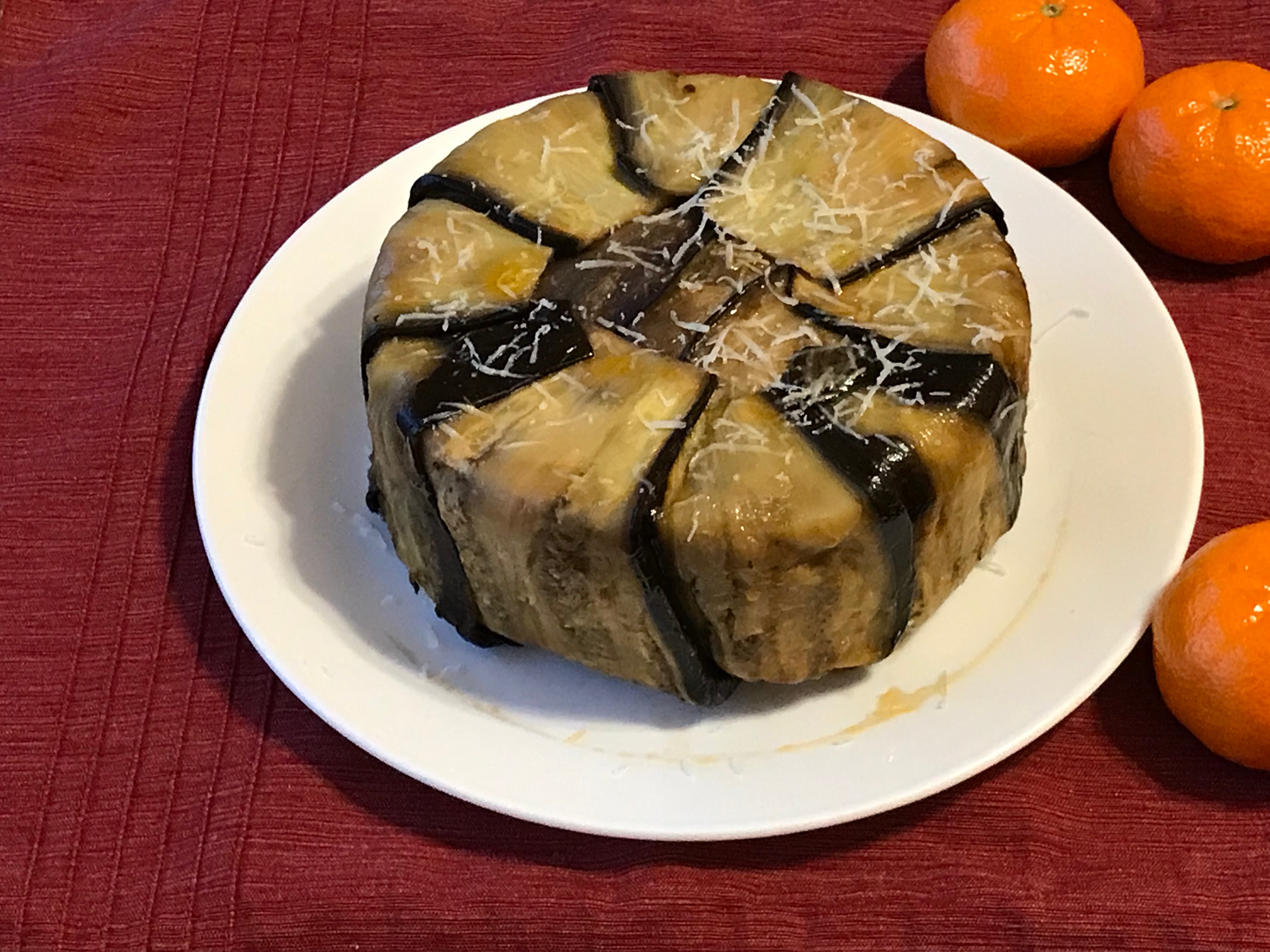
Just look how pretty the end result is. It didn’t fall apart when unmolded, and tasted as good as it looked. The timbale isn’t necessarily for every day, but it was easier than I expected and would no doubt be a great way to show off for guests. Just beware that the slices aren’t as pretty as the whole.
Despite his remarkable career, Napoleon Bonaparte had several close calls on his rise to power. One such case was at the Battle of Marengo in June 1800. Napoleon had seized power in a coup the previous year. To secure his rule, he needed military victories. At the time, he was fighting the Austrians for control of northern Italy. They met in battle near the city of Alessandria, in the Piedmont region.
At first, the battle didn’t go well for the French, but Napoleon managed to snatch victory from the jaws of defeat. His control over Italy was secured, skeptics in France were reassured, and other ambitious generals were discouraged from turning on him. To celebrate, or simply because he was hungry after a long and no doubt stressful battle, Napoleon requested a special dish. Or so the story goes.
Recipes for chicken marengo vary enormously. The only constants seem to be chicken (or occasionally veal) browned in olive oil, onions, and tomatoes, braised together to make a sort of stew. There’s usually garlic, mushrooms, and white wine. Many recipes include shallots and parsley, and a few use brandy instead of wine. Great chef Auguste Escoffier recommended including fried eggs and crayfish. Regardless of specifics, toasts fried in butter traditionally accompany chicken marengo.
To make things even more complicated, there seems to be a debate about whether chicken marengo is French or Italian. In Mimi Sheraton’s 1,000 Foods to Eat Before You Die, it’s in the French section, but I’ve also seen recipes in Italian cookbooks. Since the Piedmont region was historically part of the Duchy of Savoy, a realm straddling the Alps between France and Italy and right on the trade routes between them, it’s hardly surprising that a Piedmontese dish would be adopted into French cuisine, or vice-versa. And it’s fitting that an entrée associated with Napoleon should be considered both French and Italian. After all, he himself was a native of Corsica, then ruled by Genoa, but made his career in France.
For my own recipe, I combined the different strands into one, with no eggs or crayfish. The nice thing about chicken or “veal” marengo is that after browning the meat and making the “sauce,” it can be kept overnight and cooked the following day. Everything can be done in a Dutch oven, but if you don’t have one, a skillet and slow-cooker will also work. If you want to reduce fat and calories, the bread can be toasted dry in the oven or toaster, instead of in the buttered skillet. Or don’t toast it, if you prefer, but whatever you do, don’t skip it. You need bread to soak up the sauce.
4 garlic cloves, crushed with the side of the knife and minced
1 bunch parsley, thick stems separated from leaves and thinner stems, and both parts minced separately (don’t discard the thick stems)
3 tablespoons dry white wine, mixed with 1 tablespoon brandy
2 tablespoons flour
1 (roughly 15 oz) can crushed tomatoes, or about 2 lbs fresh tomatoes, chopped
1 pound mushrooms, cut into thick slices, with larger pieces halved
Baguette or Italian bread, to serve
Directions:
Brown meat in the olive oil and two tablespoons of the butter in the skillet or Dutch oven over medium heat. Set aside on a plate.
Add onion and shallots and sauté, stirring frequently, for about 5 minutes, or until they start to turn golden. Add the garlic and parsley stems and cook for 2 more minutes (garlic is added later because it cooks faster and burns more easily).
Stir in the wine/brandy mix, making sure to scrape up any browned bits at the bottom of the pan. Cook until the liquid is mostly evaporated, 5 to 10 minutes.
Add the flour and stir until incorporated. Follow with the tomatoes, and water if using canned. Bring sauce mixture to a boil. If using fresh tomatoes, reduce heat and simmer for 10 to 15 minutes, until the tomatoes break down and release their juice. Add salt and pepper to taste.
Place the meat, skin side up if using chicken, in the Dutch oven or slow-cooker, and cover with the sauce. At this point, the chicken/pork/veal marengo can be refrigerated overnight if desired.
Preheat oven to 325 degrees Fahrenheit, if using Dutch oven. Bake for 2 to 3 hours, until the meat is tender (if the stew was chilled overnight, it will probably be at the longer end of the time range).
If using a slow-cooker, cook for about 4 hours on high or 6 – 8 on low. If it’s a little longer, like if you put it on before leaving for work, that’s completely fine.
Half an hour before serving (with either cooking method), melt the remaining butter in a skillet over medium heat. Add the mushrooms and a little salt and cook, stirring frequently, until soft and aromatic, about 10 to 15 minutes. Add to the stew, pressing them down into the sauce, and leave to cook while browning the toasts (or for 15 minutes if you decide to use untoasted bread).
Toast the bread pieces in a buttered skillet over medium low heat until browned.
Sprinkle the stew with the parsley leaves and serve, toasts on the side.
And as always, please like, subscribe, and/or share to support my work.
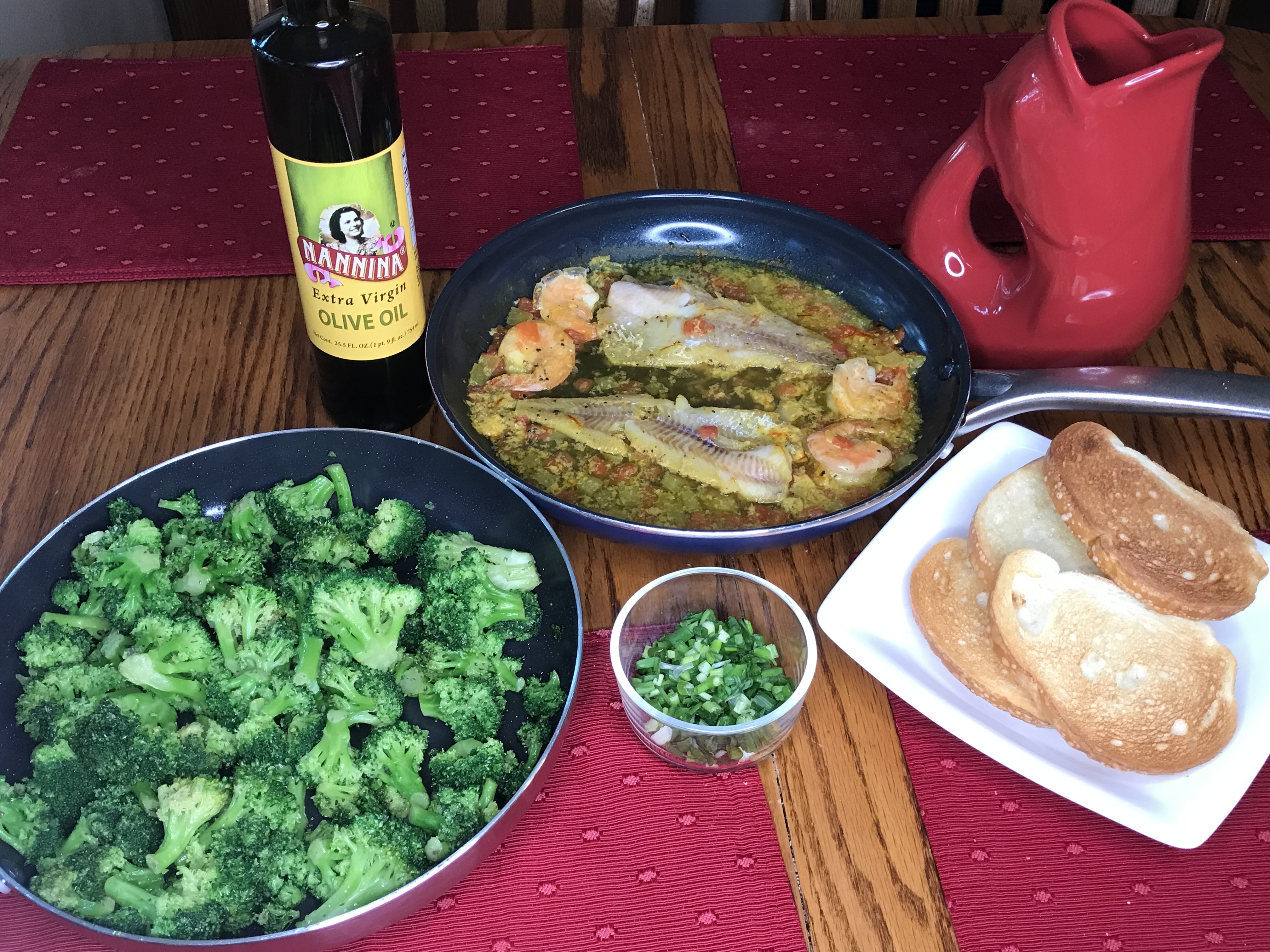
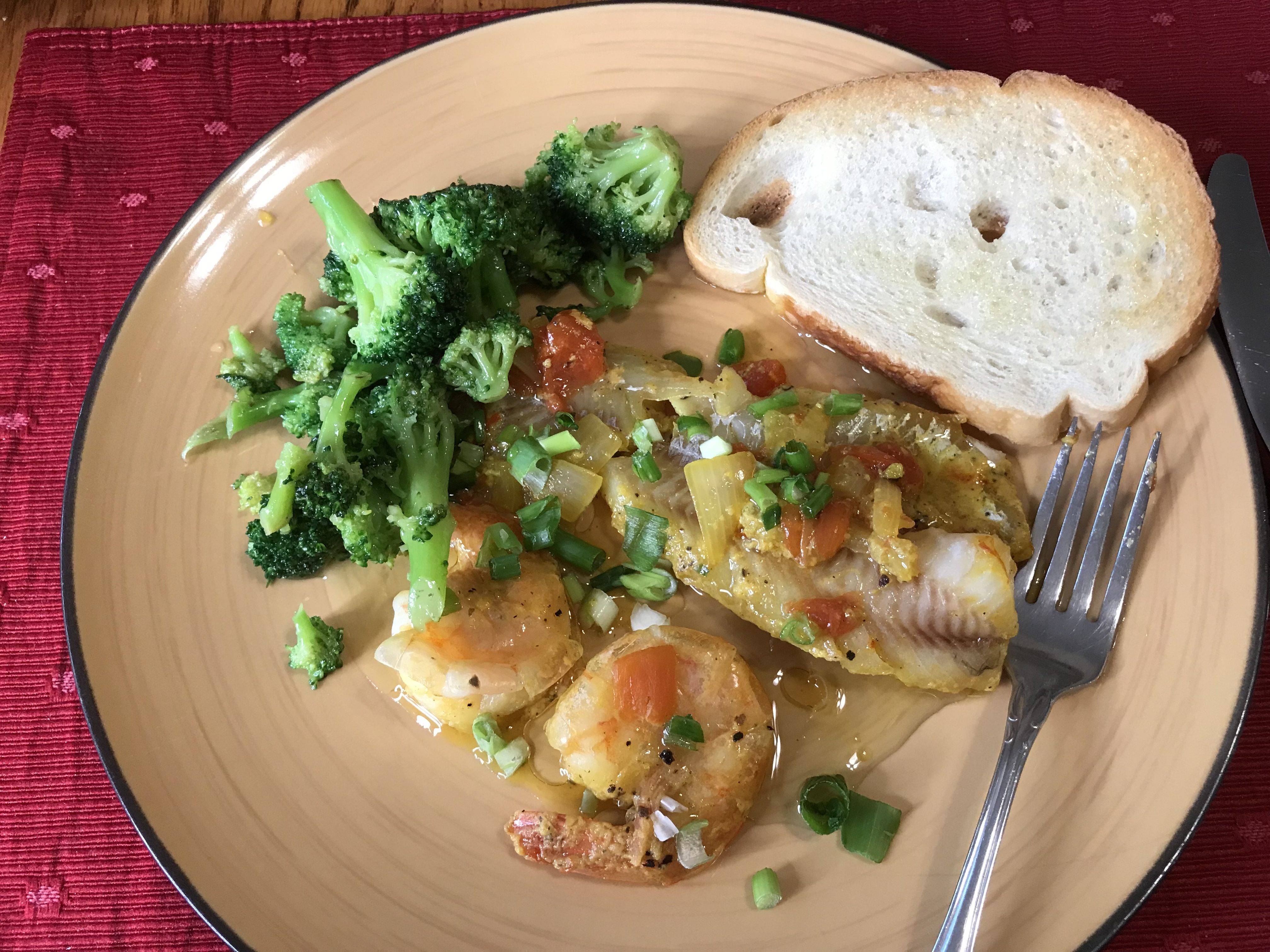
Menu: Poached “Sea Bass” with Wine and Saffron, Bruschetta, Broccoli Cooked in Garlic-Flavored Oil, Ricotta with Honey and Thyme
Recommended Wine: Orvieto (a dry or slightly sweet white)
In the 8th Century BC, rising population in their homeland led many Greeks to set out and establish colonies. They settled along the coasts of southern Italy, Sicily, Turkey, and the Black Sea, in some cases going as far as southern France, the Spanish coast, and north Africa. Over time, these colonies began setting up their own colonies. For some reason, the process slowed to a trickle by 500 BC. Had the Greeks run out of favorable locations? Did grain imports from Egypt and the Black Sea reduce population pressure in their city-states? Were local populations getting better at resisting the colonists? Or were the colonies, now grown into city-states in their own right, too busy fighting each other to keep expanding?
Whatever the reason, most colonization was finished when the Golden Age of Athens began in the 470s BC. There were a few exceptions. One of these was the city of Ancona, on Italy’s central Adriatic coast. It was founded by colonists from Syracuse in the 4th Century BC, several decades after the Syracusans crushed the Athenian invasion of Sicily. Ancona prospered but was never a great power, and was absorbed into the expanding Roman Republic in the 3rd Century BC.
Along Italy’s Adriatic (eastern) coast, various cities and regions feature seafood stews in their cuisine. Supposedly this is a remnant of Greek influence. Regardless, they are an interesting change of pace from grilled, fried, and baked fish, and cook much faster than meat or bean-based stews. It’s typical to serve these fish stews and chowders with bruschetta, to soak up the broth.
Since I couldn’t find sea bass, I used tilapia (I think). With the strong flavors of wine, tomatoes, garlic, and saffron, any affordable white fish would probably work. As promised in the introduction, this is one of the easiest main dishes in the book. Prep is just chopping a few vegetables, and cooking time is under 30 minutes. Personally, saffron is not my favorite flavoring, but the other ingredients balanced its somewhat medicinal flavor. Broccoli, lightly precooked and sauteed in garlic-infused oil, was a pleasant accompaniment, and the green was a pretty contrast with the red tomatoes and yellow saffron.
Dessert was rather interesting, fresh ricotta drizzled with honey and sprinkled with thyme. I have no problem with supermarket ricotta in lasagna, stuffed pasta, cheesecake, or cannoli filling, but don’t necessarily want to eat straight spoonfuls of it. Since fresh Italian-style ricotta was unavailable, I made my own. To serve, I had a trio of Italian honeys from World Market, chestnut, acacia, and millefiori (wildflower).
Notice the three different colors of honey
The acacia and millefiori honeys both paired well with the cheese (honestly, I couldn’t tell much difference). The chestnut took some getting used to. It’s dark in color, almost like maple syrup, and has a distinctly bitter edge. Like the saffron, it wasn’t my favorite, but overall, this was a tasty and balanced dinner.
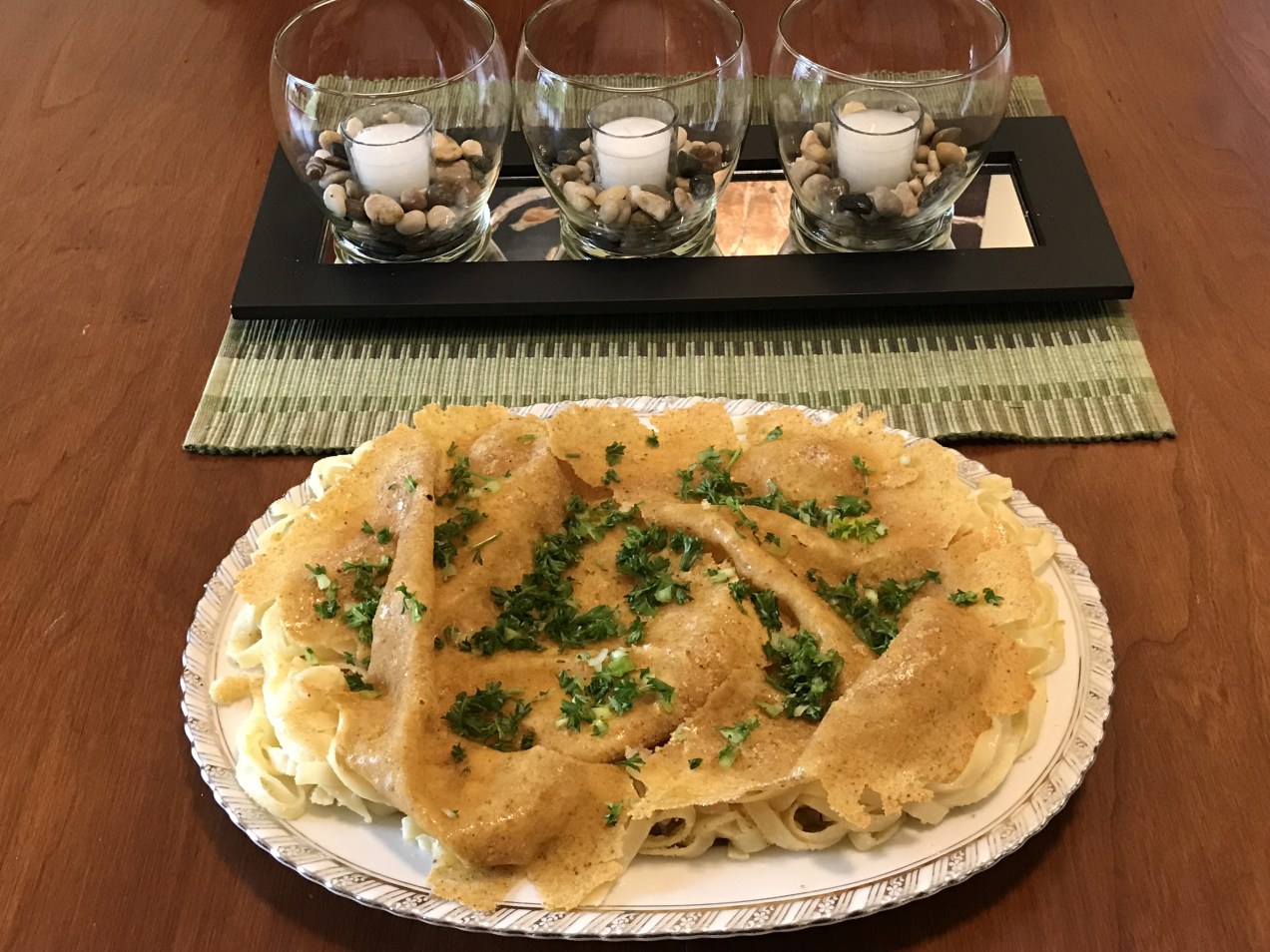
As mentioned before, Emilia-Romagna is known for its fresh pasta and dairy products. Fettuccine-like tagliatelle is frequently served with Bolognese ragu, which is never served with spaghetti. Wider pasta strands hold the sauce better. Tagliatelle can also be baked with cheese, as it is here. In this case, the two cheeses are Emilia-Romagna’s native parmesan, as well as fontina. More dairy is supplied by butter and cream.
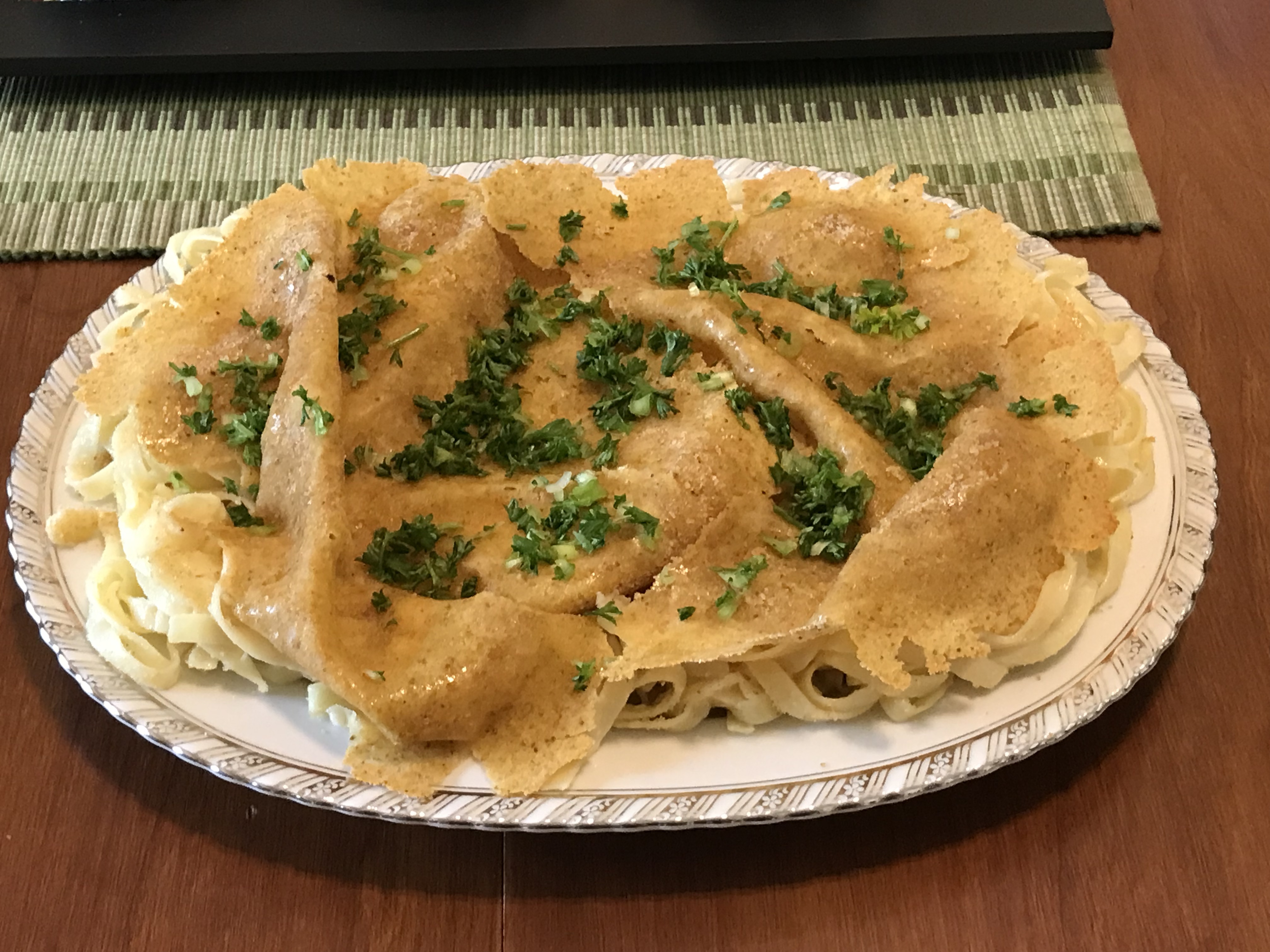
Parmesan and fontina are both cow’s milk cheeses, which predominate in northern Italy. Here, the cheese is front and center. The only contrast comes from breadcrumbs lining the baking dish and a mix of scallions and parsley minced together. Interestingly, instead of sprinkling the breadcrumbs over the top, the baking pan is buttered, coated in a layer of crumbs, then a layer of egg, then another layer of crumbs. After baking, the whole pan is inverted onto a serving platter.
I had an issue with the crumb layer sticking to the pan. It was easy to peel off, but the presentation wasn’t as pretty as it could be. And the texture wasn’t what I expected. It was more of an eggy film than the crisp crust I anticipated. Maybe it was supposed to be this way, maybe the extra egg I added because one didn’t fully coat the pan affected the texture. It was good, but in the future, I would just sprinkle the bread crumbs over the top. It’s easier and ensures that they stay crisp.
This dish reminded me of alfredo pasta, but lighter and with a stronger flavor. The scallions and parsley added a pleasant fresh contrast, and a salad would balance things out nicely. So would a cooked vegetable like green beans, and/or a bowl of fruit for dessert.
As summer fades, so do basil plants. After bringing my plants inside, a fall batch of pesto is in order to use them up. There are a million and one different ways to make it. I like the classic. Adding a bit of parsley or arugula might add some extra flavor, but the basil should dominate, supported by garlic. With those two strong flavors plus parmesan cheese, there’s no point in using expensive pine nuts. Walnuts are a common substitution, giving the final sauce a similar taste and texture. And some recipes even add a little butter along with the olive oil.
Note that while this recipe uses a food processor, connoisseurs prefer a mortar and pestle. If you have a big enough mortar and pestle and sufficient patience, by all means use it. Either way, smelling your fingers after handling the basil is optional, but highly encouraged. The aroma has a way of sticking, like that of lemon or orange peels.
Ingredients:
2 cups loosely packed fresh basil leaves
Several springs fresh parsley, if desired (seems to help reduce discoloration)
3 cloves fresh garlic, peeled, crushed with the side of a knife, and coarsely chopped
½ teaspoon salt
½ cup walnuts and/or almonds
½ cup parmesan and/or Romano cheese
½ cup olive oil
Pasta and/or vegetables, for serving
Directions:
If desired, place the walnuts in a small skillet over medium heat and toast, watching carefully, until aromatic. This will only take a few minutes.
Place the basil, optional parsley, and salt in the bowl of a food processor, and pulse several times to mince.
Add the garlic, salt, and walnuts, and blend to form a paste. Add the cheese and blend again.
With the motor running, slowly add the olive oil through the processor’s feed tube.
To thicken, add more cheese, a spoonful at a time. To thin, slowly add warm water until desired consistency is reached.
Taste for salt, adding more if necessary. Serve as soon as possible with hot pasta and/or vegetables.
Pesto can be kept in the refrigerator for a few days, but the surface will darken and brown. This is just a chemical reaction between the basil and the oxygen in the air, and will not affect the flavor. The discoloration can be slowed by covering the surface with a thin layer of olive oil. If the color change bothers you, just scrape off the top layer before serving.
To get upcoming fall recipes and posts sent directly to your inbox, be sure to subscribe. And if you liked this recipe (I hope you did), I would appreciate if you hit “like.”
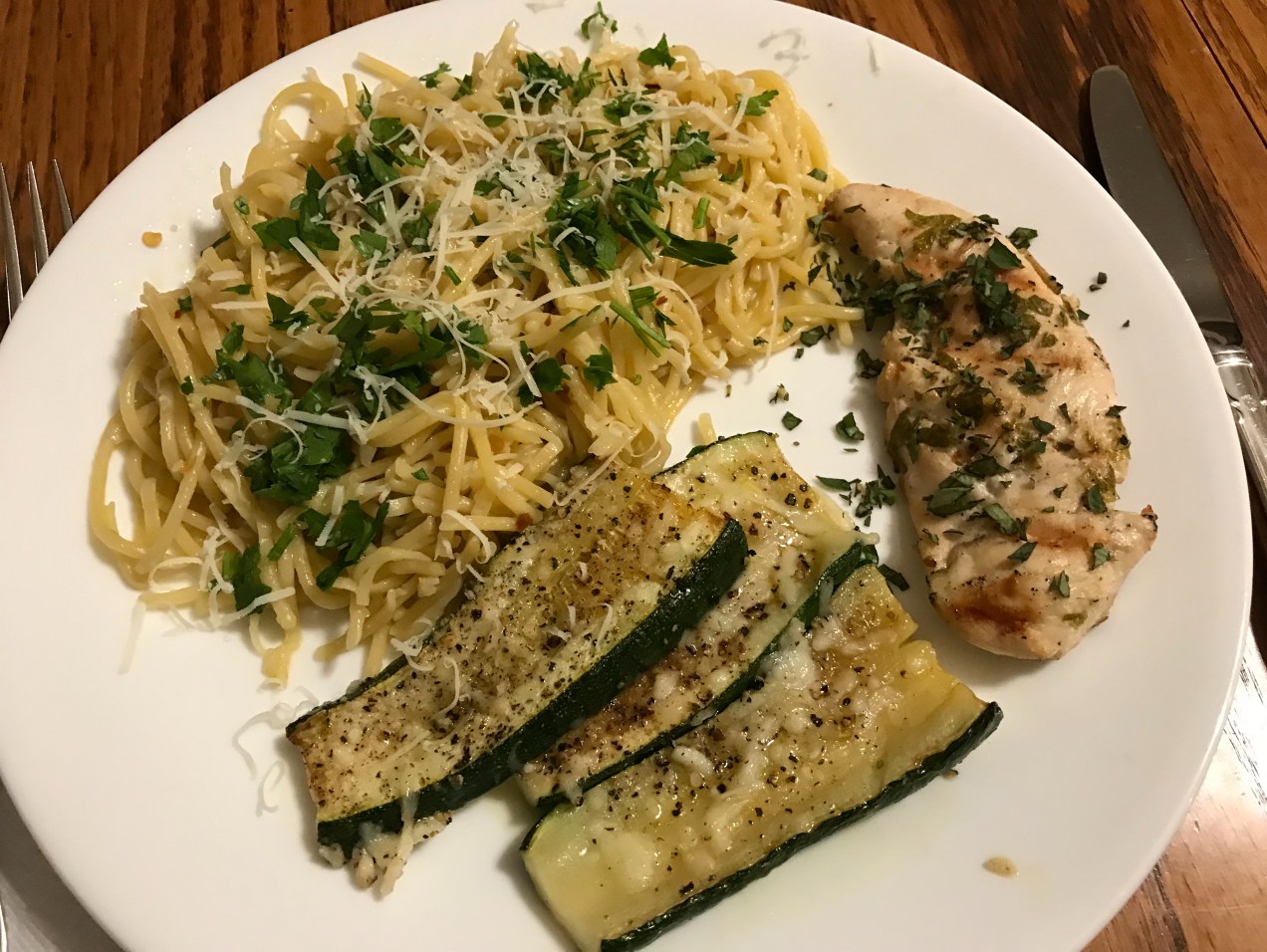
Menu: Calabrian Onion Soup with Potatoes, Skewered “Tuna” with Lemon and Oregano, Spaghetti with Garlic and Chili, Baked Zucchini with Mozzarella, Roasted Grapes with Caciocavallo
Recommended Wine: Nozze d’Oro, Sicilian white
Here is another southern Italian menu with potatoes. As discussed before, even though bread and pasta are more widely eaten there, people living in the region do occasionally eat potatoes. Like in neighboring Basilicata, Calabria has a long history of inequality and poverty, though tourism has improved the region’s economy in recent years. Directly across the Strait of Messina from Sicily, Calabrian farmers grow many similar crops, including olives and citrus fruits. Of particular note are bergamot oranges, whose aromatic peel gives earl grey tea its distinctive flavor.
The soup was a mix of onions, potatoes, and chicken broth, flavored with a bit of butter and brandy. It had a surprisingly sweet edge to it, probably due to sautéing the onions first, caramelizing their sugars. After getting used to it, this was an interesting change of pace, especially when balanced with a bit of cheese, in this case Romano. Personally I prefer the Roman minestrone or the French soupe au pistou, but there was definitely nothing wrong with this.
Chicken replaced tuna with lemon and oregano, which go well with pretty much any protein. Centuries if not millennia of heavy fishing have made tuna rarer while factory farming has brought the price of chicken down, but at one time chicken was the pricier treat. Spaghetti with a simple mix of oil, minced garlic, and chili flakes is easy to make, uses pantry staples, and pairs well with either.
It seemed a bit unusual to cook zucchini in the oven, for the simple fact that during the summer when it is in season, many people prefer not to turn the oven on. Maybe the situation is different in Italy, where people are more likely to open windows than rely on air conditioning, and where drier heat makes that feasible. Either way, I outright disregarded the advice to serve the zucchini on separate plates. It saves a few dishes, and the green color was a nice contrast with the chicken and pasta.
Roasting grapes was an interesting experiment. They aren’t cooked for so long that they become raisins, which are more cost-effective to buy than to make. Rather, they bake just long enough to soften and collapse a bit, concentrating their sugars. I personally prefer them fresh where the skin has a bit of a crunch, but these are enjoyable. No caciocavallo was available.
Overall, this would be a great special summer menu that isn’t difficult to make. If you’re worried about turning on the oven, I’m sure the zucchini could be grilled, with slices of mozzarella added at the end of cooking. And to be honest, there’s no need to mess with fresh grapes. Table (as opposed to wine) grapes are bred to be juicy and have that slight crunch as you bite through the skin. They’re best enjoyed as is, without bothering with the oven.













 Feasting Through Time