Risotto verde
food history, italian cuisine, recipes, rice, spring, vegetarian

Risotto Verde: The Taste of Spring

Risotto verde

            Among the numerous varieties of risotto, there are a few classics, as detailed in 1000 Foods to Eat Before You Die on pages 233 – 234. Risotto bianco is the basic kind, made simply with rice, butter, a little onion or shallot, white wine, broth, parmesan cheese, and maybe some pancetta or bacon. Milanese is colored a bright golden yellow with saffron. Nero is colored black with squid ink. Piedmontese is enhanced with white truffles. Other varieties might include seafood, mushrooms, or vegetables.

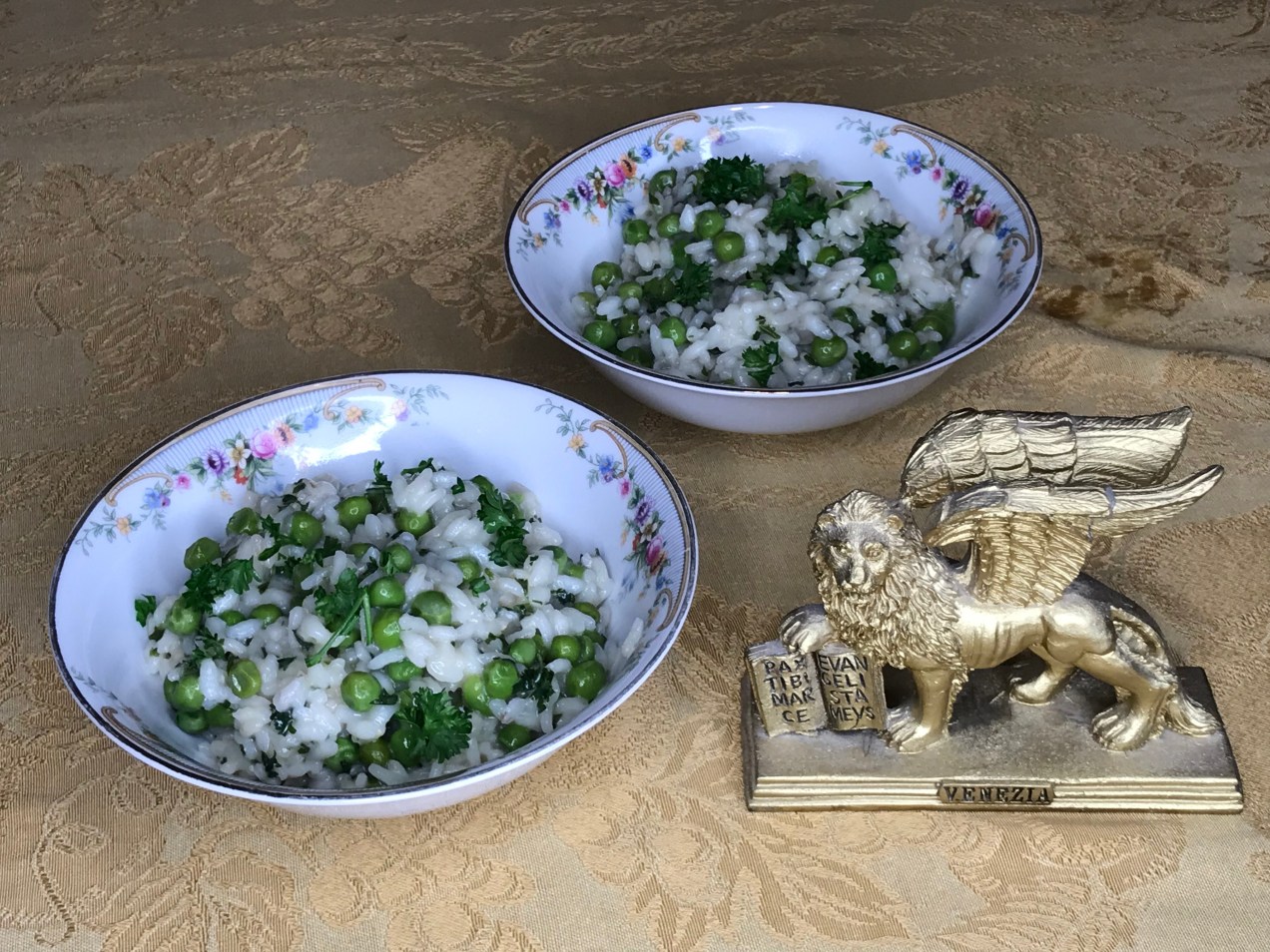
            As you can probably guess, risotto verde is meant to be green. Frequently a spring specialty, it gets its color from parsley and either sweet green peas or asparagus. It’s very fresh-tasting and, when made with frozen peas, surprisingly quick and easy to prepare. To keep everything bright and fresh, I didn’t use any pancetta for my own recipe.

            Technically, you’re not “supposed” to reheat risotto, because it thickens upon standing and can become “gluey.” I’ve never had this problem, or maybe the texture upon reheating just doesn’t bother me. Just add a few drops of water before putting it in the microwave. It will still be a great accompaniment to your chicken sandwich for lunch, and it’s way healthier than chips.

Ingredients:

  • 4 tablespoons (or ¼ cup) butter, or 2 tablespoons each butter and olive oil
  • 1 shallot or ¼ onion, minced
  • 1 ½ cups arborio or other short-grain rice
  • 4 tablespoons (or ¼ cup) dry white wine (something light like pinot grigio), or replace with extra broth
  • 4 – 5 cups chicken or vegetable broth (broth made from poaching chicken works great here)
  • 1 10-ounce bag frozen peas
  • Half bunch parsley, large stems removed, minced
  • 1 cup grated parmesan cheese

Directions:

  1. Combine the broth and peas in a medium saucepan and bring to a boil. Turn off heat, but leave on the stove.
  2. Melt the butter in a large skillet over medium heat. When bubbling, add shallot or onion and sauté for about 2 minutes, until softened.
  3. Add the rice and cook, stirring constantly, until coated and translucent, about 2 minutes.
  4. Stir in the wine and cook, stirring constantly, until evaporated, another 2 or 3 minutes.
  5. Add the broth and peas, a ladleful at a time, stirring constantly, waiting for each to absorb before adding the next. Stir in the parsley about halfway through, saving a little to sprinkle on top at serving time.
  6. After adding 4 cups of broth, the risotto should be slightly liquid. If it seems too thick, add a little more broth.
  7. Remove from the heat, stir in the parmesan, sprinkle with remaining parsley, and serve immediately.

For more recipes, history, and fun facts sent directly to your inbox, please like, subscribe, and/or share.

One-Time
Monthly
Yearly

Make a one-time donation

Make a monthly donation

Make a yearly donation

Choose an amount

$5.00
$15.00
$100.00
$5.00
$15.00
$100.00
$5.00
$15.00
$100.00

Or enter a custom amount

$

Your contribution is appreciated.

Your contribution is appreciated.

Your contribution is appreciated.

DonateDonate monthlyDonate yearly
Standard
Pork Chop Marengo
food history, french cuisine, italian cuisine, recipes

Napoleonic Entree: Chicken or “Veal” (Pork) Marengo

Pork Chop Marengo
Pork Chop Marengo

            Despite his remarkable career, Napoleon Bonaparte had several close calls on his rise to power. One such case was at the Battle of Marengo in June 1800. Napoleon had seized power in a coup the previous year. To secure his rule, he needed military victories. At the time, he was fighting the Austrians for control of northern Italy. They met in battle near the city of Alessandria, in the Piedmont region.

            At first, the battle didn’t go well for the French, but Napoleon managed to snatch victory from the jaws of defeat. His control over Italy was secured, skeptics in France were reassured, and other ambitious generals were discouraged from turning on him. To celebrate, or simply because he was hungry after a long and no doubt stressful battle, Napoleon requested a special dish. Or so the story goes.

            Recipes for chicken marengo vary enormously. The only constants seem to be chicken (or occasionally veal) browned in olive oil, onions, and tomatoes, braised together to make a sort of stew. There’s usually garlic, mushrooms, and white wine. Many recipes include shallots and parsley, and a few use brandy instead of wine. Great chef Auguste Escoffier recommended including fried eggs and crayfish. Regardless of specifics, toasts fried in butter traditionally accompany chicken marengo.

            To make things even more complicated, there seems to be a debate about whether chicken marengo is French or Italian. In Mimi Sheraton’s 1,000 Foods to Eat Before You Die, it’s in the French section, but I’ve also seen recipes in Italian cookbooks. Since the Piedmont region was historically part of the Duchy of Savoy, a realm straddling the Alps between France and Italy and right on the trade routes between them, it’s hardly surprising that a Piedmontese dish would be adopted into French cuisine, or vice-versa. And it’s fitting that an entrée associated with Napoleon should be considered both French and Italian. After all, he himself was a native of Corsica, then ruled by Genoa, but made his career in France.

            For my own recipe, I combined the different strands into one, with no eggs or crayfish. The nice thing about chicken or “veal” marengo is that after browning the meat and making the “sauce,” it can be kept overnight and cooked the following day. Everything can be done in a Dutch oven, but if you don’t have one, a skillet and slow-cooker will also work. If you want to reduce fat and calories, the bread can be toasted dry in the oven or toaster, instead of in the buttered skillet. Or don’t toast it, if you prefer, but whatever you do, don’t skip it. You need bread to soak up the sauce.

Here’s how to make it:

Ingredients:

  • 1 chicken, cut up, or roughly 3 pounds bone-in pork (or veal) chops
  • 2 tablespoons olive oil
  • 4 tablespoons butter, plus more to brown toasts
  • 1 medium onion, quartered and thinly sliced
  • 2 shallots, halved and thinly sliced
  • 4 garlic cloves, crushed with the side of the knife and minced
  • 1 bunch parsley, thick stems separated from leaves and thinner stems, and both parts minced separately (don’t discard the thick stems)
  • 3 tablespoons dry white wine, mixed with 1 tablespoon brandy
  • 2 tablespoons flour
  • 1 (roughly 15 oz) can crushed tomatoes, or about 2 lbs fresh tomatoes, chopped
  • 1 pound mushrooms, cut into thick slices, with larger pieces halved
  • Baguette or Italian bread, to serve

Directions:

  1. Brown meat in the olive oil and two tablespoons of the butter in the skillet or Dutch oven over medium heat. Set aside on a plate.
  2. Add onion and shallots and sauté, stirring frequently, for about 5 minutes, or until they start to turn golden. Add the garlic and parsley stems and cook for 2 more minutes (garlic is added later because it cooks faster and burns more easily).
  3. Stir in the wine/brandy mix, making sure to scrape up any browned bits at the bottom of the pan. Cook until the liquid is mostly evaporated, 5 to 10 minutes.
  4. Add the flour and stir until incorporated. Follow with the tomatoes, and water if using canned. Bring sauce mixture to a boil. If using fresh tomatoes, reduce heat and simmer for 10 to 15 minutes, until the tomatoes break down and release their juice. Add salt and pepper to taste.
  5. Place the meat, skin side up if using chicken, in the Dutch oven or slow-cooker, and cover with the sauce. At this point, the chicken/pork/veal marengo can be refrigerated overnight if desired.
  6. Preheat oven to 325 degrees Fahrenheit, if using Dutch oven. Bake for 2 to 3 hours, until the meat is tender (if the stew was chilled overnight, it will probably be at the longer end of the time range).
  7. If using a slow-cooker, cook for about 4 hours on high or 6 – 8 on low. If it’s a little longer, like if you put it on before leaving for work, that’s completely fine.
  8. Half an hour before serving (with either cooking method), melt the remaining butter in a skillet over medium heat. Add the mushrooms and a little salt and cook, stirring frequently, until soft and aromatic, about 10 to 15 minutes. Add to the stew, pressing them down into the sauce, and leave to cook while browning the toasts (or for 15 minutes if you decide to use untoasted bread).
  9. Toast the bread pieces in a buttered skillet over medium low heat until browned.
  10. Sprinkle the stew with the parsley leaves and serve, toasts on the side.

And as always, please like, subscribe, and/or share to support my work.

One-Time
Monthly
Yearly

Make a one-time donation

Make a monthly donation

Make a yearly donation

Choose an amount

$5.00
$15.00
$100.00
$5.00
$15.00
$100.00
$5.00
$15.00
$100.00

Or enter a custom amount

$

Your contribution is appreciated.

Your contribution is appreciated.

Your contribution is appreciated.

DonateDonate monthlyDonate yearly
Standard
food history, french cuisine, italian cuisine

Foods Not Eaten: Prohibitive Cost

Poularde en Demi-Deuil (chicken with black truffles), Insalata de Ovoli e Tartufi (oval mushroom and white truffle salad), Risotto Piedmontese (with white truffles)

1000 Foods (pgs. 118, 198, 233)

            You’ll probably notice a theme here. Truffles, particularly from the Perigord region of France and Piedmont region of Italy, are really expensive. There are two reasons for this. First, they are highly sought after. Second, these varieties have resisted all attempts to farm. Truffles generally only grow among the roots of oak and chestnut trees, but not with any predictability. They must be foraged by truffle hunters with trained dogs. Based on the laws of economics, a limited supply plus high demand equals high prices. Truffles’ reputation as an aphrodisiac, whether accurate or not, only increases their allure.

            At one time, truffle hunters used pigs, which are great at sniffing out the elusive fungi, even under several inches of soil. Problem was, pigs also like to eat the truffles, so the industry switched to dogs, who are content with a treat and some petting. Since pigs also disturb the soil when rooting out the truffles, making it harder for the spores to grow new tubers, their use has since been banned in many areas.

            While actual truffles from Perigord and Piedmont are too expensive, especially for a fungus that grows in the dirt, the chocolate variety is another story. Made of chocolate and cream and rolled in cocoa powder, they only resemble the fungus in appearance. The great thing about chocolate truffles, aside from how easy they are to make, is how customizable they are. Dark chocolate orange, milk chocolate mint, white chocolate mocha, rolled in chopped almonds, the possibilities are endless.

Standard
beverages, food history, italian cuisine, recipes

Northwestern Italy’s Afternoon Pick-Me-Up: Bicerin

1000 Foods (pgs. 165 – 166) for information, recipe is my own creation

            Italians seem to love their coffee, but have some interesting opinions about what kind of coffee to drink when. Any coffee with milk, such as cappuccino, should only be drunk in the morning. Maybe that’s because many Italians don’t eat much breakfast and need the calories. Unless they’re drinking gallons of café lattes or adding sweeteners, they probably won’t be getting many, but maybe black coffee is too irritating on an empty stomach. It seems like adding milk to coffee in the afternoon, or after dinner, would cut the caffeine and allow for better sleep, but apparently that’s culinary heresy. But I don’t care for coffee unless it has a fair amount of milk and sugar, so what do I know?

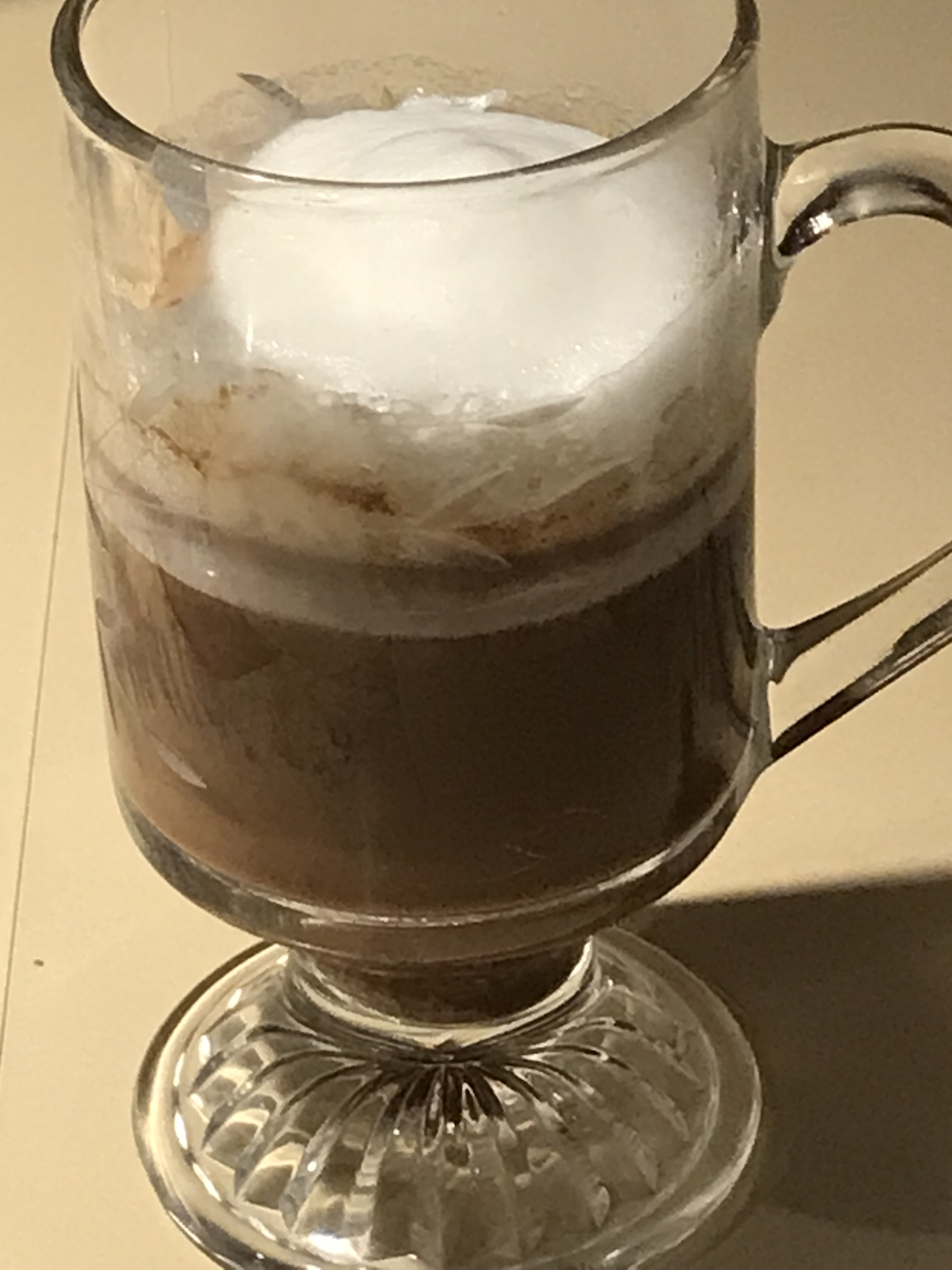
            One particularly delicious coffee drink is bicerin, essentially a fancy layered mocha native to Turin. A number of 19th Century authors loved it. To enjoy it at home, a heatproof glass is essential, as is “a steady hand,” in the words of Mimi Sheraton. The servings are small by American standards, but the drink is rich and meant to be savored. Espresso goes into the glass first, followed by thick hot chocolate. If this is done correctly and the chocolate is thick enough, it will sink to the bottom. Foamed milk goes on top, carefully, so it will stay separate, at least temporarily. Bicerin is not stirred. Rather, the layers mix as you drink it, and flavor gradually shifts from mostly coffee and milk to mostly chocolate.

            Charges of culinary heresy aside, bicerin is a great afternoon treat. Drinking it in the morning seems like a recipe for a sugar crash before lunch. Plus, it’s a bit fiddly to make, not ideal for someone who isn’t a morning person. For the right consistency, almost like a syrup, the hot chocolate should be made from scratch with chocolate pieces and milk. 2 ounces of bittersweet chocolate and 4 ounces (1/2 cup) of milk seems to be the right amount for two servings. Espresso needs to be made, and milk needs to be heated and foamed. For two servings, 6 ounces of espresso and 1 cup of a 50/50 mix of milk and half-and-half is about right. None of this is particularly difficult, but having all three elements hot and ready at the same time can be a logistical challenge to anyone still half-asleep.

            So in summary, you need: 2 ounces of bittersweet chocolate, 1 cup milk, 6 ounces espresso, and ½ cup half-and-half. Melt the chocolate in half of the milk, stirring frequently, until smooth. Remove from heat. Prepare the espresso however you choose. Combine the remaining milk with the half-and-half and heat, whisking almost constantly, until the mixture is foamy and steaming. The coffee goes in the glasses first, then the chocolate. Spoon the milk foam over the top, don’t stir, and serve. And enjoy by mid-afternoon at the latest. With three ounces espresso and an ounce of dark chocolate per serving, it will keep you up otherwise.

Standard