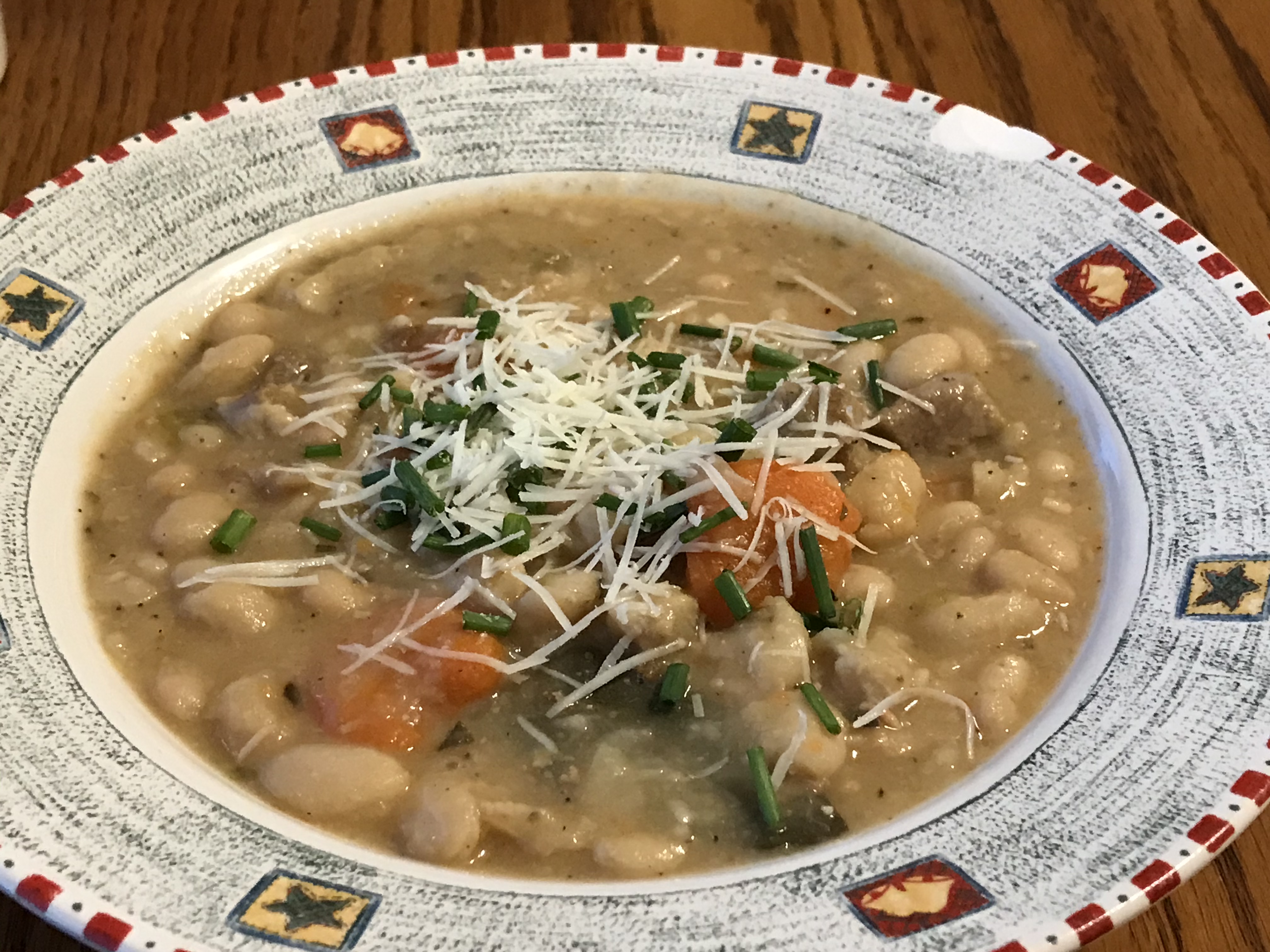
It seems like every cuisine that includes pork has some form of pork and beans, often using cured meat. Think of ham and bean soup, baked beans flavored with bacon, and the like. The pork and fat add flavor to the relatively neutral beans, which in turn stretch the meat while providing protein of their own. The particular type of pork, type of beans, flavorings and thickness all vary, but the basic idea is the same. In this dish, native to the mountainous Piedmont region of Northern Italy, we have pork shoulder and fat, great northern beans, root vegetables and herbs, seasoned with a basic salt and pepper.
The text notes that this fairly rich dish is traditionally associated with Carnival. Until the 1960s, Catholic fasting rules dictated abstaining from meat for the entirely of Lent, not just the Fridays. Thus, you have traditions like Carnival and Mardi Gras, the last chance to eat meat and rich foods before Lent. In the past, when meat was more expensive relative to income, many people couldn’t afford to celebrate with a roast or other similar centerpiece, but a rich bean dish with substantial quantities of pork and fat was a viable option.
Ideally, this recipe would use a Dutch oven or stove-safe casserole dish. Since I did not have either of these, I browned the meat and combined the ingredients in a pot on the stove, then transferred the contents to a ceramic casserole dish to bake. A small amount of the mixture didn’t fit, so I put it into a smaller ceramic dish with a cover. After a few hours, everything was finished. It just needed to stand for a few minutes to cool and thicken.
This was fabulous. The pork was meltingly tender and its flavor, along with that of the herbs, infused throughout the beans. For anyone who wants to eat less meat, whether for health or ecological reasons or both, but doesn’t want to give it up entirely, a dish like this is an excellent choice. Beans are rich in vitamins and minerals and, like a few other plants, restore nitrogen to the soil they are grown in, naturally boosting its fertility. What’s not to love?
Menu: Fontina Fondue with Steamed Vegetables, Beef Braised with Red Wine and Spices, Cabbage with Lemon, Chestnut Puree with Whipped Cream and Candied Orange Strips
Recommended Wine: Barolo or other bold Piedmontese red
Here is another pasta-free Northern menu. Home to the Kingdom of Savoy, which united Italy for the first time in over a millennium, the Piedmont region boasts a sophisticated cuisine. Perhaps its most famous product is the white truffle, among the most prized and expensive in the world. Or the red wines of the Nebbiolo grape, held by connoisseurs to be among the finest in Italy. There are hazelnut confections, candied chestnuts known as marrons glaces, cow’s milk cheeses, beef, veal, polenta, potatoes, mushrooms, and cabbage. Panna cotta originated here, where dairy is plentiful. All of the dishes in this menu contain Piedmontese specialties; fontina, beef braised in red wine, savoy cabbage, and chestnuts.
Among the cow’s milk cheeses is fontina. Semi-soft and creamy, it melts easily, lending itself to a variety of dishes. One of these is fondue, enriched with egg yolks and seasoned with white pepper and nutmeg. The reason for using white pepper is to avoid the dark flecks black pepper would cause, as well as its slightly different flavor. It can be a bit difficult to find except in its pre-ground form, but it’s worth seeking out or ordering whole white peppercorns. Pepper seems to lose its flavor faster than most other ground spices. Since you can’t be sure how long that container of pepper has been sitting on the shelf, it is always better to buy whole peppercorns and grind them as you need them. Pepper grinders are easy to find and inexpensive, but if you only use white pepper occasionally it might be better to use a mortar and pestle or spice grinder and save your pepper grinder for black pepper. If you can’t find whole white peppercorns, I would use freshly ground black pepper instead of pre-ground white pepper. The flavor difference between the two types of peppercorns is slight and whole black peppercorns are available in most spice aisles.
The beef dish, braised with wine and sweet spices along with the vegetables, has a somewhat Medieval character. Once the meat is cooked, it is removed while the other ingredients are pureed. If you have an immersion blender, this is the perfect time to use it. The pureed vegetables thicken the sauce, which is then served with the sliced beef. I had a slight incident with this dish, but the issue was human error, not the recipe. While we were eating the fondue, I left the meat in the pot to stay warm but turned off the burner. Upon starting the cabbage, I took the meat out, put it on a cutting board, and turned the burner back on to make sure the sauce was nice and hot. Unfortunately, I turned on the wrong burner. Instead of the one under the sauce, I turned on the one under the cutting board. As I was busy with the cabbage, I didn’t notice the mistake until the plastic cutting board started to warp and melt. Thankfully the melting was only on the bottom and the meat was unharmed, but I was pretty shaken up by the incident. Needless to say, the cutting board was thrown out.
Cabbage and chestnuts are favorites in Piedmontese cuisine. The cabbage is served with a straightforward lemon butter sauce. Dessert, however, is quite unusual. Cooked chestnuts are warmed in a mix of milk, sugar, and cocoa, then mashed and put through a food mill onto the plates. I don’t happen to have a food mill, so I used a small ice cream scoop to put scoops of puree on the plates. These could then be topped with whipped cream and candied orange peel as directed.
Chestnuts have an interesting history in the hilly and mountainous areas of Northern and Central Italy, as well as in neighboring Southeastern France and Corsica. In many of these regions, wheat did not grow especially well but chestnut trees did, making the abundant nuts the “bread” of the poor. Despite being viewed as an inferior substitute, they were a reasonably nutritious staple. Plus, as they were less valuable commercially than grain, chestnuts were less likely to be taxed in kind by the landowners. That’s not to say the rich had no interest in them, but they consumed them in a different manner. Candied marrons glaces became a popular confection in the Early Modern Era. As sugar prices continued to drop, a variety of cakes and tortes appeared. Over time, increased general wealth has made these things affordable to the larger population.
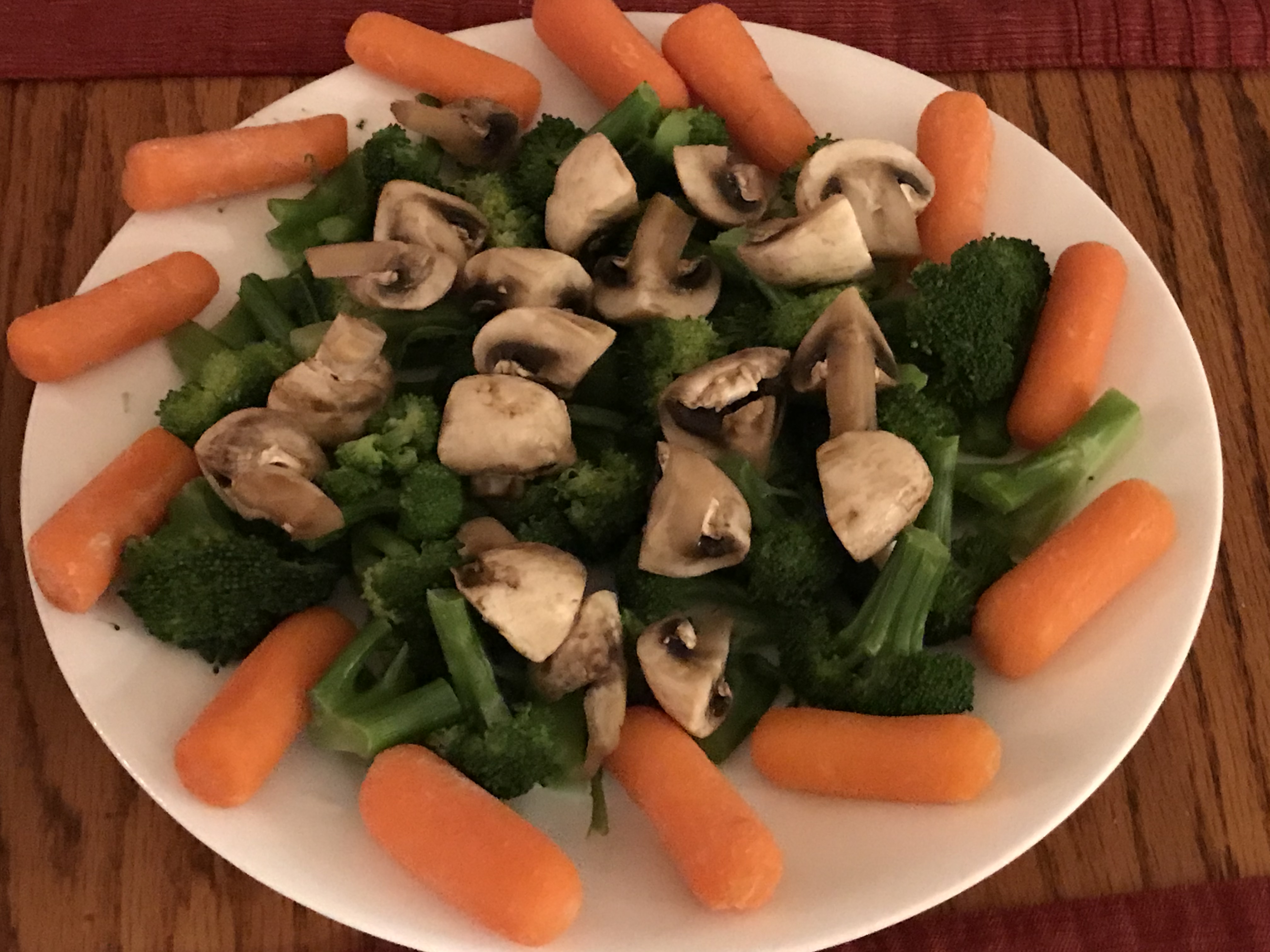
The fondue was the best part of the menu. I was a little worried about adding the beaten egg yolks directly into the cheese mixture, but due to the double boiler it was not quite hot enough to curdle them. For dipping were steamed carrots, broccoli, and mushrooms, along with my own addition of pieces of toasted Italian bread. There was supposed to be cauliflower as well, but I realized as I was getting everything together that I had forgotten to buy it. I’m sure it would have been excellent with the fondue, but so were the other vegetables and toast. The fondue was creamy, slightly salty, a little gritty from the pepper and nutmeg, and generally fabulous. While it is most commonly used as a baking spice, nutmeg adds a nice bit of extra flavor to cream and cheese sauces. The leftovers were especially good on toast, placed under the broiler to brown.
Fondue and vegetables
After the cutting board mishap, the beef was also delicious. The low, slow cooking had made it extremely tender, and there was enough leftover sauce to use with a pork tenderloin a few days later, once all the beef had been eaten. The cabbage, I must admit, was not my favorite. It was sauced with a mix of butter, fresh lemon juice, salt, pepper, and nutmeg, but the proportions were not to my taste. Though freshly squeezed lemon juice has many good uses (like lemonade, salad dressing, on seafood, etc.), it needs to be tempered with something to shine. Here there was not enough butter to do so. But again, that is a matter of personal taste.
Beef, cabbage, and dessert
I felt similarly about the dessert. It was good, but I’m not sure I’d make it again. The texture was nice, but between the heavily sweetened chestnut puree, sweet whipped cream, and candied orange peel, the sweetness was a bit overwhelming. Maybe some unsweetened whipped cream would balance it out, but with all the other excellent desserts in the book (ex. cherry jam tart, panna cotta, praline mousse cake, biscotti, almond cookies, chocolate roll, apple charlotte, baked stuffed peaches, etc.) I’m not sure I’d bother. The star here was the fondue.
This pasta dish is a somewhat unusual one from Northern Italy. The original version is made with buckwheat pasta, but the recipe here uses fresh fettuccine. Diced potatoes and Savoy cabbage are first boiled, then, when they are cooked through, the pasta is added. Once the pasta is cooked, all is drained and tossed with pecorino cheese. Melted butter, browned with sage and garlic while the pasta cooks, is poured over the pasta, which is then topped with more cheese.
Cabbage may seem like a strange thing to find in an Italian dish, but it has a long history. In ancient times it was eaten by all levels of society, as evidenced by its inclusion in the works of Apicius. In the early 4th Century AD, the Emperor Diocletian kept himself occupied in retirement by growing cabbages. It remains popular today, especially in the cooler north. The favorite variety is the stronger-flavored, crinkled Savoy cabbage. Note that this is not the same thing as Napa cabbage. Both have crinkled leaves, but Napa cabbage heads are elongated while Savoy cabbage heads are round. I was unable to find the Savoy variety, and since Napa cabbage is not always that fresh (blame lower rate of turnover) I substituted regular green cabbage, which is always cheap, fresh, and available.
Not only is this easy to cook, it turned out to be another favorite. The boiled potatoes partially break down as the pasta is tossed, mixing with the butter and thickening the sauce, acquiring a taste sort of like an alfredo sauce. The sage leaves crisp up in the skillet and make a delicious garnish. Exactly why pecorino cheese is used instead of parmesan is unclear since this is a northern Italian dish, but it worked really well. I’m sure grated parmesan would be good if pecorino is unavailable, and when I made the recipe for a second time with dried fettuccine, that worked too. Just make sure to adjust the cooking time for the pasta accordingly.






 Feasting Through Time