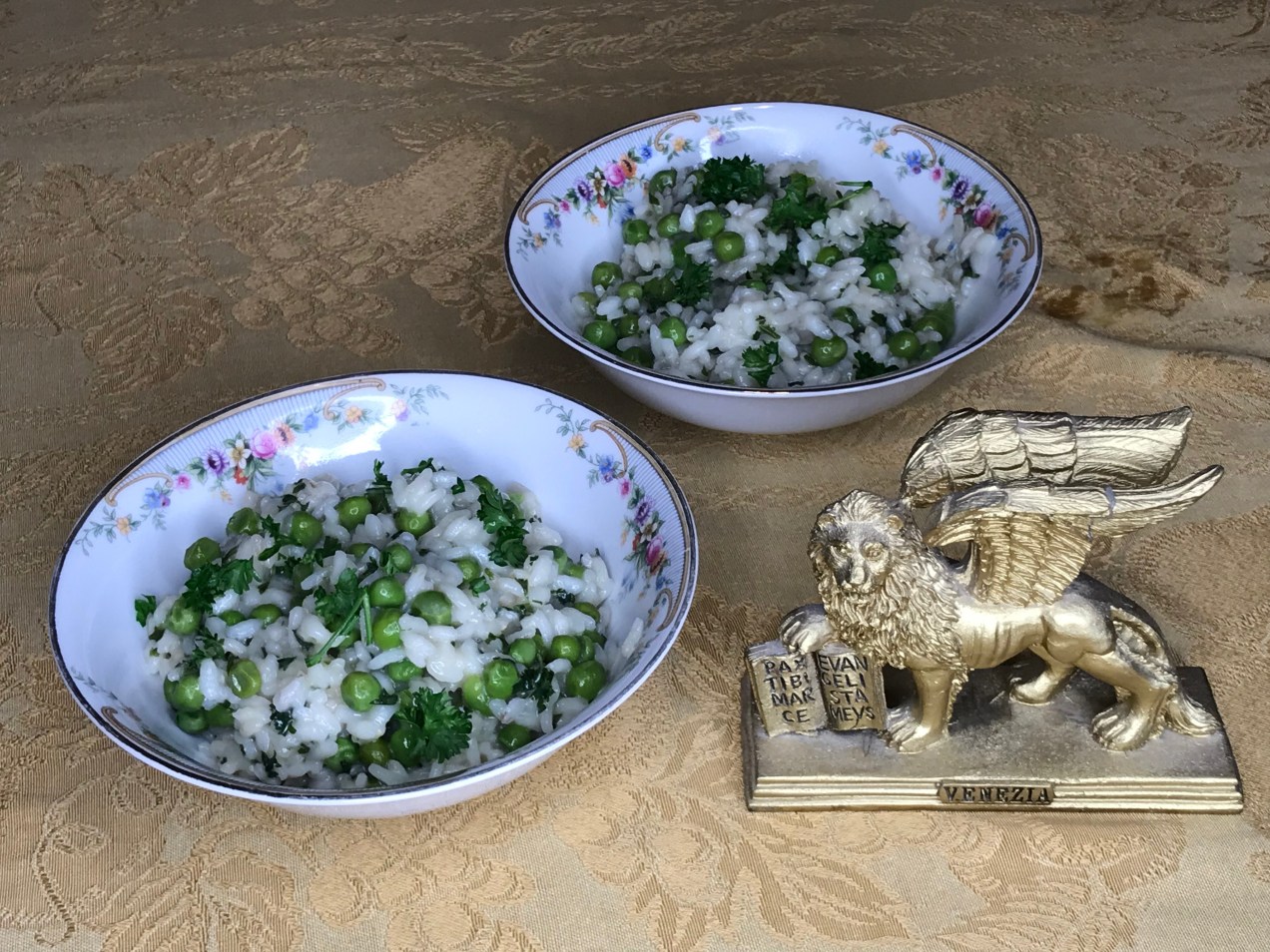
Risotto verde
food history, italian cuisine, recipes, rice, spring, vegetarian

Risotto Verde: The Taste of Spring

Risotto verde

            Among the numerous varieties of risotto, there are a few classics, as detailed in 1000 Foods to Eat Before You Die on pages 233 – 234. Risotto bianco is the basic kind, made simply with rice, butter, a little onion or shallot, white wine, broth, parmesan cheese, and maybe some pancetta or bacon. Milanese is colored a bright golden yellow with saffron. Nero is colored black with squid ink. Piedmontese is enhanced with white truffles. Other varieties might include seafood, mushrooms, or vegetables.

            As you can probably guess, risotto verde is meant to be green. Frequently a spring specialty, it gets its color from parsley and either sweet green peas or asparagus. It’s very fresh-tasting and, when made with frozen peas, surprisingly quick and easy to prepare. To keep everything bright and fresh, I didn’t use any pancetta for my own recipe.

            Technically, you’re not “supposed” to reheat risotto, because it thickens upon standing and can become “gluey.” I’ve never had this problem, or maybe the texture upon reheating just doesn’t bother me. Just add a few drops of water before putting it in the microwave. It will still be a great accompaniment to your chicken sandwich for lunch, and it’s way healthier than chips.

Ingredients:

  • 4 tablespoons (or ¼ cup) butter, or 2 tablespoons each butter and olive oil
  • 1 shallot or ¼ onion, minced
  • 1 ½ cups arborio or other short-grain rice
  • 4 tablespoons (or ¼ cup) dry white wine (something light like pinot grigio), or replace with extra broth
  • 4 – 5 cups chicken or vegetable broth (broth made from poaching chicken works great here)
  • 1 10-ounce bag frozen peas
  • Half bunch parsley, large stems removed, minced
  • 1 cup grated parmesan cheese

Directions:

  1. Combine the broth and peas in a medium saucepan and bring to a boil. Turn off heat, but leave on the stove.
  2. Melt the butter in a large skillet over medium heat. When bubbling, add shallot or onion and sauté for about 2 minutes, until softened.
  3. Add the rice and cook, stirring constantly, until coated and translucent, about 2 minutes.
  4. Stir in the wine and cook, stirring constantly, until evaporated, another 2 or 3 minutes.
  5. Add the broth and peas, a ladleful at a time, stirring constantly, waiting for each to absorb before adding the next. Stir in the parsley about halfway through, saving a little to sprinkle on top at serving time.
  6. After adding 4 cups of broth, the risotto should be slightly liquid. If it seems too thick, add a little more broth.
  7. Remove from the heat, stir in the parmesan, sprinkle with remaining parsley, and serve immediately.

For more recipes, history, and fun facts sent directly to your inbox, please like, subscribe, and/or share.

One-Time
Monthly
Yearly

Make a one-time donation

Make a monthly donation

Make a yearly donation

Choose an amount

$5.00
$15.00
$100.00
$5.00
$15.00
$100.00
$5.00
$15.00
$100.00

Or enter a custom amount

$

Your contribution is appreciated.

Your contribution is appreciated.

Your contribution is appreciated.

DonateDonate monthlyDonate yearly
Standard
Uncategorized

Cook’s Tour of Italy Menu 43 (Pgs. 137 – 138): Shrimp and “Bass” Risotto with Saffron

            With its abundance of seafood and rice, it is no surprise that Venetian cuisine would feature a number of seafood risottos. Here things are kept simple with shrimp and pieces of bass or other white fish, enhanced with zucchini, shallots and parmesan cheese, but in Venice the options are nearly limitless. One especially interesting example, called risotto nero, is colored black with squid or cuttlefish ink. For this recipe, the color is a surprisingly bright yellow, courtesy of saffron.

            Saffron has a fascinating history. Grown around the Mediterranean since ancient times, its prestige was nonetheless on the level of “exotic” spices from Asia. There were two reasons for this. First, it is really labor-intensive, with each saffron crocus yielding a few strands of the spice. It’s true allure, however, is its color. When added to a bit of liquid, it produces a brilliant golden hue. During the Middle Ages and Renaissance, it was often used to create “gilded” dishes for banquets. While stirring the threads and their steeping liquid into the dish, the color showed itself by degrees, starting with a pale, creamy yellow, gradually deepening into the color shown in the picture.

            Historically, saffron was considered to have medicinal qualities. Unfortunately, in this recipe it gave a distinct medicinal edge to the flavor. In addition, the fish broth used in the recipe is enhanced by simmering with shrimp shells. I’m not sure if it was the brand of broth I used (since I opted not to make my own) or the shrimp shells, but it gave off a powerful fishy aroma while simmering that lingered in the kitchen. Before adding it to the risotto I diluted it to compensate for what boiled off and reduce the strength, but the taste was still strongly fishy and medicinal.

            You might be thinking that fish is supposed to taste fishy, but many white fish like what I used (I think it was haddock, but I can’t remember for sure. It was on sale in the freezer section) have a fairly mild taste. I personally prefer it on the relatively rare occasions that I eat seafood, but that is a matter of personal taste. Unlike many Italian cooks, who view it as culinary heresy, Mr. Famularo has no issue with combining seafood and dairy. The addition of parmesan cheese and butter really helped balance things out. The shrimp weren’t overcooked, the fish cooked up nice and flaky, and the finished dish was actually quite enjoyable once I got used to the strong flavors. That said, if I made this again I’d reduce the amount of saffron. And probably skip the fish broth altogether.

Standard