Chicken Waterzooi - Belgian chicken stew with egg, lemon, and cream
belgian cuisine, food history, soup, stew

Belgian Chicken Stew: Waterzooi a la Gantoise

Chicken Waterzooi - Belgian chicken stew with egg, lemon, and cream

            Variants of chicken soup are eaten all over the world. Flavorings might vary, but the concept seems to be pretty universal for non-vegetarians. Historically, this usually involved a rooster or hen past their mating or egg-laying prime. Tough but flavorful, the chicken would be slow-cooked in liquid to tenderize the meat and produce a rich broth.

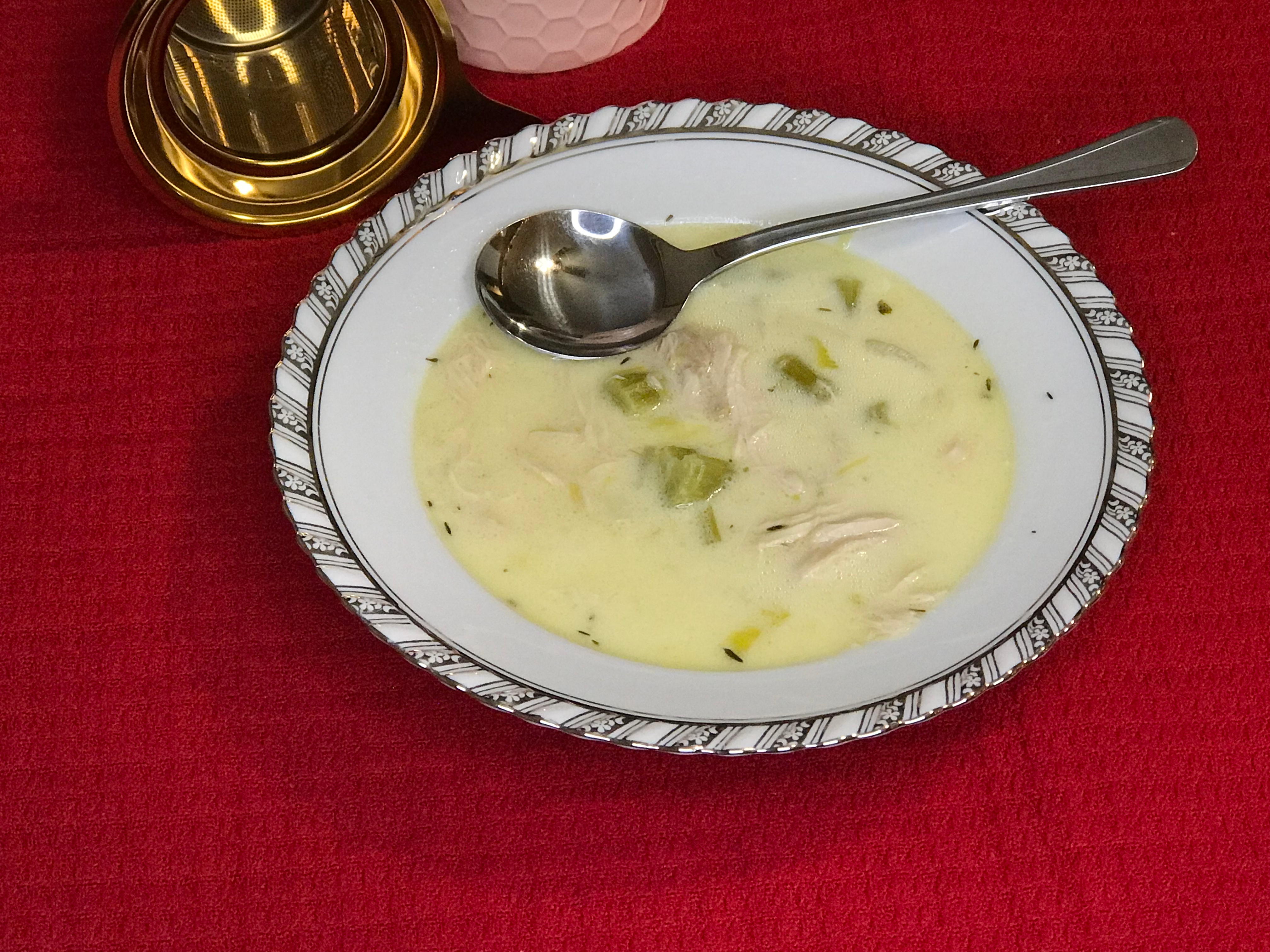
            One Belgian recipe, called Waterzooi a la Gantoise, involves stewing the chicken with leeks, celery, and parsley root or parsnips, flavoring the mixture with lemon and cream, and thickening it with beaten egg yolks. Odd as this mix might sound, the recipe from 1000 Foods to Eat Before You Die, pages 151 – 152, had a nice flavor.

            Belgium has a long and complicated history. Composed of Dutch-speaking Flanders and French-speaking Wallonia, it was a battleground between France and the Holy Roman Empire for centuries. During the Middle Ages, Flanders in particular grew wealthy from cloth production. Since they needed English wool, attempts by the French kings to shut down the trade during their many conflicts with England predictably let to unrest. So did the kings’ attempts to centralize power in general and levy taxes.

            In the late 14th Century, most of the Low Countries came under control of the Dukes of Burgundy, followed by the Habsburgs a hundred years later. Charles V, the most powerful Holy Roman Emperor in centuries, was born in Flanders in 1500. By the time of his retirement in 1556, his empire included Spain, the Low Countries, Austria, Naples, Sicily, Milan, and Spain’s growing New World empire. All except Austria and the imperial title itself went to his son Philip II.  Charles V’s brother Ferdinand I, who had been his deputy in Austria for years and gained Bohemia and Hungary through marriage, received these, creating the Habsburgs’ Austrian branch.

            Just the Spanish Habsburg territories were a monumental task to control, as Philip II soon found out. He was hardworking but struggled to delegate, which made managing the far-flung provinces difficult. A particular issue was the spread of the Reformation in the Netherlands. Philip was not inclined to compromise on matters of religion, and unlike his father, didn’t spend much time outside of Spain after taking the throne. Feeling alienated by a “foreign” ruler, the Dutch revolted in the 1560s, leading to Eighty Years’ War. They were aided by England, which was part of why Philip sent the Spanish Armada.

            When the dust settled, the modern Netherlands became independent, while modern Belgium remained part of the Spanish Empire. It was transferred to the Austrian Habsburgs in 1714, after the War of the Spanish Succession, and became part of the Revolutionary French Empire in the 1790s. After the defeat of Napoleon, Belgium was ruled by the restored Dutch monarchy. A few decades later, Belgium became independent under Leopold I, an uncle of Queen Victoria.

            After everything they went through, Belgium tried to remain neutral in the 19th and 20th Centuries. With British support, this worked until 1914. When World War 1 broke out, Belgium had a problem. Specifically, Germany’s war plans. Since German high command knew they would be fighting on two fronts, they sought to defeat France quickly, before Russia managed to mobilize its army. The issue was that the French-German border was heavily fortified. The idea, called the Schlieffen Plan, was to go around these defenses by invading through neutral Belgium.

            When Belgium refused military access, Germany declared war on them. Belgian forces put up a tougher fight than expected, giving the French time to reorganize their defense and for British support to land. By December, the Western Front was more or less stabilized, running right through Flanders, where it would remain for roughly three-and-a-half years.

            The initial German advance, the years of occupation, and the eventual retreat in 1918 did a number of Belgium, especially Flanders. Attempts to stay neutral during World War 2 also failed, resulting in another multi-year occupation. Afterwards, finally, Belgium has finally enjoyed several decades of peace.

            Evidence of prosperity can be seen the soup recipe, which uses chicken, eggs, cream, and vegetables that are not ultimately eaten. Since using vegetables to flavor the stock but then discarding them offends my sensibilities, I ended up returning them to the pot after removing the chicken skin and bones and straining the broth. The celery and leeks were a little overcooked, but still added some nice extra texture to the soup.

            Immediately before serving, some of the hot broth is whisked into the egg yolks to temper them, then the mixture is returned to the pot to thoroughly heat but not boil. This is the same technique used in making custard, but for some reason the waterzooi didn’t thicken as much as I anticipated. Maybe I used too much water (the recipe said just enough to cover the chicken, which I thought I did). Maybe I didn’t heat the soup long enough after adding the egg yolks for fear of them curdling. Or maybe the issue was my expectations. Custards thickened with egg alone and not boosted with cornstarch are very thin.

            Overall, the soup was very good, but not necessarily worth the trouble of making again as is. Perhaps pureeing the slightly overcooked vegetables into the broth as additional thickening would give it some extra body. (An immersion blender would be great for this.) On a scale of 1 to 10, I would probably give it a 7.
Standard
Arter med Flask - Swedish yellow pea soup
food history, recipes, soup, swedish cuisine

Swedish Thursday Night Special: Yellow Pea Soup and Swedish Pancakes with Lingonberries (with soup recipe)

Information is found in 100 Foods to Eat Before You Die pages 366, 371 – 372, and 340 – 341, soup recipe is my own

            Sometimes, it’s hard to figure out where food traditions come from. According to legend, the Swedish tradition of eating yellow pea soup on Thursday nights came about because on one Thursday night in 1577, that’s how King Eric XIV was poisoned, which raises a few questions. Is eating pea soup a way to memorialize a good king, or the assassination of a bad one? Why was a king eating pea soup anyway? In most countries that was commoner’s fare. Kings and princes, especially in northern Europe, favored piles of meat and fish. Perhaps his doctor recommended a lighter diet, which would add a layer of irony to the story. And how did pancakes become the traditional dessert?

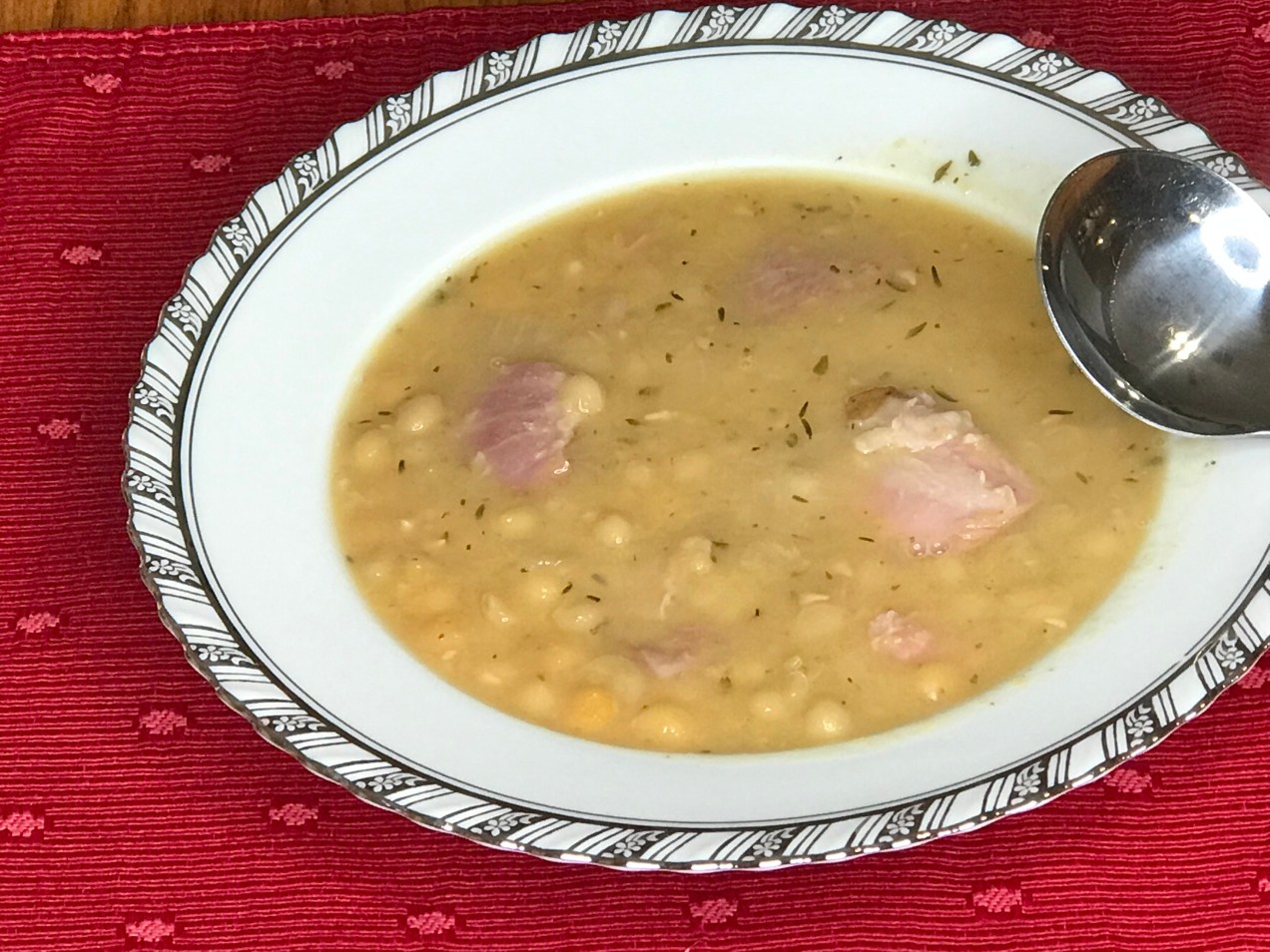
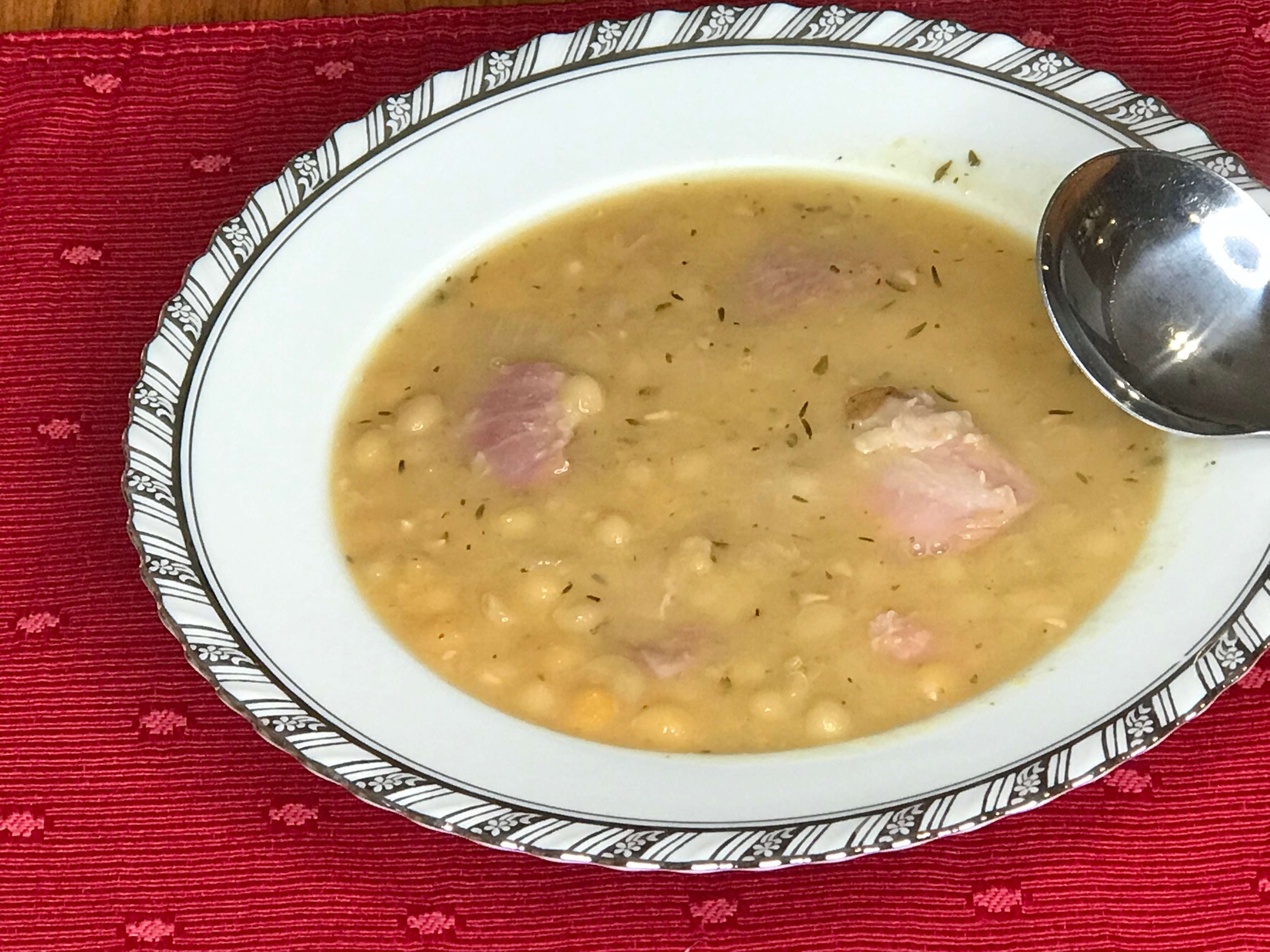
            Regardless of how it happened, yellow pea soup and pancakes are still a Swedish Thursday night tradition, even if not every week. And why not? The soup is a simple mix of dried yellow peas, water, onions, salt, dried thyme, and a little ginger, with optional pork. The recipe on the bag suggested pork ribs, Mimi Sheraton mentioned cured pork in her description on page 366 in 1000 Foods to Eat Before You Die, so I used a smoked ham shank. It added an incredible richness of flavor to the soup, though it would still be good without it.

Arter med Flash - Swedish yellow pea soup
Yellow pea soup with ham

            An interesting thing about the dried peas, aside from being yellow when many Americans are more used to green, is that they aren’t hulled or split. They take a bit longer to cook, but give the soup a much better texture and appearance. The flecks of thyme and ham pieces also improve the presentation. The soup was delicious as is, though a few rye crisps certainly wouldn’t hurt.

            I had a slight problem with the Swedish pancakes. Because the batter is so thin, making multiple small pancakes at once wasn’t working. They just ran together, making one big crepe-like pancake. Since browning is more important, I rolled with it. The finished pancakes are served with lingonberry jam and often whipped cream.

            Lingonberries are small, very tart berries native to Scandinavia. The best way to describe their flavor is about two thirds cranberry, one third sour cherry. Preserved lingonberries have a texture sort of like cranberry sauce, but the berries have softer skins. Jars of lingonberry preserves are available at most stores with an international aisle, and at some larger supermarkets next to the jam. The whole dessert, with lightly browned pancakes, reddish-purple lingonberries, and off-white whipped cream, is just beautiful.

Platter - Swedish pancakes with Lingonberries
Whipped cream is optional, but highly recommended with Swedish pancakes and lingonberries

            Here’s how to make the soup. You will need:

  • 1 lb (or 500g, which is fairly close) dried yellow peas, soaked overnight
  • 1 package (2 pieces, roughly 2 lbs) smoked ham shanks (optional)
  • 1 medium yellow onion, finely chopped
  • 1 tbsp salt (reduce to 1 ½ tsp if using the ham shanks)
  • 1 tsp dried thyme
  • Dash powdered ginger
  • Rye crisps or rye bread to serve, optional but recommended
  1. Combine all ingredients in a pot with 8 cups of water and bring to a boil.
  2. Reduce heat and simmer, with the lid tilted, until peas start to fall apart and ham shanks are tender, about 1 hour. Stir a few times toward the end of cooking.
  3. Turn off the heat, remove the ham shanks to a cutting board, and cover the pot.
  4. Once the ham shanks have cooled enough to handle, pull meat from the bone and cut into bite-sized pieces. Return ham chunks to pot.
  5. Bring soup back to a simmer over low heat, stirring frequently.
  6. Ideally serve with rye bread or crisps, even more ideally followed by Swedish pancakes.

As always, subscribe for free for recipes and trivia, sent right to your inbox. And if you want to buy me another jar of lingonberry preserves, I would be most grateful.

One-Time
Monthly
Yearly

Make a one-time donation

Make a monthly donation

Make a yearly donation

Choose an amount

$5.00
$15.00
$100.00
$5.00
$15.00
$100.00
$5.00
$15.00
$100.00

Or enter a custom amount

$

Your contribution is appreciated.

Your contribution is appreciated.

Your contribution is appreciated.

DonateDonate monthlyDonate yearly
    Standard
    british cuisine, recipes, soup, stew, welsh cuisine, winter

    Medieval-Inspired Welsh Soup: Leek Broth

    Idea comes from 1000 Foods to Eat Before You Die, pg. 35, recipe is my own

                For some reason, leeks are a Welsh symbol. They are particularly associated with St. David’s Day, dedicated to Wales’s patron saint. Exactly how this happened is unclear, and history doesn’t provide many clues. At some point after 500 BC, Celtic peoples came to dominate the British Isles, including Wales. Starting in 43 AD, the Roman Empire conquered England and Wales, staying until the 5th Century.

                During these centuries, the native population became somewhat Romanized, adopting many Roman customs and, from the 4th Century onward, Christianity. These Romano-Britons spoke a Celtic language similar to Welsh. After the legions left to deal with everything else going on in the 5th Century, Anglo-Saxons from modern Germany began invading the island. The Romano-British chieftains put up a spirited defense, but were gradually pushed west into Wales, which is why the land to the east came to be called “Angle-Land,” later England. Did the proto-Welsh use leeks, which were a favorite of the Romans, to distinguish themselves from the Saxons? It’s possible.

                One of these proto-Welsh chieftains became the basis of the King Arthur legends. In other words, the man behind the myth was Welsh, not English. Perhaps because Wales is hillier and less fertile than England, or perhaps because they were busy fighting first each other and later the Vikings, the Anglo-Saxons mostly left the Welsh alone. After the Norman Conquest in 1066, so did the descendants of William the Conqueror. They were busy fighting rebellious Saxons, building an empire in France larger than what was controlled by the French king, and fighting their relatives over shares in that empire. There were some incursions into Wales, Scotland, and Ireland, but the Anglo-Norman kings of England were mostly occupied elsewhere.

                This changed in the 13th Century, probably because the kings of England lost most of their land in France. With the French kings much stronger than before, reconquest was a difficult proposition. So the English kings turned their energy towards the rest of the British Isles. King Edward I conquered Wales in the 1280s, and from then on heirs to the English throne were called the Prince of Wales. One story goes that the Welsh asked King Edward for a prince that spoke neither English nor French, so he presented them with his infant son, the future Edward II, who did not yet speak any language.

                Unlike Scotland and Ireland, Wales merged into the English monarchy with only a few early rebellions. It remained a culturally distinct backwater, but Welsh longbowmen played an essential role in the Hundred Years’ War. Without them, the English could not have won so many battles against much larger French forces.

                In Wales’s cool, wet climate, raising livestock was more profitable than growing most crops. Oats, barley, rye, and root vegetables grow more easily than wheat. Traditional Welsh dishes tend to be homey and comforting, not spicy and exciting. Not many Welsh specialties are known outside the British Isles, but one of the more famous is leek broth, called cawl cennin in Welsh. It’s a simple mix of leeks, carrots, potatoes, and cabbage, flavored with bacon and thickened with oatmeal.

                Except for the potatoes, this sounds a lot like the thick soups, called pottages, eaten by most medieval Europeans. The ingredients varied by social class and the occasion, but for the common people, vegetable-based soups and bread were the core of the diet. These were supplemented with butter and cheese, some meat and fish (usually salted), fruit in season, and beer, cider, or wine, depending on the region. Leeks and salted pork products like ham or bacon gave pottages more flavor, and vegetables like carrots and cabbages kept reasonably well over the winter. Grains, particularly those like oats and barley that were less useful for making bread, were often added as thickeners.

                Once potatoes became common in the 17th Century, they went into the pot too. Before soup bases and bouillon cubes, water would have been the liquid. Until the 20th Century, chicken was more expensive than beef, mutton, or pork, so there would be no chicken broth in a common, everyday dish. Today, a bit of bouillon or soup base is typical in leek broth, adding extra flavor for just a few cents.

                As far as affordable home cooking goes, leek broth is a great choice. The root vegetables are full of vitamins, and the oats make it taste sort of creamy and surprisingly filling. The soup/stew has a fair amount of starch, but carbohydrates are not the enemy, especially in the form of carrots and whole grains like oats. A chunk of whole grain bread would be a great accompaniment, maybe with a piece of cheese or glass of milk for extra protein. And don’t skip the bacon. Per serving, it does not add that much fat, and a little bit adds a ton of flavor. Which makes a popular New Year’s resolution a bit easier.

    Ingredients:

    • About 8 ounces bacon, diced
    • 2 large leeks, halved lengthwise, cleaned, and thinly sliced crosswise
    • 8 ounces carrots, thinly sliced
    • 6 medium-sized red potatoes, cut into roughly ½ inch cubes
    • Half of a small green cabbage, thinly sliced
    • About ½ cup to 1 cup rolled oats (not steel-cut or instant)
    • Chicken broth or water (broth from a soup base is perfectly good here)

    Directions:

    1. Place the bacon in a large soup pot over medium heat. Cook until starting to crisp, then add the leeks, carrots, and potatoes. Do not drain the fat. All the other ingredients are healthy, and it is essential for the best flavor.
    2. Cook the root vegetables in the bacon fat with the bacon, stirring occasionally, until the vegetables start to cook down and release their moisture.
    3. Add enough water to cover, about 12 cups. If desired, add 1 teaspoon soup base or bouillon per cup of water.
    4. Bring the soup to a boil, then reduce the heat and simmer, stirring occasionally, until the potatoes are soft.
    5. Stir in the cabbage and oats. Cook on low heat, stirring frequently, until the cabbage softens and the soup begins to thicken.
    6. Ladle the soup into bowls and serve hot. Don’t worry about presentation; leek broth tastes a lot better than it looks.

                For more warming recipes over the next few months, don’t forget to subscribe for free.

    One-Time
    Monthly
    Yearly

    Make a one-time donation

    Make a monthly donation

    Make a yearly donation

    Choose an amount

    $5.00
    $15.00
    $100.00
    $5.00
    $15.00
    $100.00
    $5.00
    $15.00
    $100.00

    Or enter a custom amount

    $

    Your contribution is appreciated.

    Your contribution is appreciated.

    Your contribution is appreciated.

    DonateDonate monthlyDonate yearly
    Standard
    food history, french cuisine, recipes, soup, stew, vegetarian

    French Summer Vegetable Soup: Soupe au Pistou

    Soupe au pistou, a southern French classic

                Last summer, in my exploration of 1000 Foods to Eat Before You Die by Mimi Sheraton, I made my own version of soupe au pistou, a southern French soup loaded with summer vegetables, and loved it. Now that it’s August and vegetables are at their peak, I made it again and recorded my recipe. Southern France is quite different from Paris, Normandy, Brittany, and the other northern regions, in climate, culture, and food. If a trip isn’t in the cards for the near future, some of the local cuisine will help us both imagine it. Maybe it will happen someday, but for now, think of rolling hills, olive trees, and enjoy the lack of crowds.

                Note that you can switch up the vegetables depending on what you like or have on hand. Just make sure to include tomatoes, onions, potatoes, white and green beans, pasta, and of course the pistou. Beyond that, feel free to add a sprinkle of cheese, or switch out the angel hair for other pasta, adjusting cooking time accordingly.

                Ingredients:

    • 8 ounces (about 1 ½ cups) navy or other small white beans, soaked and drained according to package directions
    • 1 onion, quartered and thinly sliced
    • 8 tablespoons (equal to ½ cup) olive oil
    • 2 Roma tomatoes, coarsely chopped
    • Salt
    • 6 small red or other waxy potatoes, cut into roughly ½ inch cubes
    • 2 carrots, sliced crosswise with the larger pieces cut in half
    • 2 zucchini, halved lengthwise and thinly sliced
    • 4 ounces green beans, cut into roughly 2-inch pieces
    • 4 ounces angel hair pasta, broken into roughly 2-inch pieces
    • 4 large cloves garlic, peeled and crushed with the side of a knife blade
    • 80 fresh basil leaves, about 2 cups loose
    • Grated parmesan cheese, if desired
    • Sprig of parsley, if desired

                Directions:

    1. Heat the olive oil in a large pot over medium heat. When hot, add the navy beans, onion, and a pinch of salt and sauté until the onions take on some color, stirring occasionally.
    2. Add the tomatoes and cook, stirring a few times, until they begin to break down.
    3. Add just enough water to cover the beans and vegetables and bring to a boil, then reduce heat to simmer. Cook with the lid tilted for 30 minutes, adding more water if necessary.
    4. Add the potatoes, carrots, another pinch of salt, and more water to cover the new additions. Simmer for another 30 minutes.
    5. For the pistou, combine the basil, garlic, ½ teaspoon salt, the remaining 4 tablespoons of olive oil, and, if desired, a bit of parmesan and a sprig of parsley, in a food processor and blend until smooth. It won’t look like a large amount, but a little goes a long way.
    6. Test the white beans. If they are soft, add the zucchini and green beans and taste for salt, adding more if necessary.
    7. Increase the heat to medium and cook for 5 minutes, add the angel hair, and cook for another 3 minutes. Serve the soup with the pistou and optional cheese.

                For more seasonal, global, and historical recipes, make sure to subscribe for free. Of course, if you want to donate and buy me some virtual vegetables, I’m not about to complain.

    One-Time
    Monthly
    Yearly

    Make a one-time donation

    Make a monthly donation

    Make a yearly donation

    Choose an amount

    $5.00
    $15.00
    $100.00
    $5.00
    $15.00
    $100.00
    $5.00
    $15.00
    $100.00

    Or enter a custom amount

    $

    Your contribution is appreciated.

    Your contribution is appreciated.

    Your contribution is appreciated.

    DonateDonate monthlyDonate yearly
    Standard
    Aspargessuppe - Danish asparagus soup with mock veal dumplings
    danish cuisine, food history, soup

    Aspargessuppe: Danish Spring Asparagus Soup

    1000 Foods (pgs. 344 – 346), recipe found in text

                Ever since the days of Ancient Rome, asparagus has been a symbol of spring and early summer. Ready sooner than most other vegetables, it seems to be especially popular in northern Europe, where long winters mean a longer season without fresh produce. Perhaps this makes people eager to enjoy everything about summer while they can.

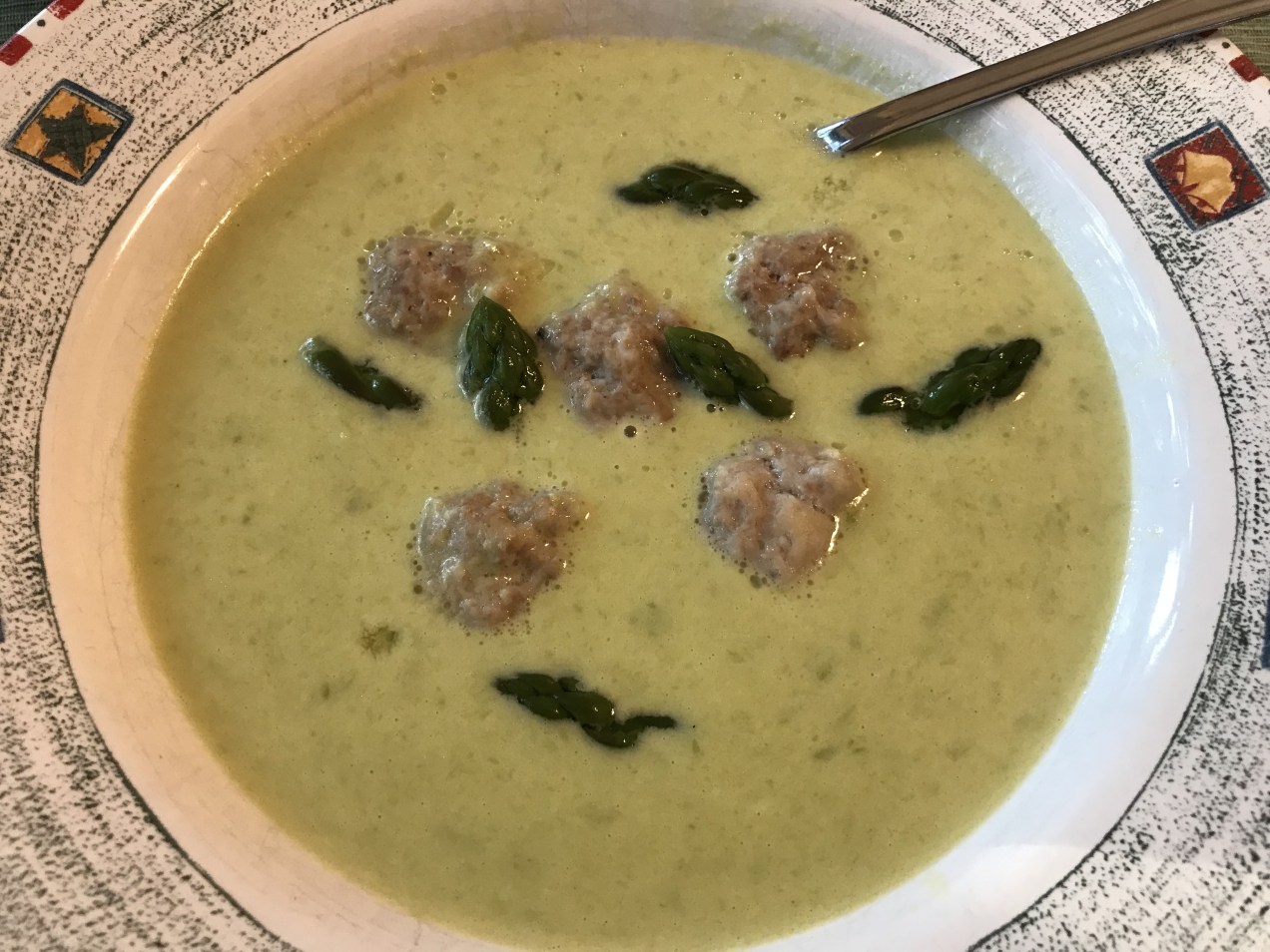
                An interesting Danish recipe for asparagus is a soup enriched with veal dumplings and garnished with asparagus tips. Supposedly, it is not as common as it used to be, at least in restaurants. Most likely, this has to do with how fiddly it is to make. The recipe in the text requires at least five saucepans – one to cook and puree the asparagus, one to heat cream or half-and-half, one to heat broth, one to make a combination bechamel/velouté sauce, and one to cook the dumplings. Egg yolks are added at the last minute. Once they are, the soup has to be heated very carefully to prevent curdling.

                I don’t have five saucepans, and I assume most other people don’t either. If the broth and cream are heated in the microwave, the number can be reduced to a more manageable three. You can save another step by not straining the pureed asparagus. The soup won’t be as smooth, but I personally prefer for it to have a bit more texture.

                The first thickener is a combination of two of the French “mother sauces,” bechamel and velouté. Both use a butter and flour mix called roux to thicken a liquid. For bechamel, or white sauce, the liquid is milk, and for velouté, it is a light broth, typically poultry or fish. Yes, velouté is essentially gravy, but using the French term makes it sound fancy. Additional thickening comes from tempered egg yolks. About half of the soup is gradually whisked into the beaten egg yolks to bring them up to temperature, then the mix is added to the pot and heated carefully.

                This was an excellent soup. The asparagus flavor was clear and distinct, enriched but not overpowered by the bechamel/velouté and egg yolks. For some reason, the combined beef and pork “veal” dumplings didn’t puff up like they were supposed to. I suspect this was because I had previously frozen them and didn’t allow adequate time to thaw before cooking, but they still tasted good. For an easier recipe, the soup would be just as good plain. As with most asparagus soup recipes, the asparagus tips are set aside after cooking, reserved as the perfect garnish.

    One-Time
    Monthly
    Yearly

    Make a one-time donation

    Make a monthly donation

    Make a yearly donation

    Choose an amount

    $5.00
    $15.00
    $100.00
    $5.00
    $15.00
    $100.00
    $5.00
    $15.00
    $100.00

    Or enter a custom amount

    $

    Your contribution is appreciated.

    Your contribution is appreciated.

    Your contribution is appreciated.

    DonateDonate monthlyDonate yearly
    Standard
    food history, german cuisine, stew

    Pre-Potato Winter Stew: Frankischer Grunkern (with green spelt)

    1000 Foods (pgs. 288 – 289)

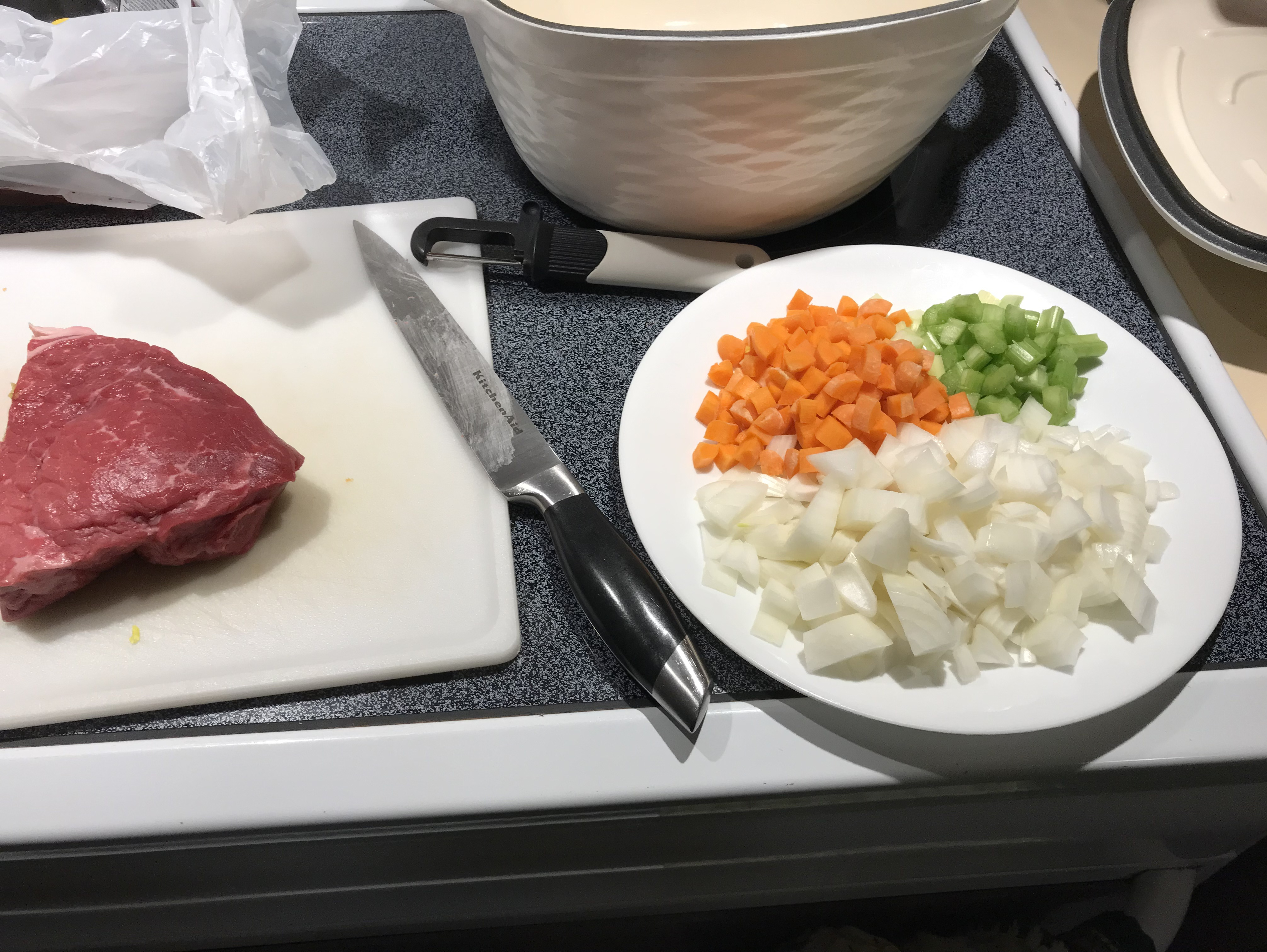
                Imagine, for a moment, that you’re making stew on a cold day. It has beef, onions, carrots, celery, and parsnips, plus some butter and minced bacon to brown the meat and vegetables before adding liquid. Most people would think of adding potatoes at this point, and some cooks do, but they aren’t the key ingredient. That particular honor goes to grunkern, or green spelt. A specialty of Baden-Wurttemberg in the southwestern corner of Germany, the stew contains starch, protein, fat, vitamins, and flavor in one bowl.

                Spelt is an ancient variety of wheat that’s been grown for thousands of years. The German word grunkern sounds very similar to “green corn,” because the grain is harvested before it’s fully ripe. In Europe, corn can mean any type of grain, not just maize and sweet corn. Exactly how green spelt was discovered is unclear. Perhaps one summer grain supplies were running low and the harvest was still a few weeks or months away, so some farmers harvested a bit of their grain early. Interestingly, grunkern doesn’t seem to be widespread in European cuisines. Maybe it was more popular before potatoes, which are also ready before the main grain harvest, were introduced from the Americas, but that’s just speculation.

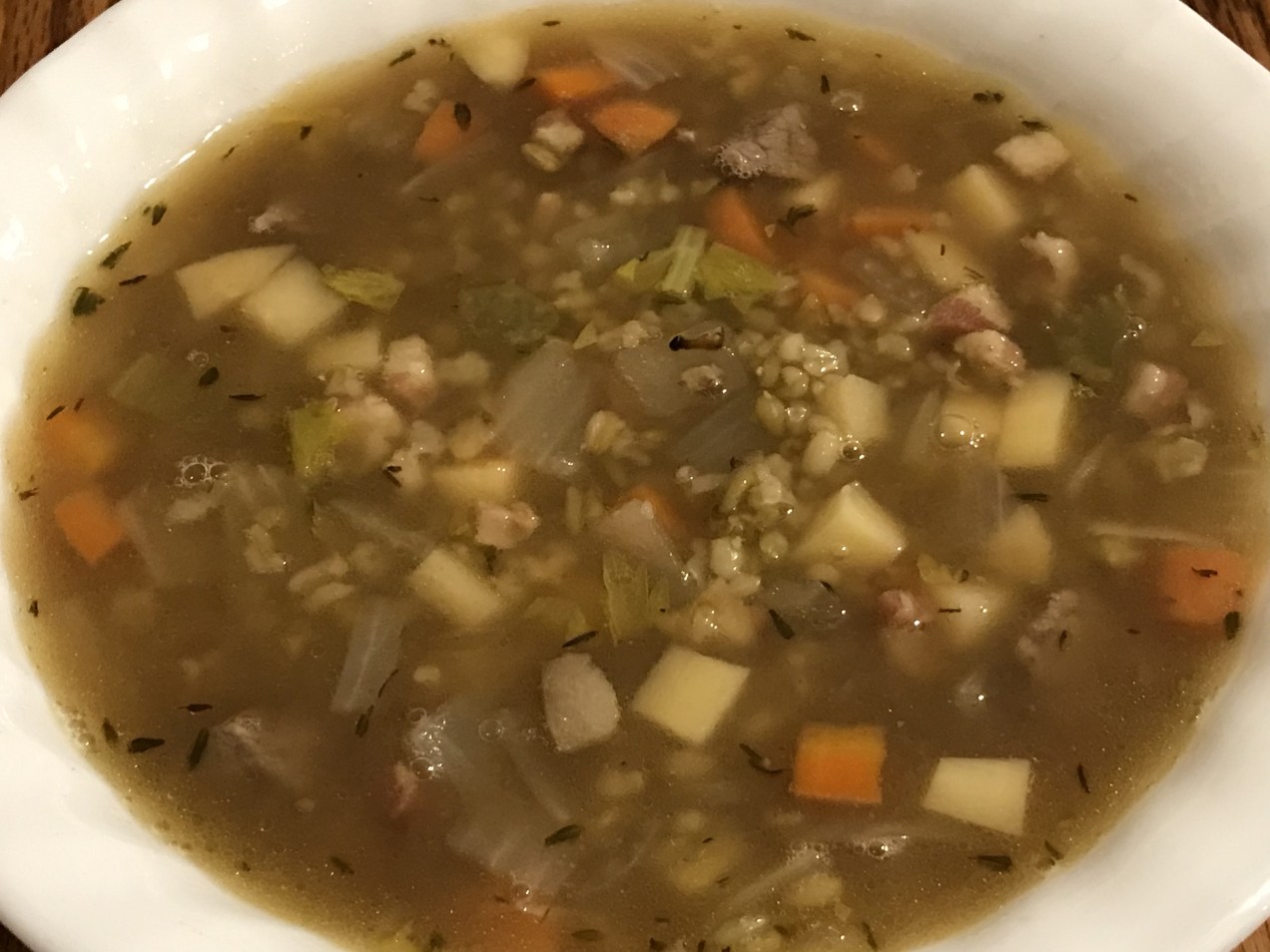
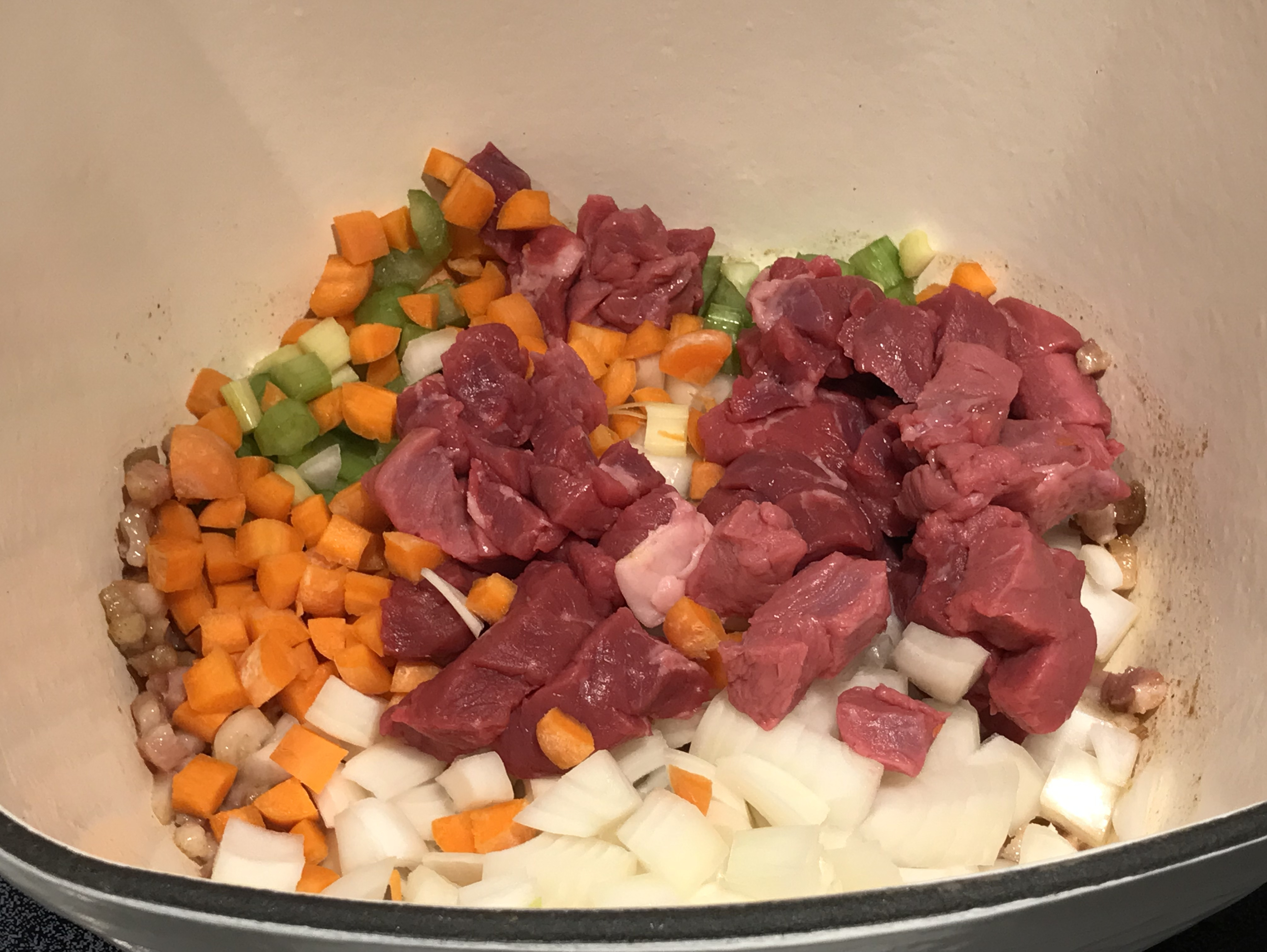
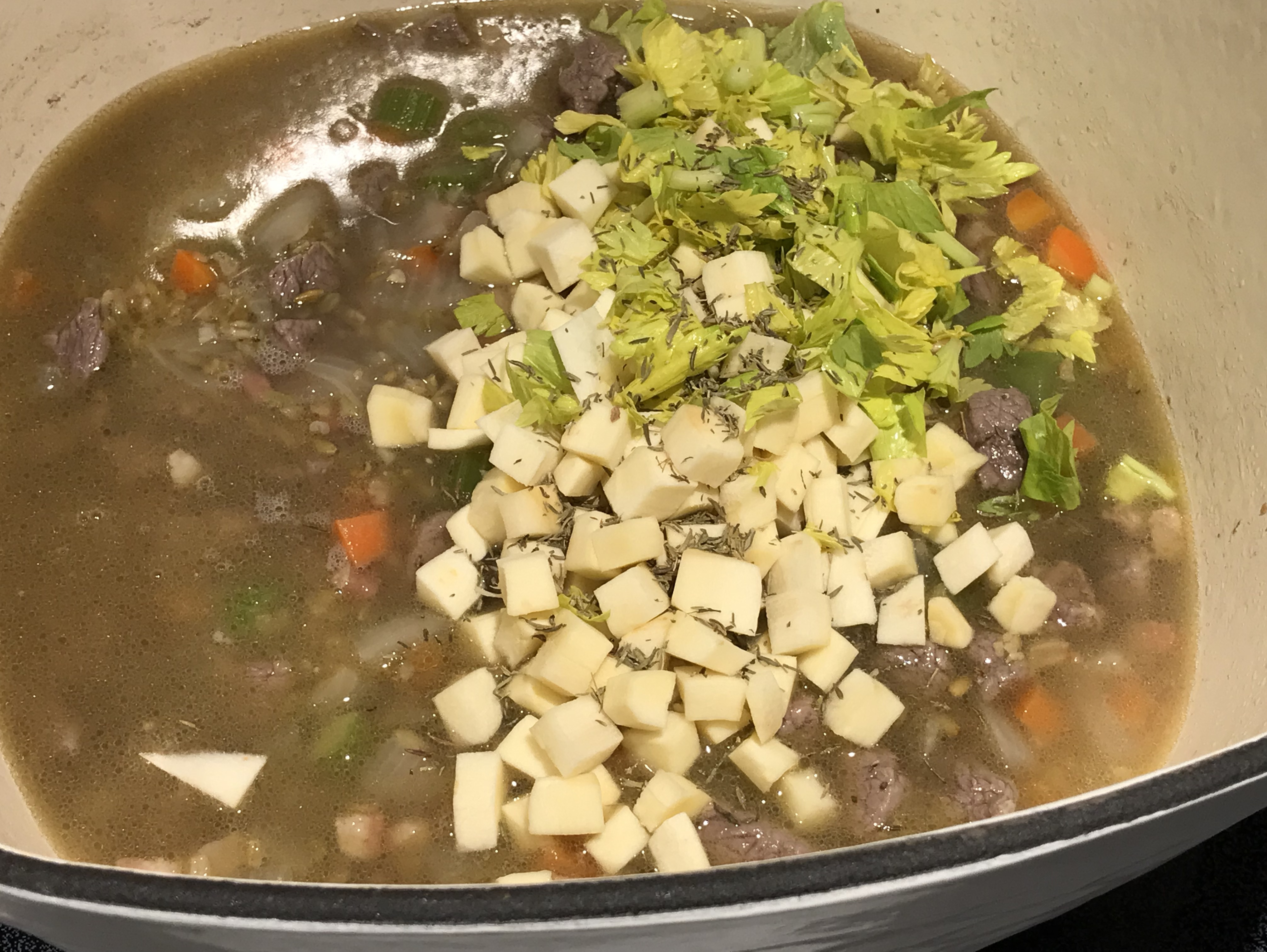
                The full recipe can be found in 1000 Foods to Eat Before You Die on pages 288 – 289, but here’s a summary. Butter is melted on the stove, then bacon, onion, carrots, and celery are added. You can add the beef or pork at this point to brown, which I did. Then soaked grunkern is added, with optional leek and parsnip, along with celery leaves and the meat, if it hasn’t been added already. This is followed by a bit of thyme, pepper, and either broth or water. I omitted the leek but added a minced parsnip, celery leaves, dried thyme, and beef broth. The recipe called for salt, but that can be added later to taste. Since I used salted butter and broth instead of water, adding extra at this point was unnecessary. Then everything simmers for a little over an hour.

                One thing that surprised me about this recipe was how little meat it uses. For 4 to 6 servings, it only called for 8 ounces beef or pork. That’s less than 2 ounces per serving, contrary to the stereotype of German food. Even though Germans have historically had more meat available per person that many other Europeans, large servings were an occasional treat, particularly during the Early Modern Era and into the 19th Century, after large-scale population growth and before industrial agriculture. So we have a stew with plenty of grain and root vegetables, with some beef and bacon as enhancements.

                Overall, this soup is highly enjoyable. My favorite from this project is still beef-mushroom-barley, but this was an interesting change of pace. Like barley, the grunkern swells up in storage and upon reheating, so a bit of extra broth or water might be necessary. If you have trouble finding green spelt or grunkern, which I couldn’t find even online, try looking in a Middle Eastern food store. There it’s called freekeh, but the product is the same. Ziyad brand is one of the most widely available.

                Next time there will be another soup recipe, so be sure to subscribe. Did I mention it’s free?

    Standard
    Uncategorized

    Reanimating Tough Beef: Mushroom Barley Soup

    1000 Foods (pgs. 450 – 451)

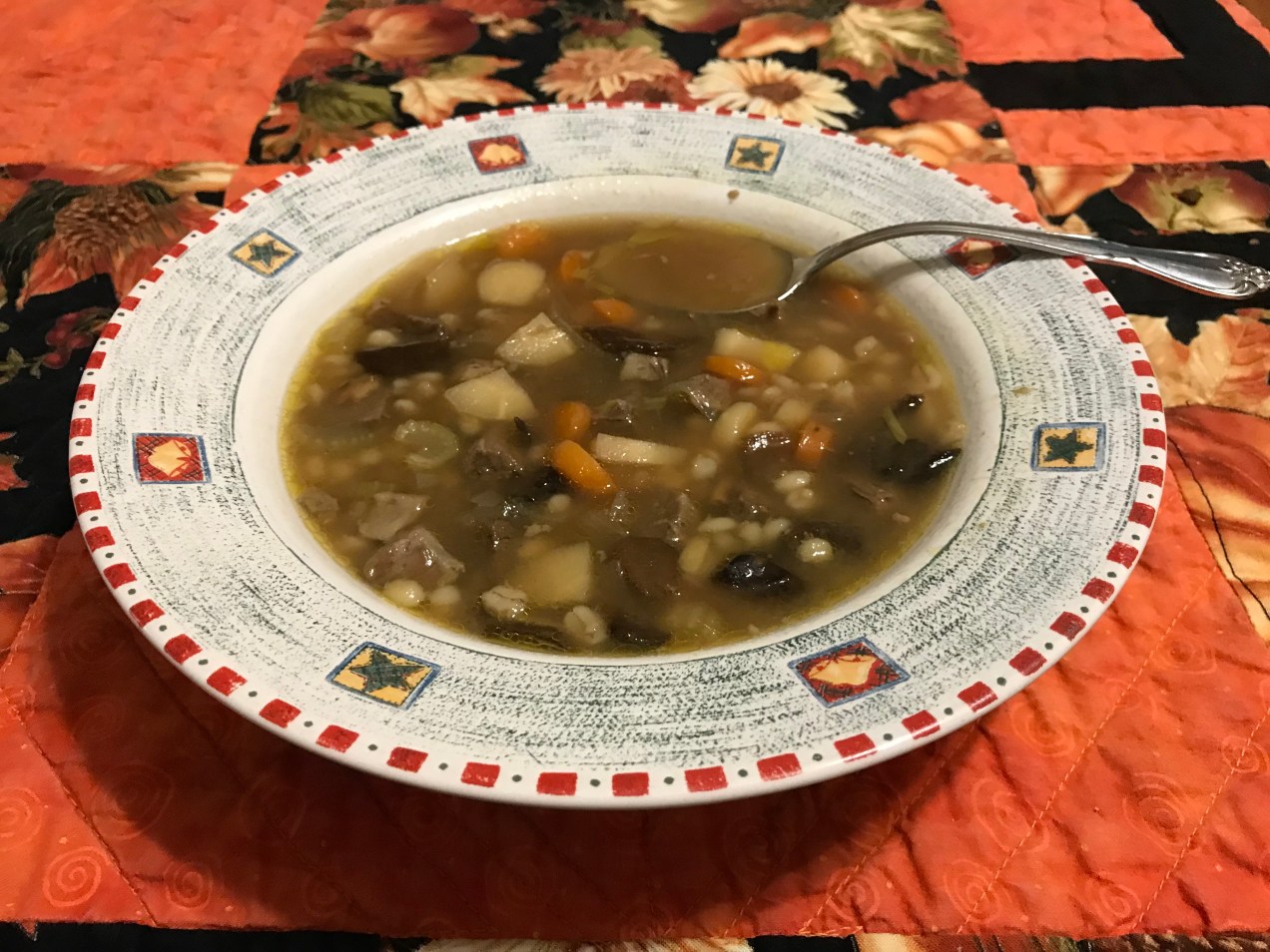
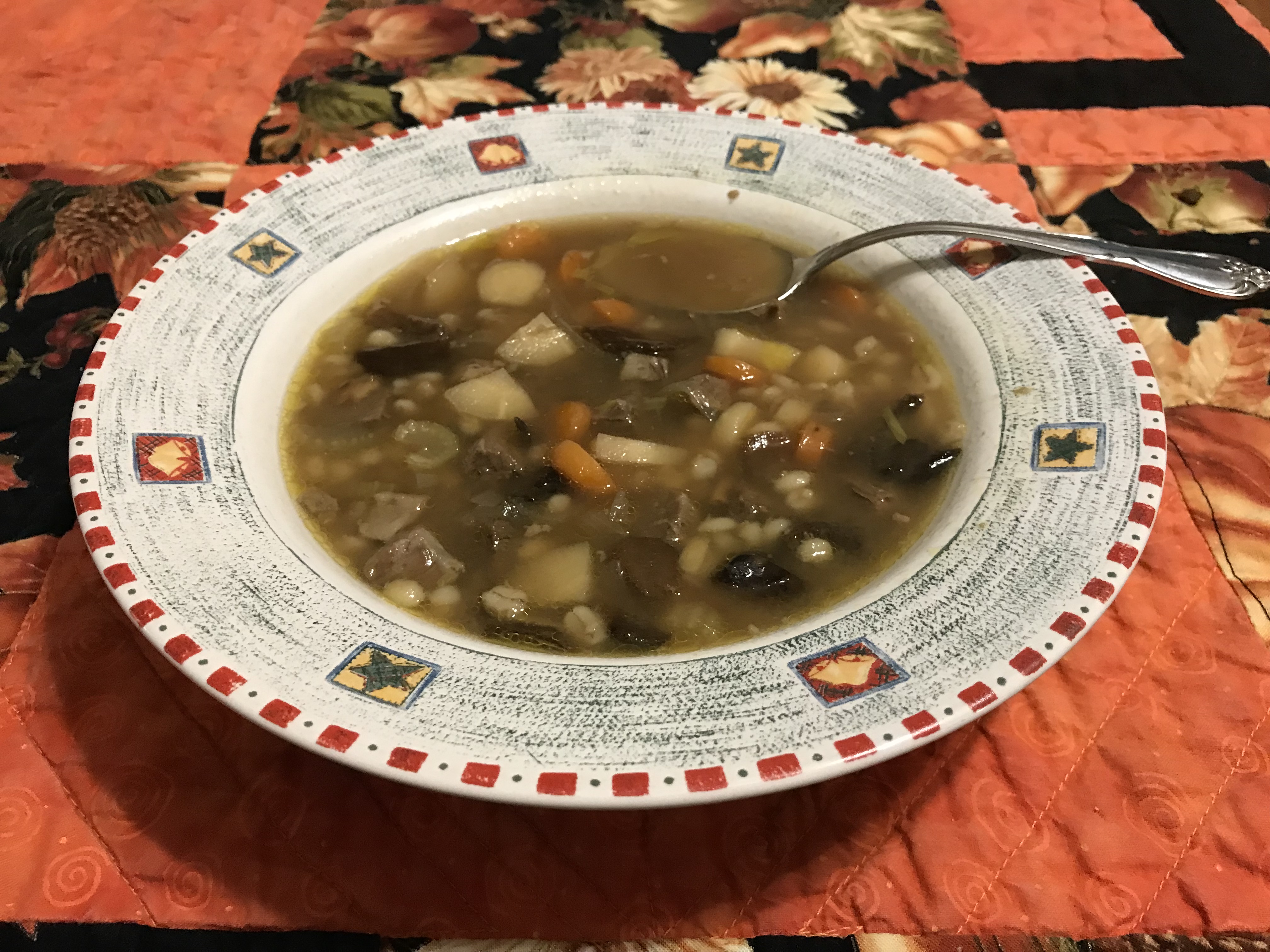
                After failing to soften the leftover tafelspitz beef by re-simmering, using the leftovers in salads, as suggested in the book, was definitely out. Fortunately, I’d been planning on using them in mushroom barley soup, since it uses many of the same vegetables (which I had extra of) needed to flavor the tafelspitz. With the failure of the emperor’s favorite lunch, I just had more beef and broth to work with. The idea was that chopping up the beef would increase its surface area, meaning more edges in contact with the broth as it re-cooked. New root vegetables plus dried mushrooms would add more flavor, while barley added substance. This time, everything went according to plan.

                Barley is one of the oldest crops cultivated by humans, deliberately planted no later than 8,000 BC, and possibly as early as 10,000 BC. A specific date is hard to come by, since the switch from gathering the wild plants, to deliberately spreading the seed, to building villages by designated fields was a gradual one. In some cases, the archaeology suggests that villages preceded agriculture, at least where there was a lot of wild grain to harvest. But whenever the process happened, barley was domesticated around the same time as wheat. The Sumerians, in modern Iraq, used barley as a form of money. Almost 3000 years before coinage, it was the perfect currency. A goat herder in need of a clay pot might not be able to find a potter in need of a goat, but everyone accepted payment in barley. The seller could eat the barley themselves, or trade it for something else they needed. Money didn’t grow on trees, but it did grow in fields.

                For almost as long as they have been growing grain, people have been turning it into alcohol. Our friends the Sumerians brewed lots of beer and even worshipped a beer goddess. From Egypt to Northern Europe, people fermented their grain. Often, they would drink their barley and eat their wheat. The reason for this is simple: wheat has more gluten than any other grain, which means it makes better bread. Most cultures seem to have preferred bread over other ways of preparing grain, creating a preference for wheat. Since wheat was usually more expensive, it made little sense to use it for beer, where its gluten would be of no use. Barley became the primary grain for brewing, and was used in soup, porridge, and cheaper bread.

                Barley is particularly good in soup. As it cooks, it swells up, taking on the flavor of the broth and creating substantial morsels. There’s a reason beef barley soup is a cold-weather classic. Mushroom barley (with beef) is another variation. I’m not sure why it’s in the Jewish food chapter, but the essential dried mushrooms provide a clue. Dried mushrooms are popular across Eastern Europe, and many of the Ashkenazi Jews who immigrated to the US in the early 20th Century came from this region. I’ll admit that I’m not very familiar with the kosher specialties associated with New York City, but the origin theory makes sense.

                Dried mushrooms have two major benefits: a long shelf life and concentrated flavor. To make the most of this flavor, don’t discard the soaking liquid. After letting the grit settle out (or straining through a coffee filter), it can be added to the dish. Mushrooms in the boletus family are particularly favored, but most varieties will work. I used some from a medley I found at Woodman’s, and they were great. All the other ingredients are available at any supermarket, making this a perfect home-cooked delight. You could order it at a restaurant, but it’s so easy to make at home, and the leftovers are as good if not better upon reheating. Over the course of a few days, they all got eaten. The tafelspitz redeemed itself.

    Standard
    Uncategorized

    Fruhlingssuppe (German seven-herb soup)

    Source: 1000 Foods (pgs. 289 – 290)

                In cold climates, the first spring vegetables and greens are particularly appreciated. Often, they appear around Easter as edible symbols of renewal. Seeing the landscape coming back to life after a long winter seems like the perfect celebration of the Resurrection. This does make the idea of celebrating Easter in the Southern Hemisphere, where it occurs during the fall, a little bit strange. My grandparents once told me that when they were in Australia one year for Easter, there were chrysanthemums on the altar at mass. While I understand why the seasons are reversed south of the Equator, thinking about a fall Easter with harvest decorations or a Christmas summer barbecue is still somewhat mind-bending.

                Anyway, back to green herbs. Traditionally, seven-herb soup was a German dish for Holy Week, right before Easter. Historically, fasting rules for Lent were a lot stricter than today. In early Christian communities, meat, fish, eggs, and dairy products were all forbidden. Fish was permitted from the Early Middle Ages onward. While this may seem surprising given the relative cost of fish today compared to most types of meat, it makes sense in the historical context. When fasting rules were first established in the later Roman Empire, most Christians lived around the Mediterranean, where grazing land was limited but fish was relatively abundant. As a result, fish was cheaper than meat.

                This changed once the people of northern Europe became Christian. Here there was plenty of land to pasture cattle and forests where pigs could forage. This made meat and dairy products more abundant and thus cheaper than they were further south. In many cases, meat was even cheaper than fish. Another issue was that north of the area where olive trees grew, people relied on lard, butter, and suet as their main cooking fats. This could be why, from the 15th Century onward, restrictions against dairy products (and eggs) during Lent and on Fridays began to be relaxed.

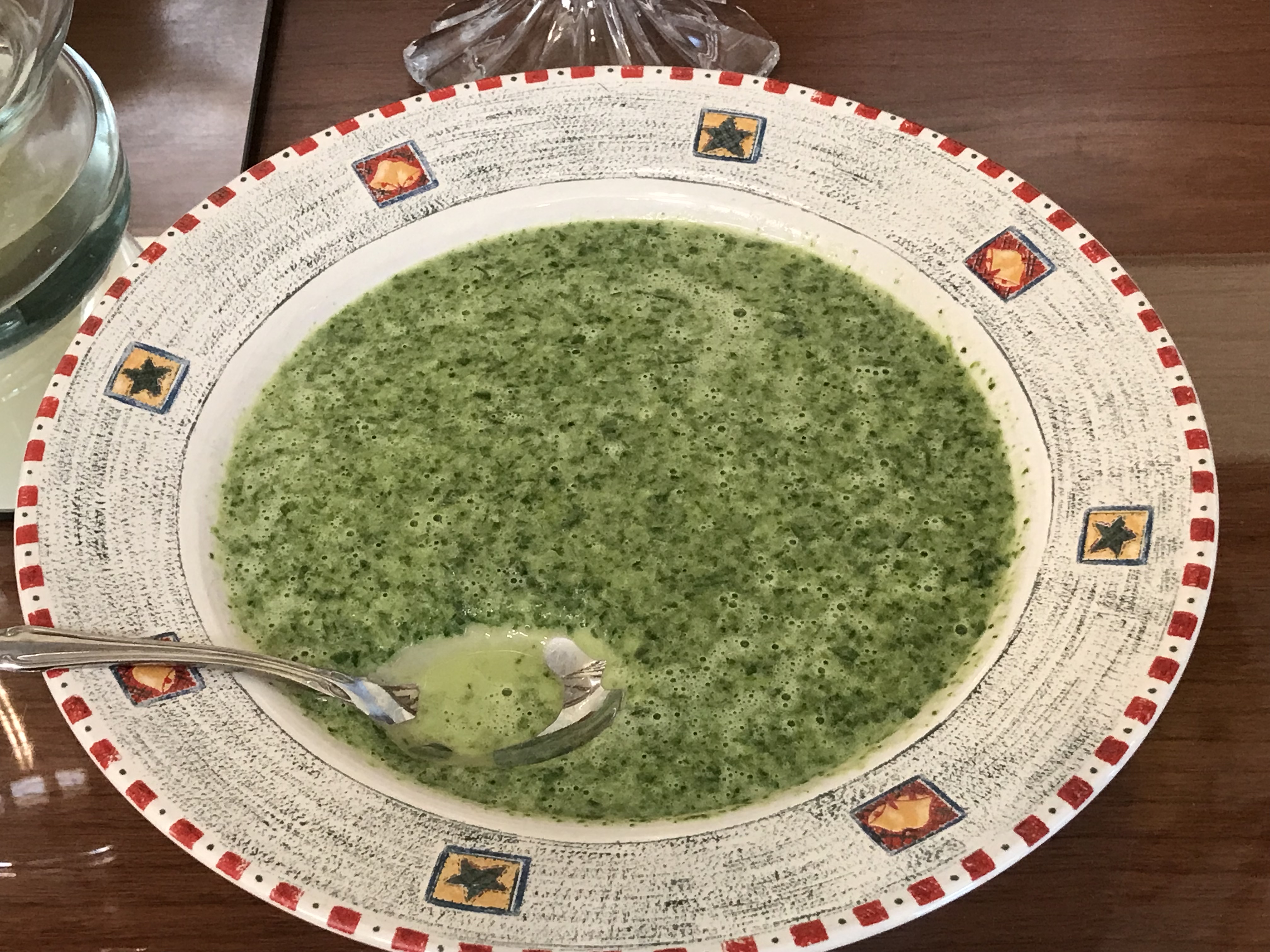
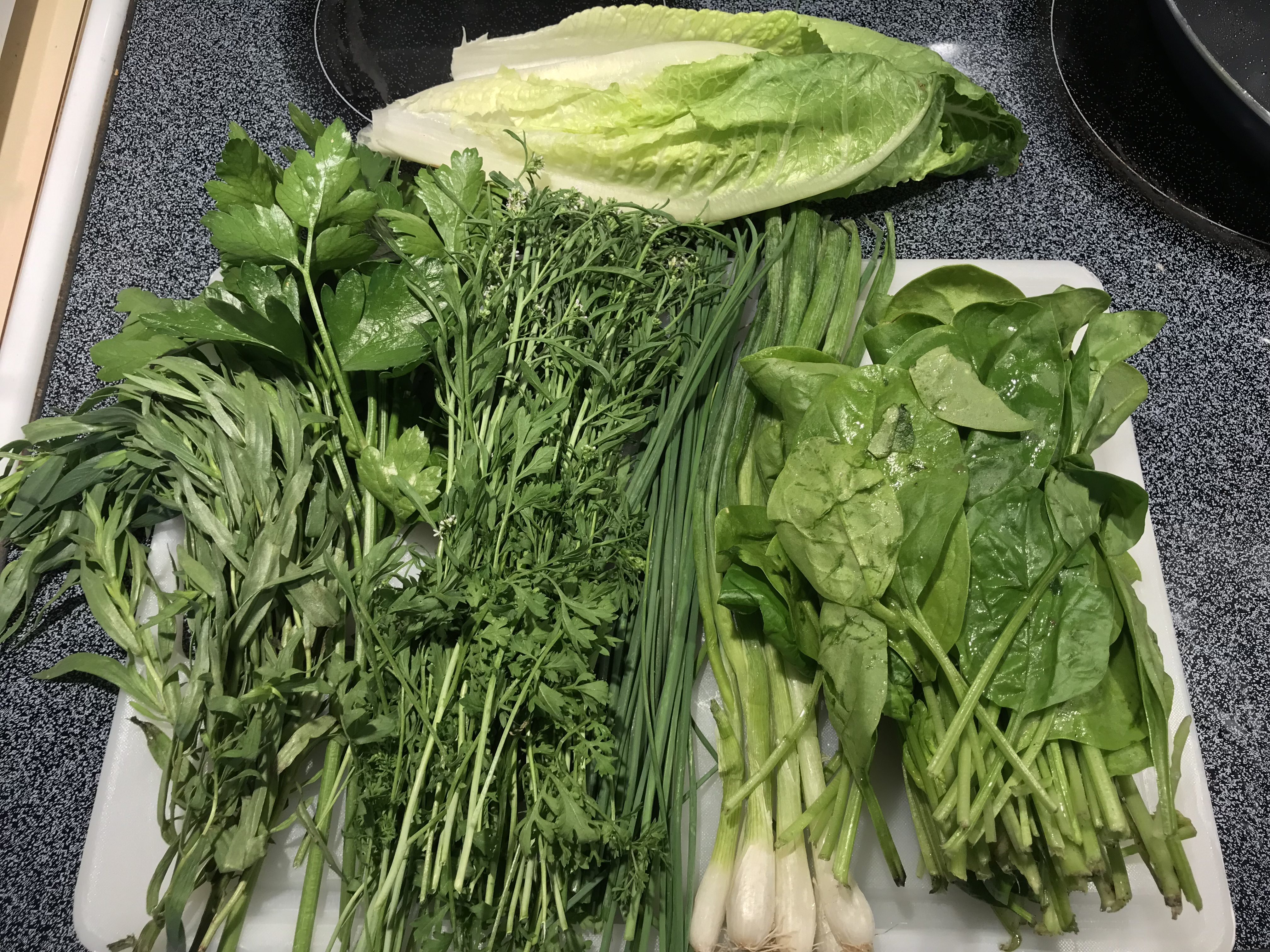
                The seven “herbs” I used were parsley, tarragon, watercress, chives, scallions, spinach, and lettuce. Cooked and pureed with vegetable broth and enriched with potato and cream, it was very fresh tasting. The only issue I had was that since I had never cooked with watercress before, I didn’t realize that the tougher stems needed to be removed, resulting in tough bits in the soup. Personally, I liked the extra texture they provided, but they weren’t supposed to be there.

                After Lent is over, an option is to use chicken or meat broth and add meatballs to the soup. Even though I made this in July, I stuck with the traditional Holy Week version to let the herbs shine. Served with some multigrain crackers, it was a light but complete meal, perfect to celebrate spring or summer.

    Standard