food history

Foods Not Eaten: Personal Taste Part 1 (Blue Cheese, Boiled Eggs, and Raw Seafood)

Blue/Funky Cheeses: Stilton, Stinking Bishop, Epoisses de Bourgogne, Fourme d’Ambert, Roquefort, Gorgonzola, Cabrales, Picon Bejes-Tresviso, Kase mit Musik, Liederkranz Cheese

Boiled/Runny Eggs: Aselila (walnut egg salad), Deviled Eggs, Fried Eggs, Pidan (preserved duck egg)

Raw Seafood: The Oysters of Locmariaquer (farmed there or elsewhere in Brittany), Nieuwe Haring (new herring eaten raw), The Fine Art of Oysters (view but not eat), Sild (Scandinavian herring), Pickled Herring, North Atlantic Clams on the Half-Shell

1000 Foods (pgs. 27 – 28, 87, 91, 127 – 128, 195, 257, 298 – 299, 592 – 593, 381, 555 – 556, 571 – 572, 778 – 779, 108 – 109, 155 – 157, 342 – 344, 457 – 458, 604 – 605)

            Everyone has their own personal tastes, so we all have different opinions about what to eat at least once in our lifetimes. For the most part, I trust Mimi Sheraton’s advice on this, but there are a few things I just don’t like. Most notably, there’s strong cheese, hard-cooked egg yolks, runny eggs (usually), raw seafood (usually), meat or fish in gelatin, ketchup, mayonnaise, most bottled salad dressings, or anything with the “wrong” temperature or texture.

            If that sounds familiar, like it might be autism-related, that’s certainly possible. I am, in fact, on the autism spectrum, which might be how I’ve managed to stay obsessed with this project for so many years. It could be a sensory thing, and I do have sensory issues with loud noise and rough/itchy clothing. On the other hand, it could also be a learned behavior. My mom won’t eat most of those things either, except for bottled salad dressing.

            Let’s start with a common aversion: blue or stinky cheese. Even when it’s a type safe to eat, I find visible mold on or in cheese most unappetizing. It isn’t just the appearance. When ground into a burger, blue cheese messes up the taste. That means there’s no point trying Stilton (British), Fourme d’Ambert, Roquefort (both French), Gorgonzola (Italian), Cabrales, or Picon Bejes-Tresviso (both Spanish). Stinky cheeses are also out. No matter how good the flavor is, getting past a “mushroomy,” “barnyard,” or “putrid” (all descriptors used in the text) smell is a tall order. That eliminates four more cheeses: the British stinking bishop, French epoisses de Bourgogne, German kase mit musik, and American Liederkranz.

            For eggs, I don’t like hard-cooked yolks, which smell like sulfur and have a weird texture. Deviling the eggs doesn’t solve either issue, and even looking at egg salad grosses me out. A poached or fried egg is sometimes okay in soup or on a burger or rice bowl, as long as the yolk isn’t cooked hard (texture issue just like hard-boiled eggs), but I don’t usually like runny eggs either. Ideally, they should be scrambled and fully cooked, used in an omelet, quiche, or casserole, or mixed into baked goods. Two exceptions to this rule are Tollhouse chocolate chip cookie dough and my homemade brownie batter. Since I can’t taste the raw eggs, they are no longer gross. And no matter now good the Chinese preserved duck eggs, sometimes called century eggs, are, they look scary.

            The Dutch, Scandinavians, and New York Jewish population seem to like herring, either raw or pickled, but I do not. This might be a partially learned behavior, since my mom hates the smell of seafood (and is actually allergic). Regardless, the idea of eating whole raw herrings, bones, skin, and all, is not appealing. They have a fairly strong, “fishy” flavor, and the texture is off. Oily fish like (presumably) snoek are also too strong. Raw oysters have a slimy texture, and I can’t imagine raw clams being any better. They make a pretty still-life painting, but actually eating them is another story.

            Speaking of oysters in the French region of Brittany, here’s a story our tour director told us on the way back to Paris from Versailles. On a previous tour, most of the group decided to get (raw) oysters in the Breton former pirate city of Saint-Malo, since the area is famous for them. The tour director himself and a handful of people opted for crepes instead. You can probably guess where this is headed. The only people who didn’t get sick were the crepe group. Everyone else was miserable for the next few days. When we got to Saint-Malo a few days later, I went with the safe option. Brittany is also known for buckwheat crepes, with both sweet and savory fillings. The buckwheat crepe with ham, cheese, and egg was delicious and affordable, even in a touristy area. After eating some real food, I could enjoy a few buttery pastries and walk off the calories exploring. Bottom line: unless you really like oysters, stick with the crepes and pastries.
Standard
Uncategorized

Northern Spain’s Winter Stew: Caldo Gallego (Updated with Recipe)

1000 Foods (pg. 255)

            When people think of Spanish cuisine, chances are they think of paella, gazpacho, and tapas. Deeper thought might recall acorn-fed ham, chorizo, olla podrida, and bitter “Seville” oranges, or other typically “Mediterranean” foods. But these dishes are not the whole story. Like France and Italy (and the US, China, and probably any other decent-sized country), Spain has its own regional climates and cuisines. Galicia, in the northwest corner, is one such region. Like neighboring Asturias to the east, Galicia has a cooler climate and more rain than the rest of the country. Like Normandy in some ways, the land is favorable for cattle raising and apple trees, there is enough rain to successfully grow corn, and seafood is widely available. An excellent description of Spanish regional cuisine can be found in Claudia Roden’s The Food of Spain.

Advertisements

            Galicia and Asturias were populated with Celtic-speaking peoples at some point in the last few centuries BC. It’s unclear what language the previous inhabitants spoke, and how much they intermarried and assimilated with the newcomers, but the region retained its Celtic character for centuries. Greek and Phoenician trading colonies were mainly in the south and east, and when Hannibal’s father and brother conquered much of the country in the late 3rd Century BC, they too focused on these areas. The Romans conquered the Carthaginian holdings in Spain soon after, but wasn’t until the 1st Century AD, almost 300 years later, that they fully controlled Galicia. As the Western Roman Empire fell apart, the Visigoths came to control the old Roman province. In the early 8th Century, Muslim armies from North Africa captured most of Iberia, but most of Asturias remained independent, and Galicia was reconquered quickly. The Reconquista originated in these regions, and they retained their unique culture.

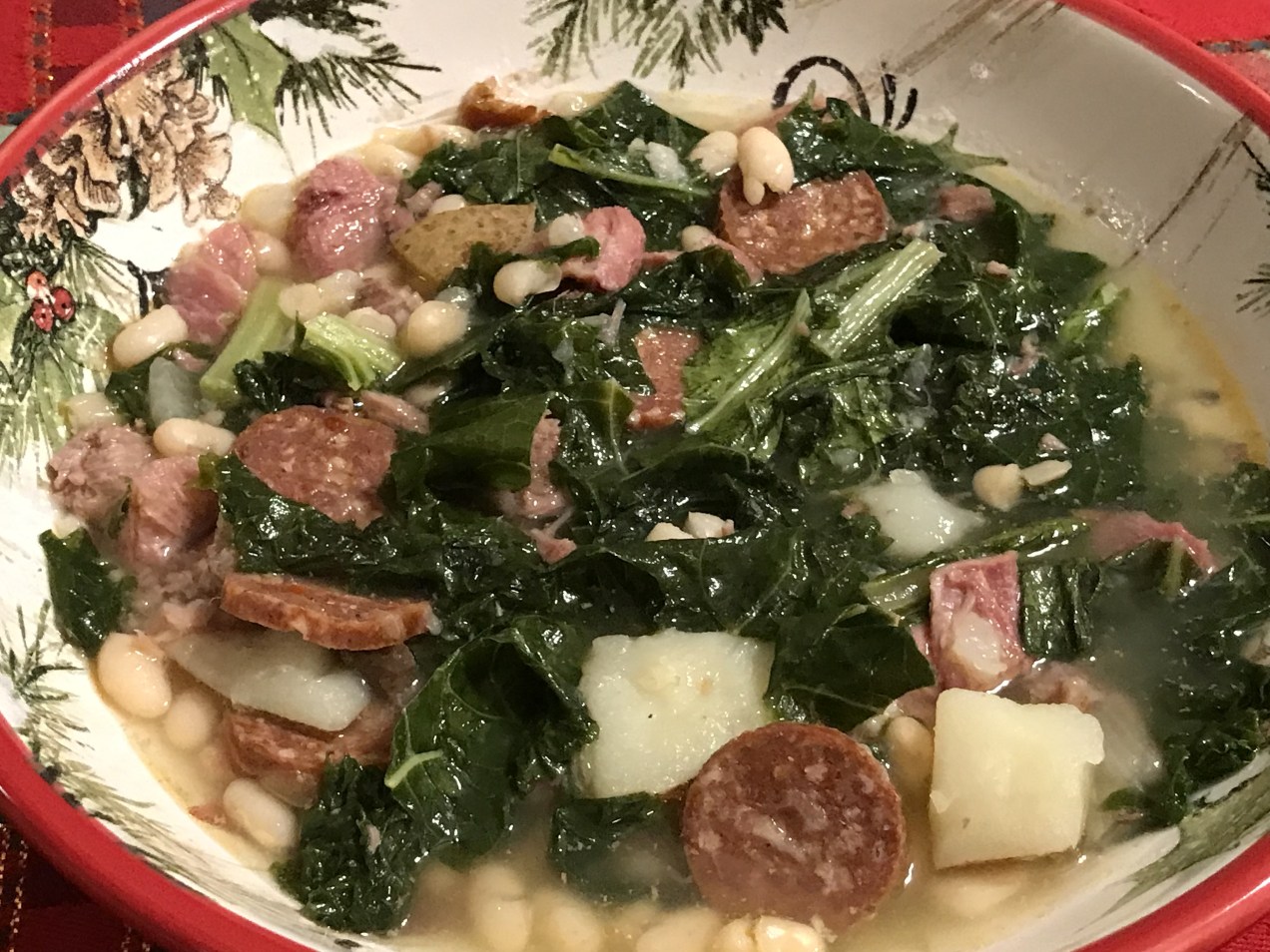
            Hilly, mountainous terrain made these regions harder to conquer, but could also make life harder for the average resident. Historically, most of the population was required by economic necessity to eat a largely vegetarian diet. Except for feast days and other special occasions, meat was usually a flavoring as much as a source of protein. Across Spain, there are a variety of slow-cooked soups and stews, where cured pork products flavor vegetables and beans. In caldo Gallego, which translates as “Galician soup/stew,” chorizo and salty smoked pork are the meats, while beans add more protein and onions more flavor. The vegetables are potatoes and a kale-type cabbage. In other words, a good choice for eating healthy in the winter.

Advertisements

            To make it, I first simmered some smoked ham shanks to tenderize and extract some of their flavor. After removing the meat and putting it back in the pot, I added the beans, onions, and chorizo nuggets. When the beans were almost done, I added the potatoes, then, at the last minute, kale and turnip greens. Everything was cooked properly, nothing was overdone, and the flavors blended together well. The only thing I couldn’t understand was the level of salt. Neither the ham nor the chorizo was that salty, and I didn’t add any extra. Was pre-soaking the beans in salted water to blame? Maybe I added more salt to the soaking water than I thought, or was supposed to rinse the beans. The stew was still good, and historically most winter dishes would have been salty from using preserved ingredients, but next time, I’ll be more careful and remember to rinse the beans.

If you wish to make this yourself, here is the recipe I developed. You’ll need:

  • 1 package smoked ham shanks (2 pieces)
  • 8 oz dry Spanish-style chorizo, sliced
  • 8 oz dried white beans (navy or great northern), soaked overnight in water to cover with 1 tsp salt and drained
  • 2 yellow onions, coarsely chopped
  • 2 medium potatoes (I used russets, but other varieties will work)
  • 1 bunch kale, coarsely chopped
  • 1 bunch turnip greens, coarsely chopped

And here is how to make it. The stew takes a few hours to cook, but most of that isn’t active time.

  1. Place the ham shanks in a large pot, with just enough water to cover. Bring water to a boil, then simmer for about 1 hour, until the meat is falling off the bones.
  2. Remove the ham shanks from the broth. When cool enough to handle, pull off and coarsely chop the meat, returning it to the pot. Discard the bones, but if you can extract the marrow, add that to the stew as well.
  3. Add the chorizo, beans, and onions to the pot and cook for about an hour, until the beans are almost soft, stirring occasionally.
  4. Cut the potatoes into roughly 1/2 inch cubes and add to the stew, cooking for 20 to 30 minutes, until tender. If they break down a bit, that’s fine, since this thickens the stew.
  5. About 10 minutes before serving, add the kale and turnip greens. Once they’ve wilted and cooked down, the stew is ready.
  6. Ladle the stew into bowls and serve with bread, if desired.

If you thought this was interesting or want more recipes, subscribe to get new content in your email. It’s free, it won’t cost you anything, you have nothing to lose, and did I mention it’s free? This is the first full recipe I’ve developed, but there will be many more to come.

Standard
Uncategorized

An Excess of Tomatoes: Red Gazpacho (Gazpacho Andaluz)

Also White Gazpacho (Ajo Blanco)

Source: 1000 Foods (pg. 260)

            In early summer, I did not expect much from my tomato plants. There weren’t many blossoms, and I was losing a lot of the first tomatoes to blossom end rot. I still can’t figure out what was wrong. Later in the summer and into the fall the problem went away without me doing anything differently. Yields began increasing in August, and by the end of the month there were so many I didn’t know what to do with all of them. The plants kept yielding heavily until the first frost, even as they became stressed by shortening days.

            One way to use up the tomatoes before they start attracting fruit flies is to make gazpacho. Interestingly, while we think of tomatoes as a central ingredient, gazpacho has been made since well before there were tomatoes in Spain. Some sources suggest that the Ancient Romans introduced a version based on stale bread, flavored with garlic, vinegar, and oil, and moistened with water as necessary. Until recently, bread and other grain products were the center of the diet in pretty much every culture. In the days before effective preservatives, bread would go stale in a day or two. You can observe this today with fresh bakery bread.

            Exactly how the Ancient Romans revived their stale bread is not clear, but there are a few possibilities. They might have pounded the ingredients with a mortar and pestle to make a puree, or cut the bread into cubes to toss with the other ingredients. Maybe the bread was toasted first, maybe not. In the Middle Ages, a white pureed version based on almonds appeared. Today it is called ajo blanco (translates as “white garlic”) and is usually served with green grapes or slices of melon, interestingly enough. This might sound weird, but until Early Modern times there was no real distinction between “sweet” and “savory” dishes. The timing of this division varied from place to place, but appears to have been earlier in France than elsewhere in Europe.

            At least in America, the sweet/savory divide is incomplete. Think of barbecue sauce, which is a combination of sour, spicy, and usually sweet. At Thanksgiving, turkey is served with sweet and sour cranberry sauce, often alongside a sweet potato casserole topped with marshmallows. Christmas and Easter hams are frequently glazed with honey or brown sugar. As dishes from cuisines that never made the distinction become more popular, the sweet/savory line appears to be blurring again, at least in some cases. Examples of this phenomenon include Chinese takeout with sweetened sauces, bacon with a sugary glaze, or desserts with crystals of sea salt. And honestly, the white gazpacho with melon was a surprisingly good combination. The texture was better with the melon, and the flavor seemed incomplete without it. Green grapes are another possible garnish.

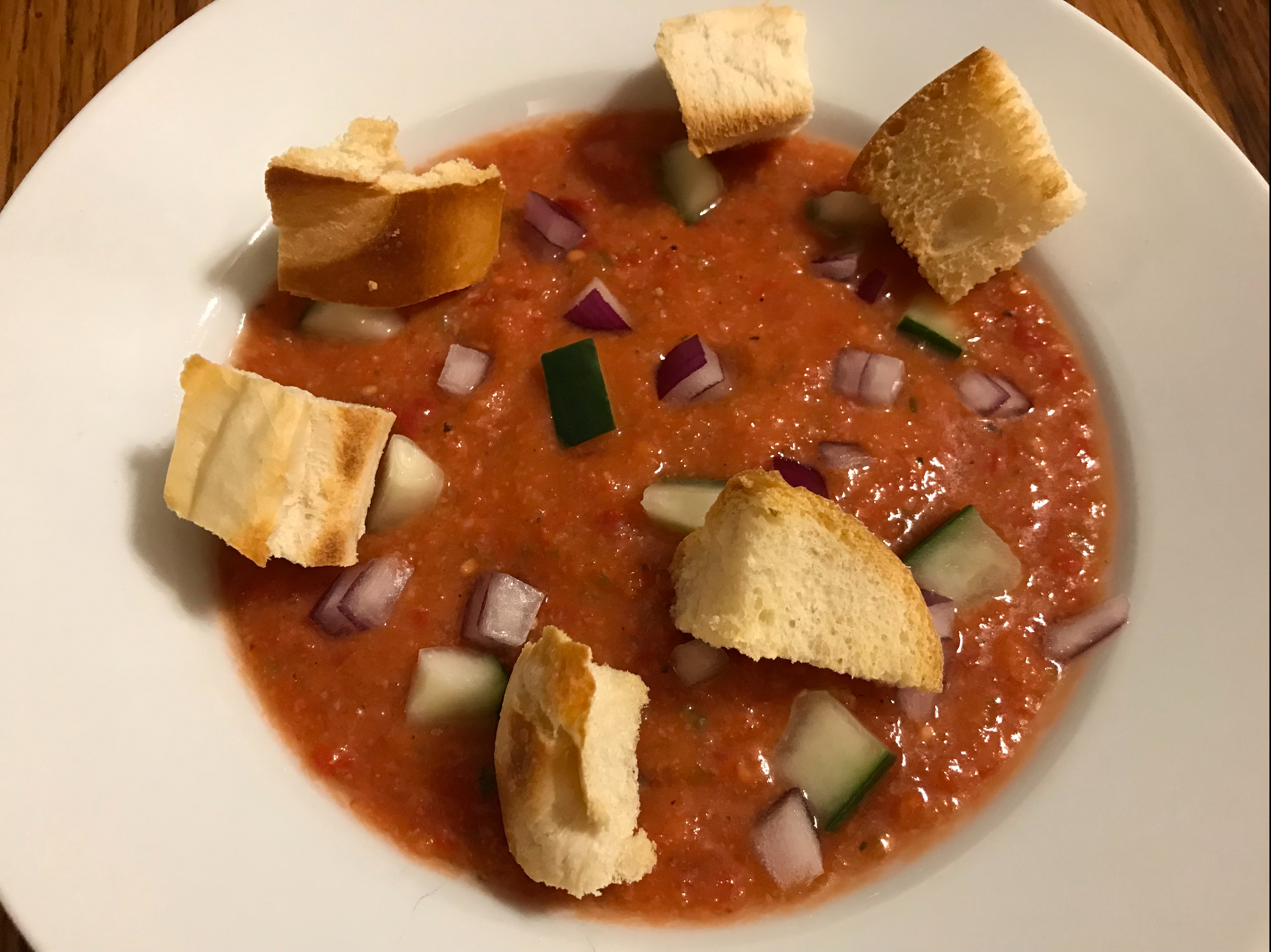
            Spaniards first encountered tomatoes in Mexico and transplanted them to Europe. They grew very well in Spain and at some point in the next few centuries, people realized that they were not poisonous. In the southern region of Andalusia, they became an essential part of gazpacho. Ms. Sheraton indicates on pg. 260 that the earliest versions were a sort of salad with tomatoes, vegetables, and croutons, but today a pureed version is most common. It can be served in a bowl with chopped vegetables and croutons as a garnish. In Andalusia, where summer temperatures often surpass 100 degrees Fahrenheit, people often serve their gazpacho in a glass over ice cubes and drink it with a straw.

            In theory, gazpacho is a good idea. It’s semi-filling but refreshing on hot summer days and is full of healthy vegetables. But I didn’t care for the red version. While I understand the appeal, I’m not a big fan of tomatoes on their own. The gazpacho tasted like pureed salsa in a bowl, and the texture was weird, even with the crunchy garnishes. But if I liked pureed soups, I probably would have enjoyed it.

Standard