hungarian cuisine, recipes, stew

Hungary’s National Dish: Goulash

            If asked to name a Hungarian dish, goulash is probably what most people would come up with first. And that isn’t a bad thing. It’s flavorful, soothing, and endlessly customizable. Plus, like most stews, it reheats extremely well. For Sunday dinner with leftovers for lunches, it’s perfect.

            According to Mimi Sheraton in 1000 Foods to Eat Before You Die, goulash was originally a cowboys’ stew. Beef is the most common meat, but pork is also widely used. Since pork is typically half the cost of beef or less, and makes excellent goulash, that is what I use in the recipe, though beef cubes will also work.

            The critical ingredient is paprika, which is actually a relative newcomer to Hungarian cuisine. It is made of dried and ground peppers, which originally came from the Americas. Most likely, peppers arrived in Hungary during the reign of Holy Roman Emperor Charles V, whose empire included Spain, the Low Countries, parts of Italy, Austria, Bohemia, and Hungary, though it took a few centuries for Europeans to accept them.

            By the 19th Century, paprika was a central flavor in Hungarian cuisine, and indispensable in goulash. Besides the meat (or occasionally beans) and paprika, other ingredients might include onions, garlic, potatoes, carrots, tomatoes, or green peppers. In other words, the usual suspects in stew. Some versions include caraway seeds, sage, sauerkraut, or even grated apple.

            For my version, I settled on all the usual suspects except green pepper, for the simple reason that it was the only one I didn’t have on hand, needing to be used up. That’s one of the nice things about goulash. The ingredients are affordable, easy to find, and often already in the kitchen. Caraway and sage add a nice extra flavor, and a bit of apple cider vinegar brightens everything up. If using fresh tomatoes, don’t worry about peeling or seeding them. With the long cooking time, they break down into the broth, leaving just their flavor, vitamins, and lovely red color.

Ingredients:

  • 4 pounds pork butt, shoulder, or assorted bone-in chops
  • 2 onions, chopped
  • 2 garlic cloves, minced
  • 8 ounces carrots, sliced
  • 4 tablespoons (¼ cup) unsmoked sweet paprika (This is not a typo. It sounds like a lot, but goulash is supposed to be very paprika-forward, not subtle.)
  • 1 tablespoon caraway seeds, lightly crushed
  • Dash cayenne pepper
  • 2 pounds fresh chopped tomatoes (about 7 – 8 Roma tomatoes), or 1 15-ounce can crushed tomatoes and 1 can of water
  • 6 small red or gold potatoes, unpeeled, cut into roughly ¾ inch cubes
  • 8 sage leaves, thinly sliced
  • 1 tablespoon apple cider vinegar

Directions:

  1. Trim the extra fat from the pork, mince it, and cook over medium heat until it’s mostly melted and rendered.
  2. Cut as much meat from the bones as you can, cut into roughly ¾ inch cubes, and set aside the meaty bones.
  3. Add the pork cubes and bones to the fat and cook over medium heat, stirring occasionally, until most of the pink is gone and the remaining fat has begun to render, about 10 minutes.
  4. Add the onions, garlic, carrots, paprika, and caraway, with salt and a dash of cayenne pepper. Cook roughly 10 more minutes, until the onions start to cook down.
  5. Add the tomatoes (and water if using canned) and cook for another 10 minutes.
  6. Reduce heat to simmer. Add the potatoes and sage leaves, cover the pot, and cook until everything is tender, ½ hour to an hour.
  7. Remove the bones, pull any pork from them, and return the meat to the pot. Discard the bones.
  8. Immediately before serving, stir in the vinegar. Serve alone or with mashed potatoes, egg noodles, dumplings, or bread.

Rating: 9/10

For more recipes and fun facts, make sure to subscribe for free. Of course, any contributions to buy more pork chops would make me very happy.

One-Time
Monthly
Yearly

Make a one-time donation

Make a monthly donation

Make a yearly donation

Choose an amount

$5.00
$15.00
$100.00
$5.00
$15.00
$100.00
$5.00
$15.00
$100.00

Or enter a custom amount

$

Your contribution is appreciated.

Your contribution is appreciated.

Your contribution is appreciated.

DonateDonate monthlyDonate yearly
Standard
Chicken Waterzooi - Belgian chicken stew with egg, lemon, and cream
belgian cuisine, food history, soup, stew

Belgian Chicken Stew: Waterzooi a la Gantoise

Chicken Waterzooi - Belgian chicken stew with egg, lemon, and cream

            Variants of chicken soup are eaten all over the world. Flavorings might vary, but the concept seems to be pretty universal for non-vegetarians. Historically, this usually involved a rooster or hen past their mating or egg-laying prime. Tough but flavorful, the chicken would be slow-cooked in liquid to tenderize the meat and produce a rich broth.

            One Belgian recipe, called Waterzooi a la Gantoise, involves stewing the chicken with leeks, celery, and parsley root or parsnips, flavoring the mixture with lemon and cream, and thickening it with beaten egg yolks. Odd as this mix might sound, the recipe from 1000 Foods to Eat Before You Die, pages 151 – 152, had a nice flavor.

            Belgium has a long and complicated history. Composed of Dutch-speaking Flanders and French-speaking Wallonia, it was a battleground between France and the Holy Roman Empire for centuries. During the Middle Ages, Flanders in particular grew wealthy from cloth production. Since they needed English wool, attempts by the French kings to shut down the trade during their many conflicts with England predictably let to unrest. So did the kings’ attempts to centralize power in general and levy taxes.

            In the late 14th Century, most of the Low Countries came under control of the Dukes of Burgundy, followed by the Habsburgs a hundred years later. Charles V, the most powerful Holy Roman Emperor in centuries, was born in Flanders in 1500. By the time of his retirement in 1556, his empire included Spain, the Low Countries, Austria, Naples, Sicily, Milan, and Spain’s growing New World empire. All except Austria and the imperial title itself went to his son Philip II.  Charles V’s brother Ferdinand I, who had been his deputy in Austria for years and gained Bohemia and Hungary through marriage, received these, creating the Habsburgs’ Austrian branch.

            Just the Spanish Habsburg territories were a monumental task to control, as Philip II soon found out. He was hardworking but struggled to delegate, which made managing the far-flung provinces difficult. A particular issue was the spread of the Reformation in the Netherlands. Philip was not inclined to compromise on matters of religion, and unlike his father, didn’t spend much time outside of Spain after taking the throne. Feeling alienated by a “foreign” ruler, the Dutch revolted in the 1560s, leading to Eighty Years’ War. They were aided by England, which was part of why Philip sent the Spanish Armada.

            When the dust settled, the modern Netherlands became independent, while modern Belgium remained part of the Spanish Empire. It was transferred to the Austrian Habsburgs in 1714, after the War of the Spanish Succession, and became part of the Revolutionary French Empire in the 1790s. After the defeat of Napoleon, Belgium was ruled by the restored Dutch monarchy. A few decades later, Belgium became independent under Leopold I, an uncle of Queen Victoria.

            After everything they went through, Belgium tried to remain neutral in the 19th and 20th Centuries. With British support, this worked until 1914. When World War 1 broke out, Belgium had a problem. Specifically, Germany’s war plans. Since German high command knew they would be fighting on two fronts, they sought to defeat France quickly, before Russia managed to mobilize its army. The issue was that the French-German border was heavily fortified. The idea, called the Schlieffen Plan, was to go around these defenses by invading through neutral Belgium.

            When Belgium refused military access, Germany declared war on them. Belgian forces put up a tougher fight than expected, giving the French time to reorganize their defense and for British support to land. By December, the Western Front was more or less stabilized, running right through Flanders, where it would remain for roughly three-and-a-half years.

            The initial German advance, the years of occupation, and the eventual retreat in 1918 did a number of Belgium, especially Flanders. Attempts to stay neutral during World War 2 also failed, resulting in another multi-year occupation. Afterwards, finally, Belgium has finally enjoyed several decades of peace.

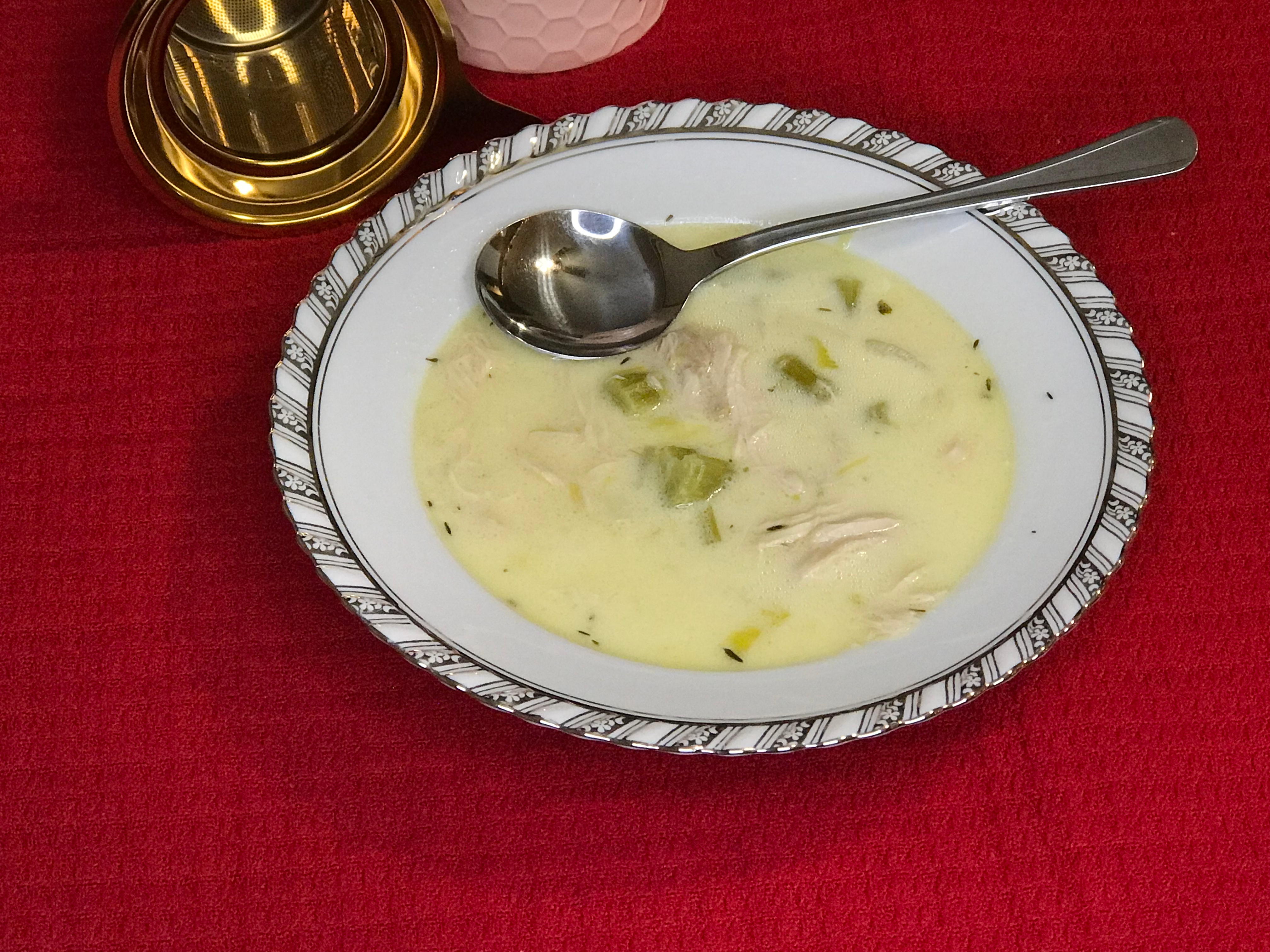
            Evidence of prosperity can be seen the soup recipe, which uses chicken, eggs, cream, and vegetables that are not ultimately eaten. Since using vegetables to flavor the stock but then discarding them offends my sensibilities, I ended up returning them to the pot after removing the chicken skin and bones and straining the broth. The celery and leeks were a little overcooked, but still added some nice extra texture to the soup.

            Immediately before serving, some of the hot broth is whisked into the egg yolks to temper them, then the mixture is returned to the pot to thoroughly heat but not boil. This is the same technique used in making custard, but for some reason the waterzooi didn’t thicken as much as I anticipated. Maybe I used too much water (the recipe said just enough to cover the chicken, which I thought I did). Maybe I didn’t heat the soup long enough after adding the egg yolks for fear of them curdling. Or maybe the issue was my expectations. Custards thickened with egg alone and not boosted with cornstarch are very thin.

            Overall, the soup was very good, but not necessarily worth the trouble of making again as is. Perhaps pureeing the slightly overcooked vegetables into the broth as additional thickening would give it some extra body. (An immersion blender would be great for this.) On a scale of 1 to 10, I would probably give it a 7.

Standard
british cuisine, recipes, soup, stew, welsh cuisine, winter

Medieval-Inspired Welsh Soup: Leek Broth

Idea comes from 1000 Foods to Eat Before You Die, pg. 35, recipe is my own

            For some reason, leeks are a Welsh symbol. They are particularly associated with St. David’s Day, dedicated to Wales’s patron saint. Exactly how this happened is unclear, and history doesn’t provide many clues. At some point after 500 BC, Celtic peoples came to dominate the British Isles, including Wales. Starting in 43 AD, the Roman Empire conquered England and Wales, staying until the 5th Century.

            During these centuries, the native population became somewhat Romanized, adopting many Roman customs and, from the 4th Century onward, Christianity. These Romano-Britons spoke a Celtic language similar to Welsh. After the legions left to deal with everything else going on in the 5th Century, Anglo-Saxons from modern Germany began invading the island. The Romano-British chieftains put up a spirited defense, but were gradually pushed west into Wales, which is why the land to the east came to be called “Angle-Land,” later England. Did the proto-Welsh use leeks, which were a favorite of the Romans, to distinguish themselves from the Saxons? It’s possible.

            One of these proto-Welsh chieftains became the basis of the King Arthur legends. In other words, the man behind the myth was Welsh, not English. Perhaps because Wales is hillier and less fertile than England, or perhaps because they were busy fighting first each other and later the Vikings, the Anglo-Saxons mostly left the Welsh alone. After the Norman Conquest in 1066, so did the descendants of William the Conqueror. They were busy fighting rebellious Saxons, building an empire in France larger than what was controlled by the French king, and fighting their relatives over shares in that empire. There were some incursions into Wales, Scotland, and Ireland, but the Anglo-Norman kings of England were mostly occupied elsewhere.

            This changed in the 13th Century, probably because the kings of England lost most of their land in France. With the French kings much stronger than before, reconquest was a difficult proposition. So the English kings turned their energy towards the rest of the British Isles. King Edward I conquered Wales in the 1280s, and from then on heirs to the English throne were called the Prince of Wales. One story goes that the Welsh asked King Edward for a prince that spoke neither English nor French, so he presented them with his infant son, the future Edward II, who did not yet speak any language.

            Unlike Scotland and Ireland, Wales merged into the English monarchy with only a few early rebellions. It remained a culturally distinct backwater, but Welsh longbowmen played an essential role in the Hundred Years’ War. Without them, the English could not have won so many battles against much larger French forces.

            In Wales’s cool, wet climate, raising livestock was more profitable than growing most crops. Oats, barley, rye, and root vegetables grow more easily than wheat. Traditional Welsh dishes tend to be homey and comforting, not spicy and exciting. Not many Welsh specialties are known outside the British Isles, but one of the more famous is leek broth, called cawl cennin in Welsh. It’s a simple mix of leeks, carrots, potatoes, and cabbage, flavored with bacon and thickened with oatmeal.

            Except for the potatoes, this sounds a lot like the thick soups, called pottages, eaten by most medieval Europeans. The ingredients varied by social class and the occasion, but for the common people, vegetable-based soups and bread were the core of the diet. These were supplemented with butter and cheese, some meat and fish (usually salted), fruit in season, and beer, cider, or wine, depending on the region. Leeks and salted pork products like ham or bacon gave pottages more flavor, and vegetables like carrots and cabbages kept reasonably well over the winter. Grains, particularly those like oats and barley that were less useful for making bread, were often added as thickeners.

            Once potatoes became common in the 17th Century, they went into the pot too. Before soup bases and bouillon cubes, water would have been the liquid. Until the 20th Century, chicken was more expensive than beef, mutton, or pork, so there would be no chicken broth in a common, everyday dish. Today, a bit of bouillon or soup base is typical in leek broth, adding extra flavor for just a few cents.

            As far as affordable home cooking goes, leek broth is a great choice. The root vegetables are full of vitamins, and the oats make it taste sort of creamy and surprisingly filling. The soup/stew has a fair amount of starch, but carbohydrates are not the enemy, especially in the form of carrots and whole grains like oats. A chunk of whole grain bread would be a great accompaniment, maybe with a piece of cheese or glass of milk for extra protein. And don’t skip the bacon. Per serving, it does not add that much fat, and a little bit adds a ton of flavor. Which makes a popular New Year’s resolution a bit easier.

Ingredients:

  • About 8 ounces bacon, diced
  • 2 large leeks, halved lengthwise, cleaned, and thinly sliced crosswise
  • 8 ounces carrots, thinly sliced
  • 6 medium-sized red potatoes, cut into roughly ½ inch cubes
  • Half of a small green cabbage, thinly sliced
  • About ½ cup to 1 cup rolled oats (not steel-cut or instant)
  • Chicken broth or water (broth from a soup base is perfectly good here)

Directions:

  1. Place the bacon in a large soup pot over medium heat. Cook until starting to crisp, then add the leeks, carrots, and potatoes. Do not drain the fat. All the other ingredients are healthy, and it is essential for the best flavor.
  2. Cook the root vegetables in the bacon fat with the bacon, stirring occasionally, until the vegetables start to cook down and release their moisture.
  3. Add enough water to cover, about 12 cups. If desired, add 1 teaspoon soup base or bouillon per cup of water.
  4. Bring the soup to a boil, then reduce the heat and simmer, stirring occasionally, until the potatoes are soft.
  5. Stir in the cabbage and oats. Cook on low heat, stirring frequently, until the cabbage softens and the soup begins to thicken.
  6. Ladle the soup into bowls and serve hot. Don’t worry about presentation; leek broth tastes a lot better than it looks.

            For more warming recipes over the next few months, don’t forget to subscribe for free.

One-Time
Monthly
Yearly

Make a one-time donation

Make a monthly donation

Make a yearly donation

Choose an amount

$5.00
$15.00
$100.00
$5.00
$15.00
$100.00
$5.00
$15.00
$100.00

Or enter a custom amount

$

Your contribution is appreciated.

Your contribution is appreciated.

Your contribution is appreciated.

DonateDonate monthlyDonate yearly
Standard
egyptian cuisine, food history, recipes, stew, vegetarian

Egyptian “Tacos”: Ful Medames (fava bean stew)

1000 Foods (pgs. 708 – 709) for information, recipe is my own creation

            There’s no liver or chianti with these fava beans. To be honest, neither sounds appealing. The purpose of the liver is to filter toxins from the body, and supposedly chianti is a fairly dry wine. But fava beans on their own sound much better. Historically, most people across the Mediterranean and Middle East ate a largely vegetarian diet by necessity. Beans of all sorts provided essential protein and vitamins, which brings to mind an interesting story. Supposedly, the Ancient Greek mathematician Pythagoras hated beans but advocated a vegetarian diet. Balanced nutrition would still be possible if eggs and dairy were allowed, but Pythagoras definitely made things more difficult for himself.

            Supposedly, he even thought that beans were evil. Crazy as that probably sounds, there might have been a logical (okay, semi-logical) explanation. A small percentage of people don’t produce a particular enzyme that breaks down a chemical naturally occurring in fava beans. If someone with this gene does eat them, they become ill. Since this gene is most common in people living near the Mediterranean, Pythagoras likely knew a few people who suffered from it. It’s unclear why he decided that other types of beans were also evil, but maybe it was just a phobia. At a time and place where legumes were an essential source of protein, it would have been an unfortunate one.

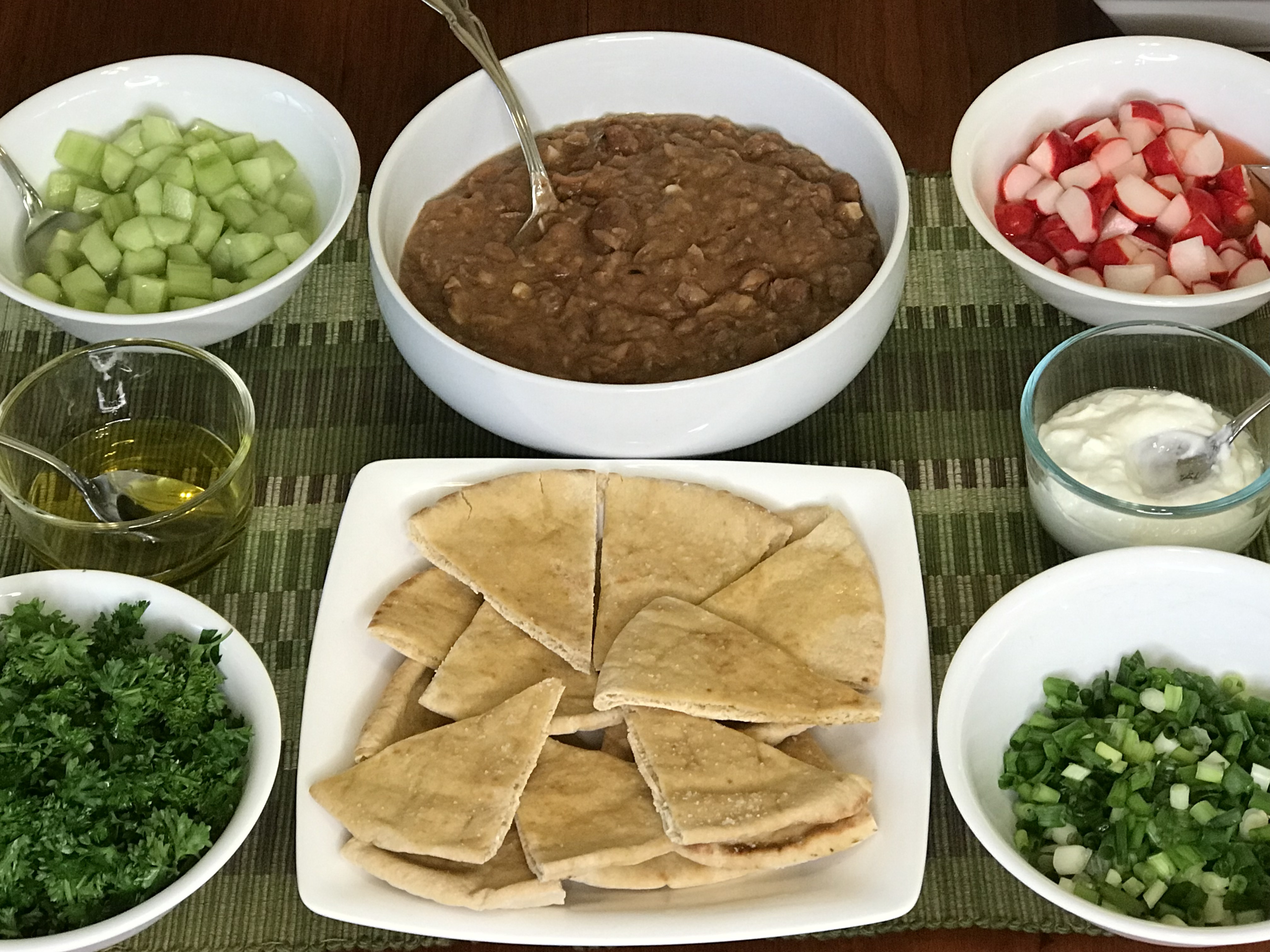
            Fava beans, also called broad beans, have a long history in Egypt as a staple food, especially for the poor. Sometimes, when prices were high, the government would even subsidize them to ensure they remained affordable. Ful medames, a basic fava bean “porridge,” is often eaten for breakfast with a variety of toppings. The beans can be enhanced with butter, oil, onions, boiled eggs, and/or herbs, depending on what’s available and affordable. It seems like a strange choice for breakfast, but the protein helps keep you full until lunchtime. Some bread provides carbs for balance, as well as a vehicle for soaking up the juice. Pitas are the traditional choice.

            The beans, flavored with garlic and cumin and cooked until partially broken down, come to resemble refried beans. Combined with pita bread and assorted toppings, they bear a distinct resemblance to vegetarian tacos in a way, hence the description. While it’s a bit messy and time-consuming for breakfast, ful medames make a great vegetarian lunch or dinner, filling but fresh. And it’s customizable. Each person can add the toppings they wish.

            Ingredients:

  • 1 large can (about 30 ounces) fava beans, drained and rinsed
  • Water or broth
  • 2 cloves garlic, crushed and minced
  • ½ teaspoon cumin
  • Pinch hot pepper flakes, to taste
  • Salt and pepper to taste
  • Bread for serving (especially pitas, lightly warmed in oven with olive oil and salt)

Toppings (optional):

  • Flaxseed, olive, or untoasted sesame oil, or butter
  • Chopped parsley and/or cilantro
  • Minced onions, raw or sauteed, or scallions
  • Lemon juice
  • Plain yogurt
  • Vegetables (I used radishes and cucumbers), chopped, with vinegar and lemon juice to cover and a pinch of salt, and marinated in refrigerator for a few hours
  • Chopped hard-boiled eggs (I do not like them, but they are a common accompaniment, so enjoy (?) if desired)

            Directions:

  1. Place drained beans, garlic, cumin, and hot pepper flakes in a small to medium saucepan. Add enough water or broth to cover, about 1 ½ cups.
  2. Bring to a soft boil over medium heat, then reduce heat to low and simmer, uncovered, for about 20 minutes, stirring occasionally and gently breaking up the beans.
  3. When the beans have the texture of refried beans, remove from heat and serve in bowls. Pass desired toppings and plenty of bread.
  4. This recipe makes two good-sized servings, but is easy to multiply for larger groups. Make sure to have at least one pita per person.

            For free posts and recipes sent straight to your inbox, be sure to subscribe.

Standard
german cuisine, recipes, stew

Nothing to Do with Ground Beef: Hamburger Aalsuppe (Hamburg eel soup)

1000 Foods (pgs. 292 – 293) for information, recipe is my own creation, but lacks eels

            Like other places in Northern Europe, the German city of Hamburg gets quite cold and dreary during the winter months. A specialty found there is eel soup, with chicken, beef, ham, vegetables, dried fruit, vinegar, and raspberry jam. If it sounds crazy, recall that combining sweet and savory flavors like meat and fruit used to be common in European dishes and is still popular in other parts of the world. Turkey and cranberry sauce, sauerbraten, and Swedish meatballs with lingonberry jam are some modern examples of this principle.

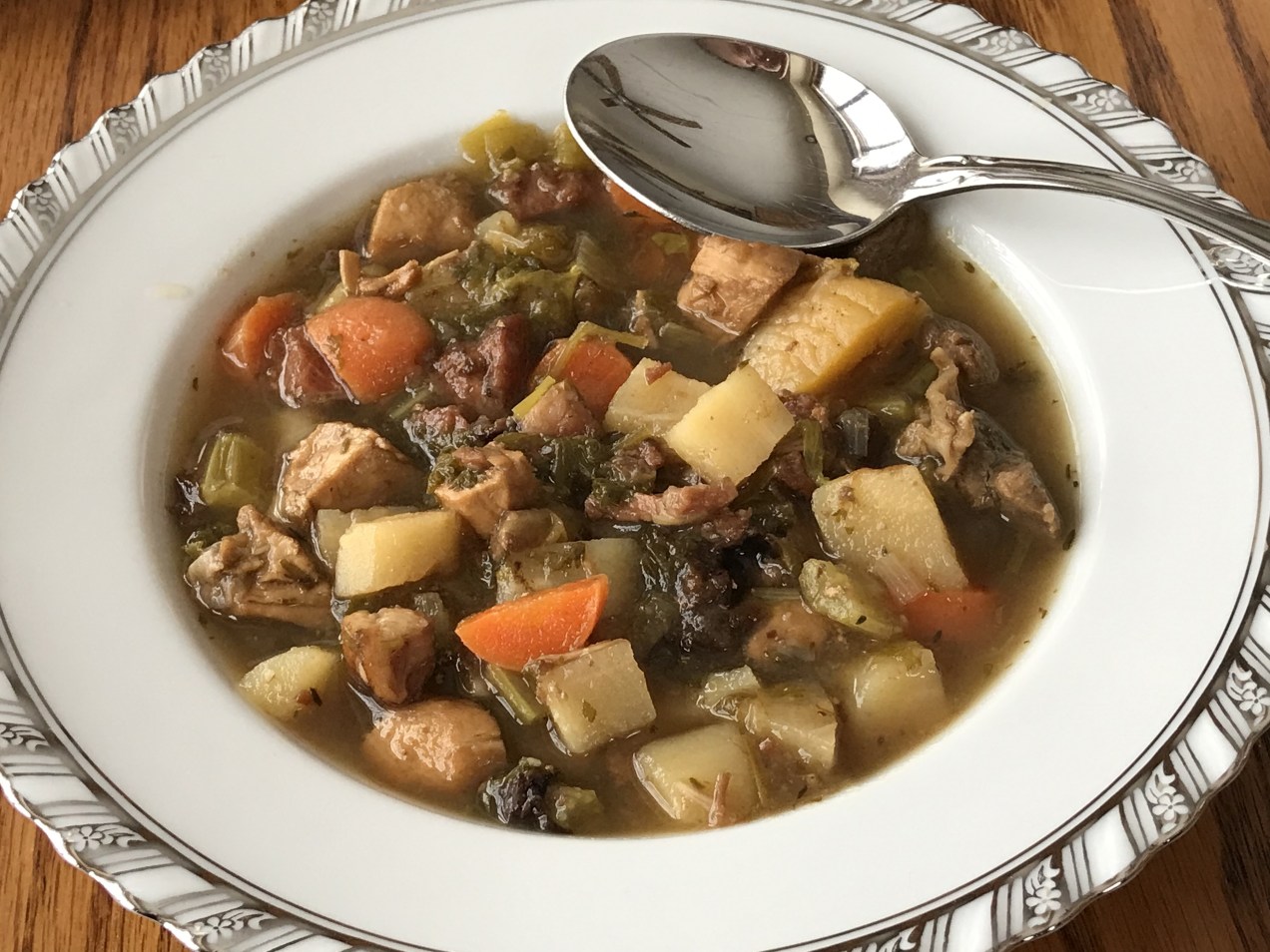
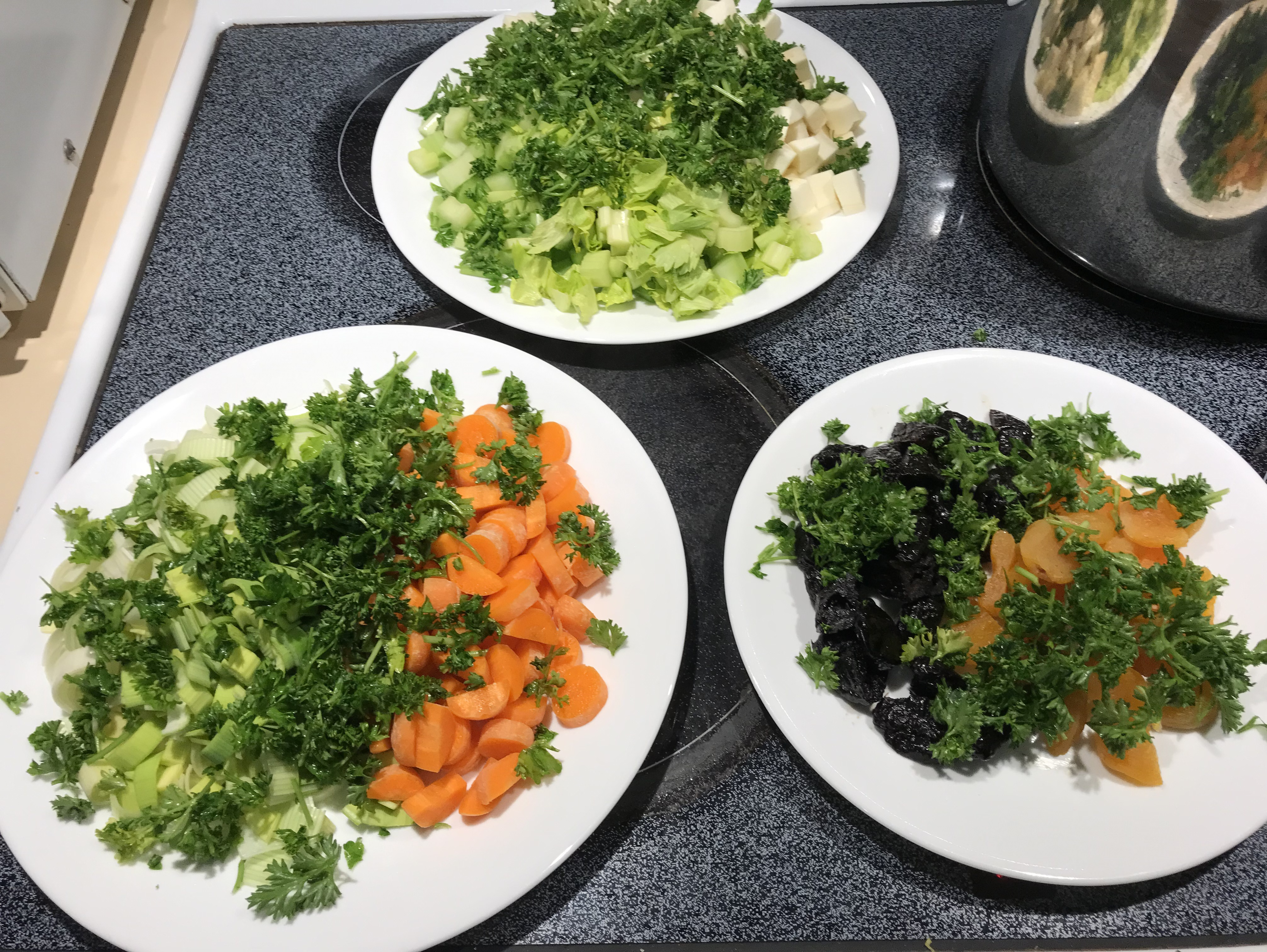
            Since eels are hard to find where I live, I decided to make “eel” soup without them, because the flavor combination sounded interesting. For the base, there’s beef chuck, ham, chicken, onions, bay leaves, and thyme. To prevent overcooking, carrots, celery, parsnips, leeks, parsley, prunes, and dried apricots are added a bit later. At the end of cooking, the soup gets a finishing touch of vinegar and jam. You can also add mini dumplings.

            For a dish that sounds so weird, the eel-less eel soup is actually delicious. The vinegar and jam give it a sweet-tart flavor resembling sauerbraten.

            Here’s what you need to make your own eel-less eel soup:

  • 1 pound beef chuck or similar cut, cubed
  • 2 chicken breasts or 4 thighs, cubed
  • 1 pound ham, chopped
  • 1 yellow onion, chopped
  • 2 bay leaves
  • 1 teaspoon dried thyme or 3 teaspoons fresh
  • 2 carrots, washed, halved, and sliced
  • 2 ribs celery, with some leaves if possible, sliced
  • 4 parsnips, peeled and chopped
  • 12 prunes, halved
  • 12 dried apricots, halved
  • 1 leek, halved and sliced crosswise
  • 1 bunch parsley, chopped
  • ¼ cup vinegar (I particularly like apple cider vinegar)
  • 2 tablespoons raspberry jam

            To make it:

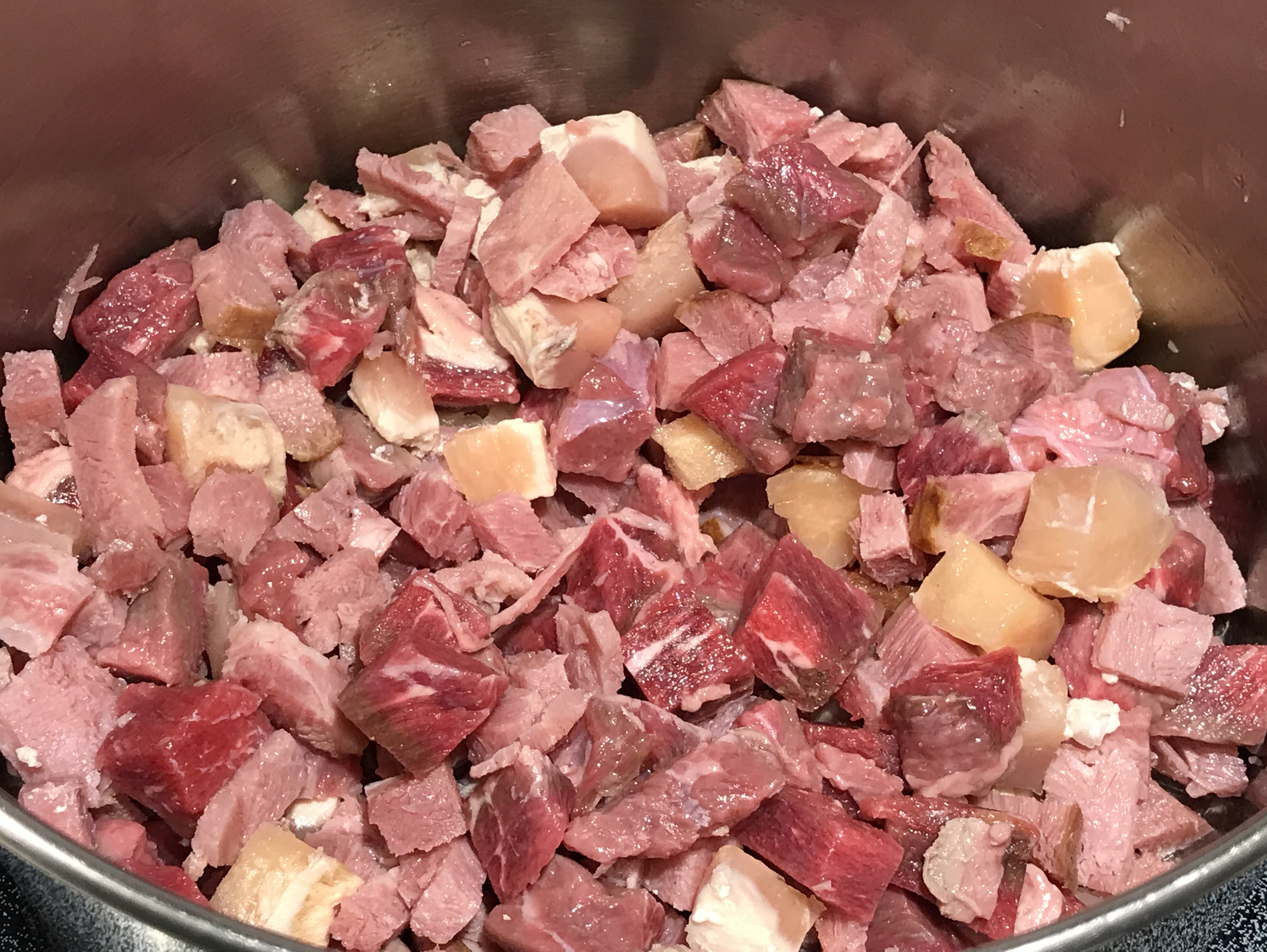
  1. Put the beef, chicken, and ham into a large pot and turn on the burner to medium, stirring frequently. When it starts to brown, add 1 cup of water and scrape any browned bits off the bottom of the pot.
  2. Add the onion, bay leaves, thyme, a pinch of salt, and enough water to cover. Simmer for about 45 minutes.
  3. Add the carrots, celery, parsnips, leek, prunes, apricots, and parsley. Stir and add more water to cover. Simmer for another 45 minutes.
  4. When the meat, vegetables, and fruit are tender, add the vinegar to the soup, followed by the jam, and stir to combine.

            And remember, subscribing is free, and you’ll get a notification whenever there’s a new post.

Standard
food history, german cuisine, stew

Pre-Potato Winter Stew: Frankischer Grunkern (with green spelt)

1000 Foods (pgs. 288 – 289)

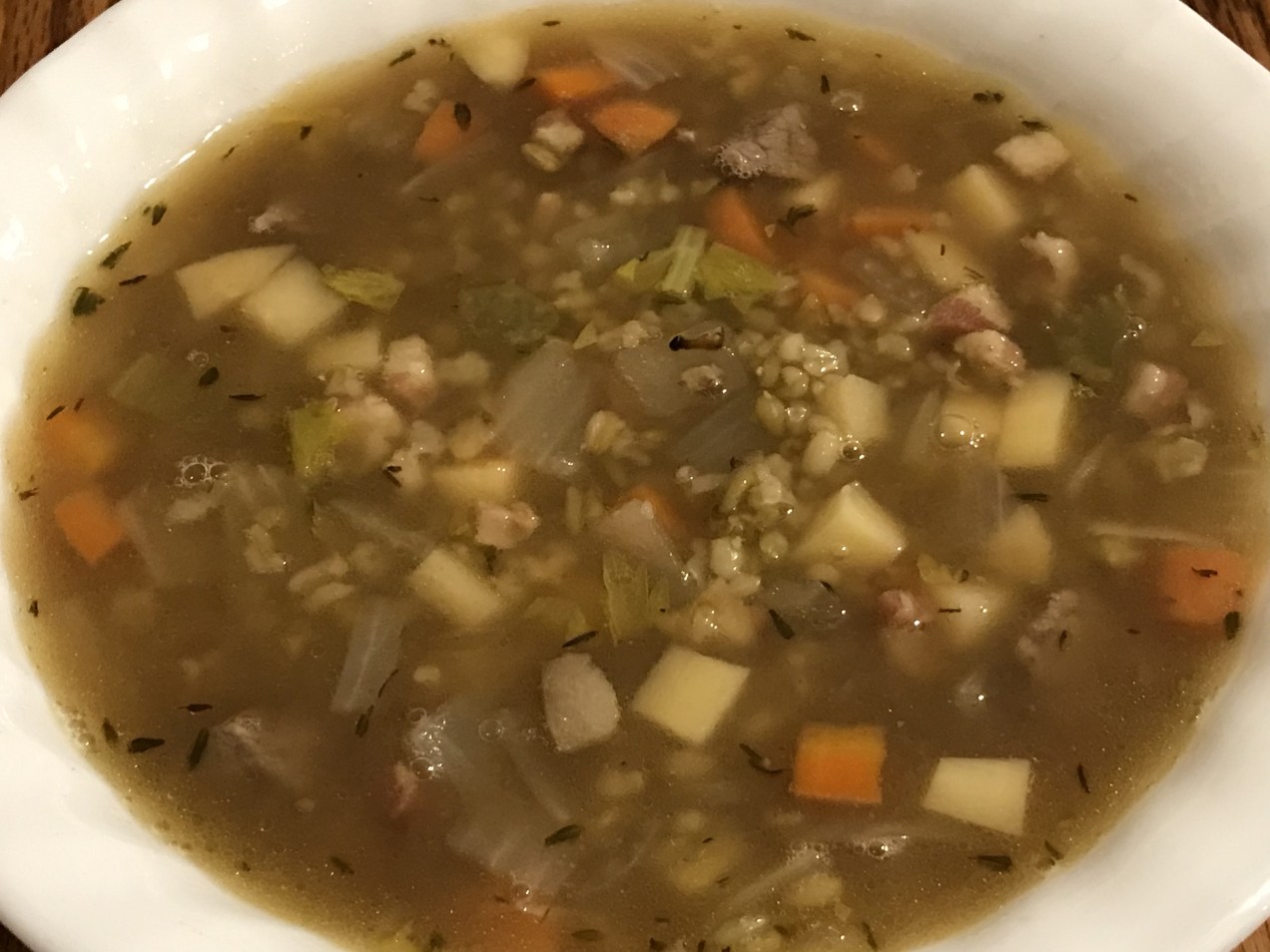
            Imagine, for a moment, that you’re making stew on a cold day. It has beef, onions, carrots, celery, and parsnips, plus some butter and minced bacon to brown the meat and vegetables before adding liquid. Most people would think of adding potatoes at this point, and some cooks do, but they aren’t the key ingredient. That particular honor goes to grunkern, or green spelt. A specialty of Baden-Wurttemberg in the southwestern corner of Germany, the stew contains starch, protein, fat, vitamins, and flavor in one bowl.

            Spelt is an ancient variety of wheat that’s been grown for thousands of years. The German word grunkern sounds very similar to “green corn,” because the grain is harvested before it’s fully ripe. In Europe, corn can mean any type of grain, not just maize and sweet corn. Exactly how green spelt was discovered is unclear. Perhaps one summer grain supplies were running low and the harvest was still a few weeks or months away, so some farmers harvested a bit of their grain early. Interestingly, grunkern doesn’t seem to be widespread in European cuisines. Maybe it was more popular before potatoes, which are also ready before the main grain harvest, were introduced from the Americas, but that’s just speculation.

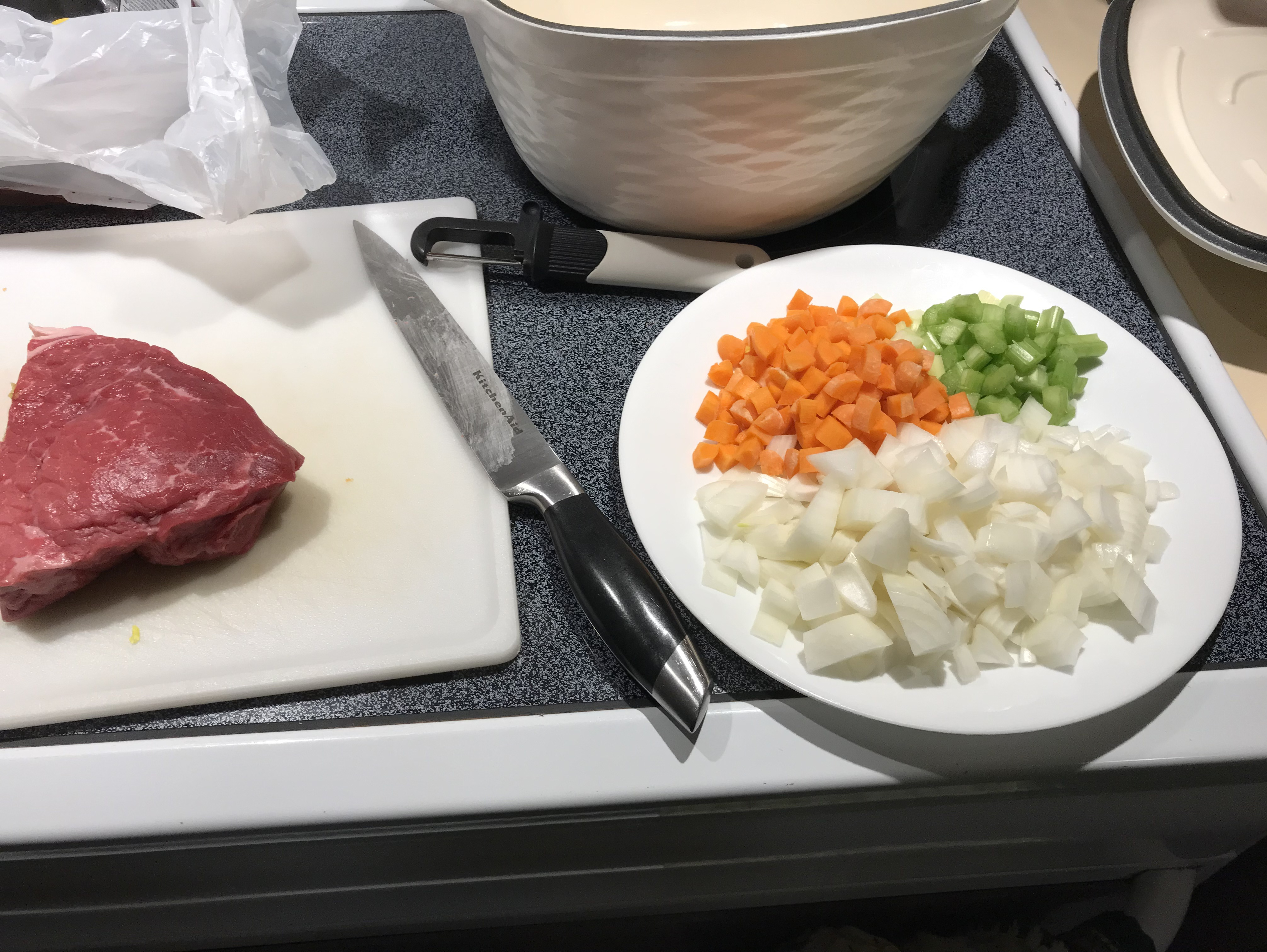
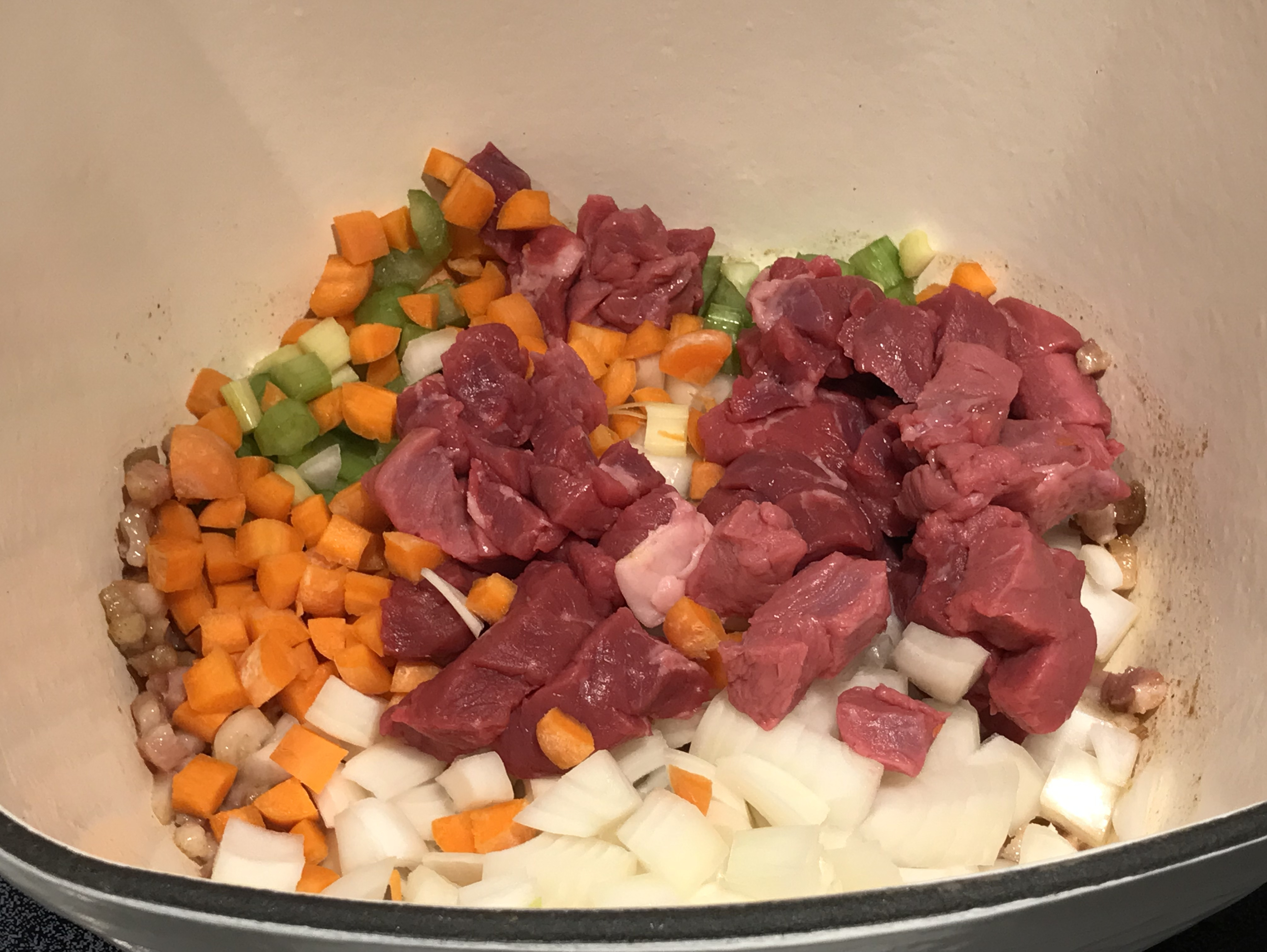
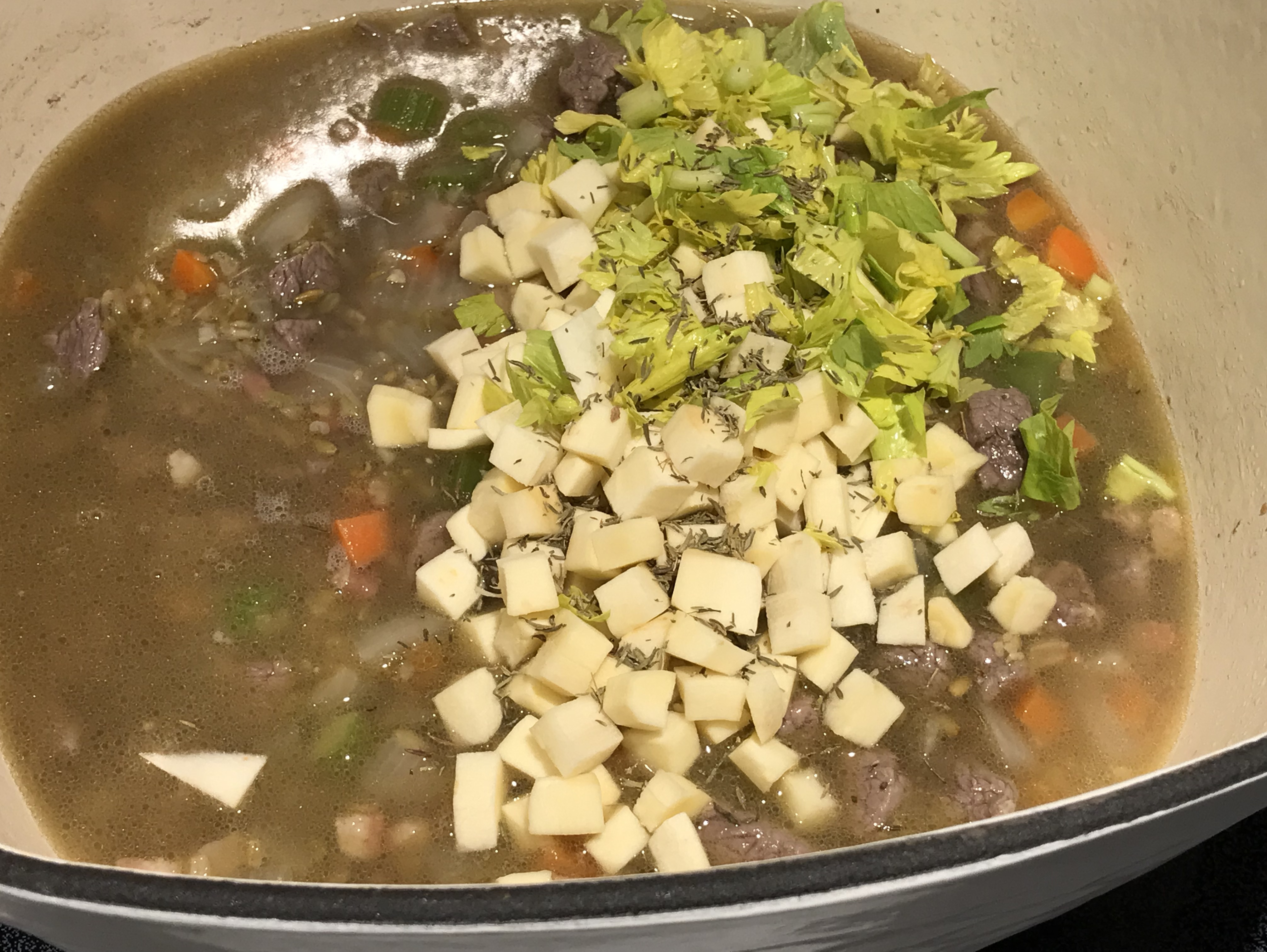
            The full recipe can be found in 1000 Foods to Eat Before You Die on pages 288 – 289, but here’s a summary. Butter is melted on the stove, then bacon, onion, carrots, and celery are added. You can add the beef or pork at this point to brown, which I did. Then soaked grunkern is added, with optional leek and parsnip, along with celery leaves and the meat, if it hasn’t been added already. This is followed by a bit of thyme, pepper, and either broth or water. I omitted the leek but added a minced parsnip, celery leaves, dried thyme, and beef broth. The recipe called for salt, but that can be added later to taste. Since I used salted butter and broth instead of water, adding extra at this point was unnecessary. Then everything simmers for a little over an hour.

            One thing that surprised me about this recipe was how little meat it uses. For 4 to 6 servings, it only called for 8 ounces beef or pork. That’s less than 2 ounces per serving, contrary to the stereotype of German food. Even though Germans have historically had more meat available per person that many other Europeans, large servings were an occasional treat, particularly during the Early Modern Era and into the 19th Century, after large-scale population growth and before industrial agriculture. So we have a stew with plenty of grain and root vegetables, with some beef and bacon as enhancements.

            Overall, this soup is highly enjoyable. My favorite from this project is still beef-mushroom-barley, but this was an interesting change of pace. Like barley, the grunkern swells up in storage and upon reheating, so a bit of extra broth or water might be necessary. If you have trouble finding green spelt or grunkern, which I couldn’t find even online, try looking in a Middle Eastern food store. There it’s called freekeh, but the product is the same. Ziyad brand is one of the most widely available.

            Next time there will be another soup recipe, so be sure to subscribe. Did I mention it’s free?

Standard