food history, recipes, turkish cuisine

Even More Walnuts: Cerkez Tavugu (Turkish chicken with walnut sauce)

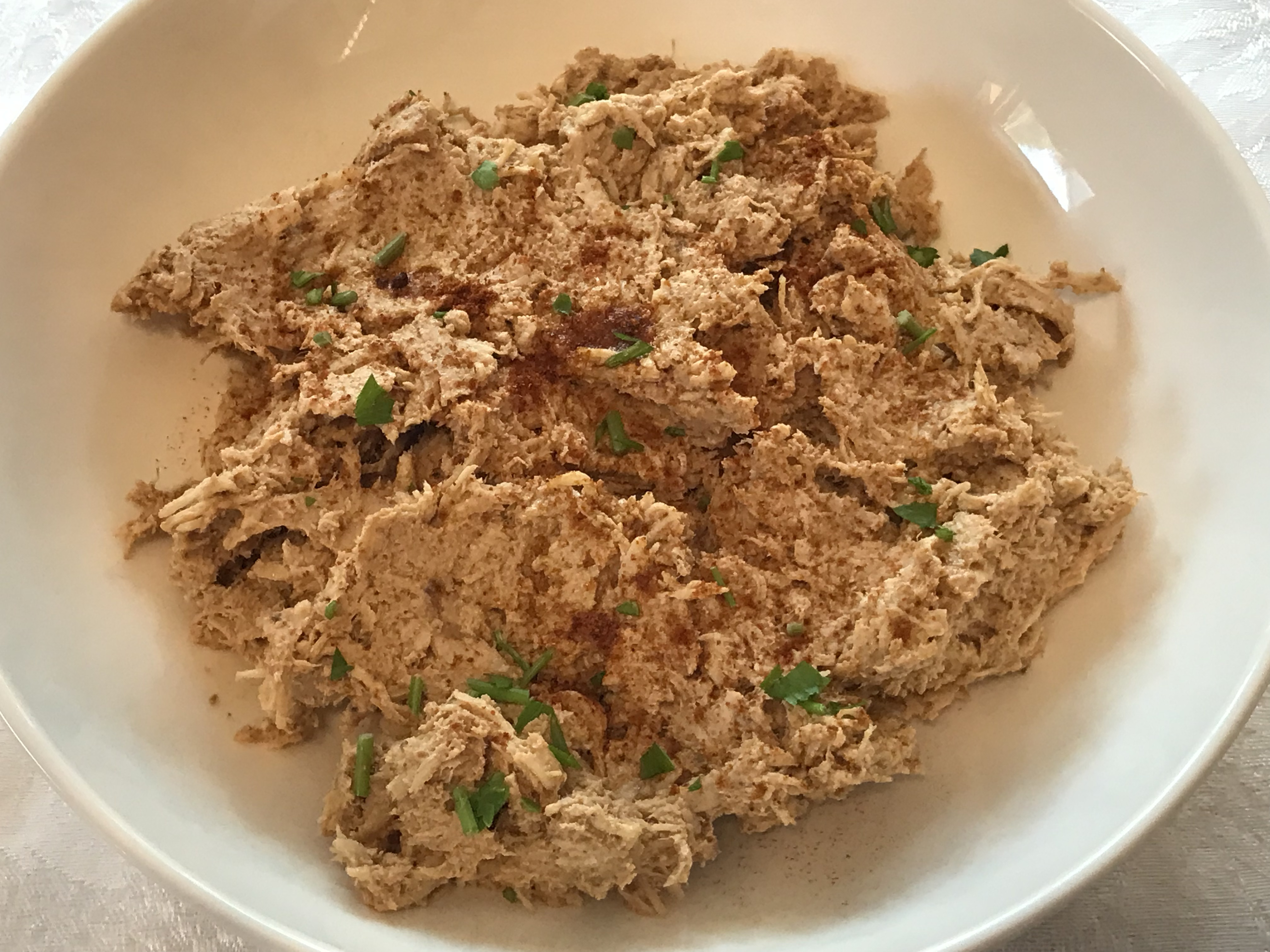
            This dish’s name, Cerkez tavugu, literally translates to “Circassian chicken.” Supposedly, the combination of shredded chicken in a creamy walnut sauce originated in Circassia, a region east of the Black Sea and just north of the Caucasus Mountains. Now part of Russia, Circassia was controlled by the Ottoman Empire for much of the Early Modern Era. During those centuries, the recipe was carried around the empire, hence the Turkish name and similarities to Greek skordalia and Balkan scordolea.

            The primary difference between the sauce for Circassian chicken and walnut scordolea is in the flavoring. Both use garlic, but the Turkish version replaces some of it with onion and seasons the dish with paprika. Traditionally, hot paprika is used, but I use sweet paprika and cayenne pepper to better control the heat. That ensures plenty of paprika flavor, with exactly as much bite as desired.

            Paprika, a blend of dried ground peppers, may have reached Turkey in two ways. From 1519 to 1556, Spain, much of the Low Countries, Naples, Sicily, part of Germany, Austria, Bohemia, and Hungary were all part of the empire of Charles V. Sweet and hot peppers might have been brought to Europe by the Spanish, who spread them across the Habsburg Empire. On their eastern frontier, Charles V, his brother Ferdinand I, and their descendants fought the Ottomans off and on for centuries. As the frontier shifted back and forth, peppers and paprika may have entered the Ottoman Empire via Hungary.

            Another possibility is that the Portuguese acquired peppers on their own voyages of exploration or from the Spanish. From there, peppers could be introduced across their vast trade network around the coasts of Africa, India, and into Indonesia and Malaysia. Unlike Europeans, who looked at hot peppers and mostly shrugged, Africans and Asians went crazy for them. Once chili peppers were introduced to Africa, they could have reached the Ottoman Empire through their holdings in Egypt and the North African coast.

            Regardless of how it got to Turkey, paprika and cayenne pepper make for an amazing sauce with an evolving flavor. When you first take a bite, it tastes slightly sweet. Then it’s sour and creamy, followed by a spicy finish.

            Ingredients:

  • 2 chicken breasts, ideally bone-in skin-on
  • A few pieces onion, carrot, and celery
  • 1 cup walnuts
  • 2 slices good-quality bakery white bread, crusts removed
  • ¼ cup milk
  • 1 garlic clove, peeled, crushed with the side of a knife, and coarsely chopped
  • ¼ cup chopped onion
  • Juice of ½ lemon
  • ¼ cup olive oil
  • 1 tbsp sweet paprika (make sure it’s fresh), plus extra to garnish
  • ½ to 1 tsp cayenne pepper
  • Chopped parsley, for garnish

            Directions:

  1. Slow cook the chicken with the onion, carrot, celery, a pinch of salt, and just enough water to cover. In a slow cooker, it typically takes about 4 hours on high or 6 on low.
  2. Remove the skin and bones from cooked chicken and shred the meat, either with two forks or clean hands. Cool completely.
  3. Place bread in a bowl, drizzle with milk, and let rest while you toast the walnuts.
  4. Heat the walnuts over medium heat in a skillet, shaking pan occasionally, until they smell toasty. Watch carefully, this only takes a few minutes.
  5. Place the toasted nuts into a food processor and pulse a few times. Add the bread and any extra milk, the garlic, onion, and a little salt. Process until smooth and blended.
  6. Add the lemon juice, paprika, and ½ teaspoon cayenne pepper and process again. Taste for salt and cayenne, adding more if desired. This usually has a kick but is not overly spicy.
  7. With the motor running, slowly add the oil through the processor’s feed tube.
  8. Slowly add ½ cup water, mixing until incorporated. The sauce should have a thick, creamy texture.
  9. Transfer the sauce to a bowl, add the shredded chicken, and toss to combine. Garnish with additional paprika and chopped parsley.

Soon it will be time for apple and pumpkin dishes! For free recipes and posts sent straight to your inbox, make sure to subscribe.

One-Time
Monthly
Yearly

Make a one-time donation

Make a monthly donation

Make a yearly donation

Choose an amount

$5.00
$15.00
$100.00
$5.00
$15.00
$100.00
$5.00
$15.00
$100.00

Or enter a custom amount

$

Your contribution is appreciated.

Your contribution is appreciated.

Your contribution is appreciated.

DonateDonate monthlyDonate yearly
Standard
Anoush Aboor - Armenian wheat and apricot pudding
armenian cuisine, dessert, food history

Armenian Christmas Pudding: Anoush Aboor (wheat berry and dried apricot pudding)

1000 Foods (pgs. 507 – 508), recipe is in the text

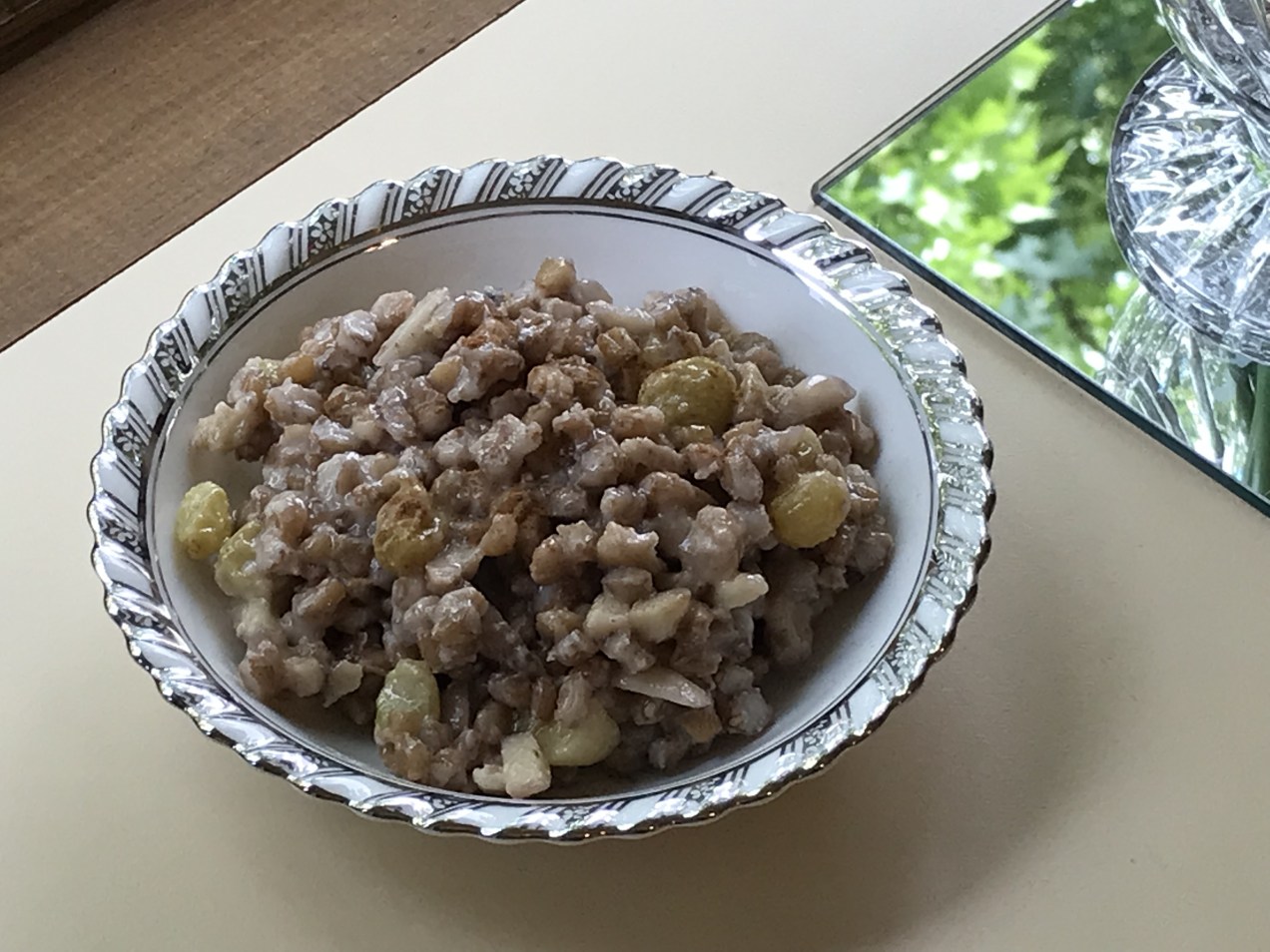
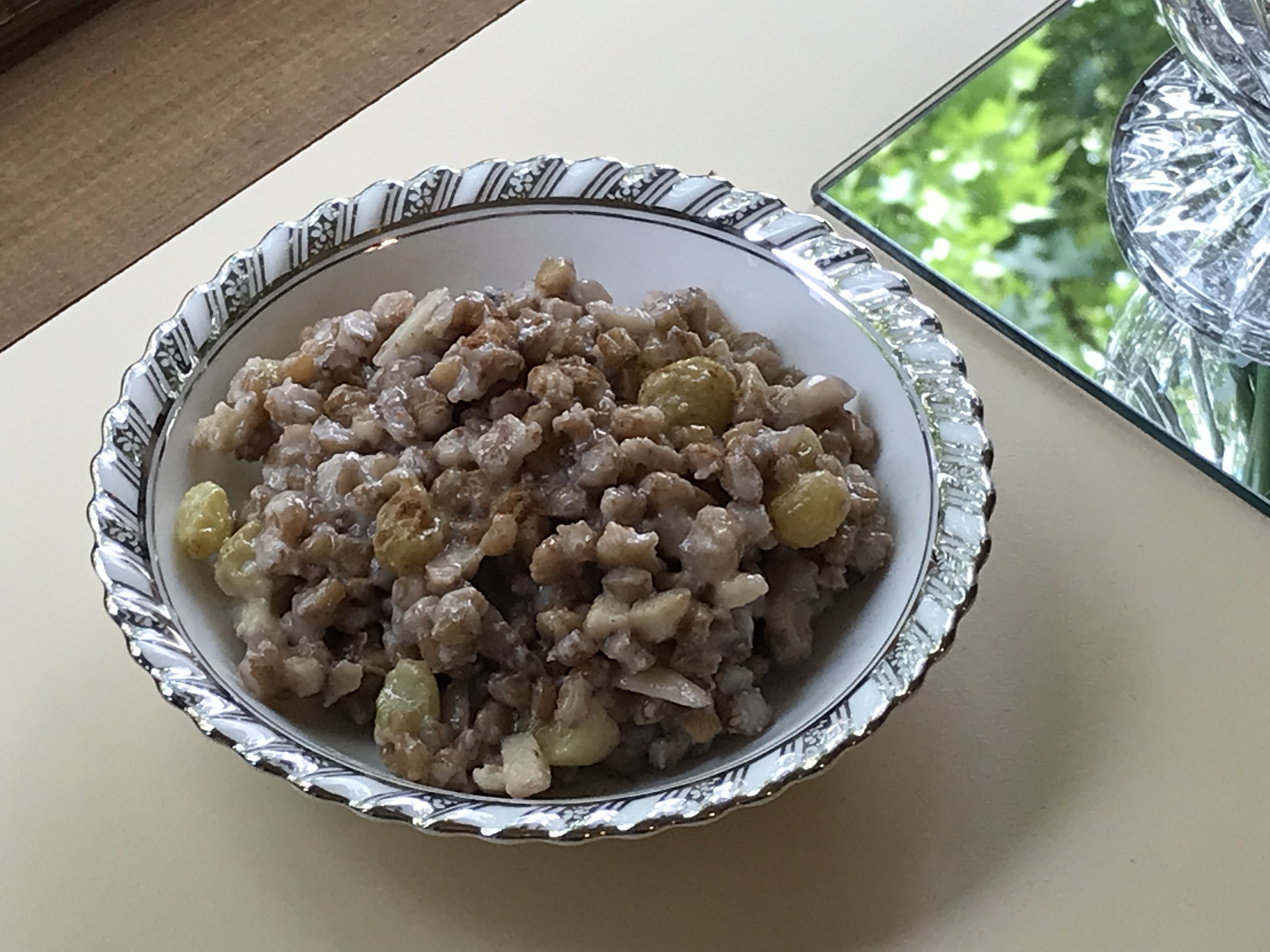
            If you’re wondering why I made a Christmas pudding in the middle of summer, it’s because I had all the ingredients in the pantry and wanted to use up what I could. The mix of wheat berries, dried apricots and golden raisins, nuts, and honey sounded like a healthy, tasty alternative to heavy desserts while still satisfying the craving for something sweet and starchy.

            Particularly popular at Christmas, anoush aboor is eaten year-round in both Armenia and Turkey. With the exception of the sugar and cinnamon, all the ingredients have been grown in the region for thousands of years. Situated in eastern Anatolia, near the headwaters of the Tigris and Euphrates rivers, this area was home to some of the earliest farmers. They grew wheat, barley, peas, and beans, raised sheep, goats, and cattle, and soon began selectively breeding and cultivating a variety of fruits, vegetables, and nuts.

            Apricots, an essential part of the dish, were originally domesticated somewhere in Turkey or Armenia. When the fruit was introduced to Rome, the Romans called it prunus armeniacus, meaning roughly “Armenian plum,” or praecox for early, since they ripen before most other stone fruits. Fresh apricots are delicious in the early summer, but are highly perishable and rarely available out of season. To have apricots year-round, people have been sun-drying them for millennia. In the Middle East’s hot dry summers, this was easy and didn’t require the use of often-scarce fuel. Even today, Turkey produces much of the world’s supply.

            Literally, the name anoush aboor translates to “sweet soup,” probably because of its porridge-like consistency. The wheat berries are cooked until they “pop” and release their starch into the water, thickening it. Despite being cooked in just water, the pudding had an almost creamy texture and even taste, sweetened with a mix of sugar, honey, and dried fruit. Chopped almonds and walnuts (I skipped the pine nuts and added extra of the others) gave it a nice crunch, and a sprinkle of cinnamon was a nice finishing touch.

            I had one problem with the recipe. It called for a teaspoon of salt. Since I made a half batch, I used half a teaspoon, which didn’t sound like much. Unfortunately, even that amount made the pudding taste distinctly briny and a bit unpleasant. The pudding was much better stirred into unsalted hot wheat cereal to cut the salt while adding texture, but to be honest, I don’t think I would make this again. Back before modern cakes, cookies, and brownies it might have been a nice treat. Today, it’s pretty lackluster.

One-Time
Monthly
Yearly

Make a one-time donation

Make a monthly donation

Make a yearly donation

Choose an amount

$5.00
$15.00
$100.00
$5.00
$15.00
$100.00
$5.00
$15.00
$100.00

Or enter a custom amount

$

Your contribution is appreciated.

Your contribution is appreciated.

Your contribution is appreciated.

DonateDonate monthlyDonate yearly
Standard
Uncategorized

Impromptu Turkish Dinner: Kilic Sis (tuna kebab), Bulgur Pilavi (bulgur pilaf)

1000 Foods (pgs. 481, 485)

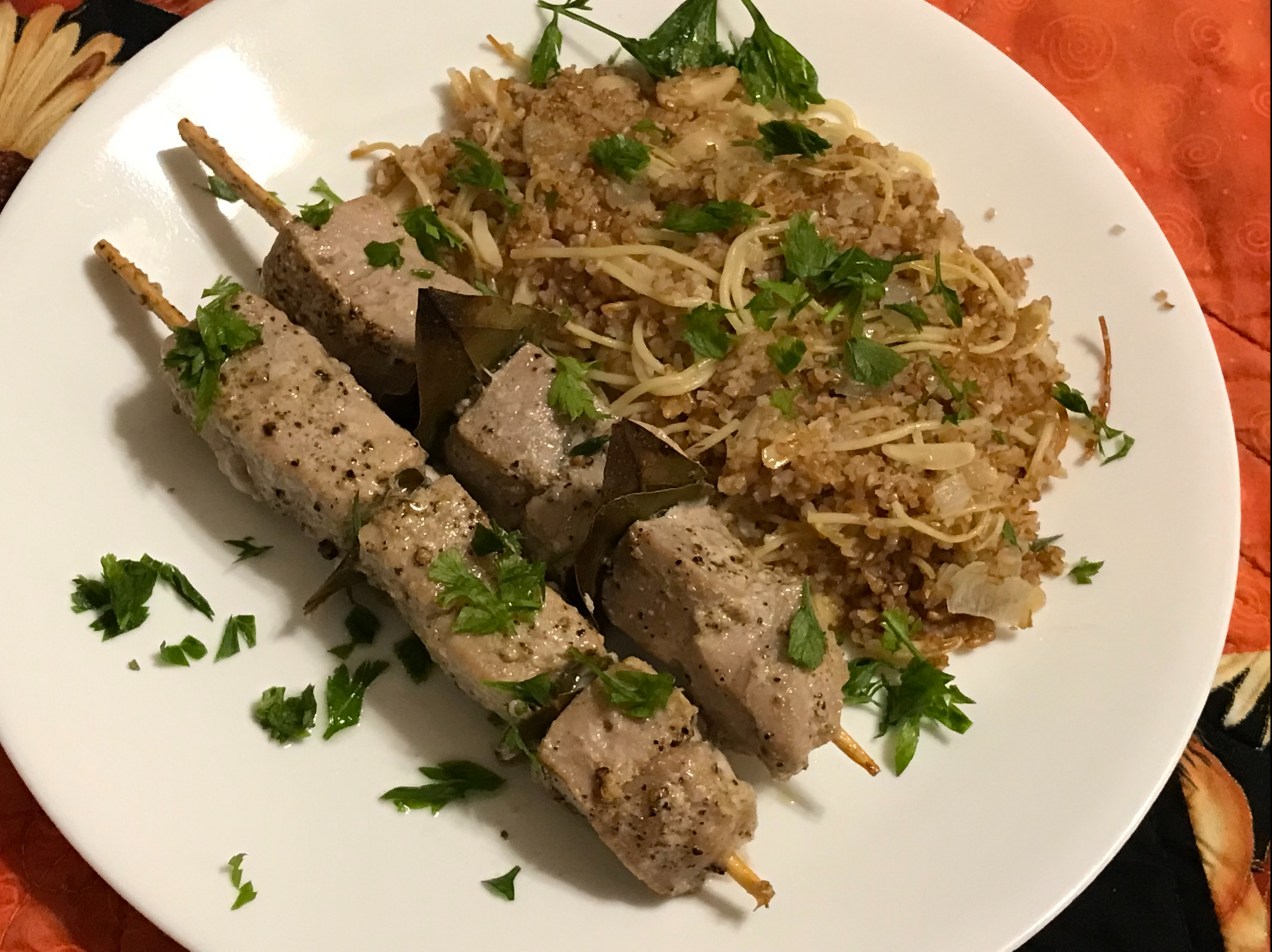
            Venturing to the Middle East again, we have two Turkish specialties: kebabs and pilaf. Specifically, swordfish kebabs (tuna is used here, for a reason detailed below), and bulgur pilaf. The fish is marinated in olive oil and lemon juice and flavored simply with bay leaves, while the bulgur fills in for rice, adding some extra flavor and texture. Both dishes were easy to make. Due to rain, the kebabs were broiled instead of grilled. For the pilaf, just toast the bulgur in the skillet with butter, minced onion, and broken vermicelli (angel hair) pieces, then add broth to finish the cooking process. Both lamb or chicken are authentic options. Since I already had chicken soup base on hand and wasn’t about to make a lamb stock/broth, I used chicken broth. The end result was one of the best things I’ve made in a while.

            For why this was an impromptu Turkish dinner, here’s the story. On a rainy Saturday, I was using up some of the herbs I’d brought in from outside. From my two basil plants, I made a big batch of pesto. After taking some to the neighbors, I took some downstairs to put in the deep freeze. When covered with a layer of oil, it can supposedly be kept for about a month. Upon opening the freezer, I noticed a strange, unpleasant smell. A bag of pulp from garden tomatoes wasn’t frozen, but it smelled fine. Then I realized that nothing in the top layer was frozen. The interior of the freezer was cool, but nowhere near where it was supposed to be, as evidenced by the fact that I could comfortably place my hand against the freezer wall. A quick look around revealed the problem. Somehow, the freezer cord had become unplugged from the extension cord, probably when some nearby bins holding decorations were moved around.

            After plugging it back in, I had to figure out which items were salvageable. Since the temperature was still around refrigerator level, the number was higher than expected. The corn, strawberries, cherries, and jam from last summer were fine, and a large chunk of pork butt I’d gotten on sale was still mostly frozen. After pulling everything out, drying it off, and cleaning up the water that had gathered in the bottom, everything was handled. The source of the smell was most likely some leftover corned beef and cabbage. One lingering question was with some tuna skewers that had thawed out. Since they were in an unopened, vacuum-packed bag I decided that they were okay, but wanted to cook them that day.

            After glancing through the recipes in both A Cook’s Tour of Italy and 1,000 Foods to Eat Before You Die, I settled on the Turkish fish kebabs. Swordfish is the traditional choice, but since the text suggests some alternatives if swordfish is unavailable, I subbed in the tuna. What’s special about this dish is that the fish is cooked with bay leaves on the skewers. This makes sense, since bay leaves grow abundantly in Turkey and their flavor complements pretty much anything. The dried variety can actually be used, as long as they are soaked in hot water to soften first. Since the kebabs are typically served with either rice or bulgur pilaf, this was a great opportunity to try out another recipe from the text. The best part of it was being able to turn a potential mini catastrophe into a thoroughly enjoyable dinner.

Standard