Scordolea - Balkan creamy walnut sauce
food history, recipes, sauce, vegetarian

Walnuts, Two Ways, Version 2: Scordolea (walnut sauce for cold chicken)

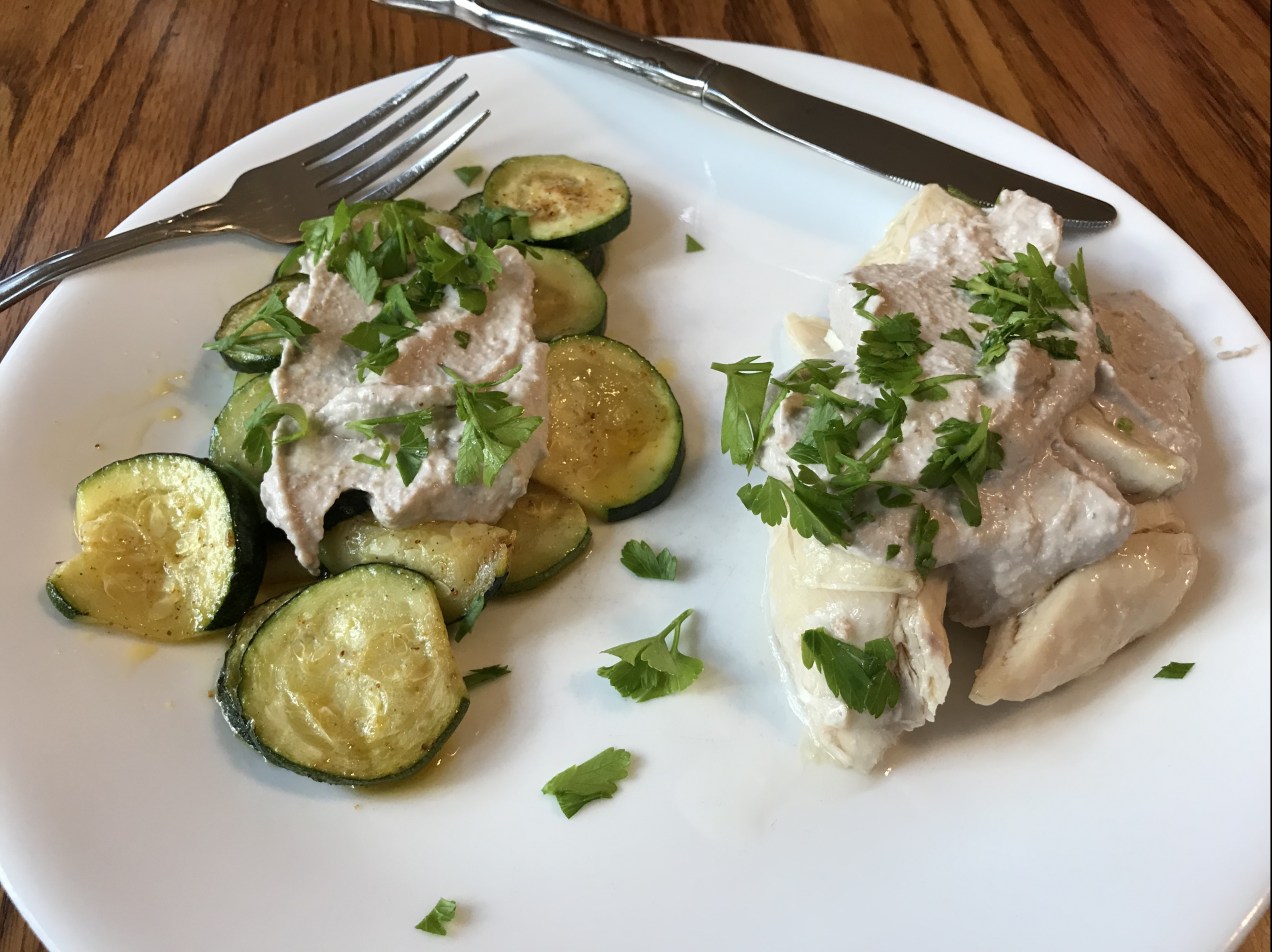
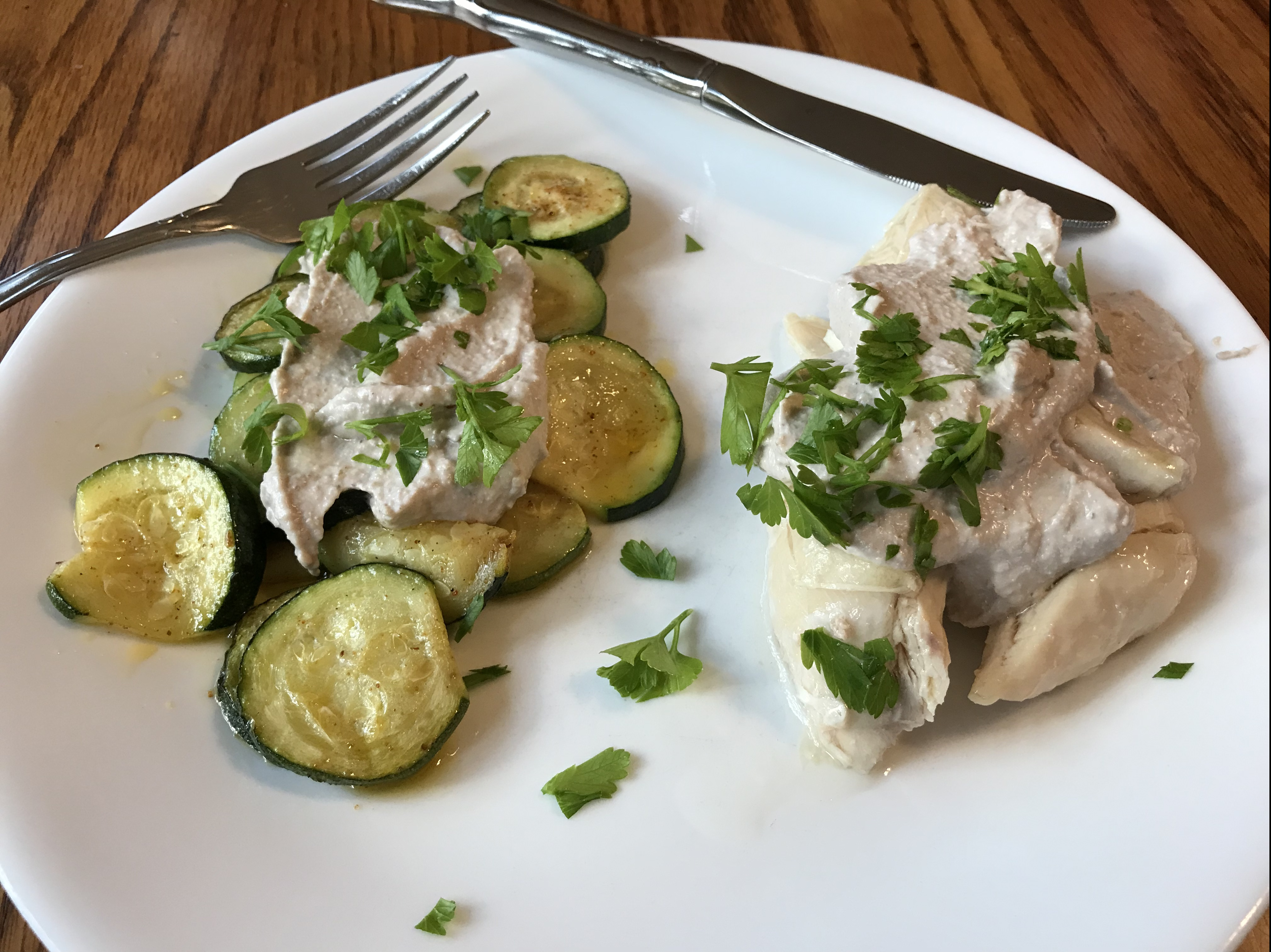
Scordolea, on cold chicken and sauteed zucchini

            When we left off with the history of the Balkans at the end of the 5th Century AD, most of the region was secure under the Eastern Roman Empire. The Huns vanished from history shortly after Attila’s death in 453, and the Germanic confederations had moved into the former Western Roman Empire. Meanwhile, the Eastern Empire became increasingly Greek. Justinian I was the last emperor to speak Latin and seriously attempt to reconquer the West, so after his death in 565, most scholars call the empire Byzantine, even though the term wasn’t used at the time. War against the Vandals in North Africa, Ostrogoths in Italy, Visigoths in Spain, and Persian Sassanids in Syria didn’t affect the Byzantine territory in the Balkans much. Even the Arab conquests of the 7th Century, which essentially cut imperial territory in half, were far away in Syria and Egypt.

            Pulling troops away to fight on the frontiers left the Balkans vulnerable, and in the 8th and 9th Centuries, new groups of peoples moved in, including nomadic Avars, Magyars, and Bulgars. Magyars settled in the Carpathian Basin and became Hungarian, while the Bulgars settled north and east of Greece. Eventually they adopted the language and customs of another new group, the Slavs, and became Bulgarian. Even Vikings made their way down the rivers of Eastern Europe to trade in Constantinople, though they didn’t stay.

            By 1000 AD, the Balkans were home to Greeks, Romanians (who continued to speak a language descended from Latin), Albanians, Hungarians, and Slavic-speaking Croatians, Bosnians, Serbians, and Bulgarians. Residents traded and exchanged ideas with Italian and German merchants. Over the next few centuries, Byzantine control weakened, particularly as most of their territory in modern Turkey was seized by the Seljuk Turks, originally from Central Asia. Hungary, Romania, and Croatia were never under Byzantine authority, and the non-Greek border regions broke away repeatedly. By the 14th Century, when the Ottoman Turks, descendants of the Seljuks, crossed the Bosporus into Europe, the Balkans was a patchwork of independent kingdoms.

            In the 1350s the Ottomans made their first incursion into Europe, gaining momentum in the 1390s. In 1453, the captured Constantinople, ending the Byzantine Empire. The emperor at the time, Mehmed II, was fascinated by the different lands and cultures under his control, and had a highly cosmopolitan court. He even hired Venetian painters to decorate his palaces. For the next 400 years, the Ottoman court and bureaucracy remained diverse. Among the cultural practices shared, food was one of them.

            Foods like phyllo dough and coffee were introduced by the Turks, and they loved their sweets and rosewater. Many of the dishes introduced during this time remained popular even after the Ottoman Empire declined in the 19th Century, often with a local twist. Such is the case with Scordolea. Where the walnut sauce originated is unclear, but variations were spread far and wide by the Ottomans. The main ingredients are walnuts, soaked stale bread, and garlic, usually. Occasionally, almonds replace walnuts, and in the most popular Greek version, usually spelled as skordalia, nuts are sometimes omitted and the bread replaced with potatoes.

            Getting the recipe right involved some trial and error. At first, I used too many walnuts, not enough bread, and tried to thin the paste with oil rather than water, resulting in a broken emulsion. The paste was sticky, the oil collected on top, and the standard white supermarket bread, which I thought would be neutral, gave the sauce a distinctive flavor. It’s good with barbecue, grilled cheese, peanut butter, and as French toast, but not for this. I needed an unsweetened, less “squishy” white bread. Fortunately, the grocery store bakery carries such loaves at a reasonable cost.

            The second attempt had less walnuts, more bread and milk, and I made sure to drizzle the oil in slowly while the food processor was running. This scordolea had a nice balance of walnut and garlic flavors, with a hint of lemon, though it looked like thick cream of wheat on its own. A garnish of some parsley I picked for my brother’s rabbit and forgot to send home with him improved the presentation significantly.

            Scordolea is eaten with a wide variety of foods. Since the sauce has its own strong, delicious flavor, it’s great for enhancing neutral-tasting foods, in this case, cold chicken and sauteed zucchini. Pretty much any affordable, easy-to-cook staple is transformed by scordolea. It is easy to see why Mimi Sheraton classified it as one of her 1000 Foods to Eat Before You Die in the book by the same name.

            Ingredients:

  • 1 cup walnuts
  • 2 slices good-quality bakery white bread, crusts removed
  • ¼ cup milk
  • 2 garlic cloves, peeled, crushed with the side of a knife, and coarsely chopped
  • Juice of ½ lemon
  • ¼ cup olive oil
  • Chopped parsley, for garnish
  • Cooked chicken, seafood, vegetables, or anything else you would like to eat with the sauce

            Directions:

  1. Place the bread slices in a bowl and drizzle the milk over them. Let the milk absorb for at least 5 minutes.
  2. Place the walnuts in a dry skillet over medium heat. Cook, shaking pan occasionally, until the nuts smell toasty. This won’t take more than a few minutes, so watch carefully.
  3. Put the toasted nuts into the food processor, pulse a few times, then add the bread, any extra milk from the bowl, the garlic, and a pinch of salt. Process to form a smooth paste.
  4. Add the lemon juice to the walnut paste and process until blended.
  5. With the motor running, slowly add the olive oil through the food processor’s feed tube to incorporate. Taste for salt, adding more if necessary.
  6. Run the motor again, and slowly add about ¼ cup water to thin the sauce. It should be on the thick side, but for a thinner sauce, slowly add more water until the desired consistency is reached.
  7. For serving, garnish the scordolea with chopped parsley. Serve with your desired protein and/or vegetables.

            And as always, subscribe for free posts and recipes, sent right to your inbox.

One-Time
Monthly
Yearly

Make a one-time donation

Make a monthly donation

Make a yearly donation

Choose an amount

$5.00
$15.00
$100.00
$5.00
$15.00
$100.00
$5.00
$15.00
$100.00

Or enter a custom amount

$

Your contribution is appreciated.

Your contribution is appreciated.

Your contribution is appreciated.

DonateDonate monthlyDonate yearly
Standard
Tarator - Balkan cucumber walnut dip or soup
food history, recipes, summer, vegetarian

Walnuts, Two Ways, Version 1: Tarator (Balkan walnut/cucumber soup)

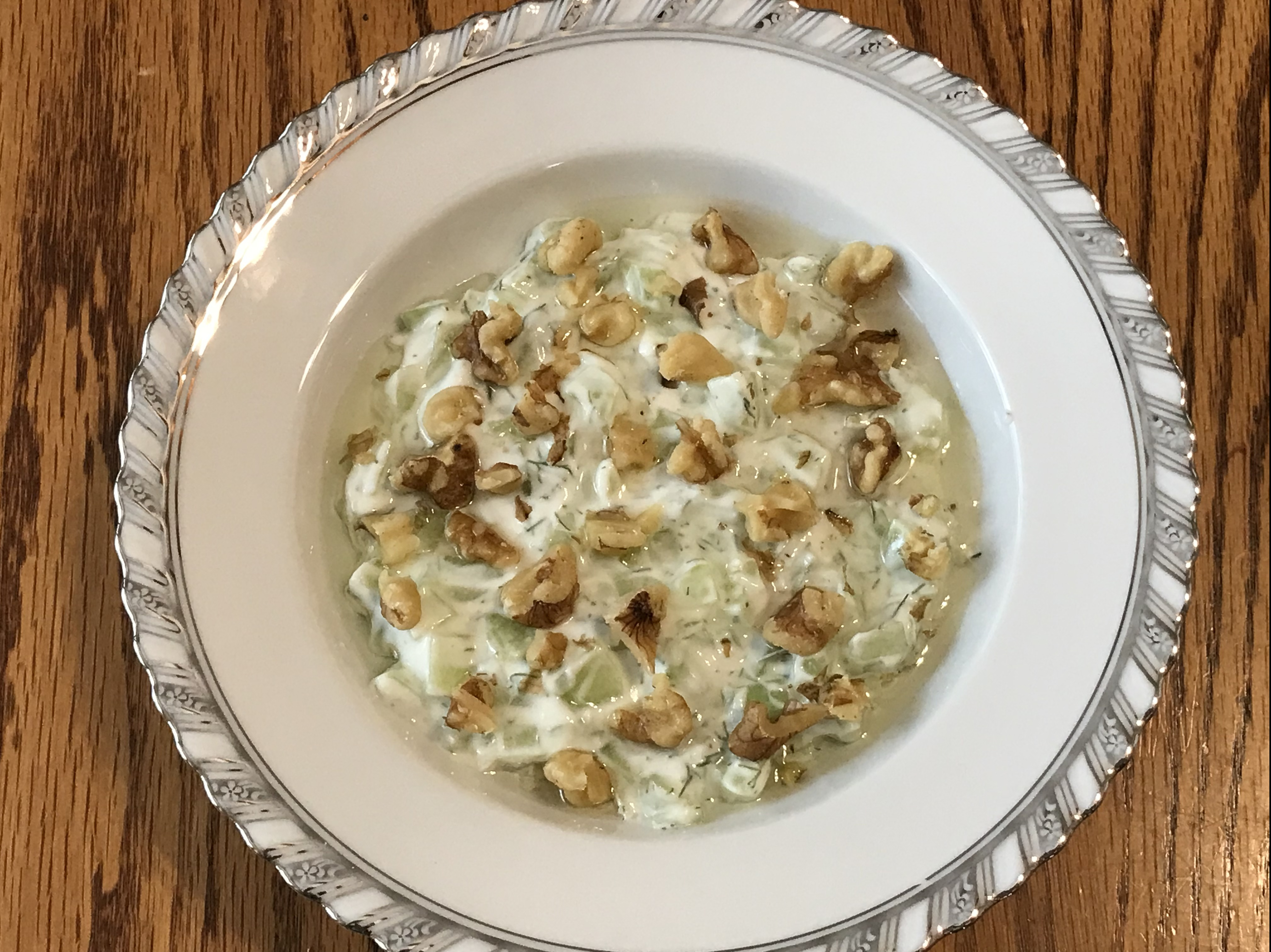
Tarator, a cucumber-walnut “soup” from the Balkans

            The Balkans, or the southeastern corner of Europe south of the Danube and west of the Black Sea, has a fascinating and often tumultuous history. Fertile valleys and plains, broken up by various hills and mountains, were home to numerous ancient civilizations – Greeks, Illyrians, Dacians, Scythians, and Sarmatians. The Persian Achaemenids tried to expand their empire here just before and after 500 BC. During the 3rd Century BC, there was even a brief Celtic incursion.

            The Romans were the first outside power to conquer and hold the Balkans. From the 2nd Century BC to the 5th Century AD, they both absorbed and influenced local cultures. Wealthy Romans were fascinated by Greek civilization, and many of the non-Greeks began to speak Latin. Anyone who spoke Latin or Greek and adopted Greco-Roman customs (which fused together somewhat during this time) could become a citizen, and many of the local people did. During the later Roman Empire, two of the most influential emperors, Diocletian and Constantine the Great, came from the Balkans, probably around modern-day Serbia.

            From the 3rd Century AD onward, new waves of invaders entered the Balkans. The first were the Germanic Goths, who were eventually pushed back, but not before killing Emperor Decius in battle in 251 (Decius was also from the region, by the way). After abandoning the province of Dacia in modern-day Romania, the Romans secured the Danube frontier for another century, when various Germanic confederations pushed into the Balkans again, fleeing from the Huns. The Goths were back, accompanied by the Vandals and others.

            What happened next was complicated, but basically went as follows. The leader of the Goths, named Fritigern, asked the Romans if his people could settle in the Empire in exchange for military service. The Romans, facing manpower shortages, agreed, but then broke their word and mistreated the Goths, which led them to revolt. After they killed another emperor, named Valens, in battle in 378, the Romans eventually honored their agreement. Over the next decades, Germanic troops made up more and more of the army.

            After the Empire was divided for good in 395 AD, most of the Balkans became part of the Eastern Roman Empire. Through a combination of better leadership, greater wealth, and a shorter frontier, the Eastern Empire was able to force/bribe the Germanic groups to leave. These Goths, Vandals, etc. then headed west and dismantled the Western Roman Empire. After the Eastern Empire teamed up with the Western Empire and the Goths against the Huns in the 450s, the last “barbarian” group in the Balkans was the Ostrogoths, or Eastern Goths. The emperors sponsored sending them to Italy in the 490s to drive out the Visigoths, or Western Goths, and no Germanic confederations tried to invade the Balkans again. But that did not mean the region was safe, as I will explain in the next post.

            With so many diverse cultures coming and going, along with a favorable climate with plenty of sunshine and rain, the food in the Balkans became just as diverse. Records indicate that the Dacians grew wine grapes. The Romans, who valued fresh produce, either introduced or improved a variety of fruits and vegetables. They were known to enjoy cucumbers, which make up the base of tarator.

            In 1,000 Foods to Eat Before You Die on page 381, Mimi Sheraton suggests 3 ways to prepare walnuts, which have grown in the Balkans for millennia. One of those methods is an egg salad called aselila. Even with a walnut-based dressing replacing mayonnaise, the hard-boiled eggs are a non-starter for me. The walnut and cucumber mix sounds a little like tzatziki sauce, with cucumbers, yogurt, garlic, and dill. It is finished with a bit of sunflower oil and chopped walnuts. The whole idea seems a bit odd as a soup, but pretty good as a dip, so I made my recipe thicker.

            Preparation is simple. There are two tricks to get the best results. First, toss the diced or grated cucumbers with salt and let drain for an hour to remove excess moisture that might otherwise make the dip watery. Second, the garlic needs to be crushed with salt, but there is not enough of it to do so in a food processor. A mortar and pestle work best. Once this is done, combine with the yogurt and dill and let sit until the cucumbers are finished draining, so the flavors can infuse.

            Ingredients:

  • 2 large or 4 small cucumbers, peeled, seeded, and diced or grated (I like diced for more texture)
  • 1 ¼ teaspoons coarse salt
  • 2 garlic cloves, peeled, crushed with the side of a knife, and coarsely chopped
  • 1 cup whole milk plain yogurt (doesn’t have to be Greek yogurt, just make sure not to use low-fat or fat-free)
  • A few sprigs dill, minced after removing any tough stems, or ½ teaspoon dried
  • Sunflower oil, to drizzle
  • Coarsely chopped walnuts, to garnish

            Directions:

  1. Toss the cucumbers with one teaspoon of the salt and place in a colander to drain for an hour.
  2. Place the garlic and remaining salt in the bowl of a mortar. Work with the pestle until a sticky, mostly smooth paste forms. A few lumps of garlic are fine.
  3. Combine the yogurt, garlic paste, and dill in a bowl and allow to sit until the cucumbers are finished draining. Add the cucumbers to the yogurt mixture and discard the liquid.
  4. Place the cucumber-yogurt mixture in a serving bowl. Drizzle with the sunflower oil and sprinkle liberally with the chopped walnuts.
  5. Serve the dip with pitas, other bread, or crackers.

            Tarator seems odd as a soup, but as a dip, it’s fantastic. It sort of tastes like non-sour dill pickles, but creamy. Considering that tarator uses the same flavorings of salt, garlic, and dill, it makes perfect sense. The yogurt, sunflower oil, and chopped walnuts make it more substantial, so it could almost be a hot-weather meal on its own with pitas.

One-Time
Monthly
Yearly

Make a one-time donation

Make a monthly donation

Make a yearly donation

Choose an amount

$5.00
$15.00
$100.00
$5.00
$15.00
$100.00
$5.00
$15.00
$100.00

Or enter a custom amount

$

Your contribution is appreciated.

Your contribution is appreciated.

Your contribution is appreciated.

DonateDonate monthlyDonate yearly
Standard