
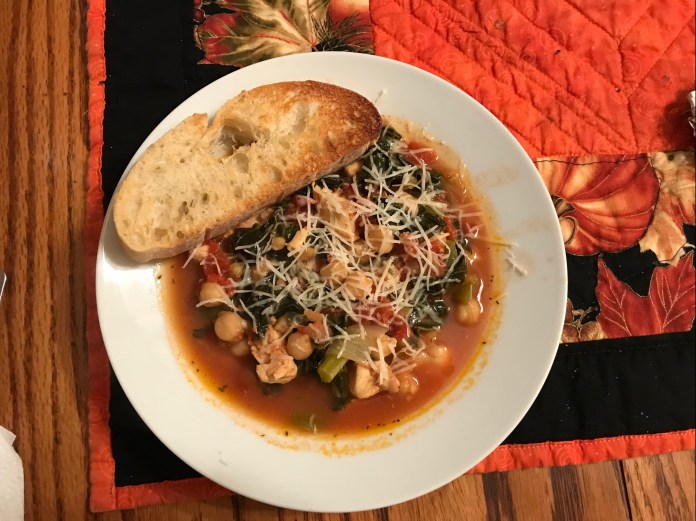
Menu: Chicken Kale and Chickpea Stew, Bruschetta
Traveling back south but not quite to Rome, we reach the region of Tuscany, a name which conjures up images of picturesque towns atop rolling hills, their sides covered in vineyards and olive groves, dotted with cypress trees. Or perhaps one imagines the Florence’s iconic Duomo, the works of Michelangelo, Da Vinci, and the other Renaissance masters, or the strife between and even within city-states featured so prominently in the works of Dante. Tuscany is all of this, and more.
The first recorded inhabitants (though there is archaeological evidence of others previously) were the Etruscans, whose presence is attested from around 1000 BC or slightly before. Though they lived only a short distance northwest of the Romans and other Latin peoples, they were a distinct people with a completely unrelated language. Only a handful of Etruscan words have been deciphered, though they wrote extensively, so most information about them comes from Greek, Roman, and Phoenician/Carthaginian records. What is known is that they made fine pottery, were skilled metalworkers, and greatly influenced the early Romans.
Despite gradually assimilating into Roman culture and adopting the Latin language, the Etruscans’ descendants never lost their importance. As with Venice and Genoa, trade and banking brought great prosperity to Tuscany during the High and Late Middle Ages. This prosperity, along with the feuding cities’ constant desire to outdo each other, both on and off the battlefield, led to a blossoming of arts and culture from the 13th century onward.
Piggybacking off of the continent-wide cultural and economic boom in the 12th century, which brought, among other things, chivalric romance and Gothic architecture from France, the cultural dominance of Late Medieval Italy began to emerge in the 13th. The artistic innovations of Duccio, Giotto, Cimabue, and Bernini paved the way for the artists of the Renaissance. The works of Dante, Petrarch, and Bocaccio, written in the vernacular, helped ensure that the Tuscan language/dialect (rather than, say, Venetian or Neapolitan) would become the basis of the modern Italian language. And all of this was before the start of the Renaissance in the 15th century.
Clearly, there is a lot for Tuscany to take pride in in its history, but Tuscans also take pride in their cuisine. Far from stereotypically Italian, it features grilled and roasted meats, lots of beans in various preparations, unsalted bread, soups, leafy green vegetables, olive oil, and red wine. Pasta is present but not as popular as bread and polenta, game like boar and rabbit is common, and there is a focus on quality ingredients and straightforward flavors.
This one-dish meal has four features of Tuscan cuisine; beans (in this case chickpeas), bread, soup, and green vegetables. The soup was easy to put together, with a variety of ingredients, some out of cans, coming together into something delicious. The little bit of cumin in the mix is unique and not stereotypically Italian (though the ancient Romans used it a fair amount), but all of the flavors melded well. A sprinkle of parmesan cheese and a few pieces of garlic-rubbed toast (bruschetta) finished the dish off perfectly.
 Feasting Through Time
Liz enjoyed your blog. The history interesting and to the point. Good tie into the foods enjoyed. I would love to try these dishes. The mentioned dishes sounded so good. I love eggplant so the first dish caught my eye and kept my attention. The most interesting as far as It made we wonder, was the marinated beans. I love bean dishes, but not sure about that addition. I certainly would be willing to try.
Thank you for you blog. I hope to read more.