
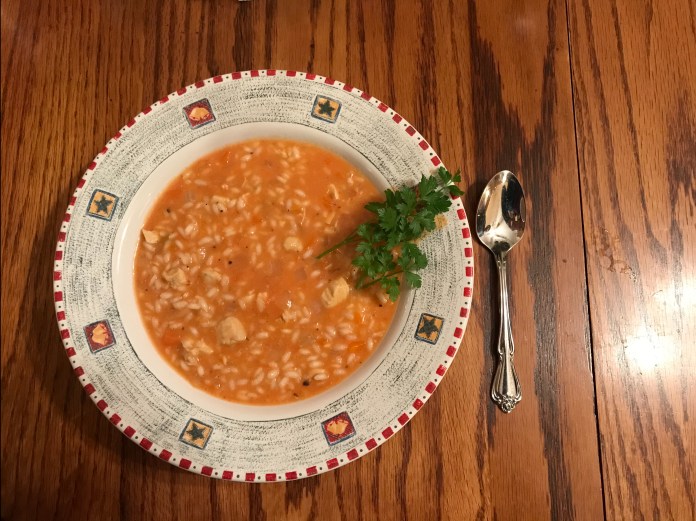
Menu: Risotto with Chicken and Vegetables
Heading northeast, we cross Emilia-Romagna to the Veneto region, most well-known for Venice, but also home to Verona, Vicenza, Trieste, and other notable cities. Unlike Rome, Florence, Milan, Naples, or their historical rival Genoa, Venice was not an established city in the Roman era. Exact dates of foundation vary, but the most common story seems to be that the city was established in the 5th Century AD by those fleeing barbarian raids on the mainland. After a century and a half or so of Byzantine rule in the 6th and 7th Centuries, the first Doge was elected either at the end of the 7th or start of the 8th Century (the jury is still out on whether the first Doge was real or legendary) and the republic began its rise.
From its earliest days, Venice relied on trade, and in his work The Venetians, author Paul Strathearn explains why. Essentially, it boiled down to the fact that space was limited on the islands in the lagoon, limiting how much food could be grown and, to a lesser degree, how many goods could be produced. Trade both provided the necessary food and made the republic wealthy. For centuries, Venice was the main point of import for “exotic” goods from Asia, including spices, sugar, incense, and silk.
Another luxury import during the Middle Ages was rice, which gradually began to be cultivated in Italy as its popularity grew. The wealthy loved it, particularly cooked in almond milk. As supply expanded, the price dropped, making rice widely available to all classes. Today, in many parts of Northern Italy, risotto and polenta are more popular than pasta, and this includes Venice. Rice, polenta, vegetables, and seafood in various combinations are staples in Venetian cookery, which is very different from what is typically thought of as “Italian.”
The best way to think of this dish is probably “Venetian chicken and rice.” With a flavoring base of carrot, onion, and celery, which occurs in many recipes in the book, the risotto includes chicken, chicken broth, tomato puree, butter, and parmesan cheese. The end result is creamy but not too rich, and flavorful without being overpowering. The tomato flavor is present but not dominant, melding into all the other flavors. Additional virtues for this recipe are that it is not very difficult to make and uses easy to find, affordable ingredients. I would definitely make this again.
 Feasting Through Time
This sounds like something I would enjoy making and eating!