
Region: South Mainland/Islands (Sardinia)
Finally, we travel to the last region in the book, the southernmost part of the mainland, Sicily, and Sardinia. Like Sicily, Sardinia has been invaded and conquered over and over for the last few thousand years. The earliest inhabitants built huge stone structures called nuraghe that still dot the landscape today. For centuries it was a battleground between Etruscans, Greeks, and Phoenicians/Carthaginians, all vying for locations to set up strategic trading ports. Romans later joined in the fray, followed by Vandals, Byzantines, Arabs, Pisans, and Genoese. From the 15th to 18th Century the island was controlled by the Kingdom of Aragon and its successor, unified Spain. The Spanish were followed by the Kingdom of Sardinia-Piedmont, which eventually unified Italy. All of these peoples left their mark on the culture and food, creating a unique region “not a bit like the rest of Italy.” (Text, pg. 241)
Interestingly, despite their strategic location, the native Sardinians were not major seafarers. While there has always been trading and fishing along the coast, the hills and mountains have historically been at least as important. Pastoralists raised sheep, goats and pigs, fattening the latter on acorns. Perhaps more carnivorous than neighboring cuisines, traditional Sardinian fare includes roasted meat, cured pork, and sheep and goats’ milk cheeses alongside the usual bread, pasta and vegetables.
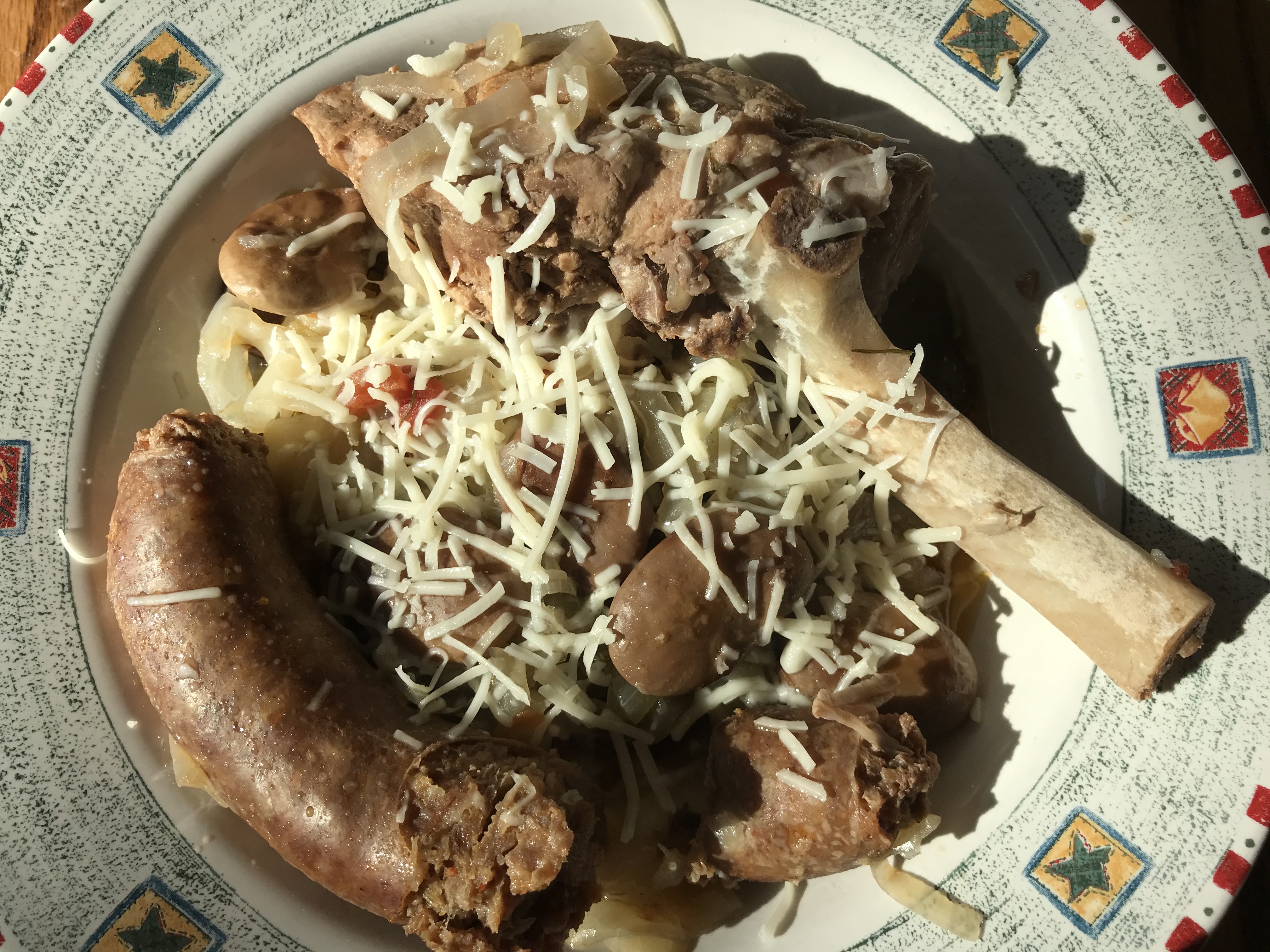
To that end, we have a Sardinian one-pot stew/casserole, with pork, fava beans, cabbage and fennel. Traditionally pigs’ feet were used, but this recipe uses Italian sausage and spareribs. The meat flavors the bean and vegetable “fillers,” with extra flavor coming from a sprinkle of Pecorino Romano cheese. Presumably this is to be served with bread.
I ran into two problems with the recipe. First, the pot was not big enough. Once the meat, beans, tomatoes and liquid were in, there was not enough room for the cabbage and fennel. I had to add it a bit at a time, waiting for previous additions to cook down a bit before adding more. The other issue was with the texture of the cabbage and beans. Soaked fava beans and cabbage are supposed to be added at the same time. As a result, the cabbage was really overcooked by the time any of the beans were cooked. Further complicating things, the beans weren’t all done at the same time. For some reason, there were fully-cooked, soft beans right next to distinctly crunchy ones.
Still, as long as the diner picks around any undercooked beans, the dish is generally enjoyable. I would make a few changes, however. First, the broth would benefit from a bit of garlic, since it was somewhat bland. And as mentioned before, the cabbage doesn’t need anywhere near as long of a cooking time. Personally, I would only add it about half an hour before the casserole is finished. Finally, I would substitute great northern beans or something similar for the favas, as they are a lot more consistent and easier to find.
 Feasting Through Time
Interesting!
Good suggestions on how to improve this dish. I like that your cooking experience gives you the knowledge to make suggestions like these.