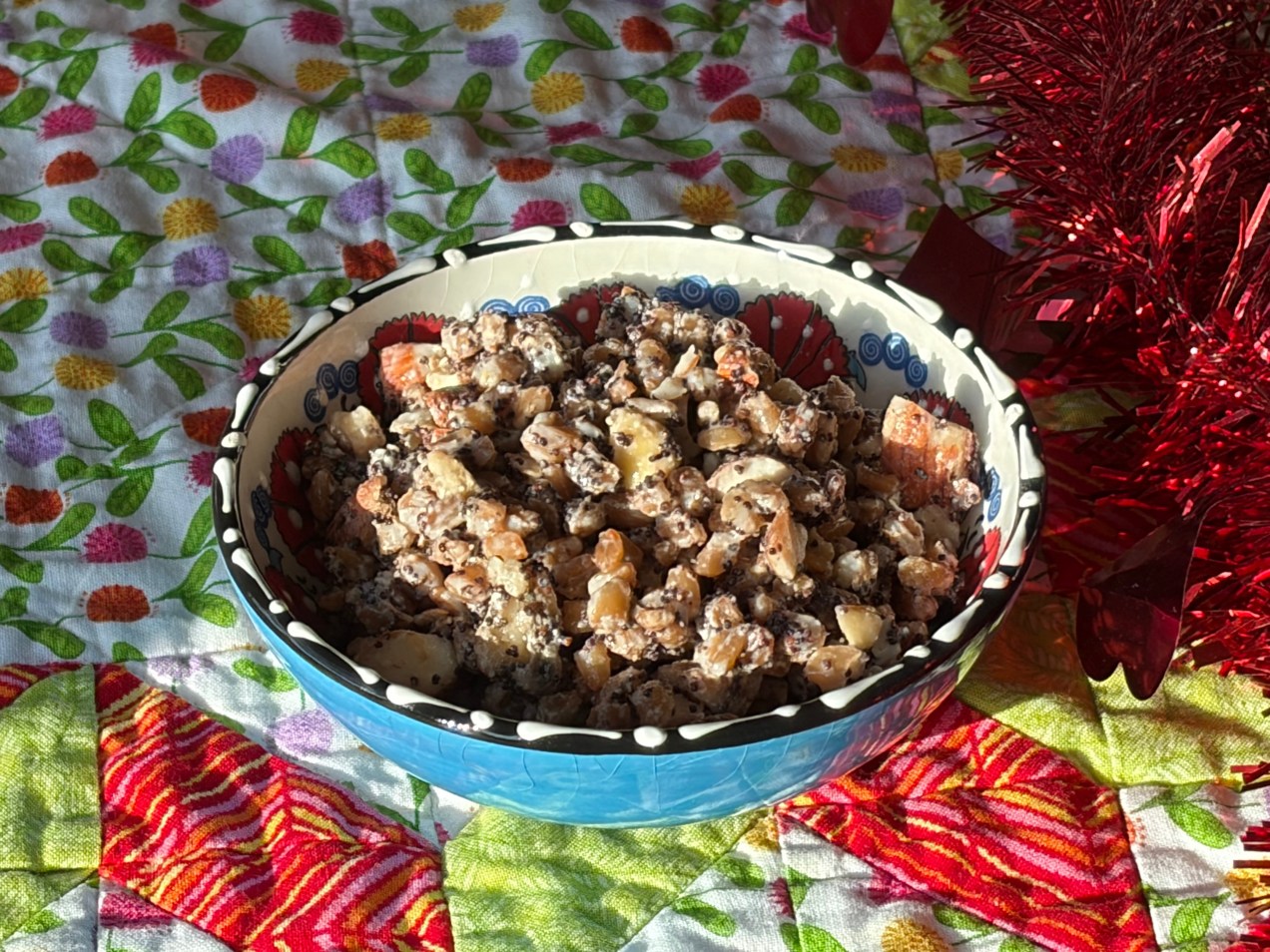
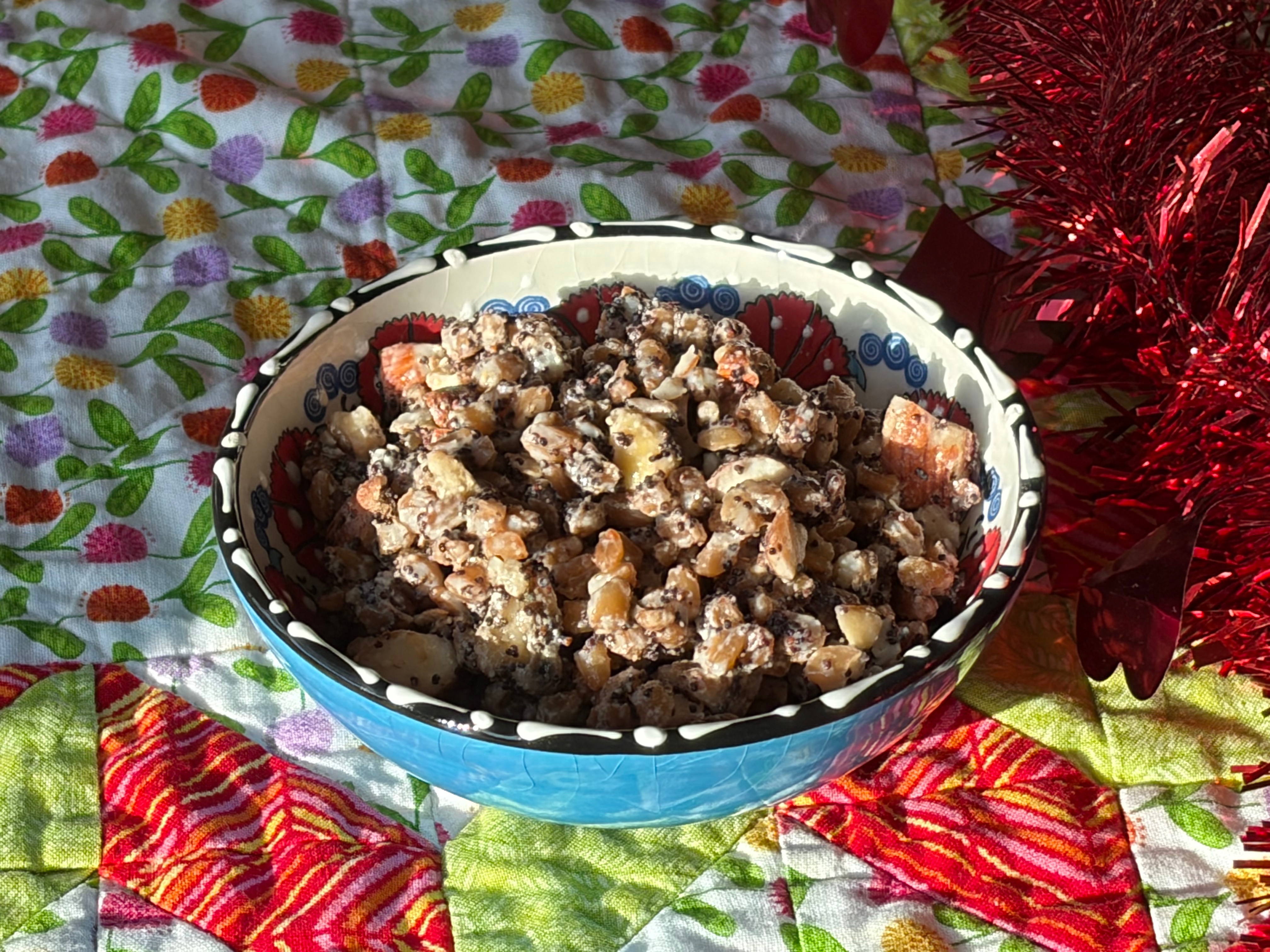
High cuisine, not a simple attempt to use things up before going out of town for Thanksgiving
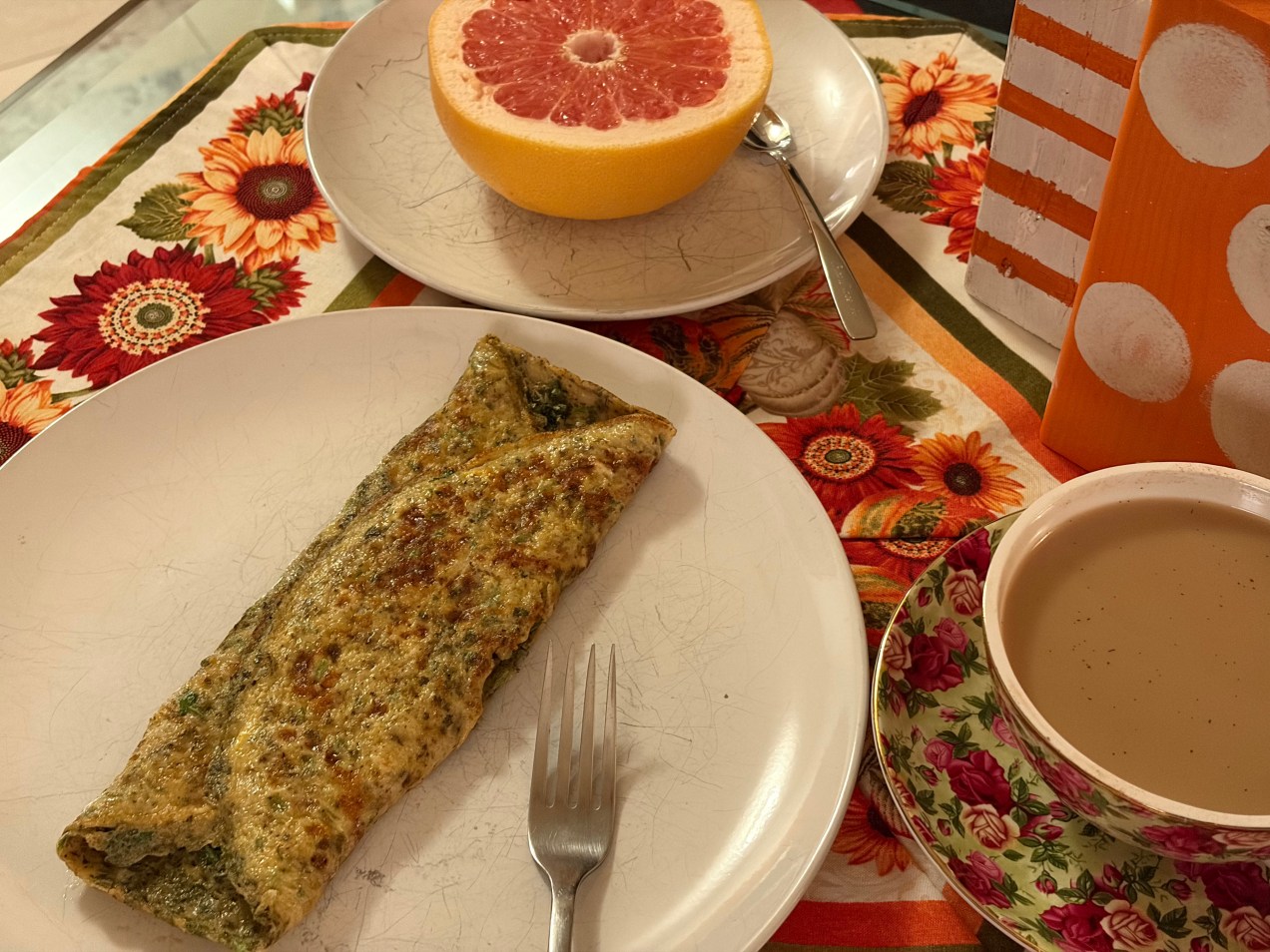
Every fall, I bring my potted herb plants in from outside to enjoy using them for a bit longer. It works well enough for a while, but eventually they start to suffer from the limited sunshine. Since most of them are annuals, the time comes to use up what I can before starting again when summer returns. Everything except the rosemary is either done or fading. To use up as much as possible, I made a French classic, omelette aux fines herbes.
Fines herbes is a mix of parsley, chives, tarragon, and chervil, common in French cuisine. The first three are widely available in the US, but chervil might require a specialty spice store or the internet. Supposedly it tastes like a milder parsley with a bit of a licorice undertone, but I couldn’t taste much difference. To compensate for all the herbs except parsley being dried, I also added some minced scallions to brighten things up.
For many French chefs, making a perfect omelet is one of the primary tests of skill. After following the basic directions on pages 107 – 108 of 1000 Foods to Eat Before You Die, mine turned out pretty well. The flavor is distinctly understated, but the freshness from the herbs was nice as fall turns to winter. The slight licorice flavor from either the tarragon or chervil is definitely there. Perhaps it just needs a little heat to release its flavor. Chefs disagree on how much browning, if any, is ideal. Personally, I like more browning, both for flavor and the fact that it helps the egg unstick itself from the pan.
Advertisements
For each omelet, I used three eggs, beaten together with salt, pepper, and a tablespoon of milk. The herb mix contained three large parsley sprigs, minced, one minced scallion, and a teaspoon each dried chives, tarragon, and chervil. Half of the herb mixture gets added into the eggs before cooking. After melting about a tablespoon butter in a skillet over medium heat, the egg mixture is added to cook.
To make sure that none of the eggs end up runny, I like to tilt the pan and lift up the edges of the cooked portion, letting the uncooked egg flow underneath. After this, sprinkle the remaining herb mixture over the surface. When the top is almost set, fold the right and left thirds of the omelet over onto the center. If this doesn’t work and you end up with a half-moon shaped omelet, don’t worry about it, it will still taste good. Let the omelet cook for another minute, covering the pan if desired to help it set, then slide it onto a plate.
To make this simple mix of eggs and herbs sound extra fancy, serve with pommes de terre frits, compote de pomme, fruits frais, café au lait, or any combination thereof. In English, these are fried potatoes, applesauce, fresh fruit, and coffee with milk. To make anything sound fancy, say it in French, even if you have to use a translation app.
At first, it might seem strange to have apples in a dish for a spring holiday. Passover, the most important holiday on the Hebrew calendar, celebrates the Israelites’ Exodus from Egypt. It always occurs in the spring (in the Northern Hemisphere), while apples are a symbol of fall. On further reflection, the use of apples actually does make sense.
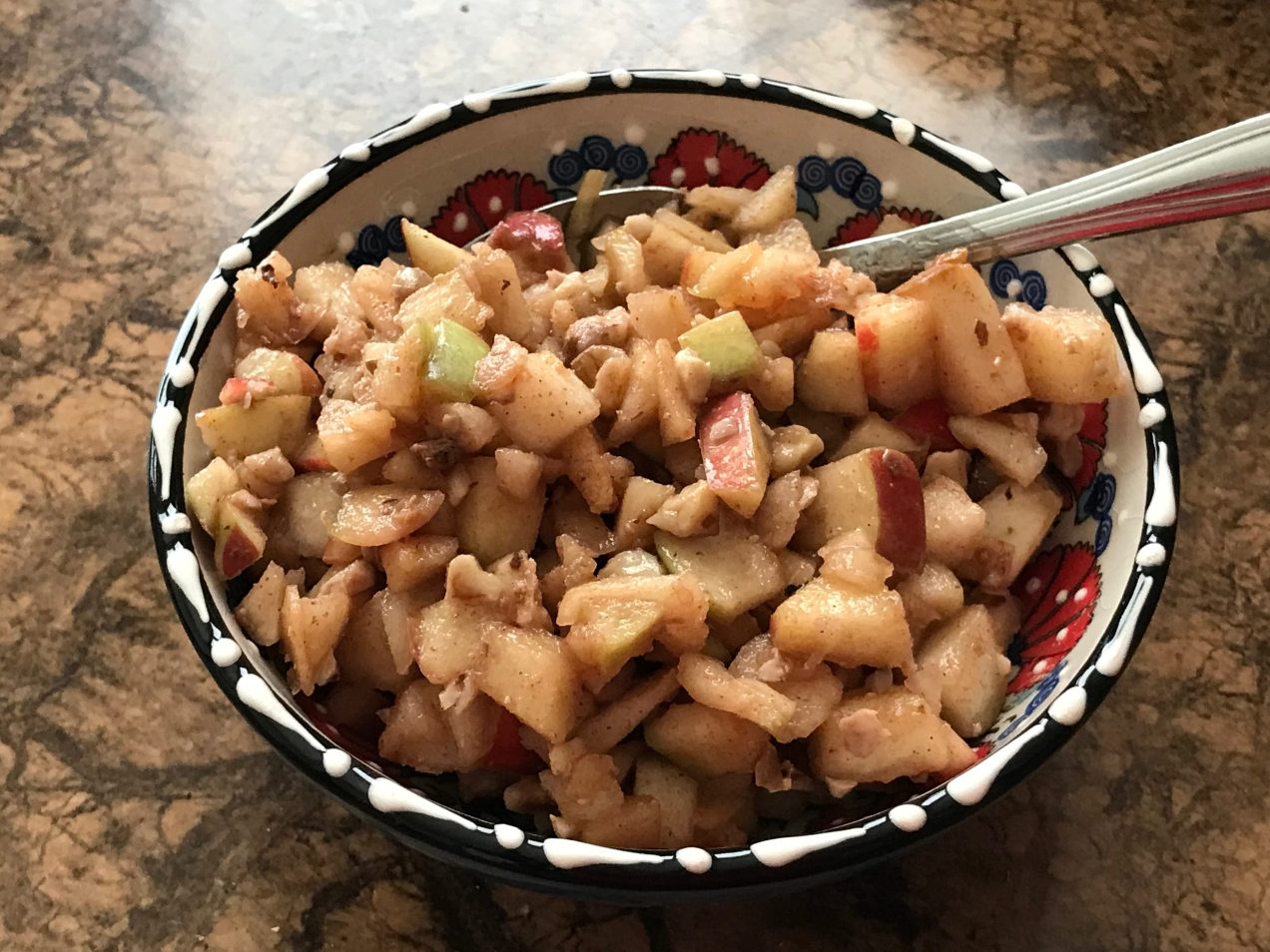
Charoset is a blend of chopped fruit and nuts, representing the mortar enslaved Israelites used in Egypt, and is an essential element on the Passover Seder plate. Historically, most Ashkenazi Jews lived in Central and especially Eastern Europe. Not many fruits are in season there in March or April, but apples could be stored in a cold cellar over the winter. The only other option might be rhubarb, at least when there is plenty of sugar to counter the acid. Holiday food traditions seem to change more slowly than what people eat every day, so even with modern shipping and preservation, apples remain the base fruit.
There are many recipes out there, typically including walnuts, sugar, spices, and an acidic liquid to keep the apples from oxidizing and turning brown. Most common is sweet, kosher red wine. Not all kosher wines are sweet, but Manischewitz, the most common brand (for all sorts of kosher products, in fact), is. With at least 51% concord grapes and a bit of extra sweetener, it tastes exactly like the classic non-fermented grape juice, with the alcohol flavor only coming in at the end. Naturally, grape juice would be the perfect non-alcoholic substitute.
Advertisements
If you’re wondering why wine isn’t all kosher (as I was), it’s because ancient pagan people often used it in their rituals. To ensure their wine hadn’t previously been used in these rituals, the production from picking to transportation to serving had to be done by kosher-observant Jews. Unless, if I understand things correctly, it gets heated, which renders it unsuitable for pagan rituals. Once that’s done, anyone can handle it.
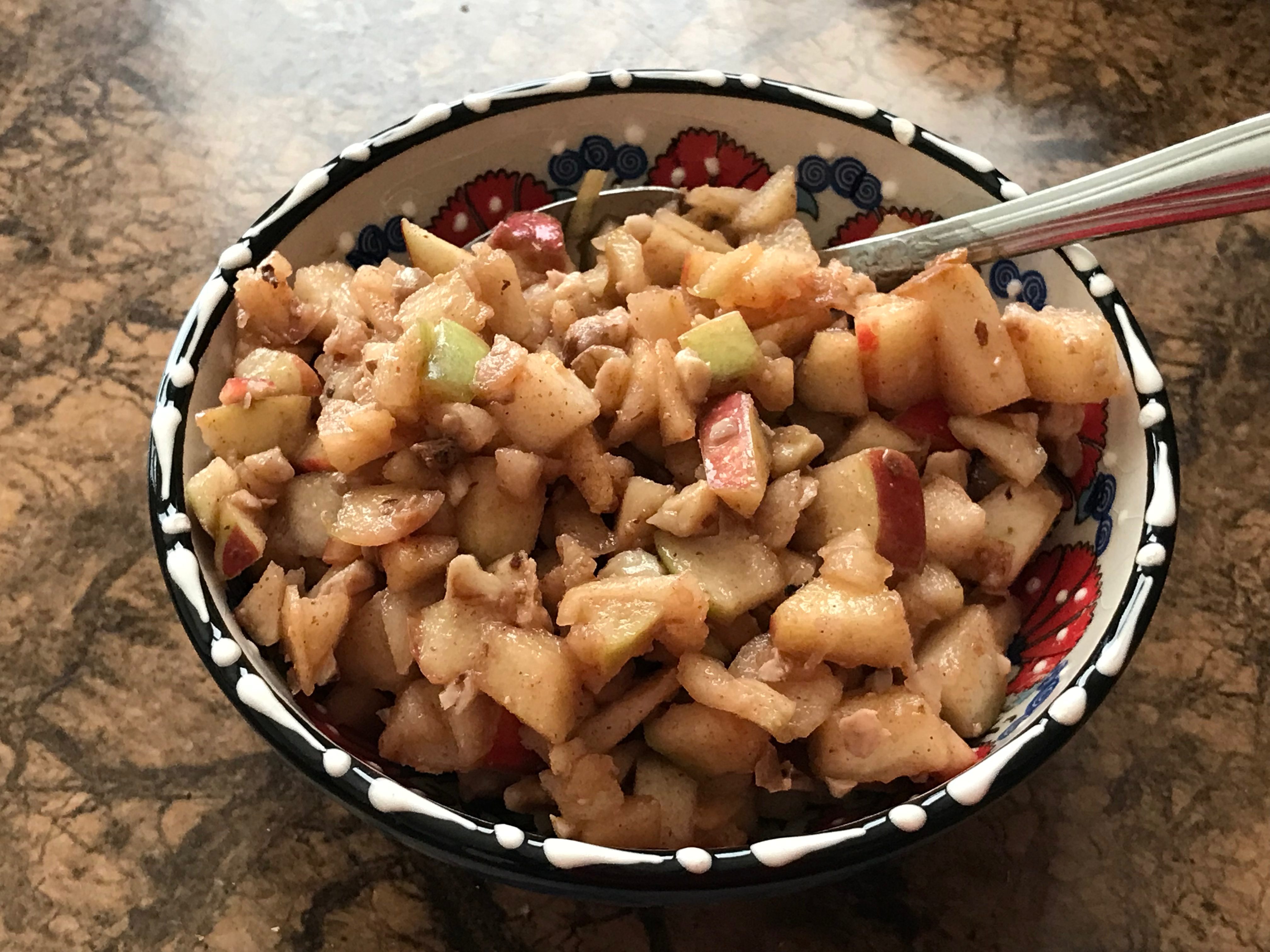
Ashkenazi charoset is delicious, regardless of faith or season. It’s sweet, tart, two different kinds of crunchy, juicy, and especially tasty during the fall, when apples are freshest. Walnuts make the mix more substantial, and spices like cinnamon and ginger make it taste like crustless apple pie.
Ingredients:
4 medium sweet-tart apples (I used 2 cortlands and 2 zestars)
½ cup walnut pieces
A few drops of lemon juice, if desired
½ teaspoon ground cinnamon
¼ teaspoon ground ginger
¼ cup (4 tablespoons) sweet kosher red wine or red concord grape juice
Sugar to taste
Directions:
Core the apples, slice, and mince as finely as you can with a knife. (One of those devices that cores an apple and cuts it into 8 or 10 slices works perfectly for the first part, and I don’t bother peeling. If using a food processor for the second part, be careful not to overprocess.) Place in a large bowl. Toss with a few drops of lemon juice if desired.
Mince the walnuts and stir in, distributing evenly. Add the spices and wine and stir again.
Taste for sweetness. Depending on the apples, you may or may not need sugar. If the mix needs it, add sugar a tablespoon at a time, tasting as you go.
Let rest in the refrigerator for 24 hours for the best flavor.
If you enjoyed this, please like, share, and/or subscribe.
Photo by Mingyang LIU on Pexels.com (I couldn’t get a good picture myself without blocking traffic)
Harrods is probably the most famous department store in London. It’s also really hard to navigate. Perhaps this is by design, so potential customers pass more high-end merchandise. After all, some of the wealthiest customers in London shop there, or have their people shop for them. But for the casual tourist who just wants to window shop in the food halls at the center, the maze is a bit annoying.
Sure, there are smaller items like rolls, pastries, jars of jam, pieces of cheese, boxes of tea, and so on, that are affordable for most people. But after being warned by the tour director that the same items are marked up heavily just because they come from Harrods, I decided to stick with admiring the selection. There is a lot to admire, starting with the store itself. It’s kept the elaborate Victorian and Edwardian columns, ceilings, arches, and crown moldings, while gleaming like any upscale modern establishment.
I’m not sure what’s more beautiful, the building or the merchandise. Right by the door where I came in was a selection of caviar, smoked salmon, and whole gourmet fish. To my other side was a whole wall of baked goods, and directly ahead was a truly international deli case. Many of the salads looked Mediterranean or Middle Eastern, but there were also ready-prepared slices of beef Wellington. On the other side of the deli I found all sorts of exotic fruits, including cacao pods. Oddly enough, after coming home I saw cacao pods at Woodman’s.
Advertisements
On a side note, if you’re ever in the produce department at Woodman’s, take a minute to smell the guavas, especially if they’re a bit overripe. The intoxicating tropical aroma is impossible to describe. Anyway, back to Harrods, where there were no guavas, but the meat cases had luxury wagyu beef, authentic Spanish jamon iberico, and any cured meat you can think of. And I’m pretty sure the cheese case contained every cheese mentioned in 1000 Foods to Eat Before You Die (the food halls themselves are featured on pg. 15).
As far as I could tell, the non-perishable (or less perishable) items like coffee, tea, honey, jams, oils, chocolates, and confectionary were more significantly overpriced than the others, though overpriced might not be the right word. There’s a quote from somewhere that “everything is worth what its purchaser will pay for it.” It’s the law of supply and demand. Perhaps because the “dry goods” can be kept for longer, the sellers can be comfortable charging more, knowing whatever doesn’t sell one day won’t be wasted. Or maybe those items are in higher demand as gifts.
In fact, the store website suggests that the chocolates and hampers (basically gift baskets) would be perfect for the hard-to-shop-for relative or business acquaintance. I’m sure they would be. Everything in the chocolate hall was beautiful, and Harrods chocolate is known to be of exceptional quality. But a mixed 15-piece box of chocolates is $35. 325 grams (just over 11 ounces) of mixed chocolate almonds is $27. And a 16-piece chocolate truffle selection box is $40. Granted, some of those are in collectible tins, but that’s still out of my price range.
For the cost of 2 of those items, I could get a bulk bag of pecans, make a batch of cinnamon sugar nuts, eat half of them, make another batch, and have enough for several homemade gift baskets. With the money left over, the baskets and tins (which have been passed back and forth between friends and relatives since about 1995) could be finished with Lindt truffles, clementines, and some homemade cookies and/or Chex mix. Maybe it’s just me, but that feels so much more personal. And who doesn’t love cinnamon sugar pecans?
Advertisements
After finishing my window shopping, there was still plenty of evening sunlight to ride the Underground to visit the Tower of London. (Another interesting thing is that because the British Isles are further north than many Americans might expect, it stays light really late during the summer. In July, there was still some twilight at 10pm.) The inside was closed (not sure why they don’t stay open later in the summer to profit from the long days and tourist surge), but I had a great view of the outside of both the Tower itself and the Tower Bridge. Even from a distance, the arrow slots in the walls were clearly visible. Add in the multiple layers of walls, and the Tower could rival any modern maximum-security prison.
Better luck getting pictures of the tower bridge
And on the ride home, there were a few drunk guys doing pull-ups on the handhold straps hanging down from the subway roof. I was a little worried the straps would give way, injuring them physically or mentally, but they held firm. Since drunken pull-ups are apparently a common thing, the train engineers probably factored that into their designs.
Point is, even if buying much from Harrods is out of your budget, it’s well worth a look around. If only they had free samples, which might encourage hesitant shoppers to buy.
Over the course of my culinary exploration, I’ve been amazed by just how many different types of oil there are. Some are pretty standard and widespread. Canola and vegetable (often soybean) oils are neutrally flavored, easy-to-find, affordable, and widely used in baking and frying. Some cooks prefer corn or peanut oil for deep frying. For sautéing and salad dressings, olive oil is a favorite. In a well-stocked grocery store, you often find sunflower, sesame, flaxseed, grapeseed, avocado, and coconut oils.
Certain oils are largely restricted to particular cuisines or uses. Sunflower is popular in Eastern Europe due to Orthodox fasting rules and the inability to grow olives. Toasted sesame oil is common in East Asia, especially China, while Middle Easterners prefer untoasted. Nut oils like almond or walnut are sometimes used in European salad dressings. And bright reddish-orange palm oil gives many West African dishes their distinctive flavor.
Advertisements
In Austria, a local specialty is pumpkin seed oil, called kurbiskernol, made from the appropriately-named oilseed pumpkin. It’s typically used in salad dressings and as a dip for bread. Due to its low smoke point, it’s not suitable for cooking, which damages its distinctive flavor. But here’s a question for you. If the stereotypical pumpkin is orange and inner seed kernels (pepitas) are green, what color is pumpkin seed oil?
Answer: It’s a lovely deep purple, with yellow-green undertones.
In 1000 Foods to Eat Before You Die (pgs. 323 – 324), Mimi Sheraton describes pumpkin seed oil as resembling liquid amethysts. If it had been available during the Middle Ages, sophisticated diners would have been all over it. They loved bright, even tacky colors, and very few foods are naturally that shade of purple. For people who created elaborate gilded dishes with egg yolks and saffron, liquid jewels sound right up their alley.
Pumpkins arrived in Europe after Columbus. Exactly when Europeans began eating them or pressing their seeds is unclear, but the oil makes a great vinaigrette base. To boost its color, I added red wine vinegar, minced shallots, a little salt, and a dash of mustard and honey to keep the dressing from separating. If you find the flavor of the pumpkin seed oil a little strong, try replacing about half of it with sunflower oil, which is typically pale, for a lighter shade of amethyst. Yellow or greenish olive oil will make it look muddy.
Thinner layers of the oil can look muddy anyway, but the taste, clearly that of roasted pumpkin seeds, is worth it. It’s a fantastic complement to potatoes, and makes salads much more satisfying. Kale is especially good, because its strong flavor is less likely to be overwhelmed. It also holds up in the fridge for a few days, even with dressing.
Advertisements
To dress about six medium potatoes or one bunch of kale, just combine 6 tablespoons of pumpkin seed oil, 2 tablespoons red wine vinegar, a minced shallot, and a little salt. Mix in a teaspoon each of Dijon mustard and honey and whisk until combined. Toss with cubes of hot cooked potatoes (waxy varieties like reds or Yukon golds are best, peeled or not is up to you) or chopped kale and let rest for an hour at room temperature. Store leftovers in refrigerator, bringing potato salad back to room temperature before serving. If desired, rewarm for about 30 seconds in the microwave. The kale salad is ready right out of the fridge.
Vinaigrette-based vegetable salads are perfect year-round. They stay crisp (if applicable) better than lettuce, are more interesting than a veggie tray, and provide a pleasantly light counterpoint to grilled or roasted meats, heavy sides, and desserts. With no egg or dairy, they’re safer on hot days than those with mayonnaise. And during the winter, sturdy vegetables like potatoes and kale (or even frozen vegetables like green beans) are more consistent than fresh sweet corn, tomatoes, or lettuce.
And with how popular pumpkin spice is, pumpkin seed dressing would be perfect on a fall or Halloween theme menu. Perhaps a kale or other cabbage salad with pumpkin seed vinaigrette and toasted pumpkin seeds to start, followed by pumpkin or squash ravioli with butter and sage, and concluding with a pumpkin or apple dessert. With plain coffee or tea, though. Pumpkin spice belongs in desserts, not beverages.
Add seasonal flowers for a lovely modern still life
Crazy as it sounds, ring bologna is actually a decent substitute for mortadella in a pinch. After all, mortadella originated in bologna. American “baloney” was an attempt to imitate it. The ring variety is better than the slices, and in either case, crisping it up in a pan gives the bologna a boost in flavor and texture. On this pizza, the oven takes care of that step for you.
If you make the dough the night before and leave it in the fridge, and if you still have garlic oil on hand (the recipe makes enough for several pizzas), this is the easiest pizza in the book. No vegetables need to be precooked; no herbs need to be minced. Just shred the fontina, rinse and chop up the canned artichokes, chop up the mortadella (or bologna) and you’re good to go.
Advertisements
The flavors and textures in this pizza are very well-balanced, between briny, slightly meaty artichokes, peppery bologna, creamy cheese, crispy crust, and garlic. On page 226, author Joe Famularo says the best way to get a good garlic flavor on a pizza without it scorching or being overwhelming is to use garlic-infused oil. And he’s absolutely right. The flavor is definitely there, but it doesn’t overpower the other flavors. Everything is in harmony.
A few months ago, I came across some ricotta salata while browsing at Woodman’s. Remembering that lack of it led me to improvise on sweet pepper pizza a few years ago, I decided to remake the recipe and give it a try. Plus, I had some unbleached flour and quick-rising yeast I wanted to use up before they went bad. At the time, I’d been trying to clear out the pantry, find a use for the ingredients pushed to the back, and therefore avoid food waste.
Recently I started watching Hoarders, which is enough to make anyone want to clean, even if they don’t have a problem. Many of the jam-packed kitchens came about because their owners liked to stock up when preferred items went on sale. There’s nothing wrong with that, as long as you don’t buy more than you can use before it goes bad. Having some extra cereal, pasta, crackers, and canned goods in the basement is handy. Just don’t overdo it.
Some items, like the cornmeal that I bought at the start of Covid, expired two or three years ago and weren’t salvageable. The yeast and unbleached flour were still good, but expiring soon, so it was as good a time as any to make pizza. I made the garlic oil that all the recipes use, stuck it in a jar in the fridge, and decided to start with a white pizza using the leftover provolone and some of the pecorino from the eggplant timbale (and leftover parmesan from some gnocchi, and some mozzarella already in the fridge).
Advertisements
When I went to put the dough in the intended pan, a large round sheet pan with a short “lip,” it wasn’t there. Turns out, it had started flaking and reached the end of its natural life. Looking at my other options, I settled on a roasting pan with slightly higher sides. If I spread the dough all the way to the edge, the surface area would be similar, just in rectangular form. Nothing wrong with that.
This turned out to be the best culinary misadventure in a while. Because this dough recipe produces a thick crust, I had never spread it to the edge of the pan before, in case the garlic oil in the topping dripped off onto the bottom of the oven. Being able to do so made a huge difference. The crust rose evenly instead of bulging in the middle, and the edges got extra golden and crispy. Everything was delicious, but the edges were phenomenal. And the pizza fit perfectly on the new, giant wooden cutting board.
After this success, I decided to make any future pizzas in this pan. The sweet pepper and ricotta salata pizza was up next, for the simple reason that peppers were on sale at the store. This was good, but a little dry, even with the garlic oil. For pizza, meltier cheeses with a bit more fat seem to be the way to go.
Menu: Bergamo-Style Ravioli, Rabbit Roasted in Red Wine, Bergamo-Style Polenta, Cheese with Mixed Salad, Sambuca-Flavored Cocoa Roll (orange flavor instead)
Recommended Wine: Spumante
Bergamo is in the northern Italian province of Lombardy, north of Milan. As in the rest of northern Italy, there is a lot of fresh pasta and polenta, butter often replaces olive oil, and there are plentiful cow’s milk cheeses like fontina, gorgonzola, parmesan, and mascarpone. While generally overshadowed by its larger neighbor, Bergamo has its own specialties. One of these is a unique ravioli, filled with a mix of chicken, pork, salami, vegetables, and a little cheese. They are dressed in melted butter and sage, parmesan cheese, and toasted bread crumbs.
This was my first attempt at making my own pasta, and it went surprisingly well. Since I don’t have a pasta roller, I rolled little pieces of dough into circles with a rolling pin and folded them around the filling in a half-moon shape. It was a slow process, but making the ravioli bigger sped things along. The meat-and-vegetable filling was deliciously different from the usual cheese-heavy varieties, though there’s nothing wrong with those.
The only thing I would change is to cook the larger ravioli for an extra minute or two. Having thicker pasta kept the ravioli from bursting open, but not factoring it into the cooking time left it a little tough. It was still delicious, and the extras are in the freezer for whenever a quick homemade dinner is desired.
Advertisements
Another first for this menu was the rabbit. The idea was a little tough at first, until I reminded myself that this rabbit (which according to the package was a product of Spain) was bred and raised exclusively for food. It was never someone’s pet, or a former resident of the nearby farm/petting zoo. Besides, people have been eating rabbits for a lot longer than they’ve been keeping them as pets. They were a common protein into the 20th Century, and one 1930s menu even had rabbit pot pie as an economical alternative to chicken.
Rabbit does, in fact, taste sort of like dark meat chicken, but a little different and very lean. The fact that chicken is easier to farm on an industrial scale probably explains why rabbit isn’t as popular as it used to be. Or maybe it’s just that people didn’t grow up with the Easter Chicken. Or the fact that chickens won’t stand on their hind legs like a prairie dog when offered a banana chip.
Not the second course…and I wasn’t rabbit sitting when I made this menu either.
Regardless, most rabbit recipes seem to involve slow-cooking it in liquid and/or adding some extra fat. In this case, the fat came from a bit of Italian sausage, and the liquid was red wine. It did taste very good, though in the future I would probably just use chicken thighs, which are cheaper and easier to find. At least for this recipe.
Upon reading the recipe, I was surprised at how quickly the polenta cooked. Once the salted water was boiling, the corn grits/polenta only had to cook for about five minutes. It required frequent but not constant stirring, and didn’t get lumpy, which is a common problem. Was the addition of a little buckwheat flour the key to a good consistency? Perhaps, and either way, the addition of butter, sage, and fontina cheese gave the final mix a pleasant rich but mild flavor that contrasted well with the stronger flavors in the rest of the meal.
The salad was similar to many others in the book; a mix of greens dressed with a flavorful homemade dressing. The store didn’t have the endive called for in the recipe, so I just used the arugula and radicchio. Unlike other lemon juice and oil “vinaigrettes,” a little bit of orange zest and some minced shallots seemed to sweeten the mix, keeping it from becoming too sour and letting it balance the bitter radicchio. Don’t worry if the oil solidifies in the refrigerator. Fifteen to thirty minutes at room temperature will take care of that.
For the cheese, I used fresh mozzarella instead of taleggio because that’s what was available at the store. Even though it’s a southern Italian cheese not native to the Bergamo area, it went very well with the salad, especially when served on the dressed greens instead of next to them. The bitter arugula and radicchio, sour and slightly sweet dressing, and mild mozzarella all contrasted beautifully without clashing.
Dessert was one of the best things I’ve made in a while. The “cake” is a mix of egg yolks whipped with sugar, melted chocolate, a bit of flavoring, and separately whipped egg whites folded in at the end. The original recipe calls for three tablespoons of sambuca to be mixed in with the chocolate. Since I didn’t want to buy a whole bottle that I would be unlikely to drink or use in other recipes, I considered replacing it with a teaspoon of anise extract mixed into some cream, until I remembered that replacing wine with milk caused a previous attempt at zabaglione to fail. To keep the chemistry similar, I initially settled on a teaspoon of anise extract mixed into three tablespoons brandy.
Advertisements
Then I considered that anise (the flavor of black licorice) is not generally my favorite flavoring. Trying a bit over a scoop of ice cream with a sprinkle of coffee granules is one thing. It’s a single serving that takes two minutes to make. Even though that turned out well, I was hesitant to put anise flavoring into an entire cake that was a bit fiddly to make. Other extract options were vanilla, almond, and orange. Since I was already making an almond cheesecake for a different event, I settled on orange for something different. A teaspoon went into the “cake,” and half a teaspoon went into the whipped cream filling.
The cake was spectacular. The texture ended up somewhere between a brownie and a mousse, intensely chocolate lightened with a touch of orange. While the cake did crack slightly as I rolled it up, the inside still formed a recognizable spiral. Not pastry shop window perfect, and it wouldn’t pass muster on the Great British Baking Show, but still a pretty special occasion dessert. And of course, it’s the taste that counts. From time to time it’s well worth the effort.
No-bake desserts are great for special occasions during the summer. I’ve already discussed strawberry trifle, which uses frozen pound cake for beautiful and delicious results. Another showy use for berries and their juices is the British dessert summer pudding. It involves lining the bottom and sides of a bowl with white bread slices, filling the center with a mix of berries and sugar, covering the top with more bread, and pressing everything together with another bowl overnight. Excess juices are thus forced into the bread, coloring it a lovely hue between red, pink, and purple, depending on what fruit you use.
I was a little skeptical at first. It sounded like a recipe for soggy bread, but if summer pudding is popular in the British Isles, there had to be a reason. After finding red currants at the farmer’s market, I decided to give it a try. If the bread part wasn’t good, the berry filling could be scooped out and served on its own with whipped cream.
This turned out to be unnecessary. Odd as it sounded, the bread worked perfectly. Due to its gluten structure, it soaked up the juices like a sponge and held together even when fully saturated. Cake would typically fall apart in a similar situation. Beyond that, the bread balanced out the tart currants and raspberries very well. It was indeed soggy, but in a good way.
Advertisements
Let’s pause here to talk about currants. The dried currants you can buy in boxes are not true currants at all. They are actually a type of small raisin. Most boxes now specifically refer to their contents as Zante currants to avoid confusion. These Zante currants are worth trying in their own right in scones, oatmeal, and the like. But they’re not what we’re talking about today.
True currants come in three common colors: red, white, and black. All are much more common in Europe than in the US, though the red kind is occasionally found fresh in farmers’ markets and backyard gardens. White currants are a mutant form of the red variety. Black currants are even harder to find, and were in fact banned for several decades because they could carry white pine blister rust, which threatened the US logging industry. Even with new disease-resistant varieties, black currants are still illegal to grow in several states. Which is a pity, because they make great jams and juices.
Red currants, with my hand for scale
This history could explain the rarity of currants in the US. So too could be the fact that red currants, which were never banned, have to compete with native cranberries. Both are tart red fruits that make excellent juices and sauces, but cranberries are a lot cheaper and easier to store. And in the Midwest, where growing conditions are favorable for currant bushes, people prefer sour cherries in jams and desserts. Red and occasionally black currant jam can be found at stores and farmer’s markets, but beyond that, there are few traditional (or modern) American recipes for the fruit.
British cuisine, by contrast, has plenty of uses for currants, especially, it seems, for the black variety, which are in fact dark purple. Blackcurrant jam is one of the favorite varieties. Many candies use the flavor. A sweetened concentrate called Ribena (which is not uncommon in the international food aisles in the US, at least in big stores) makes what tastes like currant-flavored Kool-Aid. It would taste better with a little less sugar, but is enjoyable nonetheless. And of course, there are numerous desserts made with all varieties of currant.
One of the favorites is summer pudding, which Mimi Sheraton suggests is best made with a mix of red currants and raspberries. Taking the expert’s advice, I picked up some frozen raspberries, scaled down the recipe on pages 29 – 30 in 1000 Foods to Eat Before You Die by half, and got started. (Information about currants can be found on pages 12 – 13). Whether or not to cook the fruit or just briskly stir it with the sugar depends on how soft and/or ripe the fruit is. Since currants are firmer and tarter, even when ripe, I decided to cook them with the sugar for a few minutes, then stir in the raspberries, which are more prone to fall apart, after. This worked perfectly.
The biggest challenge turned out to be finding a bowl that would fit perfectly inside the bowl with the pudding. This is important because pressing down on the surface with adequate weight (provided by a few cans of food) is what forces the excess syrup into the bread. The other issue was unmolding. I’m not sure why the recipe called for buttering the main bowl, since the butter completely solidifies when everything is chilled, unless it’s for flavor. The now-solid butter stuck the bread to the bowl, making for a slightly messy presentation.
Not as pretty as in the picture in the book (okay it looks like an amoeba)……but whipped cream improves the presentation.
Messy or not, the juice-stained bread and red fruits were pretty in their own way, especially with a contrast of whipped cream. Brits often serve summer pudding with either clotted or whipped cream. I’m not sure how the former is, but the latter is perfect, especially if you make it yourself. Homemade whipped cream is super easy to make, and it makes the odd-sounding but delicious summer pudding even better. To be honest, it makes any dessert better.
Fun fact: Big Ben is technically not the name of the tower itself, but the bell inside it.
British cuisine gets a bad rap. Jokes abound about it being bland, heavy, and sometimes bizarre. Even the island’s inhabitants make fun of it, and often don’t eat “traditional” British dishes on a daily basis. Partly due to immigration from the Indian Subcontinent, Brits love curry and other Indian dishes. You can find falafel, Italian, and Chinese food everywhere. Still, some local dishes are worth trying. Read through the Harry Potter series for some good examples.
Last month, I went on a trip to Great Britain and Ireland. The history was fascinating and the scenery was lovely. There were just two surprising things. First, people don’t just drive on the left. They also keep to the left on sidewalks, staircases, and anywhere else people might be passing each other in opposite directions. It felt completely backwards and I couldn’t quite get used to it. Luckily we had a bus for long distances and didn’t have to drive.
The Tower Bridge in London
I was also surprised by how difficult some of the local accents were to understand. Despite having a fraction of the landmass and only about a fifth of the population, the British Isles have a greater number of distinct accents than the US. This makes sense, since people have been speaking some form of English there for around 1600 years instead of 400, giving the language a lot longer to develop various dialects.
American English certainly has its diversity, but for the most part, a speaker of one dialect can understand another. This isn’t the case in Britain and Ireland, particularly in more rural areas. On several occasions, I could only get a rough idea of what someone was saying. If asking them to repeat themselves didn’t work, I would just say ok, nod, and hope for the best.
Swans in the Avon River in Stratford. They were a popular Medieval feast dish, but apparently don’t taste very good.
The food was easier to understand. Most of the ingredients are familiar and easy to find. Fish and chips are just fried fish and French fries. Beef and Guinness stew is straightforward and delicious, even if you don’t usually like Guinness. Pasties are meat and vegetables in a pie crust. Think of them as cousins of empanadas. Cheeses like cheddar are imitated all over the world. There’s bangers and mash (sausages with mashed potatoes), shepherd’s pie, roast beef and what are essentially popovers, cheese sauce with toast, and a variety of jams and marmalades.
Advertisements
Then there’s the desserts, which is where British cuisines excel. The best introduction can be found by watching the Great British Baking Show. The Victoria sponges, loaf cakes, shortbread, sticky toffee pudding, and cream-filled fruit tartlets look and sound delicious. There have definitely been some odd flavor combinations (like miso caramel and black sesame ice cream), but sometimes they turn out to be inspired. Other times, the classics done well are what impress the judges.
That contrast seems to sum up British cuisine as a whole: willing to try new ingredients and dishes, but not forgetting the classics.
By European standards, France is a large country. As with any nation with varied terrain and climate, it has a number of regional specialties. There are the dairy-heavy cuisines of Normandy and Brittany, Germanic-inspired dishes of Alsace in the northeast, and wine-based sauces and stews from the wine-growing regions of Burgundy and Bordeaux. And in the south, along the Mediterranean, is Provence, where many dishes resemble those from neighboring Liguria in Italy.
Provence is one of the few French regions where olive trees can produce fruit. The oil is ubiquitous, including in a sauce for roasted eggplant. Other Mediterranean flavors come from lemon juice, capers, and a bit of anchovy. Before you get grossed out, it’s just a small amount of paste used as a flavor booster, not enough to make it taste “fishy.” All these other flavors, which are rather strong on their own, plus garlic and plenty of fresh parsley, balance it out.
Aubergine is the French word for eggplant. Here it is cooked and pureed just like in baba ghanoush, except in the oven instead of over a wood fire, producing a lighter color and mild, slightly sweet flavor. Rather than mixed into the puree, the sauce is served over the top, for a greater contrast.
As Mimi Sheraton suggested in 1000 Foods to Eat Before You Die on page 54, a simple description is sufficient to compose a recipe, at least for the sauce. It was the eggplant itself that gave me trouble. When cooking whole, which is necessary to keep the pulp a greenish color instead of browning, it takes a surprisingly long time to soften. At 400 degrees Fahrenheit (or just under 205 degrees Celsius), it took nearly an hour. Since it was a cool day that was fine, but on a hot summer day that would never be an option. Plus, using the oven for that long for one fairly small item doesn’t seem energy efficient.
I considered ways to “pre-cook” the eggplant before finishing it off in the oven. After poking holes all over (to release steam and avoid an explosion), boiling or steaming would probably introduce too much water. But what about the microwave? They work by making water molecules move faster, creating friction and raising the temperature. And since the rays pass through the food, the center warms up much faster than with other cooking methods.
For a vegetable like eggplant, which has a high water content, this worked like a charm. To avoid an explosion and mess, I poked the holes all the way through with the pointy end of a meat thermometer, giving plenty of openings for steam to escape. Just heat on a microwave safe plate, turn every two minutes, and be careful when handling. The eggplant steams inside the skin, creating the perfect silky texture with just the right amount of moisture.
As it turned out, the oven wasn’t even required, making this interesting dish perfect for a hot day. When the eggplant is cool enough to handle, just cut in half, scoop out the pulp, puree it, and serve warm or at room temperature with the sauce. Accompany with bread, crackers, or crunchy vegetables.
The sauce recipe is easy to double and can be kept in the refrigerator for several days. Don’t worry if the oil solidifies; it will turn liquid again as it warms up. This is common for vinaigrette-type dressings and sauces. Just get them out of the fridge half an hour to an hour or so before using, and they’ll be fine.
Ingredients:
1 large eggplant, about 2 pounds
3 tablespoons olive oil
Juice from ½ lemon
1 clove garlic, minced
2 tablespoons capers, minced
¼ teaspoon anchovy paste
½ bunch parsley, minced
Salt to taste
Directions:
Combine all ingredients except eggplant, parsley, and salt in a bowl and whisk to dissolve anchovy paste and combine.
Whisk in the parsley and taste for salt. The anchovy paste and capers are both salty, so you might not need it.
Set sauce aside at room temperature, or refrigerate overnight. Bring to room temperature before serving.
Poke holes all over the eggplant, all the way through. Place on a microwave-safe plate and cover with a paper towel. Microwave on high for 8 to 10 minutes, turning every 2 minutes, until a skewer slides easily into the flesh. Let rest until cool enough to handle.
Cut eggplant in half and scoop flesh into bowl of a food processor. Process until smooth.
Scoop eggplant puree onto a plate, spoon sauce over, and serve with bread, raw vegetables, and/or crackers.
For more recipes and food history, sent right to your inbox, please like, subscribe, and/or share.