Omelette ux fines herbes
breakfast/brunch, fall, french cuisine, summer, vegetarian

Using Up Herb Plants: Omelette aux Fines Herbes (with basic recipe)

Omelette ux fines herbes
High cuisine, not a simple attempt to use things up before going out of town for Thanksgiving

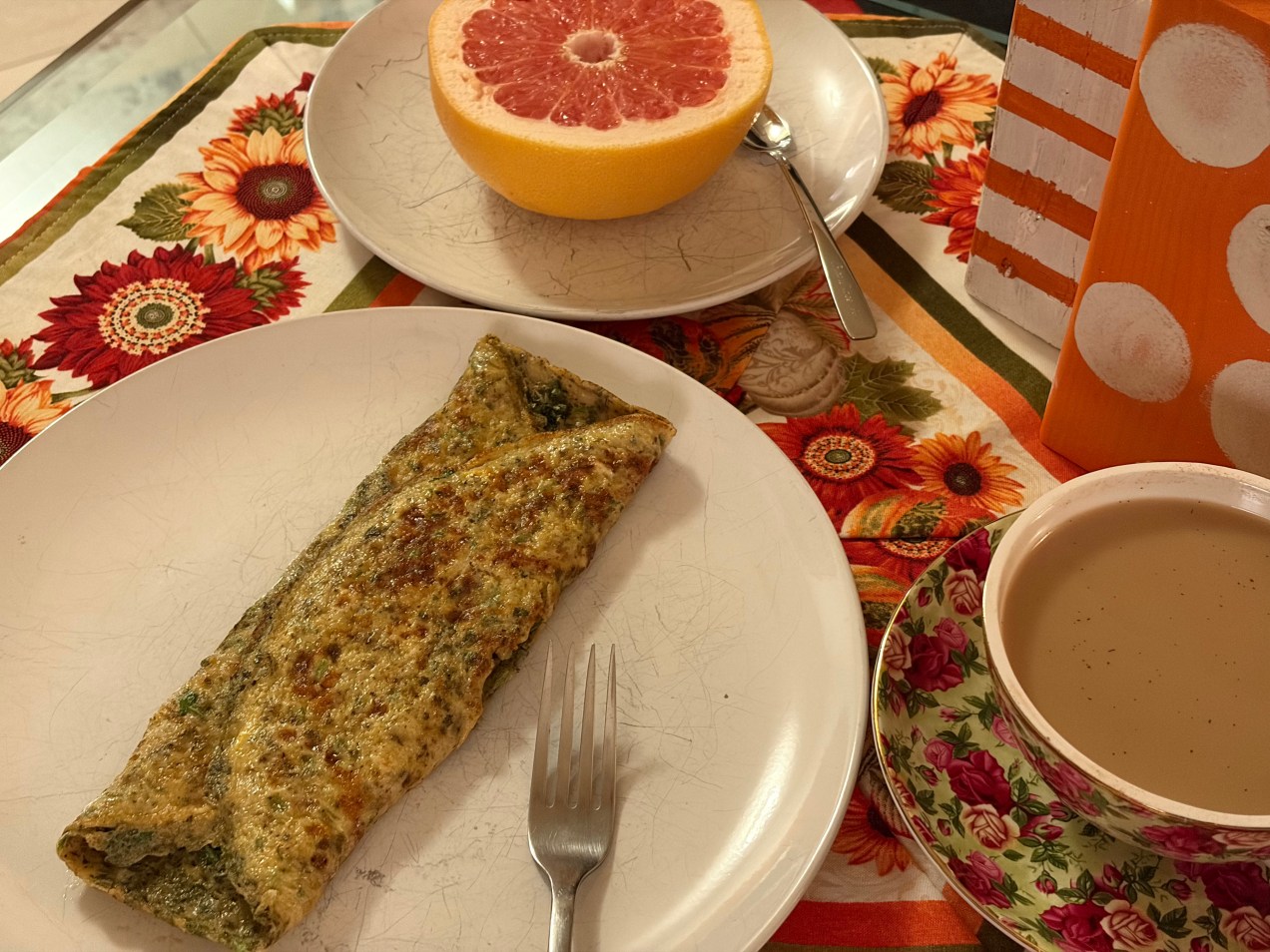
            Every fall, I bring my potted herb plants in from outside to enjoy using them for a bit longer. It works well enough for a while, but eventually they start to suffer from the limited sunshine. Since most of them are annuals, the time comes to use up what I can before starting again when summer returns. Everything except the rosemary is either done or fading. To use up as much as possible, I made a French classic, omelette aux fines herbes.

            Fines herbes is a mix of parsley, chives, tarragon, and chervil, common in French cuisine. The first three are widely available in the US, but chervil might require a specialty spice store or the internet. Supposedly it tastes like a milder parsley with a bit of a licorice undertone, but I couldn’t taste much difference. To compensate for all the herbs except parsley being dried, I also added some minced scallions to brighten things up.

            For many French chefs, making a perfect omelet is one of the primary tests of skill. After following the basic directions on pages 107 – 108 of 1000 Foods to Eat Before You Die, mine turned out pretty well. The flavor is distinctly understated, but the freshness from the herbs was nice as fall turns to winter. The slight licorice flavor from either the tarragon or chervil is definitely there. Perhaps it just needs a little heat to release its flavor. Chefs disagree on how much browning, if any, is ideal. Personally, I like more browning, both for flavor and the fact that it helps the egg unstick itself from the pan.

Advertisements

            For each omelet, I used three eggs, beaten together with salt, pepper, and a tablespoon of milk. The herb mix contained three large parsley sprigs, minced, one minced scallion, and a teaspoon each dried chives, tarragon, and chervil. Half of the herb mixture gets added into the eggs before cooking. After melting about a tablespoon butter in a skillet over medium heat, the egg mixture is added to cook.

            To make sure that none of the eggs end up runny, I like to tilt the pan and lift up the edges of the cooked portion, letting the uncooked egg flow underneath. After this, sprinkle the remaining herb mixture over the surface. When the top is almost set, fold the right and left thirds of the omelet over onto the center. If this doesn’t work and you end up with a half-moon shaped omelet, don’t worry about it, it will still taste good. Let the omelet cook for another minute, covering the pan if desired to help it set, then slide it onto a plate.

            To make this simple mix of eggs and herbs sound extra fancy, serve with pommes de terre frits, compote de pomme, fruits frais, café au lait, or any combination thereof. In English, these are fried potatoes, applesauce, fresh fruit, and coffee with milk. To make anything sound fancy, say it in French, even if you have to use a translation app.

One-Time
Monthly
Yearly

Make a one-time donation

Make a monthly donation

Make a yearly donation

Choose an amount

$5.00
$15.00
$100.00
$5.00
$15.00
$100.00
$5.00
$15.00
$100.00

Or enter a custom amount

$

Your contribution is appreciated.

Your contribution is appreciated.

Your contribution is appreciated.

DonateDonate monthlyDonate yearly
Standard
Aubergine en caton
appetizers, french cuisine, recipes, summer, vegetarian

French Baba Ghanoush: Aubergine en Caton

Aubergine en caton

            By European standards, France is a large country. As with any nation with varied terrain and climate, it has a number of regional specialties. There are the dairy-heavy cuisines of Normandy and Brittany, Germanic-inspired dishes of Alsace in the northeast, and wine-based sauces and stews from the wine-growing regions of Burgundy and Bordeaux. And in the south, along the Mediterranean, is Provence, where many dishes resemble those from neighboring Liguria in Italy.

            Provence is one of the few French regions where olive trees can produce fruit. The oil is ubiquitous, including in a sauce for roasted eggplant. Other Mediterranean flavors come from lemon juice, capers, and a bit of anchovy. Before you get grossed out, it’s just a small amount of paste used as a flavor booster, not enough to make it taste “fishy.” All these other flavors, which are rather strong on their own, plus garlic and plenty of fresh parsley, balance it out.

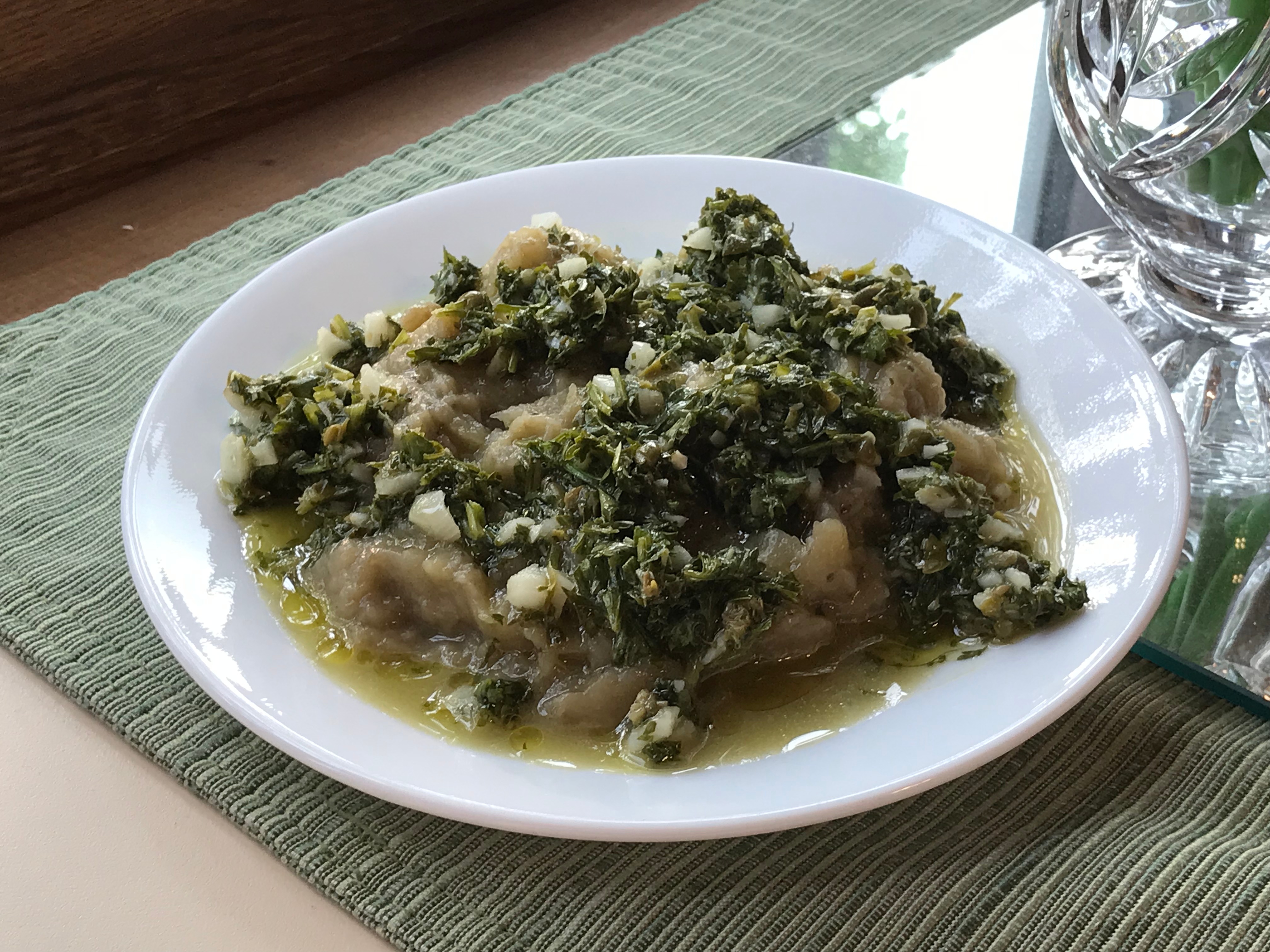
            Aubergine is the French word for eggplant. Here it is cooked and pureed just like in baba ghanoush, except in the oven instead of over a wood fire, producing a lighter color and mild, slightly sweet flavor. Rather than mixed into the puree, the sauce is served over the top, for a greater contrast.

            As Mimi Sheraton suggested in 1000 Foods to Eat Before You Die on page 54, a simple description is sufficient to compose a recipe, at least for the sauce. It was the eggplant itself that gave me trouble. When cooking whole, which is necessary to keep the pulp a greenish color instead of browning, it takes a surprisingly long time to soften. At 400 degrees Fahrenheit (or just under 205 degrees Celsius), it took nearly an hour. Since it was a cool day that was fine, but on a hot summer day that would never be an option. Plus, using the oven for that long for one fairly small item doesn’t seem energy efficient.

            I considered ways to “pre-cook” the eggplant before finishing it off in the oven. After poking holes all over (to release steam and avoid an explosion), boiling or steaming would probably introduce too much water. But what about the microwave? They work by making water molecules move faster, creating friction and raising the temperature. And since the rays pass through the food, the center warms up much faster than with other cooking methods.

            For a vegetable like eggplant, which has a high water content, this worked like a charm. To avoid an explosion and mess, I poked the holes all the way through with the pointy end of a meat thermometer, giving plenty of openings for steam to escape. Just heat on a microwave safe plate, turn every two minutes, and be careful when handling. The eggplant steams inside the skin, creating the perfect silky texture with just the right amount of moisture.

            As it turned out, the oven wasn’t even required, making this interesting dish perfect for a hot day. When the eggplant is cool enough to handle, just cut in half, scoop out the pulp, puree it, and serve warm or at room temperature with the sauce. Accompany with bread, crackers, or crunchy vegetables.

            The sauce recipe is easy to double and can be kept in the refrigerator for several days. Don’t worry if the oil solidifies; it will turn liquid again as it warms up. This is common for vinaigrette-type dressings and sauces. Just get them out of the fridge half an hour to an hour or so before using, and they’ll be fine.

Ingredients:

  • 1 large eggplant, about 2 pounds
  • 3 tablespoons olive oil
  • Juice from ½ lemon
  • 1 clove garlic, minced
  • 2 tablespoons capers, minced
  • ¼ teaspoon anchovy paste
  • ½ bunch parsley, minced
  • Salt to taste

Directions:

  1. Combine all ingredients except eggplant, parsley, and salt in a bowl and whisk to dissolve anchovy paste and combine.
  2. Whisk in the parsley and taste for salt. The anchovy paste and capers are both salty, so you might not need it.
  3. Set sauce aside at room temperature, or refrigerate overnight. Bring to room temperature before serving.
  4. Poke holes all over the eggplant, all the way through. Place on a microwave-safe plate and cover with a paper towel. Microwave on high for 8 to 10 minutes, turning every 2 minutes, until a skewer slides easily into the flesh. Let rest until cool enough to handle.
  5. Cut eggplant in half and scoop flesh into bowl of a food processor. Process until smooth.
  6. Scoop eggplant puree onto a plate, spoon sauce over, and serve with bread, raw vegetables, and/or crackers.

            For more recipes and food history, sent right to your inbox, please like, subscribe, and/or share.

One-Time
Monthly
Yearly

Make a one-time donation

Make a monthly donation

Make a yearly donation

Choose an amount

$5.00
$15.00
$100.00
$5.00
$15.00
$100.00
$5.00
$15.00
$100.00

Or enter a custom amount

$

Your contribution is appreciated.

Your contribution is appreciated.

Your contribution is appreciated.

DonateDonate monthlyDonate yearly
Standard
Risotto verde
food history, italian cuisine, recipes, rice, spring, vegetarian

Risotto Verde: The Taste of Spring

Risotto verde

            Among the numerous varieties of risotto, there are a few classics, as detailed in 1000 Foods to Eat Before You Die on pages 233 – 234. Risotto bianco is the basic kind, made simply with rice, butter, a little onion or shallot, white wine, broth, parmesan cheese, and maybe some pancetta or bacon. Milanese is colored a bright golden yellow with saffron. Nero is colored black with squid ink. Piedmontese is enhanced with white truffles. Other varieties might include seafood, mushrooms, or vegetables.

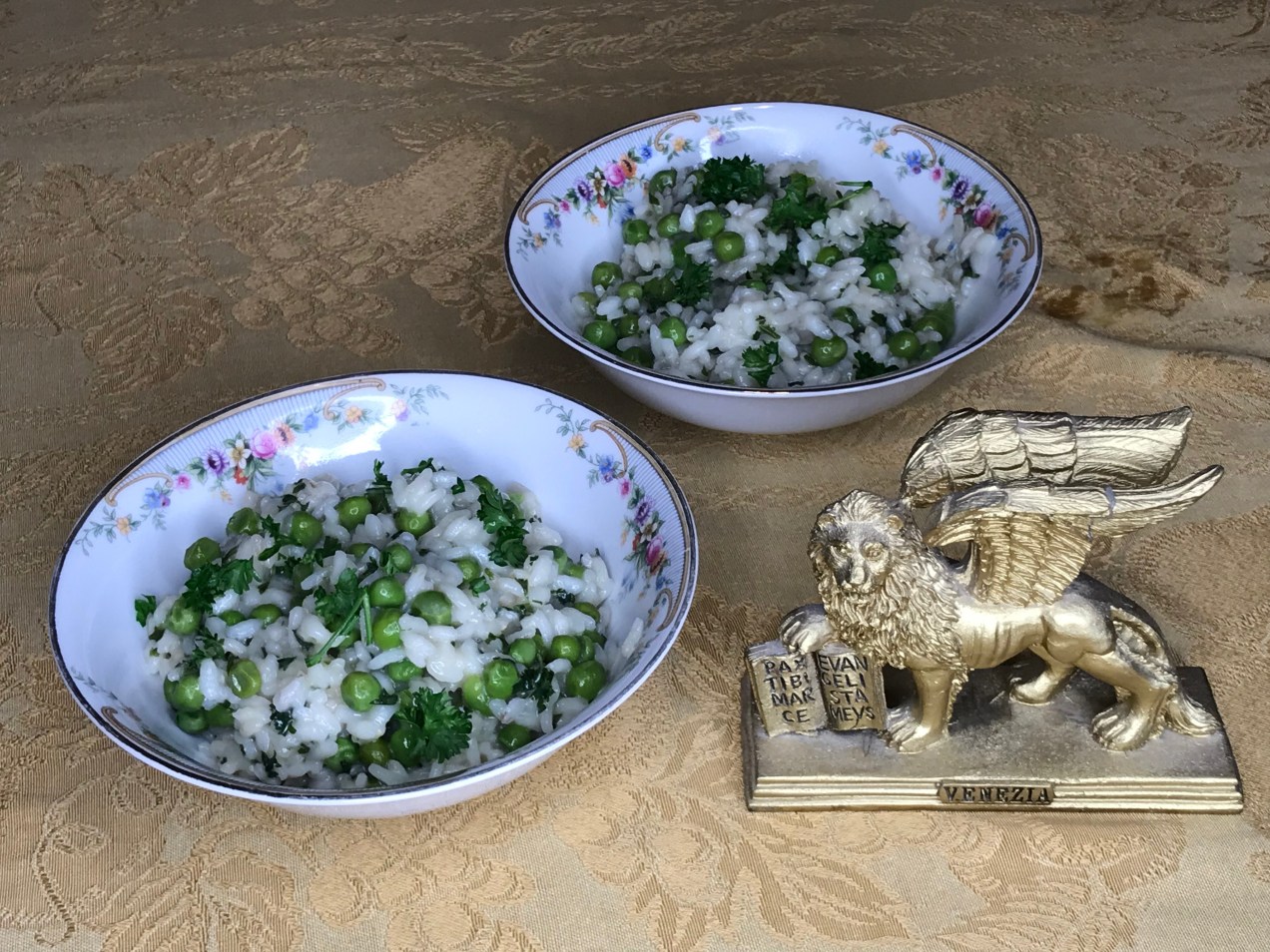
            As you can probably guess, risotto verde is meant to be green. Frequently a spring specialty, it gets its color from parsley and either sweet green peas or asparagus. It’s very fresh-tasting and, when made with frozen peas, surprisingly quick and easy to prepare. To keep everything bright and fresh, I didn’t use any pancetta for my own recipe.

            Technically, you’re not “supposed” to reheat risotto, because it thickens upon standing and can become “gluey.” I’ve never had this problem, or maybe the texture upon reheating just doesn’t bother me. Just add a few drops of water before putting it in the microwave. It will still be a great accompaniment to your chicken sandwich for lunch, and it’s way healthier than chips.

Ingredients:

  • 4 tablespoons (or ¼ cup) butter, or 2 tablespoons each butter and olive oil
  • 1 shallot or ¼ onion, minced
  • 1 ½ cups arborio or other short-grain rice
  • 4 tablespoons (or ¼ cup) dry white wine (something light like pinot grigio), or replace with extra broth
  • 4 – 5 cups chicken or vegetable broth (broth made from poaching chicken works great here)
  • 1 10-ounce bag frozen peas
  • Half bunch parsley, large stems removed, minced
  • 1 cup grated parmesan cheese

Directions:

  1. Combine the broth and peas in a medium saucepan and bring to a boil. Turn off heat, but leave on the stove.
  2. Melt the butter in a large skillet over medium heat. When bubbling, add shallot or onion and sauté for about 2 minutes, until softened.
  3. Add the rice and cook, stirring constantly, until coated and translucent, about 2 minutes.
  4. Stir in the wine and cook, stirring constantly, until evaporated, another 2 or 3 minutes.
  5. Add the broth and peas, a ladleful at a time, stirring constantly, waiting for each to absorb before adding the next. Stir in the parsley about halfway through, saving a little to sprinkle on top at serving time.
  6. After adding 4 cups of broth, the risotto should be slightly liquid. If it seems too thick, add a little more broth.
  7. Remove from the heat, stir in the parmesan, sprinkle with remaining parsley, and serve immediately.

For more recipes, history, and fun facts sent directly to your inbox, please like, subscribe, and/or share.

One-Time
Monthly
Yearly

Make a one-time donation

Make a monthly donation

Make a yearly donation

Choose an amount

$5.00
$15.00
$100.00
$5.00
$15.00
$100.00
$5.00
$15.00
$100.00

Or enter a custom amount

$

Your contribution is appreciated.

Your contribution is appreciated.

Your contribution is appreciated.

DonateDonate monthlyDonate yearly
Standard
Eggplant Timbale
food history, italian cuisine, pasta, vegetarian

Cook’s Tour of Italy Menu 84 (Pgs. 264 – 265): Timbale of Eggplant and Pasta

Eggplant Timbale

Region: South Mainland/Islands (Sicily)

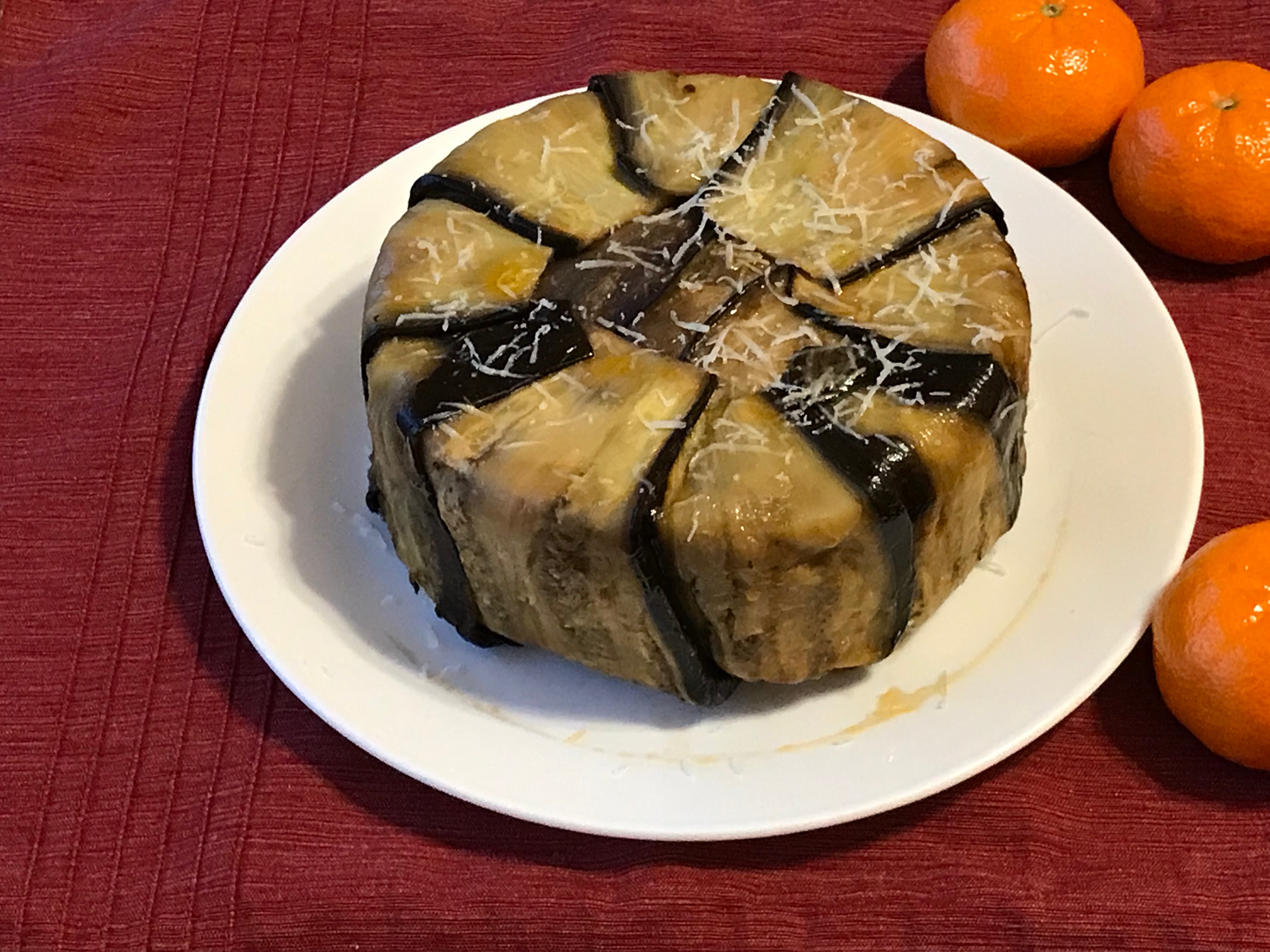
            As far as I can tell, the plain English definition of timbale is “food, encased in a different type of food, cooked in a mold, then turned out onto a platter to serve.” Timbales, or timballos in Italian, are popular in Sicily, probably originating in the kitchens of wealthy aristocrats. Elaborate versions might include a pastry crust, or rice molded precariously around a complex filling of meats, cheeses, vegetables, and eggs.

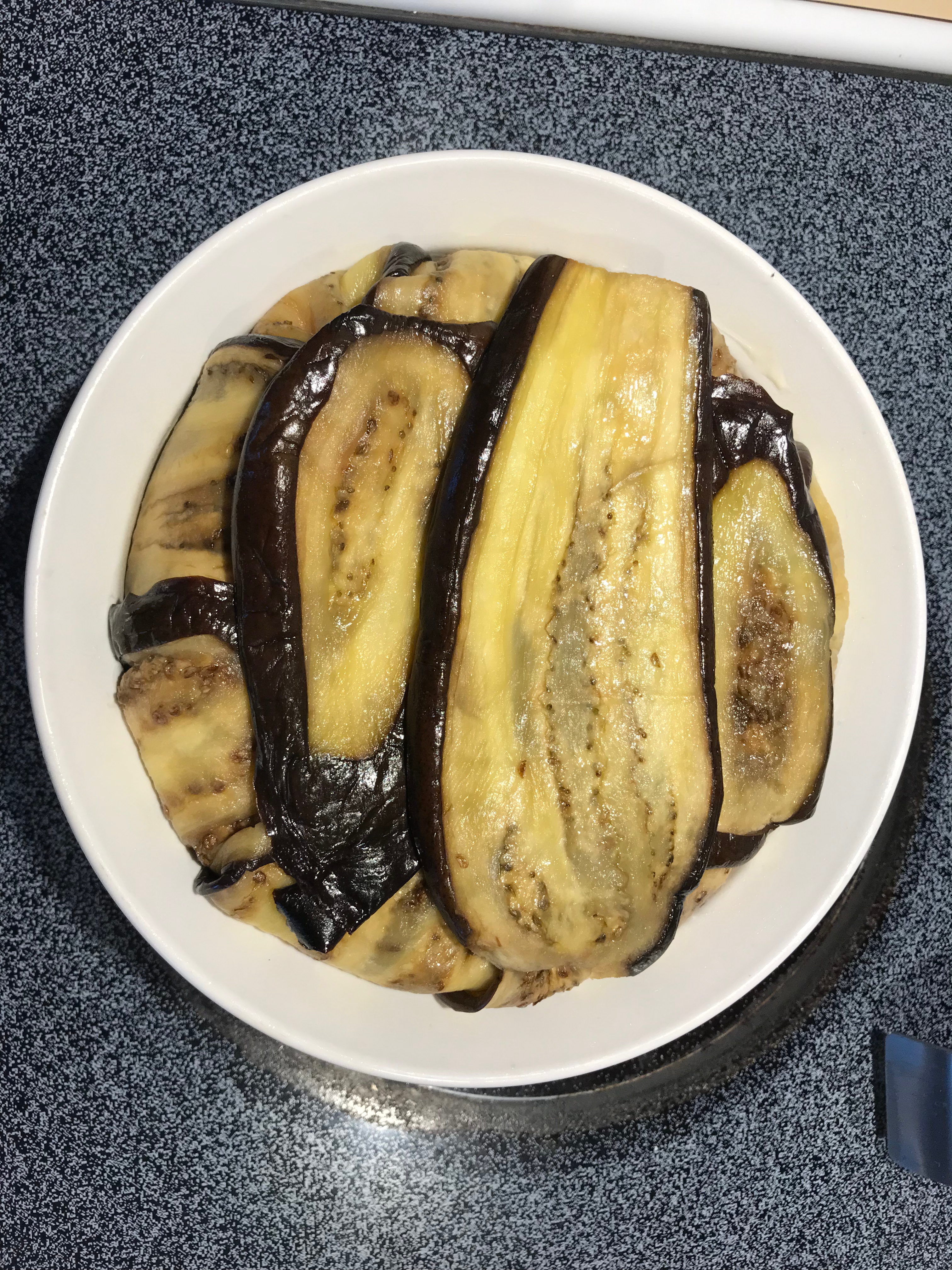
            The recipe here is much simpler, a mix of pasta, tomato sauce, cheese, and eggs, stuffed into an eggplant “shell.” There are two time-consuming steps, preparing the eggplant (slicing super thin, salting, and broiling) and making the homemade tomato sauce, but both can be done ahead of time. In fact, it isn’t a bad idea to make extra sauce, set aside what’s needed for the timbale, and have the rest with meatballs (and the gnocchi you made to clear the semolina flour out of the pantry). It’s also helpful to grate the cheese a day ahead. (And make the hard-boiled eggs the recipe calls for but I omitted.)

            If all of this is done, this fancy-looking timbale is actually feasible for a weeknight. While the water boils and the pasta cooks, you can butter the baking dish, line it with overlapping eggplant slices, and warm the tomato sauce. Then it’s just a matter of mixing the filling, packing it into the mold, covering it with more eggplant slices, and baking.

            Just look how pretty the end result is. It didn’t fall apart when unmolded, and tasted as good as it looked. The timbale isn’t necessarily for every day, but it was easier than I expected and would no doubt be a great way to show off for guests. Just beware that the slices aren’t as pretty as the whole.

Standard
french cuisine, recipes, vegetarian

French Meze/Tapa: Green Lentil Salad

            Lentils are an excellent source of plant-based protein and full of vitamins. Besides soup, some varieties make excellent salads. Green lentils are particularly good for this, since they hold their shape the best. Common brown lentils will also work. Yellow or red lentils fall apart when cooked, and are better in dal or as a thickener for curries.

            Green lentils are most associated with France, where a particularly fine variety grows in the volcanic soil of the south-central Auvergne region. In 1000 Foods to Eat Before You Die, Mimi Sheraton suggests trying the authentic lentilles de puy. These are dark green, speckled, and smaller than regular lentils. The genuine article is rather pricey, but I found French-style green lentils at Woodman’s and decided to give them a try.

            They were amazing. Somehow, the green lentils tasted vaguely like sausage, peppery with a suggestion of sage, even though none of those ingredients were present. Naturally, they would make an excellent vegetarian main course. Not only are they delicious, but I was able to make a few salads with multiple servings in each from one affordable bag.

            The bag had a recipe for French-style warm lentil salad, which I’m sure would be great during the winter with mashed potatoes and/or a pork chop. For summer meze, I created my own simple recipe, dressed with vinegar and oil and flavored with onions. It can be enjoyed warm, room temperature, or cold.

            If you can’t find green French-style lentils by the dried beans and peas, look in the health food section. Bob’s Red Mill is the most common brand, and is what I used. They also carry specialty grains like bulgur, buckwheat, rice flour, and so on.

            Ingredients:

  • 1 cup green lentils
  • 2 bay leaves
  • ¼ red onion, thinly sliced
  • ¼ cup olive oil
  • 2 tbsp red or white wine vinegar
  • Salt and pepper to taste

            Directions:

  1. Cook and drain the lentils according to package directions, adding a pinch of salt and the bay leaves to the water. Cool slightly.
  2. Toss the cooked lentils with the onion, oil, and vinegar. Taste for salt, and add pepper if desired.
  3. Let rest for at least an hour before serving for flavors to meld.

Next time, I’ll post another meze recipe, for chicken with walnut sauce.

Standard
Summer meze
food history, middle eastern cuisine, recipes, summer, Uncategorized, vegetarian

Assorted Meze: Perfect Appetizers/Sides for a Barbecue

This spread is way easier than it looks

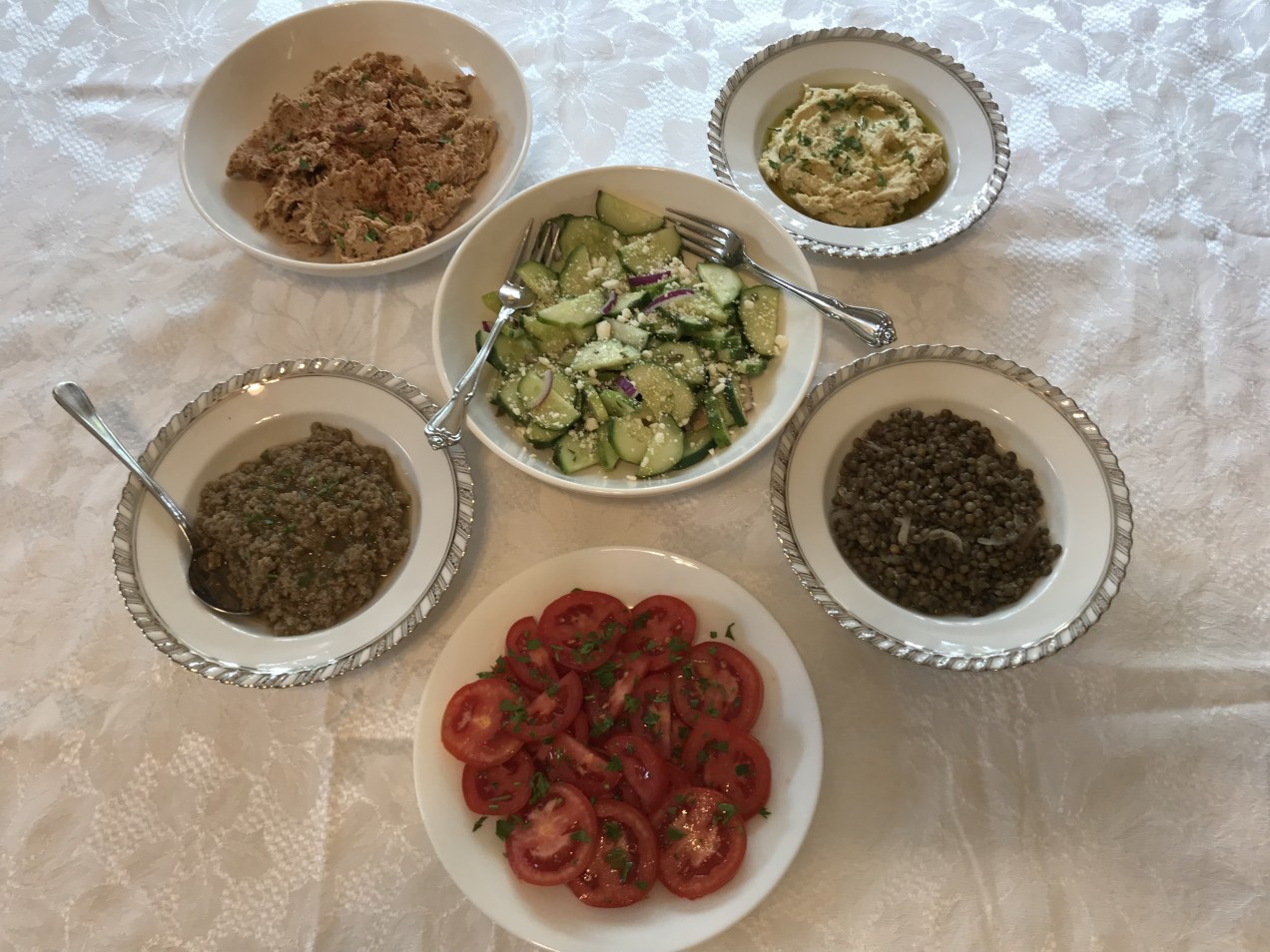
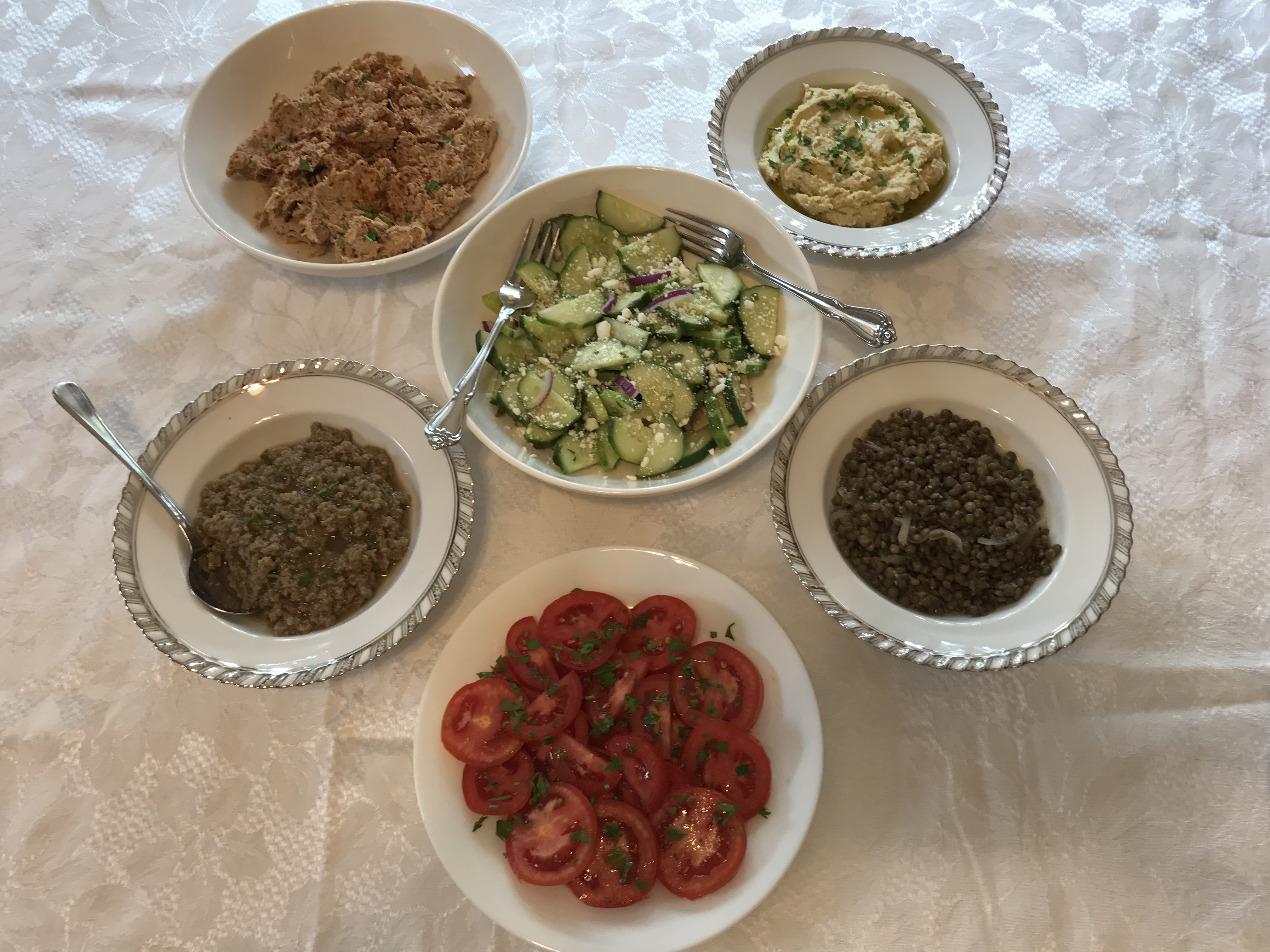
Menu: Hummus, Tahini Dip, Tomato Salad, Cucumber Salad, French-Style Lentil Salad, Turkish-Style Chicken with Walnut Sauce (last two recipes in subsequent posts)

            Just as Spain has tapas and Italy has antipasti, Greece and the Middle East have meze. Reading through Mimi Sheraton’s description of the different varieties in 1000 Foods to Eat Before You Die (on pages 498 – 500), it became abundantly clear they would be perfect for entertaining a crowd, particularly during the summer. Most of the common varieties are served cold or at room temperature, and so could be made ahead. Only a few need last minute cooking, and many require no cooking at all. For a barbecue, meze would be ideal to either nibble before the other food comes off the grill or to serve alongside the main dishes.

            Because meze are traditional over such a large area, with diverse landscapes, climates, and traditions, the variety is endless. Common options include olives, vegetable and legume salads, sausages, various dips like hummus or baba ghanoush, fish, stuffed grape leaves, fried items, tabbouleh, and phyllo pastry turnovers, alongside more local specialties. A large proportion of meze are flavored with lemon, garlic, olive oil, or fresh herbs.

            Meze usually serve as a leisurely meal on their own, so having a variety with some substantial dishes is important. So is plenty of pita bread. For a representative summer/early fall selection, I chose hummus (a classic and always a favorite), tahini dip (interesting on its own), tomato, cucumber, and lentil salads, and Cerkez tavugu (Turkish chicken with walnut sauce). As long as you have a food processor, this entire menu is easy to put together. It’s a good idea to make the hummus, tahini dip, lentil salad, and chicken dish a day ahead to allow time for flavors to meld.

To make hummus:

            Across the Middle East, hummus is frequently eaten as a main dish with pita bread. The idea makes perfect sense. Historically, people got much more protein from legumes like chickpeas than from meat. Comparatively speaking, the chickpeas and flavorings were relatively affordable staples. True connoisseurs say that the best hummus is made with a mortar and pestle, with dried chickpeas, but to save time, canned chickpeas and a food processor make a delicious, protein and vitamin-packed snack or meal.

            Ingredients:

  • 1 can chickpeas/garbanzo beans (about 15.5 ounces), drained
  • 4 cloves garlic (peeled, crushed with the side of a knife, and roughly chopped
  • ½ cup tahini (sesame seed paste)
  • Juice of ½ to 1 lemon
  • ¼ cup olive oil, plus more to drizzle if desired
  • Chopped parsley to garnish, if desired
  • Pita bread and/or vegetables, for serving

            Directions:

  1. Combine the chickpeas, garlic, tahini, and juice of ½ lemon in the bowl of a food processor with a pinch of salt. Process to make a thick, slightly gritty paste, scraping bowl as necessary.
  2. With the motor running, slowly add the olive oil through the feed tube. Once the oil is incorporated, taste for salt and lemon, adding more if necessary.
  3. Add water to thin hummus to the desired consistency. ¼ cup produces a thick paste, for a thinner paste, use ½ cup.
  4. Spoon hummus into a bowl. If desired, drizzle with olive oil and garnish with parsley, olives, roasted peppers, etc. (In the Middle East, pomegranate seeds are a popular garnish).
  5. Serve with pita bread and/or vegetables for dipping.

To make tahini dip:

            Tahini actually makes a fascinating, although distinctly bitter, dip on its own. Personally I prefer it sweetened for halva or used for hummus, but the bittersweet flavor is beloved across the Middle East. Here its flavor is further enhanced with garlic, salt, and lemon juice. All you have to do is crush 1 garlic clove with ¼ teaspoon salt in a mortar and pestle until it becomes a sticky paste. Stir the garlic paste into ½ cup of tahini, and mix in 2 teaspoons lemon juice and 2 tablespoons water. The paste will appear to “seize,” just keep stirring to smooth it out. Don’t add more water, which will make the oil separate out. Place in a bowl and serve with pita bread and/or vegetables (during the late summer and early fall, fresh carrots are particularly tasty).

To make tomato salad:

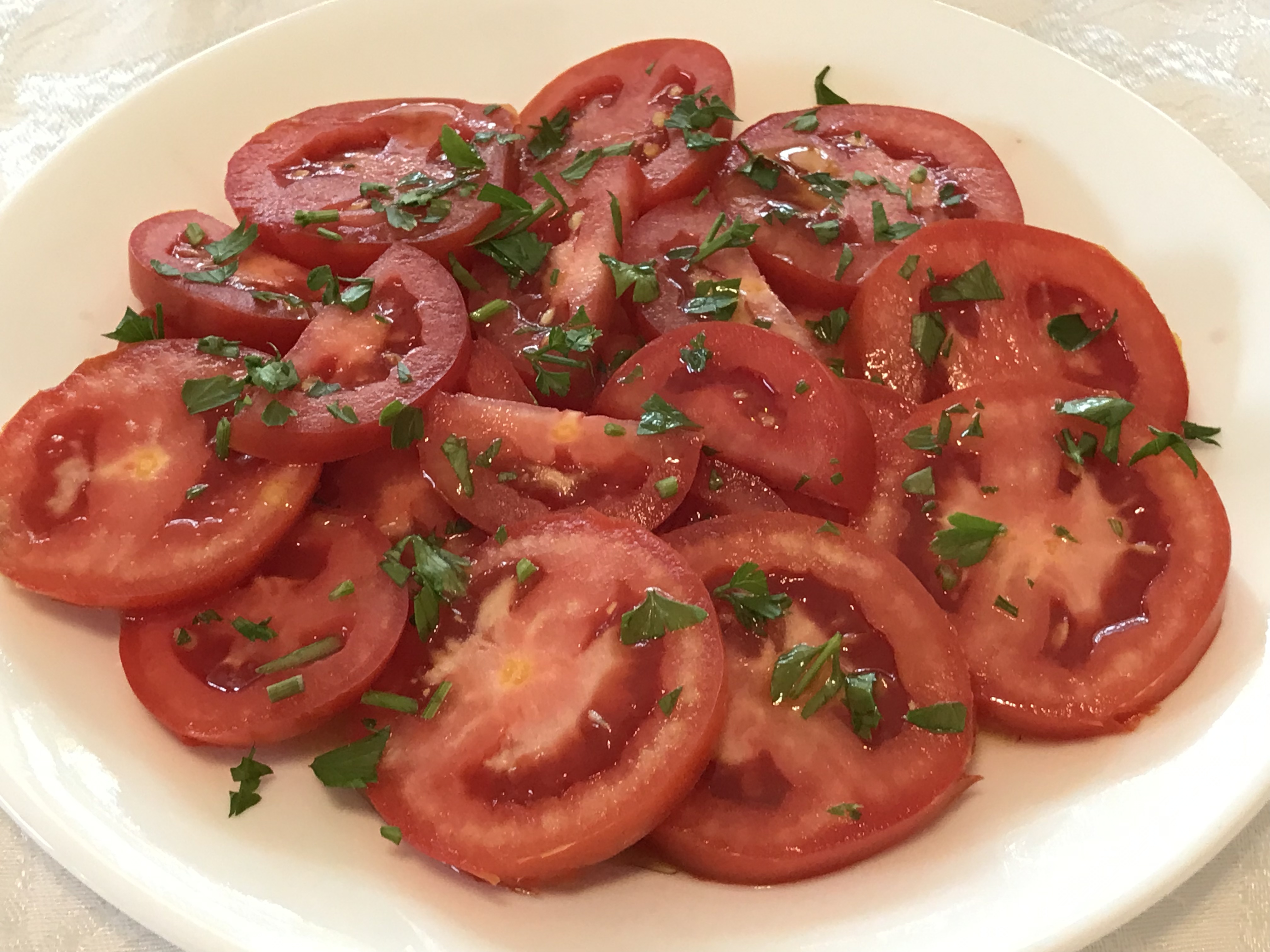
            First, make sure you have fresh seasonal tomatoes. If so, cut them into chunks or thin slices, place on a plate, drizzle with olive oil, salt and pepper to taste, and garnish with chopped parsley for a beautiful red and green effect. (If tomatoes aren’t in season, choose a different meze dish for the best flavor.)

To make cucumber salad:

            Cucumbers, with their mild flavor and high water content, are quite refreshing, which reminds me of a story I heard recently. During the early centuries AD, Christian ascetics competed with each other, seeing who could eat the least food, go the longest without sleep, and so on. This was particularly common in the deserts of Egypt and Syria. In one instance, an ascetic tested his resolve by sitting in the hot sun with a cucumber and seeing how long he could go without eating it. He lasted for several days (presumably he had some water), at which point I shudder to think of the condition of the cucumber.

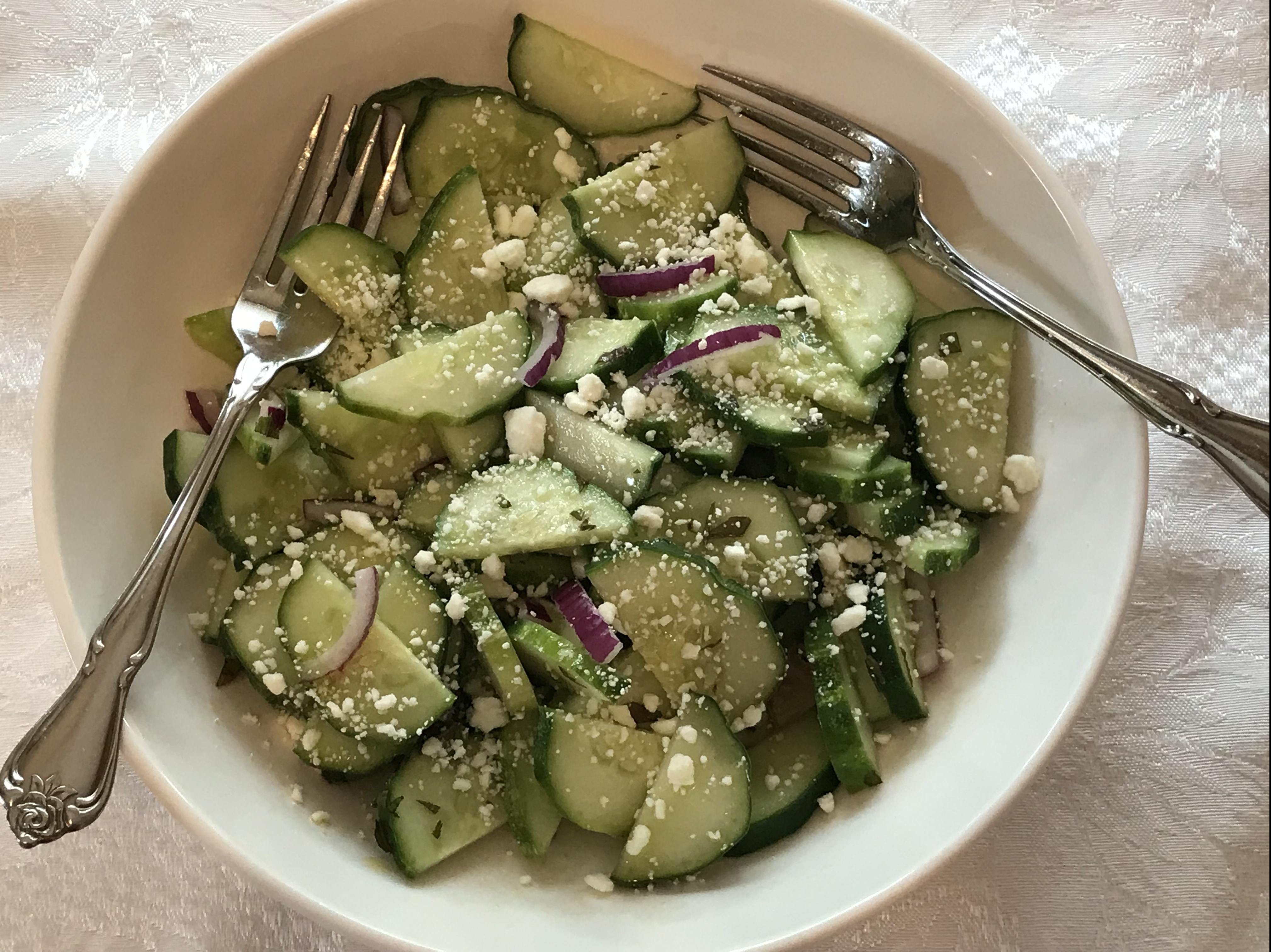
            For a better-tasting salad, use 2 large or 4 small cucumbers. Peel them if desired, and slice thinly. Toss with ¼ red onion, also thinly sliced, 2 tbsp olive oil, 1 tbsp red or white wine vinegar, and a few finely chopped mint leaves. If desired, add a few crumbles of feta cheese.

            Another common way to prepare cucumbers for meze is to combine with yogurt. Next time, I’ll have a recipe for green lentil salad, so be sure to subscribe.

One-Time
Monthly
Yearly

Make a one-time donation

Make a monthly donation

Make a yearly donation

Choose an amount

$5.00
$15.00
$100.00
$5.00
$15.00
$100.00
$5.00
$15.00
$100.00

Or enter a custom amount

$

Your contribution is appreciated.

Your contribution is appreciated.

Your contribution is appreciated.

DonateDonate monthlyDonate yearly
Standard
Scordolea - Balkan creamy walnut sauce
food history, recipes, sauce, vegetarian

Walnuts, Two Ways, Version 2: Scordolea (walnut sauce for cold chicken)

Scordolea, on cold chicken and sauteed zucchini

            When we left off with the history of the Balkans at the end of the 5th Century AD, most of the region was secure under the Eastern Roman Empire. The Huns vanished from history shortly after Attila’s death in 453, and the Germanic confederations had moved into the former Western Roman Empire. Meanwhile, the Eastern Empire became increasingly Greek. Justinian I was the last emperor to speak Latin and seriously attempt to reconquer the West, so after his death in 565, most scholars call the empire Byzantine, even though the term wasn’t used at the time. War against the Vandals in North Africa, Ostrogoths in Italy, Visigoths in Spain, and Persian Sassanids in Syria didn’t affect the Byzantine territory in the Balkans much. Even the Arab conquests of the 7th Century, which essentially cut imperial territory in half, were far away in Syria and Egypt.

            Pulling troops away to fight on the frontiers left the Balkans vulnerable, and in the 8th and 9th Centuries, new groups of peoples moved in, including nomadic Avars, Magyars, and Bulgars. Magyars settled in the Carpathian Basin and became Hungarian, while the Bulgars settled north and east of Greece. Eventually they adopted the language and customs of another new group, the Slavs, and became Bulgarian. Even Vikings made their way down the rivers of Eastern Europe to trade in Constantinople, though they didn’t stay.

            By 1000 AD, the Balkans were home to Greeks, Romanians (who continued to speak a language descended from Latin), Albanians, Hungarians, and Slavic-speaking Croatians, Bosnians, Serbians, and Bulgarians. Residents traded and exchanged ideas with Italian and German merchants. Over the next few centuries, Byzantine control weakened, particularly as most of their territory in modern Turkey was seized by the Seljuk Turks, originally from Central Asia. Hungary, Romania, and Croatia were never under Byzantine authority, and the non-Greek border regions broke away repeatedly. By the 14th Century, when the Ottoman Turks, descendants of the Seljuks, crossed the Bosporus into Europe, the Balkans was a patchwork of independent kingdoms.

            In the 1350s the Ottomans made their first incursion into Europe, gaining momentum in the 1390s. In 1453, the captured Constantinople, ending the Byzantine Empire. The emperor at the time, Mehmed II, was fascinated by the different lands and cultures under his control, and had a highly cosmopolitan court. He even hired Venetian painters to decorate his palaces. For the next 400 years, the Ottoman court and bureaucracy remained diverse. Among the cultural practices shared, food was one of them.

            Foods like phyllo dough and coffee were introduced by the Turks, and they loved their sweets and rosewater. Many of the dishes introduced during this time remained popular even after the Ottoman Empire declined in the 19th Century, often with a local twist. Such is the case with Scordolea. Where the walnut sauce originated is unclear, but variations were spread far and wide by the Ottomans. The main ingredients are walnuts, soaked stale bread, and garlic, usually. Occasionally, almonds replace walnuts, and in the most popular Greek version, usually spelled as skordalia, nuts are sometimes omitted and the bread replaced with potatoes.

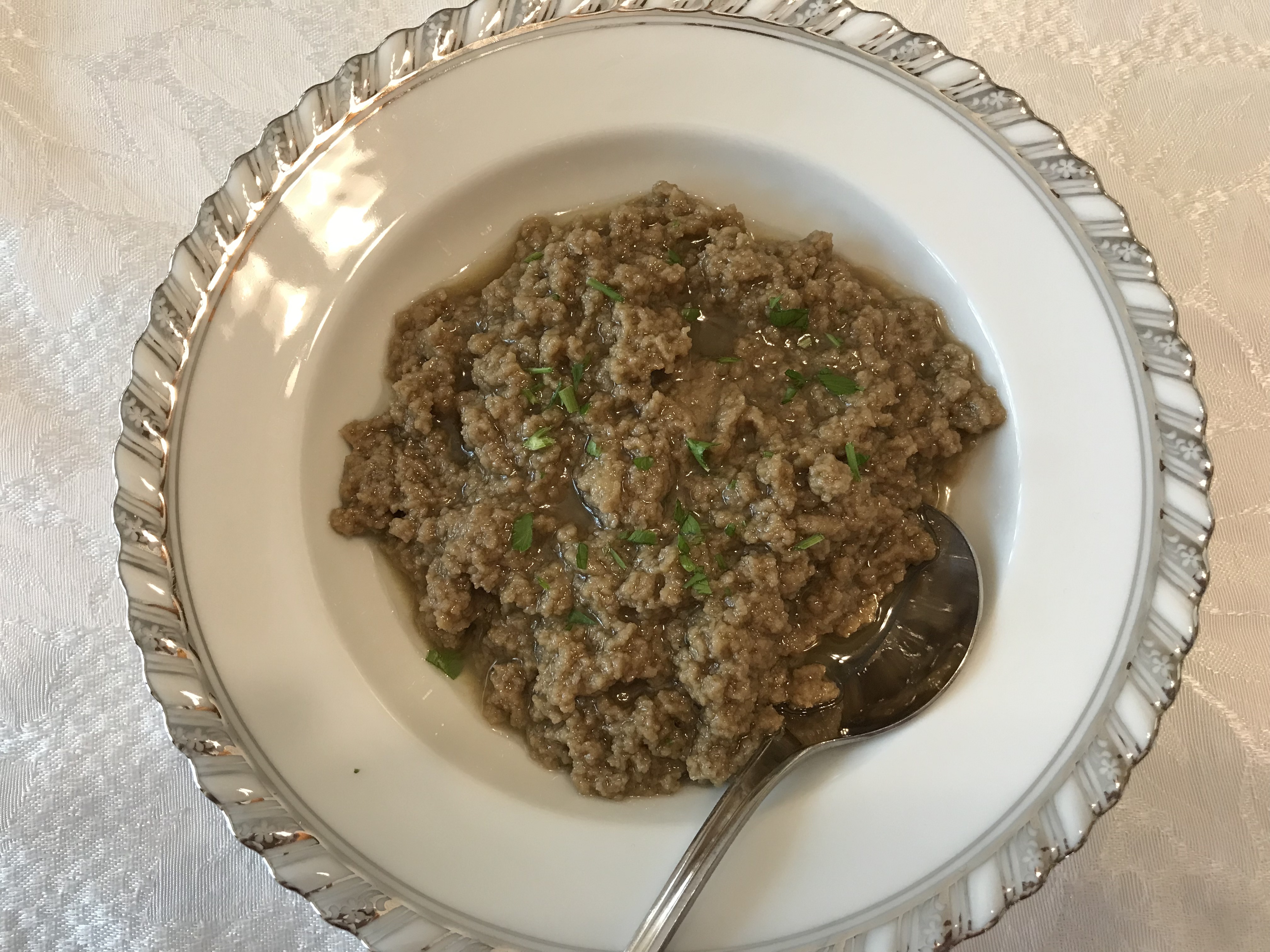
            Getting the recipe right involved some trial and error. At first, I used too many walnuts, not enough bread, and tried to thin the paste with oil rather than water, resulting in a broken emulsion. The paste was sticky, the oil collected on top, and the standard white supermarket bread, which I thought would be neutral, gave the sauce a distinctive flavor. It’s good with barbecue, grilled cheese, peanut butter, and as French toast, but not for this. I needed an unsweetened, less “squishy” white bread. Fortunately, the grocery store bakery carries such loaves at a reasonable cost.

            The second attempt had less walnuts, more bread and milk, and I made sure to drizzle the oil in slowly while the food processor was running. This scordolea had a nice balance of walnut and garlic flavors, with a hint of lemon, though it looked like thick cream of wheat on its own. A garnish of some parsley I picked for my brother’s rabbit and forgot to send home with him improved the presentation significantly.

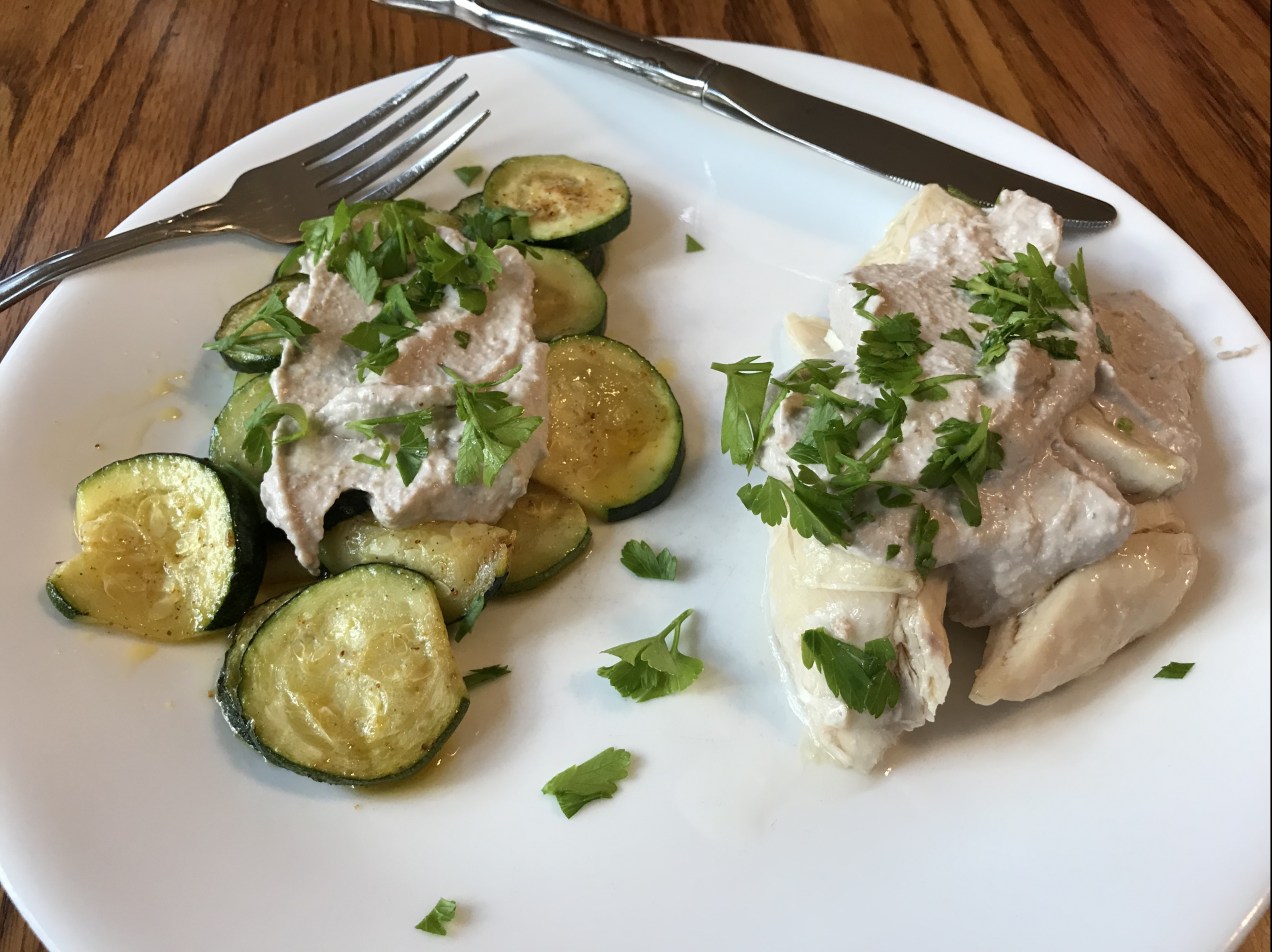
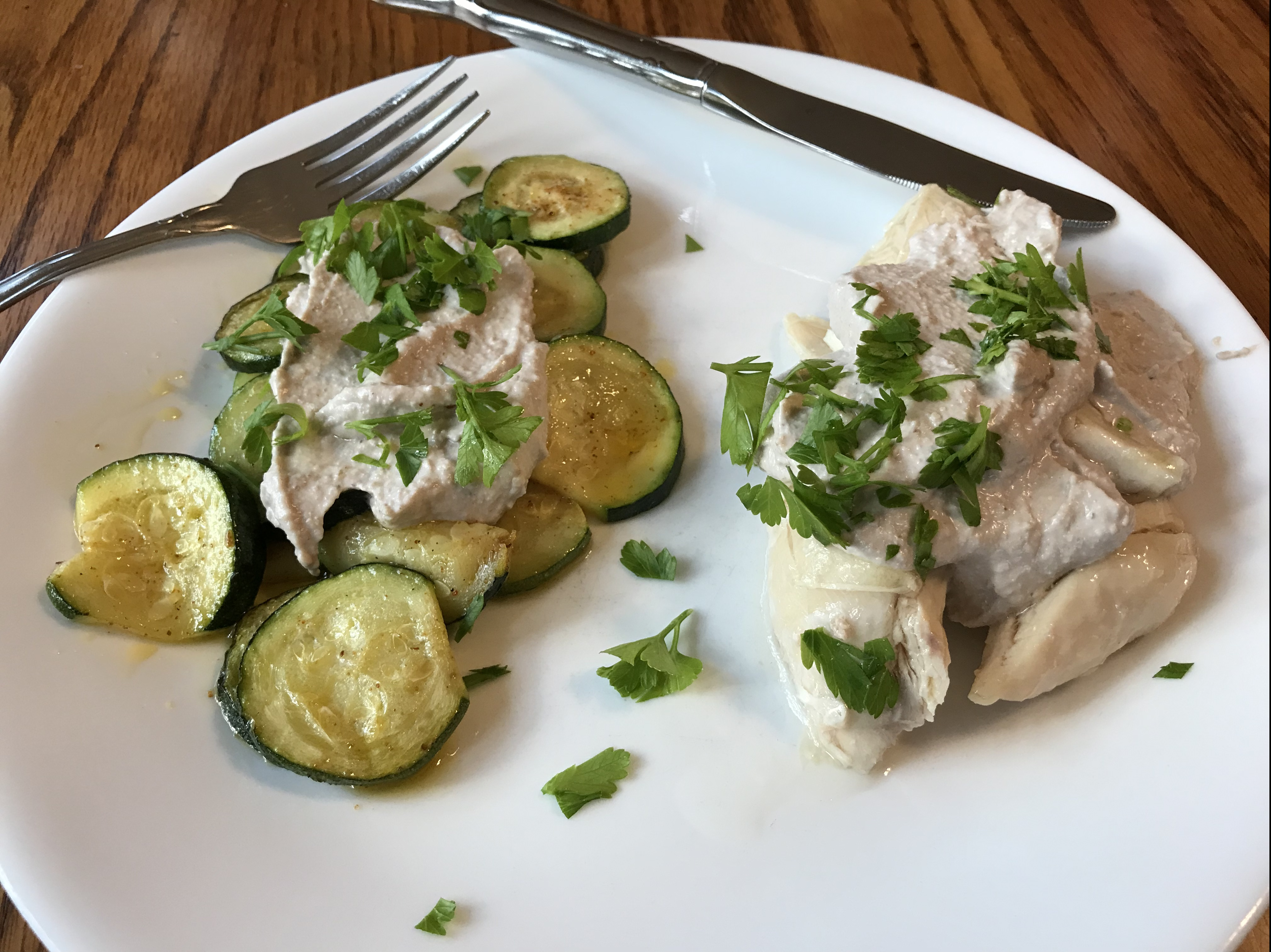
            Scordolea is eaten with a wide variety of foods. Since the sauce has its own strong, delicious flavor, it’s great for enhancing neutral-tasting foods, in this case, cold chicken and sauteed zucchini. Pretty much any affordable, easy-to-cook staple is transformed by scordolea. It is easy to see why Mimi Sheraton classified it as one of her 1000 Foods to Eat Before You Die in the book by the same name.

            Ingredients:

  • 1 cup walnuts
  • 2 slices good-quality bakery white bread, crusts removed
  • ¼ cup milk
  • 2 garlic cloves, peeled, crushed with the side of a knife, and coarsely chopped
  • Juice of ½ lemon
  • ¼ cup olive oil
  • Chopped parsley, for garnish
  • Cooked chicken, seafood, vegetables, or anything else you would like to eat with the sauce

            Directions:

  1. Place the bread slices in a bowl and drizzle the milk over them. Let the milk absorb for at least 5 minutes.
  2. Place the walnuts in a dry skillet over medium heat. Cook, shaking pan occasionally, until the nuts smell toasty. This won’t take more than a few minutes, so watch carefully.
  3. Put the toasted nuts into the food processor, pulse a few times, then add the bread, any extra milk from the bowl, the garlic, and a pinch of salt. Process to form a smooth paste.
  4. Add the lemon juice to the walnut paste and process until blended.
  5. With the motor running, slowly add the olive oil through the food processor’s feed tube to incorporate. Taste for salt, adding more if necessary.
  6. Run the motor again, and slowly add about ¼ cup water to thin the sauce. It should be on the thick side, but for a thinner sauce, slowly add more water until the desired consistency is reached.
  7. For serving, garnish the scordolea with chopped parsley. Serve with your desired protein and/or vegetables.

            And as always, subscribe for free posts and recipes, sent right to your inbox.

One-Time
Monthly
Yearly

Make a one-time donation

Make a monthly donation

Make a yearly donation

Choose an amount

$5.00
$15.00
$100.00
$5.00
$15.00
$100.00
$5.00
$15.00
$100.00

Or enter a custom amount

$

Your contribution is appreciated.

Your contribution is appreciated.

Your contribution is appreciated.

DonateDonate monthlyDonate yearly
Standard
Tarator - Balkan cucumber walnut dip or soup
food history, recipes, summer, vegetarian

Walnuts, Two Ways, Version 1: Tarator (Balkan walnut/cucumber soup)

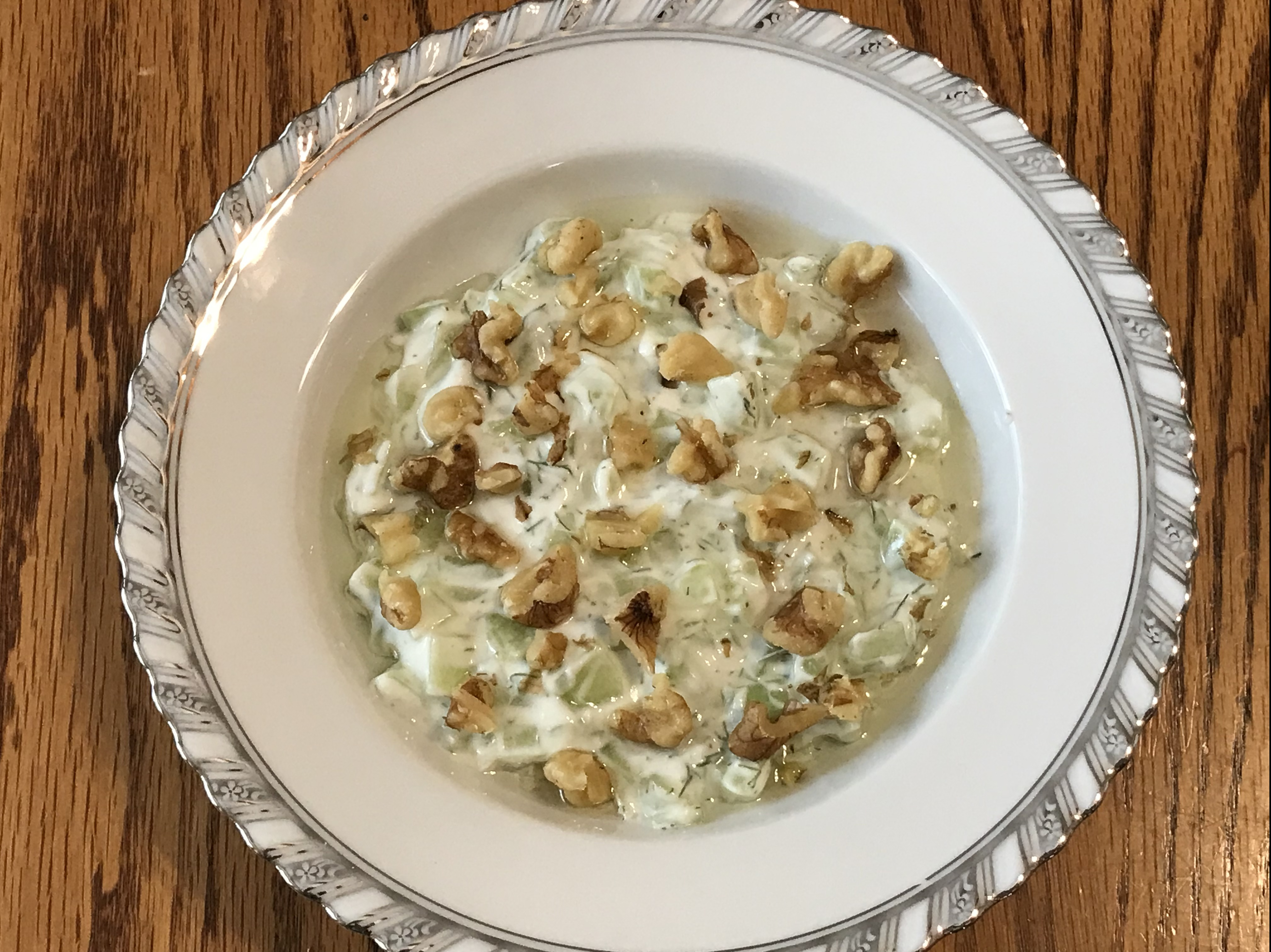
Tarator, a cucumber-walnut “soup” from the Balkans

            The Balkans, or the southeastern corner of Europe south of the Danube and west of the Black Sea, has a fascinating and often tumultuous history. Fertile valleys and plains, broken up by various hills and mountains, were home to numerous ancient civilizations – Greeks, Illyrians, Dacians, Scythians, and Sarmatians. The Persian Achaemenids tried to expand their empire here just before and after 500 BC. During the 3rd Century BC, there was even a brief Celtic incursion.

            The Romans were the first outside power to conquer and hold the Balkans. From the 2nd Century BC to the 5th Century AD, they both absorbed and influenced local cultures. Wealthy Romans were fascinated by Greek civilization, and many of the non-Greeks began to speak Latin. Anyone who spoke Latin or Greek and adopted Greco-Roman customs (which fused together somewhat during this time) could become a citizen, and many of the local people did. During the later Roman Empire, two of the most influential emperors, Diocletian and Constantine the Great, came from the Balkans, probably around modern-day Serbia.

            From the 3rd Century AD onward, new waves of invaders entered the Balkans. The first were the Germanic Goths, who were eventually pushed back, but not before killing Emperor Decius in battle in 251 (Decius was also from the region, by the way). After abandoning the province of Dacia in modern-day Romania, the Romans secured the Danube frontier for another century, when various Germanic confederations pushed into the Balkans again, fleeing from the Huns. The Goths were back, accompanied by the Vandals and others.

            What happened next was complicated, but basically went as follows. The leader of the Goths, named Fritigern, asked the Romans if his people could settle in the Empire in exchange for military service. The Romans, facing manpower shortages, agreed, but then broke their word and mistreated the Goths, which led them to revolt. After they killed another emperor, named Valens, in battle in 378, the Romans eventually honored their agreement. Over the next decades, Germanic troops made up more and more of the army.

            After the Empire was divided for good in 395 AD, most of the Balkans became part of the Eastern Roman Empire. Through a combination of better leadership, greater wealth, and a shorter frontier, the Eastern Empire was able to force/bribe the Germanic groups to leave. These Goths, Vandals, etc. then headed west and dismantled the Western Roman Empire. After the Eastern Empire teamed up with the Western Empire and the Goths against the Huns in the 450s, the last “barbarian” group in the Balkans was the Ostrogoths, or Eastern Goths. The emperors sponsored sending them to Italy in the 490s to drive out the Visigoths, or Western Goths, and no Germanic confederations tried to invade the Balkans again. But that did not mean the region was safe, as I will explain in the next post.

            With so many diverse cultures coming and going, along with a favorable climate with plenty of sunshine and rain, the food in the Balkans became just as diverse. Records indicate that the Dacians grew wine grapes. The Romans, who valued fresh produce, either introduced or improved a variety of fruits and vegetables. They were known to enjoy cucumbers, which make up the base of tarator.

            In 1,000 Foods to Eat Before You Die on page 381, Mimi Sheraton suggests 3 ways to prepare walnuts, which have grown in the Balkans for millennia. One of those methods is an egg salad called aselila. Even with a walnut-based dressing replacing mayonnaise, the hard-boiled eggs are a non-starter for me. The walnut and cucumber mix sounds a little like tzatziki sauce, with cucumbers, yogurt, garlic, and dill. It is finished with a bit of sunflower oil and chopped walnuts. The whole idea seems a bit odd as a soup, but pretty good as a dip, so I made my recipe thicker.

            Preparation is simple. There are two tricks to get the best results. First, toss the diced or grated cucumbers with salt and let drain for an hour to remove excess moisture that might otherwise make the dip watery. Second, the garlic needs to be crushed with salt, but there is not enough of it to do so in a food processor. A mortar and pestle work best. Once this is done, combine with the yogurt and dill and let sit until the cucumbers are finished draining, so the flavors can infuse.

            Ingredients:

  • 2 large or 4 small cucumbers, peeled, seeded, and diced or grated (I like diced for more texture)
  • 1 ¼ teaspoons coarse salt
  • 2 garlic cloves, peeled, crushed with the side of a knife, and coarsely chopped
  • 1 cup whole milk plain yogurt (doesn’t have to be Greek yogurt, just make sure not to use low-fat or fat-free)
  • A few sprigs dill, minced after removing any tough stems, or ½ teaspoon dried
  • Sunflower oil, to drizzle
  • Coarsely chopped walnuts, to garnish

            Directions:

  1. Toss the cucumbers with one teaspoon of the salt and place in a colander to drain for an hour.
  2. Place the garlic and remaining salt in the bowl of a mortar. Work with the pestle until a sticky, mostly smooth paste forms. A few lumps of garlic are fine.
  3. Combine the yogurt, garlic paste, and dill in a bowl and allow to sit until the cucumbers are finished draining. Add the cucumbers to the yogurt mixture and discard the liquid.
  4. Place the cucumber-yogurt mixture in a serving bowl. Drizzle with the sunflower oil and sprinkle liberally with the chopped walnuts.
  5. Serve the dip with pitas, other bread, or crackers.

            Tarator seems odd as a soup, but as a dip, it’s fantastic. It sort of tastes like non-sour dill pickles, but creamy. Considering that tarator uses the same flavorings of salt, garlic, and dill, it makes perfect sense. The yogurt, sunflower oil, and chopped walnuts make it more substantial, so it could almost be a hot-weather meal on its own with pitas.

One-Time
Monthly
Yearly

Make a one-time donation

Make a monthly donation

Make a yearly donation

Choose an amount

$5.00
$15.00
$100.00
$5.00
$15.00
$100.00
$5.00
$15.00
$100.00

Or enter a custom amount

$

Your contribution is appreciated.

Your contribution is appreciated.

Your contribution is appreciated.

DonateDonate monthlyDonate yearly
Standard
food history, french cuisine, recipes, stew, vegetarian

Ratatouille + Recipe

Ratatouille, not made by rats

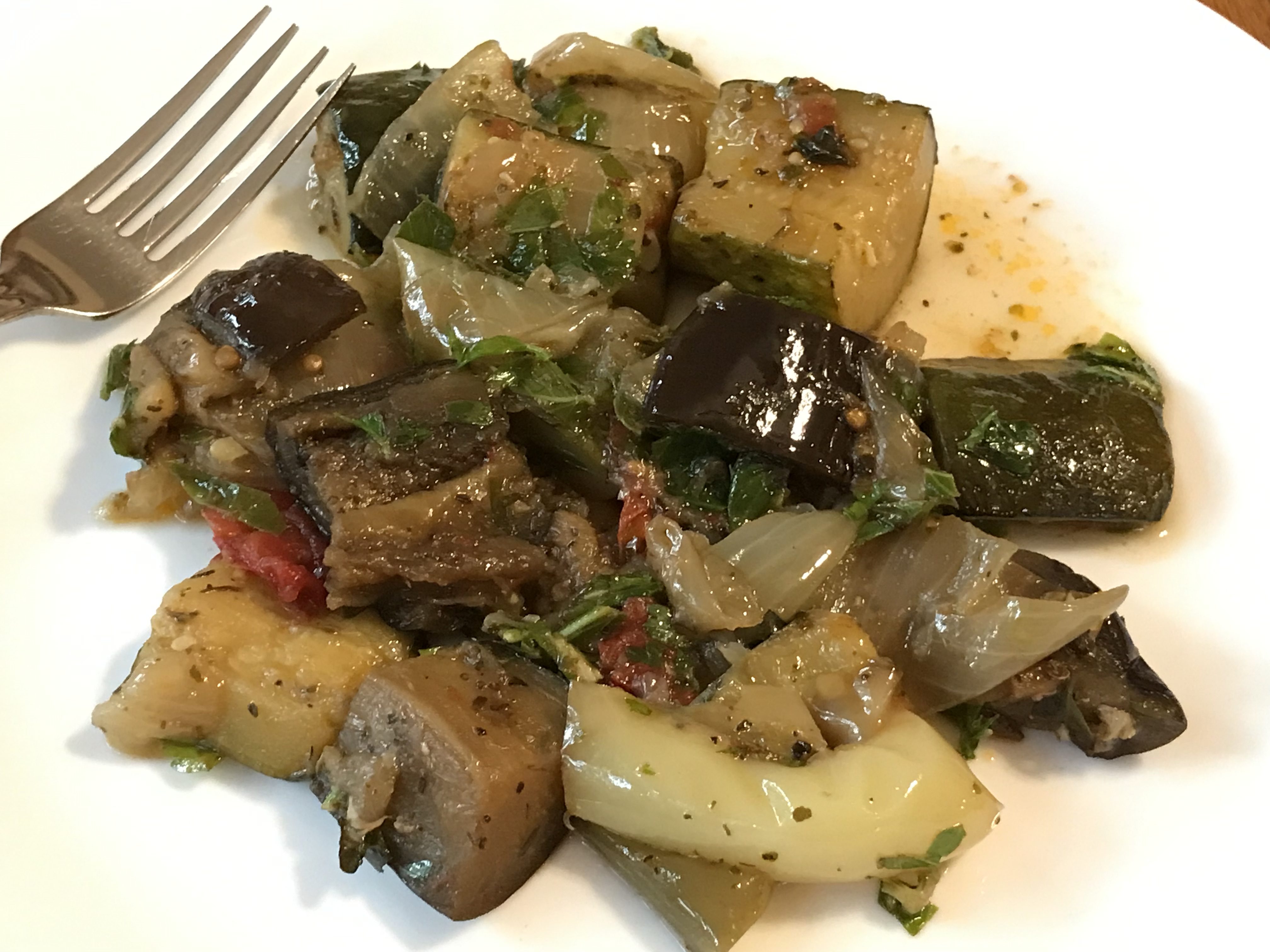
            Let’s revisit another late summer dish I made last year. Ratatouille, a rustic vegetable stew hailing from the same region of Southern France as soupe au pistou, is even easier to make. Mimi Sheraton describes it as one of 1,000 Foods to Eat Before You Die in the book of the same name. Unlike some of the foods in the book, no travel or specially ordered ingredients are required. It’s just vegetables commonly available at the store or farmer’s market, served with bread, pasta, or alongside meat, if desired.

            Many of the same ingredients, like eggplant, zucchini, tomatoes, garlic, and olive oil, are combined in similar ways all around the Mediterranean. One example is the Sicilian caponata, which also includes capers, vinegar, and typically celery. But you don’t have to be anywhere near the Mediterranean to enjoy ratatouille. Just make sure to make it in the summer, when the vegetables are at their best (and most affordable).

            Note that ratatouille can be baked in the oven, and many recipes use that method. I prefer the stovetop because it heats the kitchen less. Like most stews, ratatouille reheats very well, and leftovers make a great omelet filling.

            Ingredients:

  • 1 medium eggplant, cut into 1-inch cubes, tossed with 1 teaspoon salt, and left to sit for half an hour
  • 2 medium zucchini, sliced into roughly half-inch thick rounds
  • 1 green bell pepper, coarsely chopped
  • 1 yellow onion, coarsely chopped
  • 4 Roma tomatoes, coarsely chopped
  • 6 cloves garlic, peeled, crushed with the edge of a knife, and minced
  • ½ cup olive oil
  • 4 sprigs parsley, thick stems minced separately from leaves
  • 4 fresh basil leaves or more to taste, left whole until needed

            Directions:

  1. Combine the eggplant, zucchini, bell pepper, onion, tomatoes, garlic, olive oil, and minced parsley stems in a large pot with 2 tablespoons water.
  2. Bring to a simmer over medium low heat, then cook, stirring occasionally, for about 30 to 35 minutes.
  3. Mince the basil and add to the pot with the parsley leaves. Taste for salt, adding more if necessary, then simmer for 10 more minutes.
  4. Serve the ratatouille with bread, pasta, grilled meat, or all of the above. Sprinkle with additional parsley if desired.

            Eating the ratatouille while watching the movie of the same name is encouraged. It isn’t weird, I promise. For more recipes, subscribe below for free. And if you’re feeling extra generous and would like to support my work, I would be most grateful.

One-Time
Monthly
Yearly

Make a one-time donation

Make a monthly donation

Make a yearly donation

Choose an amount

$5.00
$15.00
$100.00
$5.00
$15.00
$100.00
$5.00
$15.00
$100.00

Or enter a custom amount

$

Your contribution is appreciated.

Your contribution is appreciated.

Your contribution is appreciated.

DonateDonate monthlyDonate yearly
Standard
food history, french cuisine, recipes, soup, stew, vegetarian

French Summer Vegetable Soup: Soupe au Pistou

Soupe au pistou, a southern French classic

            Last summer, in my exploration of 1000 Foods to Eat Before You Die by Mimi Sheraton, I made my own version of soupe au pistou, a southern French soup loaded with summer vegetables, and loved it. Now that it’s August and vegetables are at their peak, I made it again and recorded my recipe. Southern France is quite different from Paris, Normandy, Brittany, and the other northern regions, in climate, culture, and food. If a trip isn’t in the cards for the near future, some of the local cuisine will help us both imagine it. Maybe it will happen someday, but for now, think of rolling hills, olive trees, and enjoy the lack of crowds.

            Note that you can switch up the vegetables depending on what you like or have on hand. Just make sure to include tomatoes, onions, potatoes, white and green beans, pasta, and of course the pistou. Beyond that, feel free to add a sprinkle of cheese, or switch out the angel hair for other pasta, adjusting cooking time accordingly.

            Ingredients:

  • 8 ounces (about 1 ½ cups) navy or other small white beans, soaked and drained according to package directions
  • 1 onion, quartered and thinly sliced
  • 8 tablespoons (equal to ½ cup) olive oil
  • 2 Roma tomatoes, coarsely chopped
  • Salt
  • 6 small red or other waxy potatoes, cut into roughly ½ inch cubes
  • 2 carrots, sliced crosswise with the larger pieces cut in half
  • 2 zucchini, halved lengthwise and thinly sliced
  • 4 ounces green beans, cut into roughly 2-inch pieces
  • 4 ounces angel hair pasta, broken into roughly 2-inch pieces
  • 4 large cloves garlic, peeled and crushed with the side of a knife blade
  • 80 fresh basil leaves, about 2 cups loose
  • Grated parmesan cheese, if desired
  • Sprig of parsley, if desired

            Directions:

  1. Heat the olive oil in a large pot over medium heat. When hot, add the navy beans, onion, and a pinch of salt and sauté until the onions take on some color, stirring occasionally.
  2. Add the tomatoes and cook, stirring a few times, until they begin to break down.
  3. Add just enough water to cover the beans and vegetables and bring to a boil, then reduce heat to simmer. Cook with the lid tilted for 30 minutes, adding more water if necessary.
  4. Add the potatoes, carrots, another pinch of salt, and more water to cover the new additions. Simmer for another 30 minutes.
  5. For the pistou, combine the basil, garlic, ½ teaspoon salt, the remaining 4 tablespoons of olive oil, and, if desired, a bit of parmesan and a sprig of parsley, in a food processor and blend until smooth. It won’t look like a large amount, but a little goes a long way.
  6. Test the white beans. If they are soft, add the zucchini and green beans and taste for salt, adding more if necessary.
  7. Increase the heat to medium and cook for 5 minutes, add the angel hair, and cook for another 3 minutes. Serve the soup with the pistou and optional cheese.

            For more seasonal, global, and historical recipes, make sure to subscribe for free. Of course, if you want to donate and buy me some virtual vegetables, I’m not about to complain.

One-Time
Monthly
Yearly

Make a one-time donation

Make a monthly donation

Make a yearly donation

Choose an amount

$5.00
$15.00
$100.00
$5.00
$15.00
$100.00
$5.00
$15.00
$100.00

Or enter a custom amount

$

Your contribution is appreciated.

Your contribution is appreciated.

Your contribution is appreciated.

DonateDonate monthlyDonate yearly
Standard