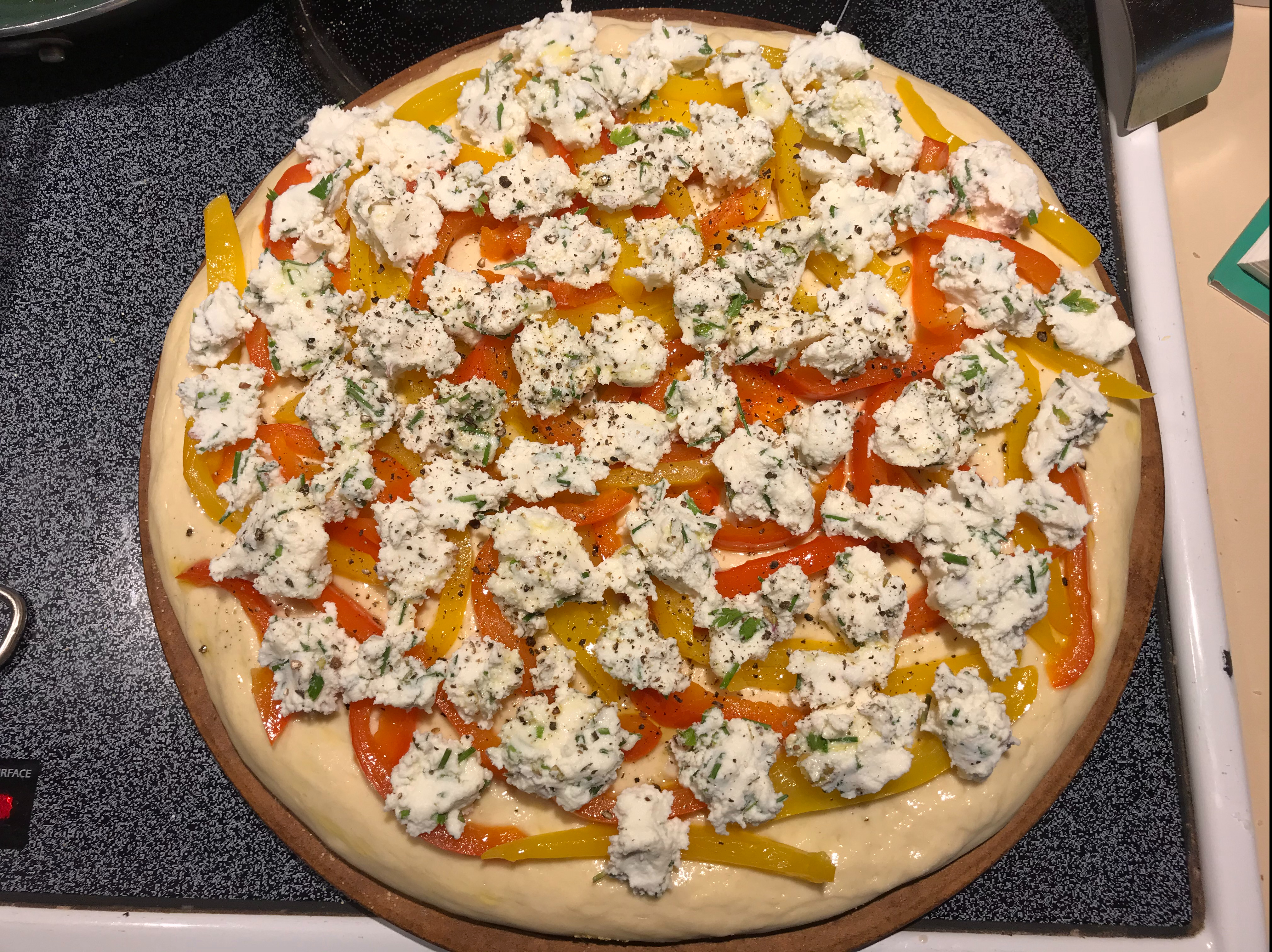
Finally, we have one of the most iconic Italian dishes: a pizza. Three pizza recipes are featured in the text, but none of them are the stereotypical takeout or delivery staple. None of these recipes have tomato sauce, pepperoni, or sausage, and only one of them has mozzarella cheese. Not that there is anything wrong with the American staple, far from it, but it is nice to have a change of pace from time to time. In this case we have pizza dough topped with garlic-infused oil, sauteed bell peppers, and ricotta salata mixed with herbs.
Pizza is an interesting dish with an unclear history. As discussed in the text on page 224, it does not have any special meaning and was originally commoners’ food. Bread dough with a few toppings to make it more interesting seems to have been around for hundreds of years if not longer, but perhaps because it was the food of peasants and poor urban dwellers, it was not written down. The earliest mention of it that I have found is an aristocratic recipe for a sweet dough with marzipan and crushed cookies from the 16th Century. Perhaps in the past the definition of pizza was broader than it is today. At any rate, the story goes that pizza became “respectable” in the 19th Century when a chef created the original “Pizza Margherita” for the queen at the time, Margherita of Savoy. From there, it’s popularity only grew.
While not quite as fast as takeout or delivery, this recipe is not particularly difficult. Most of the time required is in kneading the dough and letting it rise. A stand mixer with a dough hook saves a lot of time and mess for the first part. While it’s rising, there’s plenty of time to assemble/prepare the other ingredients and make the garlic oil, if there isn’t some already made from a previous pizza (the recipe makes enough for several). There are only two real tricks here. First, make sure the water is not too hot when adding it to the yeast. If it is, it will kill the yeast and the dough won’t rise properly. Second, infuse the garlic in the oil over very low heat to prevent the garlic from scorching and imparting that flavor to the finished product.
Since I could not find ricotta salata anywhere near me, I tried to make my own by mixing ricotta cheese with some extra salt, wrapping it in cheesecloth, and pressing it between two plates for a few days. The idea was to squeeze out some of the excess moisture, ideally enough to make the cheese firm and able to be grated. That didn’t quite work out as planned. Some moisture was soaked up by the cheesecloth, but the texture didn’t change significantly. I went ahead with the recipe anyway. Rather than mixing the herbs with the grated cheese, I just stirred them into the soft cheese and called it good. As there was no sprinkling this over the top of the pizza, I spaced globs of it on there as evenly as I could and hoped for the best.
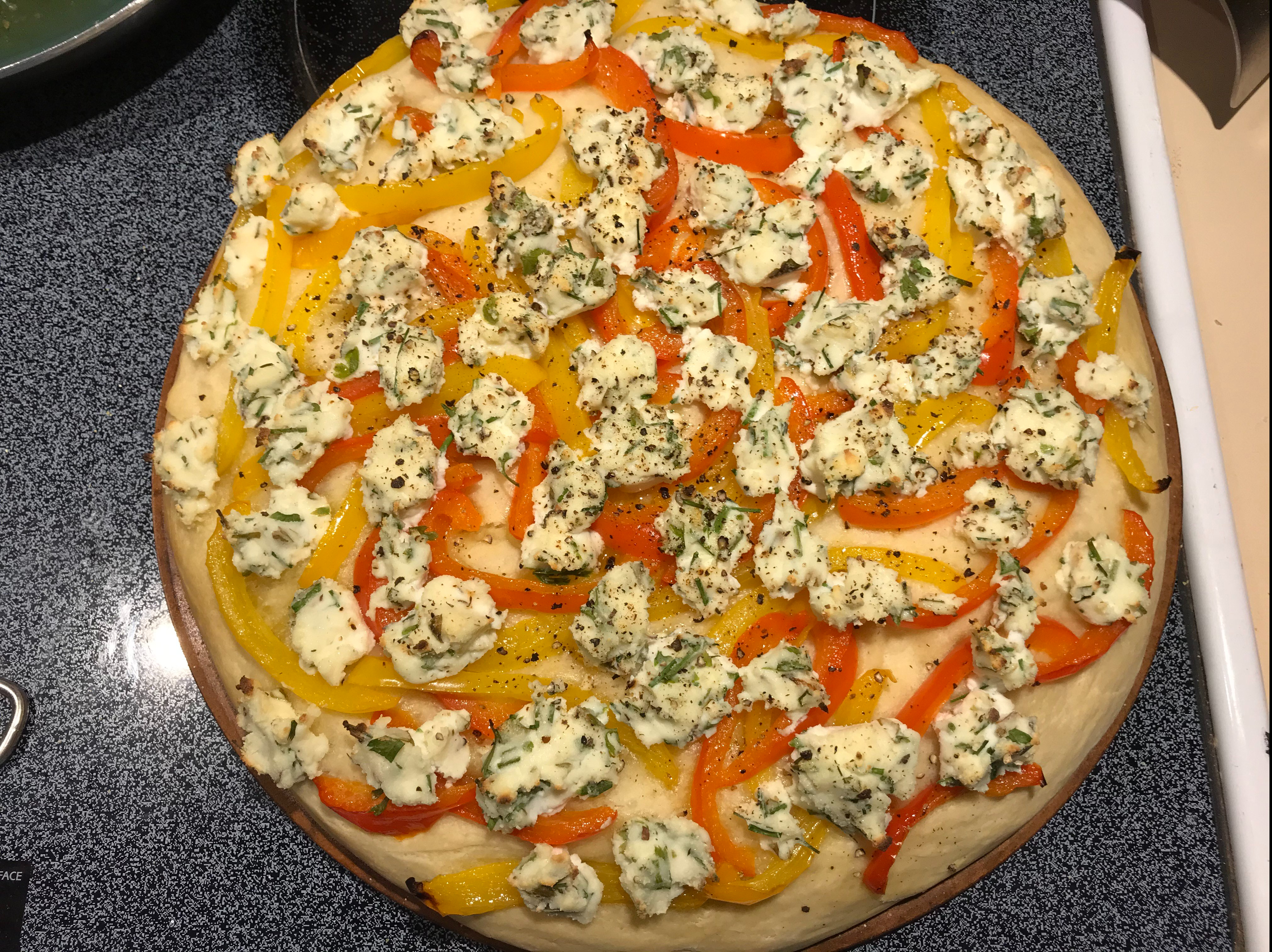
The finished product
The cheese didn’t spread out over the surface as I thought it might, but the pizza was still delicious. The crust crisped up well on the pizza stone, the garlic flavor was clearly there but not overpowering, and the outside parts of the cheese globs browned a bit for added flavor. At some point it would be nice to try this with actual ricotta salata, but in the meantime, the modified version is more than worth making again.
Menu: Fresh Asparagus Soup, Ricotta Gnocchi with a Light Picante Tomato Shrimp Sauce, Cubes of Butternut Squash with Cinnamon, Stewed Figs with Ice Cream
Recommended Wine: Muller-Thurgau from Trento, a Yellowish Fruity White
We now return to the mainland of the Veneto region, famous for a variety of fruits and vegetables (text, page 132). Fitting with that theme, this menu features asparagus, butternut squash, and figs, prepared in interesting ways. Asparagus soup is thickened with semolina flour, and steamed squash is served with butter and cinnamon. In the original recipe, fresh figs are drizzled in kirsch, but since I could not find either of those items, I adapted by stewing dried figs in cherry juice and serving them over ice cream. While not like the original, this adaptation retained the flavors of figs and cherries.
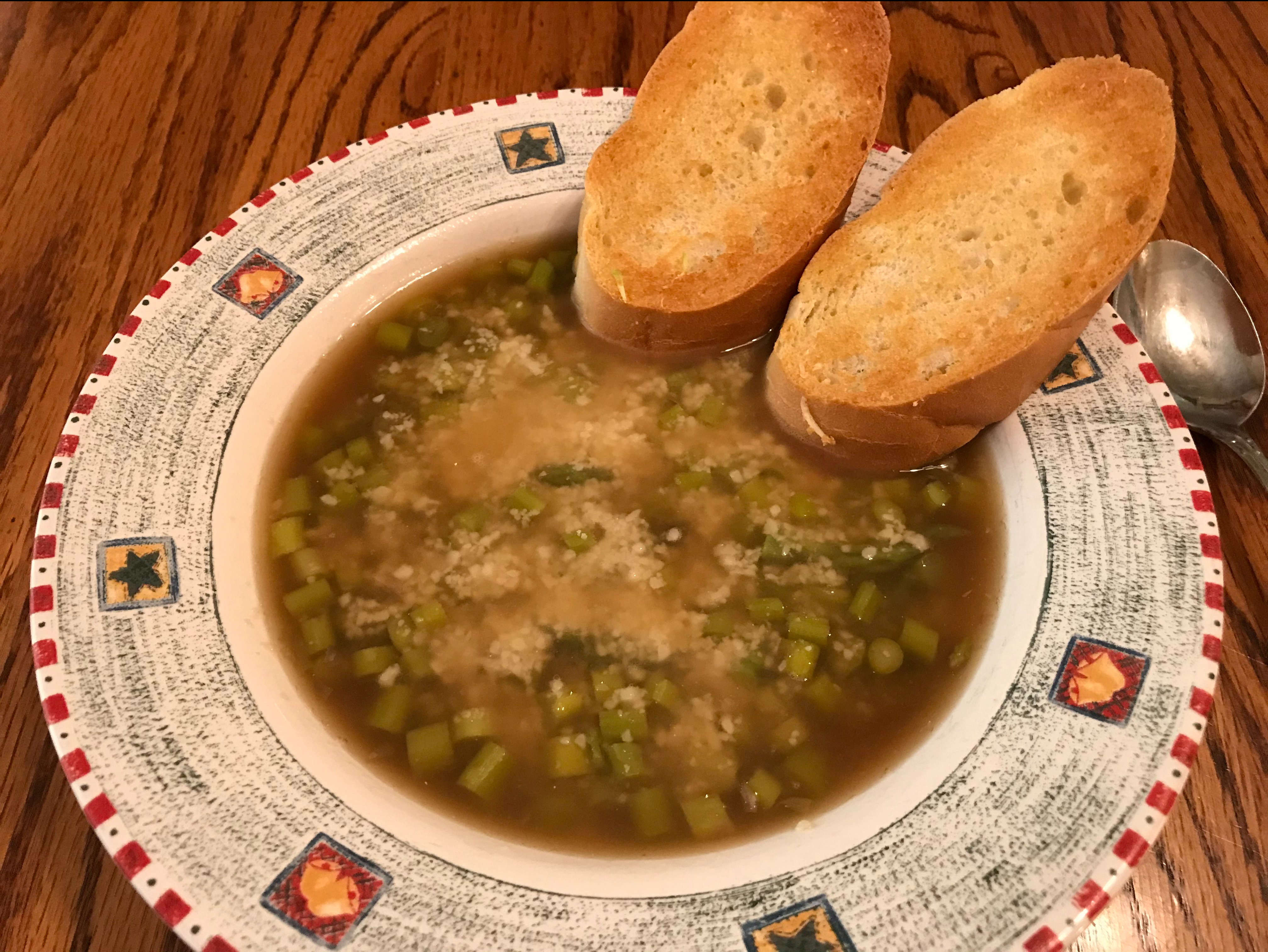
The soup is composed of just five ingredients: chicken and beef broth, semolina flour, thinly sliced asparagus, and grated parmesan cheese. Just bring the broth to boiling, add the semolina and let it cook, stirring occasionally. Once that’s thickened, add the sliced asparagus stems, and after a few more minutes, add the tips. Serve with a sprinkle of parmesan cheese and the recommended piece of garlic-rubbed toast. The squash is even simpler: just cube, steam, drizzle with melted butter, and sprinkle with cinnamon.
Asparagus soup
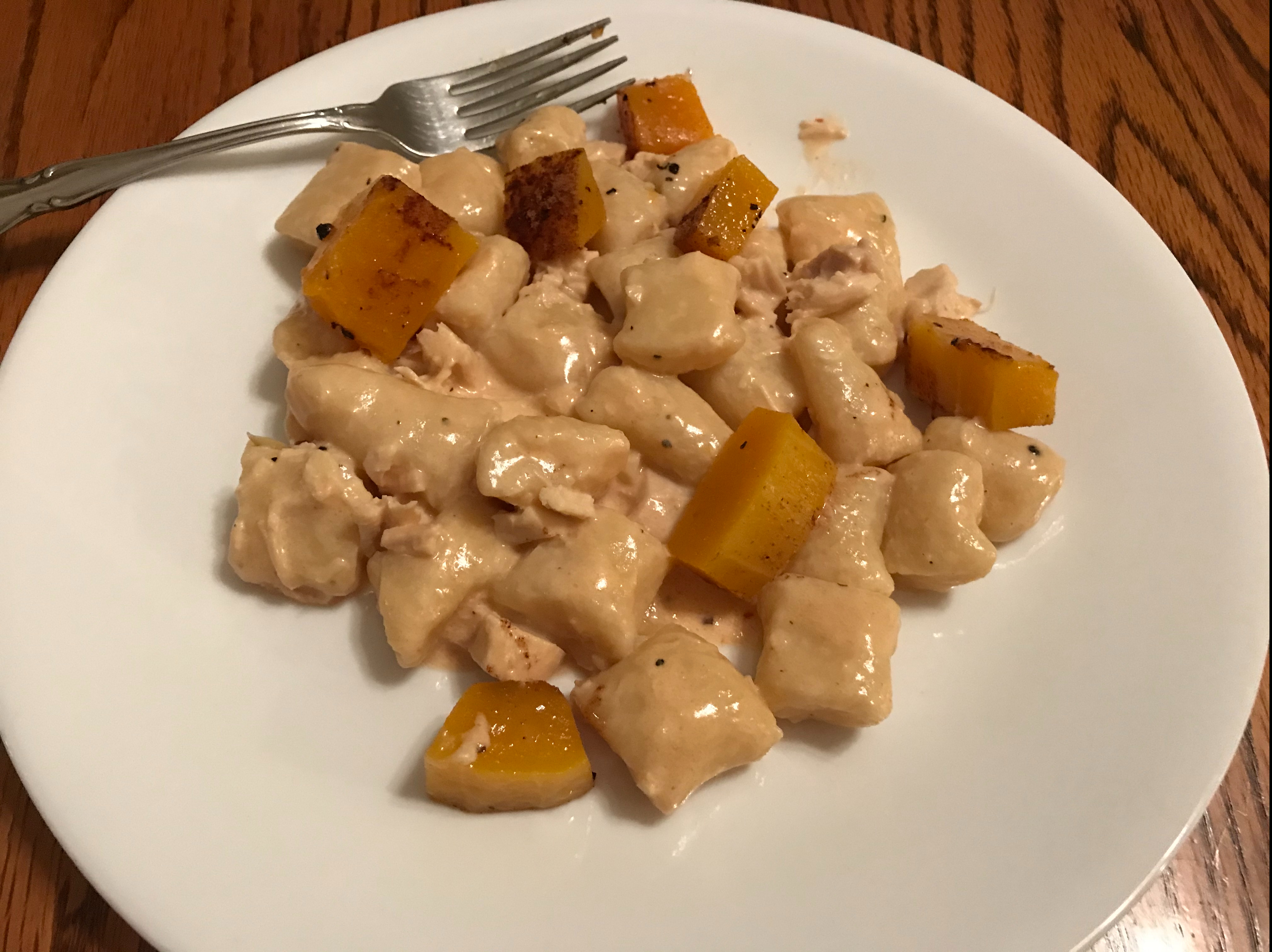
The gnocchi were a bit more complicated to make, but not overly so. It’s possible to mix up the dough ahead of time, then just roll it out and cut it just before cooking. Contrary to its name, the sauce is not very spicy. A creamy base is flavored with a bit of onion, garlic, and red pepper, with a bit of tomato paste providing a lovely color. In an attempt to appeal to pickier diners, I did modify the recipe somewhat. The actual recipe calls for adding some fish broth and bouillon to the cream sauce, along with chopped cooked shrimp. For convenience and broader appeal, I used chicken broth and leftover rotisserie chicken. The pickier diner still didn’t care for it, but it was worth a try.
Squash and gnocchi
None of this was difficult to make, and with the exception of gnocchi, it was not particularly time-consuming either. While the soup simmered and squash steamed, there was plenty of time to cook the gnocchi and make the sauce. Even better, this time I managed to time things right and we could enjoy the food in the order it’s supposed to be eaten in.
Stewed figs and ice cream
I’ve never seen a soup thickened with semolina before, but it worked really well to add a bit of extra body without diluting the asparagus flavor. The gnocchi tasted kind of like homemade mac and cheese in little dumplings, with a creamy, chickeny sauce. These were especially good alongside the sweet, buttery squash. The figs were a nice closing to the dinner. The tartness from the cherry juice acted as a bit of a palate cleanser, while the sweetness from the figs and ice cream kept it from being overwhelming. This was yet another excellent dinner.
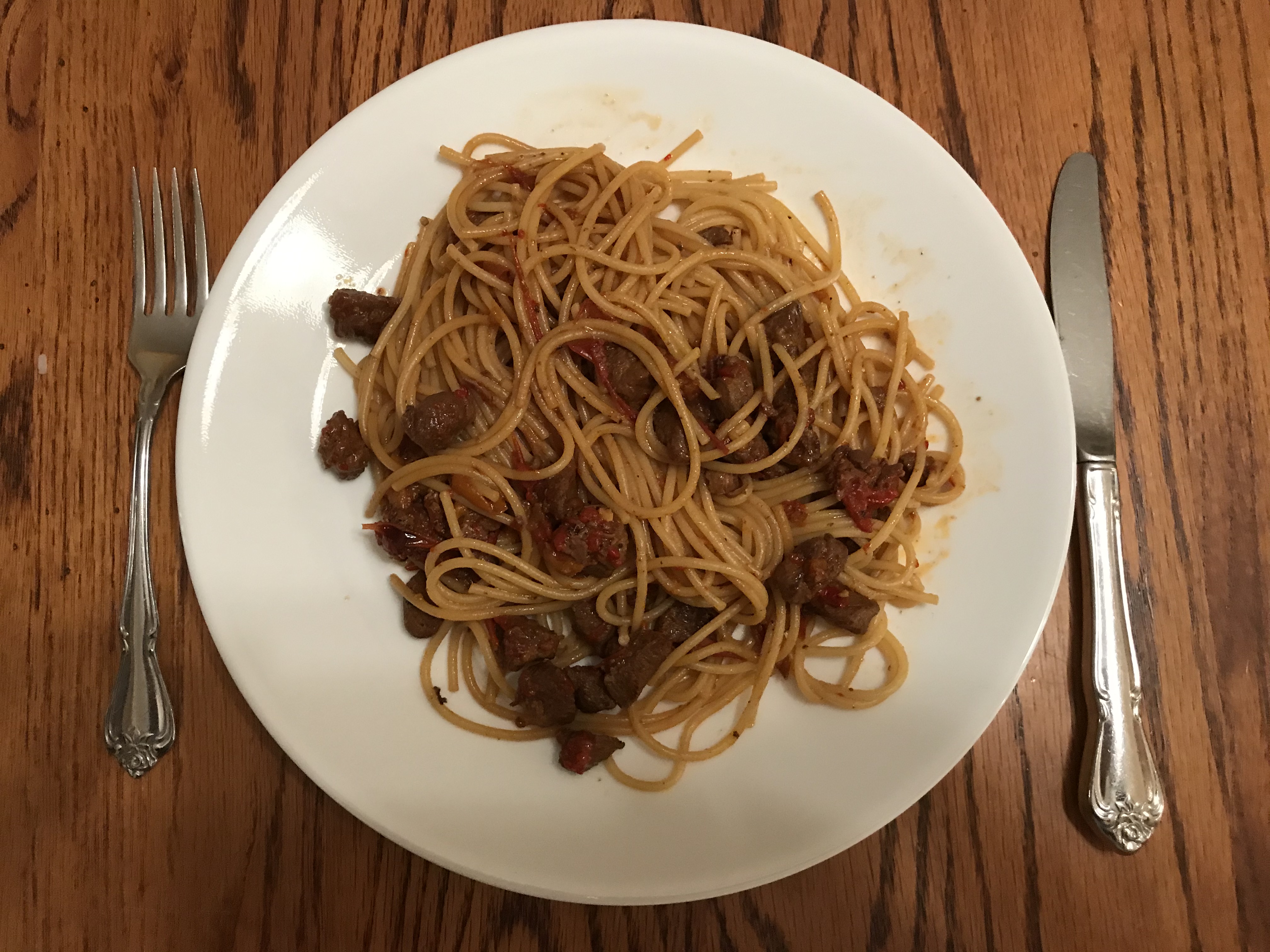
As in Lazio, lamb is popular in neighboring Umbria and its own eastern neighbor, Abruzzo. The rugged landscape has provided pasture for sheep for millennia, which in turn provided the residents with a variety of cheeses as well as meat. In this interesting regional specialty, lamb is used instead of beef or pork in a sauce that is then tossed with pasta. This is not the only dish of its kind. As discussed on page 174, lamb is often added to the tomato sauce in the pasta dish with two sauces during the winter months.
This was fairly straightforward to put together. Sauté the minced lamb with garlic, add some wine or water and let that cook for a few minutes, then add tomatoes and bell peppers and cover the skillet to simmer for two hours. Occasionally check the pan to see if some broth or water may be needed. When that’s finished, cook the pasta, add it to the skillet, toss, and serve.
I had a slight glitch in the preparation. Knowing extra liquid would probably be needed, I added the cup of water at the start of the simmering time, then went outside to work in the yard for a bit. Thinking my task would take about an hour, I planned to check the sauce after I finished. It turned out to be a bigger task than I anticipated. Almost two hours later, I was finishing up when I was alerted that I should probably check the pan, since it smelled like it was starting to scorch. As there was no smoke and the scorching seemed pretty mild, I immediately added more water and stirred to remove the browned layer from the bottom of the pan. This seemed to resolve the issue. The sauce didn’t taste scorched at this point, just pleasantly caramelized, so I continued with the recipe.
Altogether, this was quite good. The peppers and tomatoes break up in the sauce, adding depth and acidity to counter the lamb, which has a rich, distinct flavor of its own. I wouldn’t have thought of putting lamb in pasta sauce, but it really shines when combined with the tomato flavor.
This pasta dish is a somewhat unusual one from Northern Italy. The original version is made with buckwheat pasta, but the recipe here uses fresh fettuccine. Diced potatoes and Savoy cabbage are first boiled, then, when they are cooked through, the pasta is added. Once the pasta is cooked, all is drained and tossed with pecorino cheese. Melted butter, browned with sage and garlic while the pasta cooks, is poured over the pasta, which is then topped with more cheese.
Cabbage may seem like a strange thing to find in an Italian dish, but it has a long history. In ancient times it was eaten by all levels of society, as evidenced by its inclusion in the works of Apicius. In the early 4th Century AD, the Emperor Diocletian kept himself occupied in retirement by growing cabbages. It remains popular today, especially in the cooler north. The favorite variety is the stronger-flavored, crinkled Savoy cabbage. Note that this is not the same thing as Napa cabbage. Both have crinkled leaves, but Napa cabbage heads are elongated while Savoy cabbage heads are round. I was unable to find the Savoy variety, and since Napa cabbage is not always that fresh (blame lower rate of turnover) I substituted regular green cabbage, which is always cheap, fresh, and available.
Not only is this easy to cook, it turned out to be another favorite. The boiled potatoes partially break down as the pasta is tossed, mixing with the butter and thickening the sauce, acquiring a taste sort of like an alfredo sauce. The sage leaves crisp up in the skillet and make a delicious garnish. Exactly why pecorino cheese is used instead of parmesan is unclear since this is a northern Italian dish, but it worked really well. I’m sure grated parmesan would be good if pecorino is unavailable, and when I made the recipe for a second time with dried fettuccine, that worked too. Just make sure to adjust the cooking time for the pasta accordingly.
Menu: Marinated Cannellini Beans with Oregano and Crisp Salami, “Grilled Eel” with Thyme, Zucchini Pudding, Assorted Melon with “Caprini” Cheese
Recommended Wine: Fiano de Avellino or Taurasi (White Wines), or Greco di Tufo
Returning to the southern Adriatic coast, near Bari, we have another seafood menu. Since I have no idea where to find eel, I used the seasoning in the recipe on chicken, and since it was raining, I used a grill pan and cooked it in the oven. Apparently, conger eel is relatively available in American fish markets (pg. 216), but I suspect that is probably only true on the coasts and in the big cities. I doubt that I could find it any closer than Chicago, which is three hours away from where I live. With the worst pandemic in a century still raging, the journey is simply not going to happen. Maybe at some point I’ll try it with eel, a favorite of both the Greeks and Romans, but for now, adapting is necessary.
The beans, marinated with vinegar, oil, and oregano and served with pieces of crisped salami are pretty good, but it was the zucchini dish that really stood out. Shredded zucchini is salted and squeezed out to remove the excess moisture (which could split the custard) before being mixed with eggs, half-and-half, basil, and diced red peppers. The end result is a cross between a quiche and a custard, with a creamy texture and mild vegetable flavors. Ultimately, it was one of my favorite recipes from the book.
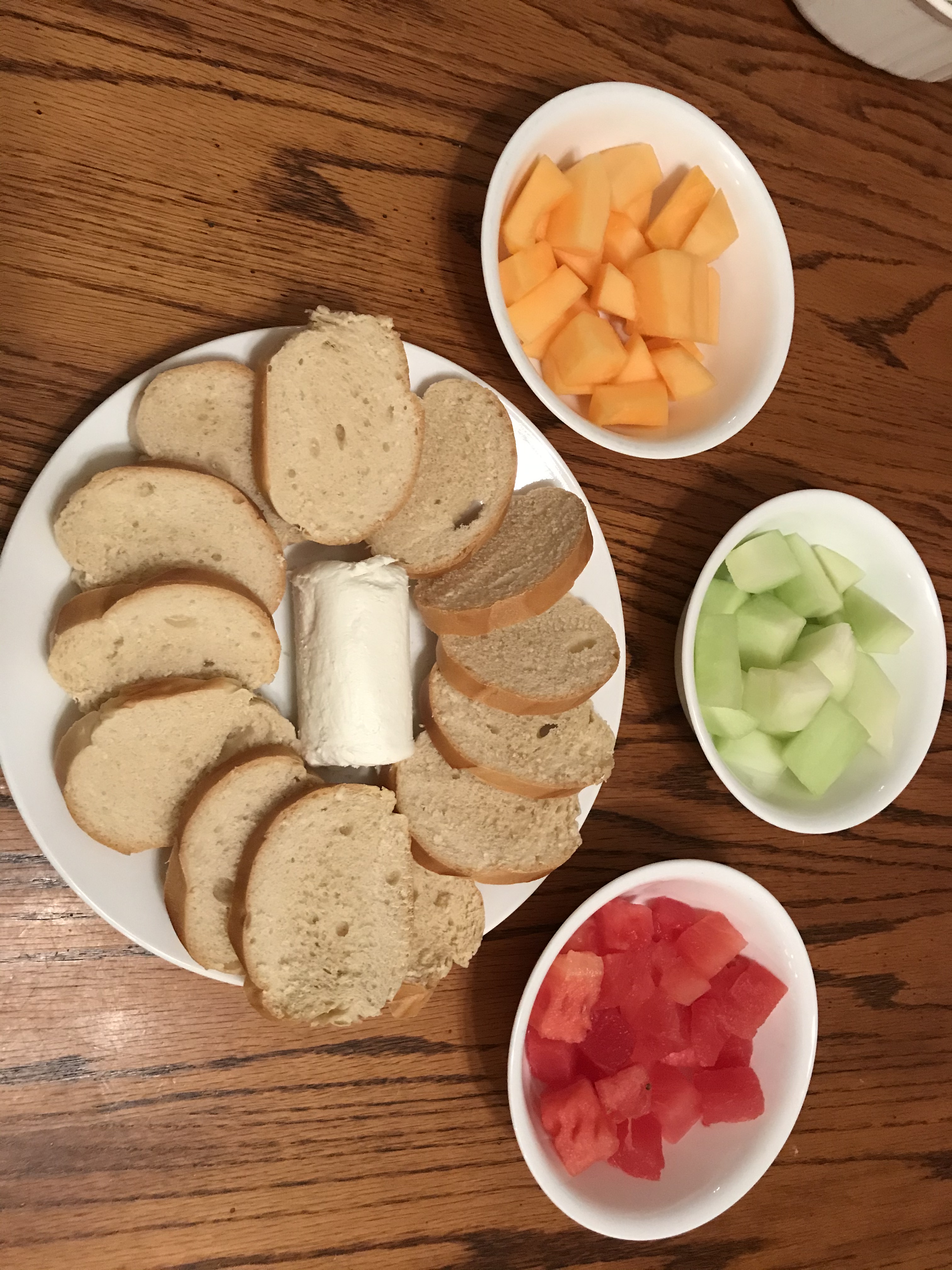
For dessert, we have an authentically Italian fruit and cheese combination. Watermelon, cantaloupe, and honeydew are served alongside toasted bread and caprini cheese, which, as you might infer from its name, is a goat cheese. As caprini is hard to find in the US, I replaced it with a regular goat cheese, with good results. The cheese makes for a more substantial dessert than fruit alone, while the fruit provides sweetness without a bunch of sugar. If you want a sweet but semi-substantial dessert while watching how much sugar you’re eating, this combination checks all the boxes.
Menu: Rice and Pea Risotto, Fried Marinated “Sole” in Sweet and Sour Sauce, Stewed Sweet Peppers, Venetian Nut Cake
Recommended Wine: Soave (white wine from near Verona)
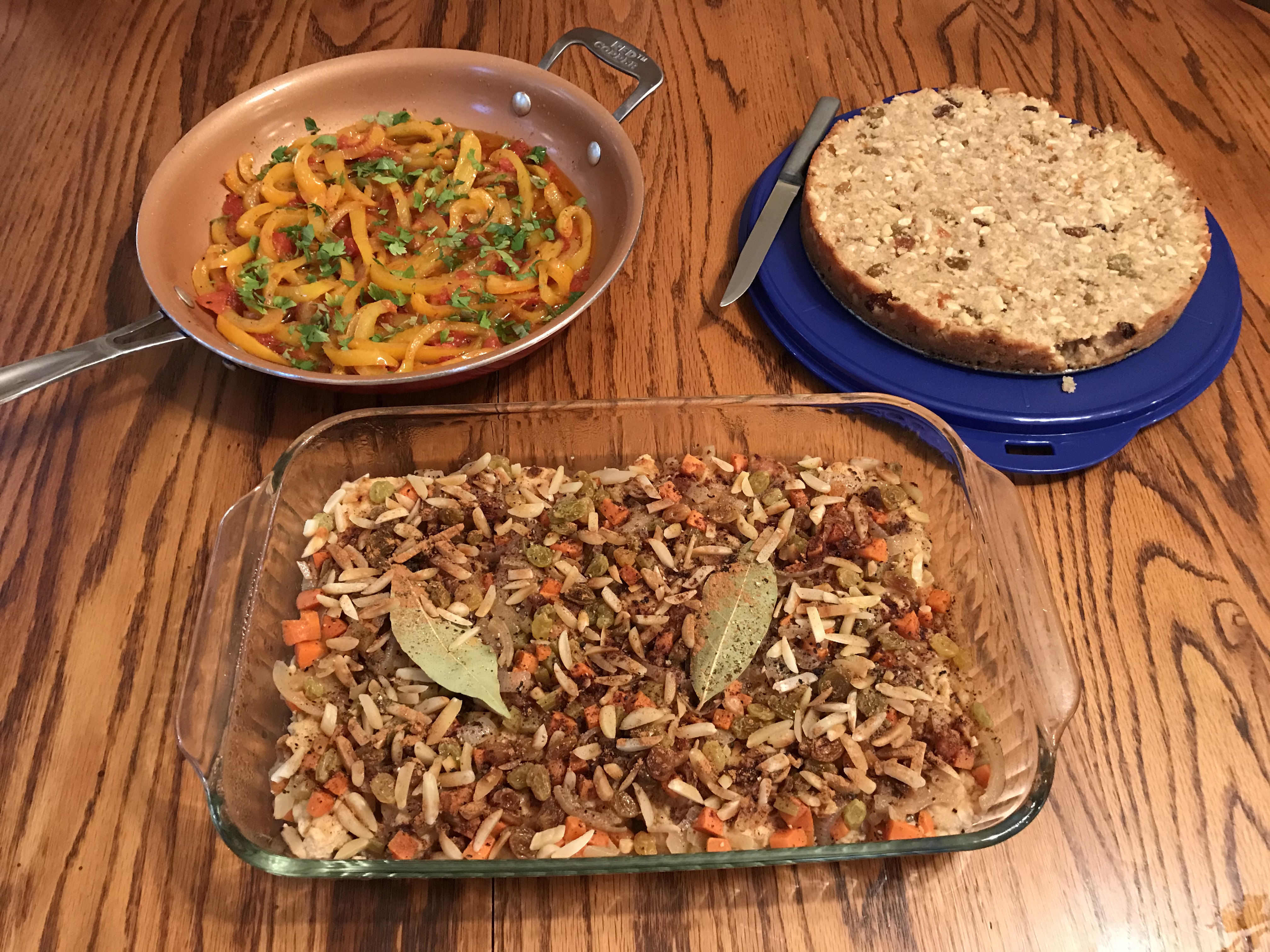
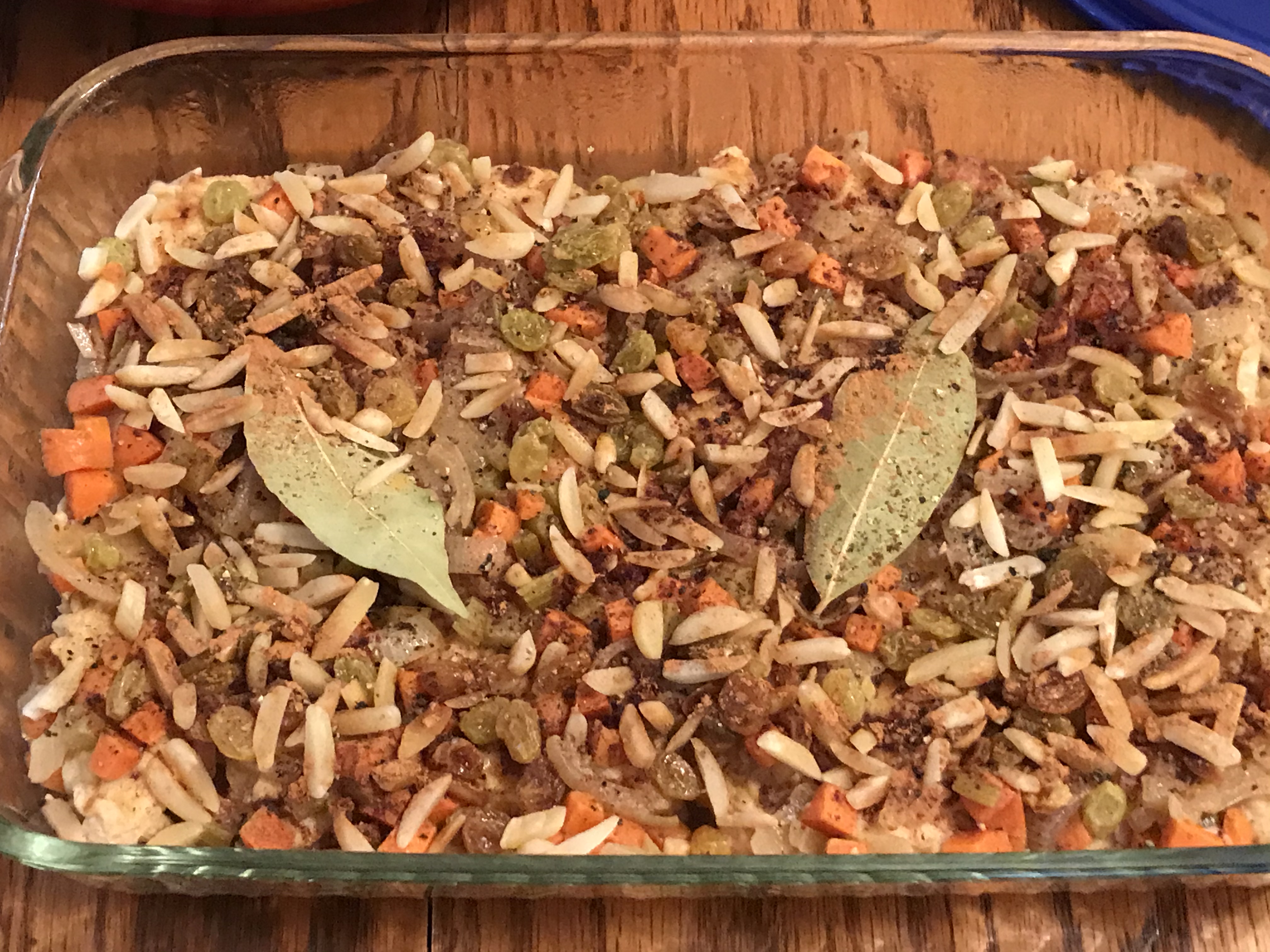
This menu here includes two Venetian classics; rice and peas (risi e bisi) and fried fish, topped with golden raisins, pine nuts, and a sprinkle of spices, marinated in a vinegary, sweet and sour sauce. Alongside these dishes are sweet yellow peppers stewed with tomatoes and a Venetian cake popular around Carnival time, loaded with nuts, golden raisins, and candied peel. All of the dishes except for the risotto can be made ahead, and the fish is in fact served cold after two days of marinating. For reasons of cost and convenience, I replaced the fish with halved chicken breast pieces.
The fish dish is historically quite interesting. As mentioned in previous posts, sweet and sour sauces have a long ancient and medieval history, and vinegar, the main component in the sauce, is both a flavoring agent and a preservative. Historically, the fish would be fried, then covered in vinegar. According to late 18th and early 19th century British cookbook authors (this method of preservation was quite widely used), fish could be preserved for up to a year this way. While I am not sure if this would actually work, I have no intention of finding out one way or the other. Thankfully, the fish here is just marinated for two days to gain flavor.
To be completely honest, I was not a big fan of the flavor. The vinegar was very strong, and the sweetness of the raisins was not quite enough to cut through it. The almonds sprinkled over the top (as a replacement for pine nuts, which are a lot more expensive) provided a nice crunch, but the coating on the chicken pieces became a soggy, sour, sponge-like layer, rather than having the crispy texture characteristic of frying. This must be an acquired taste, because seafood dishes with sweet and sour sauces are very popular in the Venice region.
The risotto has an entirely different flavor. Made with short-grain rice, sweet green peas, pancetta, parmesan cheese, and a mixture of chicken and beef broth, it is much milder. The sweet green peas, a favorite across Italy in the springtime, were a novelty in 17th Century France. When they arrived in Venice is not clear, but regardless, the risotto is a springtime classic, and on tasting it, the reason is obvious. When fresh peas are not in season (or if you don’t want to bother shelling them), frozen peas can be used, though many Venetians would say that is inauthentic.
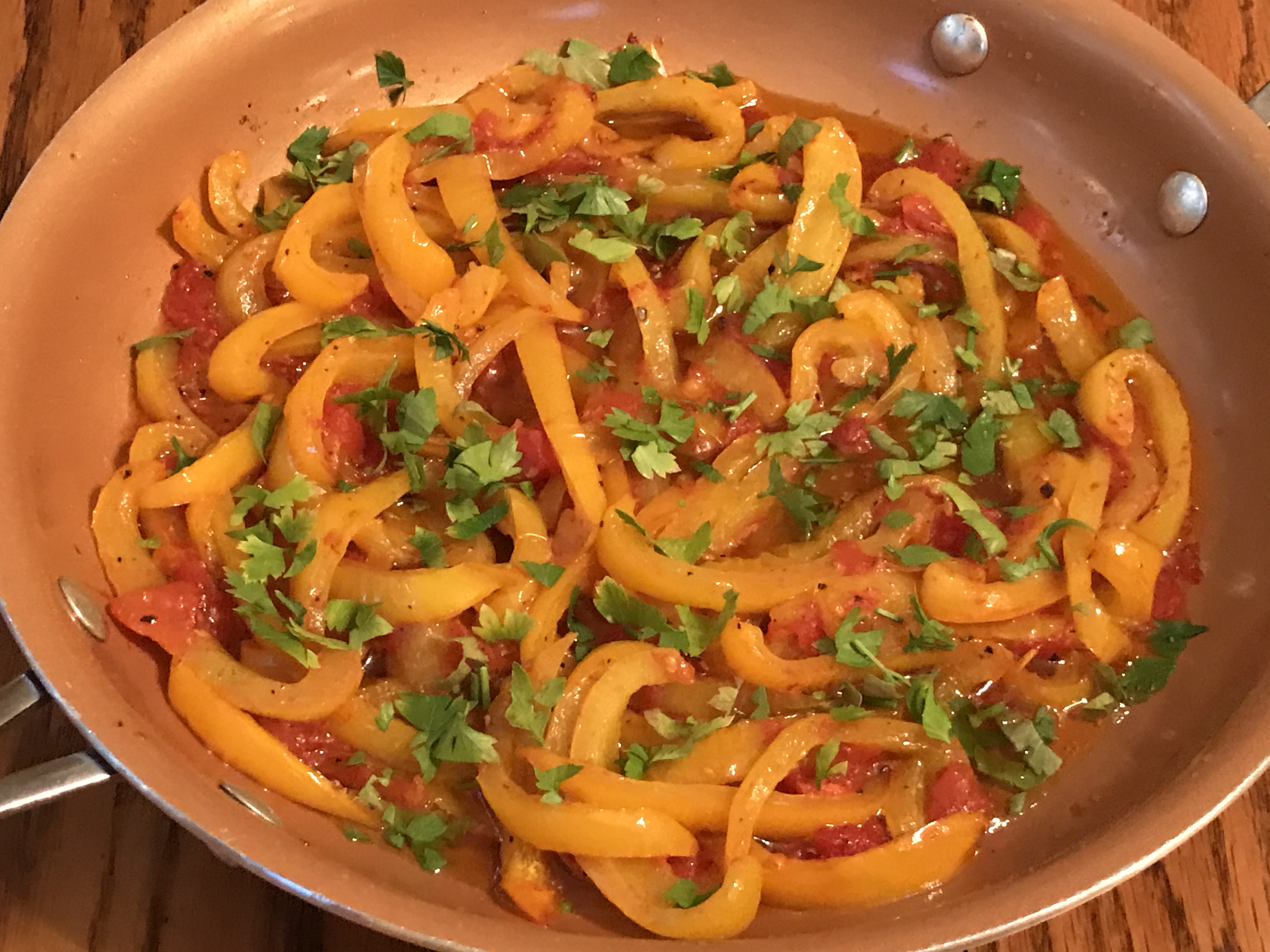
For another dish with a sweet and sour flavor but different from the fish dish, sweet yellow peppers are sliced thin and sauteed with tomatoes and garlic. This was much more balanced than the “fish” and quite good. The flavor was somewhat reminiscent of fajita vegetables, interestingly enough. Any leftovers would definitely be good on tacos, fajitas, burritos, or the like.
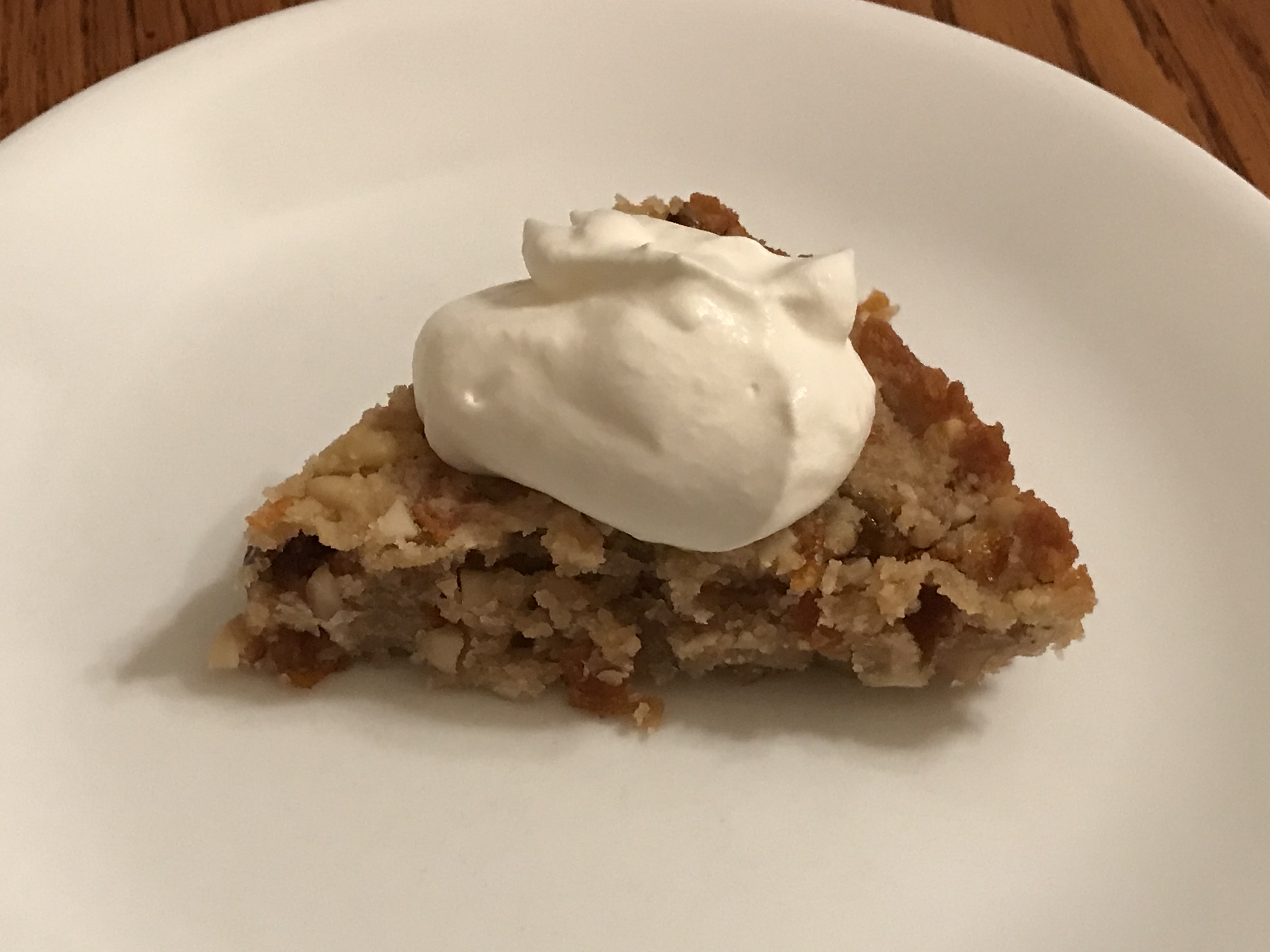
The cake was a really interesting mix of sponge cake crumbs, almonds, walnuts, pine nuts, golden raisins, and candied peel, held together by a sugar syrup. The base is a genoise sponge. In this recipe, as in the original version, no baking powder or baking soda is used. The rise comes solely from air beaten into the eggs. The trick is to avoid forcing the air out upon folding in the flour. I have not yet mastered this and ended up with a cross between a cake and a pancake, but it was a rather tasty pancake. Since it was to be used as crumbs, the lack of rise was not a big deal.
The final product was flavorful, but between the cake crumbs, candied peel, and sugar syrup, was overly sweet. In addition, the sugar syrup was not a particularly strong binder at room temperature, so the cake was very crumbly. A solution for this was found by accident. As the cake is so rich and sweet, it is difficult for two people to finish before it would go bad, so I stored the extra in the freezer. This firmed up the syrup and made the cake easier to eat, and the optional unsweetened whipped cream helped balance the sweetness.
Menu: Roman Minestrone, “Sole” Fillets Wrapped in Leeks with Brussels Sprouts, Orange Panna Cotta with Blueberry Sauce
Recommended Wine: Verdicchio from near Rome or Virtu Romane
Returning to the Eternal City, we have a menu enjoyed at the home of two of Mr. Famularo’s friends, who both happen to be chefs. The first course is a minestrone typical of the Rome/Lazio region, with beef broth, chopped cooked beef, red beans, red wine, assorted vegetables, and a small pasta called pastina. The friends’ restaurant, which features updated and reinvented Roman cuisine, provides the inspiration for the second course: pieces of sole filet, wrapped in leek leaves and tied with string, braised and served with buttery sauce and brussels sprouts. Dessert is a classic originally from the Piedmont region and now found all over Italy: panna cotta, in this case lightly flavored with orange and served with a blueberry-orange sauce.
The really nice thing about this menu is that the soup, panna cotta, and blueberry sauce can be made ahead. In fact, as is often the case with soups, it is best to make the minestrone ahead by a day or two to allow time for the flavors to meld. This is especially useful here, since the process of assembling the fish dish is somewhat time-consuming. The leeks need to be cleaned and blanched, the fish cut into pieces that can be wrapped by the leek leaves, and the fish and leeks assembled and tied into “packets,” that can then be braised in the skillet. The final effect is really pretty, but it does take time.
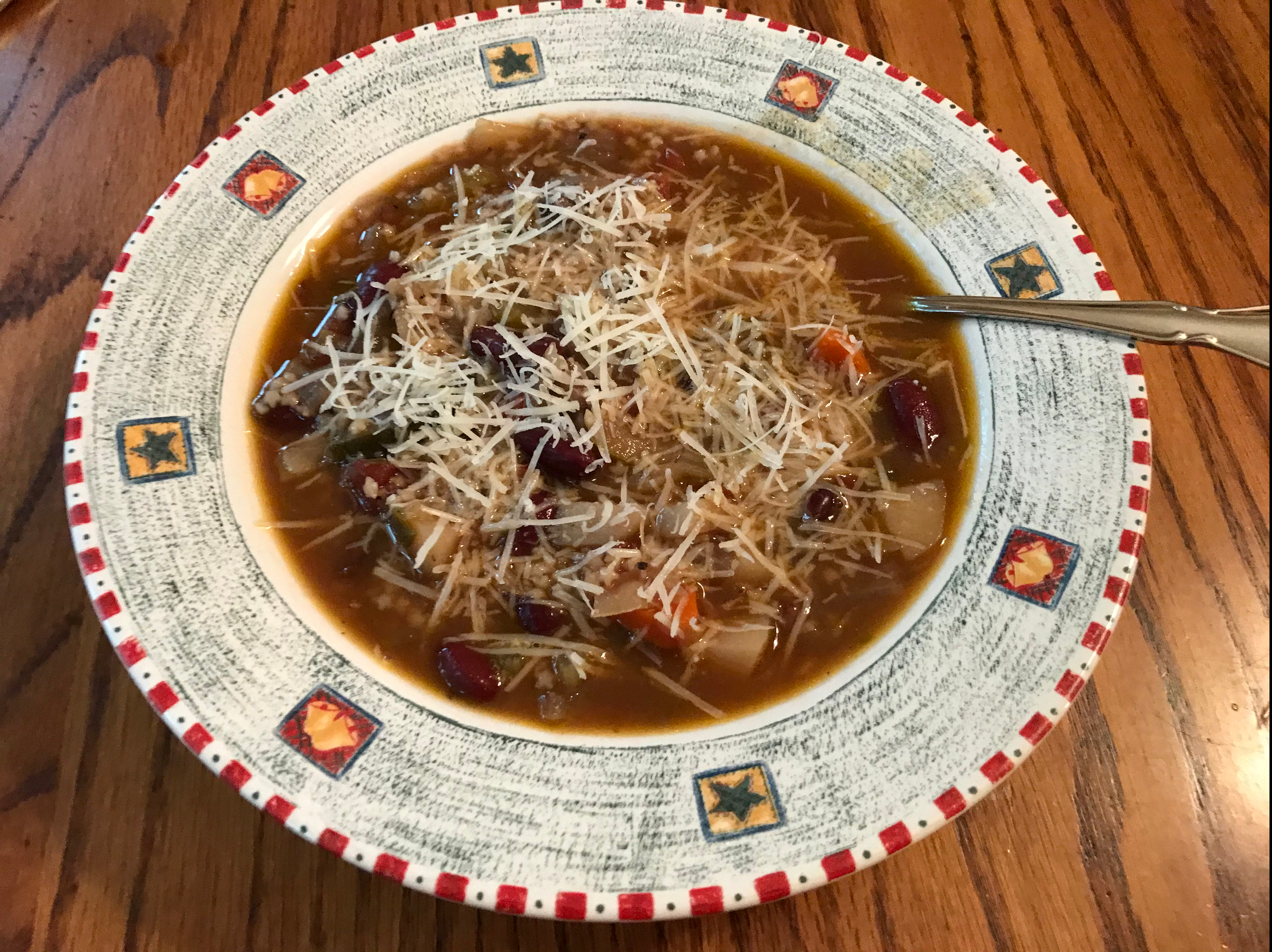
The soup was another excellent one. While it was good immediately after cooking, it really came into its own upon reheating the next day. I had been a bit worried about the pastina getting mushy, but it maintained a good texture while soaking up the flavor of the broth. As discussed on Pages 18 – 19, each region has its own typical style of minestrone and each cook has their own variation. They all have a variety of vegetables, a starch and/or legume to add substance (which could be rice, pasta, or a few different types of beans), and various flavoring agents. Sometimes meat is added, particularly leftover. Regardless of the particular variation, minestrone is a great historical example of peasant ingenuity in the kitchen. The other ingredients allowed the cook to stretch the more expensive meat, while providing a nutritious, satisfying meal.
Roman minestrone
Sea fish was not particularly important in Early Rome. The city is located about 15 miles inland, so providing fresh seafood was a bit of a logistical challenge. Shipping it up the Tiber from the port at Ostia, presumably kept alive in tanks of water, was possible but expensive. During the Early Republic, even the rich ate a largely vegetarian diet. Much of the limited animal protein came from eggs, cheese, freshwater fish, and a variety of pork products. During the Late Republic, saltwater fish and especially shellfish became fashionable. Sources from the era describe banquets featuring mountains of oysters and sea urchins as starters, and aristocrats were known to spend fortunes on a single particularly fine red mullet. While some of these accounts were probably exaggerated for comic or shock value, parody often has at least some basis in reality.
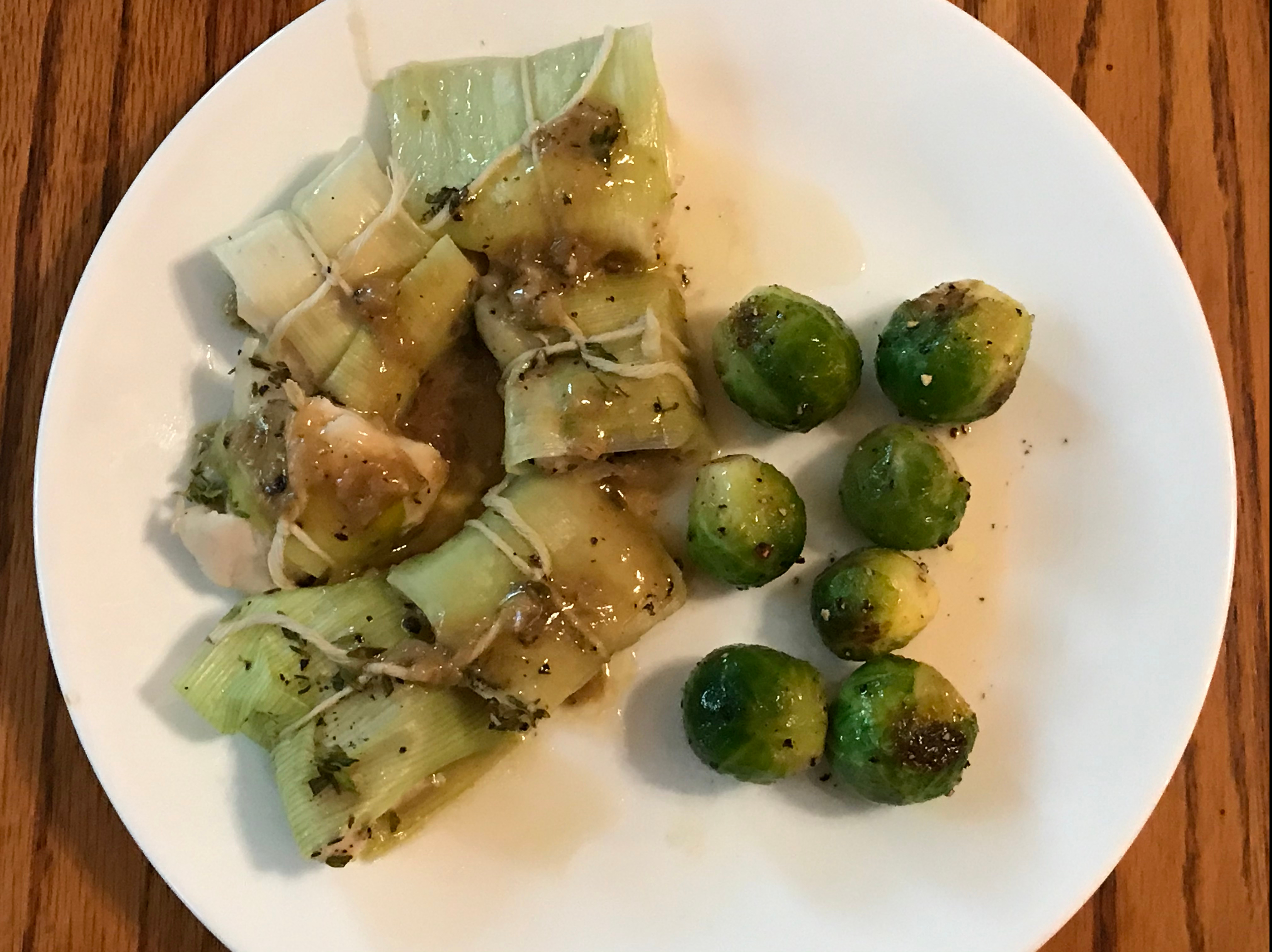
The fish dish here was very tasty, though dealing with the tied packets on the plate was a bit of a hassle. Due to the price and difficulty finding sole, I used farmed catfish, which is apparently a reasonable substitute. It cooked up mild and flaky but tender, enhanced by the leeks and buttery, shallot-flavored sauce. The brussels sprouts were a great accompaniment, their flavor boosted by being cooked in the water the leeks were braised in.
Panna cotta and sauce
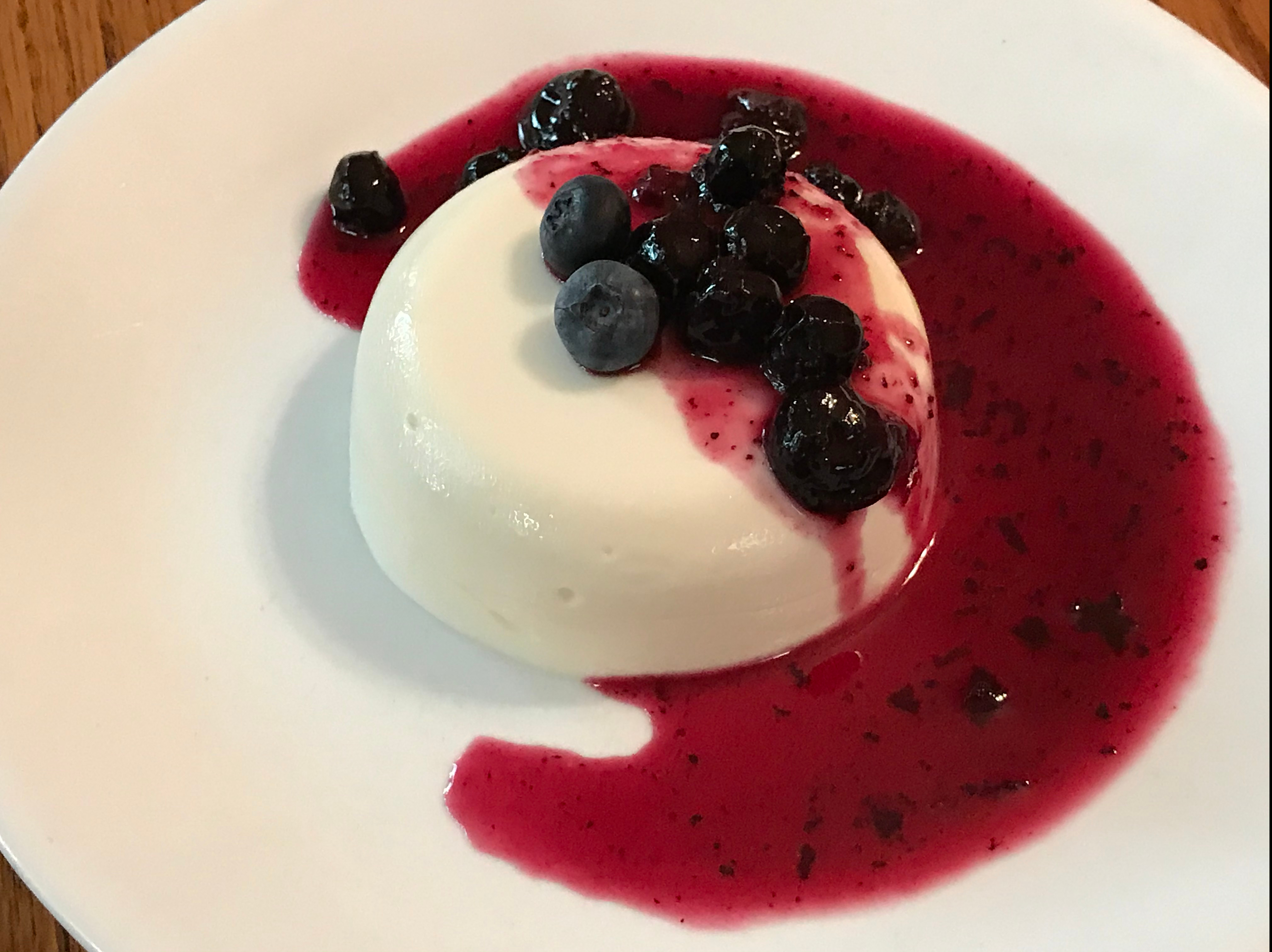
Panna cotta is in the same family of desserts as pudding and custard. What makes it unique is that it is set with gelatin rather than thickened with egg or cornstarch. As a result, despite the name meaning “cooked cream,” the ingredients don’t have to be cooked for long. The cream or half-and-half just needs to be heated enough to dissolve the gelatin and sugar. At its simplest, panna cotta consists of just half-and-half or milk and cream, sugar, and gelatin. Vanilla is usually included as well, and fresh fruit or fruit-based sauce are the most common toppings. Here, the custard includes sour cream, cream cheese, and a touch of orange, giving it a cheesecake-like quality. The desserts are served topped with a blueberry-orange sauce. The combined flavors were very good, and there was a fair amount of extra sauce left over. Fortunately, these kinds of sauces freeze and thaw well. The leftovers would be worth trying over pancakes, waffles, or ice cream.
Menu: Potato and Zucchini Soup, Shrimp in Olive Oil and Lemon Juice with Rosemary, Red Bell Peppers Stuffed with Pine Nuts and Golden Raisins, Roasted Figs with Almonds and Chocolate
Recommended Wine: Terradora Di Paolo, Fiano Di Avellino from Campania
Heading south again, we enter the region of Apulia, now called Puglia, in the Southeast along the Adriatic Coast. Despite being across the Apennines on the other side of the peninsula, the food here has a lot of similarities to that from the Naples region (Campania). In both places, pasta, vegetables, olive oil, and fruit are staples, supplemented with smaller amounts of meat, dairy, and seafood. These ingredients are often prepared differently, however. While bold, exuberant flavors dominate around Naples, Puglia tends to favor more clear, straightforward flavors. (Text, pg. 211)
Like much of Southern Italy, Apulia was part of Magna Graecia and had a number of Greek colonies from the 7th to 3rd Centuries BC. As discussed on page 210, the Greek influence is stronger here than in Naples. At first this seems surprising, since Naples was also a Greek colony. In fact, its original Greek name, Neapolis, roughly translates as “New City.” I suspect, but cannot be sure, that geography had something to do with the difference. The coast of Apulia is more or less directly across a strait from the Greek mainland, while Naples is on the opposite side of the peninsula and only about 120 miles from Rome over relatively flat terrain. As a result, though Apulia did eventually Romanize to a degree, the process was slower and less thorough, with more lingering Greek influences.
Many elements of this menu have a long history. Seafood has been an essential element in the diet in most coastal regions since before agriculture. Olive oil was essential in the Ancient Mediterranean, and the recipes of the Roman gourmet Apicius frequently contain anchovies or fish sauce. Raisins and pine nuts were frequent additions to sauces and stuffings both in the Ancient and Medieval world. Other fruits and nuts, including almonds and figs, have always been popular desserts.
In fact, in his bestselling book Guns, Germs, and Steel, the anthropologist Jared Diamond discusses how figs were domesticated thousands of years before apples. Basically, fig trees can self-pollinate and produce seeds yielding identical offspring, making breeding the trees fairly straightforward for early farmers. Apple trees, on the other hand, tend to pollinate other apple trees, usually producing offspring different from the parent. To ensure identical offspring, the much more complicated technique of grafting is required. This process was not mastered until the Classical Period around 500 BC, so until then, apple trees remained more or less wild, though widespread. Meanwhile, the ancients had been feasting on domesticated figs, both fresh and dried, for millennia.
A few elements, such as the lemon and rosemary in the shrimp, are Medieval introductions, but most of this menu would not be possible without ingredients originally from the Americas. Potatoes, zucchini, peppers, and chocolate were brought to Europe by the Spanish in the 16th Century but took a while to catch on. By the end of the century, hot chocolate was fairly common among the wealthy in Spain, and in the next century spread throughout Europe. Since the historic Kingdom of Naples, which included pretty much all of Italy south of Rome, was controlled by Spain for most of the Early Modern Period, these New World ingredients may have been arrived sooner in Puglia than in many parts of Europe. Still, with the exception of chocolate, they were not widely consumed until the 18th Century.
Since peppers and potatoes (and tomatoes, for that matter) are in the same family as deadly nightshade, they were viewed with suspicion at first and only eaten out of necessity. As author Ken Albala explains in Food in Early Modern Europe, their high yields helped peppers and especially tomatoes catch on throughout Southern Europe, but for some reason, potatoes took even longer. Despite their hardiness, yield, and versatility, most Europeans were only starting to accept them in the late 18th Century.
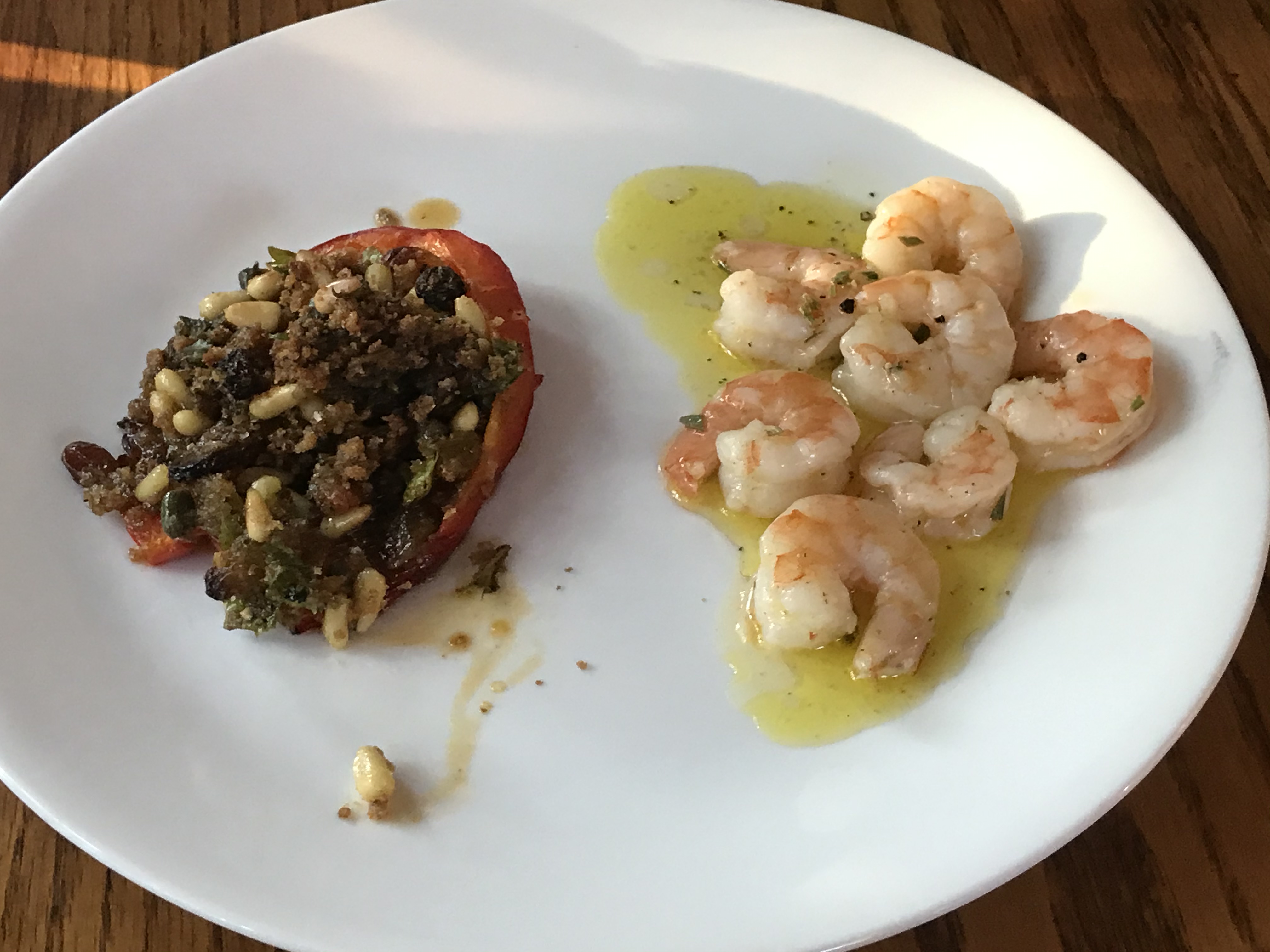
Now, let’s look at the menu. It features a number of southern Italian staples, including zucchini, dried pasta, seafood, olive oil, citrus fruit, peppers, and figs. Due to a timing miscalculation, the shrimp and peppers were eaten before the soup. The shrimp were cooked for a few minutes in boiling water, then cooled and marinated in lemon juice, olive oil, and rosemary. After being roasted and peeled, the peppers were stuffed with a mixture of breadcrumbs, raisins, pine nuts, parsley, and a bit of anchovy, then baked. This was all good, but pretty salty. As in most of the book’s recipes, salt and pepper are to taste, but I seem to have used a bit much, especially for the peppers. Plus, the anchovy flavor in the peppers was a bit strong. The raisins in the stuffing helped cut through this, but if I were to make them again, I think I would not only be more careful with the salt, but also reduce the amount of anchovy.
Shrimp and stuffed peppers
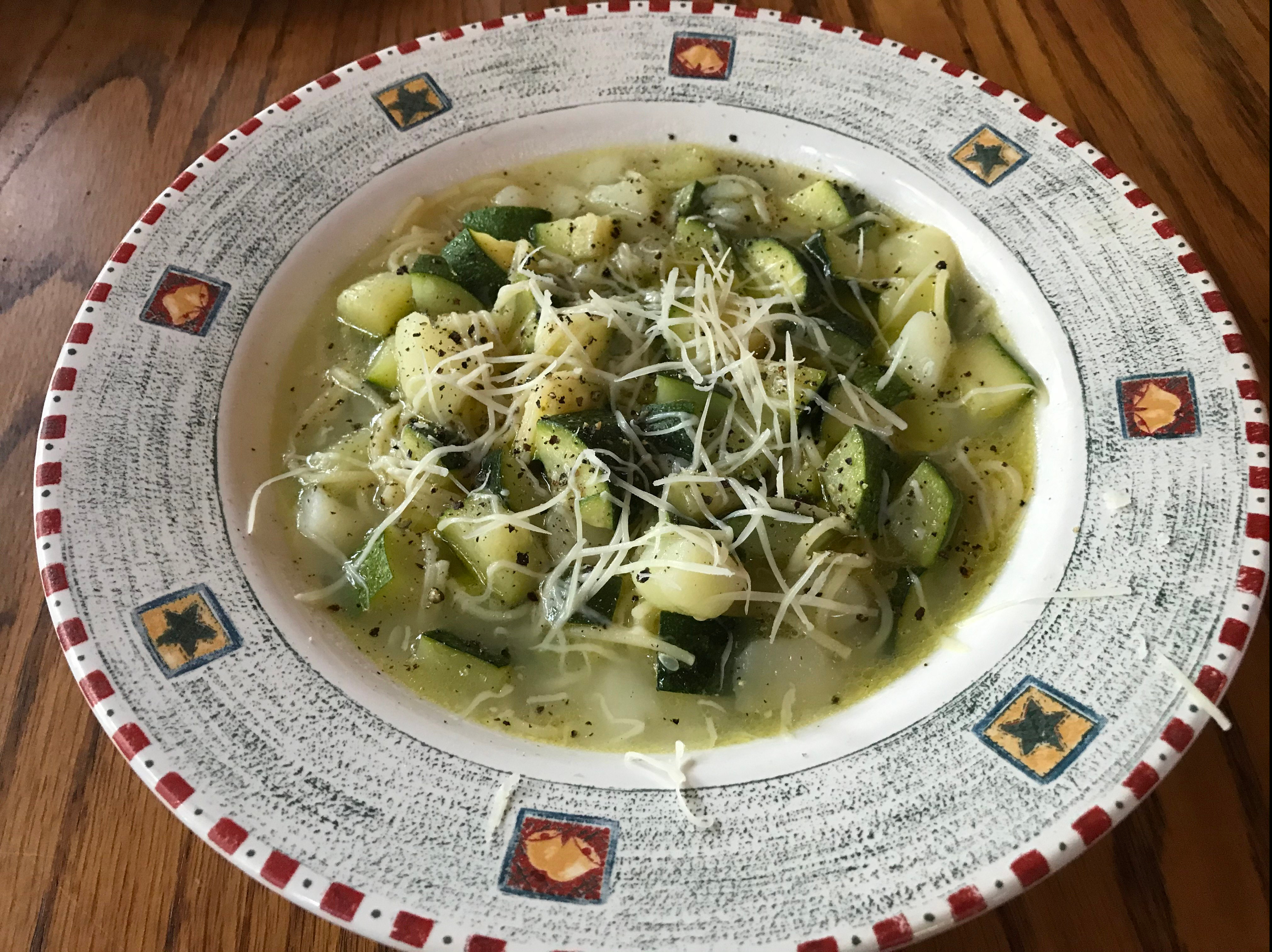
After the salty, strong flavors, the soup was really nice contrast. It’s simply a mix of potatoes, zucchini and vermicelli, cooked in salted water with a little olive oil, topped with a sprinkle of Parmesan cheese and black pepper. On page 211, Mr. Famularo describes a friend’s skepticism upon being told about the soup, wondering how it had any flavor, but then enjoying it to the point of it becoming a favorite. Upon reading the recipe, I had a similar initial reaction. I thought that without at least a bit of onion, it would be extremely bland, but it all worked together. The flavor is mild, but the large quantity of vegetables for the amount of water ensures that the broth doesn’t taste like water. The vermicelli and olive oil add body, while the cheese and pepper add another layer of depth. I was surprised by how much I enjoyed it.
Potato and zucchini soup
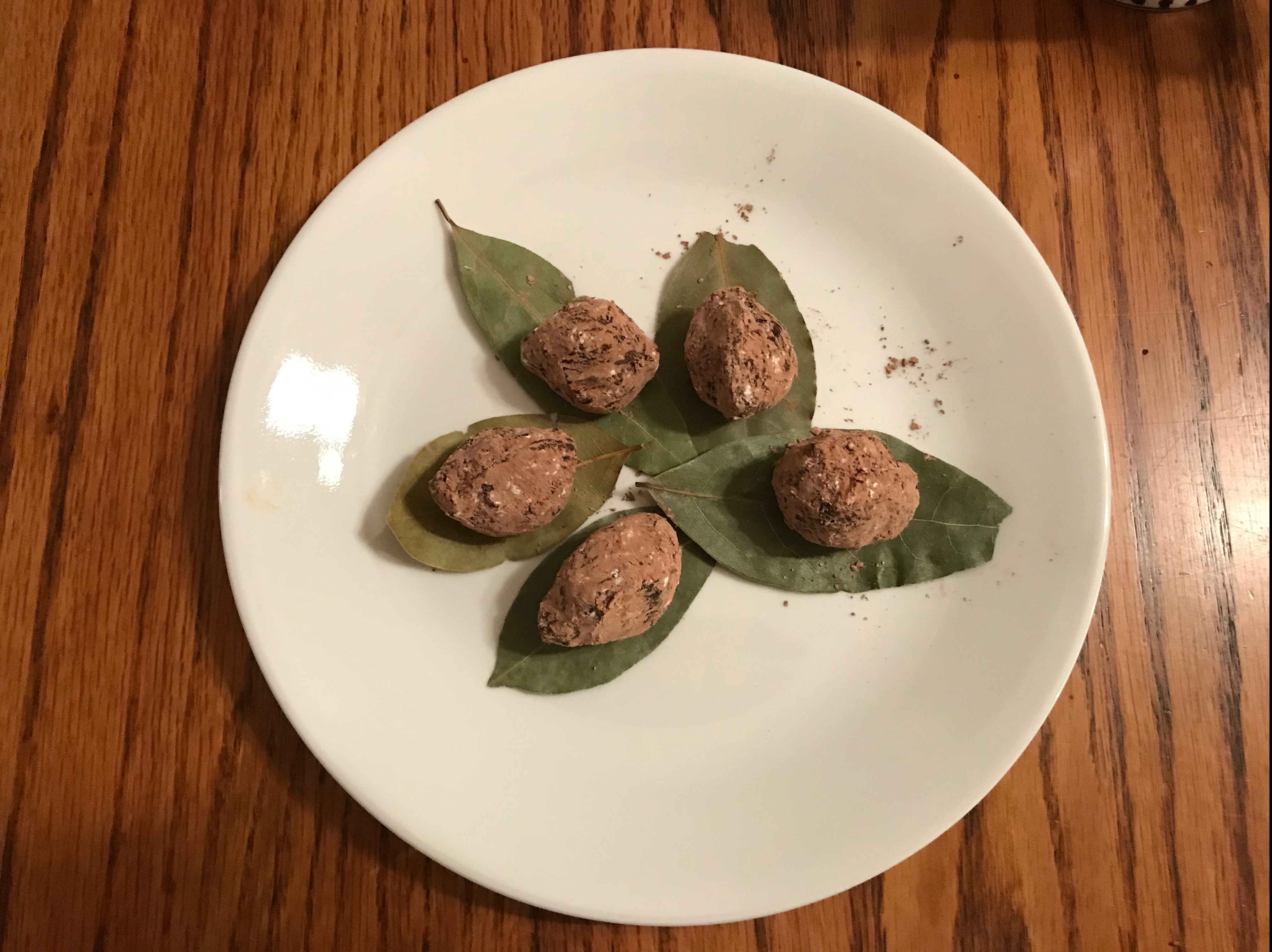
The stuffed, roasted figs were a bit time-consuming to make, but they can be made ahead and last for several days in an airtight container. Each dried fig has a pocket cut in the side, which is then stuffed with a roasted almond, a small piece of dark chocolate, a few fennel seeds, and a few small pieces of candied peel. After baking, they are rolled in a mix of cocoa powder and powdered sugar while still hot and stored in an airtight container with bay leaves. These were definitely different, but quite enjoyable. The figs and candied peel are quite sweet, but the fennel and dark chocolate help balance that, while the almonds provide a nice crunch. Overall, this was a tasty and balanced dinner.
Menu: Tuscan Style Kale Soup, Grilled Porterhouse Steak, Grilled Chicory and Smoked Mozzarella, Praline Mousse Cake
Recommended Wine: Brunello di Montalcino or other big Italian red
Here we have a number of Tuscan specialties: bread, olive oil, green vegetables, and the famous Florentine steak. Mentioned as far back as the Middle Ages, these steaks are cooked very rare and served simply, with just salt, pepper, a brushing of olive oil, and a squeeze of lemon, to avoid interfering with their natural taste. They are basically a thick-cut porterhouse, sourced from a special breed of cattle called Chianina. These are massive white beasts, with exquisite marbling and flavor. Unlike other grilled and roasted meats, Florentine steaks are not common everyday fare, but a favorite treat, both for native Florentines and visitors alike. While Chianina beef is hard to find in the US, this menu features a similar steak, served with kale soup, grilled chicory, and what is essentially a flourless chocolate cake with a layer of mousse.
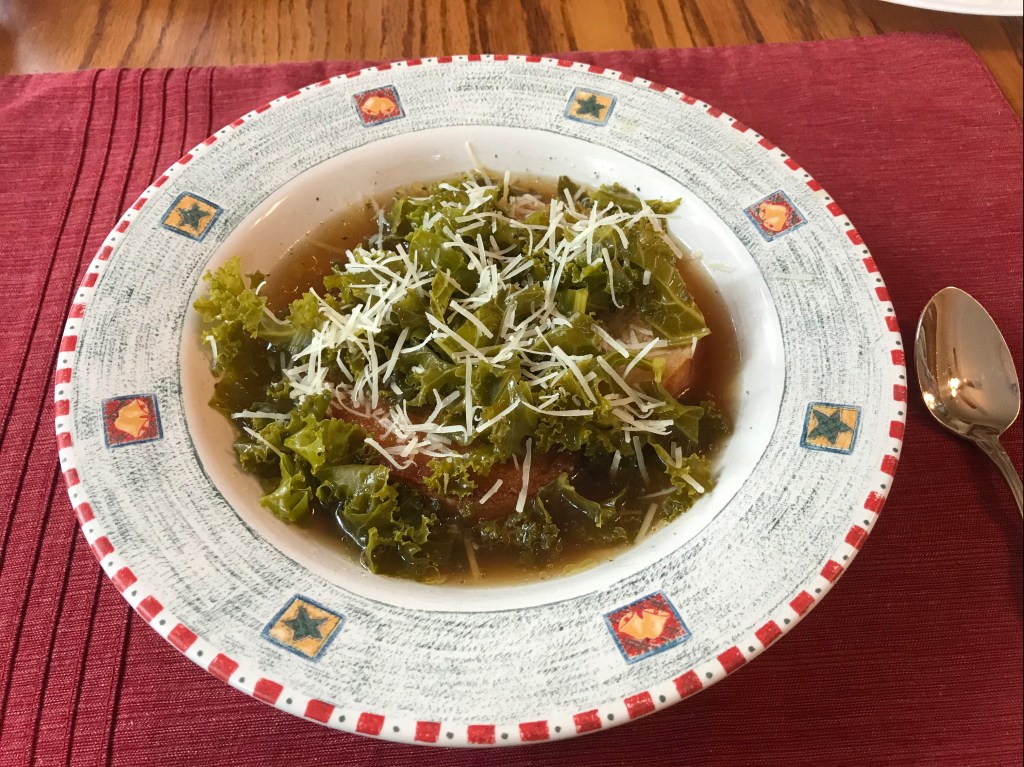
The soup is a fine example of the rustic simplicity of many Tuscan dishes. The kale, in this case harvested a few hours before from a pot on the deck, is cooked in a mixture of chicken and beef broth. Meanwhile, slices of Italian bread are toasted under the broiler and rubbed with garlic. Pieces of toast are then placed in the soup bowls, given a sprinkling of salt, pepper, and olive oil, topped with the cooked kale, and given a bit more salt, pepper and oil before being finished with the broth and a sprinkle of parmesan cheese. The layered effect this gave the soup was both interesting and pretty, and it tasted as good as it looked.
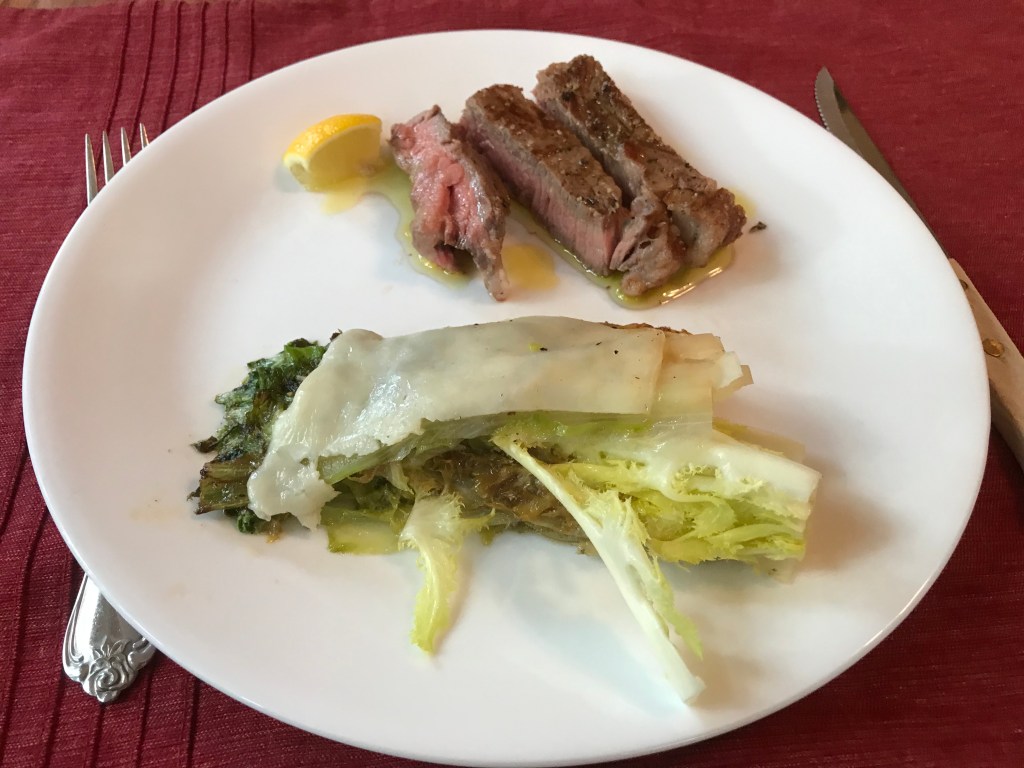
The second course was also fairly easy to make. For the steak, the recipe provides directions for using a charcoal grill, but provides an alternative on a gas grill. First, the meat is seared close to the coals, then moved further away to cook for a few minutes, with the procedure repeated for the second side. Since the gas grill I have access to does not have a way to move the meat closer or further from the heat, I had to improvise. To have better control of the temperature, I used a skillet instead, raising and lowering the heat. This worked pretty well. Though the meat ended up more medium than rare, it remained tender and had a nice sear on the outside. Topped with garlic-infused olive oil (which is really quick and easy to make in a small skillet or saucepan) and a squeeze of fresh lemon, it was delicious.
On a side note, the recipe may have been affected further by using a smaller steak. Though it looked to be at least an inch thick, as was needed, it was just under 1 ½ pounds, rather than the 3-pound monster steak the recipe called for. Since the original recipe is designed to serve six and I was only serving three people, this seemed reasonable, plus the 1.3 or 1.4 pounder was the largest steak available at the supermarket. While I made the full batch of soup in order to have leftovers, steak does not reheat particularly well, so I didn’t make a second one. When the really good sale price is $10.49/lb, you want to make sure you enjoy it at its best.
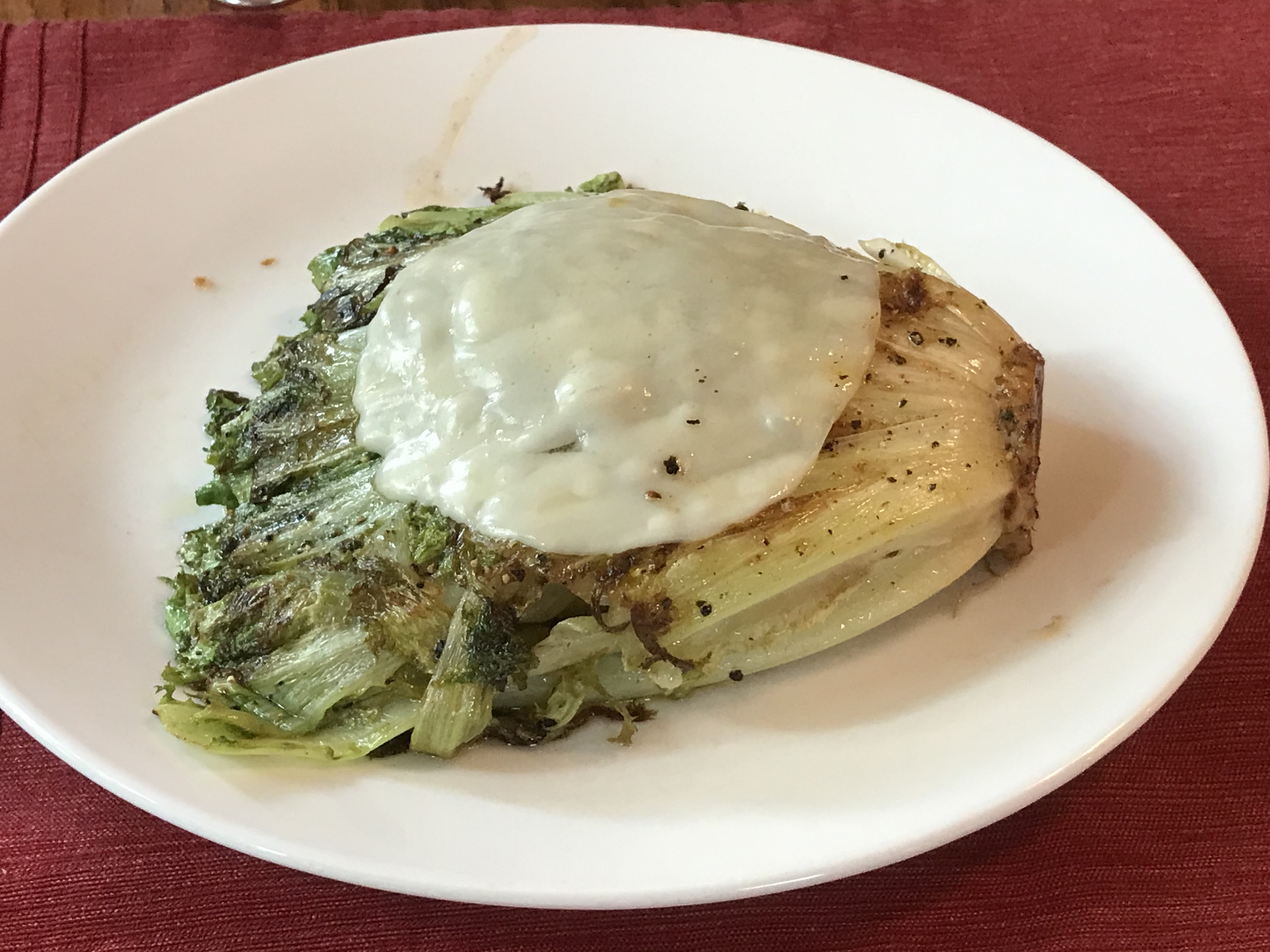
Since the steak needed time to rest before slicing, I used the already-hot skillet to cook the chicory. Also called curly endive, it is a slightly bitter green. The darker, more bitter outer leaves are removed and either reserved for another use or discarded, while the lighter yellow and white hearts are seared briefly over very high heat with olive oil, salt, and pepper. Once removed from the heat source, a thin slice of smoked mozzarella is added on top to melt. The store didn’t have smoked mozzarella, so I got a deli pack of lightly smoked provolone. I only needed one slice, but provolone makes really good grilled cheese, the perfect accompaniment to leftover soup or a salad of the leftover chicory leaves.
I wouldn’t have thought of cooking greens in the skillet, but the chicory turned out really well. The quick sear cuts the bitterness and imparts a bit of a roasted flavor while creating a perfect crisp-tender texture, soft enough to cut easily but with a bit of crunch. The bit of melty smoked cheese was a nice finishing touch, but if unavailable, the dish would still be fantastic without it.
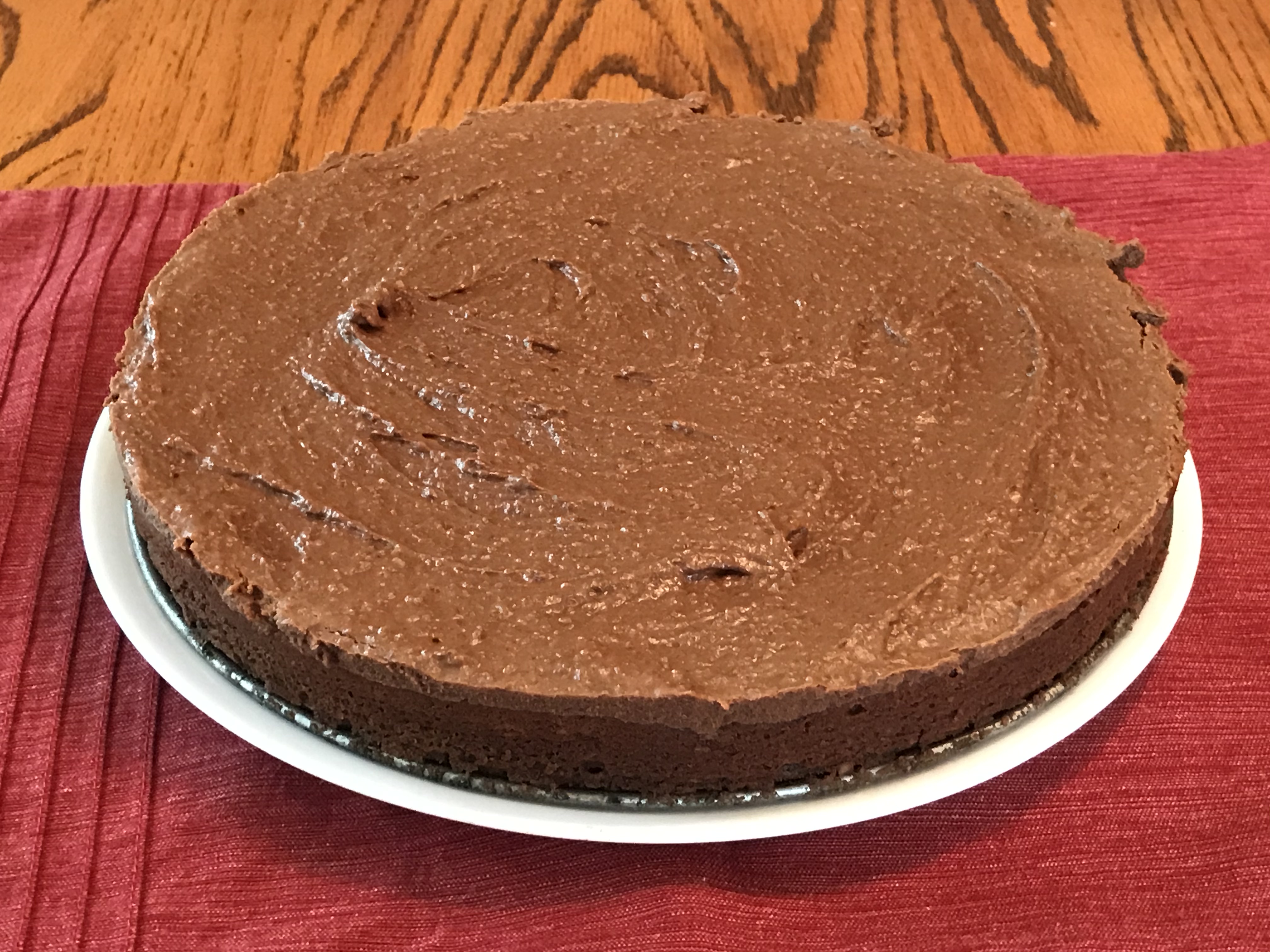
The cake was one of the best desserts from the book. It contains no flour, rather it is held together by ground almonds. The volume comes from adequately beating the butter, sugar, and egg yolks, then, after adding the almonds and melted bittersweet chocolate, carefully folding in the beaten egg whites. Half of the mixture is baked and cooled, acquiring a brownie-like texture. The other half is then spread over the top. After chilling overnight to firm up the mousse, the cake is served. The flavor is perfect, with just the right balance of sweet and bitter. Though excellent as is, a bit of almond extract, some whipped cream, and/or fresh berries to cut through the intensity and richness would be nice additions. But as with the rest of this menu, it’s really hard to go wrong.
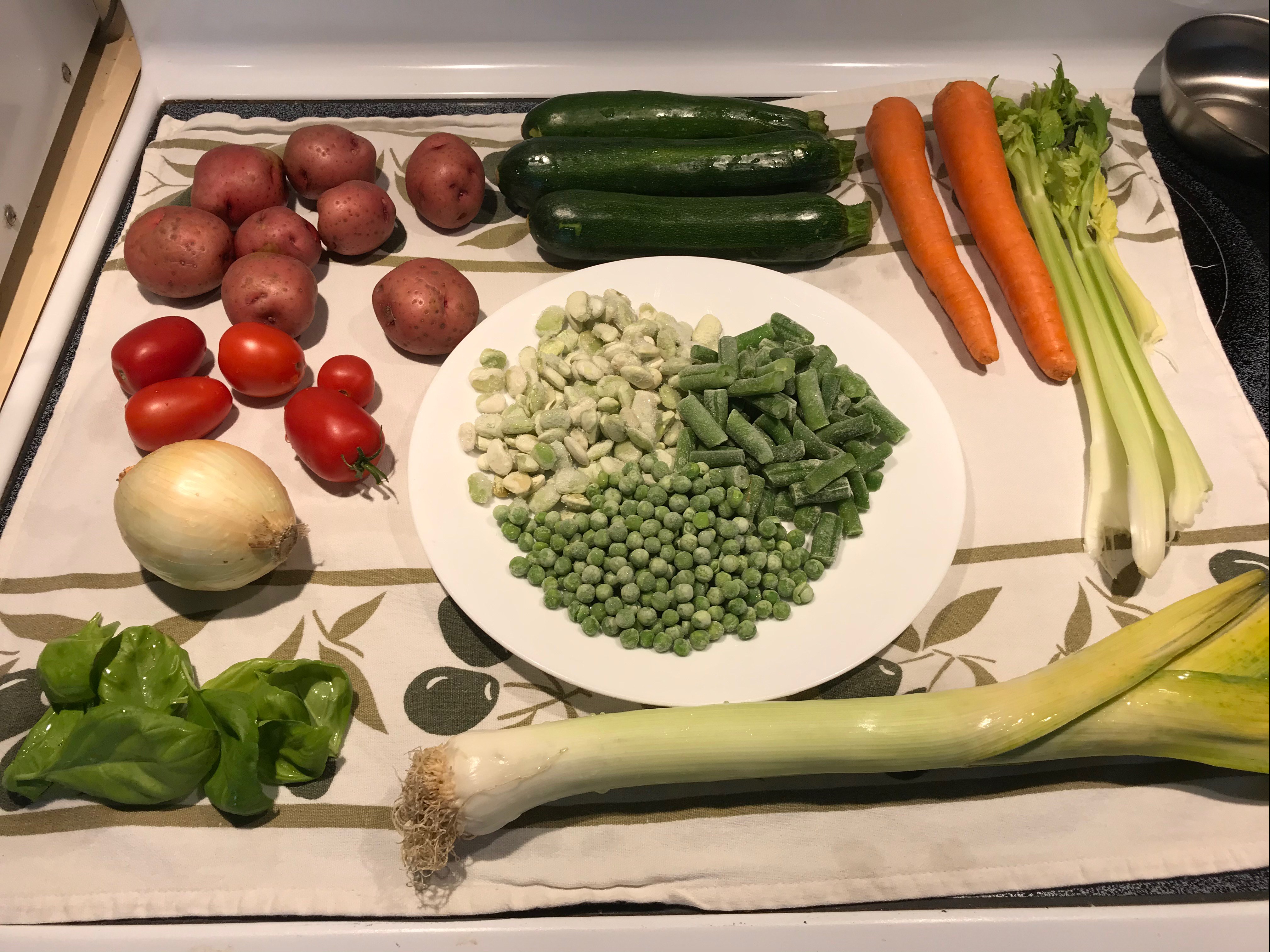
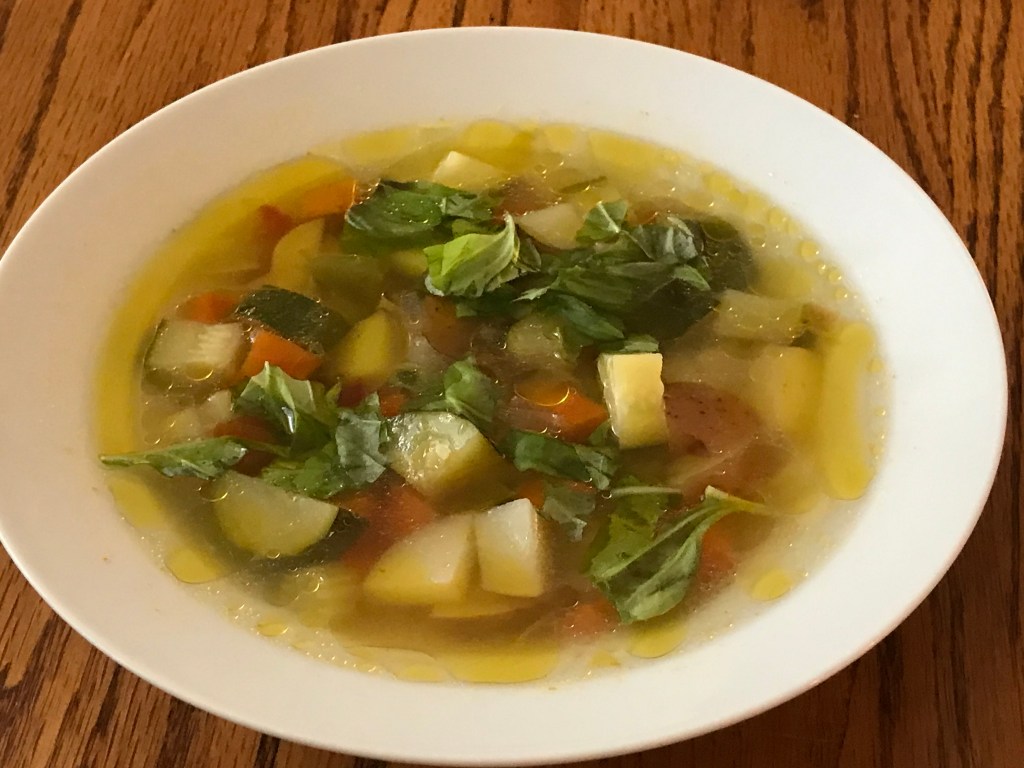
Now its’s time to consider healthy food and fresh summer vegetables. This soup and those like it are frequently enjoyed by the residents of Lombardy while vacationing on the Ligurian Coast. Loaded with potatoes, beans, peas, zucchini, tomatoes, and several other vegetables, it contains no meat, meat broth, butter, or cheese. It’s just vegetables, water, salt, and olive oil, designed to be eaten with bread. These two foods, bread or some other starch and soup, are some of the most ancient and traditional dishes in numerous cultures across the globe. The reason for this is fairly simple. Since the rise of agriculture, most humans’ diet has been starch-based. Furthermore, cooking other foods in pottery or later metal vessels made sure all their calories and most of their nutrients went into the broth that would be consumed, rather than dripping into the embers and being wasted. Plus, soup can be made of pretty much anything available.
In the case of Liguria, this has historically been lots of vegetables, herbs, and olive oil. The mild maritime climate allows vegetables to grow for a large part of the year and lets olive trees flourish north of where they ordinarily could (Liguria is north of Tuscany, their typical northern limit). Meanwhile the narrow coastal plain limits how much space can be dedicated to raising livestock. Hence, fish, vegetables, and olive oil have historically been more common than meat and butter and are still essential elements in the local cuisine.
The soup is really good, just make sure to add adequate salt. Since all the vegetables are fresh or, if necessary, frozen rather than canned and no broth is used, the only salt is whatever the cook adds. I thought I added plenty, but upon tasting the broth I thought it to be almost flavorless. Adding more salt changed my perspective entirely. It didn’t make the soup taste like salt, rather it brought out the vegetable flavors in the broth. While it is even better with a sprinkle of parmesan cheese and might benefit from a bit of vegetable soup base/bouillon, overall this recipe can be thought of as a tasty vegetarian minestrone.







 Feasting Through Time