
Menu: Frittata with Pancetta, Pasta and Peas
Probably the two most famous places in Umbria are Assisi and Lake Trasimene. Besides being the home of St. Francis and St. Clare, both noteworthy recommendations in themselves, Assisi features some of the finest examples of Medieval Italian art and architecture. Unlike Rome, Florence, and Venice, whose Medieval constructions were in many cases renovated or rebuilt during the Renaissance and Early Modern eras, the Medieval city center of Assisi is more or less intact. The difference between the Renaissance/Baroque basilicas St. John Lateran and St. Peter’s in Rome and the Basilica of St. Francis in Assisi is night and day, though all are magnificent. While many Italian architects never fully embraced the Gothic style, elements of it are clear in the Basilica of St. Francis, with its colorful frescoes, ceiling painted in bright colors, and rose window. After devoting appropriate time to this Basilica, which is really a must-see, several of the smaller churches are interesting as well. On our trip two years ago, my friend and I discovered a mini museum in the underground vaults of one of them, full of medieval painted panels, frescoes, and metalwork, along with ancient Roman and even pre-Roman artifacts. For an extra 5 to 8 euros (there was no price of admission to the church itself), it was a great way to spend a few hours of the free time we had to explore.
Also in Umbria is Lake Trasimene, which the tour guides pointed out to us as the bus passed right by the shore. It is most famous for what happened there in June 217 BC. After his famous crossing of the Alps seven months earlier, the Carthaginian general Hannibal had already defeated the Romans twice, once in a fairly minor skirmish at the river Ticinus, and once at the larger battle at the Trebia in late December 218 BC. Shocked that he 1) attempted the crossing of the Alps, 2) succeeded at it, and 3) did something that aggressive (according to Professor Shutt again, the Carthaginians had been nowhere near as aggressive in the First Punic War, so the Romans expected another conflict more or less at “arms’ length”), the Romans assembled a massive army to deal with the threat in their backyard. Meanwhile, Hannibal moved south from his winter camp in the Po Valley area towards Rome. As the Roman forces raced to meet him, Hannibal drew them into a trap.
Not only was he a brilliant tactician, but Hannibal was really good at getting the enemy to fight where he wanted them to fight. In this case, it was luring them into an ambush. Creating fake signal fires to trick the Romans into thinking his troops were elsewhere, he hid their true location in the fog rising off the lake. As the legions marched along the side of the lake, Hannibal boxed them in. Only a handful were able to fight their way out. The rest were either killed or captured then and there, tried to escape into the lake and drowned, or went in up to their necks in an attempt to wait out the enemy and were picked off by Carthaginian archers at their leisure. Despite the massive bloodshed, Hannibal was just getting started. It would take another 15 years and massive bloodshed on both sides before the Romans finally emerged victorious.
Turning from history to food, here we have another egg-based dish, this time a frittata. Varieties of frittatas are found all over Italy, including the central region of Umbria and the neighboring Marche region, on the Adriatic coast. In many ways, Umbria resembles Tuscany, with hills covered in vineyards, olive trees, and cypresses. Like Medieval Tuscany, Medieval Umbria was home to a number of feuding city-states, centered on fortified hill towns, including Perugia, Spoleto, and Assisi. There are similarities in the cuisine as well, with a focus on straightforward, distinct flavors, a variety of cured pork products, and good bread and olive oil. In addition, Umbrian cuisine features a variety of freshwater fish from the lakes and rivers, high-quality lentils, black truffles, and famous Perugia chocolates.
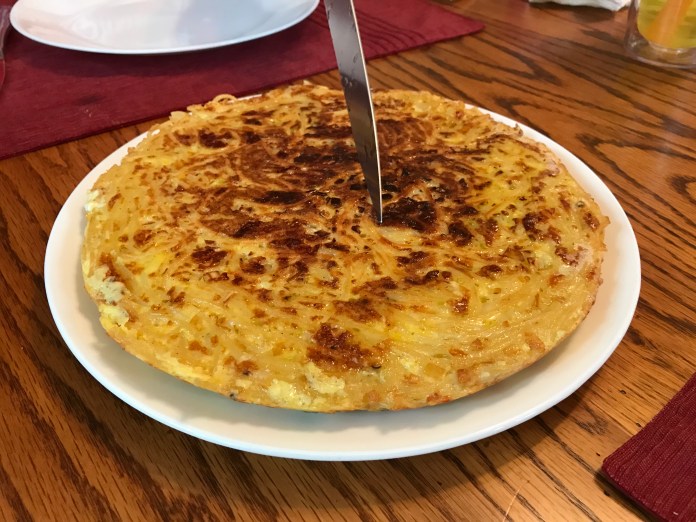
Though no truffle is used in this recipe, it is apparently a fairly common addition to omelets in Umbria. What is included is cooked spaghetti and mozzarella cheese mixed with the eggs, and a filling of lightly cooked peas, pancetta bits, and parmesan cheese. A little garlic is sautéed in oil, half of the egg/mozzarella/spaghetti mixture is put into the pan, the mix of peas, parmesan, and pancetta (or, in a pinch, bacon) is added, then topped with the rest of the egg mixture. After the first side is cooked through, the frittata is slid onto a plate, flipped, and returned to the pan to cook on the second side.
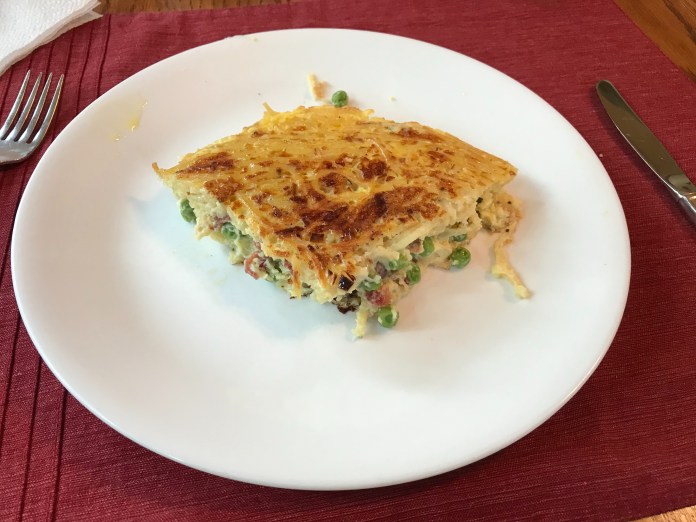
Peas and spaghetti in an egg dish might sound a bit odd, but this was fantastic. The spaghetti and mozzarella in the egg mixture help form a crispy, flavorful crust on the outside, while the peas add a bit of lightness and sweet contrast to the otherwise rich dish. Best of all, it is surprisingly easy, the only slightly technical part is flipping it over. Just be careful not to scorch the garlic and wear an apron to protect your clothing from oil splatters during the frying/flipping. I would definitely make this again.
 Feasting Through Time
Liz, this sounds delicious! I think I would like to visit Assisi!